Chapter : Testing Strategies
Strategic approach to software testing
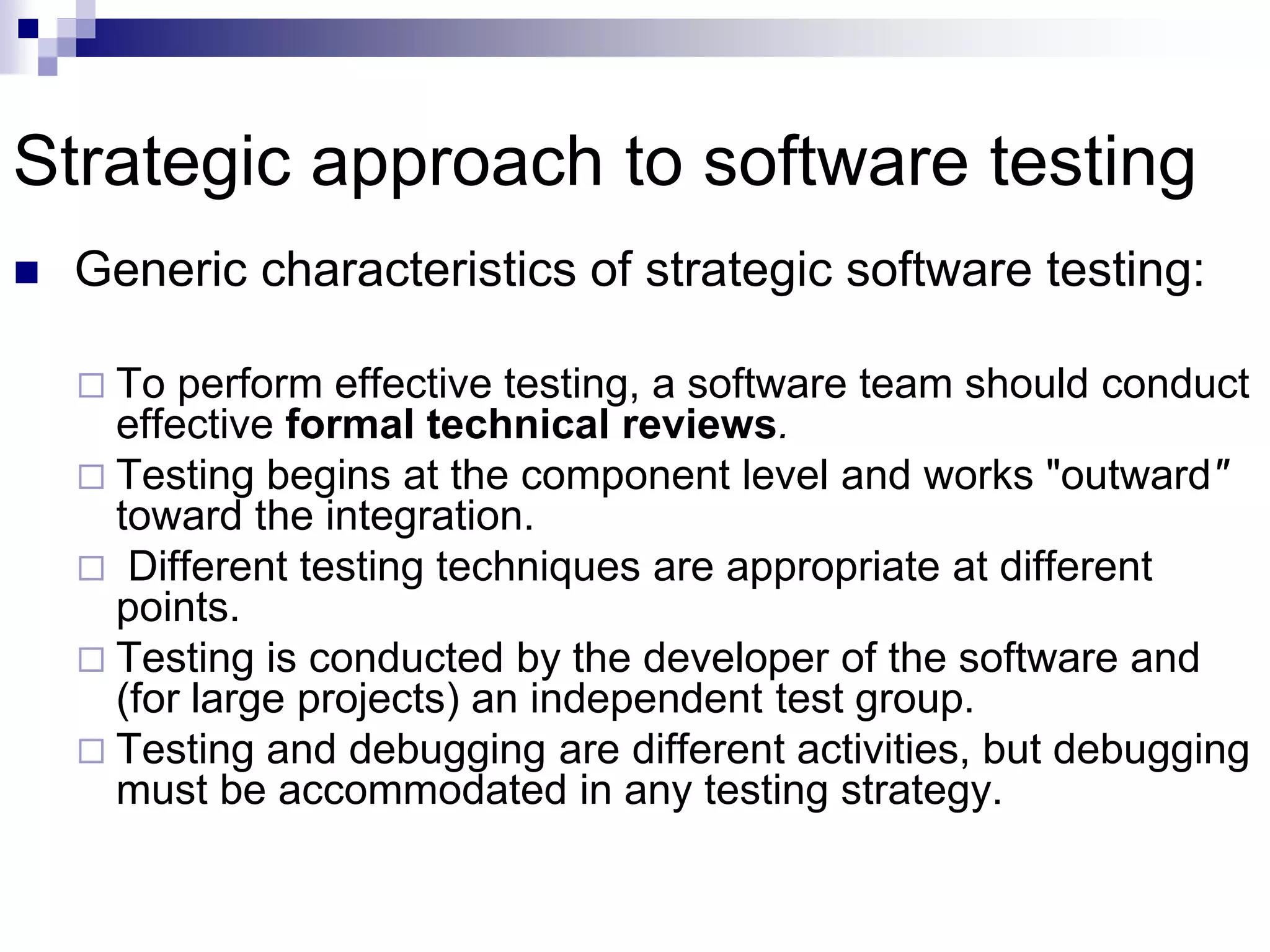
 Generic characteristics of strategic software testing:
 To perform effective testing, a software team should conduct
effective formal technical reviews.
 Testing begins at the component level and works "outward"
toward the integration.
 Different testing techniques are appropriate at different
points.
 Testing is conducted by the developer of the software and
(for large projects) an independent test group.
 Testing and debugging are different activities, but debugging
must be accommodated in any testing strategy.
Verification and Validation
 Testing is one element of a broader topic that is often
referred to as verification and validation (V&V).
 Verification refers to the set of activities that ensure that
software correctly implements a specific function.
 Validation refers to a different set of activities that ensure
that the software that has been built is traceable to
customer requirements.
 State another way:
 Verification: "Are we building the product right?"
 Validation: "Are we building the right product?“
 The definition of V&V encompasses many of the
activities that are similar to software quality assurance
(SQA).
 V&V encompasses a wide array of SQA activities that include
 Formal technical reviews,
 quality and configuration audits,
 performance monitoring,
 simulation,
 feasibility study,
 documentation review,
 database review,
 algorithm analysis,
 development testing,
 qualification testing, and installation testing
 Testing does provide the last bastion from which quality can
be assessed and, more pragmatically, errors can be
uncovered.
Software Testing Strategy for
conventional software architecture
 A Software process & strategy for software testing may
also be viewed in the context of the spiral.
 Unit testing begins at the vortex of the spiral and
concentrates on each unit (i.e., component) of the
software.
 Testing progresses by moving outward along the spiral
to integration testing, where the focus is on design and
the construction.
 Another turn outward on the spiral, we encounter
validation testing, where requirements established as
part of software requirements analysis are validated
against the software.
 Finally, we arrive at system testing, where the software
and other system elements are tested as a whole.
 Initially, tests focus on each component individually,
ensuring that it functions properly as a unit.
 Unit testing makes heavy use of white-box testing
techniques.
 Now, validation testing provides final assurance that
software meets all functional, behavioral, and
performance requirements.
 Black-box testing techniques are used exclusively during
validation.
 Once validated, must be combined with other system
elements (e.g., hardware, people, databases).
 System testing verifies that all elements mesh properly
and that overall system function / performance is
achieved.
Criteria for Completion of Testing
 There is no definitive answer to state that “we have done
with testing”.
 One response to the question is: "You're never done
testing, the burden simply shifts from you (the software
engineer) to your customer." Every time the customer/
user executes a computer program, the program is being
tested.
 Another response is: "You're done testing when you run
out of time (deadline to deliver product to customer) or
you run out of money (spend so much money on
testing).
Unit testing strategies for conventional
software
 Focuses verification effort on the smallest unit of
software design – component or module.
 Using the component-level design description as a guide
 important control paths are tested to uncover errors
within the boundary of the module.
 Unit test is white-box oriented, and the step can be
conducted in parallel for multiple components.
 Unit test consists of
 Unit Test Considerations
 Unit Test Procedures
Unit Test Considerations
Errors are commonly found during unit testing
 More common errors in computation are
 misunderstood or incorrect arithmetic precedence
 mixed mode operations,
 incorrect initialization,
 precision inaccuracy,
 incorrect symbolic representation of an expression.
 Comparison and control flow are closely coupled to one another
 Comparison of different data types,
 Incorrect logical operators or precedence,
 Incorrect comparison of variables
 Improper or nonexistent loop termination,
 Failure to exit when divergent iteration is encountered
 improperly modified loop variables.
Unit Test Procedures
 Perform after source code has been generated.
 A review of design information provides guidance for
establishing test cases. Each test case should be coupled
with a set of expected results.
Unit Test Procedures
Unit Test Environment
Integration testing
 Integration testing is a systematic technique for constructing the
program structure while at the same time conducting tests to
uncover errors associated with interfacing.
 The objective is to take unit tested components and build a
program structure that has been dictated by design.
Top down integration
Regression Testing
 Each time a new module is added as part of integration
testing
 New data flow paths are established
 New I/O may occur
 New control logic is invoked
 Due to these changes, may cause problems with
functions that previously worked flawlessly.
 Regression testing is the re-execution of some subset of
tests that have already been conducted to ensure that
changes have not propagated unintended side effects.
Validation Testing
 Validation testing succeeds when software functions in a
manner that can be reasonably expected by the
customer.
 Like all other testing steps, validation tries to uncover
errors, but the focus is at the requirements level— on
things that will be immediately apparent to the end-user.
 Reasonable expectations are defined in the Software
Requirements Specification— a document that describes
all user-visible attributes of the software.
 Validation testing comprises of
 Validation Test criteria
 Configuration review
 Alpha & Beta Testing
Validation Test criteria
 It is achieved through a series of tests that demonstrate agreement
with requirements.
 Both the plan and procedure are designed to ensure that
 all functional requirements are satisfied,
 all behavioral characteristics are achieved,
 all performance requirements are attained,
 documentation is correct,
 other requirements are met.
Configuration Review
 The intent of the review is to ensure that
all elements of the software configuration
have been properly developed, are
cataloged, and have the necessary detail
to the support phase of the software life
cycle.
 The configuration review, sometimes
called an audit.
Alpha and Beta Testing
 When custom software is built for one customer,
a series of acceptance tests are conducted to
enable the customer to validate all requirements.
 Conducted by the end-user rather than software
engineers, an acceptance test can range from
an informal "test drive" to a planned and
systematically executed series of tests.
 Most software product builders use a process
called alpha and beta testing to uncover errors
that only the end-user seems able to find.
Alpha testing
 The alpha test is conducted at the
developer's site by a customer.
 The software is used in a natural setting
with the developer "looking over the
shoulder" of the user and recording errors
and usage problems.
 Alpha tests are conducted in a controlled
environment.
Beta testing
 The beta test is conducted at one or more customer sites
by the end-user of the software.
 beta test is a "live" application of the software in an
environment that cannot be controlled by the developer.
 The customer records all problems (real or imagined)
that are encountered during beta testing and reports
these to the developer at regular intervals.
 As a result of problems reported during beta tests,
software engineers make modifications and then prepare
for release of the software product to the entire customer
base.

Testing strategies in Software Engineering

  • 1.
  • 2.
    Strategic approach tosoftware testing  Generic characteristics of strategic software testing:  To perform effective testing, a software team should conduct effective formal technical reviews.  Testing begins at the component level and works "outward" toward the integration.  Different testing techniques are appropriate at different points.  Testing is conducted by the developer of the software and (for large projects) an independent test group.  Testing and debugging are different activities, but debugging must be accommodated in any testing strategy.
  • 3.
    Verification and Validation Testing is one element of a broader topic that is often referred to as verification and validation (V&V).  Verification refers to the set of activities that ensure that software correctly implements a specific function.  Validation refers to a different set of activities that ensure that the software that has been built is traceable to customer requirements.  State another way:  Verification: "Are we building the product right?"  Validation: "Are we building the right product?“  The definition of V&V encompasses many of the activities that are similar to software quality assurance (SQA).
  • 4.
     V&V encompassesa wide array of SQA activities that include  Formal technical reviews,  quality and configuration audits,  performance monitoring,  simulation,  feasibility study,  documentation review,  database review,  algorithm analysis,  development testing,  qualification testing, and installation testing  Testing does provide the last bastion from which quality can be assessed and, more pragmatically, errors can be uncovered.
  • 5.
    Software Testing Strategyfor conventional software architecture
  • 6.
     A Softwareprocess & strategy for software testing may also be viewed in the context of the spiral.  Unit testing begins at the vortex of the spiral and concentrates on each unit (i.e., component) of the software.  Testing progresses by moving outward along the spiral to integration testing, where the focus is on design and the construction.  Another turn outward on the spiral, we encounter validation testing, where requirements established as part of software requirements analysis are validated against the software.  Finally, we arrive at system testing, where the software and other system elements are tested as a whole.
  • 8.
     Initially, testsfocus on each component individually, ensuring that it functions properly as a unit.  Unit testing makes heavy use of white-box testing techniques.  Now, validation testing provides final assurance that software meets all functional, behavioral, and performance requirements.  Black-box testing techniques are used exclusively during validation.  Once validated, must be combined with other system elements (e.g., hardware, people, databases).  System testing verifies that all elements mesh properly and that overall system function / performance is achieved.
  • 9.
    Criteria for Completionof Testing  There is no definitive answer to state that “we have done with testing”.  One response to the question is: "You're never done testing, the burden simply shifts from you (the software engineer) to your customer." Every time the customer/ user executes a computer program, the program is being tested.  Another response is: "You're done testing when you run out of time (deadline to deliver product to customer) or you run out of money (spend so much money on testing).
  • 10.
    Unit testing strategiesfor conventional software  Focuses verification effort on the smallest unit of software design – component or module.  Using the component-level design description as a guide  important control paths are tested to uncover errors within the boundary of the module.  Unit test is white-box oriented, and the step can be conducted in parallel for multiple components.  Unit test consists of  Unit Test Considerations  Unit Test Procedures
  • 11.
  • 12.
    Errors are commonlyfound during unit testing  More common errors in computation are  misunderstood or incorrect arithmetic precedence  mixed mode operations,  incorrect initialization,  precision inaccuracy,  incorrect symbolic representation of an expression.  Comparison and control flow are closely coupled to one another  Comparison of different data types,  Incorrect logical operators or precedence,  Incorrect comparison of variables  Improper or nonexistent loop termination,  Failure to exit when divergent iteration is encountered  improperly modified loop variables.
  • 13.
    Unit Test Procedures Perform after source code has been generated.  A review of design information provides guidance for establishing test cases. Each test case should be coupled with a set of expected results.
  • 14.
    Unit Test Procedures UnitTest Environment
  • 15.
    Integration testing  Integrationtesting is a systematic technique for constructing the program structure while at the same time conducting tests to uncover errors associated with interfacing.  The objective is to take unit tested components and build a program structure that has been dictated by design.
  • 16.
  • 17.
    Regression Testing  Eachtime a new module is added as part of integration testing  New data flow paths are established  New I/O may occur  New control logic is invoked  Due to these changes, may cause problems with functions that previously worked flawlessly.  Regression testing is the re-execution of some subset of tests that have already been conducted to ensure that changes have not propagated unintended side effects.
  • 18.
    Validation Testing  Validationtesting succeeds when software functions in a manner that can be reasonably expected by the customer.  Like all other testing steps, validation tries to uncover errors, but the focus is at the requirements level— on things that will be immediately apparent to the end-user.  Reasonable expectations are defined in the Software Requirements Specification— a document that describes all user-visible attributes of the software.  Validation testing comprises of  Validation Test criteria  Configuration review  Alpha & Beta Testing
  • 19.
    Validation Test criteria It is achieved through a series of tests that demonstrate agreement with requirements.  Both the plan and procedure are designed to ensure that  all functional requirements are satisfied,  all behavioral characteristics are achieved,  all performance requirements are attained,  documentation is correct,  other requirements are met.
  • 20.
    Configuration Review  Theintent of the review is to ensure that all elements of the software configuration have been properly developed, are cataloged, and have the necessary detail to the support phase of the software life cycle.  The configuration review, sometimes called an audit.
  • 21.
    Alpha and BetaTesting  When custom software is built for one customer, a series of acceptance tests are conducted to enable the customer to validate all requirements.  Conducted by the end-user rather than software engineers, an acceptance test can range from an informal "test drive" to a planned and systematically executed series of tests.  Most software product builders use a process called alpha and beta testing to uncover errors that only the end-user seems able to find.
  • 22.
    Alpha testing  Thealpha test is conducted at the developer's site by a customer.  The software is used in a natural setting with the developer "looking over the shoulder" of the user and recording errors and usage problems.  Alpha tests are conducted in a controlled environment.
  • 23.
    Beta testing  Thebeta test is conducted at one or more customer sites by the end-user of the software.  beta test is a "live" application of the software in an environment that cannot be controlled by the developer.  The customer records all problems (real or imagined) that are encountered during beta testing and reports these to the developer at regular intervals.  As a result of problems reported during beta tests, software engineers make modifications and then prepare for release of the software product to the entire customer base.