European Union Water Initiative plus
for Eastern Partnership
© iStockphoto.com/ansonsaw
Support of Water Policy Reforms
towards Integrated Water Resources Management
WORKSHOP ON
ECOLOGICAL CLASSIFICATION
Principles of biological classification
Georg Wolfram
Kyiv, 19-20 June 2018
European Union Water Initiative plus
for Eastern Partnership
© iStockphoto.com/ansonsaw
 The WFD aims at achieving a good ecological status (GES)
and a good chemical status in all surface waters.
 One of the main challenges: same understanding of GES
among all countries
 The harmonisation of the understanding of GES across
Europe was garantueed by the intercalibration of
assessment methods. During this process, all methods were
checked, compared and statistically evaluated.
KEY OBJECTIVE OF THE WFD
2
European Union Water Initiative plus
for Eastern Partnership
© iStockphoto.com/ansonsaw
WHAT IS A METHOD?
3
European Union Water Initiative plus
for Eastern Partnership
© iStockphoto.com/ansonsaw
WHAT IS A METHOD?
4
European Union Water Initiative plus
for Eastern Partnership
© iStockphoto.com/ansonsaw
WHAT IS A METHOD?
5
„Samples are taken following the AQEM method
(multi-habitat sampling, modified)“
Haase et al. 2004
European Union Water Initiative plus
for Eastern Partnership
© iStockphoto.com/ansonsaw
WHAT IS A METHOD?
6
„Samples are taken following the AQEM method
(multi-habitat sampling, modified)“
European Union Water Initiative plus
for Eastern Partnership
© iStockphoto.com/ansonsaw
WHAT IS A METHOD?
7
„Samples are taken following the AQEM method
(multi-habitat sampling, modified)“
ID
km
Site
Status
78
498 Russenski Lom
good
79
488 Downstream Ruse
good
432 Arges
moderate
80
429 Downstream Arges poor
81
378 Chiciu / Silistra
good
235 Giurgeni
high
167 Braila
high
82
154 Siret
good
84
130 Reni
moderate
European Union Water Initiative plus
for Eastern Partnership
© iStockphoto.com/ansonsaw
1. Which water body shall be assessed? (category, type)
2. What is the expected key pressure?
3. What is the most sensitive biological quality element?
4. Which sampling method is most appropriate?
5. How shall the sample be processed in the lab?
6. How shall the data be analysed?
7. WFD compliance check & statistical evaluation
HOW TO BEGIN
8
European Union Water Initiative plus
for Eastern Partnership
© iStockphoto.com/ansonsaw
Water category
natural river
Type
a small lowland river
Ecoregion: 16
Geology: Siliceous
Altitude: 200-500 m asl
Catchment area: 10-100 km2
EXAMPLE 1
1. CATEGORY AND TYPE?
9
http://www.freeworldmaps.net
Alex Zelenko, Wikimedia Commons, GNU Free Documentation License
European Union Water Initiative plus
for Eastern Partnership
© iStockphoto.com/ansonsaw
 Organic pollution
 Physical alterations of the banks
 Hydrological impacts from water abstraction
EXAMPLE 1
2. KEY PRESSURE?
10
Andrew Curtis, Creative Commons Licence (CC BY-SA 2.0) USDA NRCS Photo Gallery, Wikimedia Commons, Public Domain Big Sky Fishing, Creative Commons Attribution-Share Alike 3.0 Unported
European Union Water Initiative plus
for Eastern Partnership
© iStockphoto.com/ansonsaw
EXAMPLE 1
3. MOST SENSITIVE QUALITY ELEMENT?
11
Rivers
Macrophytes Diatoms Zoobenthos Fish
Pollution
Temperature ● ●
Organic pollution ● ●
Nutrients ● ● ●
Salinisation ● ● ● ●
Hydromorphology
Discharge fluctuations ● ● ●
Morph. alterations ● ●
Impoundment ● ● ●
River continuum ● ●
Morphology ● ●
European Union Water Initiative plus
for Eastern Partnership
© iStockphoto.com/ansonsaw
EXAMPLE 1
3. MOST SENSITIVE QUALITY ELEMENT?
12
Lakes
Macrophytes Phytoplankton Zoobenthos Fish
Pollution
Organic pollution ● ●
Nutrients ● ●
Nutrients (locall impact) ● ●
Hydromorphology
Water level fluctations ● ● ●
Continuum (tributaries) ●
Morphology ● ● ●
European Union Water Initiative plus
for Eastern Partnership
© iStockphoto.com/ansonsaw
13
Rivers
Macrophytes Diatoms Zoobenthos Fish
Pollution
Temperature ● ●
Organic pollution ● ●
Nutrients ● ● ●
Salinisation ● ● ● ●
Hydromorphology
Discharge fluctuations ● ● ●
Morph. alterations ● ●
Impoundment ● ● ●
River continuum ● ●
Morphology ● ●
Most sensitive, well-established field/lab methods, long tradition (saprobic index)
EXAMPLE 1
3. MOST SENSITIVE QUALITY ELEMENT?
European Union Water Initiative plus
for Eastern Partnership
© iStockphoto.com/ansonsaw
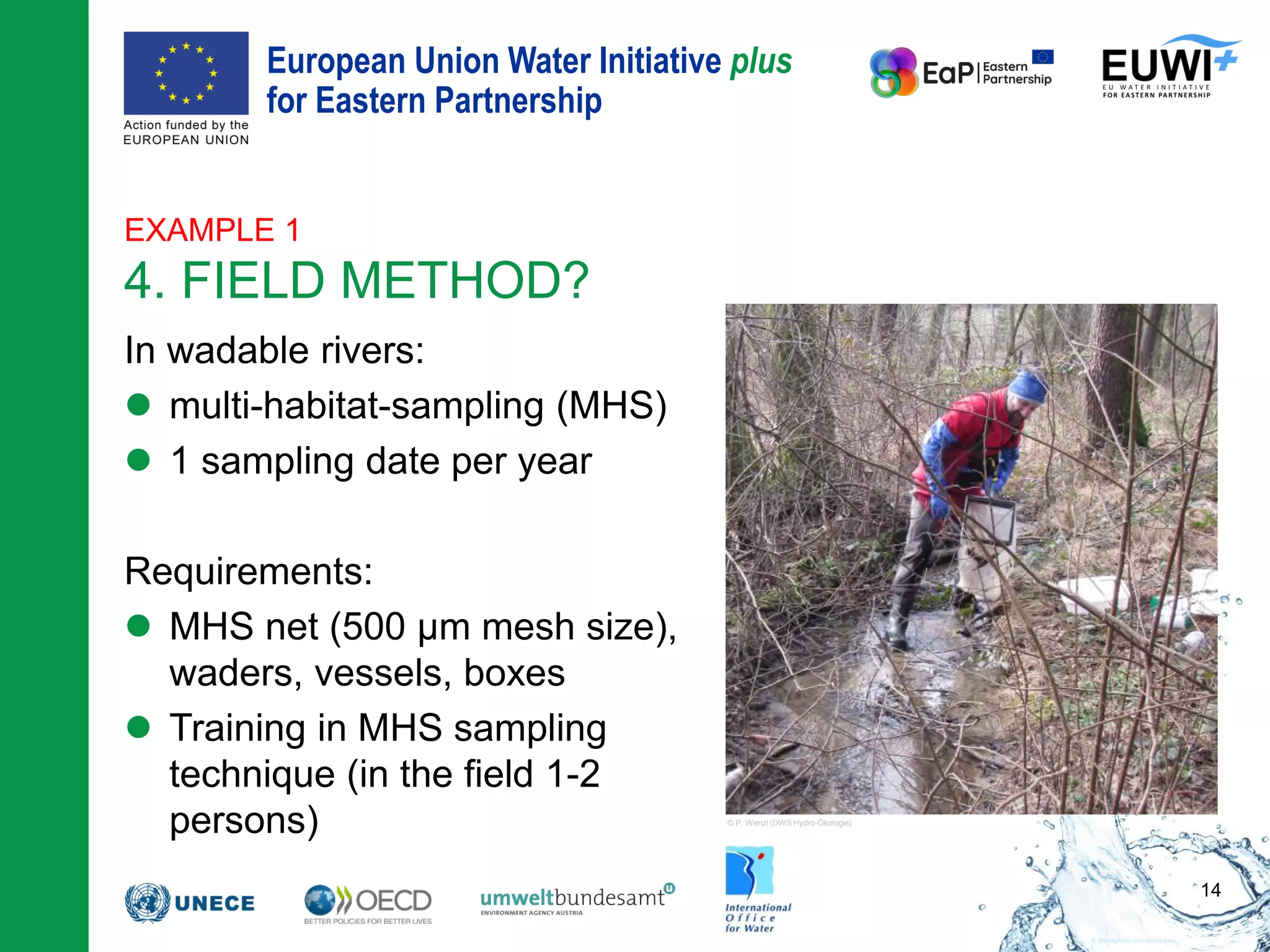
In wadable rivers:
 multi-habitat-sampling (MHS)
 1 sampling date per year
Requirements:
 MHS net (500 µm mesh size),
waders, vessels, boxes
 Training in MHS sampling
technique (in the field 1-2
persons)
EXAMPLE 1
4. FIELD METHOD?
14
© P. Wenzl (DWS Hydro-Ökologie)
European Union Water Initiative plus
for Eastern Partnership
© iStockphoto.com/ansonsaw
EXAMPLE 1
SAMPLE PROCESSING: FIELD OR LAB?
15
Field methods Lab methods
Time quick time-consuming
Lab equipment – microscopes
Training only field field and lab (taxonomy)
Costs Low high
Significance
High vs bad + +
Good vs moderate – +
European Union Water Initiative plus
for Eastern Partnership
© iStockphoto.com/ansonsaw
EXAMPLE 1
SAMPLE PROCESSING: FIELD OR LAB?
16
Field methods Lab methods
Time quick time-consuming
Lab equipment – microscopes
Training only field field and lab (taxonomy)
Costs Low high
Significance
High vs bad + +
Good vs moderate – +
European Union Water Initiative plus
for Eastern Partnership
© iStockphoto.com/ansonsaw
EXAMPLE 1
SAMPLE PROCESSING: FIELD OR LAB?
17
Field methods Lab methods
Time quick time-consuming
Lab equipment – microscopes
Training only field field and lab (taxonomy)
Costs Low high
Significance
High vs bad + +
Good vs moderate – +
European Union Water Initiative plus
for Eastern Partnership
© iStockphoto.com/ansonsaw
EXAMPLE 1
SAMPLE PROCESSING: FIELD OR LAB?
18
Field methods Lab methods
Time quick time-consuming
Lab equipment – microscopes
Training only field field and lab (taxonomy)
Costs Low high
Significance
High vs bad + +
Good vs moderate – +
European Union Water Initiative plus
for Eastern Partnership
© iStockphoto.com/ansonsaw
EXAMPLE 1
SAMPLE PROCESSING: FIELD OR LAB?
19
Field methods Lab methods
Time quick time-consuming
Lab equipment – microscopes
Training only field field and lab (taxonomy)
Costs Low high
Significance
High vs bad + +
Good vs moderate – +
European Union Water Initiative plus
for Eastern Partnership
© iStockphoto.com/ansonsaw
EXAMPLE 1
SAMPLE PROCESSING: FIELD OR LAB?
20
Field methods Lab methods
Time quick time-consuming
Lab equipment – microscopes
Training only field field and lab (taxonomy)
Costs Low high
Significance
High vs bad + +
Good vs moderate – +
European Union Water Initiative plus
for Eastern Partnership
© iStockphoto.com/ansonsaw
EXAMPLE 1
SAMPLE PROCESSING: FIELD OR LAB?
21
Field methods Lab methods
Time quick time-consuming
Lab equipment – microscopes
Training only field field and lab (taxonomy)
Costs Low high
Significance
High vs bad + +
Good vs moderate – +
European Union Water Initiative plus
for Eastern Partnership
© iStockphoto.com/ansonsaw
 Sorting (AQEM approach, EN 16150)
 Identification under the microscope
 Taxonomical level depending on the
assessment method
Requirements:
 AQEM grid
 Training in MHS sorting
 Training in identification of
invertebrates
EXAMPLE 1
5. LAB METHOD
22
Haase et al. 2004
U.S. Fish and Wildlife Service Southeast Region, Public Domain Mark 1.0GcG(jawp), Wikimedia Commons, Public Domain
© P. Wenzl (DWS Hydro-Ökologie)
European Union Water Initiative plus
for Eastern Partnership
© iStockphoto.com/ansonsaw
 Taxonomy
 at first step: family level
 for some groups extend to genus/species
EXAMPLE 1
5. LAB METHOD
23
© W. Lechthaler (eutaxa)
European Union Water Initiative plus
for Eastern Partnership
© iStockphoto.com/ansonsaw
EXAMPLE 1
5. LAB METHOD
24
© W. Lechthaler (eutaxa)
family level
European Union Water Initiative plus
for Eastern Partnership
© iStockphoto.com/ansonsaw
EXAMPLE 1
5. LAB METHOD
25
© W. Lechthaler (eutaxa)
species level
European Union Water Initiative plus
for Eastern Partnership
© iStockphoto.com/ansonsaw
 MS Excel, Asterics,
Statistical software packages
“And the result is …
But: A metric/index is not the same thing as a WFD compliant
assessment method!
 open questions:
 Reference conditions
 Boundary setting
 Pressure-response relationship …
EXAMPLE 1
6. DATA ANALYSIS
26
14.6”
European Union Water Initiative plus
for Eastern Partnership
© iStockphoto.com/ansonsaw
Water category
lake
Type
a deep stratified lake or reservoir
Ecoregion: 24
Geology: Siliceous
Altitude: >800 m asl
Mean depth: 40 m
Max. depth: 80 m
EXAMPLE 2
1. CATEGORY AND TYPE?
27
Creative Commons CC0 1.0 Universal Public Domain Dedication
John Fielding, Creative Commons (CC BY-SA 2.0)
European Union Water Initiative plus
for Eastern Partnership
© iStockphoto.com/ansonsaw
 Water level fluctuations?
 Eutrophication?
EXAMPLE 2
2. KEY PRESSURE?
28
Greenpeace China, Creative Commons (CC BY 2.0)
© G. Kum (DWS Hydr-Ökologie)
European Union Water Initiative plus
for Eastern Partnership
© iStockphoto.com/ansonsaw
EXAMPLE 2
3. MOST SENSITIVE QUALITY ELEMENT?
29
Lakes
Macrophytes Phytoplankton Zoobenthos Fish
Pollution
Organic pollution ● ●
Nutrients ● ●
Nutrients (locally) ● ●
Hydromorphology
Water level fluctations ● ● ●
Continuum (tributaries) ●
Morphology ● ● ●
Most sensitive, well-established field/lab methods, long tradition (chlorophyll-a)
European Union Water Initiative plus
for Eastern Partnership
© iStockphoto.com/ansonsaw
EXAMPLE 2
4. FIELD METHOD
30
0 2 4 6 8 10 12 14 16 18 20 22 24
Water temperature [°C]
25
20
15
10
5
0
Waterdepth[m]
epilimnion
metalimnion
hypolimnion
thermocline
8,9
7,8
6,9
20,9
20,1
17,7
0 2 4 6 8 10 12 14 16 18 20 22 24
Water temperature [°C]
25
20
15
10
5
0
Waterdepth[m]
Secchi depth
euphotic zone
14,1
aphotic zone
= Secchi depth x 2.5
compensation level
= max T
European Union Water Initiative plus
for Eastern Partnership
© iStockphoto.com/ansonsaw
 Several sampling dates
 Central part of the lake (deepest point)
 Temperature profile (stratification?)
 Secchi depth (euphotic zone)
 Chemical samples from different water depths,
e.g. 0 m, 5 m, 10 m, 20 m, 40 m, 60 m, above ground
 Phytoplankton samples from the epilimnion or the euphotic
zone (integrative or bulk sample from several depth)
e.g. 0 m, 1 m, 2 m, 3 m, 4 m, 5 m, 6 m and 7 m
EXAMPLE 2
4. FIELD METHOD
31
© P. Wenzl (DWS Hydr-Ökologie)
European Union Water Initiative plus
for Eastern Partnership
© iStockphoto.com/ansonsaw
Requirements:
 Boat (+ winch)
 Water sampler, vessels,
cooling boxes
 Secchi disk
 Temperature sensor
 (O2, pH, EC probes)
 Optionally plankton net (30-40 µm) for fresh samples
 Training in water and plankton sampling technique
EXAMPLE 2
4. FIELD METHOD
32
© P. Wenzl (DWS Hydr-Ökologie)
European Union Water Initiative plus
for Eastern Partnership
© iStockphoto.com/ansonsaw
 Chemical analysis (nutrients …)
 Phytoplankton: Chlorophyll-a,
Utermöhl countings
Requirements:
 (Chemical lab – nutrients as supporting information)
 Microscope (transmission microscope for fresh samples,
inverted microscope for quantitative Utermöhl countirngs)
 Training in microscope handling and phytoplankton
identification
EXAMPLE 2
5. LAB METHOD
33
Mateus S. Figueiredo, CreativeCommons (CC BY 4.0)
European Union Water Initiative plus
for Eastern Partnership
© iStockphoto.com/ansonsaw
 MS Excel, Statistical software packages
But: Data on Chlorophyll-a concentration allow defining the
trophic state, but are not the same thing as a WFD compliant
assessment method!
 open questions:
 Reference conditions
 Boundary setting
 Pressure-response relationship
 …
EXAMPLE 2
6. DATA ANALYSIS
34
European Union Water Initiative plus
for Eastern Partnership
© iStockphoto.com/ansonsaw
STANDARDISATION & QUALITY ASSURANCE
35
 Standardisation
 Legal implementation
 Documentation
 Training
 Control
European Union Water Initiative plus
for Eastern Partnership
© iStockphoto.com/ansonsaw
STANDARDISATION & QUALITY ASSURANCE
36
 Standardisation  AQEM protocol, national guidelines
 avoid too much freedom (expert judgment)
© G. Wolfram (DWS Hydro-Ökologie)
European Union Water Initiative plus
for Eastern Partnership
© iStockphoto.com/ansonsaw
STANDARDISATION & QUALITY ASSURANCE
37
 Legal implementation  Legally binding
(e.g. Austrian Water Law)
Matt Wade, Creative Commons Attribution-Share Alike 3.0 Unported license
European Union Water Initiative plus
for Eastern Partnership
© iStockphoto.com/ansonsaw
STANDARDISATION & QUALITY ASSURANCE
38
 Documentation  Write down everything, which might be
relevant for the assessment result
 field and lab protocols
 comprehensive and standardised reports
 who did when what how?
EPIRB Project© P. Wenzl (DWS Hydro-Ökologie)
European Union Water Initiative plus
for Eastern Partnership
© iStockphoto.com/ansonsaw
STANDARDISATION & QUALITY ASSURANCE
39
 Training  Field work
 Lab skills
 Taxonomy
 Safety instructions
EPIRB Project © P. Riedler (DWS Hydro-Ökologie)
European Union Water Initiative plus
for Eastern Partnership
© iStockphoto.com/ansonsaw
STANDARDISATION & QUALITY ASSURANCE
40
 Control  Internal and external audits
 ring tests
 Prepare permanent slides
 Keep original samples for later control
(up to several years)
© S. Hintermaier (DWS Hydro-Ökologie)
European Union Water Initiative plus
for Eastern Partnership
© iStockphoto.com/ansonsaw
41
Thank you for your attention!
© G. Wolfram (DWS Hydro-Ökologie)

Principles of biological classification

  • 1.
    European Union WaterInitiative plus for Eastern Partnership © iStockphoto.com/ansonsaw Support of Water Policy Reforms towards Integrated Water Resources Management WORKSHOP ON ECOLOGICAL CLASSIFICATION Principles of biological classification Georg Wolfram Kyiv, 19-20 June 2018
  • 2.
    European Union WaterInitiative plus for Eastern Partnership © iStockphoto.com/ansonsaw  The WFD aims at achieving a good ecological status (GES) and a good chemical status in all surface waters.  One of the main challenges: same understanding of GES among all countries  The harmonisation of the understanding of GES across Europe was garantueed by the intercalibration of assessment methods. During this process, all methods were checked, compared and statistically evaluated. KEY OBJECTIVE OF THE WFD 2
  • 3.
    European Union WaterInitiative plus for Eastern Partnership © iStockphoto.com/ansonsaw WHAT IS A METHOD? 3
  • 4.
    European Union WaterInitiative plus for Eastern Partnership © iStockphoto.com/ansonsaw WHAT IS A METHOD? 4
  • 5.
    European Union WaterInitiative plus for Eastern Partnership © iStockphoto.com/ansonsaw WHAT IS A METHOD? 5 „Samples are taken following the AQEM method (multi-habitat sampling, modified)“ Haase et al. 2004
  • 6.
    European Union WaterInitiative plus for Eastern Partnership © iStockphoto.com/ansonsaw WHAT IS A METHOD? 6 „Samples are taken following the AQEM method (multi-habitat sampling, modified)“
  • 7.
    European Union WaterInitiative plus for Eastern Partnership © iStockphoto.com/ansonsaw WHAT IS A METHOD? 7 „Samples are taken following the AQEM method (multi-habitat sampling, modified)“ ID km Site Status 78 498 Russenski Lom good 79 488 Downstream Ruse good 432 Arges moderate 80 429 Downstream Arges poor 81 378 Chiciu / Silistra good 235 Giurgeni high 167 Braila high 82 154 Siret good 84 130 Reni moderate
  • 8.
    European Union WaterInitiative plus for Eastern Partnership © iStockphoto.com/ansonsaw 1. Which water body shall be assessed? (category, type) 2. What is the expected key pressure? 3. What is the most sensitive biological quality element? 4. Which sampling method is most appropriate? 5. How shall the sample be processed in the lab? 6. How shall the data be analysed? 7. WFD compliance check & statistical evaluation HOW TO BEGIN 8
  • 9.
    European Union WaterInitiative plus for Eastern Partnership © iStockphoto.com/ansonsaw Water category natural river Type a small lowland river Ecoregion: 16 Geology: Siliceous Altitude: 200-500 m asl Catchment area: 10-100 km2 EXAMPLE 1 1. CATEGORY AND TYPE? 9 http://www.freeworldmaps.net Alex Zelenko, Wikimedia Commons, GNU Free Documentation License
  • 10.
    European Union WaterInitiative plus for Eastern Partnership © iStockphoto.com/ansonsaw  Organic pollution  Physical alterations of the banks  Hydrological impacts from water abstraction EXAMPLE 1 2. KEY PRESSURE? 10 Andrew Curtis, Creative Commons Licence (CC BY-SA 2.0) USDA NRCS Photo Gallery, Wikimedia Commons, Public Domain Big Sky Fishing, Creative Commons Attribution-Share Alike 3.0 Unported
  • 11.
    European Union WaterInitiative plus for Eastern Partnership © iStockphoto.com/ansonsaw EXAMPLE 1 3. MOST SENSITIVE QUALITY ELEMENT? 11 Rivers Macrophytes Diatoms Zoobenthos Fish Pollution Temperature ● ● Organic pollution ● ● Nutrients ● ● ● Salinisation ● ● ● ● Hydromorphology Discharge fluctuations ● ● ● Morph. alterations ● ● Impoundment ● ● ● River continuum ● ● Morphology ● ●
  • 12.
    European Union WaterInitiative plus for Eastern Partnership © iStockphoto.com/ansonsaw EXAMPLE 1 3. MOST SENSITIVE QUALITY ELEMENT? 12 Lakes Macrophytes Phytoplankton Zoobenthos Fish Pollution Organic pollution ● ● Nutrients ● ● Nutrients (locall impact) ● ● Hydromorphology Water level fluctations ● ● ● Continuum (tributaries) ● Morphology ● ● ●
  • 13.
    European Union WaterInitiative plus for Eastern Partnership © iStockphoto.com/ansonsaw 13 Rivers Macrophytes Diatoms Zoobenthos Fish Pollution Temperature ● ● Organic pollution ● ● Nutrients ● ● ● Salinisation ● ● ● ● Hydromorphology Discharge fluctuations ● ● ● Morph. alterations ● ● Impoundment ● ● ● River continuum ● ● Morphology ● ● Most sensitive, well-established field/lab methods, long tradition (saprobic index) EXAMPLE 1 3. MOST SENSITIVE QUALITY ELEMENT?
  • 14.
    European Union WaterInitiative plus for Eastern Partnership © iStockphoto.com/ansonsaw In wadable rivers:  multi-habitat-sampling (MHS)  1 sampling date per year Requirements:  MHS net (500 µm mesh size), waders, vessels, boxes  Training in MHS sampling technique (in the field 1-2 persons) EXAMPLE 1 4. FIELD METHOD? 14 © P. Wenzl (DWS Hydro-Ökologie)
  • 15.
    European Union WaterInitiative plus for Eastern Partnership © iStockphoto.com/ansonsaw EXAMPLE 1 SAMPLE PROCESSING: FIELD OR LAB? 15 Field methods Lab methods Time quick time-consuming Lab equipment – microscopes Training only field field and lab (taxonomy) Costs Low high Significance High vs bad + + Good vs moderate – +
  • 16.
    European Union WaterInitiative plus for Eastern Partnership © iStockphoto.com/ansonsaw EXAMPLE 1 SAMPLE PROCESSING: FIELD OR LAB? 16 Field methods Lab methods Time quick time-consuming Lab equipment – microscopes Training only field field and lab (taxonomy) Costs Low high Significance High vs bad + + Good vs moderate – +
  • 17.
    European Union WaterInitiative plus for Eastern Partnership © iStockphoto.com/ansonsaw EXAMPLE 1 SAMPLE PROCESSING: FIELD OR LAB? 17 Field methods Lab methods Time quick time-consuming Lab equipment – microscopes Training only field field and lab (taxonomy) Costs Low high Significance High vs bad + + Good vs moderate – +
  • 18.
    European Union WaterInitiative plus for Eastern Partnership © iStockphoto.com/ansonsaw EXAMPLE 1 SAMPLE PROCESSING: FIELD OR LAB? 18 Field methods Lab methods Time quick time-consuming Lab equipment – microscopes Training only field field and lab (taxonomy) Costs Low high Significance High vs bad + + Good vs moderate – +
  • 19.
    European Union WaterInitiative plus for Eastern Partnership © iStockphoto.com/ansonsaw EXAMPLE 1 SAMPLE PROCESSING: FIELD OR LAB? 19 Field methods Lab methods Time quick time-consuming Lab equipment – microscopes Training only field field and lab (taxonomy) Costs Low high Significance High vs bad + + Good vs moderate – +
  • 20.
    European Union WaterInitiative plus for Eastern Partnership © iStockphoto.com/ansonsaw EXAMPLE 1 SAMPLE PROCESSING: FIELD OR LAB? 20 Field methods Lab methods Time quick time-consuming Lab equipment – microscopes Training only field field and lab (taxonomy) Costs Low high Significance High vs bad + + Good vs moderate – +
  • 21.
    European Union WaterInitiative plus for Eastern Partnership © iStockphoto.com/ansonsaw EXAMPLE 1 SAMPLE PROCESSING: FIELD OR LAB? 21 Field methods Lab methods Time quick time-consuming Lab equipment – microscopes Training only field field and lab (taxonomy) Costs Low high Significance High vs bad + + Good vs moderate – +
  • 22.
    European Union WaterInitiative plus for Eastern Partnership © iStockphoto.com/ansonsaw  Sorting (AQEM approach, EN 16150)  Identification under the microscope  Taxonomical level depending on the assessment method Requirements:  AQEM grid  Training in MHS sorting  Training in identification of invertebrates EXAMPLE 1 5. LAB METHOD 22 Haase et al. 2004 U.S. Fish and Wildlife Service Southeast Region, Public Domain Mark 1.0GcG(jawp), Wikimedia Commons, Public Domain © P. Wenzl (DWS Hydro-Ökologie)
  • 23.
    European Union WaterInitiative plus for Eastern Partnership © iStockphoto.com/ansonsaw  Taxonomy  at first step: family level  for some groups extend to genus/species EXAMPLE 1 5. LAB METHOD 23 © W. Lechthaler (eutaxa) © W. Lechthaler (eutaxa)
  • 24.
    European Union WaterInitiative plus for Eastern Partnership © iStockphoto.com/ansonsaw EXAMPLE 1 5. LAB METHOD 24 © W. Lechthaler (eutaxa) family level
  • 25.
    European Union WaterInitiative plus for Eastern Partnership © iStockphoto.com/ansonsaw EXAMPLE 1 5. LAB METHOD 25 © W. Lechthaler (eutaxa) species level
  • 26.
    European Union WaterInitiative plus for Eastern Partnership © iStockphoto.com/ansonsaw  MS Excel, Asterics, Statistical software packages “And the result is … But: A metric/index is not the same thing as a WFD compliant assessment method!  open questions:  Reference conditions  Boundary setting  Pressure-response relationship … EXAMPLE 1 6. DATA ANALYSIS 26 14.6”
  • 27.
    European Union WaterInitiative plus for Eastern Partnership © iStockphoto.com/ansonsaw Water category lake Type a deep stratified lake or reservoir Ecoregion: 24 Geology: Siliceous Altitude: >800 m asl Mean depth: 40 m Max. depth: 80 m EXAMPLE 2 1. CATEGORY AND TYPE? 27 Creative Commons CC0 1.0 Universal Public Domain Dedication John Fielding, Creative Commons (CC BY-SA 2.0)
  • 28.
    European Union WaterInitiative plus for Eastern Partnership © iStockphoto.com/ansonsaw  Water level fluctuations?  Eutrophication? EXAMPLE 2 2. KEY PRESSURE? 28 Greenpeace China, Creative Commons (CC BY 2.0) © G. Kum (DWS Hydr-Ökologie)
  • 29.
    European Union WaterInitiative plus for Eastern Partnership © iStockphoto.com/ansonsaw EXAMPLE 2 3. MOST SENSITIVE QUALITY ELEMENT? 29 Lakes Macrophytes Phytoplankton Zoobenthos Fish Pollution Organic pollution ● ● Nutrients ● ● Nutrients (locally) ● ● Hydromorphology Water level fluctations ● ● ● Continuum (tributaries) ● Morphology ● ● ● Most sensitive, well-established field/lab methods, long tradition (chlorophyll-a)
  • 30.
    European Union WaterInitiative plus for Eastern Partnership © iStockphoto.com/ansonsaw EXAMPLE 2 4. FIELD METHOD 30 0 2 4 6 8 10 12 14 16 18 20 22 24 Water temperature [°C] 25 20 15 10 5 0 Waterdepth[m] epilimnion metalimnion hypolimnion thermocline 8,9 7,8 6,9 20,9 20,1 17,7 0 2 4 6 8 10 12 14 16 18 20 22 24 Water temperature [°C] 25 20 15 10 5 0 Waterdepth[m] Secchi depth euphotic zone 14,1 aphotic zone = Secchi depth x 2.5 compensation level = max T
  • 31.
    European Union WaterInitiative plus for Eastern Partnership © iStockphoto.com/ansonsaw  Several sampling dates  Central part of the lake (deepest point)  Temperature profile (stratification?)  Secchi depth (euphotic zone)  Chemical samples from different water depths, e.g. 0 m, 5 m, 10 m, 20 m, 40 m, 60 m, above ground  Phytoplankton samples from the epilimnion or the euphotic zone (integrative or bulk sample from several depth) e.g. 0 m, 1 m, 2 m, 3 m, 4 m, 5 m, 6 m and 7 m EXAMPLE 2 4. FIELD METHOD 31 © P. Wenzl (DWS Hydr-Ökologie)
  • 32.
    European Union WaterInitiative plus for Eastern Partnership © iStockphoto.com/ansonsaw Requirements:  Boat (+ winch)  Water sampler, vessels, cooling boxes  Secchi disk  Temperature sensor  (O2, pH, EC probes)  Optionally plankton net (30-40 µm) for fresh samples  Training in water and plankton sampling technique EXAMPLE 2 4. FIELD METHOD 32 © P. Wenzl (DWS Hydr-Ökologie)
  • 33.
    European Union WaterInitiative plus for Eastern Partnership © iStockphoto.com/ansonsaw  Chemical analysis (nutrients …)  Phytoplankton: Chlorophyll-a, Utermöhl countings Requirements:  (Chemical lab – nutrients as supporting information)  Microscope (transmission microscope for fresh samples, inverted microscope for quantitative Utermöhl countirngs)  Training in microscope handling and phytoplankton identification EXAMPLE 2 5. LAB METHOD 33 Mateus S. Figueiredo, CreativeCommons (CC BY 4.0)
  • 34.
    European Union WaterInitiative plus for Eastern Partnership © iStockphoto.com/ansonsaw  MS Excel, Statistical software packages But: Data on Chlorophyll-a concentration allow defining the trophic state, but are not the same thing as a WFD compliant assessment method!  open questions:  Reference conditions  Boundary setting  Pressure-response relationship  … EXAMPLE 2 6. DATA ANALYSIS 34
  • 35.
    European Union WaterInitiative plus for Eastern Partnership © iStockphoto.com/ansonsaw STANDARDISATION & QUALITY ASSURANCE 35  Standardisation  Legal implementation  Documentation  Training  Control
  • 36.
    European Union WaterInitiative plus for Eastern Partnership © iStockphoto.com/ansonsaw STANDARDISATION & QUALITY ASSURANCE 36  Standardisation  AQEM protocol, national guidelines  avoid too much freedom (expert judgment) © G. Wolfram (DWS Hydro-Ökologie)
  • 37.
    European Union WaterInitiative plus for Eastern Partnership © iStockphoto.com/ansonsaw STANDARDISATION & QUALITY ASSURANCE 37  Legal implementation  Legally binding (e.g. Austrian Water Law) Matt Wade, Creative Commons Attribution-Share Alike 3.0 Unported license
  • 38.
    European Union WaterInitiative plus for Eastern Partnership © iStockphoto.com/ansonsaw STANDARDISATION & QUALITY ASSURANCE 38  Documentation  Write down everything, which might be relevant for the assessment result  field and lab protocols  comprehensive and standardised reports  who did when what how? EPIRB Project© P. Wenzl (DWS Hydro-Ökologie)
  • 39.
    European Union WaterInitiative plus for Eastern Partnership © iStockphoto.com/ansonsaw STANDARDISATION & QUALITY ASSURANCE 39  Training  Field work  Lab skills  Taxonomy  Safety instructions EPIRB Project © P. Riedler (DWS Hydro-Ökologie)
  • 40.
    European Union WaterInitiative plus for Eastern Partnership © iStockphoto.com/ansonsaw STANDARDISATION & QUALITY ASSURANCE 40  Control  Internal and external audits  ring tests  Prepare permanent slides  Keep original samples for later control (up to several years) © S. Hintermaier (DWS Hydro-Ökologie)
  • 41.
    European Union WaterInitiative plus for Eastern Partnership © iStockphoto.com/ansonsaw 41 Thank you for your attention! © G. Wolfram (DWS Hydro-Ökologie)