European Union Water Initiative plus
for Eastern Partnership
© iStockphoto.com/ansonsaw
Support of Water Policy Reforms
towards Integrated Water Resources Management
WORKSHOP ON
ECOLOGICAL CLASSIFICATION
Requirements for field and lab
Georg Wolfram
Kyiv, 19-20 June 2018
European Union Water Initiative plus
for Eastern Partnership
© iStockphoto.com/ansonsaw
Depends on
 Typology
 Pressures and sensitivity of BQE
 …
But also on
 Time and financial constraints
 Availability of equipment
 Availability of (trained) staff
WHICH BQE / WHICH METHOD?
2
European Union Water Initiative plus
for Eastern Partnership
© iStockphoto.com/ansonsaw
 Summary overview of requirements for equipment and staff
(mainly with MZB and phytoplankton in mind; for fish, diatoms
etc  workshop on field/lab training and survey in autumn)
 Address also the demands from quality assurance
WHAT THIS PRESENTATION SHALL PROVIDE:
3
European Union Water Initiative plus
for Eastern Partnership
© iStockphoto.com/ansonsaw
 General equipment
 Safety measures
 Sampling
 Transport + storage
 Sample processing
 Data analysis
 Documentation
EQUIPMENT
4
European Union Water Initiative plus
for Eastern Partnership
© iStockphoto.com/ansonsaw
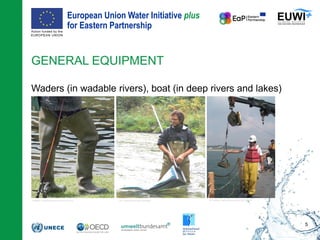
Waders (in wadable rivers), boat (in deep rivers and lakes)
GENERAL EQUIPMENT
5
Safedom, CreativeCommons (CC BY-SA 3.0) M. Lansing, CreativeCommons (CC BY-SA 2.0)© P. Wenzl (DWS Hydro-Ökologie)
European Union Water Initiative plus
for Eastern Partnership
© iStockphoto.com/ansonsaw
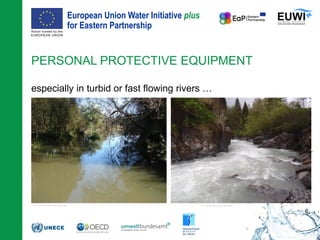
especially in turbid or fast flowing rivers …
PERSONAL PROTECTIVE EQUIPMENT
6
© G. Wolfram (DWS Hydro-Ökologie) © P. Wenzl (DWS Hydro-Ökologie)
European Union Water Initiative plus
for Eastern Partnership
© iStockphoto.com/ansonsaw
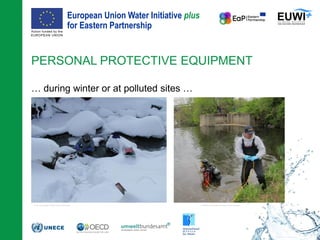
… during winter or at polluted sites …
PERSONAL PROTECTIVE EQUIPMENT
7
© W. Stockinger (DWS Hydro-Ökologie) USEPA, CreativeCommons, Public Domain
European Union Water Initiative plus
for Eastern Partnership
© iStockphoto.com/ansonsaw
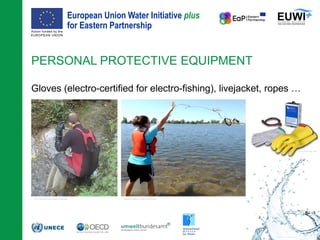
Gloves (electro-certified for electro-fishing), livejacket, ropes …
PERSONAL PROTECTIVE EQUIPMENT
8
© G. Wolfram (DWS Hydro-Ökologie) Delanie Stafford, CreativeCommons
www.smith-root.com
European Union Water Initiative plus
for Eastern Partnership
© iStockphoto.com/ansonsaw
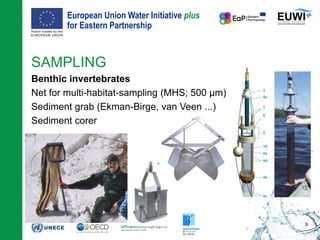
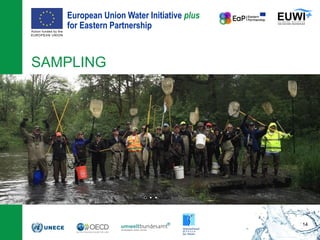
SAMPLING
Benthic invertebrates
Net for multi-habitat-sampling (MHS; 500 µm)
Sediment grab (Ekman-Birge, van Veen ...)
Sediment corer
9
European Union Water Initiative plus
for Eastern Partnership
© iStockphoto.com/ansonsaw
SAMPLING
Benthic invertebrates
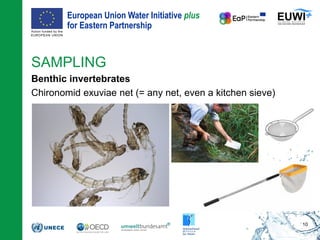
Chironomid exuviae net (= any net, even a kitchen sieve)
10
European Union Water Initiative plus
for Eastern Partnership
© iStockphoto.com/ansonsaw
SAMPLING
Benthic invertebrates
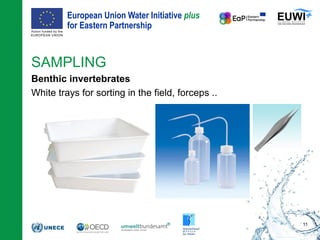
White trays for sorting in the field, forceps ..
11
European Union Water Initiative plus
for Eastern Partnership
© iStockphoto.com/ansonsaw
SAMPLING
Phytoplankton
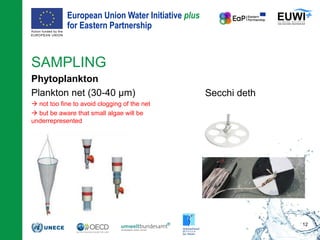
Plankton net (30-40 µm)
 not too fine to avoid clogging of the net
 but be aware that small algae will be
underrepresented
12
Secchi deth
European Union Water Initiative plus
for Eastern Partnership
© iStockphoto.com/ansonsaw
SAMPLING
Phytoplankton
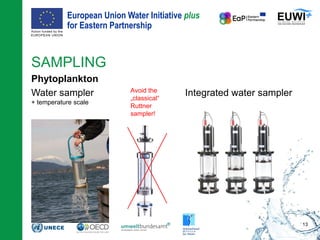
Water sampler
+ temperature scale
13
Avoid the
„classical“
Ruttner
sampler!
Integrated water sampler
European Union Water Initiative plus
for Eastern Partnership
© iStockphoto.com/ansonsaw
SAMPLING
14
European Union Water Initiative plus
for Eastern Partnership
© iStockphoto.com/ansonsaw
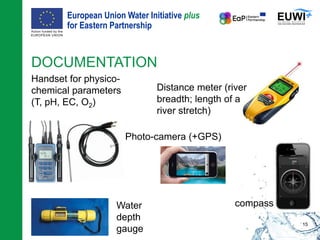
DOCUMENTATION
Handset for physico-
chemical parameters
(T, pH, EC, O2)
15
Distance meter (river
breadth; length of a
river stretch)
compass
Photo-camera (+GPS)
Water
depth
gauge
European Union Water Initiative plus
for Eastern Partnership
© iStockphoto.com/ansonsaw
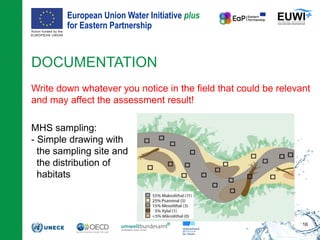
DOCUMENTATION
Write down whatever you notice in the field that could be relevant
and may affect the assessment result!
MHS sampling:
- Simple drawing with
the sampling site and
the distribution of
habitats
16
European Union Water Initiative plus
for Eastern Partnership
© iStockphoto.com/ansonsaw
17
European Union Water Initiative plus
for Eastern Partnership
© iStockphoto.com/ansonsaw
18
European Union Water Initiative plus
for Eastern Partnership
© iStockphoto.com/ansonsaw
DOCUMENTATION
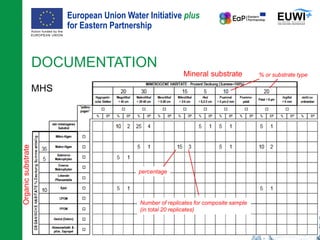
MHS
Mineral substrate
Organicsubstrate
percentage
Number of replicates for composite sample
(in total 20 replicates)
% or substrate type
European Union Water Initiative plus
for Eastern Partnership
© iStockphoto.com/ansonsaw
DOCUMENTATION
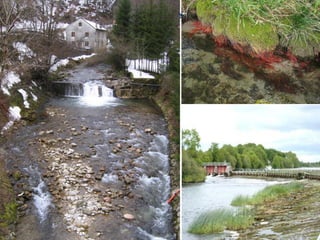
Take photos that allow to reconstruct the conditions during the
sampling!
e.g. sampling team and method, water level, turbidity, surface
foam or film, invertebrate drift, litter, cattle upstream …
20
European Union Water Initiative plus
for Eastern Partnership
© iStockphoto.com/ansonsaw
TRANSPORT + STORAGE
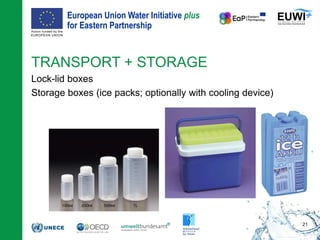
Lock-lid boxes
Storage boxes (ice packs; optionally with cooling device)
21
European Union Water Initiative plus
for Eastern Partnership
© iStockphoto.com/ansonsaw
TRANSPORT + STORAGE
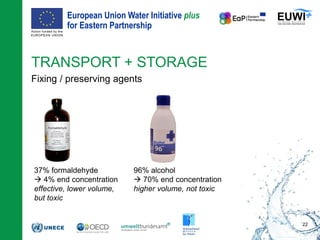
Fixing / preserving agents
22
37% formaldehyde
 4% end concentration
effective, lower volume,
but toxic
96% alcohol
 70% end concentration
higher volume, not toxic
European Union Water Initiative plus
for Eastern Partnership
© iStockphoto.com/ansonsaw
TRANSPORT + STORAGE
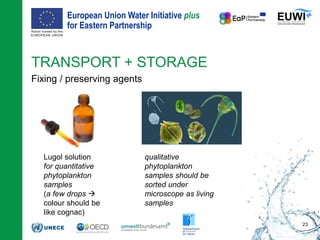
Fixing / preserving agents
23
Lugol solution
for quantitative
phytoplankton
samples
(a few drops 
colour should be
like cognac)
qualitative
phytoplankton
samples should be
sorted under
microscope as living
samples
European Union Water Initiative plus
for Eastern Partnership
© iStockphoto.com/ansonsaw
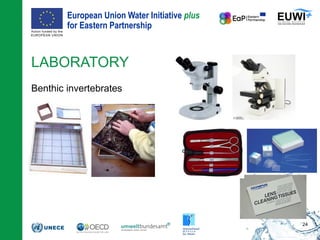
LABORATORY
Benthic invertebrates
24
European Union Water Initiative plus
for Eastern Partnership
© iStockphoto.com/ansonsaw
MICROSCOPY
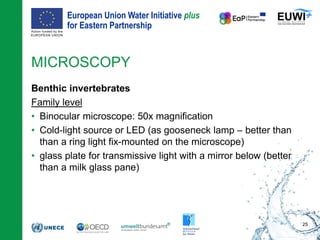
Benthic invertebrates
Family level
• Binocular microscope: 50x magnification
• Cold-light source or LED (as gooseneck lamp – better than
than a ring light fix-mounted on the microscope)
• glass plate for transmissive light with a mirror below (better
than a milk glass pane)
25
European Union Water Initiative plus
for Eastern Partnership
© iStockphoto.com/ansonsaw
MICROSCOPY
Benthic invertebrates
Species level
• Binocular microscope: 70x magnification
• Light as for family level
• Transmission microscope (e.g. for chironomids, oligochaetes,
aquatic beetles …): max 500x magnification (12.5x ocular and 40x
objective)
• Phase contrast, interference contrast and dark field are helpful in
some cases, but not necessary
• Oil immersion (objective with 100x magnification) is not necessary
26
European Union Water Initiative plus
for Eastern Partnership
© iStockphoto.com/ansonsaw
MICROSCOPY
Benthic invertebrates
Photo
• Can be taken simply with the mobile phone through the ocular
(simple; can be quickly sent to collegues; quality is sufficient in
most cases)
Permanent slides
• necessary for some groups such as oligochaetes: polyvinyl
alcohol (PVA) or levulose syrup
• Permanent slides: Glycerine, Euparal, Canada balsam or
DMHF (5.5-Dimethylhydantoin Formaldehyde Resin, also
known as Hydantoin739)
27
European Union Water Initiative plus
for Eastern Partnership
© iStockphoto.com/ansonsaw
MICROSCOPY
Diatoms
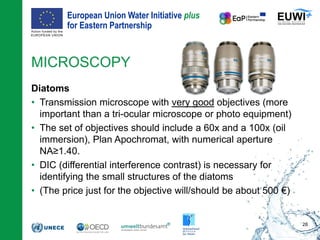
• Transmission microscope with very good objectives (more
important than a tri-ocular microscope or photo equipment)
• The set of objectives should include a 60x and a 100x (oil
immersion), Plan Apochromat, with numerical aperture
NA≥1.40.
• DIC (differential interference contrast) is necessary for
identifying the small structures of the diatoms
• (The price just for the objective will/should be about 500 €)
28
European Union Water Initiative plus
for Eastern Partnership
© iStockphoto.com/ansonsaw
29
Thank you for your attention!

Requirements for field and lab

  • 1.
    European Union WaterInitiative plus for Eastern Partnership © iStockphoto.com/ansonsaw Support of Water Policy Reforms towards Integrated Water Resources Management WORKSHOP ON ECOLOGICAL CLASSIFICATION Requirements for field and lab Georg Wolfram Kyiv, 19-20 June 2018
  • 2.
    European Union WaterInitiative plus for Eastern Partnership © iStockphoto.com/ansonsaw Depends on  Typology  Pressures and sensitivity of BQE  … But also on  Time and financial constraints  Availability of equipment  Availability of (trained) staff WHICH BQE / WHICH METHOD? 2
  • 3.
    European Union WaterInitiative plus for Eastern Partnership © iStockphoto.com/ansonsaw  Summary overview of requirements for equipment and staff (mainly with MZB and phytoplankton in mind; for fish, diatoms etc  workshop on field/lab training and survey in autumn)  Address also the demands from quality assurance WHAT THIS PRESENTATION SHALL PROVIDE: 3
  • 4.
    European Union WaterInitiative plus for Eastern Partnership © iStockphoto.com/ansonsaw  General equipment  Safety measures  Sampling  Transport + storage  Sample processing  Data analysis  Documentation EQUIPMENT 4
  • 5.
    European Union WaterInitiative plus for Eastern Partnership © iStockphoto.com/ansonsaw Waders (in wadable rivers), boat (in deep rivers and lakes) GENERAL EQUIPMENT 5 Safedom, CreativeCommons (CC BY-SA 3.0) M. Lansing, CreativeCommons (CC BY-SA 2.0)© P. Wenzl (DWS Hydro-Ökologie)
  • 6.
    European Union WaterInitiative plus for Eastern Partnership © iStockphoto.com/ansonsaw especially in turbid or fast flowing rivers … PERSONAL PROTECTIVE EQUIPMENT 6 © G. Wolfram (DWS Hydro-Ökologie) © P. Wenzl (DWS Hydro-Ökologie)
  • 7.
    European Union WaterInitiative plus for Eastern Partnership © iStockphoto.com/ansonsaw … during winter or at polluted sites … PERSONAL PROTECTIVE EQUIPMENT 7 © W. Stockinger (DWS Hydro-Ökologie) USEPA, CreativeCommons, Public Domain
  • 8.
    European Union WaterInitiative plus for Eastern Partnership © iStockphoto.com/ansonsaw Gloves (electro-certified for electro-fishing), livejacket, ropes … PERSONAL PROTECTIVE EQUIPMENT 8 © G. Wolfram (DWS Hydro-Ökologie) Delanie Stafford, CreativeCommons www.smith-root.com
  • 9.
    European Union WaterInitiative plus for Eastern Partnership © iStockphoto.com/ansonsaw SAMPLING Benthic invertebrates Net for multi-habitat-sampling (MHS; 500 µm) Sediment grab (Ekman-Birge, van Veen ...) Sediment corer 9
  • 10.
    European Union WaterInitiative plus for Eastern Partnership © iStockphoto.com/ansonsaw SAMPLING Benthic invertebrates Chironomid exuviae net (= any net, even a kitchen sieve) 10
  • 11.
    European Union WaterInitiative plus for Eastern Partnership © iStockphoto.com/ansonsaw SAMPLING Benthic invertebrates White trays for sorting in the field, forceps .. 11
  • 12.
    European Union WaterInitiative plus for Eastern Partnership © iStockphoto.com/ansonsaw SAMPLING Phytoplankton Plankton net (30-40 µm)  not too fine to avoid clogging of the net  but be aware that small algae will be underrepresented 12 Secchi deth
  • 13.
    European Union WaterInitiative plus for Eastern Partnership © iStockphoto.com/ansonsaw SAMPLING Phytoplankton Water sampler + temperature scale 13 Avoid the „classical“ Ruttner sampler! Integrated water sampler
  • 14.
    European Union WaterInitiative plus for Eastern Partnership © iStockphoto.com/ansonsaw SAMPLING 14
  • 15.
    European Union WaterInitiative plus for Eastern Partnership © iStockphoto.com/ansonsaw DOCUMENTATION Handset for physico- chemical parameters (T, pH, EC, O2) 15 Distance meter (river breadth; length of a river stretch) compass Photo-camera (+GPS) Water depth gauge
  • 16.
    European Union WaterInitiative plus for Eastern Partnership © iStockphoto.com/ansonsaw DOCUMENTATION Write down whatever you notice in the field that could be relevant and may affect the assessment result! MHS sampling: - Simple drawing with the sampling site and the distribution of habitats 16
  • 17.
    European Union WaterInitiative plus for Eastern Partnership © iStockphoto.com/ansonsaw 17
  • 18.
    European Union WaterInitiative plus for Eastern Partnership © iStockphoto.com/ansonsaw 18
  • 19.
    European Union WaterInitiative plus for Eastern Partnership © iStockphoto.com/ansonsaw DOCUMENTATION MHS Mineral substrate Organicsubstrate percentage Number of replicates for composite sample (in total 20 replicates) % or substrate type
  • 20.
    European Union WaterInitiative plus for Eastern Partnership © iStockphoto.com/ansonsaw DOCUMENTATION Take photos that allow to reconstruct the conditions during the sampling! e.g. sampling team and method, water level, turbidity, surface foam or film, invertebrate drift, litter, cattle upstream … 20
  • 21.
    European Union WaterInitiative plus for Eastern Partnership © iStockphoto.com/ansonsaw TRANSPORT + STORAGE Lock-lid boxes Storage boxes (ice packs; optionally with cooling device) 21
  • 22.
    European Union WaterInitiative plus for Eastern Partnership © iStockphoto.com/ansonsaw TRANSPORT + STORAGE Fixing / preserving agents 22 37% formaldehyde  4% end concentration effective, lower volume, but toxic 96% alcohol  70% end concentration higher volume, not toxic
  • 23.
    European Union WaterInitiative plus for Eastern Partnership © iStockphoto.com/ansonsaw TRANSPORT + STORAGE Fixing / preserving agents 23 Lugol solution for quantitative phytoplankton samples (a few drops  colour should be like cognac) qualitative phytoplankton samples should be sorted under microscope as living samples
  • 24.
    European Union WaterInitiative plus for Eastern Partnership © iStockphoto.com/ansonsaw LABORATORY Benthic invertebrates 24
  • 25.
    European Union WaterInitiative plus for Eastern Partnership © iStockphoto.com/ansonsaw MICROSCOPY Benthic invertebrates Family level • Binocular microscope: 50x magnification • Cold-light source or LED (as gooseneck lamp – better than than a ring light fix-mounted on the microscope) • glass plate for transmissive light with a mirror below (better than a milk glass pane) 25
  • 26.
    European Union WaterInitiative plus for Eastern Partnership © iStockphoto.com/ansonsaw MICROSCOPY Benthic invertebrates Species level • Binocular microscope: 70x magnification • Light as for family level • Transmission microscope (e.g. for chironomids, oligochaetes, aquatic beetles …): max 500x magnification (12.5x ocular and 40x objective) • Phase contrast, interference contrast and dark field are helpful in some cases, but not necessary • Oil immersion (objective with 100x magnification) is not necessary 26
  • 27.
    European Union WaterInitiative plus for Eastern Partnership © iStockphoto.com/ansonsaw MICROSCOPY Benthic invertebrates Photo • Can be taken simply with the mobile phone through the ocular (simple; can be quickly sent to collegues; quality is sufficient in most cases) Permanent slides • necessary for some groups such as oligochaetes: polyvinyl alcohol (PVA) or levulose syrup • Permanent slides: Glycerine, Euparal, Canada balsam or DMHF (5.5-Dimethylhydantoin Formaldehyde Resin, also known as Hydantoin739) 27
  • 28.
    European Union WaterInitiative plus for Eastern Partnership © iStockphoto.com/ansonsaw MICROSCOPY Diatoms • Transmission microscope with very good objectives (more important than a tri-ocular microscope or photo equipment) • The set of objectives should include a 60x and a 100x (oil immersion), Plan Apochromat, with numerical aperture NA≥1.40. • DIC (differential interference contrast) is necessary for identifying the small structures of the diatoms • (The price just for the objective will/should be about 500 €) 28
  • 29.
    European Union WaterInitiative plus for Eastern Partnership © iStockphoto.com/ansonsaw 29 Thank you for your attention!