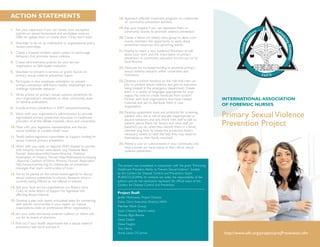
1. Ask your supervisor if you can review your workplace
policies on sexual harassment and workplace violence.
Offer to update them or create them if they don't exist.
2. Volunteer to be on an institutional or organizational policy
review committee.
3. Create a hospital incident report system to discourage
behaviors that promote sexual violence.
4. Create zero-tolerance policies for your service
organization or faith-based institution.
5. Volunteer to present in-services or grand rounds on
primary sexual violence prevention topics.
6. Participate in new employee orientation to present
primary prevention definitions, healthy relationships and
challenge bystander behavior.
7. Write articles on primary sexual violence prevention for
your organization's newsletter, or other community, state
or national publications.
8. Include primary prevention in SART education/training.
9. Work with your organization's administration to provide
regionalized primary prevention education to healthcare
providers of all the affiliate hospitals, clinics and universities.
10. Meet with your legislative representative and discuss
sexual violence as a public health issue.
11. Testify before legislative committees to support funding for
sexual violence primary prevention.
12. Work with your state or regional IAFN chapter to partner
with minority nurses' associations (e.g. National Black
Nurses' Association http://www.nbna.org , National
Association of Hispanic Nurses http://thehispanicnurses.org
, National Coalition of Ethnic Minority Nurses' Association
http://www.ncemna.org) to collaborate on prevention
messages that reach communities of color.
13. Ask to be placed on the school board agenda to discuss
sexual violence prevention in schools. Research what is
currently being offered or not offered in schools.
14. Ask your local service organizations (i.e. Rotary, Lions
Club) to write letters of support for legislative bills
effecting sexual violence.
15. Develop a plan with clearly articulated steps for connecting
with specific communities in your region via cultural
organizations, clubs or professional ethnic organizations.
16.Join your state anti-sexual violence coalition, or better yet,
run for its board of directors.
17.Find out if your health department has a sexual violence
prevention task force and join it.
ACTION STATEMENTS 18.Approach offender treatment programs to collaborate
on community prevention activities.
19.Ask your hospital if you can represent them on
community boards to promote violence prevention.
20.Create a Yahoo (or other) news group to allow com-
munity members the opportunity to easily share
prevention resources and upcoming events.
21.Hoping to reach a new audience? Volunteer to talk
about your work and the importance of primary
prevention at community education forums put on by
local libraries.
22.Advocate for increased funding to promote primary
sexual violence research within universities and
institutions.
23.Develop a patient handout on the role that men can
play to prevent sexual violence and give to everyone
being treated in the emergency department. Create
them in a variety of languages appropriate for your
region. No time to create handouts from scratch?
Partner with local organizations that have created
materials and ask to distribute them in your
organization.
24.Develop assessment tools and protocols for screening
patients who are at risk of sexually inappropriate or
abusive behaviors and acts.Work with staff to talk to
patients about these risk factors and what staff (or
patients?) can do when they identify them in a family
member (e.g. how to create the protective factors
necessary; where to seek the help they may need for
themselves or their family member)
25.Attend a civic or cultural event in your community and
have a booth (or hand stamp or flier) about sexual
violence prevention.
This project was completed in conjunction with the grant “Enhancing
Healthcare Providers Ability to Prevent Sexual Violence”, funded
by the Centers for Disease Control and Prevention, Grant
#US4/CCU224946. Its contents are solely the responsibility of the
authors and do not necessarily represent the official views of the
Centers for Disease Control and Prevention.
Project Staff:
Jenifer Markowitz, Project Director
Carey Goryl, Executive Director, IAFN
Member Work Group:
Susan Chasson, Board Liaison
Yolanda Bigio-Ramos
Diane Daiber
Diana Faugno
Tara Henry
Annie Lewis O’Connor http://www.iafn.org/project/projPrevention.cfm
INTERNATIONAL ASSOCIATION
OF FORENSIC NURSES
Primary Sexual Violence
Prevention Project
Forensic nurses come
in contact with a variety of patients
across the clinical spectrum.
Although our work is focused on
caring for patients after violence
has been perpetrated, there are a
variety of opportunities to be
part of the violence prevention
effort, as well.
For more information about the
IAFN's Primary SexualViolence
Prevention project, including valuable
online links and an annotated
bibliography, please visit our website:
http://www.iafn.org/project/projPrevention.cfm
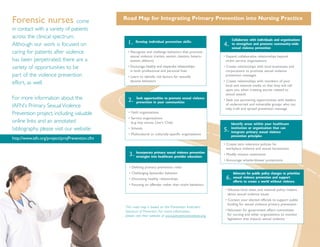
Road Map for Integrating Primary Prevention into Nursing Practice
• Expand collaborative relationships beyond
victim service organizations
• Create relationships with local businesses and
corporations to promote sexual violence
prevention messages
• Create relationships with members of your
local and national media so that they will call
upon you when creating stories related to
sexual assault.
• Seek out partnering opportunities with leaders
of underserved and vulnerable groups who can
help craft and spread prevention message
Collaborate with individuals and organizations
to strengthen and promote community-wide
sexual violence prevention
4.
• Create zero tolerance policies for
workplace violence and sexual harassment
• Modify mission statements
• Encourage whistle-blower protections
Identify areas within your healthcare
institution or organization that can
integrate primary sexual violence
prevention principles
5.
• Educate local, state, and national policy makers
about sexual violence issues
• Contact your elected officials to support public
funding for sexual violence primary prevention
• Volunteer for government affairs committees
for nursing and other organizations to monitor
legislation that impacts sexual violence
Advocate for public policy changes to prioritize
sexual violence prevention and support
efforts to create a world without violence.
6.
• Defining primary prevention roles
• Challenging bystander behavior
• Discussing healthy relationships
• Focusing on offender rather than victim behaviors
Incorporate primary sexual violence prevention
strategies into healthcare provider education:3.
• Faith organizations
• Service organizations
(e.g. boy scouts, Lion's Club)
• Schools
• Multicultural or culturally-specific organizations
Seek opportunities to promote sexual violence
prevention in your communities2.
• Recognize and challenge behaviors that promote
sexual violence (racism, sexism, classism, hetero-
sexism, ableism)
• Encourage healthy and respectful relationships
in both professional and personal lives
• Learn to identify risk factors for sexually
abusive behaviors
Develop individual prevention skills:1.
This road map is based on the Prevention Institute's
Spectrum of Prevention. For more information,
please visit their website at www.preventioninstitute.org

Primary prevention brochure

  • 1.
    1. Ask yoursupervisor if you can review your workplace policies on sexual harassment and workplace violence. Offer to update them or create them if they don't exist. 2. Volunteer to be on an institutional or organizational policy review committee. 3. Create a hospital incident report system to discourage behaviors that promote sexual violence. 4. Create zero-tolerance policies for your service organization or faith-based institution. 5. Volunteer to present in-services or grand rounds on primary sexual violence prevention topics. 6. Participate in new employee orientation to present primary prevention definitions, healthy relationships and challenge bystander behavior. 7. Write articles on primary sexual violence prevention for your organization's newsletter, or other community, state or national publications. 8. Include primary prevention in SART education/training. 9. Work with your organization's administration to provide regionalized primary prevention education to healthcare providers of all the affiliate hospitals, clinics and universities. 10. Meet with your legislative representative and discuss sexual violence as a public health issue. 11. Testify before legislative committees to support funding for sexual violence primary prevention. 12. Work with your state or regional IAFN chapter to partner with minority nurses' associations (e.g. National Black Nurses' Association http://www.nbna.org , National Association of Hispanic Nurses http://thehispanicnurses.org , National Coalition of Ethnic Minority Nurses' Association http://www.ncemna.org) to collaborate on prevention messages that reach communities of color. 13. Ask to be placed on the school board agenda to discuss sexual violence prevention in schools. Research what is currently being offered or not offered in schools. 14. Ask your local service organizations (i.e. Rotary, Lions Club) to write letters of support for legislative bills effecting sexual violence. 15. Develop a plan with clearly articulated steps for connecting with specific communities in your region via cultural organizations, clubs or professional ethnic organizations. 16.Join your state anti-sexual violence coalition, or better yet, run for its board of directors. 17.Find out if your health department has a sexual violence prevention task force and join it. ACTION STATEMENTS 18.Approach offender treatment programs to collaborate on community prevention activities. 19.Ask your hospital if you can represent them on community boards to promote violence prevention. 20.Create a Yahoo (or other) news group to allow com- munity members the opportunity to easily share prevention resources and upcoming events. 21.Hoping to reach a new audience? Volunteer to talk about your work and the importance of primary prevention at community education forums put on by local libraries. 22.Advocate for increased funding to promote primary sexual violence research within universities and institutions. 23.Develop a patient handout on the role that men can play to prevent sexual violence and give to everyone being treated in the emergency department. Create them in a variety of languages appropriate for your region. No time to create handouts from scratch? Partner with local organizations that have created materials and ask to distribute them in your organization. 24.Develop assessment tools and protocols for screening patients who are at risk of sexually inappropriate or abusive behaviors and acts.Work with staff to talk to patients about these risk factors and what staff (or patients?) can do when they identify them in a family member (e.g. how to create the protective factors necessary; where to seek the help they may need for themselves or their family member) 25.Attend a civic or cultural event in your community and have a booth (or hand stamp or flier) about sexual violence prevention. This project was completed in conjunction with the grant “Enhancing Healthcare Providers Ability to Prevent Sexual Violence”, funded by the Centers for Disease Control and Prevention, Grant #US4/CCU224946. Its contents are solely the responsibility of the authors and do not necessarily represent the official views of the Centers for Disease Control and Prevention. Project Staff: Jenifer Markowitz, Project Director Carey Goryl, Executive Director, IAFN Member Work Group: Susan Chasson, Board Liaison Yolanda Bigio-Ramos Diane Daiber Diana Faugno Tara Henry Annie Lewis O’Connor http://www.iafn.org/project/projPrevention.cfm INTERNATIONAL ASSOCIATION OF FORENSIC NURSES Primary Sexual Violence Prevention Project
  • 2.
    Forensic nurses come incontact with a variety of patients across the clinical spectrum. Although our work is focused on caring for patients after violence has been perpetrated, there are a variety of opportunities to be part of the violence prevention effort, as well. For more information about the IAFN's Primary SexualViolence Prevention project, including valuable online links and an annotated bibliography, please visit our website: http://www.iafn.org/project/projPrevention.cfm Road Map for Integrating Primary Prevention into Nursing Practice • Expand collaborative relationships beyond victim service organizations • Create relationships with local businesses and corporations to promote sexual violence prevention messages • Create relationships with members of your local and national media so that they will call upon you when creating stories related to sexual assault. • Seek out partnering opportunities with leaders of underserved and vulnerable groups who can help craft and spread prevention message Collaborate with individuals and organizations to strengthen and promote community-wide sexual violence prevention 4. • Create zero tolerance policies for workplace violence and sexual harassment • Modify mission statements • Encourage whistle-blower protections Identify areas within your healthcare institution or organization that can integrate primary sexual violence prevention principles 5. • Educate local, state, and national policy makers about sexual violence issues • Contact your elected officials to support public funding for sexual violence primary prevention • Volunteer for government affairs committees for nursing and other organizations to monitor legislation that impacts sexual violence Advocate for public policy changes to prioritize sexual violence prevention and support efforts to create a world without violence. 6. • Defining primary prevention roles • Challenging bystander behavior • Discussing healthy relationships • Focusing on offender rather than victim behaviors Incorporate primary sexual violence prevention strategies into healthcare provider education:3. • Faith organizations • Service organizations (e.g. boy scouts, Lion's Club) • Schools • Multicultural or culturally-specific organizations Seek opportunities to promote sexual violence prevention in your communities2. • Recognize and challenge behaviors that promote sexual violence (racism, sexism, classism, hetero- sexism, ableism) • Encourage healthy and respectful relationships in both professional and personal lives • Learn to identify risk factors for sexually abusive behaviors Develop individual prevention skills:1. This road map is based on the Prevention Institute's Spectrum of Prevention. For more information, please visit their website at www.preventioninstitute.org