Elder Abuse and
Domestic Violence in
Later Life:
Innovative New Resources for the Community
Lisa Furr, MA and Adrienne Johnson, MS
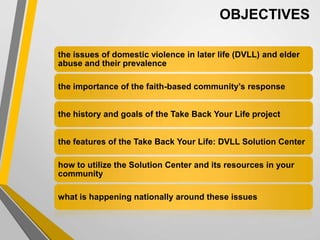
the issues of domestic violence in later life (DVLL) and elder
abuse and their prevalence
the importance of the faith-based community’s response
the history and goals of the Take Back Your Life project
the features of the Take Back Your Life: DVLL Solution Center
how to utilize the Solution Center and its resources in your
community
what is happening nationally around these issues
OBJECTIVES
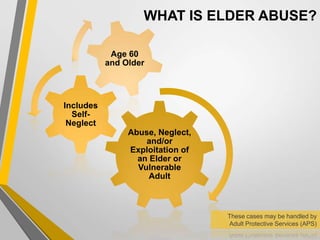
WHAT IS ELDER ABUSE?
Abuse, Neglect,
and/or
Exploitation of
an Elder or
Vulnerable
Adult
Includes
Self-
Neglect
Age 60
and Older
These cases may be handled by
Adult Protective Services (APS)
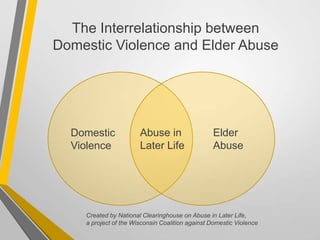
The Interrelationship between
Domestic Violence and Elder Abuse
Domestic
Violence
Abuse in
Later Life
Elder
Abuse
Created by National Clearinghouse on Abuse in Later Life,
a project of the Wisconsin Coalition against Domestic Violence
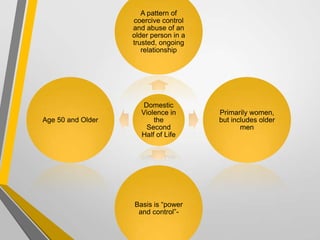
Domestic
Violence in
the
Second
Half of Life
A pattern of
coercive control
and abuse of an
older person in a
trusted, ongoing
relationship
Primarily women,
but includes older
men
Basis is “power
and control”-
Age 50 and Older
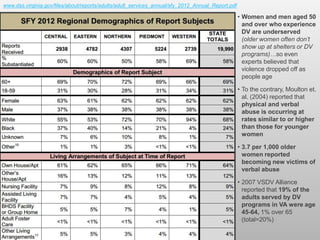
• Women and men aged 50
and over who experience
DV are underserved
(older women often don’t
show up at shelters or DV
programs)…so even
experts believed that
violence dropped off as
people age
• To the contrary, Moulton et.
al. (2004) reported that
physical and verbal
abuse is occurring at
rates similar to or higher
than those for younger
women
• 3.7 per 1,000 older
women reported
becoming new victims of
verbal abuse
• 2007 VSDV Alliance
reported that 19% of the
adults served by DV
programs in VA were age
45-64, 1% over 65
(total=20%)
www.dss.virginia.gov/files/about/reports/adults/adult_services_annual/sfy_2012_Annual_Report.pdf
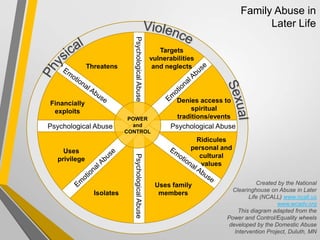
Family Abuse in
Later Life
PsychologicalAbusePsychologicalAbuse
Psychological Abuse Psychological Abuse
Threatens
Targets
vulnerabilities
and neglects
Financially
exploits
Uses
privilege
Isolates
Uses family
members
Ridicules
personal and
cultural
values
Denies access to
spiritual
traditions/eventsPOWER
and
CONTROL
Created by the National
Clearinghouse on Abuse in Later
Life (NCALL) www.ncall.us
www.wcadv.org
This diagram adapted from the
Power and Control/Equality wheels
developed by the Domestic Abuse
Intervention Project, Duluth, MN
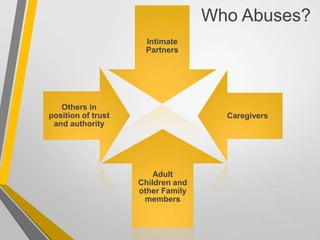
Who Abuses?
Intimate
Partners
Caregivers
Adult
Children and
other Family
members
Others in
position of trust
and authority
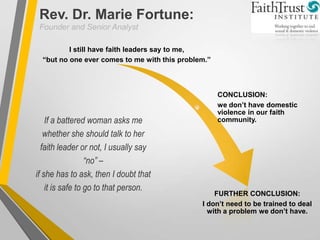
If a battered woman asks me
whether she should talk to her
faith leader or not, I usually say
“no” –
if she has to ask, then I doubt that
it is safe to go to that person.
I still have faith leaders say to me,
“but no one ever comes to me with this problem.”
CONCLUSION:
we don’t have domestic
violence in our faith
community.
FURTHER CONCLUSION:
I don’t need to be trained to deal
with a problem we don’t have.
Rev. Dr. Marie Fortune:
Founder and Senior Analyst
Faith-based Community
As People of Faith, we are called to
create healthy individuals, relationships,
families and communities.
We create a more Healthy World.
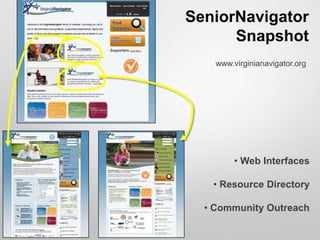
• Web Interfaces
• Resource Directory
• Community Outreach
SeniorNavigator
Snapshot
www.virginianavigator.org
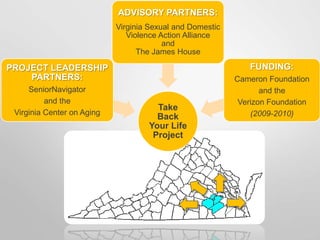
Take
Back
Your Life
Project
PROJECT LEADERSHIP
PARTNERS:
SeniorNavigator
and the
Virginia Center on Aging
ADVISORY PARTNERS:
Virginia Sexual and Domestic
Violence Action Alliance
and
The James House
FUNDING:
Cameron Foundation
and the
Verizon Foundation
(2009-2010)
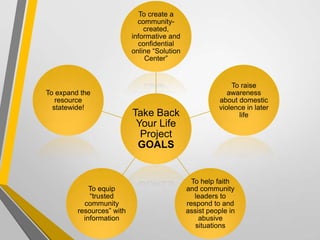
Take Back
Your Life
Project
GOALS
To create a
community-
created,
informative and
confidential
online “Solution
Center”
To raise
awareness
about domestic
violence in later
life
To help faith
and community
leaders to
respond to and
assist people in
abusive
situations
To equip
“trusted
community
resources” with
information
To expand the
resource
statewide!
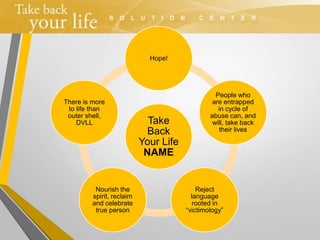
Take
Back
Your Life
NAME
Hope!
People who
are entrapped
in cycle of
abuse can, and
will, take back
their lives
Reject
language
rooted in
“victimology”
Nourish the
spirit, reclaim
and celebrate
true person
There is more
to life than
outer shell,
DVLL
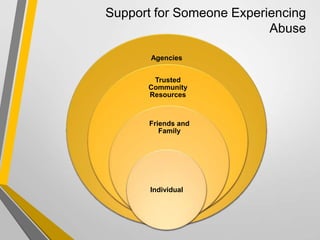
Support for Someone Experiencing
Abuse
Agencies
Trusted
Community
Resources
Friends and
Family
Individual
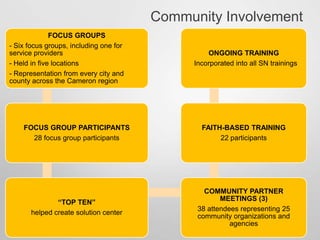
Community Involvement
FOCUS GROUPS
- Six focus groups, including one for
service providers
- Held in five locations
- Representation from every city and
county across the Cameron region
FOCUS GROUP PARTICIPANTS
28 focus group participants
“TOP TEN”
helped create solution center
COMMUNITY PARTNER
MEETINGS (3)
38 attendees representing 25
community organizations and
agencies
FAITH-BASED TRAINING
22 participants
ONGOING TRAINING
Incorporated into all SN trainings
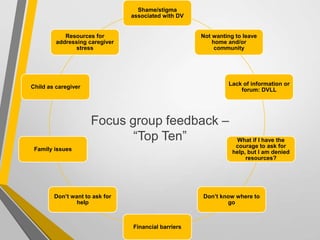
Focus group feedback –
“Top Ten”
Shame/stigma
associated with DV
Not wanting to leave
home and/or
community
Lack of information or
forum: DVLL
What if I have the
courage to ask for
help, but I am denied
resources?
Don’t know where to
go
Financial barriers
Don’t want to ask for
help
Family issues
Child as caregiver
Resources for
addressing caregiver
stress
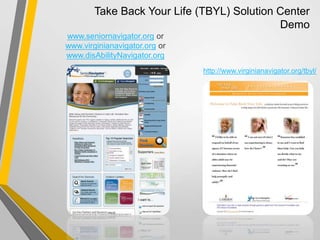
Take Back Your Life (TBYL) Solution Center
Demo
http://www.virginianavigator.org/tbyl/
www.seniornavigator.org or
www.virginianavigator.org or
www.disAbilityNavigator.org
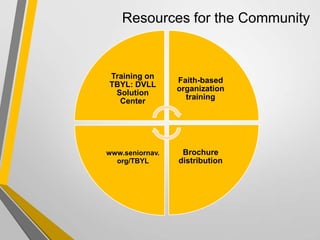
Resources for the Community
Training on
TBYL: DVLL
Solution
Center
Faith-based
organization
training
Brochure
distribution
www.seniornav.
org/TBYL
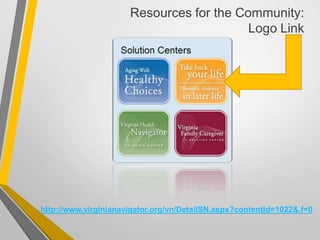
Resources for the Community:
Logo Link
http://www.virginianavigator.org/vn/DetailSN.aspx?contentId=1022&.f=0
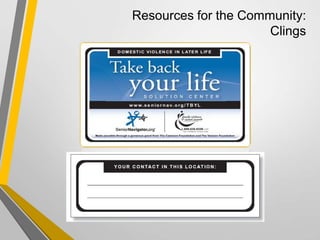
Resources for the Community:
Clings
National Level Review
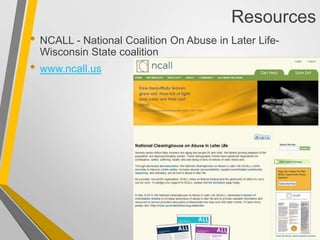
Resources
• NCALL - National Coalition On Abuse in Later Life-
Wisconsin State coalition
• www.ncall.us
Resources
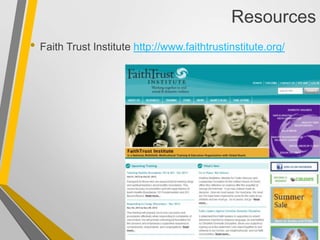
• Faith Trust Institute http://www.faithtrustinstitute.org/
Resources
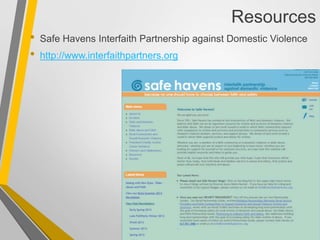
• Safe Havens Interfaith Partnership against Domestic Violence
• http://www.interfaithpartners.org
Resources
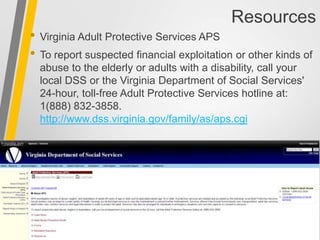
• Virginia Adult Protective Services APS
• To report suspected financial exploitation or other kinds of
abuse to the elderly or adults with a disability, call your
local DSS or the Virginia Department of Social Services'
24-hour, toll-free Adult Protective Services hotline at:
1(888) 832-3858.
http://www.dss.virginia.gov/family/as/aps.cgi
• SeniorNavigator:
• www.seniornav.org/tbyl (Direct Link)
• 1-866-393-0957 Toll-free
• 1-804-525-7728 (Metro Richmond)
• JOIN US:
• List your programs in the database
• Provide feedback on the TBYL: DVLL Solution Center
• Find a Navigator Center near you
• Book a presentation or invite us to your community event!
RECORDED
WEBINAR
featuring Dr. Paula Kupstas
and Lisa Furr, MA
www.alzpossible.org/wordpress-
3.1.4/wordpress/webinars-2/elder-abuse-neglect-and-
exploitation/
Webinar recording and slides available at:
MORE ON THE TOPIC OF ELDER ABUSE
and TECHNICAL ASSISTANCE/
TRAINING STATEWIDE
Call Lisa G. Furr
furrl@vcu.edu | 804.828.1525
TECHNICAL
ASSISTANCE/
TRAINING
STATEWIDE
Contact info:
Adrienne Johnson
adrienne@seniornavigator.org
804.525.7735
Lisa G. Furr
furrl@vcu.edu
804.828.1525

TAKE BACK YOUR LIFE Project

  • 1.
    Elder Abuse and DomesticViolence in Later Life: Innovative New Resources for the Community Lisa Furr, MA and Adrienne Johnson, MS
  • 2.
    the issues ofdomestic violence in later life (DVLL) and elder abuse and their prevalence the importance of the faith-based community’s response the history and goals of the Take Back Your Life project the features of the Take Back Your Life: DVLL Solution Center how to utilize the Solution Center and its resources in your community what is happening nationally around these issues OBJECTIVES
  • 3.
    WHAT IS ELDERABUSE? Abuse, Neglect, and/or Exploitation of an Elder or Vulnerable Adult Includes Self- Neglect Age 60 and Older These cases may be handled by Adult Protective Services (APS)
  • 4.
    The Interrelationship between DomesticViolence and Elder Abuse Domestic Violence Abuse in Later Life Elder Abuse Created by National Clearinghouse on Abuse in Later Life, a project of the Wisconsin Coalition against Domestic Violence
  • 5.
    Domestic Violence in the Second Half ofLife A pattern of coercive control and abuse of an older person in a trusted, ongoing relationship Primarily women, but includes older men Basis is “power and control”- Age 50 and Older
  • 6.
    • Women andmen aged 50 and over who experience DV are underserved (older women often don’t show up at shelters or DV programs)…so even experts believed that violence dropped off as people age • To the contrary, Moulton et. al. (2004) reported that physical and verbal abuse is occurring at rates similar to or higher than those for younger women • 3.7 per 1,000 older women reported becoming new victims of verbal abuse • 2007 VSDV Alliance reported that 19% of the adults served by DV programs in VA were age 45-64, 1% over 65 (total=20%) www.dss.virginia.gov/files/about/reports/adults/adult_services_annual/sfy_2012_Annual_Report.pdf
  • 7.
    Family Abuse in LaterLife PsychologicalAbusePsychologicalAbuse Psychological Abuse Psychological Abuse Threatens Targets vulnerabilities and neglects Financially exploits Uses privilege Isolates Uses family members Ridicules personal and cultural values Denies access to spiritual traditions/eventsPOWER and CONTROL Created by the National Clearinghouse on Abuse in Later Life (NCALL) www.ncall.us www.wcadv.org This diagram adapted from the Power and Control/Equality wheels developed by the Domestic Abuse Intervention Project, Duluth, MN
  • 8.
    Who Abuses? Intimate Partners Caregivers Adult Children and otherFamily members Others in position of trust and authority
  • 9.
    If a batteredwoman asks me whether she should talk to her faith leader or not, I usually say “no” – if she has to ask, then I doubt that it is safe to go to that person. I still have faith leaders say to me, “but no one ever comes to me with this problem.” CONCLUSION: we don’t have domestic violence in our faith community. FURTHER CONCLUSION: I don’t need to be trained to deal with a problem we don’t have. Rev. Dr. Marie Fortune: Founder and Senior Analyst
  • 10.
    Faith-based Community As Peopleof Faith, we are called to create healthy individuals, relationships, families and communities. We create a more Healthy World.
  • 11.
    • Web Interfaces •Resource Directory • Community Outreach SeniorNavigator Snapshot www.virginianavigator.org
  • 12.
    Take Back Your Life Project PROJECT LEADERSHIP PARTNERS: SeniorNavigator andthe Virginia Center on Aging ADVISORY PARTNERS: Virginia Sexual and Domestic Violence Action Alliance and The James House FUNDING: Cameron Foundation and the Verizon Foundation (2009-2010)
  • 13.
    Take Back Your Life Project GOALS Tocreate a community- created, informative and confidential online “Solution Center” To raise awareness about domestic violence in later life To help faith and community leaders to respond to and assist people in abusive situations To equip “trusted community resources” with information To expand the resource statewide!
  • 14.
    Take Back Your Life NAME Hope! People who areentrapped in cycle of abuse can, and will, take back their lives Reject language rooted in “victimology” Nourish the spirit, reclaim and celebrate true person There is more to life than outer shell, DVLL
  • 15.
    Support for SomeoneExperiencing Abuse Agencies Trusted Community Resources Friends and Family Individual
  • 16.
    Community Involvement FOCUS GROUPS -Six focus groups, including one for service providers - Held in five locations - Representation from every city and county across the Cameron region FOCUS GROUP PARTICIPANTS 28 focus group participants “TOP TEN” helped create solution center COMMUNITY PARTNER MEETINGS (3) 38 attendees representing 25 community organizations and agencies FAITH-BASED TRAINING 22 participants ONGOING TRAINING Incorporated into all SN trainings
  • 17.
    Focus group feedback– “Top Ten” Shame/stigma associated with DV Not wanting to leave home and/or community Lack of information or forum: DVLL What if I have the courage to ask for help, but I am denied resources? Don’t know where to go Financial barriers Don’t want to ask for help Family issues Child as caregiver Resources for addressing caregiver stress
  • 18.
    Take Back YourLife (TBYL) Solution Center Demo http://www.virginianavigator.org/tbyl/ www.seniornavigator.org or www.virginianavigator.org or www.disAbilityNavigator.org
  • 19.
    Resources for theCommunity Training on TBYL: DVLL Solution Center Faith-based organization training Brochure distribution www.seniornav. org/TBYL
  • 20.
    Resources for theCommunity: Logo Link http://www.virginianavigator.org/vn/DetailSN.aspx?contentId=1022&.f=0
  • 21.
    Resources for theCommunity: Clings
  • 22.
  • 23.
    Resources • NCALL -National Coalition On Abuse in Later Life- Wisconsin State coalition • www.ncall.us
  • 24.
    Resources • Faith TrustInstitute http://www.faithtrustinstitute.org/
  • 25.
    Resources • Safe HavensInterfaith Partnership against Domestic Violence • http://www.interfaithpartners.org
  • 26.
    Resources • Virginia AdultProtective Services APS • To report suspected financial exploitation or other kinds of abuse to the elderly or adults with a disability, call your local DSS or the Virginia Department of Social Services' 24-hour, toll-free Adult Protective Services hotline at: 1(888) 832-3858. http://www.dss.virginia.gov/family/as/aps.cgi
  • 27.
    • SeniorNavigator: • www.seniornav.org/tbyl(Direct Link) • 1-866-393-0957 Toll-free • 1-804-525-7728 (Metro Richmond) • JOIN US: • List your programs in the database • Provide feedback on the TBYL: DVLL Solution Center • Find a Navigator Center near you • Book a presentation or invite us to your community event!
  • 28.
    RECORDED WEBINAR featuring Dr. PaulaKupstas and Lisa Furr, MA www.alzpossible.org/wordpress- 3.1.4/wordpress/webinars-2/elder-abuse-neglect-and- exploitation/ Webinar recording and slides available at: MORE ON THE TOPIC OF ELDER ABUSE and TECHNICAL ASSISTANCE/ TRAINING STATEWIDE Call Lisa G. Furr furrl@vcu.edu | 804.828.1525 TECHNICAL ASSISTANCE/ TRAINING STATEWIDE
  • 29.

Editor's Notes

  • #17 81 SeniorNavigator Centers contacted to invite to focus groups (34 faith-based)
  • #19 COULD WE DO THIS LIVE?