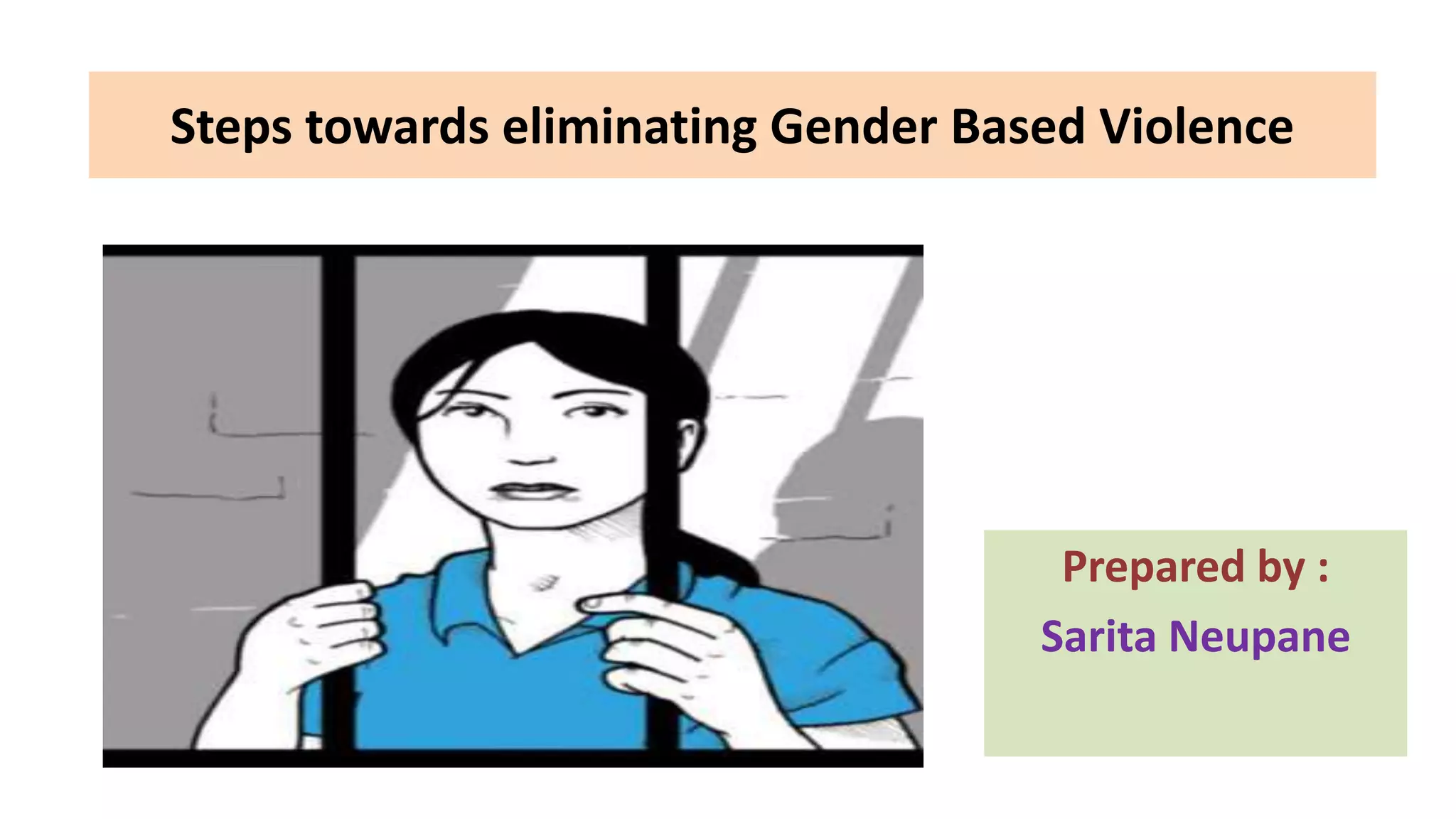
Steps towards eliminating Gender Based Violence
Prepared by :
Sarita Neupane
INTRODUCTION
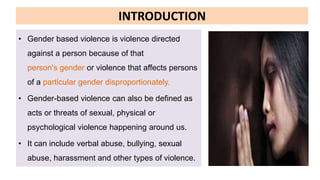
• Gender based violence is violence directed
against a person because of that
person's gender or violence that affects persons
of a particular gender disproportionately.
• Gender-based violence can also be defined as
acts or threats of sexual, physical or
psychological violence happening around us.
• It can include verbal abuse, bullying, sexual
abuse, harassment and other types of violence.
Public health
responsibilities
to preventing
violence
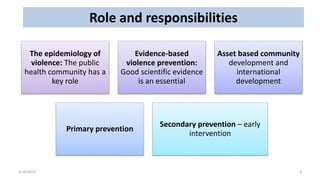
Role and responsibilities
4/16/2022 4
The epidemiology of
violence: The public
health community has a
key role
Evidence-based
violence prevention:
Good scientific evidence
is an essential
Asset based community
development and
international
development
Primary prevention
Secondary prevention – early
intervention
4/16/2022 5
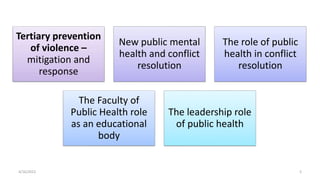
Tertiary prevention
of violence –
mitigation and
response
New public mental
health and conflict
resolution
The role of public
health in conflict
resolution
The Faculty of
Public Health role
as an educational
body
The leadership role
of public health
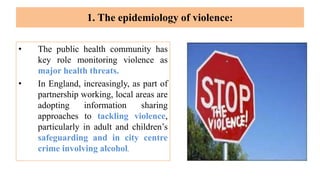
1. The epidemiology of violence:
• The public health community has
key role monitoring violence as
major health threats.
• In England, increasingly, as part of
partnership working, local areas are
adopting information sharing
approaches to tackling violence,
particularly in adult and children’s
safeguarding and in city centre
crime involving alcohol.
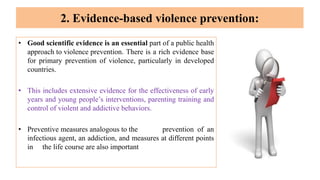
2. Evidence-based violence prevention:
• Good scientific evidence is an essential part of a public health
approach to violence prevention. There is a rich evidence base
for primary prevention of violence, particularly in developed
countries.
• This includes extensive evidence for the effectiveness of early
years and young people’s interventions, parenting training and
control of violent and addictive behaviors.
• Preventive measures analogous to the prevention of an
infectious agent, an addiction, and measures at different points
in the life course are also important
3. Asset based community development and international development:
We need an asset-based approach, recognizing all the strengths and
resources – natural, human, educational, economic and environmental –
available to a community to improve its security and health. This favors
human development over pre-occupation with economic growth, which
may increase inequalities, and fail to grow social and educational
support or improve health.
4. Primary prevention:
The key role and responsibility of the public health community in this
area is to prevent violence. Public health practitioners and policy makers
are uniquely placed to address inequalities and root causes of conflict in
local, community and international situations. Primary prevention of
conditions for violence should be our main objective
4/16/2022 8
5. Secondary prevention – early intervention: Where it is not possible to prevent violence, early
intervention should be undertaken to mitigate further escalation. This involves early warning
and intervention, de-escalation and conflict handling, alongside effective planning.
6. Tertiary prevention of violence – mitigation and response: Faculty of Public Health (FPH)
systems and public health professionals must be effectively mobilized in response to violent
conflicts. Tertiary prevention involves response, treatment and rehabilitation, as well as
reconstruction and resolution.
7. New public mental health and conflict resolution: New learning from brain science, psychology
and public mental health fields needs to be applied in developing violence prevention strategies,
humanitarian aid and conflict resolution. Discussion of power differences is important and can
be part of recognizing our common human and civil rights.
4/16/2022 9
8. The role of public health in conflict resolution: Public health is neutral territory in which enemies
can come together. As a professional body with a respected membership throughout the world,
our first response to violent conflict should be to behave as honest broker. We should seek to bring
together public health specialists on different sides of a conflict to create a dialogue aimed at
influencing peaceful resolution and rapprochement.
9. The Faculty of Public Health role as an educational body: FPH will review educational materials on
violence for our curriculum and look to accredit relevant interdisciplinary resources and courses on
violence as a public health problem. FPH special interest groups are encouraged to take forward
the prevention agenda from local to international levels. Our Global Health Committee will play a
role and developing ethics and values work will be vital.
10. The leadership role of public health: FPH professionals need to take up leadership roles in
prevention, control and response to violence, at local, national and international level. Public
health professionals should be actively involved in the measurement and surveillance of all forms
of violence, in advocating for effective interventions and monitoring of outcomes and in
partnerships to promote safeguarding and crime and disorder
4/16/2022 10
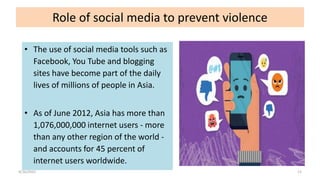
Role of social media to prevent violence
• The use of social media tools such as
Facebook, You Tube and blogging
sites have become part of the daily
lives of millions of people in Asia.
• As of June 2012, Asia has more than
1,076,000,000 internet users - more
than any other region of the world -
and accounts for 45 percent of
internet users worldwide.
4/16/2022 11
• While internet penetration rates are only 28
percent, Asia - particularly amongst youth -
is the world’s fastest growing and largest
segment of social network users in the
world.
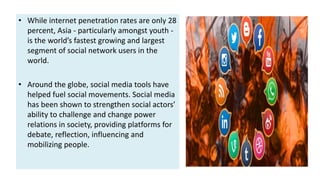
• Around the globe, social media tools have
helped fuel social movements. Social media
has been shown to strengthen social actors’
ability to challenge and change power
relations in society, providing platforms for
debate, reflection, influencing and
mobilizing people.
Role of media
• Primary prevention of violence
against women describes all
efforts to stop violence before
it starts.
• Prevention focuses on
identifying and addressing
underlying causes of violence
to minimize the chance that
violence happens in the first
place.
4/16/2022 13
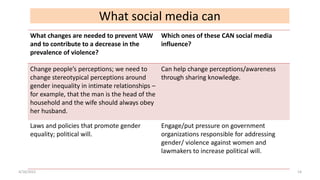
What social media can
What changes are needed to prevent VAW
and to contribute to a decrease in the
prevalence of violence?
Which ones of these CAN social media
influence?
Change people’s perceptions; we need to
change stereotypical perceptions around
gender inequality in intimate relationships –
for example, that the man is the head of the
household and the wife should always obey
her husband.
Can help change perceptions/awareness
through sharing knowledge.
Laws and policies that promote gender
equality; political will.
Engage/put pressure on government
organizations responsible for addressing
gender/ violence against women and
lawmakers to increase political will.
4/16/2022 14
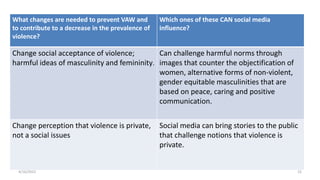
What changes are needed to prevent VAW and
to contribute to a decrease in the prevalence of
violence?
Which ones of these CAN social media
influence?
Change social acceptance of violence;
harmful ideas of masculinity and femininity.
Can challenge harmful norms through
images that counter the objectification of
women, alternative forms of non-violent,
gender equitable masculinities that are
based on peace, caring and positive
communication.
Change perception that violence is private,
not a social issues
Social media can bring stories to the public
that challenge notions that violence is
private.
4/16/2022 15
Role of family member to prevent domestic violence in women
• Avoid dowry system, child marriage
• Promote women education and
empowerment
• Create safe, respectful, lovely, caring and
open environment at home
• Can change bad perception on gender role
• Equal distribution of economic and
decision making power
4/16/2022 16
Role of family member to prevent domestic violence
in children
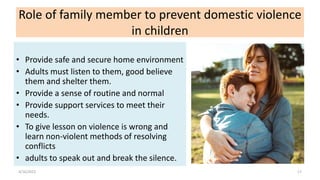
• Provide safe and secure home environment
• Adults must listen to them, good believe
them and shelter them.
• Provide a sense of routine and normal
• Provide support services to meet their
needs.
• To give lesson on violence is wrong and
learn non-violent methods of resolving
conflicts
• adults to speak out and break the silence.
4/16/2022 17
Role of family on consequences of violence
• Provide the health care services. actively identify challenges
and solve problems associated with their illness.
• Monitoring physical indicators;
• Managing complex medication regimens;
• Maintaining proper levels of nutrition, diet, and exercise;
• Adjusting to the psychological and social demands, including
difficult lifestyle adjustments; and
• Engaging in effective interactions with health care providers.
4/16/2022 18
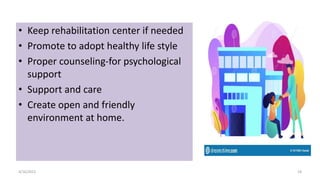
• Keep rehabilitation center if needed
• Promote to adopt healthy life style
• Proper counseling-for psychological
support
• Support and care
• Create open and friendly
environment at home.
4/16/2022 19
Any Questions ??
GENDER BASED Violence.pptx

GENDER BASED Violence.pptx

  • 1.
    Steps towards eliminatingGender Based Violence Prepared by : Sarita Neupane
  • 2.
    INTRODUCTION • Gender basedviolence is violence directed against a person because of that person's gender or violence that affects persons of a particular gender disproportionately. • Gender-based violence can also be defined as acts or threats of sexual, physical or psychological violence happening around us. • It can include verbal abuse, bullying, sexual abuse, harassment and other types of violence.
  • 3.
  • 4.
    Role and responsibilities 4/16/20224 The epidemiology of violence: The public health community has a key role Evidence-based violence prevention: Good scientific evidence is an essential Asset based community development and international development Primary prevention Secondary prevention – early intervention
  • 5.
    4/16/2022 5 Tertiary prevention ofviolence – mitigation and response New public mental health and conflict resolution The role of public health in conflict resolution The Faculty of Public Health role as an educational body The leadership role of public health
  • 6.
    1. The epidemiologyof violence: • The public health community has key role monitoring violence as major health threats. • In England, increasingly, as part of partnership working, local areas are adopting information sharing approaches to tackling violence, particularly in adult and children’s safeguarding and in city centre crime involving alcohol.
  • 7.
    2. Evidence-based violenceprevention: • Good scientific evidence is an essential part of a public health approach to violence prevention. There is a rich evidence base for primary prevention of violence, particularly in developed countries. • This includes extensive evidence for the effectiveness of early years and young people’s interventions, parenting training and control of violent and addictive behaviors. • Preventive measures analogous to the prevention of an infectious agent, an addiction, and measures at different points in the life course are also important
  • 8.
    3. Asset basedcommunity development and international development: We need an asset-based approach, recognizing all the strengths and resources – natural, human, educational, economic and environmental – available to a community to improve its security and health. This favors human development over pre-occupation with economic growth, which may increase inequalities, and fail to grow social and educational support or improve health. 4. Primary prevention: The key role and responsibility of the public health community in this area is to prevent violence. Public health practitioners and policy makers are uniquely placed to address inequalities and root causes of conflict in local, community and international situations. Primary prevention of conditions for violence should be our main objective 4/16/2022 8
  • 9.
    5. Secondary prevention– early intervention: Where it is not possible to prevent violence, early intervention should be undertaken to mitigate further escalation. This involves early warning and intervention, de-escalation and conflict handling, alongside effective planning. 6. Tertiary prevention of violence – mitigation and response: Faculty of Public Health (FPH) systems and public health professionals must be effectively mobilized in response to violent conflicts. Tertiary prevention involves response, treatment and rehabilitation, as well as reconstruction and resolution. 7. New public mental health and conflict resolution: New learning from brain science, psychology and public mental health fields needs to be applied in developing violence prevention strategies, humanitarian aid and conflict resolution. Discussion of power differences is important and can be part of recognizing our common human and civil rights. 4/16/2022 9
  • 10.
    8. The roleof public health in conflict resolution: Public health is neutral territory in which enemies can come together. As a professional body with a respected membership throughout the world, our first response to violent conflict should be to behave as honest broker. We should seek to bring together public health specialists on different sides of a conflict to create a dialogue aimed at influencing peaceful resolution and rapprochement. 9. The Faculty of Public Health role as an educational body: FPH will review educational materials on violence for our curriculum and look to accredit relevant interdisciplinary resources and courses on violence as a public health problem. FPH special interest groups are encouraged to take forward the prevention agenda from local to international levels. Our Global Health Committee will play a role and developing ethics and values work will be vital. 10. The leadership role of public health: FPH professionals need to take up leadership roles in prevention, control and response to violence, at local, national and international level. Public health professionals should be actively involved in the measurement and surveillance of all forms of violence, in advocating for effective interventions and monitoring of outcomes and in partnerships to promote safeguarding and crime and disorder 4/16/2022 10
  • 11.
    Role of socialmedia to prevent violence • The use of social media tools such as Facebook, You Tube and blogging sites have become part of the daily lives of millions of people in Asia. • As of June 2012, Asia has more than 1,076,000,000 internet users - more than any other region of the world - and accounts for 45 percent of internet users worldwide. 4/16/2022 11
  • 12.
    • While internetpenetration rates are only 28 percent, Asia - particularly amongst youth - is the world’s fastest growing and largest segment of social network users in the world. • Around the globe, social media tools have helped fuel social movements. Social media has been shown to strengthen social actors’ ability to challenge and change power relations in society, providing platforms for debate, reflection, influencing and mobilizing people.
  • 13.
    Role of media •Primary prevention of violence against women describes all efforts to stop violence before it starts. • Prevention focuses on identifying and addressing underlying causes of violence to minimize the chance that violence happens in the first place. 4/16/2022 13
  • 14.
    What social mediacan What changes are needed to prevent VAW and to contribute to a decrease in the prevalence of violence? Which ones of these CAN social media influence? Change people’s perceptions; we need to change stereotypical perceptions around gender inequality in intimate relationships – for example, that the man is the head of the household and the wife should always obey her husband. Can help change perceptions/awareness through sharing knowledge. Laws and policies that promote gender equality; political will. Engage/put pressure on government organizations responsible for addressing gender/ violence against women and lawmakers to increase political will. 4/16/2022 14
  • 15.
    What changes areneeded to prevent VAW and to contribute to a decrease in the prevalence of violence? Which ones of these CAN social media influence? Change social acceptance of violence; harmful ideas of masculinity and femininity. Can challenge harmful norms through images that counter the objectification of women, alternative forms of non-violent, gender equitable masculinities that are based on peace, caring and positive communication. Change perception that violence is private, not a social issues Social media can bring stories to the public that challenge notions that violence is private. 4/16/2022 15
  • 16.
    Role of familymember to prevent domestic violence in women • Avoid dowry system, child marriage • Promote women education and empowerment • Create safe, respectful, lovely, caring and open environment at home • Can change bad perception on gender role • Equal distribution of economic and decision making power 4/16/2022 16
  • 17.
    Role of familymember to prevent domestic violence in children • Provide safe and secure home environment • Adults must listen to them, good believe them and shelter them. • Provide a sense of routine and normal • Provide support services to meet their needs. • To give lesson on violence is wrong and learn non-violent methods of resolving conflicts • adults to speak out and break the silence. 4/16/2022 17
  • 18.
    Role of familyon consequences of violence • Provide the health care services. actively identify challenges and solve problems associated with their illness. • Monitoring physical indicators; • Managing complex medication regimens; • Maintaining proper levels of nutrition, diet, and exercise; • Adjusting to the psychological and social demands, including difficult lifestyle adjustments; and • Engaging in effective interactions with health care providers. 4/16/2022 18
  • 19.
    • Keep rehabilitationcenter if needed • Promote to adopt healthy life style • Proper counseling-for psychological support • Support and care • Create open and friendly environment at home. 4/16/2022 19
  • 20.