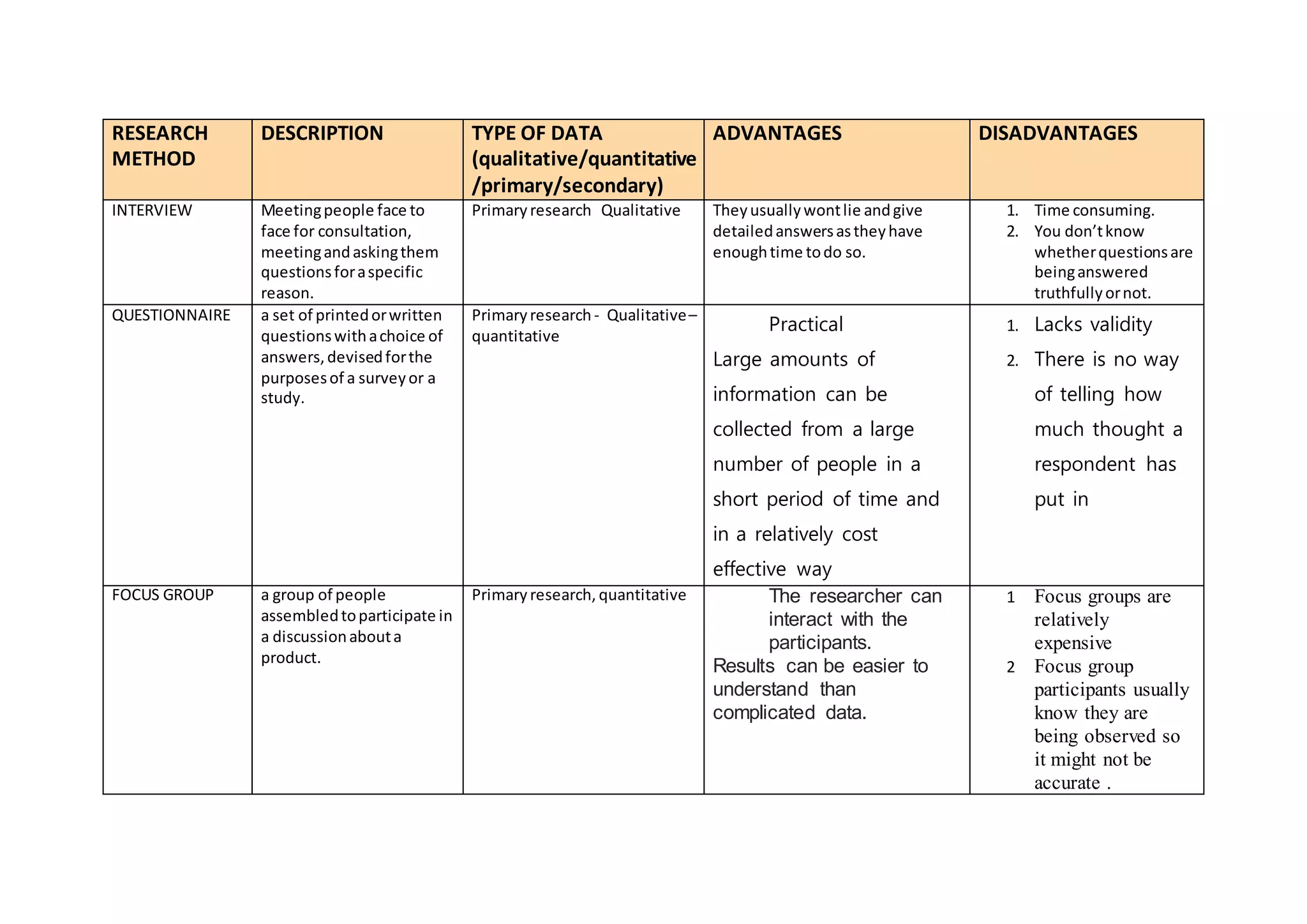
RESEARCH
METHOD
DESCRIPTION TYPE OF DATA
(qualitative/quantitative
/primary/secondary)
ADVANTAGES DISADVANTAGES
INTERVIEW Meetingpeople face to
face for consultation,
meetingandaskingthem
questionsforaspecific
reason.
Primaryresearch Qualitative Theyusuallywontlie andgive
detailedanswersastheyhave
enoughtime todo so.
1. Time consuming.
2. You don’tknow
whetherquestionsare
beinganswered
truthfullyornot.
QUESTIONNAIRE a set of printedorwritten
questionswithachoice of
answers,devisedforthe
purposesof a surveyor a
study.
Primaryresearch- Qualitative–
quantitative
Practical
Large amounts of
information can be
collected from a large
number of people in a
short period of time and
in a relatively cost
effective way
1. Lacks validity
2. There is no way
of telling how
much thought a
respondent has
put in
FOCUS GROUP a group of people
assembledtoparticipate in
a discussionabouta
product.
Primaryresearch, quantitative The researcher can
interact with the
participants.
Results can be easier to
understand than
complicated data.
1 Focus groups are
relatively
expensive
2 Focus group
participants usually
know they are
being observed so
it might not be
accurate .
SURVEY Investigate the opinionsor
experience of (agroupof
people) byaskingthem
questions.
Primaryresearch, quantitative
, Qualitative
Relatively easy to
answer questions.
Can be developed in less
time (compared to other
data-collection methods)
People may not
feel encouraged to
provide accurate
honest answers.
Respondents may not
feel comfortable
providing answers that
present themselves in a
unfavorable way.
INTERNET
RESEARCH
Usingthe internettofind
out informationbasedon
the researchyouare
lookingfor.
Secondaryresearch,
quantitative , Qualitative
1 Ability to obtain a large
sample of
information.
2 Reduced cost of
conducting research.
1. The informationmight
not be accurate.
2. There isno single
answerto your
questionyouhave to
go throughvarious
sources.
LIBRARY
RESEARCH
Usingbooksor oldjournals
to elaborate onyour
researchmethod.
Secondary, Quantitative 1. Libraryhas librariesthat
knowall the booksin the
librarysoyou don’thave to
lookforthe booksyourself.
2. Majorityof the itemsinthe
libraryare reliable sources.
1.time and accesscan be
obstaclestolibraryresearch.
2.people mustgoto the library
at library timingsonly.

Research methods table zak

  • 1.
    RESEARCH METHOD DESCRIPTION TYPE OFDATA (qualitative/quantitative /primary/secondary) ADVANTAGES DISADVANTAGES INTERVIEW Meetingpeople face to face for consultation, meetingandaskingthem questionsforaspecific reason. Primaryresearch Qualitative Theyusuallywontlie andgive detailedanswersastheyhave enoughtime todo so. 1. Time consuming. 2. You don’tknow whetherquestionsare beinganswered truthfullyornot. QUESTIONNAIRE a set of printedorwritten questionswithachoice of answers,devisedforthe purposesof a surveyor a study. Primaryresearch- Qualitative– quantitative Practical Large amounts of information can be collected from a large number of people in a short period of time and in a relatively cost effective way 1. Lacks validity 2. There is no way of telling how much thought a respondent has put in FOCUS GROUP a group of people assembledtoparticipate in a discussionabouta product. Primaryresearch, quantitative The researcher can interact with the participants. Results can be easier to understand than complicated data. 1 Focus groups are relatively expensive 2 Focus group participants usually know they are being observed so it might not be accurate .
  • 2.
    SURVEY Investigate theopinionsor experience of (agroupof people) byaskingthem questions. Primaryresearch, quantitative , Qualitative Relatively easy to answer questions. Can be developed in less time (compared to other data-collection methods) People may not feel encouraged to provide accurate honest answers. Respondents may not feel comfortable providing answers that present themselves in a unfavorable way. INTERNET RESEARCH Usingthe internettofind out informationbasedon the researchyouare lookingfor. Secondaryresearch, quantitative , Qualitative 1 Ability to obtain a large sample of information. 2 Reduced cost of conducting research. 1. The informationmight not be accurate. 2. There isno single answerto your questionyouhave to go throughvarious sources. LIBRARY RESEARCH Usingbooksor oldjournals to elaborate onyour researchmethod. Secondary, Quantitative 1. Libraryhas librariesthat knowall the booksin the librarysoyou don’thave to lookforthe booksyourself. 2. Majorityof the itemsinthe libraryare reliable sources. 1.time and accesscan be obstaclestolibraryresearch. 2.people mustgoto the library at library timingsonly.