Republic of the Philippines
CAMARINES SUR POLYTECHNIC COLLEGES
Nabua, Camarines Sur
COMMUNITY HEALTH NURSING 1
(Individual and Family as Clients)
WILMA N. BERALDE, RM, RN, MAN
Clinical Instructor
BIRTH AND NEWBORN SERVICES (28 DAYS)
RA 8980 also known as “Early Childhood Care Development”
(ECCD), refers to the full range of health, nutrition, education, and
social services programs that provide for the holistic needs of young
children from birth to 6 years of age, to promote their optimum growth
and development.
AO 2005-0014
a. early initiation of breastfeeding
b. exclusive breastfeeding for the first 6 months
c. Extended breastfeeding for 2 years and beyond
d. Appropriate complementary feeding
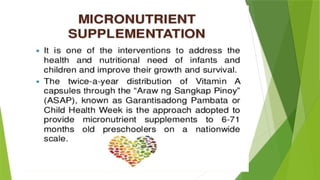
e. Micronutrient supplementation
f. Universal salt iodization
g. Food fortification
• Early initiation of breastfeeding
• Exclusive breastfeeding for the first months, which possible,
exept for a few medical conditions, such as galactosemia.
• Extent breastfeeding up to 2years and beyond.
• Appropriate complementary feeding with the use of locally
available and culturally acceptable foods
• Micronutrients supplementation
• Universal salt iodization since ordinary salt contains very little
iodine that cannot provide for the needs of the human body
• Food fortification
Recommended infant and young child feeding practices:
According to DOH, in summary the advantages of breastfeeding
are as follows:
B - best for baby
R - reduce allergy
E - emotional bonding
A - antibody present – IgA
S - stool inoffensive
T - temperature always right
F - fresh always
E - economical
E - easy once established
D - digested easily
I - immediately available
N - nutritious
G - gastroenteritis is avoided
EO no. 51 – also known as the MILK CODE
EO no. 382 – provided for the observance of the NATIONAL FOOD
FORTIFICATION day in November 7.
RA 7600 – also known as ROOMING-IN AND BREAST FEEDING ACT
RA 8172 – also known as ASIN (ACT FOR SALT IODIZATION
NATIONWIDE)
RA 8976 – also known as the PHILIPPINE FOOD FORTIFICATION ACT
RA 10028 – also known as EXPANDED BREASTFEEDING PROMOTION
ACT
AO 36, s2010 – also known as EXPANDED GARANTISADONG PAMBATA
Related Laws and Policies on Breastfeeding
• Exclusive breastfeeding – infant receives breast milk and allows to receive
oral hydration salt, drops, syrups(minerals, vitamins, medicines) but nothing
else.
• Predominant breastfeeding - infant’s predominant source of nourishment
has been breast milk, including milk expressed or from a we nurse as the
predominant source of nourishment.
• Complementary feeding – the process of giving the infant food and liquids,
along with breast milk, when breast milk is no longer sufficient to meet the
infant’s nutritional requirements.
• Bottle feeding – the child is given food or drink from a bottle with
nipple/teat.
• Early initiation of breastfeeding – initiating breastfeeding of the newborn
after birth within 90mins of life in accordance to essential newborn care
protocol.
BREASTFEEDING PRACTICES
• It provides all of the nutrients an infant needs for
growth in the 1st
6months.
• It carries antibodies from the mother to help combat
disease.
• It prevents diarrhea because of reduce risk from
contaminated formula as well as of the antibodies in the
breast milk.
• It lowers risk of developing later in life chronic
conditions, like allergies, asthma, obesity, diabetes and
heart disease.
• It provides benefit for intellectual and motor
development of the infant
Benefits of breastfeeding to the infant includes:
• Early initiation of breastfeeding helps to contract
the uterus and therefore reduce bleeding.
• It may help in the return to prepregnancy weight.
• Exclusive breastfeeding delays the return of
fertility
• A long term benefit is a lower risk of
premenopausal breast cancer and ovarian cancer.
Benefits of breastfeeding to the mother:
1. Cradle hold –the mother sits with her arms supported and, using her arm on
the same side as the nursing breast cracle the infant of her body.
2. Cross-cradle hold – same to the cradle hold, except that the mother cradles
her infant with arm on the opposite side of the nursing breast.
3. Football, clutch or underarm hold – the mother sits, hold the infant
between her flexed arm and body, positions the infant facing her, and
supports the infant’s head with her open arm. Twins may be fed at the same
time using the double-football hold.
4. Side-lying hold – the mother lies on her side with one arm supporting her
head. The infant lies aside beside the mother, facing the breast. The mother
grasps and offers her breast to the infant with the other hand. Once the
infant has latched on, she supports her infant’s body.
Types of position when breast feeding the baby:
PROPER BABY LATCHING
A. The mother should hold her breast in a C-hold technique.
B. Stimulate the baby’s rooting reflex
C. With baby’s wide mouth open, put the nipple and as much of the
areola as possible into his mouth.
SIGNS OF PROPERLY LATCHED ON INFANT
a. The baby’s mouth is wide open.
b. The baby and the mother are in tummy to tummy position.
c. Much of the mother’s areola is inside of the baby’s mouth and more
visible above the baby’s mouth than below.
d. The baby’s lower lip is turned out.
e. The baby’s chin is touching the breast (or nearly so).
f. The mother does not feel nipple pain.
g. The baby is relaxed and happy
SIGNS THAT THE BABY IS GETTING ENOUGH MILK
A. The baby’s swallowing can be seen or heard
b. The baby’s cheeks are full and not drawn inward during a feed
c. The baby finished the feed and releases the breast by
himself/herself and looks contented
BREASTMILK STORAGE
Room temperature - 8 hours
Refrigerator’s body - 24 hours
Refrigerator’s freezer- 1 month
Chest freezer - 1 year
Timely – complementary foods are introduced when the energy and
nutrients exceeds when can be provided through exclusive and
frequent breastfeeding.
Adequate – they should provide sufficient energy, protein, and
macronutrients to meet a growing child’s nutritional goal.
Properly fed – food are given consistent with a child’s signal of
appetite and satiety, and that meal frequency and feeding method –
actively encouraging the child, even during illness, to consume
sufficient food using finger, spoon, or self-feeding – are suitable for
age.
Ensuring the nutritional needs are met requires
complementary foods be:
Benefits:
• Improved maternal/family and infant bonding
• Increased and sustained breastfeeding success
• Better weight gain
• Decreased risk for infection
• Maternal and family empowerment
• Decreased cost of care (early discharge) and health maintenance
(breastfeeding)
Kangaroo mother care intervention (KMCI)
Newborn Screening (NBS) – a simple procedure to find out if a baby has a congenital
metabolic disorder that may lead to mental retardation or death if left untreated.
- ideally done on the 48th
-72nd
hour of life; also be done after 24hours of life but not
later than 3days from the complete delivery of the newborn.
RA 9288 – also known as NEWBORN SCREENING ACT OF 2004
Newborn Screening Reference Center (NSRC) – responsible for the national testing database and
case registries, training, technical assistance and continuing education for laboratory staff.
Located at the following sites:
1. NSC-NIH for the NCR and Luzon: National Institute of Health, University of the Philippines
Manila, Pedro Gil St., Ermita, Manila
2. NSC-Central Luzon for Regon I, II, III and CAR: Angeles University Foundation Medical Center,
Angeles City.
3. NSC-Visayas: Western Visayas State University Medical Center, Iloilo City
4. NSC-Mindanao: Southern Philippines Medical Center, Davao City
Disorders detected by NBS and their long-term effects:
Disorder Definition Long-term Effects
Congenital Hypothyroidism Inability to produce thyroid hormone Severe Mental Retardation
Congenital Adrenal
Hyperplasia
Inherited disorder; inability of the adrenal
gland to secrete cortisol or aldosterone, or
both.
Death
Galactosemia Inherited disorder; the body unable to
metabolize galactose and the person is
unable to tolerate any form of milk.
Death or Cataracts
Phenylketonuria Without the ability to properly break down
an amino acid called phenylalanine.
Severe Mental Retardation
Glucose-6-phosphate-
dehydrogenase (G6PD
Deficiency)
The red blood cells break down when the
body is exposed to certain drugs, food,
severe stress or severe infection.
Severe Anemia, Kernicterus
Maple Syrup Urine disease Unable to break down amino acid leucine,
isoleucine and valine; urine of affected
person smells like maple syrup.
Death
Newborn screening procedure:
- The specimen is obtained through a heel prick.
- A few drops of blood are taken, blotted on a special absorbent filter card and then sent to NSC
Blood sample may be obtained by:
• Physician
 Nurse
 Medical technologist
 Trained midwife
NBS is available in:
 Hospitals
 Lying-in clinics
 RHUs
 Health centers
 Some private clinics
Normal (Negative) – results are available 7 – 14 working days from the time samples are received at the
NSC.
- Positive – results should be relayed to the parents immediately and must be referred to a specialist for
confirmatory testing and further management.
Republic Act 9709 also known as “Universal Newborn Hearing
Screening and Intervention Act of 2009” – aims for the early
detection of congenital hearing loss and referral for early
intervention. This requires that all newborns should be screened
prior to discharge from the hospital. However, in case the baby
was not screened due to unavailability of instruments they may
seek hearing screening within the first three months after birth
in the nearest facility doing hearing screening.
NEWBORN HEARING SCREENING TEST
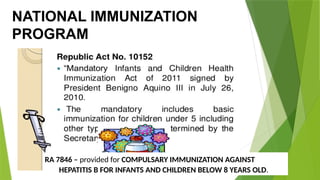
NATIONAL IMMUNIZATION
PROGRAM
RA 7846 – provided for COMPULSARY IMMUNIZATION AGAINST
HEPATITIS B FOR INFANTS AND CHILDREN BELOW 8 YEARS OLD.
IMMUNIZATION
It is an essential public health service and is commonly
defined as the process of conferring artificial immunity to
population groups.
IMMUNITY
It is described as resistance and protection from disease
attributed to the presence of antibodies in the blood.
HERD IMMUNITY
Occurs when an enough portion of population is immune
to specific diseases, thereby protecting individuals who have
not developed immunity.
TYPES OF IMMUNITY
NATURAL ARTIFICIAL
ACTIVE • Exposure
• Carrier
• Sick of disease
• Antigens
• Attenuated – BCG, OPV,
AMV
• Rotavirus
• Killed – Pertussis, HBV
• Weakened toxins – TT,
Diptheria
PASSIVE • Breastmilk (IgA)
• Placenta (IgG)
• Gamma globulin (6months –
1 year)
• Antitoxin/antiserum/serum
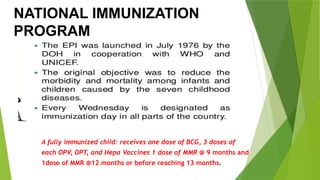
A fully immunized child: receives one dose of BCG, 3 doses of
each OPV, DPT, and Hepa Vaccines 1 dose of MMR @ 9 months and
1dose of MMR @12 months or before reaching 13 months.
NATIONAL IMMUNIZATION
PROGRAM
The specific goals of the program:
1.To immunize all infants/children against the most
common vaccine-preventable diseases,
2.To sustain the polio-free status of the Philippines
3.To eliminate measles infection.
4.To eliminate maternal and neonatal tetanus.
5.To control diphtheria, pertussis, hepatitis B, and German
measles.
6.To prevent extrapulmonary TB among children.
The nurses uses the following formulas to estimate
eligible population:
Estimated number of infant = total population x 2.7%
Estimated number 12–59 month old children = total population x 10.8%
Estimated number of pregnant women = total population x 3.5%
a.Proper Vaccine Storage
b.“First Expiry, First Out” (FEFO) Principle
c.Vaccine Vial Monitor. It is a round disc of heat
sensitive material to register cumulative heat exposure.
The lower the temperature the slower the color change
and vise versa.
d.Shake Test. This approach can be used to determine
if the biological should be used or discarded. If the vial
is smooth and cloudy immediately after shaking, the
biological can be used. However, if it appears granular
and not smooth, it should be discarded.
EPI vaccines and the special diluents have the
following cold chain requirements:
OPV : -15 to -25o
C; must stored in the freezer.
All other vaccines have to be stored in the refrigerator at a
temperature of +2 to +8o
C
Hepatitis B, Pentavalent vaccine, Rotavirus vaccine and TT
should not be stored in the freezer. Wrap the container with
paper before putting in the vaccine bag with cold packs.
Keep diluents cold by storing them in the refrigerator in the
lower or door shelves
Fully immunized children (FIC) – a child who has received all
immunizations that should be given before reaching 1st
year of life:
1 dose of BCG, Hepatitis B, MMR vaccine and IPV and 3 doses of
Pentavalent and OPV.
Completely immunized children – who completed their
immunization schedule at the age of 12 -23 months.
A child protected at birth (CPAB) – used to describe a child
whose mother has received:
a.2doses to DT during this pregnancy, provided that the 2nd
dose
was given at least a month prior to delivery; or
b.at least 3doses of DT anytime prior to pregnancy with this child.
RECOMMENDED TEMPERATURE FOR VACCINE
STORAGE
VACCINE TEMPERATURE STABILITY
Most sensitive OPV (-) 15 to (-) 25 C
Freezer
Least sensitive to
heat/most sensitive
to cold
Pentavalent
Hepatitis B
Diptheria Tetanus
Toxoid
2-8 C
Body of
refrigerator
8 hours if in
room
temperature
Most sensitive to
light
4-6 hours
INTERPRETATION OF VACCINE VIAL MONITOR
VACCINE VIAL MONITOR (VVM)
The square is lighter than the
circle
If the expiry date is not passed,
use the vaccine
The square matches the circle Do not use the vaccine, inform
the supervisor
The square is darker than the
circle
Do not use the vaccine, inform
the supervisor
ABSOLUTE CONTRAINDICATIONS
• Any serious condition that needs hospitalization
• Immunocompromised conditions such as AIDS
THE FOLLOWING ARE NOT CONTRAINDICTAIONS
• Fever up to 38.5 C
• Mild acute respiratory infection
• Simple diarrhea
• Malnutrition – considered an indication
VACCINES OF THE NATIONAL IMMUNIZATION
PROGRAM OF THE PHILIPPINES
VACCINE DISEASE/S COMPONENTS AGE DOSE ROUTE SITE
Bacillus
Calmette
Guerin (BCG)
Tuberculosis Live-attenuated bacteria;
Freeze-dried with special
diluent
At birth 0.05 ml ID Right upper
arm/deltoid
Hepatitis B
Vaccine
(Monovalent)
Hepatitis B Plasma derivative or RNA
recombinant
Cloudy, liquid
At birth 0.5 ml IM Vastus
lateralis
Pentavalent
Vaccine (DPT-
HepaB-
Haemophilus-
Influenza)
Diptheria
Pertussis
Tetanus
Hepatitis B
Pneumonia
Meningitis
D-weakened toxins
P-killed bacteria
T-weakened toxins
Liquid, clear
6, 10, 14
weeks
0.5 ml IM Vastus
lateralis
Oral Polio
Vaccine (OPV)
Poliomyelitis Live-attenuated virus
-for GI mucosal immunity
(mouth and GI tract)
-Clear, pinkish
6, 10, 14
weeks
0.5 ml PO mouth
VACCINES OF THE NATIONAL IMMUNIZATION
PROGRAM OF THE PHILIPPINES
VACCINE DISEASE/S COMPONENTS AGE DOSE ROUTE SITE
Inactivated
Polio vaccine
(IPV)
Poliomyelitis -Liquid, clear
-for serum immunity
(blood)
14 weeks 0.5 ml IM Vastus
lateralis
Pneumococcal
Conjugate
Vaccine (PCV)
Pneumonia
Meningitis
Liquid, clear 6, 10, 14
weeks
For 2-5 years
old give 1 dose
0.5 ml IM Vastus
lateralis
Measles,
Mumps,
Rubella (MMR)
Mumps
Measles
German
Measles
Live-attenuated virus
Dried freeze with special
diluent
9 months and
12-15 months
0.5 ml SC Outer arm
RECOMMENDED ROUTINE IMMUNIZATION
SCHEDULE FOR CHILDREN
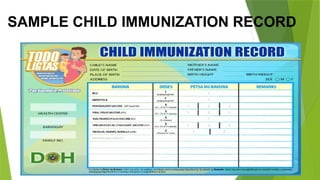
SAMPLE CHILD IMMUNIZATION RECORD
COMMON SIDE EFFECTS OF VACCINATION
AND THEIR MANAGEMENT
VACCINE SIDE EFFECTS MANAGEMENT
BCG Wheal for 30 minutes following by ulceration within 2
weeks then scar formation within 12weeks or 3 months
Koch’s phenomenon: an acute inflammatory reaction
within 2-4days after vaccination usually indicated
previous exposure to tuberculosis
Deep (subcutaneous) abscess at vaccination site; almost
invariably due to subcutaneous or deeper injection
Indolent ulcer. An ulcer which persists after 12 weeks
from vaccination date
Glandular enlargement: enlargement of the lymph glands
draining the injection site.
Normal reaction
No management is needed
Refer to the physician for incision
and drainage
Treat with Isoniazid (INH) powder
If suppuration occurs, treat as
deep abscess
VACCINE SIDE EFFECTS MANAGEMENT
Hepatitis B Local soreness at the injection site No treatment necessary
May apply cold compress
Pentavalent Fever that usually last for only 1 day. Fever beyond
24 hour is not due to the vaccine but to other causes
Local soreness at the injection site
Abscess after a week or more usually indicates that
the injection was not deep enough or the needle was
not sterile.
Convulsions, although very rare, may occur in
children older than 3 months caused by pertussis
component
Advise parents to give antipyretic
Reassure parents that soreness will
disappear after 3-4days
May give paracetamol for pain
Incision and drainage may be
necessary
Proper management of convulsions;
May give DT next vaccination
COMMON SIDE EFFECTS OF VACCINATION
AND THEIR MANAGEMENT
VACCINE SIDE EFFECTS MANAGEMENT
Oral Polio
Vaccine
(OPV)
None • Nothing per orem for 30 minutes to prevent the child
from vomiting and enhance absorption
• If child vomits, administer another dose
• If the child has simple diarrhea may give OPV but
dose not counted and should be instructed to return
for next due dose
Inactivated
Polio
Vaccine
(IPV)
Local tenderness Cold compress
Measles,
Mumps,
Rubella
(MMR
Vaccine)
Local tenderness, fever, irritability
and malaise in some children
• Reassure parents and instruct parents to give
antipyretic to the child
• Give 200,000 IU of Vitamin A to promote
ephithelialization and increase immunity.
COMMON SIDE EFFECTS OF VACCINATION
AND THEIR MANAGEMENT
LAWS AND POLICIES REGULATING THE NUTRITIONAL
PROGRAM IN THE PHILIPPINES
• RA 8172 “Asin Law” – aims to help contribute in
eliminating iodine deficiency in the population thru the
use of iodized salt in food preparation.
• PD No. 491 – declared July as the Nutrition Month and
created the National Nutrition Council.
• LOI 441 – mandates the integration of nutrition
education in the school curriculum.
• RA 8976 “Philippine Food Fortification Act of
2009” – provides the mandatory fortification of: Rice
with iron, wheat flour with Vitamin A and iron, Refined
sugar with Vitamin A, Cooking oil with Vitamin A
COMPLEMENTARY FEEDING
• Timely. Complementary foods are introduced when the
need for energy and nutrients exceed what can be
provided through exclusive and frequent breastfeeding.
• Adequate. They should provide enough energy, protein,
and micronutrients to meet a growing child’s nutritional
needs.
• Safe. Foods are hygienically stored and prepared with
clean hands using clean utensils and not bottles and
artificial nipples.
• Properly Fed. Foods are given consistent with a child’s
signal of appetite and satiety.
Major Micronutrient Deficiencies in the
Philippines:
1.Vitamin A Deficiency (VAD) or Xeropthalmia. This condition
diminishes a person’s ability to fight infection which contributes to
maternal mortality and other poor outcomes of pregnancy. Signs and
symptoms are as follows:
• Night Blindness is difficulty seeing in the dark with the child refusing to play after
dusk, stumbling on furniture, groping for food and often asks questions at dusk.
• Photophobia or light sensitivity.
• Conjunctival xerosis described as marked dryness of cornea and conjunctiva due to
inadequate tears.
• Bitot’s spots are foamy, soapy, whitish or silvery spot or patches seen on the white
part of the eye or sclera which block the entry of light.
• Corneal opacity is the scarring of the cornea which prevents light penetration.
• Corneal ulceration or Keratomalacia is the softening and bulging of the cornea with
large perforation or holes in the surface.
Major Micronutrient Deficiencies in the
Philippines:
2. Iron Deficiency Anemia (IDA). Anemia is defined as children under 5
years of age and pregnant women with hemoglobin value less than
110g/L. Generally, palmar pallor is considered a major sign of IDA.
3. Iodine Deficiency Disorder (IDD). The most serious effect of IDD is
poor mental health and development. The child may develop mental
retardation (cretinism) if the mother does not have enough supply of
iodine during pregnancy. Signs of cretinism: growth stunting, pasty skin,
protruding abdomen, and deafness or mutism. This can be prevented
through the use of iodized salt in food preparation or the administration
of iodine capsules once per year.
RECOMMENDED DOSE AND SCHEDULE FOR MICRONUTRIENT
SUPPLEMENTATION
MICRONUTRIENT TARGET POPULATION SCHEDULE FOOD SOURCES
Vitamin A
Infants 6-11months 100,000 IU only Liver, egg yolk, milk (retinol)
Dark green leafy vegetables,
yellow fruits and vegetables
(carotene)
Children (pre-school)
12-59 months
200,000 IU every 6 months
Iron
Infants 2-6 months with
LBW (>2,500 g)
0.3 ml once a day to start at 2
months until 6 months when
complementary foods are given
Liver and other internal
organs, egg yolk, dark green
leafy vegetables.
Anemic children 2-59
months
1 tbsp a day for 3 months or
30mg a week for 6 months
Iodine Pregnant women and
children in endemic
areas (0-59 months)
200 mg capsule once a year Seafoods
Zinc
Infant less than 6
months
10mg elemental zinc per day Meat, shellfish, nuts, eggs
6 months or children 0-
59 months
20mg elemental zinc per day
for 14 days
RECOMMENDED DOSE OF FERROUS
SULFATE DROPS FOR CHILDREN
Below 4 months 2.5 ml
4-12 months 4 ml
1-3 years 5 ml
3-5 years 10ml
DEWORMING PROGRAM
• Deworming of children ages 1 to 12 years old is done every 6
months to help reduce risk of developing malnutrition among
children.
• Parental consent should be secured before subjecting the child
to deworming.
• Nurse should assess for the following contraindications:
a. Serious illness
b. Abdominal pain
c. Diarrhea
d. History of hypersensitivity
e. Severe malnutrition
• The drug should be taken on full stomach.
RECOMMENDED DOSE FOR DEWORMING
CHILDREN
AGE
ALBENDAZOLE
400 mg/tab
MEBENDAZOLE
500 mg/tab
12-23 months ½ tab 1 tab
24-59 months 1 tab 1 tab
COMMON ADVERSE EFFECTS OF DEWORMING
AND CORRESPONDING MANAGEMENT
ADVERSE EFFECTS MANAGEMENT
Local sensitivity or allergic
reaction
Give antihistamine
Mild abdominal pain Give antispasmodic
Diarrhea Give ORS
Erratic worm migration Pull out worms from mouth
or nose or from other body
orifices
Integrated Management
of Childhood
Illnesses(IMCI)
IMCI – initiated by WHO, offers simple and effective
methods for child survival, healthy growth and
development, and is based on the combined community
and health facility.
3 Main components of IMCI strategy:
1. Improvements in case management skills of health care
staffs.
2. Improvements in health systems needed for effective
management of childhood illness.
3. Improvements in family and community practices.
Integrated Management of Childhood Illness (IMCI)
The IMCI guidelines describe how to care for a child who is brought to the clinic with an
illness, or for a scheduled follow-up visit to check the child’s progress. The guidelines give
instructions on how to routinely assess a child for general danger sign(or possible bacterial
infection in a young infant) common illnesses, malnutrition and anemia, and to look for
other problems.
The IMCI protocol guides the health worker in:
Assessing signs that indicate severe disease
Assessing the child’s nutrition immunization
and feeding.
Teaching parents how to care for a child at
home
Counseling parents to solve feeding problems
Advising parents about when to return to a
health facility.
Elements of IMCI Case Management:
1. Assess by checking first for danger signs including the other health problems.
2. Classify a child’s illness using a color-coded triage system. Each illness is
classified according to whether it requires:
 Urgent referral treatment and referral (PINK)
 Specific medical treatment and advices (YELLOW)
 Simple advice on home management (GREEN)
3. Identify specific treatments for the child
4. Provide practical treatment instruction including teaching the mother on how to
give oral drugs, how to feed and give fluids during illness, and how to treat local
infections at home.
5. Counsel Assess feeding, including assessment of breastfeeding practices and
counsel to solve any feeding problems found. Then counsel the mother about her
own health.
6. When a child is brought back to the clinic as requested, give follow-up care and,
if necessary, reassess the child for new problems.
Choose any program from the Department
of Health (DOH), then make a pamphlet or
leaflet about the chosen program. You can
check the internet for ideas but strictly NO
COPY and PASTE content from the internet.
Discuss it with your groupmates, make sure
that no health programs were duplicated or
of the same topic as the other. Make your
own pamphlet/leaflets brief, concise,
informative and creative.

DOH HEALTH PROGRAMS (CHILD PROGRAM).pptx

  • 1.
    Republic of thePhilippines CAMARINES SUR POLYTECHNIC COLLEGES Nabua, Camarines Sur COMMUNITY HEALTH NURSING 1 (Individual and Family as Clients) WILMA N. BERALDE, RM, RN, MAN Clinical Instructor
  • 4.
    BIRTH AND NEWBORNSERVICES (28 DAYS) RA 8980 also known as “Early Childhood Care Development” (ECCD), refers to the full range of health, nutrition, education, and social services programs that provide for the holistic needs of young children from birth to 6 years of age, to promote their optimum growth and development. AO 2005-0014 a. early initiation of breastfeeding b. exclusive breastfeeding for the first 6 months c. Extended breastfeeding for 2 years and beyond d. Appropriate complementary feeding e. Micronutrient supplementation f. Universal salt iodization g. Food fortification
  • 7.
    • Early initiationof breastfeeding • Exclusive breastfeeding for the first months, which possible, exept for a few medical conditions, such as galactosemia. • Extent breastfeeding up to 2years and beyond. • Appropriate complementary feeding with the use of locally available and culturally acceptable foods • Micronutrients supplementation • Universal salt iodization since ordinary salt contains very little iodine that cannot provide for the needs of the human body • Food fortification Recommended infant and young child feeding practices:
  • 8.
    According to DOH,in summary the advantages of breastfeeding are as follows: B - best for baby R - reduce allergy E - emotional bonding A - antibody present – IgA S - stool inoffensive T - temperature always right F - fresh always E - economical E - easy once established D - digested easily I - immediately available N - nutritious G - gastroenteritis is avoided
  • 9.
    EO no. 51– also known as the MILK CODE EO no. 382 – provided for the observance of the NATIONAL FOOD FORTIFICATION day in November 7. RA 7600 – also known as ROOMING-IN AND BREAST FEEDING ACT RA 8172 – also known as ASIN (ACT FOR SALT IODIZATION NATIONWIDE) RA 8976 – also known as the PHILIPPINE FOOD FORTIFICATION ACT RA 10028 – also known as EXPANDED BREASTFEEDING PROMOTION ACT AO 36, s2010 – also known as EXPANDED GARANTISADONG PAMBATA Related Laws and Policies on Breastfeeding
  • 10.
    • Exclusive breastfeeding– infant receives breast milk and allows to receive oral hydration salt, drops, syrups(minerals, vitamins, medicines) but nothing else. • Predominant breastfeeding - infant’s predominant source of nourishment has been breast milk, including milk expressed or from a we nurse as the predominant source of nourishment. • Complementary feeding – the process of giving the infant food and liquids, along with breast milk, when breast milk is no longer sufficient to meet the infant’s nutritional requirements. • Bottle feeding – the child is given food or drink from a bottle with nipple/teat. • Early initiation of breastfeeding – initiating breastfeeding of the newborn after birth within 90mins of life in accordance to essential newborn care protocol. BREASTFEEDING PRACTICES
  • 11.
    • It providesall of the nutrients an infant needs for growth in the 1st 6months. • It carries antibodies from the mother to help combat disease. • It prevents diarrhea because of reduce risk from contaminated formula as well as of the antibodies in the breast milk. • It lowers risk of developing later in life chronic conditions, like allergies, asthma, obesity, diabetes and heart disease. • It provides benefit for intellectual and motor development of the infant Benefits of breastfeeding to the infant includes:
  • 12.
    • Early initiationof breastfeeding helps to contract the uterus and therefore reduce bleeding. • It may help in the return to prepregnancy weight. • Exclusive breastfeeding delays the return of fertility • A long term benefit is a lower risk of premenopausal breast cancer and ovarian cancer. Benefits of breastfeeding to the mother:
  • 13.
    1. Cradle hold–the mother sits with her arms supported and, using her arm on the same side as the nursing breast cracle the infant of her body. 2. Cross-cradle hold – same to the cradle hold, except that the mother cradles her infant with arm on the opposite side of the nursing breast. 3. Football, clutch or underarm hold – the mother sits, hold the infant between her flexed arm and body, positions the infant facing her, and supports the infant’s head with her open arm. Twins may be fed at the same time using the double-football hold. 4. Side-lying hold – the mother lies on her side with one arm supporting her head. The infant lies aside beside the mother, facing the breast. The mother grasps and offers her breast to the infant with the other hand. Once the infant has latched on, she supports her infant’s body. Types of position when breast feeding the baby:
  • 15.
    PROPER BABY LATCHING A.The mother should hold her breast in a C-hold technique. B. Stimulate the baby’s rooting reflex C. With baby’s wide mouth open, put the nipple and as much of the areola as possible into his mouth. SIGNS OF PROPERLY LATCHED ON INFANT a. The baby’s mouth is wide open. b. The baby and the mother are in tummy to tummy position. c. Much of the mother’s areola is inside of the baby’s mouth and more visible above the baby’s mouth than below. d. The baby’s lower lip is turned out. e. The baby’s chin is touching the breast (or nearly so). f. The mother does not feel nipple pain. g. The baby is relaxed and happy
  • 18.
    SIGNS THAT THEBABY IS GETTING ENOUGH MILK A. The baby’s swallowing can be seen or heard b. The baby’s cheeks are full and not drawn inward during a feed c. The baby finished the feed and releases the breast by himself/herself and looks contented BREASTMILK STORAGE Room temperature - 8 hours Refrigerator’s body - 24 hours Refrigerator’s freezer- 1 month Chest freezer - 1 year
  • 19.
    Timely – complementaryfoods are introduced when the energy and nutrients exceeds when can be provided through exclusive and frequent breastfeeding. Adequate – they should provide sufficient energy, protein, and macronutrients to meet a growing child’s nutritional goal. Properly fed – food are given consistent with a child’s signal of appetite and satiety, and that meal frequency and feeding method – actively encouraging the child, even during illness, to consume sufficient food using finger, spoon, or self-feeding – are suitable for age. Ensuring the nutritional needs are met requires complementary foods be:
  • 20.
    Benefits: • Improved maternal/familyand infant bonding • Increased and sustained breastfeeding success • Better weight gain • Decreased risk for infection • Maternal and family empowerment • Decreased cost of care (early discharge) and health maintenance (breastfeeding) Kangaroo mother care intervention (KMCI)
  • 21.
    Newborn Screening (NBS)– a simple procedure to find out if a baby has a congenital metabolic disorder that may lead to mental retardation or death if left untreated. - ideally done on the 48th -72nd hour of life; also be done after 24hours of life but not later than 3days from the complete delivery of the newborn. RA 9288 – also known as NEWBORN SCREENING ACT OF 2004 Newborn Screening Reference Center (NSRC) – responsible for the national testing database and case registries, training, technical assistance and continuing education for laboratory staff. Located at the following sites: 1. NSC-NIH for the NCR and Luzon: National Institute of Health, University of the Philippines Manila, Pedro Gil St., Ermita, Manila 2. NSC-Central Luzon for Regon I, II, III and CAR: Angeles University Foundation Medical Center, Angeles City. 3. NSC-Visayas: Western Visayas State University Medical Center, Iloilo City 4. NSC-Mindanao: Southern Philippines Medical Center, Davao City
  • 24.
    Disorders detected byNBS and their long-term effects: Disorder Definition Long-term Effects Congenital Hypothyroidism Inability to produce thyroid hormone Severe Mental Retardation Congenital Adrenal Hyperplasia Inherited disorder; inability of the adrenal gland to secrete cortisol or aldosterone, or both. Death Galactosemia Inherited disorder; the body unable to metabolize galactose and the person is unable to tolerate any form of milk. Death or Cataracts Phenylketonuria Without the ability to properly break down an amino acid called phenylalanine. Severe Mental Retardation Glucose-6-phosphate- dehydrogenase (G6PD Deficiency) The red blood cells break down when the body is exposed to certain drugs, food, severe stress or severe infection. Severe Anemia, Kernicterus Maple Syrup Urine disease Unable to break down amino acid leucine, isoleucine and valine; urine of affected person smells like maple syrup. Death
  • 25.
    Newborn screening procedure: -The specimen is obtained through a heel prick. - A few drops of blood are taken, blotted on a special absorbent filter card and then sent to NSC Blood sample may be obtained by: • Physician  Nurse  Medical technologist  Trained midwife NBS is available in:  Hospitals  Lying-in clinics  RHUs  Health centers  Some private clinics Normal (Negative) – results are available 7 – 14 working days from the time samples are received at the NSC. - Positive – results should be relayed to the parents immediately and must be referred to a specialist for confirmatory testing and further management.
  • 26.
    Republic Act 9709also known as “Universal Newborn Hearing Screening and Intervention Act of 2009” – aims for the early detection of congenital hearing loss and referral for early intervention. This requires that all newborns should be screened prior to discharge from the hospital. However, in case the baby was not screened due to unavailability of instruments they may seek hearing screening within the first three months after birth in the nearest facility doing hearing screening. NEWBORN HEARING SCREENING TEST
  • 27.
    NATIONAL IMMUNIZATION PROGRAM RA 7846– provided for COMPULSARY IMMUNIZATION AGAINST HEPATITIS B FOR INFANTS AND CHILDREN BELOW 8 YEARS OLD.
  • 28.
    IMMUNIZATION It is anessential public health service and is commonly defined as the process of conferring artificial immunity to population groups. IMMUNITY It is described as resistance and protection from disease attributed to the presence of antibodies in the blood. HERD IMMUNITY Occurs when an enough portion of population is immune to specific diseases, thereby protecting individuals who have not developed immunity.
  • 29.
    TYPES OF IMMUNITY NATURALARTIFICIAL ACTIVE • Exposure • Carrier • Sick of disease • Antigens • Attenuated – BCG, OPV, AMV • Rotavirus • Killed – Pertussis, HBV • Weakened toxins – TT, Diptheria PASSIVE • Breastmilk (IgA) • Placenta (IgG) • Gamma globulin (6months – 1 year) • Antitoxin/antiserum/serum
  • 30.
    A fully immunizedchild: receives one dose of BCG, 3 doses of each OPV, DPT, and Hepa Vaccines 1 dose of MMR @ 9 months and 1dose of MMR @12 months or before reaching 13 months. NATIONAL IMMUNIZATION PROGRAM
  • 31.
    The specific goalsof the program: 1.To immunize all infants/children against the most common vaccine-preventable diseases, 2.To sustain the polio-free status of the Philippines 3.To eliminate measles infection. 4.To eliminate maternal and neonatal tetanus. 5.To control diphtheria, pertussis, hepatitis B, and German measles. 6.To prevent extrapulmonary TB among children.
  • 32.
    The nurses usesthe following formulas to estimate eligible population: Estimated number of infant = total population x 2.7% Estimated number 12–59 month old children = total population x 10.8% Estimated number of pregnant women = total population x 3.5%
  • 33.
    a.Proper Vaccine Storage b.“FirstExpiry, First Out” (FEFO) Principle c.Vaccine Vial Monitor. It is a round disc of heat sensitive material to register cumulative heat exposure. The lower the temperature the slower the color change and vise versa. d.Shake Test. This approach can be used to determine if the biological should be used or discarded. If the vial is smooth and cloudy immediately after shaking, the biological can be used. However, if it appears granular and not smooth, it should be discarded.
  • 34.
    EPI vaccines andthe special diluents have the following cold chain requirements: OPV : -15 to -25o C; must stored in the freezer. All other vaccines have to be stored in the refrigerator at a temperature of +2 to +8o C Hepatitis B, Pentavalent vaccine, Rotavirus vaccine and TT should not be stored in the freezer. Wrap the container with paper before putting in the vaccine bag with cold packs. Keep diluents cold by storing them in the refrigerator in the lower or door shelves
  • 35.
    Fully immunized children(FIC) – a child who has received all immunizations that should be given before reaching 1st year of life: 1 dose of BCG, Hepatitis B, MMR vaccine and IPV and 3 doses of Pentavalent and OPV. Completely immunized children – who completed their immunization schedule at the age of 12 -23 months. A child protected at birth (CPAB) – used to describe a child whose mother has received: a.2doses to DT during this pregnancy, provided that the 2nd dose was given at least a month prior to delivery; or b.at least 3doses of DT anytime prior to pregnancy with this child.
  • 36.
    RECOMMENDED TEMPERATURE FORVACCINE STORAGE VACCINE TEMPERATURE STABILITY Most sensitive OPV (-) 15 to (-) 25 C Freezer Least sensitive to heat/most sensitive to cold Pentavalent Hepatitis B Diptheria Tetanus Toxoid 2-8 C Body of refrigerator 8 hours if in room temperature Most sensitive to light 4-6 hours
  • 37.
    INTERPRETATION OF VACCINEVIAL MONITOR VACCINE VIAL MONITOR (VVM) The square is lighter than the circle If the expiry date is not passed, use the vaccine The square matches the circle Do not use the vaccine, inform the supervisor The square is darker than the circle Do not use the vaccine, inform the supervisor
  • 39.
    ABSOLUTE CONTRAINDICATIONS • Anyserious condition that needs hospitalization • Immunocompromised conditions such as AIDS THE FOLLOWING ARE NOT CONTRAINDICTAIONS • Fever up to 38.5 C • Mild acute respiratory infection • Simple diarrhea • Malnutrition – considered an indication
  • 40.
    VACCINES OF THENATIONAL IMMUNIZATION PROGRAM OF THE PHILIPPINES VACCINE DISEASE/S COMPONENTS AGE DOSE ROUTE SITE Bacillus Calmette Guerin (BCG) Tuberculosis Live-attenuated bacteria; Freeze-dried with special diluent At birth 0.05 ml ID Right upper arm/deltoid Hepatitis B Vaccine (Monovalent) Hepatitis B Plasma derivative or RNA recombinant Cloudy, liquid At birth 0.5 ml IM Vastus lateralis Pentavalent Vaccine (DPT- HepaB- Haemophilus- Influenza) Diptheria Pertussis Tetanus Hepatitis B Pneumonia Meningitis D-weakened toxins P-killed bacteria T-weakened toxins Liquid, clear 6, 10, 14 weeks 0.5 ml IM Vastus lateralis Oral Polio Vaccine (OPV) Poliomyelitis Live-attenuated virus -for GI mucosal immunity (mouth and GI tract) -Clear, pinkish 6, 10, 14 weeks 0.5 ml PO mouth
  • 41.
    VACCINES OF THENATIONAL IMMUNIZATION PROGRAM OF THE PHILIPPINES VACCINE DISEASE/S COMPONENTS AGE DOSE ROUTE SITE Inactivated Polio vaccine (IPV) Poliomyelitis -Liquid, clear -for serum immunity (blood) 14 weeks 0.5 ml IM Vastus lateralis Pneumococcal Conjugate Vaccine (PCV) Pneumonia Meningitis Liquid, clear 6, 10, 14 weeks For 2-5 years old give 1 dose 0.5 ml IM Vastus lateralis Measles, Mumps, Rubella (MMR) Mumps Measles German Measles Live-attenuated virus Dried freeze with special diluent 9 months and 12-15 months 0.5 ml SC Outer arm
  • 42.
  • 43.
  • 44.
    COMMON SIDE EFFECTSOF VACCINATION AND THEIR MANAGEMENT VACCINE SIDE EFFECTS MANAGEMENT BCG Wheal for 30 minutes following by ulceration within 2 weeks then scar formation within 12weeks or 3 months Koch’s phenomenon: an acute inflammatory reaction within 2-4days after vaccination usually indicated previous exposure to tuberculosis Deep (subcutaneous) abscess at vaccination site; almost invariably due to subcutaneous or deeper injection Indolent ulcer. An ulcer which persists after 12 weeks from vaccination date Glandular enlargement: enlargement of the lymph glands draining the injection site. Normal reaction No management is needed Refer to the physician for incision and drainage Treat with Isoniazid (INH) powder If suppuration occurs, treat as deep abscess
  • 45.
    VACCINE SIDE EFFECTSMANAGEMENT Hepatitis B Local soreness at the injection site No treatment necessary May apply cold compress Pentavalent Fever that usually last for only 1 day. Fever beyond 24 hour is not due to the vaccine but to other causes Local soreness at the injection site Abscess after a week or more usually indicates that the injection was not deep enough or the needle was not sterile. Convulsions, although very rare, may occur in children older than 3 months caused by pertussis component Advise parents to give antipyretic Reassure parents that soreness will disappear after 3-4days May give paracetamol for pain Incision and drainage may be necessary Proper management of convulsions; May give DT next vaccination COMMON SIDE EFFECTS OF VACCINATION AND THEIR MANAGEMENT
  • 46.
    VACCINE SIDE EFFECTSMANAGEMENT Oral Polio Vaccine (OPV) None • Nothing per orem for 30 minutes to prevent the child from vomiting and enhance absorption • If child vomits, administer another dose • If the child has simple diarrhea may give OPV but dose not counted and should be instructed to return for next due dose Inactivated Polio Vaccine (IPV) Local tenderness Cold compress Measles, Mumps, Rubella (MMR Vaccine) Local tenderness, fever, irritability and malaise in some children • Reassure parents and instruct parents to give antipyretic to the child • Give 200,000 IU of Vitamin A to promote ephithelialization and increase immunity. COMMON SIDE EFFECTS OF VACCINATION AND THEIR MANAGEMENT
  • 48.
    LAWS AND POLICIESREGULATING THE NUTRITIONAL PROGRAM IN THE PHILIPPINES • RA 8172 “Asin Law” – aims to help contribute in eliminating iodine deficiency in the population thru the use of iodized salt in food preparation. • PD No. 491 – declared July as the Nutrition Month and created the National Nutrition Council. • LOI 441 – mandates the integration of nutrition education in the school curriculum. • RA 8976 “Philippine Food Fortification Act of 2009” – provides the mandatory fortification of: Rice with iron, wheat flour with Vitamin A and iron, Refined sugar with Vitamin A, Cooking oil with Vitamin A
  • 49.
    COMPLEMENTARY FEEDING • Timely.Complementary foods are introduced when the need for energy and nutrients exceed what can be provided through exclusive and frequent breastfeeding. • Adequate. They should provide enough energy, protein, and micronutrients to meet a growing child’s nutritional needs. • Safe. Foods are hygienically stored and prepared with clean hands using clean utensils and not bottles and artificial nipples. • Properly Fed. Foods are given consistent with a child’s signal of appetite and satiety.
  • 51.
    Major Micronutrient Deficienciesin the Philippines: 1.Vitamin A Deficiency (VAD) or Xeropthalmia. This condition diminishes a person’s ability to fight infection which contributes to maternal mortality and other poor outcomes of pregnancy. Signs and symptoms are as follows: • Night Blindness is difficulty seeing in the dark with the child refusing to play after dusk, stumbling on furniture, groping for food and often asks questions at dusk. • Photophobia or light sensitivity. • Conjunctival xerosis described as marked dryness of cornea and conjunctiva due to inadequate tears. • Bitot’s spots are foamy, soapy, whitish or silvery spot or patches seen on the white part of the eye or sclera which block the entry of light. • Corneal opacity is the scarring of the cornea which prevents light penetration. • Corneal ulceration or Keratomalacia is the softening and bulging of the cornea with large perforation or holes in the surface.
  • 52.
    Major Micronutrient Deficienciesin the Philippines: 2. Iron Deficiency Anemia (IDA). Anemia is defined as children under 5 years of age and pregnant women with hemoglobin value less than 110g/L. Generally, palmar pallor is considered a major sign of IDA. 3. Iodine Deficiency Disorder (IDD). The most serious effect of IDD is poor mental health and development. The child may develop mental retardation (cretinism) if the mother does not have enough supply of iodine during pregnancy. Signs of cretinism: growth stunting, pasty skin, protruding abdomen, and deafness or mutism. This can be prevented through the use of iodized salt in food preparation or the administration of iodine capsules once per year.
  • 53.
    RECOMMENDED DOSE ANDSCHEDULE FOR MICRONUTRIENT SUPPLEMENTATION MICRONUTRIENT TARGET POPULATION SCHEDULE FOOD SOURCES Vitamin A Infants 6-11months 100,000 IU only Liver, egg yolk, milk (retinol) Dark green leafy vegetables, yellow fruits and vegetables (carotene) Children (pre-school) 12-59 months 200,000 IU every 6 months Iron Infants 2-6 months with LBW (>2,500 g) 0.3 ml once a day to start at 2 months until 6 months when complementary foods are given Liver and other internal organs, egg yolk, dark green leafy vegetables. Anemic children 2-59 months 1 tbsp a day for 3 months or 30mg a week for 6 months Iodine Pregnant women and children in endemic areas (0-59 months) 200 mg capsule once a year Seafoods Zinc Infant less than 6 months 10mg elemental zinc per day Meat, shellfish, nuts, eggs 6 months or children 0- 59 months 20mg elemental zinc per day for 14 days
  • 54.
    RECOMMENDED DOSE OFFERROUS SULFATE DROPS FOR CHILDREN Below 4 months 2.5 ml 4-12 months 4 ml 1-3 years 5 ml 3-5 years 10ml
  • 56.
    DEWORMING PROGRAM • Dewormingof children ages 1 to 12 years old is done every 6 months to help reduce risk of developing malnutrition among children. • Parental consent should be secured before subjecting the child to deworming. • Nurse should assess for the following contraindications: a. Serious illness b. Abdominal pain c. Diarrhea d. History of hypersensitivity e. Severe malnutrition • The drug should be taken on full stomach.
  • 57.
    RECOMMENDED DOSE FORDEWORMING CHILDREN AGE ALBENDAZOLE 400 mg/tab MEBENDAZOLE 500 mg/tab 12-23 months ½ tab 1 tab 24-59 months 1 tab 1 tab
  • 58.
    COMMON ADVERSE EFFECTSOF DEWORMING AND CORRESPONDING MANAGEMENT ADVERSE EFFECTS MANAGEMENT Local sensitivity or allergic reaction Give antihistamine Mild abdominal pain Give antispasmodic Diarrhea Give ORS Erratic worm migration Pull out worms from mouth or nose or from other body orifices
  • 59.
  • 60.
    IMCI – initiatedby WHO, offers simple and effective methods for child survival, healthy growth and development, and is based on the combined community and health facility. 3 Main components of IMCI strategy: 1. Improvements in case management skills of health care staffs. 2. Improvements in health systems needed for effective management of childhood illness. 3. Improvements in family and community practices. Integrated Management of Childhood Illness (IMCI)
  • 61.
    The IMCI guidelinesdescribe how to care for a child who is brought to the clinic with an illness, or for a scheduled follow-up visit to check the child’s progress. The guidelines give instructions on how to routinely assess a child for general danger sign(or possible bacterial infection in a young infant) common illnesses, malnutrition and anemia, and to look for other problems.
  • 62.
    The IMCI protocolguides the health worker in: Assessing signs that indicate severe disease Assessing the child’s nutrition immunization and feeding. Teaching parents how to care for a child at home Counseling parents to solve feeding problems Advising parents about when to return to a health facility.
  • 63.
    Elements of IMCICase Management: 1. Assess by checking first for danger signs including the other health problems. 2. Classify a child’s illness using a color-coded triage system. Each illness is classified according to whether it requires:  Urgent referral treatment and referral (PINK)  Specific medical treatment and advices (YELLOW)  Simple advice on home management (GREEN) 3. Identify specific treatments for the child 4. Provide practical treatment instruction including teaching the mother on how to give oral drugs, how to feed and give fluids during illness, and how to treat local infections at home. 5. Counsel Assess feeding, including assessment of breastfeeding practices and counsel to solve any feeding problems found. Then counsel the mother about her own health. 6. When a child is brought back to the clinic as requested, give follow-up care and, if necessary, reassess the child for new problems.
  • 65.
    Choose any programfrom the Department of Health (DOH), then make a pamphlet or leaflet about the chosen program. You can check the internet for ideas but strictly NO COPY and PASTE content from the internet. Discuss it with your groupmates, make sure that no health programs were duplicated or of the same topic as the other. Make your own pamphlet/leaflets brief, concise, informative and creative.