Pricing Concepts
Prepared by Eng. Sameh H. Aly
Contents
• Pricing Definition
• Pricing Philosophy
• Pricing Goals
• Factors Affecting Pricing Decision
• Pricing Strategies
• Pricing Tools
• Conclusion
Prepared by Eng. Sameh H. Aly
Pricing Definition
Prepared by Eng. Sameh H. Aly
Pricing Definition
• You've labored long and hard.
• Developing and making your
product.
• You did the research.
• You raised the funds.
• You worked tirelessly to build a
strong, creative team.
• Now – finally – it's ready to be
launched.
Just one question: How much do you
think it's worth?
Prepared by Eng. Sameh H. Aly
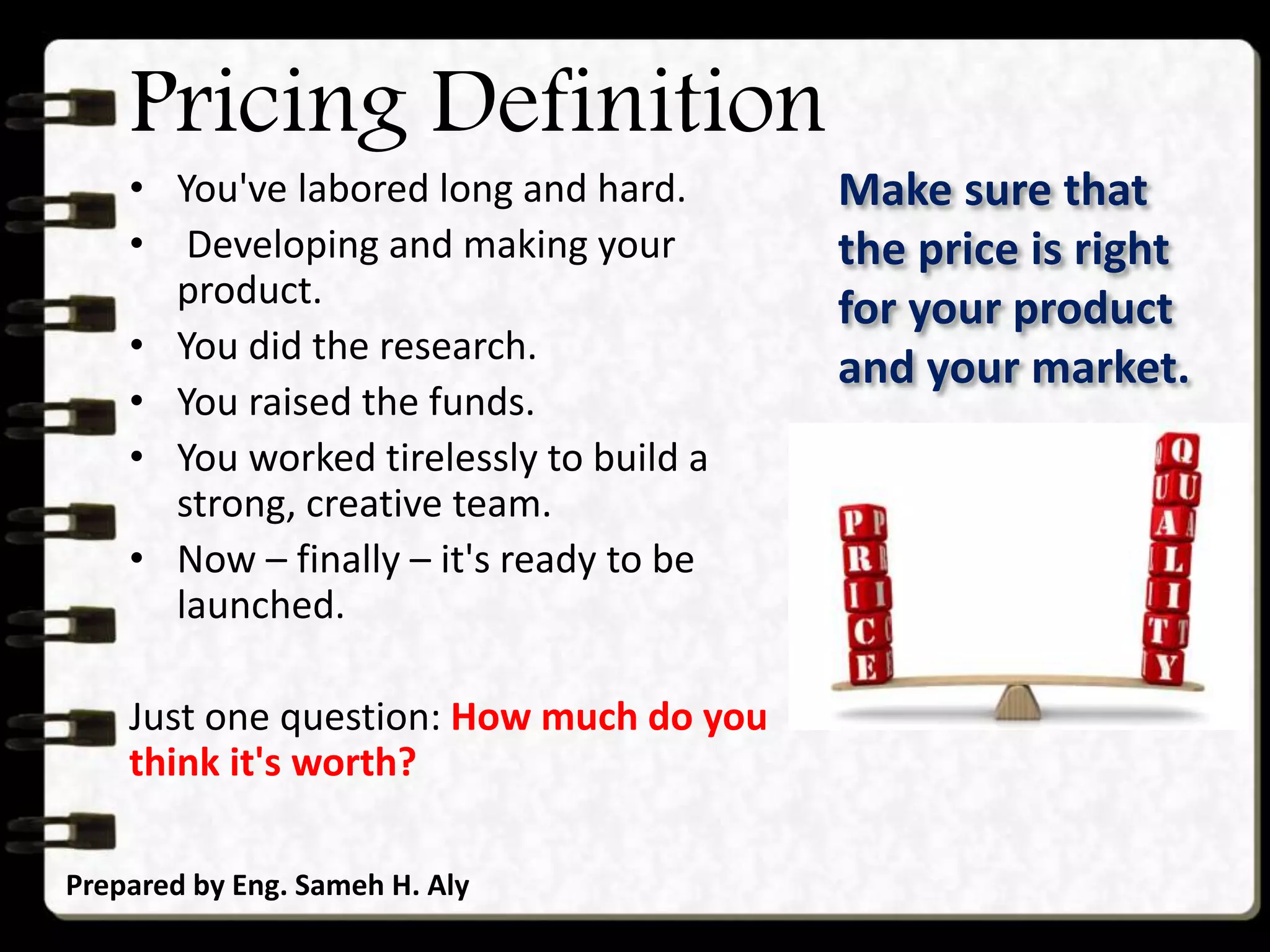
Make sure that
the price is right
for your product
and your market.
Pricing Definition
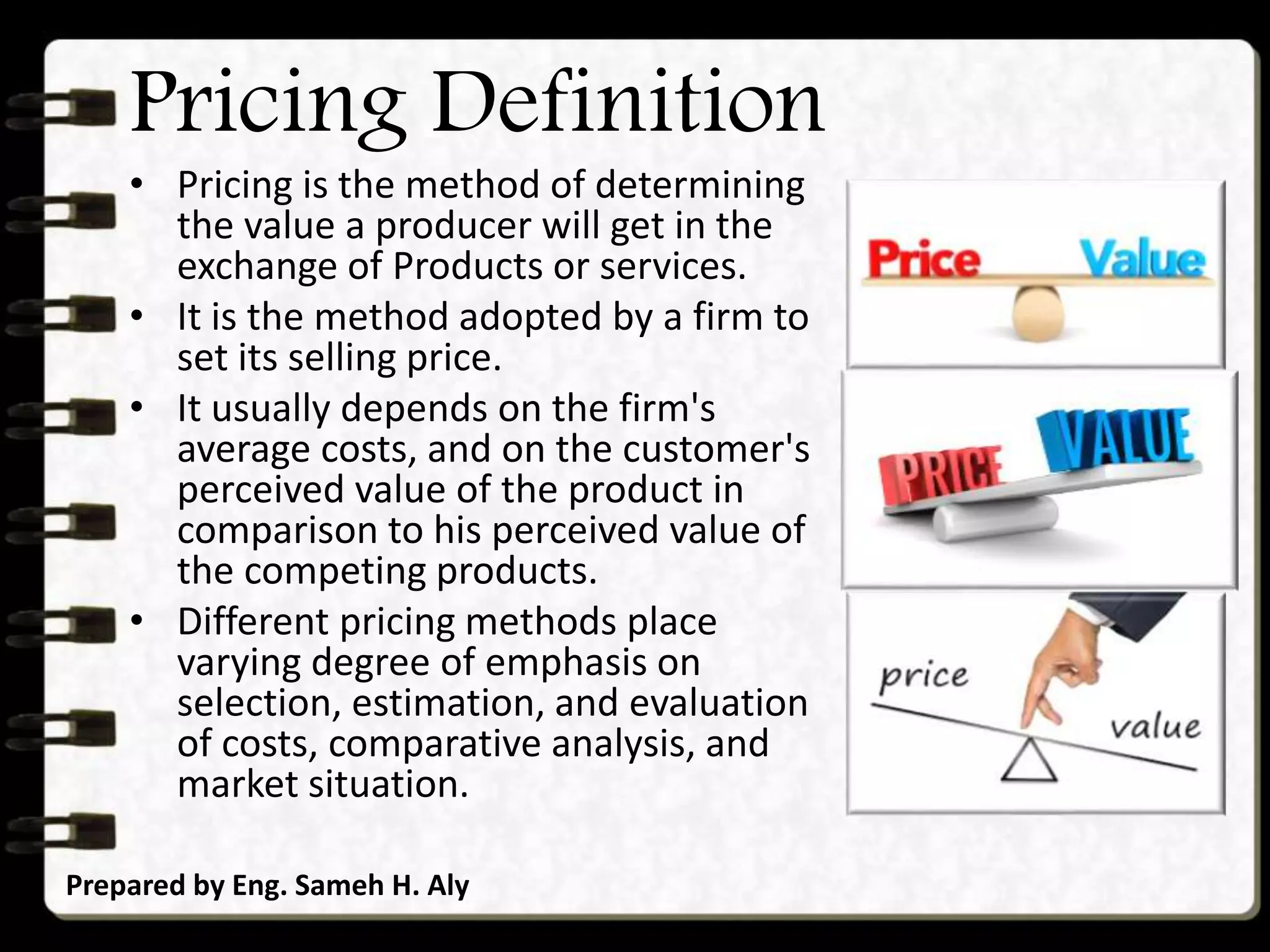
• Pricing is the method of determining
the value a producer will get in the
exchange of Products or services.
• It is the method adopted by a firm to
set its selling price.
• It usually depends on the firm's
average costs, and on the customer's
perceived value of the product in
comparison to his perceived value of
the competing products.
• Different pricing methods place
varying degree of emphasis on
selection, estimation, and evaluation
of costs, comparative analysis, and
market situation.
Prepared by Eng. Sameh H. Aly
Pricing Definition
Prepared by Eng. Sameh H. Aly
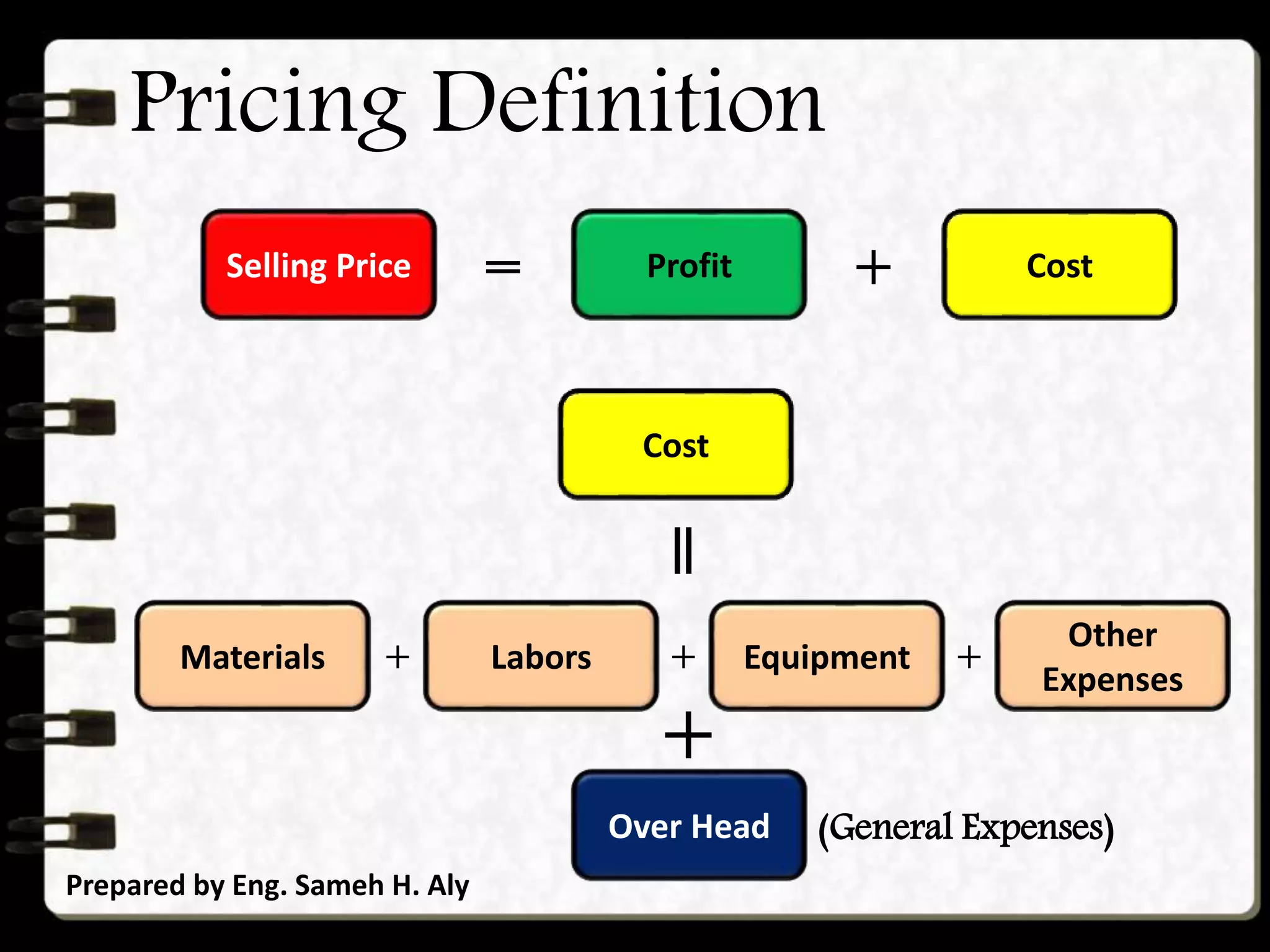
Selling Price = Profit + Cost
Cost
Materials
Other
Expenses
EquipmentLabors+ + +
+
Over Head
=
(General Expenses)
Pricing Definition
Prepared by Eng. Sameh H. Aly
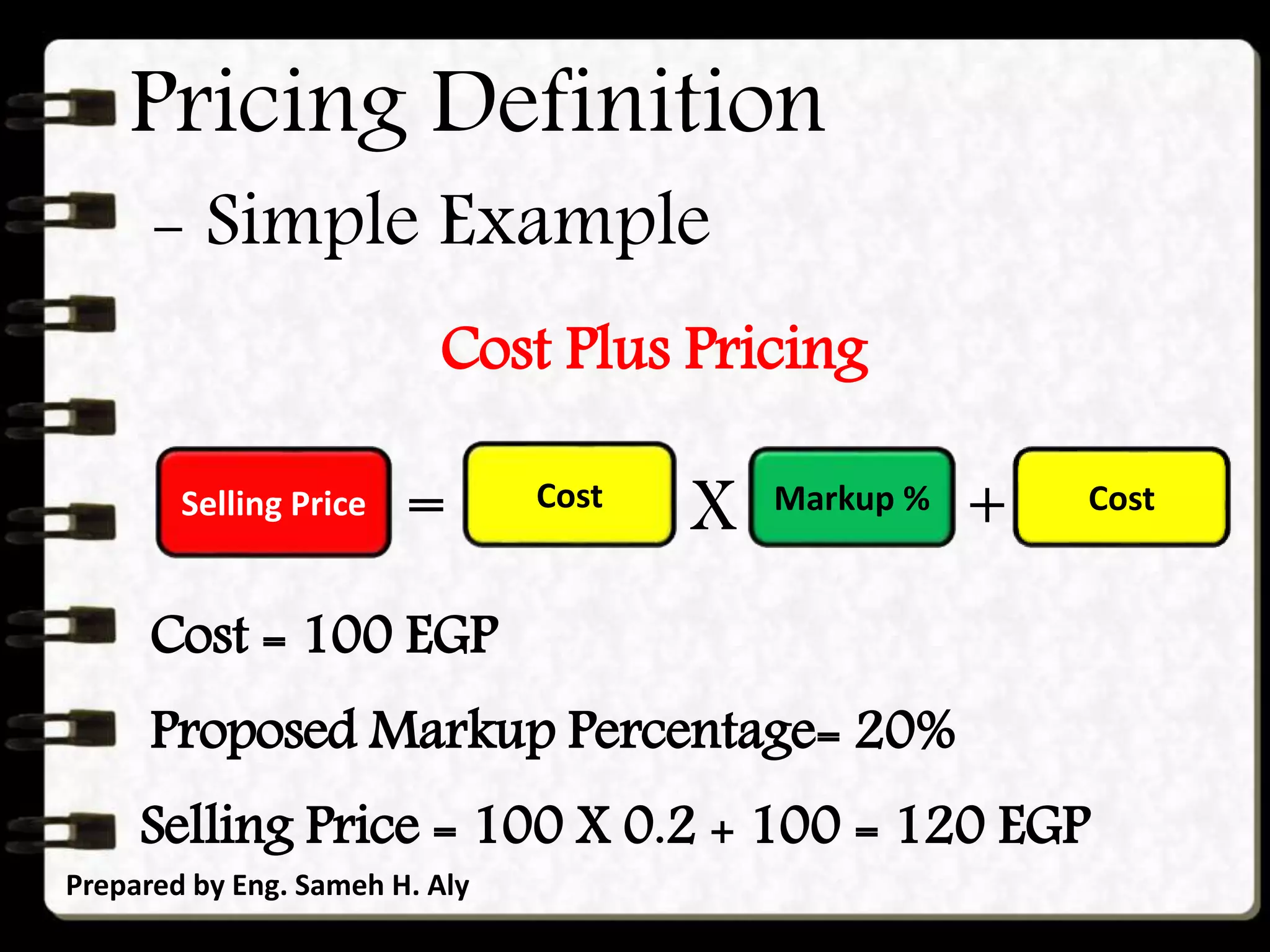
Selling Price = Markup % + Cost
Cost Plus Pricing
- Simple Example
Cost
X
Cost = 100 EGP
Proposed Markup Percentage= 20%
Selling Price = 100 X 0.2 + 100 = 120 EGP
Pricing Philosophy
Prepared by Eng. Sameh H. Aly
Pricing Philosophy
Prepared by Eng. Sameh H. Aly
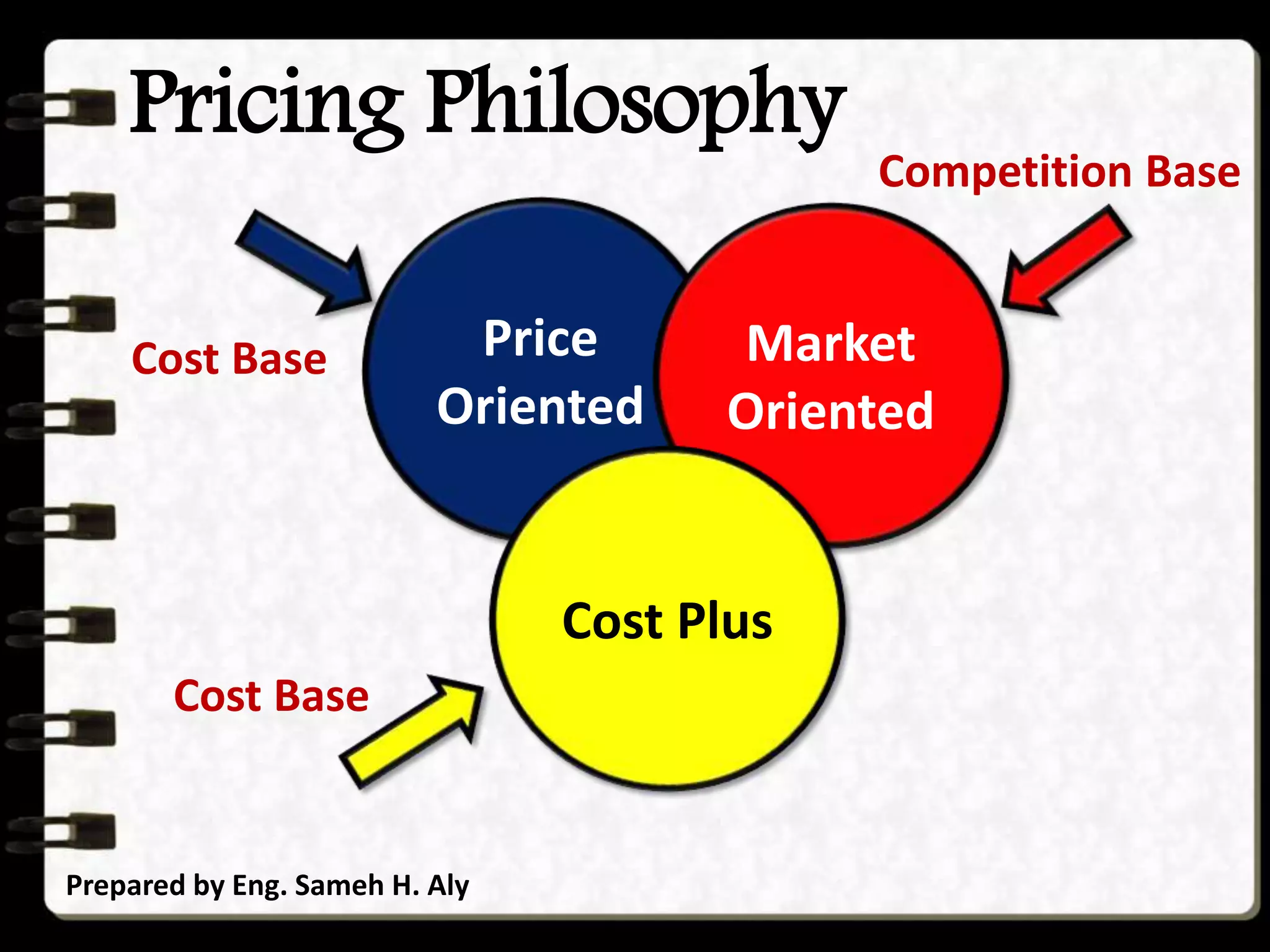
Price
Oriented
Market
Oriented
Cost Plus
Cost Base
Competition Base
Cost Base
Pricing Philosophy
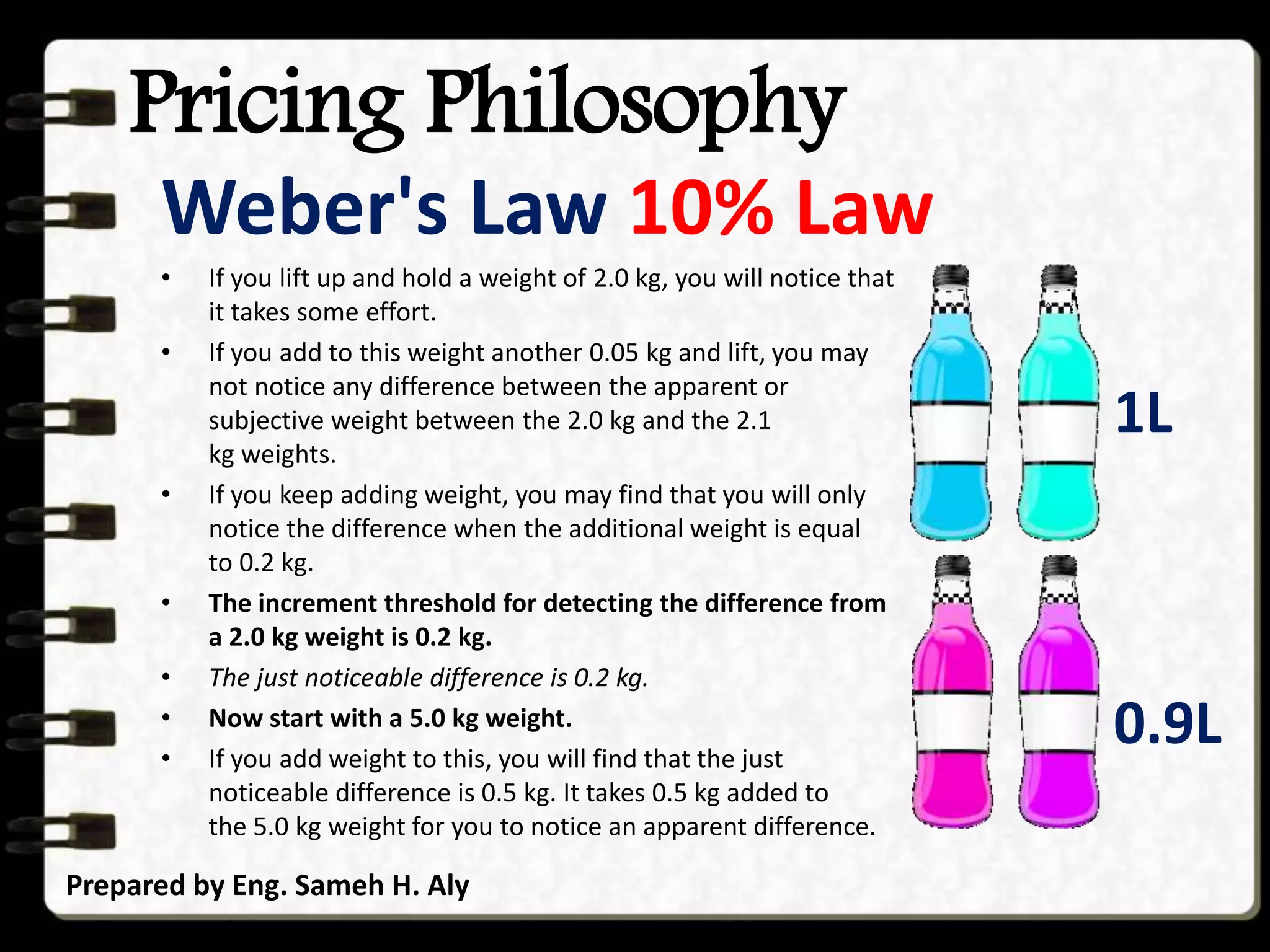
Weber's Law 10% Law
Prepared by Eng. Sameh H. Aly
• If you lift up and hold a weight of 2.0 kg, you will notice that
it takes some effort.
• If you add to this weight another 0.05 kg and lift, you may
not notice any difference between the apparent or
subjective weight between the 2.0 kg and the 2.1
kg weights.
• If you keep adding weight, you may find that you will only
notice the difference when the additional weight is equal
to 0.2 kg.
• The increment threshold for detecting the difference from
a 2.0 kg weight is 0.2 kg.
• The just noticeable difference is 0.2 kg.
• Now start with a 5.0 kg weight.
• If you add weight to this, you will find that the just
noticeable difference is 0.5 kg. It takes 0.5 kg added to
the 5.0 kg weight for you to notice an apparent difference.
1L
0.9L
Factors Affecting
Pricing Decision
Prepared by Eng. Sameh H. Aly
Factors Affecting Pricing Decision
Prepared by Eng. Sameh H. Aly
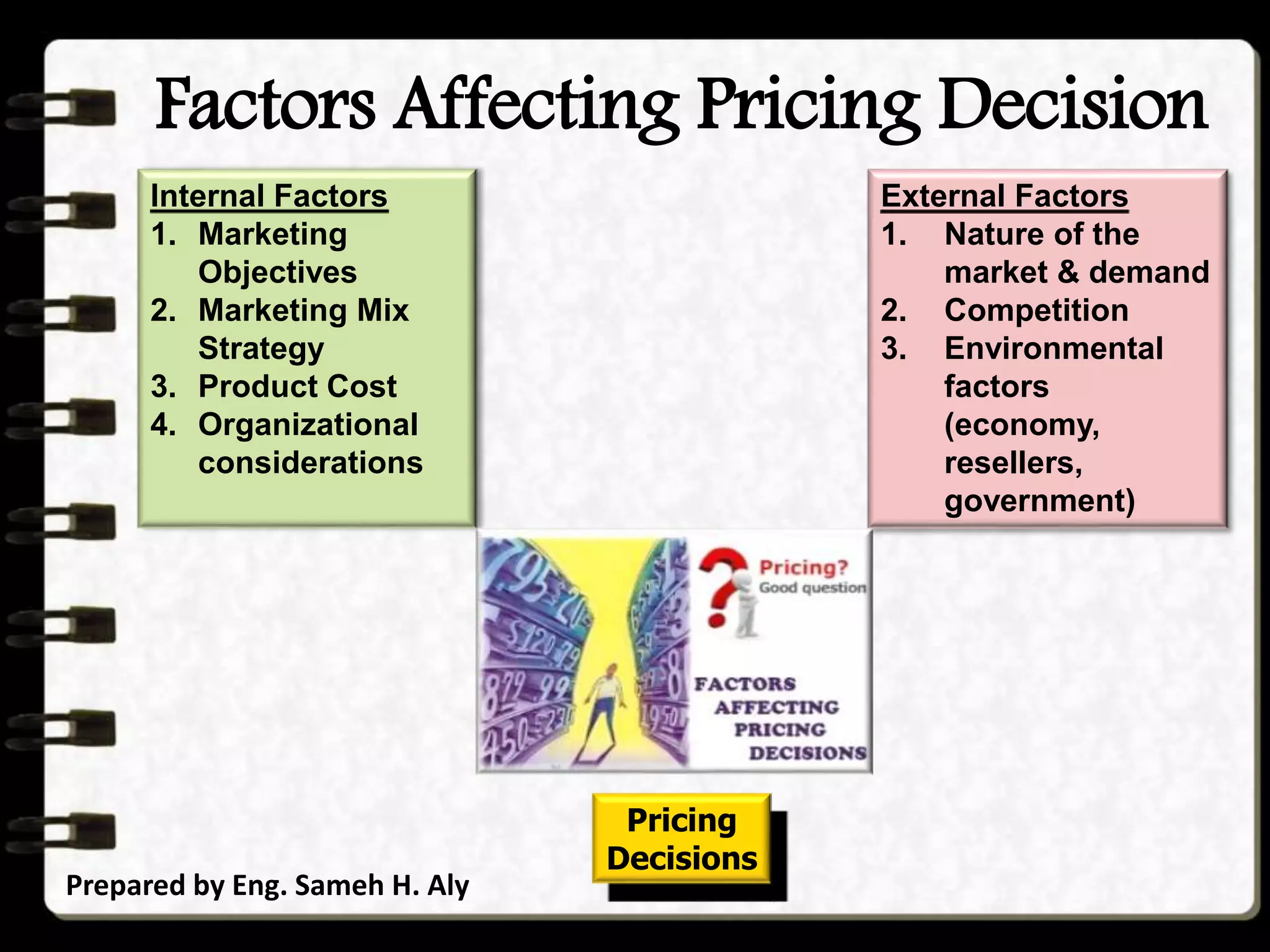
Internal Factors
1. Marketing
Objectives
2. Marketing Mix
Strategy
3. Product Cost
4. Organizational
considerations
External Factors
1. Nature of the
market & demand
2. Competition
3. Environmental
factors
(economy,
resellers,
government)
Pricing
Decisions
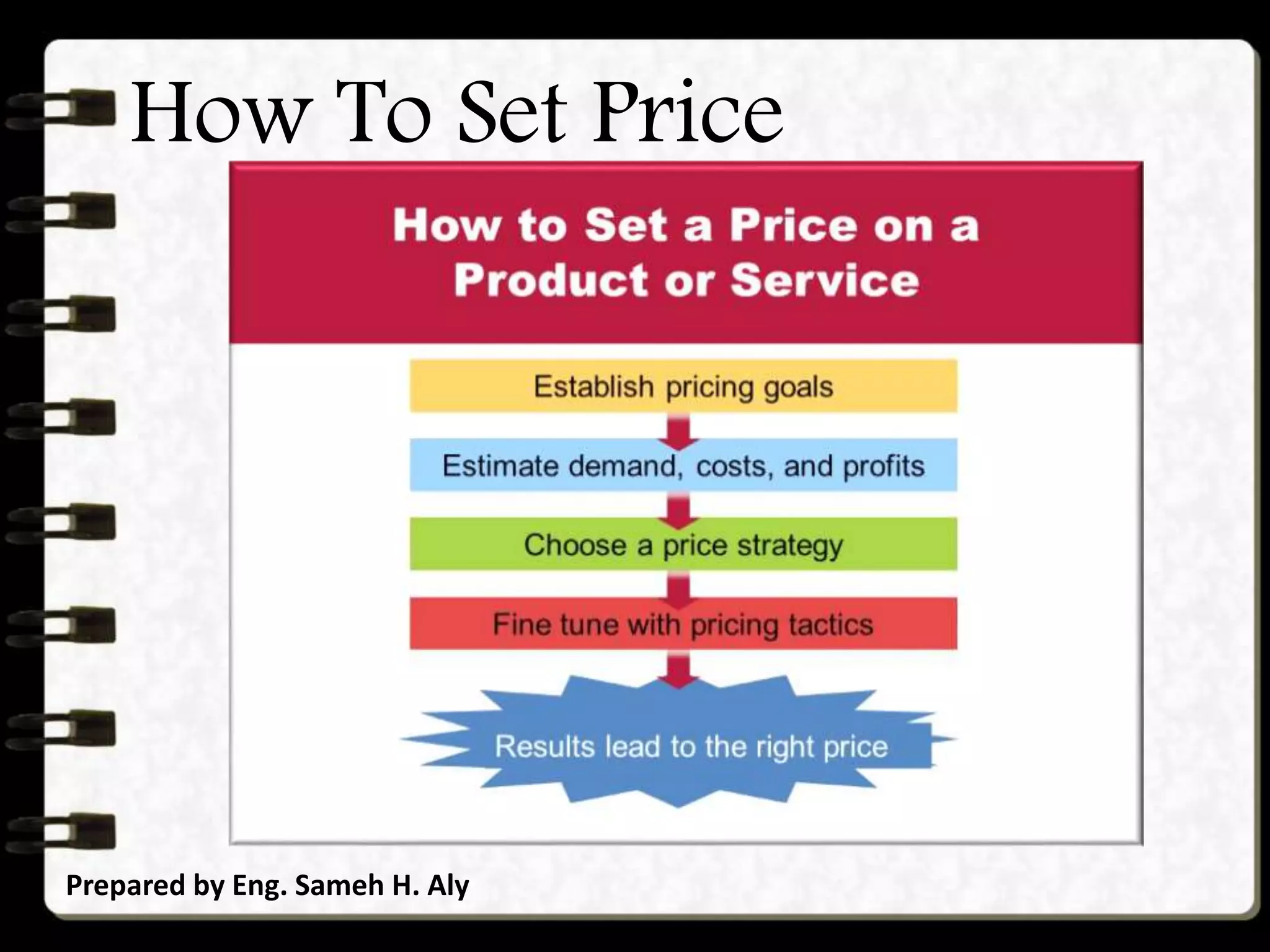
How To Set Price
Prepared by Eng. Sameh H. Aly
Pricing Goals
Prepared by Eng. Sameh H. Aly
Pricing Goals
• The main goals in pricing may be classified as
follows:
1- Pricing for Target Return (on Investment) (ROI). [PO]
2- Market Share. [MO]
3- To Meet or Prevent Competition. [MO]
4- Profit Maximization. [PO]
5- Stabilize Price. [PO]
6- Customers Ability to Pay. [PO]
7- Resource Mobilization. [PO]
8- Leading The Market (Quality & Name Selling). [MO]
9- Surviving & Continue in Market. [MO]
Prepared by Eng. Sameh H. Aly
Pricing Goals
1- Pricing for Target Return (on Investment) (ROI).
Prepared by Eng. Sameh H. Aly
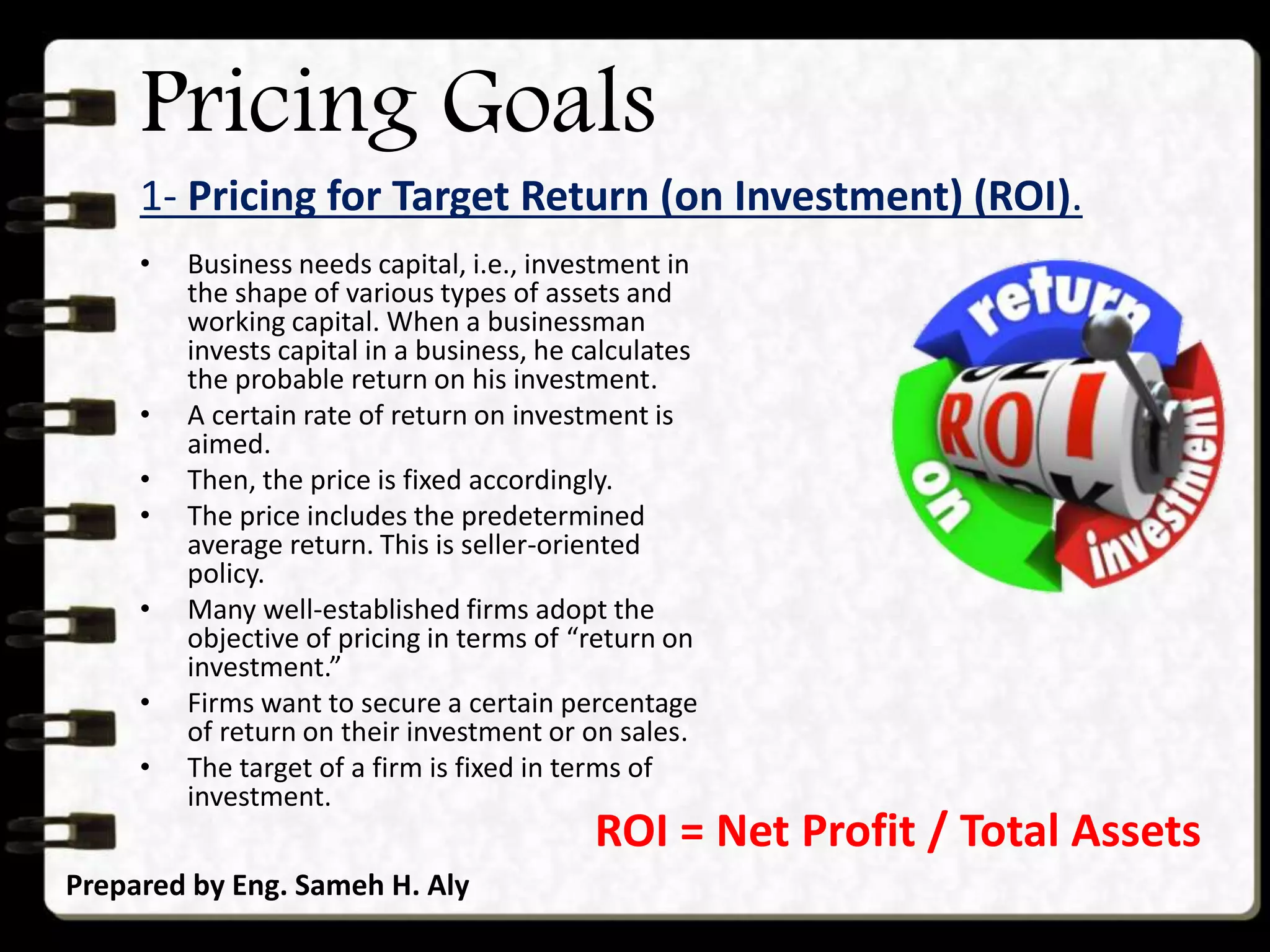
• Business needs capital, i.e., investment in
the shape of various types of assets and
working capital. When a businessman
invests capital in a business, he calculates
the probable return on his investment.
• A certain rate of return on investment is
aimed.
• Then, the price is fixed accordingly.
• The price includes the predetermined
average return. This is seller-oriented
policy.
• Many well-established firms adopt the
objective of pricing in terms of “return on
investment.”
• Firms want to secure a certain percentage
of return on their investment or on sales.
• The target of a firm is fixed in terms of
investment.
ROI = Net Profit / Total Assets
Pricing Goals
1- Pricing for Target Return (on Investment) (ROI).
Prepared by Eng. Sameh H. Aly
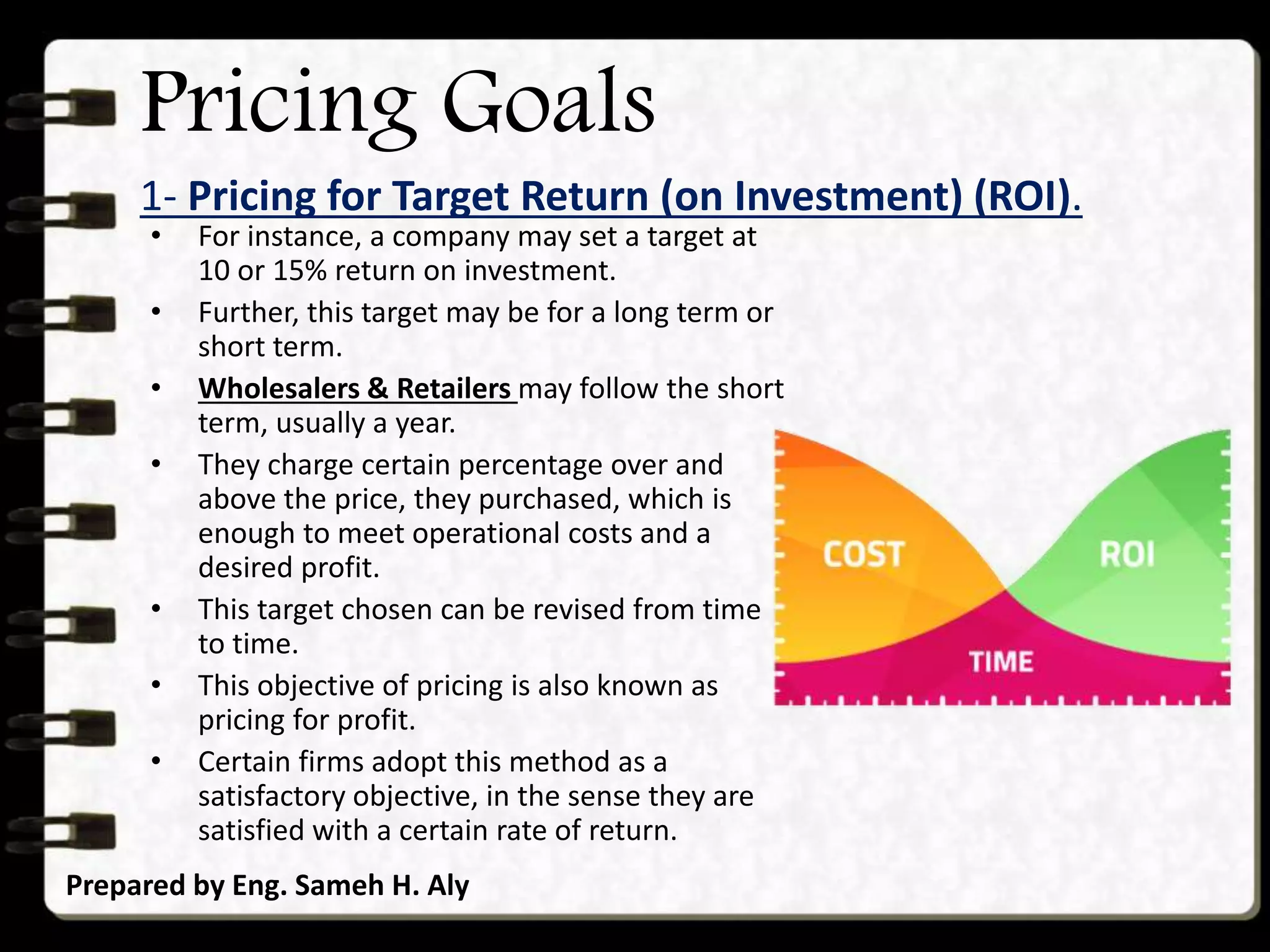
• For instance, a company may set a target at
10 or 15% return on investment.
• Further, this target may be for a long term or
short term.
• Wholesalers & Retailers may follow the short
term, usually a year.
• They charge certain percentage over and
above the price, they purchased, which is
enough to meet operational costs and a
desired profit.
• This target chosen can be revised from time
to time.
• This objective of pricing is also known as
pricing for profit.
• Certain firms adopt this method as a
satisfactory objective, in the sense they are
satisfied with a certain rate of return.
Pricing Goals
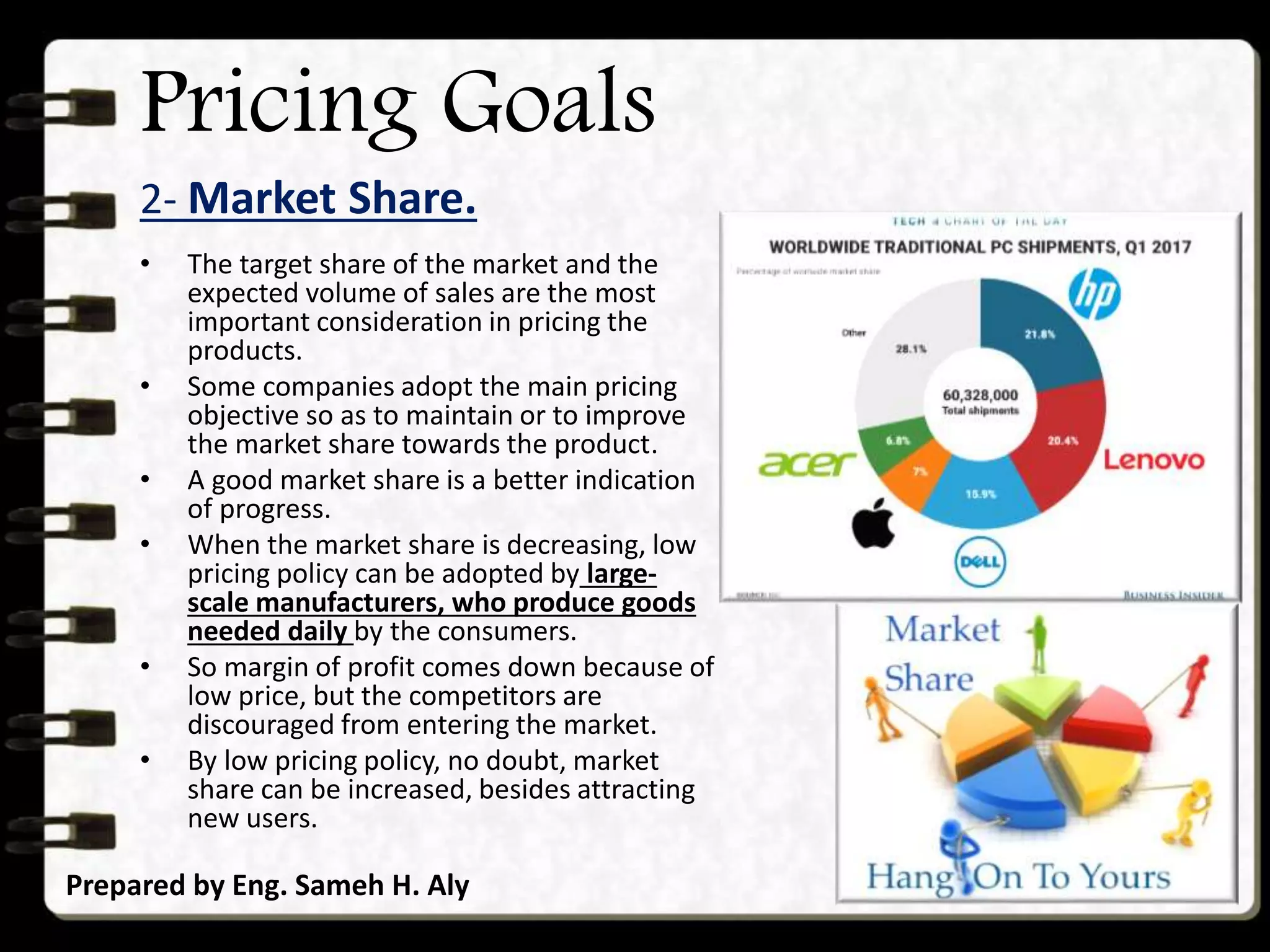
2- Market Share.
Prepared by Eng. Sameh H. Aly
• The target share of the market and the
expected volume of sales are the most
important consideration in pricing the
products.
• Some companies adopt the main pricing
objective so as to maintain or to improve
the market share towards the product.
• A good market share is a better indication
of progress.
• When the market share is decreasing, low
pricing policy can be adopted by large-
scale manufacturers, who produce goods
needed daily by the consumers.
• So margin of profit comes down because of
low price, but the competitors are
discouraged from entering the market.
• By low pricing policy, no doubt, market
share can be increased, besides attracting
new users.
Pricing Goals
3- To Meet or Prevent Competition.
Prepared by Eng. Sameh H. Aly
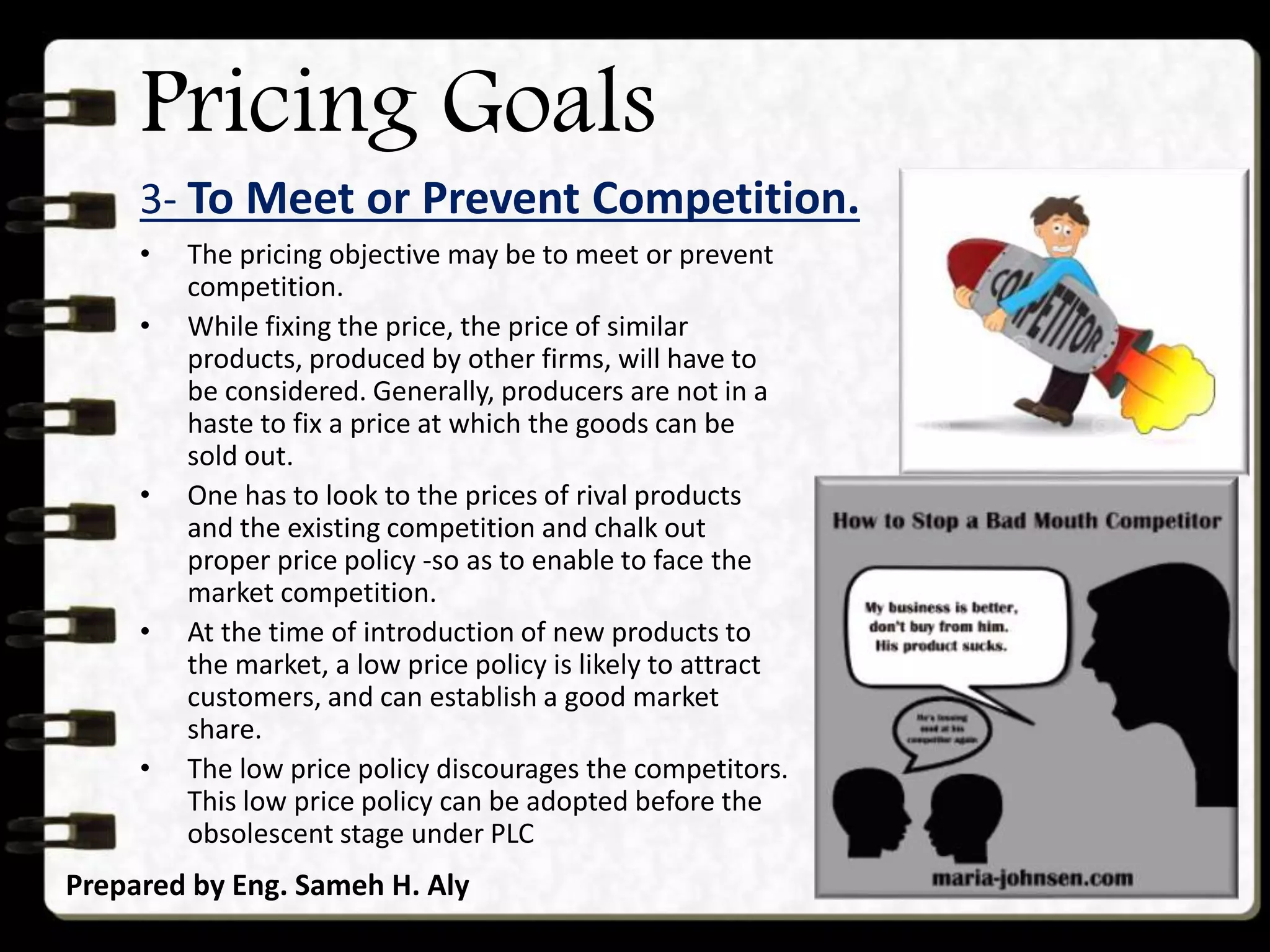
• The pricing objective may be to meet or prevent
competition.
• While fixing the price, the price of similar
products, produced by other firms, will have to
be considered. Generally, producers are not in a
haste to fix a price at which the goods can be
sold out.
• One has to look to the prices of rival products
and the existing competition and chalk out
proper price policy -so as to enable to face the
market competition.
• At the time of introduction of new products to
the market, a low price policy is likely to attract
customers, and can establish a good market
share.
• The low price policy discourages the competitors.
This low price policy can be adopted before the
obsolescent stage under PLC
Pricing Goals
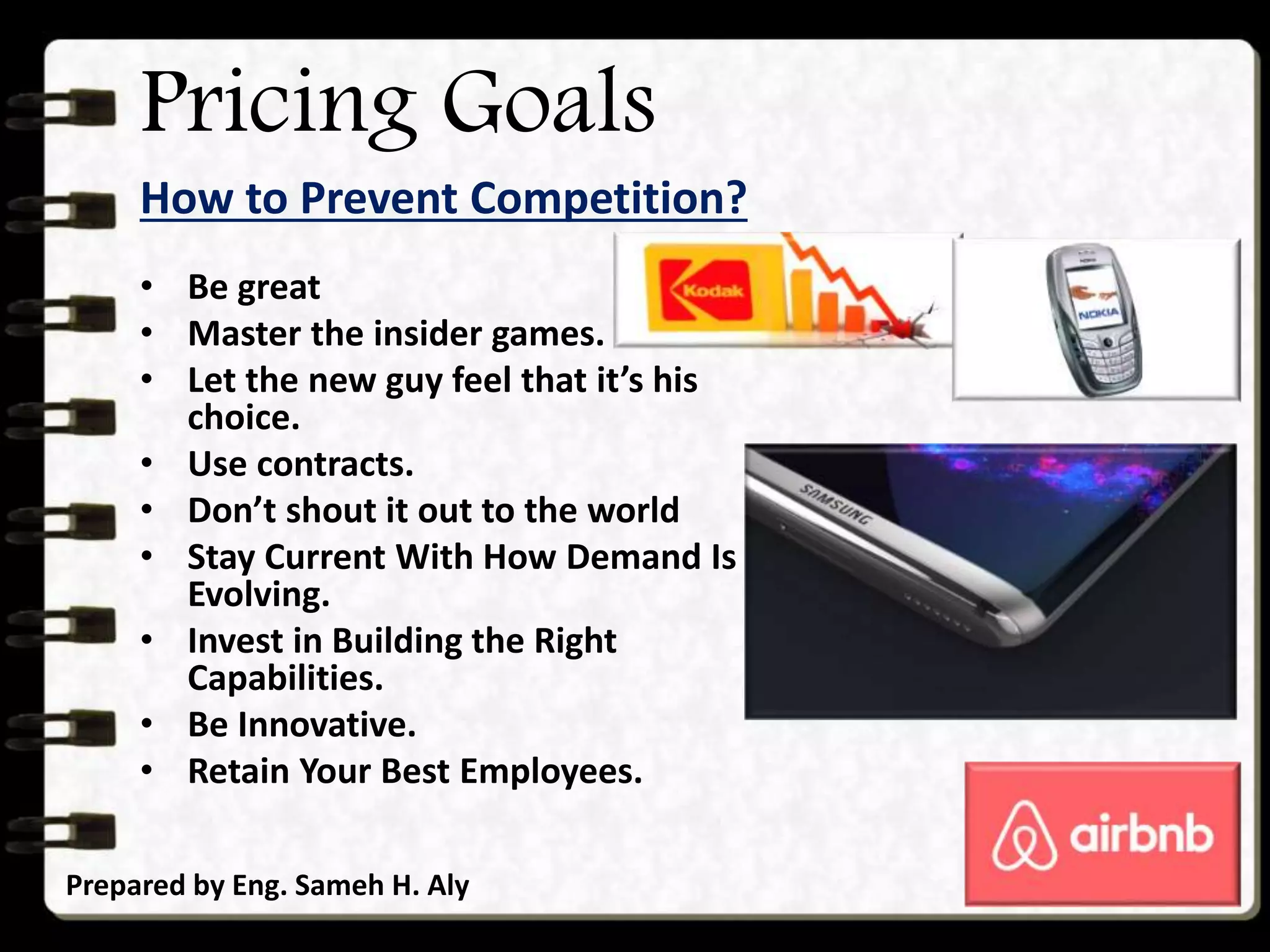
How to Prevent Competition?
Prepared by Eng. Sameh H. Aly
• Be great
• Master the insider games.
• Let the new guy feel that it’s his
choice.
• Use contracts.
• Don’t shout it out to the world
• Stay Current With How Demand Is
Evolving.
• Invest in Building the Right
Capabilities.
• Be Innovative.
• Retain Your Best Employees.
Pricing Goals
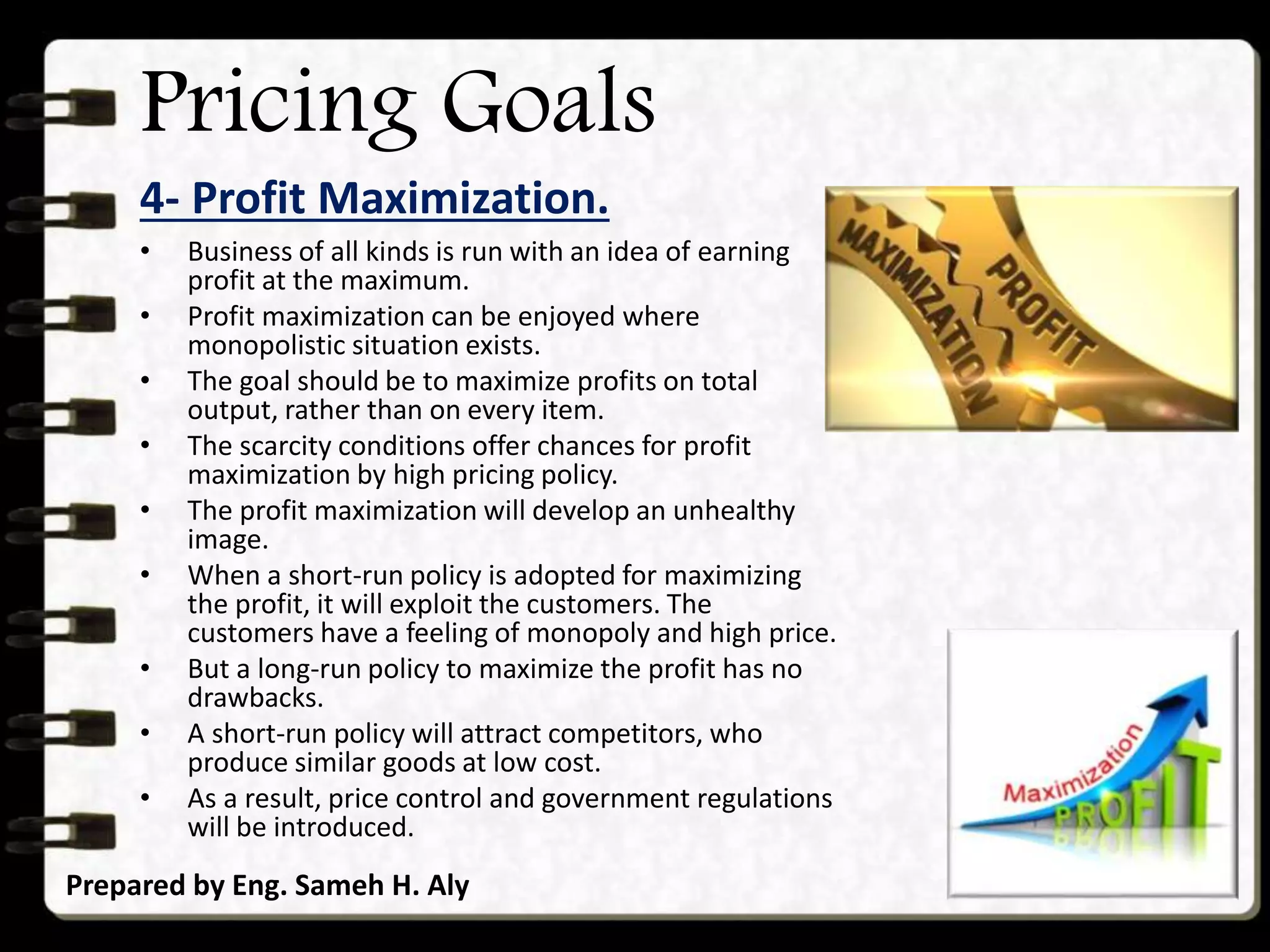
4- Profit Maximization.
Prepared by Eng. Sameh H. Aly
• Business of all kinds is run with an idea of earning
profit at the maximum.
• Profit maximization can be enjoyed where
monopolistic situation exists.
• The goal should be to maximize profits on total
output, rather than on every item.
• The scarcity conditions offer chances for profit
maximization by high pricing policy.
• The profit maximization will develop an unhealthy
image.
• When a short-run policy is adopted for maximizing
the profit, it will exploit the customers. The
customers have a feeling of monopoly and high price.
• But a long-run policy to maximize the profit has no
drawbacks.
• A short-run policy will attract competitors, who
produce similar goods at low cost.
• As a result, price control and government regulations
will be introduced.
Pricing Goals
4- Profit Maximization.
Prepared by Eng. Sameh H. Aly
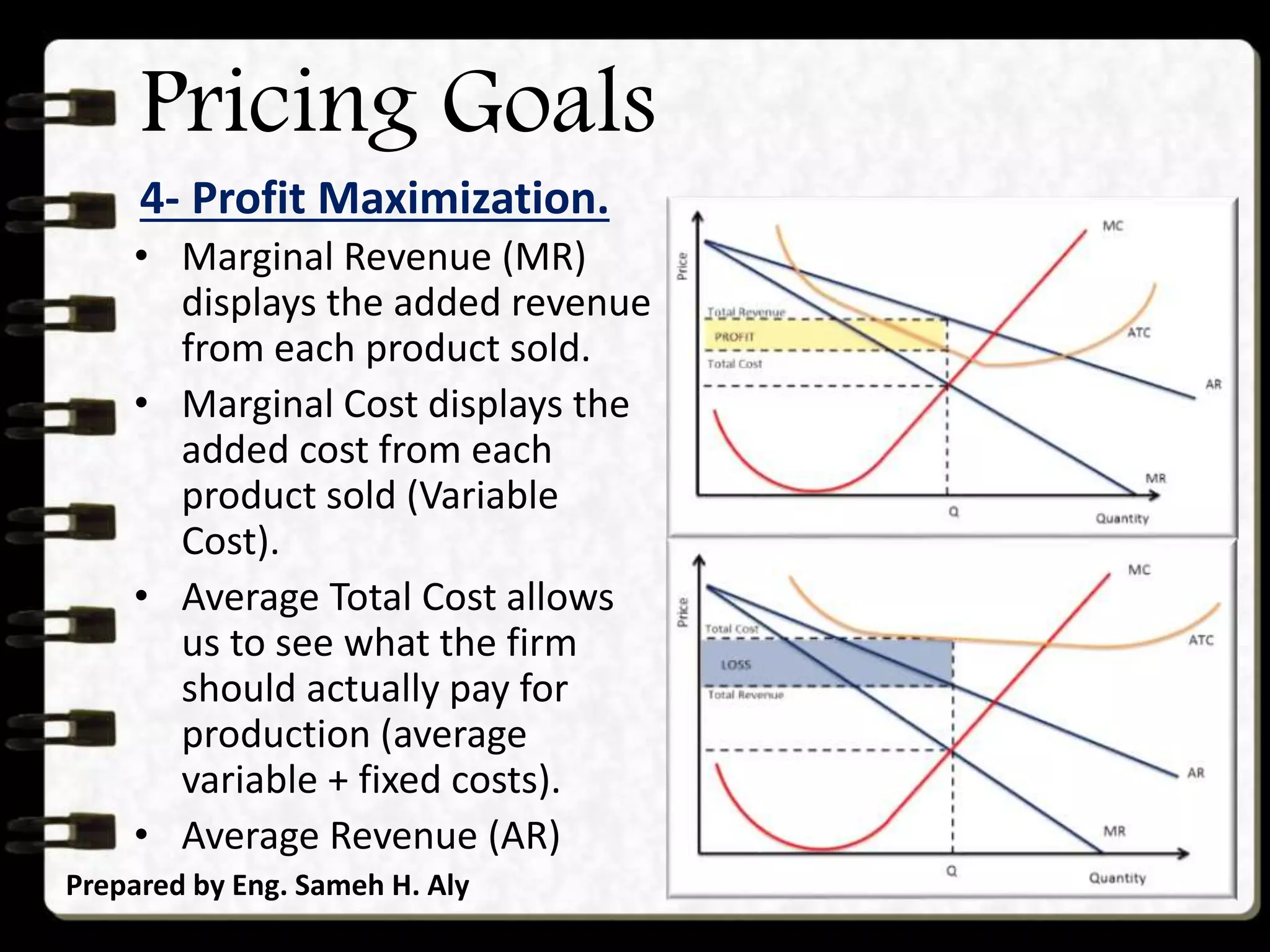
• Marginal Revenue (MR)
displays the added revenue
from each product sold.
• Marginal Cost displays the
added cost from each
product sold (Variable
Cost).
• Average Total Cost allows
us to see what the firm
should actually pay for
production (average
variable + fixed costs).
• Average Revenue (AR)
Pricing Goals
5- Stabilize Price.
Prepared by Eng. Sameh H. Aly
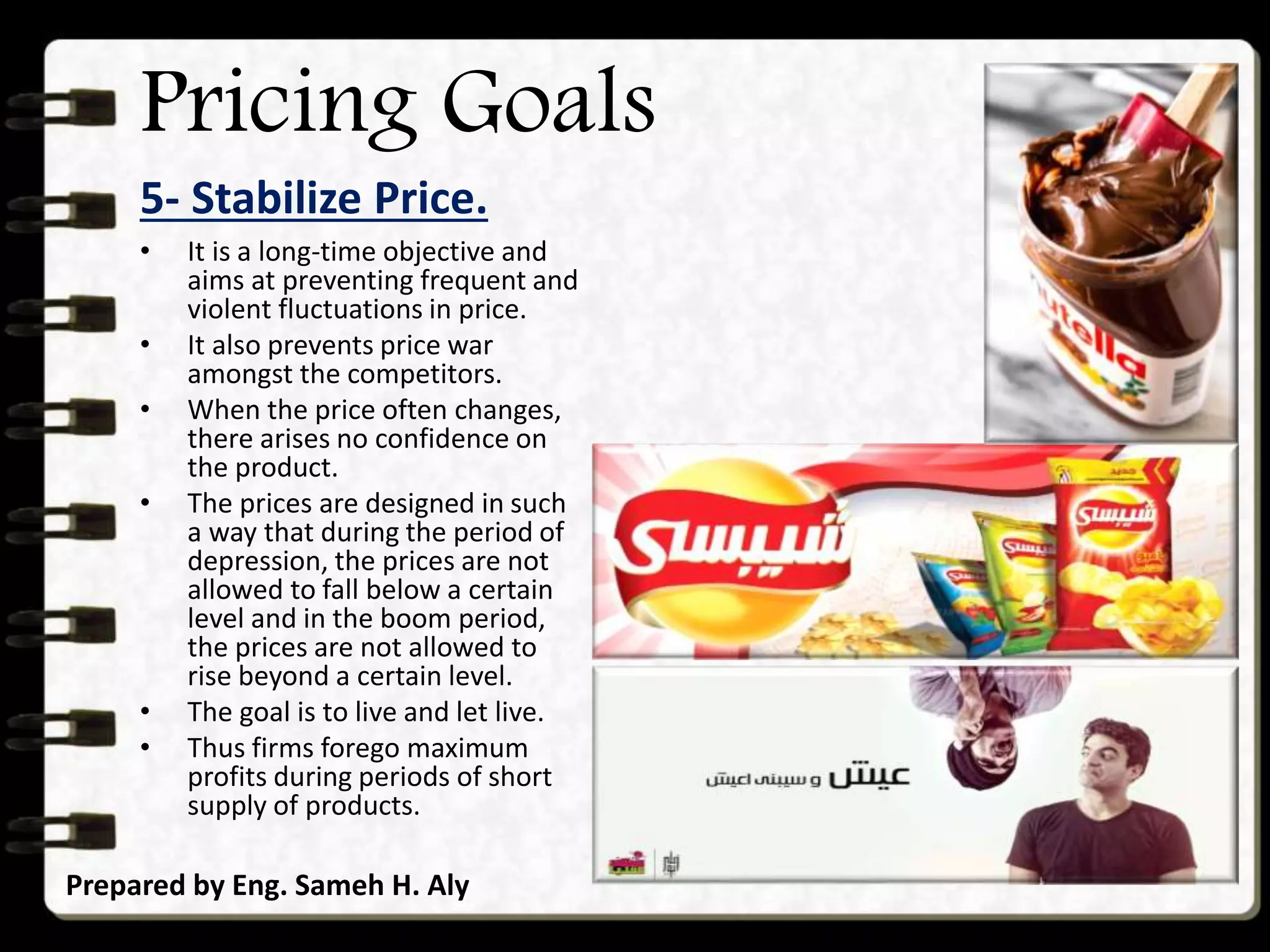
• It is a long-time objective and
aims at preventing frequent and
violent fluctuations in price.
• It also prevents price war
amongst the competitors.
• When the price often changes,
there arises no confidence on
the product.
• The prices are designed in such
a way that during the period of
depression, the prices are not
allowed to fall below a certain
level and in the boom period,
the prices are not allowed to
rise beyond a certain level.
• The goal is to live and let live.
• Thus firms forego maximum
profits during periods of short
supply of products.
Pricing Goals
6- Customers Ability to Pay.
Prepared by Eng. Sameh H. Aly
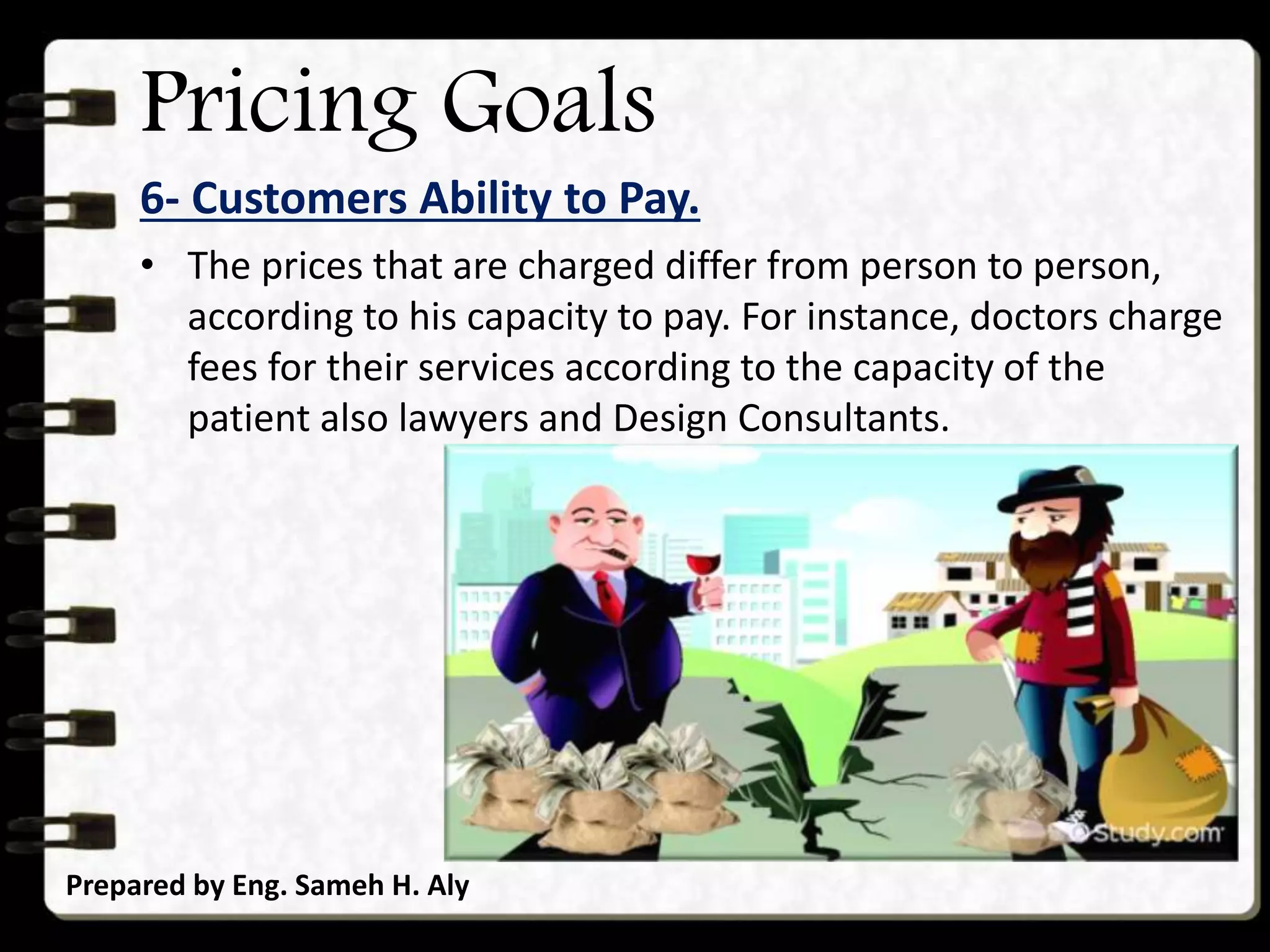
• The prices that are charged differ from person to person,
according to his capacity to pay. For instance, doctors charge
fees for their services according to the capacity of the
patient also lawyers and Design Consultants.
Pricing Goals
7- Resource Mobilization.
Prepared by Eng. Sameh H. Aly
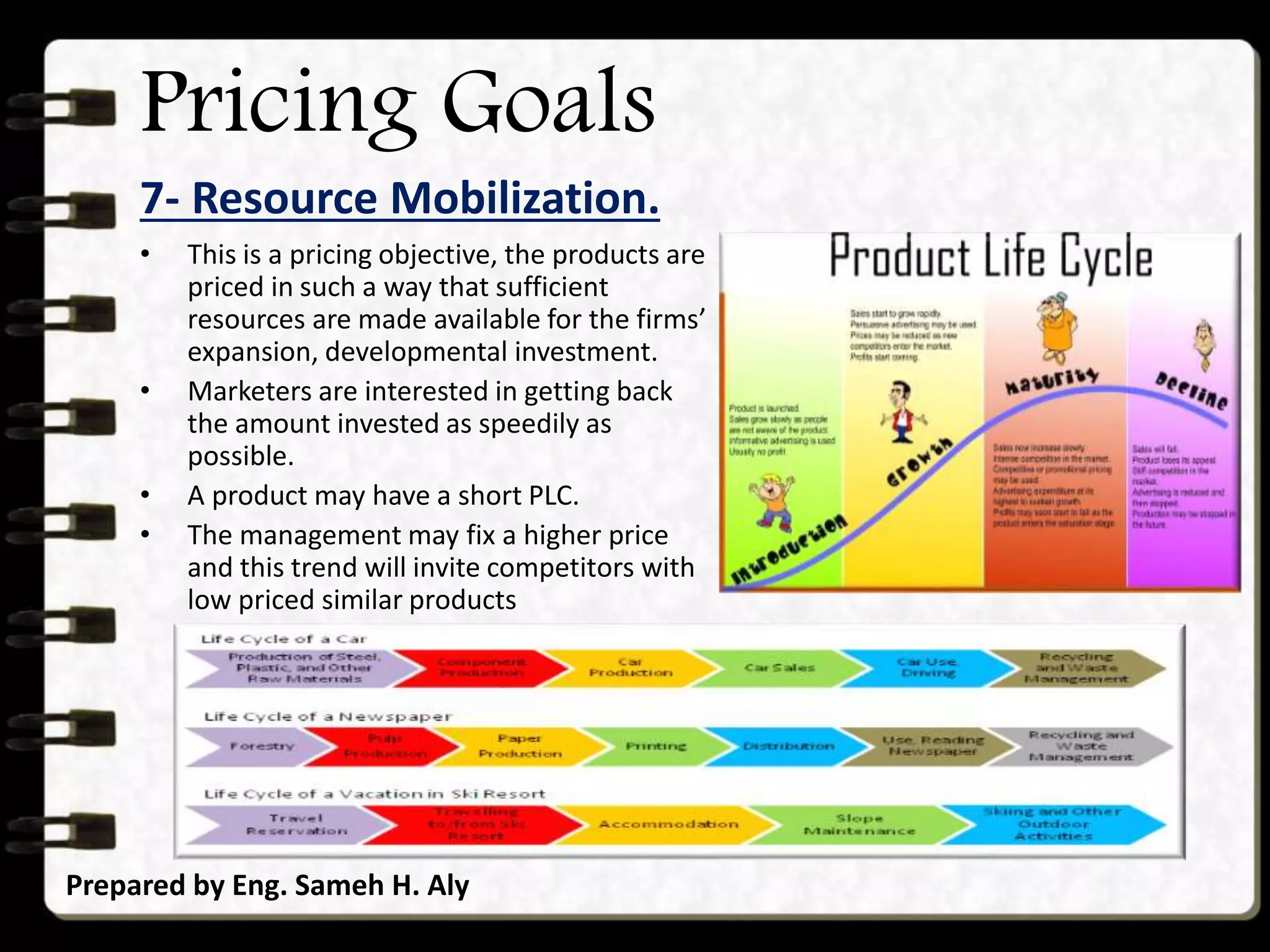
• This is a pricing objective, the products are
priced in such a way that sufficient
resources are made available for the firms’
expansion, developmental investment.
• Marketers are interested in getting back
the amount invested as speedily as
possible.
• A product may have a short PLC.
• The management may fix a higher price
and this trend will invite competitors with
low priced similar products
Pricing Goals
8- Leading The Market (Quality & Name Selling).
Prepared by Eng. Sameh H. Aly
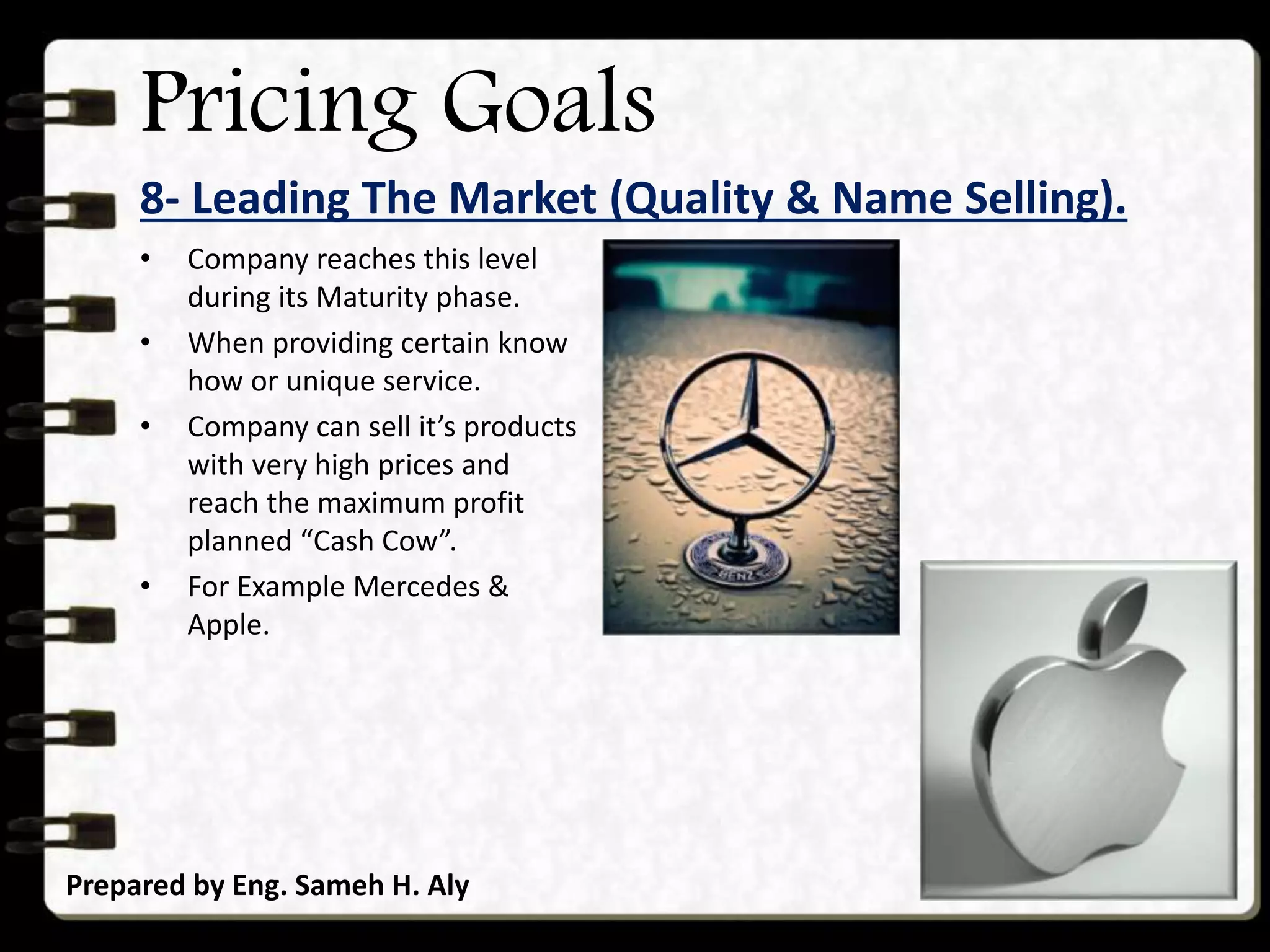
• Company reaches this level
during its Maturity phase.
• When providing certain know
how or unique service.
• Company can sell it’s products
with very high prices and
reach the maximum profit
planned “Cash Cow”.
• For Example Mercedes &
Apple.
Pricing Goals
9- Surviving & Continue in Market.
Prepared by Eng. Sameh H. Aly
• Company in introduction or in
decline stage.
• Pricing with dry cost no profit
seeking.
• Must be for limited period till
reach maturity or market
conditions become better or
fine closing of the business
with minimum losses.
Pricing Strategies
Prepared by Eng. Sameh H. Aly
Pricing Strategies
Prepared by Eng. Sameh H. Aly
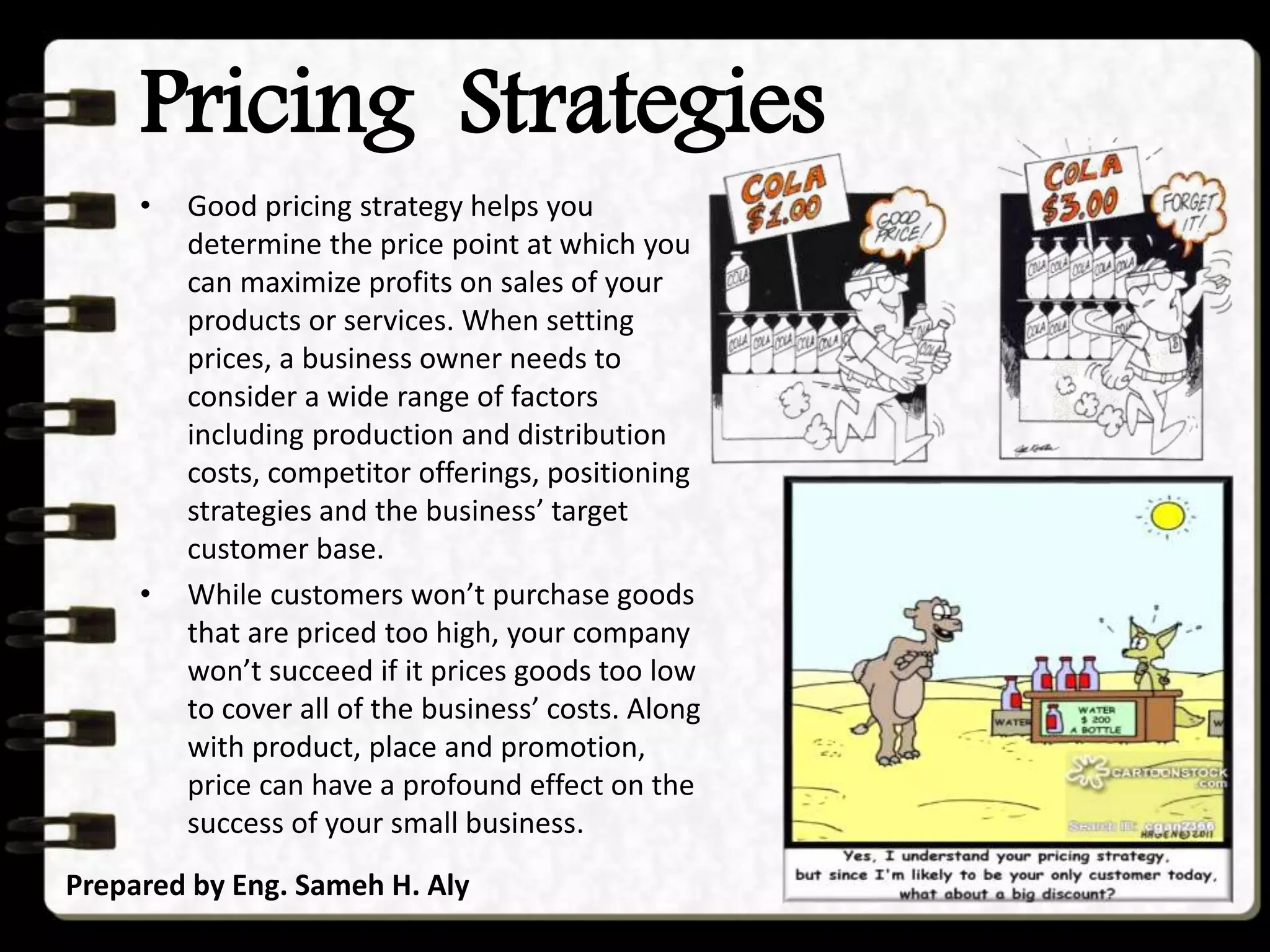
• Good pricing strategy helps you
determine the price point at which you
can maximize profits on sales of your
products or services. When setting
prices, a business owner needs to
consider a wide range of factors
including production and distribution
costs, competitor offerings, positioning
strategies and the business’ target
customer base.
• While customers won’t purchase goods
that are priced too high, your company
won’t succeed if it prices goods too low
to cover all of the business’ costs. Along
with product, place and promotion,
price can have a profound effect on the
success of your small business.
Pricing Strategies
1- Pricing at a Premium.
2- Pricing for Market
Penetration.
3- Economy Pricing.
4- Price Skimming.
5- Psychology Pricing.
6- Bundle Pricing.
Prepared by Eng. Sameh H. Aly
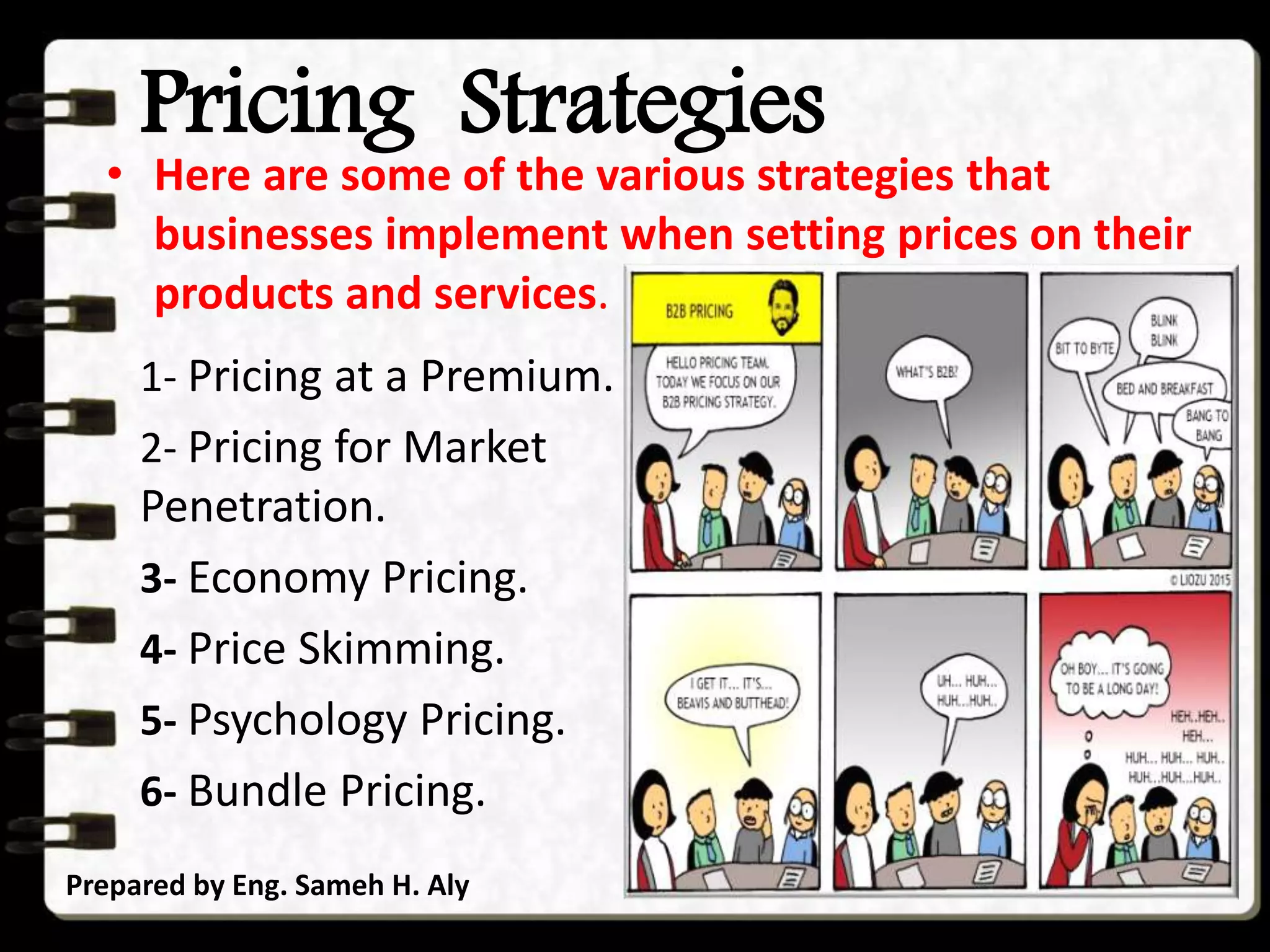
• Here are some of the various strategies that
businesses implement when setting prices on their
products and services.
Pricing Strategies
1- Pricing at a Premium.
Prepared by Eng. Sameh H. Aly
• With premium pricing, businesses set
costs higher than their competitors.
Premium pricing is often most effective
in the early days of a product’s life
cycle, and ideal for small businesses
that sell unique goods.
• Because customers need to perceive
products as being worth the higher
price tag, a business must work hard to
create a value perception.
• Along with creating a high-quality
product, owners should ensure their
marketing efforts, the product’s
packaging and the store’s décor all
combine to support the premium price.
Pricing Strategies
2- Pricing for Market Penetration.
Prepared by Eng. Sameh H. Aly
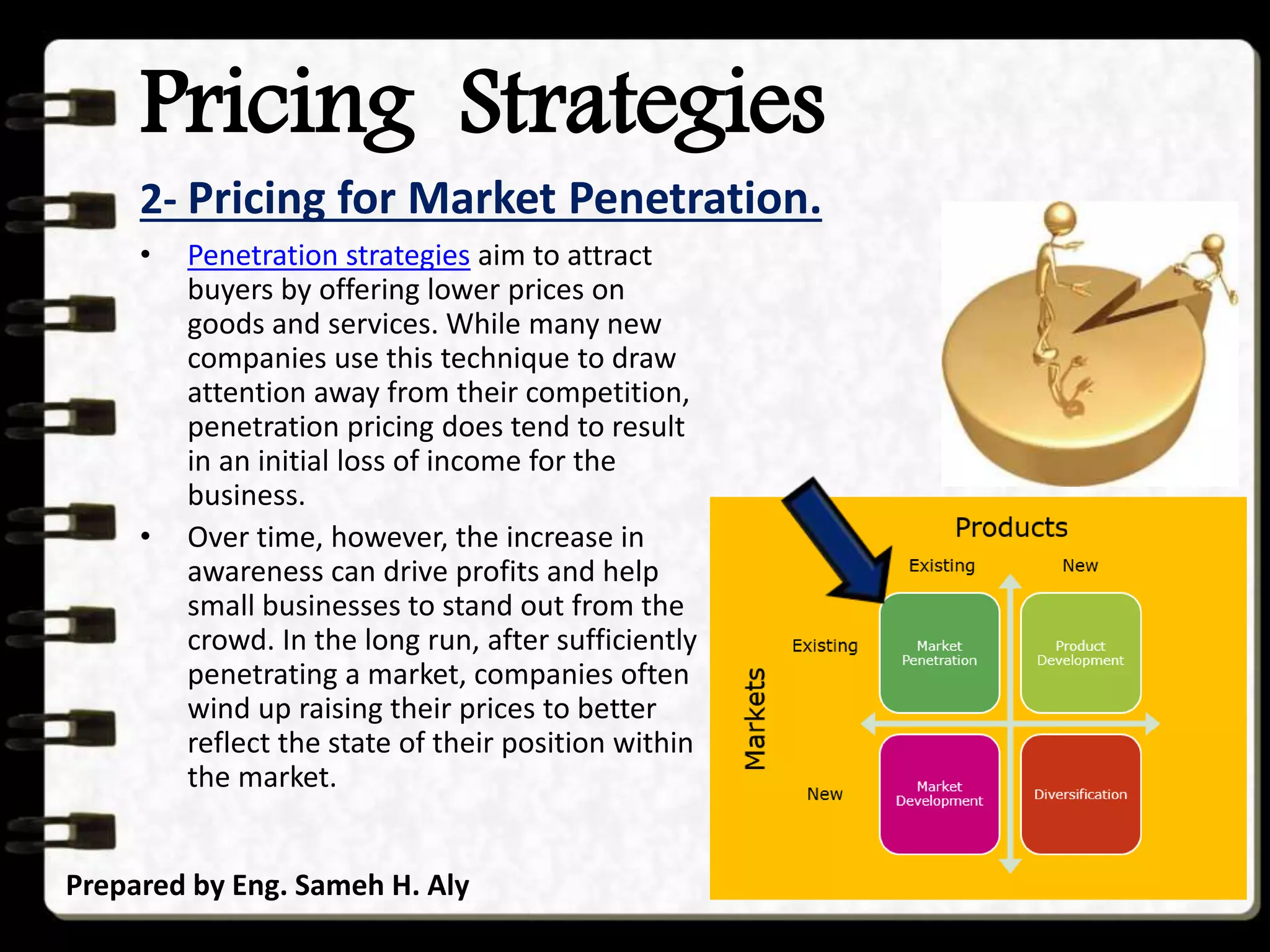
• Penetration strategies aim to attract
buyers by offering lower prices on
goods and services. While many new
companies use this technique to draw
attention away from their competition,
penetration pricing does tend to result
in an initial loss of income for the
business.
• Over time, however, the increase in
awareness can drive profits and help
small businesses to stand out from the
crowd. In the long run, after sufficiently
penetrating a market, companies often
wind up raising their prices to better
reflect the state of their position within
the market.
Pricing Strategies
2- Pricing for Market Penetration.
Prepared by Eng. Sameh H. Aly
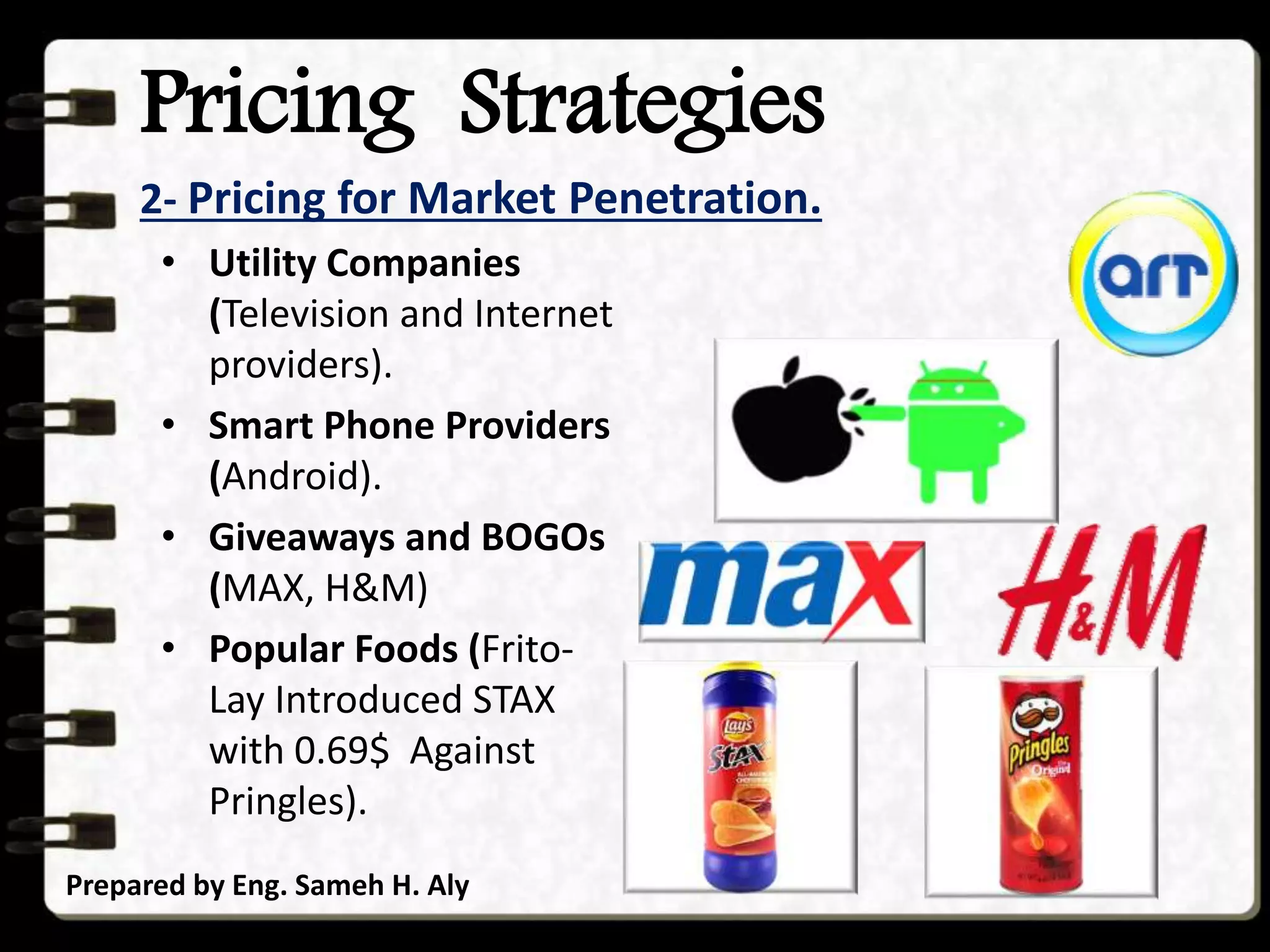
• Utility Companies
(Television and Internet
providers).
• Smart Phone Providers
(Android).
• Giveaways and BOGOs
(MAX, H&M)
• Popular Foods (Frito-
Lay Introduced STAX
with 0.69$ Against
Pringles).
Pricing Strategies
3- Economy Pricing.
Prepared by Eng. Sameh H. Aly
• Used by a wide range of businesses including
generic food suppliers and discount retailers,
economy pricing aims to attract the most price-
conscious of consumers.
• With this strategy, businesses minimize the costs
associated with marketing and production in
order to keep product prices down.
• As a result, customers can purchase the
products they need without frills.
• While economy pricing is incredibly effective for
large companies like Wal-Mart and Carrefour,
the technique can be dangerous for small
businesses.
• Because small businesses lack the sales volume
of larger companies, they may struggle to
generate a sufficient profit when prices are too
low.
• Still, selectively tailoring discounts to your most
loyal customers can be a great way to guarantee
their patronage for years to come.
Pricing Strategies
4- Price Skimming.
Prepared by Eng. Sameh H. Aly
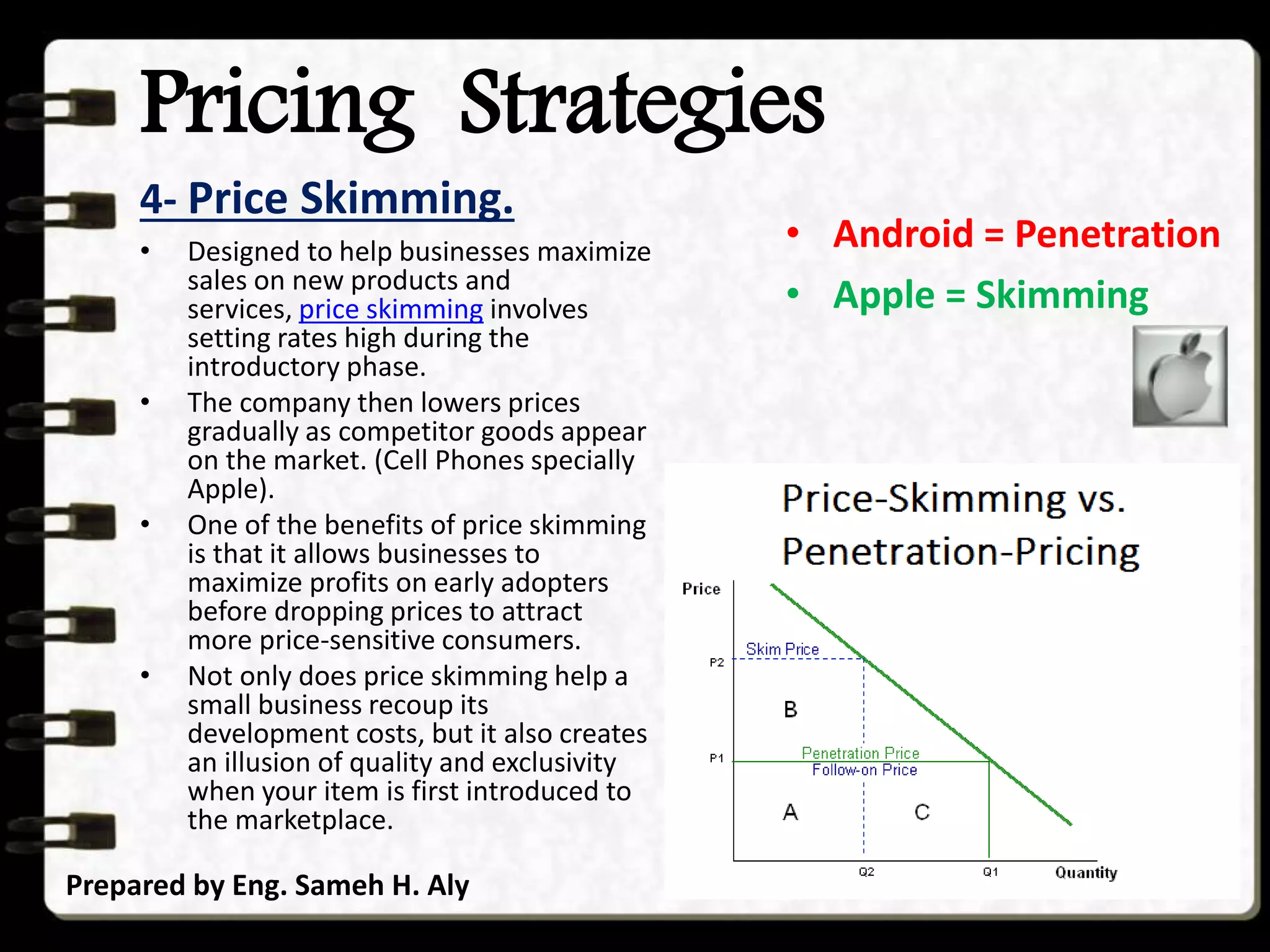
• Designed to help businesses maximize
sales on new products and
services, price skimming involves
setting rates high during the
introductory phase.
• The company then lowers prices
gradually as competitor goods appear
on the market. (Cell Phones specially
Apple).
• One of the benefits of price skimming
is that it allows businesses to
maximize profits on early adopters
before dropping prices to attract
more price-sensitive consumers.
• Not only does price skimming help a
small business recoup its
development costs, but it also creates
an illusion of quality and exclusivity
when your item is first introduced to
the marketplace.
• Android = Penetration
• Apple = Skimming
Pricing Strategies
5- Psychology Pricing.
Prepared by Eng. Sameh H. Aly
• With the economy still limping back to
full health, price remains a major
concern for American consumers.
• Psychology pricing refers to techniques
that marketers use to encourage
customers to respond on emotional
levels rather than logical ones.
• For example, setting the price of a
watch at $199 is proven to attract more
consumers than setting it at $200, even
though the true difference here is
quite small.
• One explanation for this trend is that
consumers tend to put more attention
on the first number on a price tag than
the last.
• The goal of psychology pricing is to
increase demand by creating an illusion
of enhanced value for the consumer.
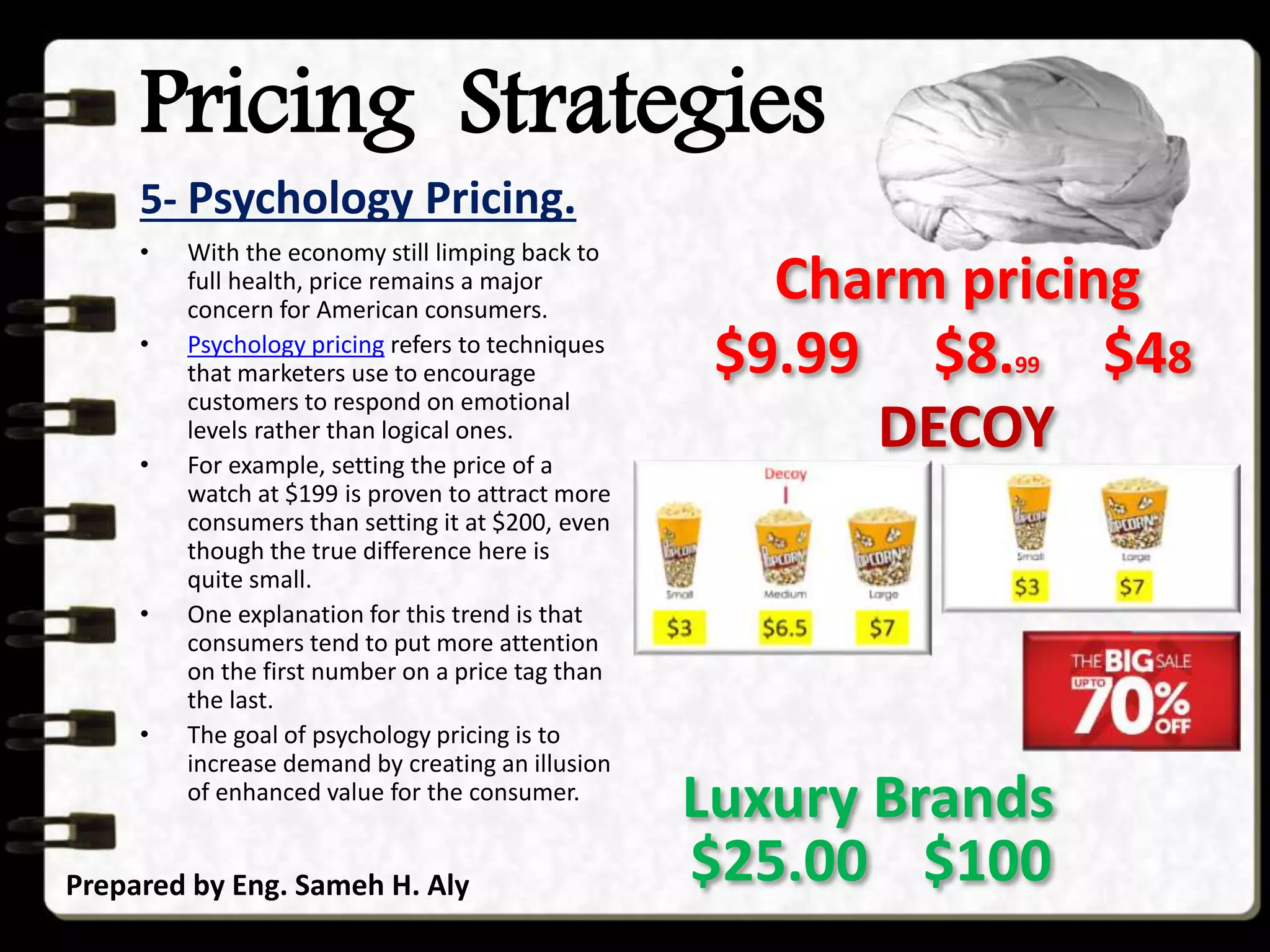
$9.99 $8.99
Charm pricing
$48
DECOY
$25.00 $100
Luxury Brands
Pricing Strategies
6- Bundle Pricing.
Prepared by Eng. Sameh H. Aly
• With bundle pricing, small businesses
sell multiple products for a lower rate
than consumers would face if they
purchased each item individually.
• Not only is bundling goods an effective
way of moving unsold items that are
taking up space in your facility, but it
can also increase the value perception
in the eyes of your customers, since
you’re essentially giving them
something for free.
• Bundle pricing is more effective for
companies that sell complimentary
products.
• For example, a restaurant can take
advantage of bundle pricing by
including dessert with every entrée
sold on a particular day of the week.
Small businesses should keep in mind
that the profits they earn on the
higher-value items must make up for
the losses they take on the lower-value
product.
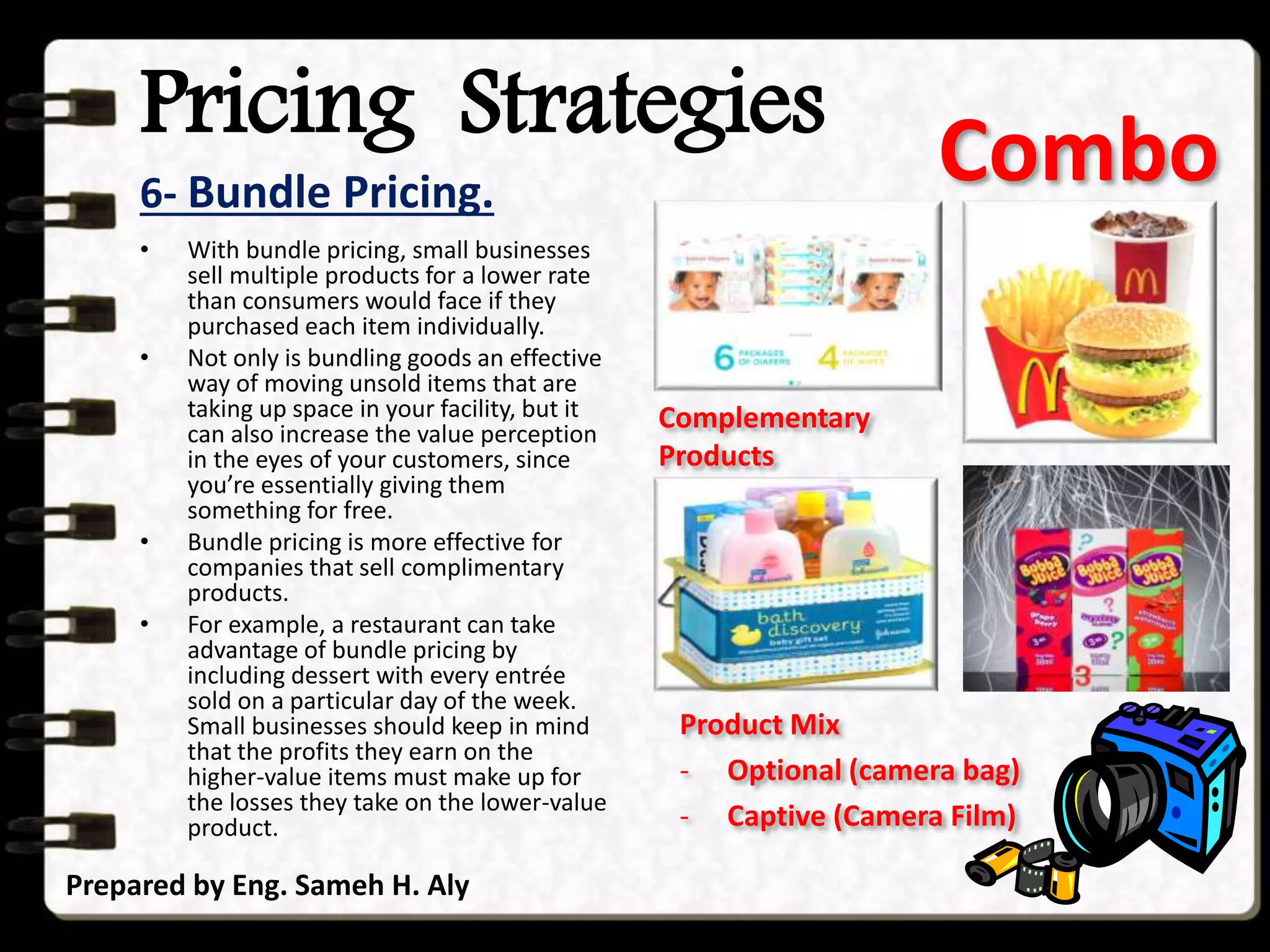
Combo
Complementary
Products
Product Mix
- Optional (camera bag)
- Captive (Camera Film)
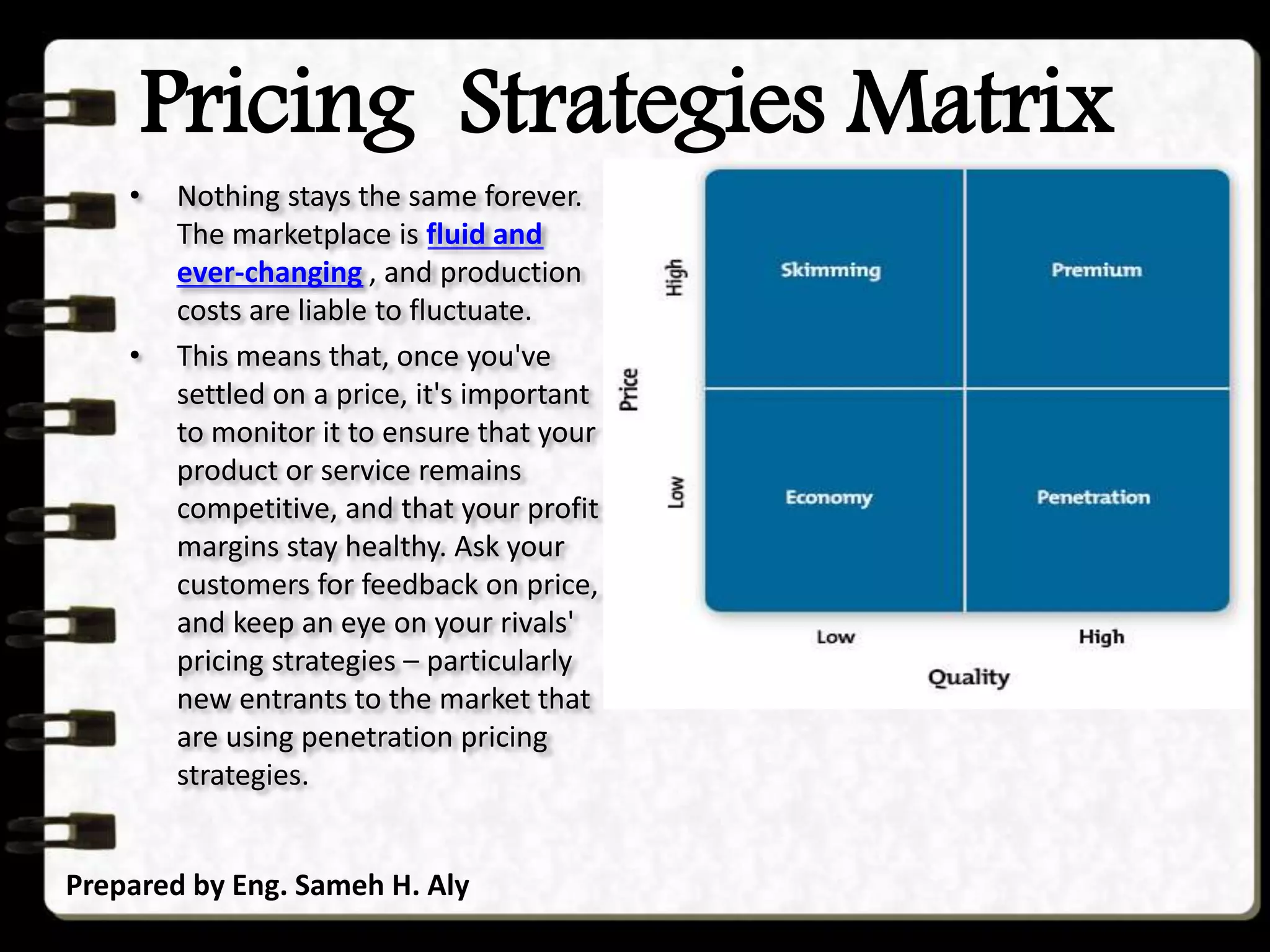
Pricing Strategies Matrix
Prepared by Eng. Sameh H. Aly
• Nothing stays the same forever.
The marketplace is fluid and
ever-changing , and production
costs are liable to fluctuate.
• This means that, once you've
settled on a price, it's important
to monitor it to ensure that your
product or service remains
competitive, and that your profit
margins stay healthy. Ask your
customers for feedback on price,
and keep an eye on your rivals'
pricing strategies – particularly
new entrants to the market that
are using penetration pricing
strategies.
Pricing Strategies Matrix
Prepared by Eng. Sameh H. Aly
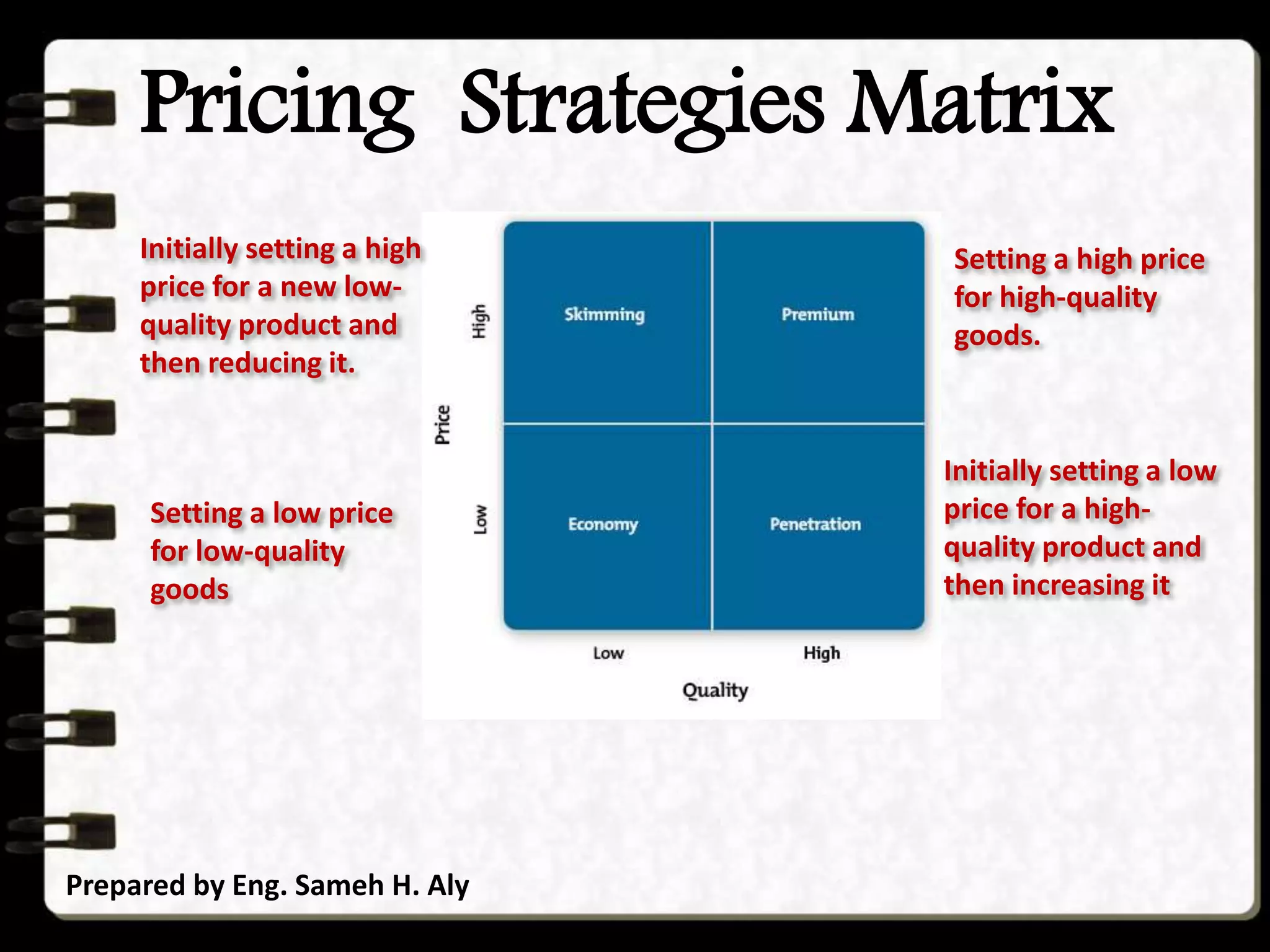
Setting a low price
for low-quality
goods
Initially setting a low
price for a high-
quality product and
then increasing it
Initially setting a high
price for a new low-
quality product and
then reducing it.
Setting a high price
for high-quality
goods.
Pricing Strategies Matrix
Prepared by Eng. Sameh H. Aly
• Each of these strategies serves a different
purpose, and it's important to choose the one
that is most relevant to your situation.
• Think about the type of product that you are
launching and the market that you are targeting.
And consider factors such as your costs, the
competition, and the objectives of your
company, brand or product.
• It's also important to review your pricing
strategy, particularly if market conditions
change.
Pricing Strategies Matrix
Prepared by Eng. Sameh H. Aly
In a complex, fast-changing world, businesses need flexible pricing
options to stay competitive and optimize customer value.
Setting the prices for products and services is a key strategy that
can define business success.
• Two of the most important elements in developing a pricing
strategy are knowledge and flexibility.
• Knowing your true cost for each product is essential for
ensuring all costs are covered and determining the sales price
delivers a profit.
• Knowing your customers enables demographic and trend
analysis that can help determine correct margin levels.
• Knowing demand changes & trends can potentially place high
demand products on our shelves when the competition is out
of stock.
• One size does not fit all and it definitely does not when it
comes to setting pricing strategies. While cost-plus may be the
norm for one market, tiered-pricing may be for another.
Pricing Tools
Prepared by Eng. Sameh H. Aly
• Does your company have the tools to develop a
pricing strategy?
• Price optimization is critical for
success and requires three key
factors to be effectively executed:
1- A flexible system to put the pricing
strategies into action.
2- Access to historical data & analytics
to make well-informed pricing decisions.
3- The ability to know the true product cost
by capturing and tracking all costs associated
with product acquisition
Pricing Tools
Prepared by Eng. Sameh H. Aly
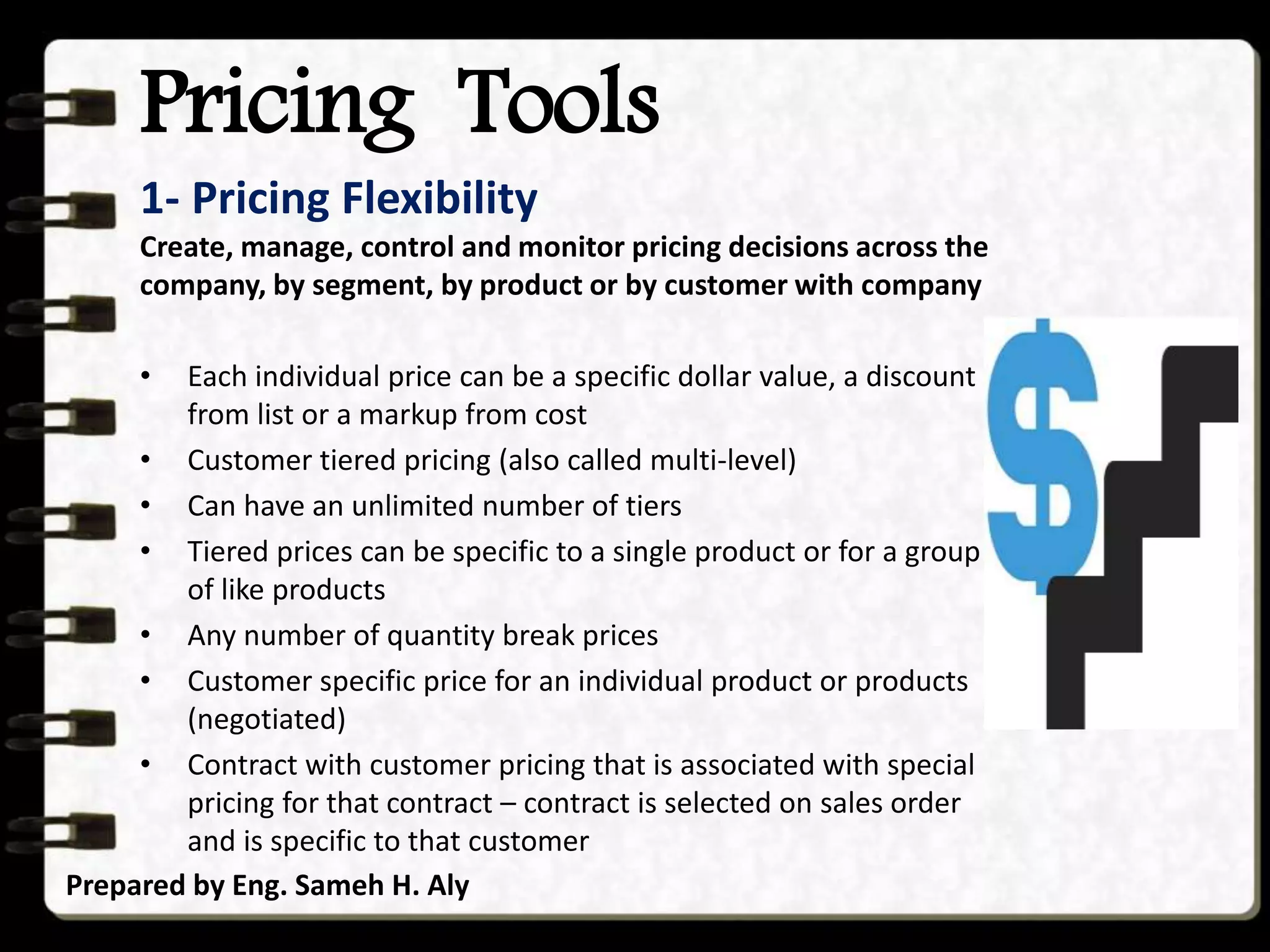
1- Pricing Flexibility
Create, manage, control and monitor pricing decisions across the
company, by segment, by product or by customer with company
• Each individual price can be a specific dollar value, a discount
from list or a markup from cost
• Customer tiered pricing (also called multi-level)
• Can have an unlimited number of tiers
• Tiered prices can be specific to a single product or for a group
of like products
• Any number of quantity break prices
• Customer specific price for an individual product or products
(negotiated)
• Contract with customer pricing that is associated with special
pricing for that contract – contract is selected on sales order
and is specific to that customer
Pricing Tools
Prepared by Eng. Sameh H. Aly
1- Pricing Flexibility
• Upcharge or discount capabilities
• Cost plus: Cost, for cost plus based pricing
calculations, can be an average of stock on
hand, last cost, or arbitrarily established
specifically to determine cost + pricing
• Line level % discount
• Invoice level discount by set dollar amount
or % of total pre-tax order amount
• Any price can have an optional effective
and/or an expiration date
• Person entering order may be constrained
to choice of price or manual override of
price
Pricing Tools
Prepared by Eng. Sameh H. Aly
2- History, Reporting & Trend Analysis
• A complete historical record of customer sales
orders, invoices, payments, products purchased,
credit history and other associated sales order
information relating to the account is maintained in
company.
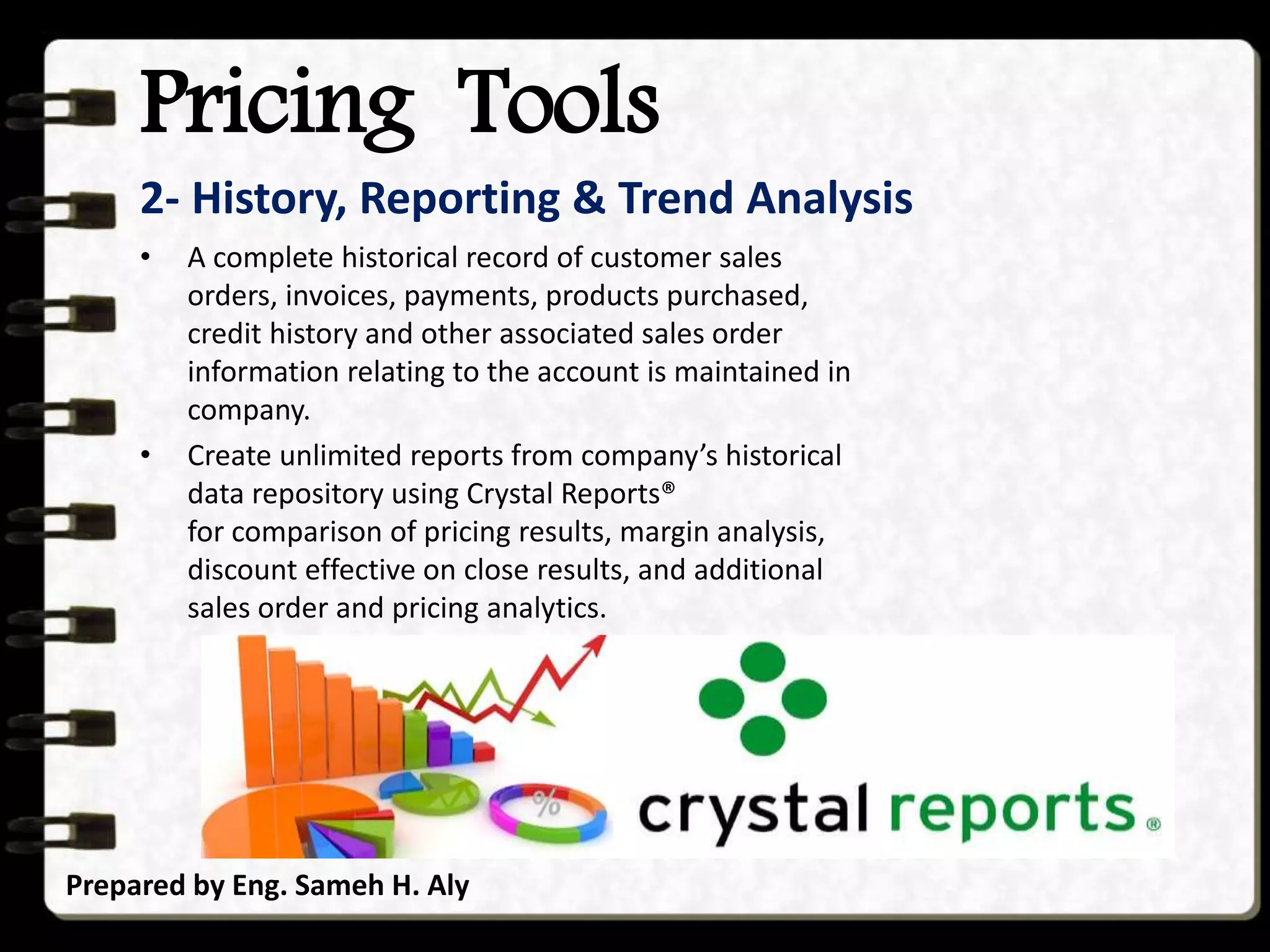
• Create unlimited reports from company’s historical
data repository using Crystal Reports®
for comparison of pricing results, margin analysis,
discount effective on close results, and additional
sales order and pricing analytics.
Pricing Tools
Prepared by Eng. Sameh H. Aly
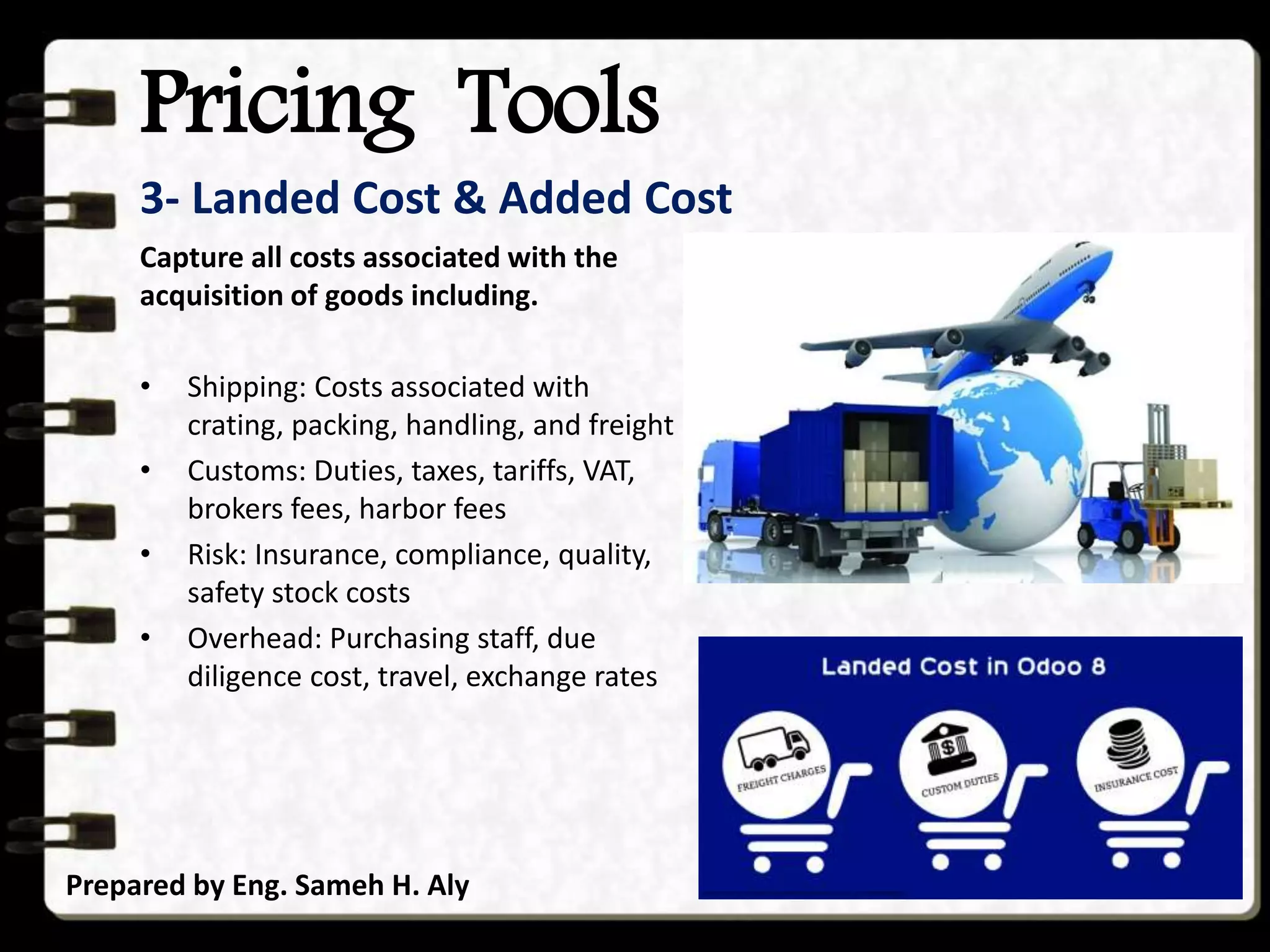
3- Landed Cost & Added Cost
Capture all costs associated with the
acquisition of goods including.
• Shipping: Costs associated with
crating, packing, handling, and freight
• Customs: Duties, taxes, tariffs, VAT,
brokers fees, harbor fees
• Risk: Insurance, compliance, quality,
safety stock costs
• Overhead: Purchasing staff, due
diligence cost, travel, exchange rates
Conclusion
Prepared by Eng. Sameh H. Aly
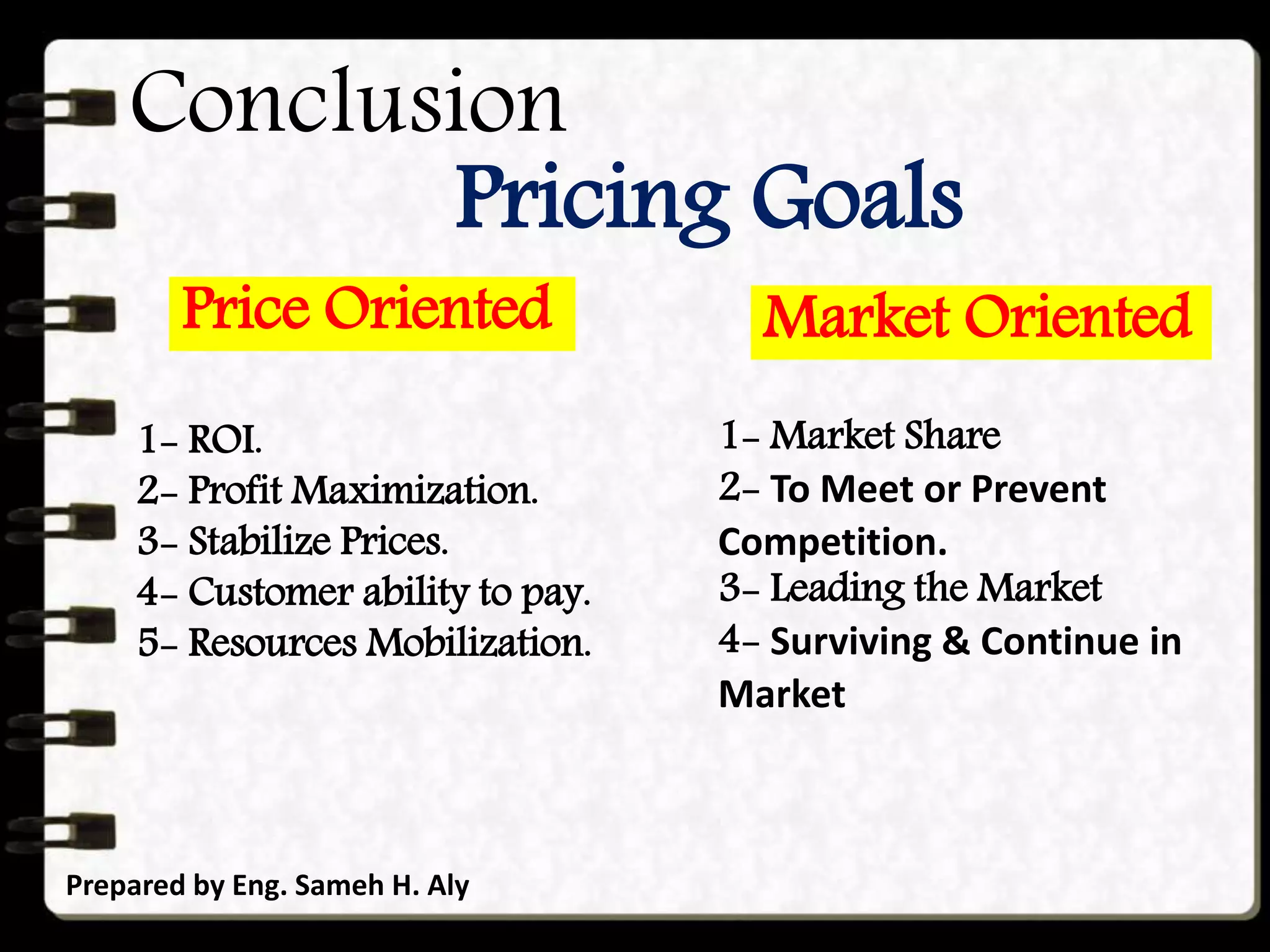
Price Oriented
Pricing Goals
1- ROI.
2- Profit Maximization.
3- Stabilize Prices.
4- Customer ability to pay.
5- Resources Mobilization.
Market Oriented
1- Market Share
2- To Meet or Prevent
Competition.
3- Leading the Market
4- Surviving & Continue in
Market
Conclusion
Prepared by Eng. Sameh H. Aly
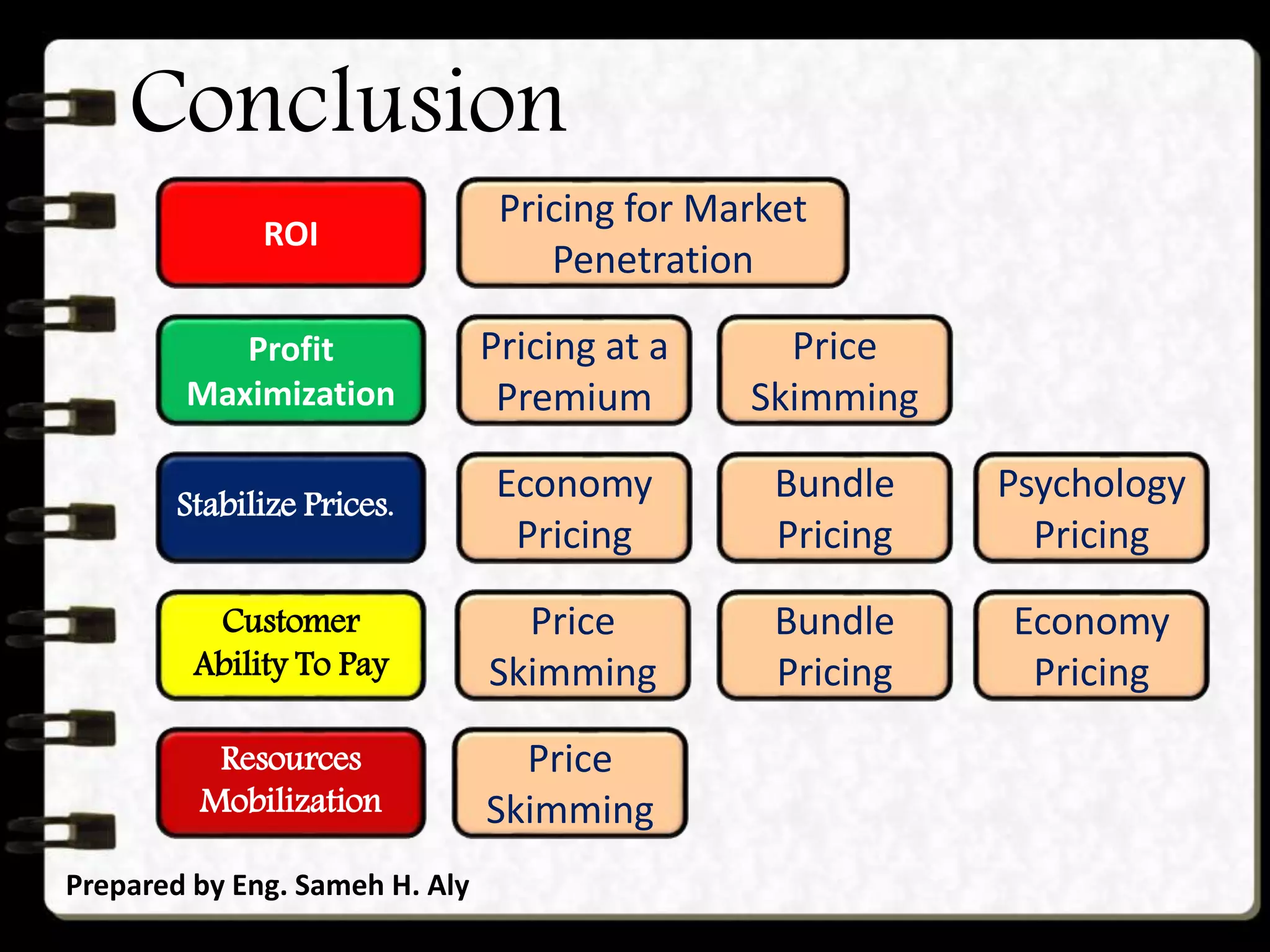
ROI
Profit
Maximization
Customer
Ability To Pay
Pricing for Market
Penetration
Economy
Pricing
Price
Skimming
Pricing at a
Premium
Stabilize Prices.
Bundle
Pricing
Psychology
Pricing
Price
Skimming
Bundle
Pricing
Economy
Pricing
Resources
Mobilization
Price
Skimming
Conclusion
Prepared by Eng. Sameh H. Aly
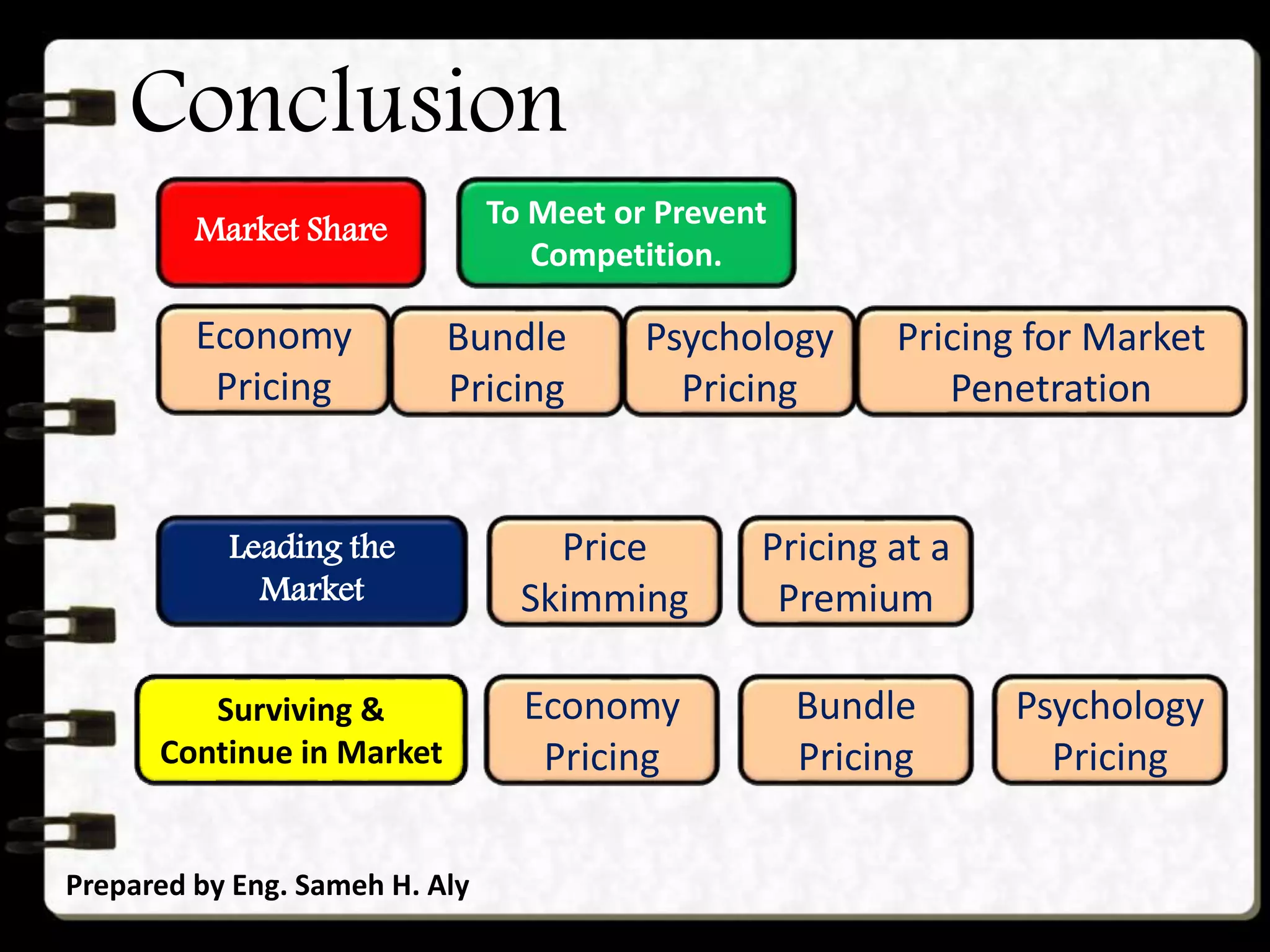
Market Share
To Meet or Prevent
Competition.
Surviving &
Continue in Market
Pricing for Market
Penetration
Economy
Pricing
Leading the
Market
Bundle
Pricing
Psychology
Pricing
Price
Skimming
Bundle
Pricing
Economy
Pricing
Pricing at a
Premium
Psychology
Pricing
Thank You
Sameh Hassan Aly

Pricing Concepts

  • 1.
  • 2.
    Contents • Pricing Definition •Pricing Philosophy • Pricing Goals • Factors Affecting Pricing Decision • Pricing Strategies • Pricing Tools • Conclusion Prepared by Eng. Sameh H. Aly
  • 3.
  • 4.
    Pricing Definition • You'velabored long and hard. • Developing and making your product. • You did the research. • You raised the funds. • You worked tirelessly to build a strong, creative team. • Now – finally – it's ready to be launched. Just one question: How much do you think it's worth? Prepared by Eng. Sameh H. Aly Make sure that the price is right for your product and your market.
  • 5.
    Pricing Definition • Pricingis the method of determining the value a producer will get in the exchange of Products or services. • It is the method adopted by a firm to set its selling price. • It usually depends on the firm's average costs, and on the customer's perceived value of the product in comparison to his perceived value of the competing products. • Different pricing methods place varying degree of emphasis on selection, estimation, and evaluation of costs, comparative analysis, and market situation. Prepared by Eng. Sameh H. Aly
  • 6.
    Pricing Definition Prepared byEng. Sameh H. Aly Selling Price = Profit + Cost Cost Materials Other Expenses EquipmentLabors+ + + + Over Head = (General Expenses)
  • 7.
    Pricing Definition Prepared byEng. Sameh H. Aly Selling Price = Markup % + Cost Cost Plus Pricing - Simple Example Cost X Cost = 100 EGP Proposed Markup Percentage= 20% Selling Price = 100 X 0.2 + 100 = 120 EGP
  • 8.
  • 9.
    Pricing Philosophy Prepared byEng. Sameh H. Aly Price Oriented Market Oriented Cost Plus Cost Base Competition Base Cost Base
  • 10.
    Pricing Philosophy Weber's Law10% Law Prepared by Eng. Sameh H. Aly • If you lift up and hold a weight of 2.0 kg, you will notice that it takes some effort. • If you add to this weight another 0.05 kg and lift, you may not notice any difference between the apparent or subjective weight between the 2.0 kg and the 2.1 kg weights. • If you keep adding weight, you may find that you will only notice the difference when the additional weight is equal to 0.2 kg. • The increment threshold for detecting the difference from a 2.0 kg weight is 0.2 kg. • The just noticeable difference is 0.2 kg. • Now start with a 5.0 kg weight. • If you add weight to this, you will find that the just noticeable difference is 0.5 kg. It takes 0.5 kg added to the 5.0 kg weight for you to notice an apparent difference. 1L 0.9L
  • 11.
  • 12.
    Factors Affecting PricingDecision Prepared by Eng. Sameh H. Aly Internal Factors 1. Marketing Objectives 2. Marketing Mix Strategy 3. Product Cost 4. Organizational considerations External Factors 1. Nature of the market & demand 2. Competition 3. Environmental factors (economy, resellers, government) Pricing Decisions
  • 13.
    How To SetPrice Prepared by Eng. Sameh H. Aly
  • 14.
    Pricing Goals Prepared byEng. Sameh H. Aly
  • 15.
    Pricing Goals • Themain goals in pricing may be classified as follows: 1- Pricing for Target Return (on Investment) (ROI). [PO] 2- Market Share. [MO] 3- To Meet or Prevent Competition. [MO] 4- Profit Maximization. [PO] 5- Stabilize Price. [PO] 6- Customers Ability to Pay. [PO] 7- Resource Mobilization. [PO] 8- Leading The Market (Quality & Name Selling). [MO] 9- Surviving & Continue in Market. [MO] Prepared by Eng. Sameh H. Aly
  • 16.
    Pricing Goals 1- Pricingfor Target Return (on Investment) (ROI). Prepared by Eng. Sameh H. Aly • Business needs capital, i.e., investment in the shape of various types of assets and working capital. When a businessman invests capital in a business, he calculates the probable return on his investment. • A certain rate of return on investment is aimed. • Then, the price is fixed accordingly. • The price includes the predetermined average return. This is seller-oriented policy. • Many well-established firms adopt the objective of pricing in terms of “return on investment.” • Firms want to secure a certain percentage of return on their investment or on sales. • The target of a firm is fixed in terms of investment. ROI = Net Profit / Total Assets
  • 17.
    Pricing Goals 1- Pricingfor Target Return (on Investment) (ROI). Prepared by Eng. Sameh H. Aly • For instance, a company may set a target at 10 or 15% return on investment. • Further, this target may be for a long term or short term. • Wholesalers & Retailers may follow the short term, usually a year. • They charge certain percentage over and above the price, they purchased, which is enough to meet operational costs and a desired profit. • This target chosen can be revised from time to time. • This objective of pricing is also known as pricing for profit. • Certain firms adopt this method as a satisfactory objective, in the sense they are satisfied with a certain rate of return.
  • 18.
    Pricing Goals 2- MarketShare. Prepared by Eng. Sameh H. Aly • The target share of the market and the expected volume of sales are the most important consideration in pricing the products. • Some companies adopt the main pricing objective so as to maintain or to improve the market share towards the product. • A good market share is a better indication of progress. • When the market share is decreasing, low pricing policy can be adopted by large- scale manufacturers, who produce goods needed daily by the consumers. • So margin of profit comes down because of low price, but the competitors are discouraged from entering the market. • By low pricing policy, no doubt, market share can be increased, besides attracting new users.
  • 19.
    Pricing Goals 3- ToMeet or Prevent Competition. Prepared by Eng. Sameh H. Aly • The pricing objective may be to meet or prevent competition. • While fixing the price, the price of similar products, produced by other firms, will have to be considered. Generally, producers are not in a haste to fix a price at which the goods can be sold out. • One has to look to the prices of rival products and the existing competition and chalk out proper price policy -so as to enable to face the market competition. • At the time of introduction of new products to the market, a low price policy is likely to attract customers, and can establish a good market share. • The low price policy discourages the competitors. This low price policy can be adopted before the obsolescent stage under PLC
  • 20.
    Pricing Goals How toPrevent Competition? Prepared by Eng. Sameh H. Aly • Be great • Master the insider games. • Let the new guy feel that it’s his choice. • Use contracts. • Don’t shout it out to the world • Stay Current With How Demand Is Evolving. • Invest in Building the Right Capabilities. • Be Innovative. • Retain Your Best Employees.
  • 21.
    Pricing Goals 4- ProfitMaximization. Prepared by Eng. Sameh H. Aly • Business of all kinds is run with an idea of earning profit at the maximum. • Profit maximization can be enjoyed where monopolistic situation exists. • The goal should be to maximize profits on total output, rather than on every item. • The scarcity conditions offer chances for profit maximization by high pricing policy. • The profit maximization will develop an unhealthy image. • When a short-run policy is adopted for maximizing the profit, it will exploit the customers. The customers have a feeling of monopoly and high price. • But a long-run policy to maximize the profit has no drawbacks. • A short-run policy will attract competitors, who produce similar goods at low cost. • As a result, price control and government regulations will be introduced.
  • 22.
    Pricing Goals 4- ProfitMaximization. Prepared by Eng. Sameh H. Aly • Marginal Revenue (MR) displays the added revenue from each product sold. • Marginal Cost displays the added cost from each product sold (Variable Cost). • Average Total Cost allows us to see what the firm should actually pay for production (average variable + fixed costs). • Average Revenue (AR)
  • 23.
    Pricing Goals 5- StabilizePrice. Prepared by Eng. Sameh H. Aly • It is a long-time objective and aims at preventing frequent and violent fluctuations in price. • It also prevents price war amongst the competitors. • When the price often changes, there arises no confidence on the product. • The prices are designed in such a way that during the period of depression, the prices are not allowed to fall below a certain level and in the boom period, the prices are not allowed to rise beyond a certain level. • The goal is to live and let live. • Thus firms forego maximum profits during periods of short supply of products.
  • 24.
    Pricing Goals 6- CustomersAbility to Pay. Prepared by Eng. Sameh H. Aly • The prices that are charged differ from person to person, according to his capacity to pay. For instance, doctors charge fees for their services according to the capacity of the patient also lawyers and Design Consultants.
  • 25.
    Pricing Goals 7- ResourceMobilization. Prepared by Eng. Sameh H. Aly • This is a pricing objective, the products are priced in such a way that sufficient resources are made available for the firms’ expansion, developmental investment. • Marketers are interested in getting back the amount invested as speedily as possible. • A product may have a short PLC. • The management may fix a higher price and this trend will invite competitors with low priced similar products
  • 26.
    Pricing Goals 8- LeadingThe Market (Quality & Name Selling). Prepared by Eng. Sameh H. Aly • Company reaches this level during its Maturity phase. • When providing certain know how or unique service. • Company can sell it’s products with very high prices and reach the maximum profit planned “Cash Cow”. • For Example Mercedes & Apple.
  • 27.
    Pricing Goals 9- Surviving& Continue in Market. Prepared by Eng. Sameh H. Aly • Company in introduction or in decline stage. • Pricing with dry cost no profit seeking. • Must be for limited period till reach maturity or market conditions become better or fine closing of the business with minimum losses.
  • 28.
  • 29.
    Pricing Strategies Prepared byEng. Sameh H. Aly • Good pricing strategy helps you determine the price point at which you can maximize profits on sales of your products or services. When setting prices, a business owner needs to consider a wide range of factors including production and distribution costs, competitor offerings, positioning strategies and the business’ target customer base. • While customers won’t purchase goods that are priced too high, your company won’t succeed if it prices goods too low to cover all of the business’ costs. Along with product, place and promotion, price can have a profound effect on the success of your small business.
  • 30.
    Pricing Strategies 1- Pricingat a Premium. 2- Pricing for Market Penetration. 3- Economy Pricing. 4- Price Skimming. 5- Psychology Pricing. 6- Bundle Pricing. Prepared by Eng. Sameh H. Aly • Here are some of the various strategies that businesses implement when setting prices on their products and services.
  • 31.
    Pricing Strategies 1- Pricingat a Premium. Prepared by Eng. Sameh H. Aly • With premium pricing, businesses set costs higher than their competitors. Premium pricing is often most effective in the early days of a product’s life cycle, and ideal for small businesses that sell unique goods. • Because customers need to perceive products as being worth the higher price tag, a business must work hard to create a value perception. • Along with creating a high-quality product, owners should ensure their marketing efforts, the product’s packaging and the store’s décor all combine to support the premium price.
  • 32.
    Pricing Strategies 2- Pricingfor Market Penetration. Prepared by Eng. Sameh H. Aly • Penetration strategies aim to attract buyers by offering lower prices on goods and services. While many new companies use this technique to draw attention away from their competition, penetration pricing does tend to result in an initial loss of income for the business. • Over time, however, the increase in awareness can drive profits and help small businesses to stand out from the crowd. In the long run, after sufficiently penetrating a market, companies often wind up raising their prices to better reflect the state of their position within the market.
  • 33.
    Pricing Strategies 2- Pricingfor Market Penetration. Prepared by Eng. Sameh H. Aly • Utility Companies (Television and Internet providers). • Smart Phone Providers (Android). • Giveaways and BOGOs (MAX, H&M) • Popular Foods (Frito- Lay Introduced STAX with 0.69$ Against Pringles).
  • 34.
    Pricing Strategies 3- EconomyPricing. Prepared by Eng. Sameh H. Aly • Used by a wide range of businesses including generic food suppliers and discount retailers, economy pricing aims to attract the most price- conscious of consumers. • With this strategy, businesses minimize the costs associated with marketing and production in order to keep product prices down. • As a result, customers can purchase the products they need without frills. • While economy pricing is incredibly effective for large companies like Wal-Mart and Carrefour, the technique can be dangerous for small businesses. • Because small businesses lack the sales volume of larger companies, they may struggle to generate a sufficient profit when prices are too low. • Still, selectively tailoring discounts to your most loyal customers can be a great way to guarantee their patronage for years to come.
  • 35.
    Pricing Strategies 4- PriceSkimming. Prepared by Eng. Sameh H. Aly • Designed to help businesses maximize sales on new products and services, price skimming involves setting rates high during the introductory phase. • The company then lowers prices gradually as competitor goods appear on the market. (Cell Phones specially Apple). • One of the benefits of price skimming is that it allows businesses to maximize profits on early adopters before dropping prices to attract more price-sensitive consumers. • Not only does price skimming help a small business recoup its development costs, but it also creates an illusion of quality and exclusivity when your item is first introduced to the marketplace. • Android = Penetration • Apple = Skimming
  • 36.
    Pricing Strategies 5- PsychologyPricing. Prepared by Eng. Sameh H. Aly • With the economy still limping back to full health, price remains a major concern for American consumers. • Psychology pricing refers to techniques that marketers use to encourage customers to respond on emotional levels rather than logical ones. • For example, setting the price of a watch at $199 is proven to attract more consumers than setting it at $200, even though the true difference here is quite small. • One explanation for this trend is that consumers tend to put more attention on the first number on a price tag than the last. • The goal of psychology pricing is to increase demand by creating an illusion of enhanced value for the consumer. $9.99 $8.99 Charm pricing $48 DECOY $25.00 $100 Luxury Brands
  • 37.
    Pricing Strategies 6- BundlePricing. Prepared by Eng. Sameh H. Aly • With bundle pricing, small businesses sell multiple products for a lower rate than consumers would face if they purchased each item individually. • Not only is bundling goods an effective way of moving unsold items that are taking up space in your facility, but it can also increase the value perception in the eyes of your customers, since you’re essentially giving them something for free. • Bundle pricing is more effective for companies that sell complimentary products. • For example, a restaurant can take advantage of bundle pricing by including dessert with every entrée sold on a particular day of the week. Small businesses should keep in mind that the profits they earn on the higher-value items must make up for the losses they take on the lower-value product. Combo Complementary Products Product Mix - Optional (camera bag) - Captive (Camera Film)
  • 38.
    Pricing Strategies Matrix Preparedby Eng. Sameh H. Aly • Nothing stays the same forever. The marketplace is fluid and ever-changing , and production costs are liable to fluctuate. • This means that, once you've settled on a price, it's important to monitor it to ensure that your product or service remains competitive, and that your profit margins stay healthy. Ask your customers for feedback on price, and keep an eye on your rivals' pricing strategies – particularly new entrants to the market that are using penetration pricing strategies.
  • 39.
    Pricing Strategies Matrix Preparedby Eng. Sameh H. Aly Setting a low price for low-quality goods Initially setting a low price for a high- quality product and then increasing it Initially setting a high price for a new low- quality product and then reducing it. Setting a high price for high-quality goods.
  • 40.
    Pricing Strategies Matrix Preparedby Eng. Sameh H. Aly • Each of these strategies serves a different purpose, and it's important to choose the one that is most relevant to your situation. • Think about the type of product that you are launching and the market that you are targeting. And consider factors such as your costs, the competition, and the objectives of your company, brand or product. • It's also important to review your pricing strategy, particularly if market conditions change.
  • 41.
    Pricing Strategies Matrix Preparedby Eng. Sameh H. Aly In a complex, fast-changing world, businesses need flexible pricing options to stay competitive and optimize customer value. Setting the prices for products and services is a key strategy that can define business success. • Two of the most important elements in developing a pricing strategy are knowledge and flexibility. • Knowing your true cost for each product is essential for ensuring all costs are covered and determining the sales price delivers a profit. • Knowing your customers enables demographic and trend analysis that can help determine correct margin levels. • Knowing demand changes & trends can potentially place high demand products on our shelves when the competition is out of stock. • One size does not fit all and it definitely does not when it comes to setting pricing strategies. While cost-plus may be the norm for one market, tiered-pricing may be for another.
  • 42.
    Pricing Tools Prepared byEng. Sameh H. Aly • Does your company have the tools to develop a pricing strategy? • Price optimization is critical for success and requires three key factors to be effectively executed: 1- A flexible system to put the pricing strategies into action. 2- Access to historical data & analytics to make well-informed pricing decisions. 3- The ability to know the true product cost by capturing and tracking all costs associated with product acquisition
  • 43.
    Pricing Tools Prepared byEng. Sameh H. Aly 1- Pricing Flexibility Create, manage, control and monitor pricing decisions across the company, by segment, by product or by customer with company • Each individual price can be a specific dollar value, a discount from list or a markup from cost • Customer tiered pricing (also called multi-level) • Can have an unlimited number of tiers • Tiered prices can be specific to a single product or for a group of like products • Any number of quantity break prices • Customer specific price for an individual product or products (negotiated) • Contract with customer pricing that is associated with special pricing for that contract – contract is selected on sales order and is specific to that customer
  • 44.
    Pricing Tools Prepared byEng. Sameh H. Aly 1- Pricing Flexibility • Upcharge or discount capabilities • Cost plus: Cost, for cost plus based pricing calculations, can be an average of stock on hand, last cost, or arbitrarily established specifically to determine cost + pricing • Line level % discount • Invoice level discount by set dollar amount or % of total pre-tax order amount • Any price can have an optional effective and/or an expiration date • Person entering order may be constrained to choice of price or manual override of price
  • 45.
    Pricing Tools Prepared byEng. Sameh H. Aly 2- History, Reporting & Trend Analysis • A complete historical record of customer sales orders, invoices, payments, products purchased, credit history and other associated sales order information relating to the account is maintained in company. • Create unlimited reports from company’s historical data repository using Crystal Reports® for comparison of pricing results, margin analysis, discount effective on close results, and additional sales order and pricing analytics.
  • 46.
    Pricing Tools Prepared byEng. Sameh H. Aly 3- Landed Cost & Added Cost Capture all costs associated with the acquisition of goods including. • Shipping: Costs associated with crating, packing, handling, and freight • Customs: Duties, taxes, tariffs, VAT, brokers fees, harbor fees • Risk: Insurance, compliance, quality, safety stock costs • Overhead: Purchasing staff, due diligence cost, travel, exchange rates
  • 47.
    Conclusion Prepared by Eng.Sameh H. Aly Price Oriented Pricing Goals 1- ROI. 2- Profit Maximization. 3- Stabilize Prices. 4- Customer ability to pay. 5- Resources Mobilization. Market Oriented 1- Market Share 2- To Meet or Prevent Competition. 3- Leading the Market 4- Surviving & Continue in Market
  • 48.
    Conclusion Prepared by Eng.Sameh H. Aly ROI Profit Maximization Customer Ability To Pay Pricing for Market Penetration Economy Pricing Price Skimming Pricing at a Premium Stabilize Prices. Bundle Pricing Psychology Pricing Price Skimming Bundle Pricing Economy Pricing Resources Mobilization Price Skimming
  • 49.
    Conclusion Prepared by Eng.Sameh H. Aly Market Share To Meet or Prevent Competition. Surviving & Continue in Market Pricing for Market Penetration Economy Pricing Leading the Market Bundle Pricing Psychology Pricing Price Skimming Bundle Pricing Economy Pricing Pricing at a Premium Psychology Pricing
  • 50.