Uses of the Imperfect &
Preterite
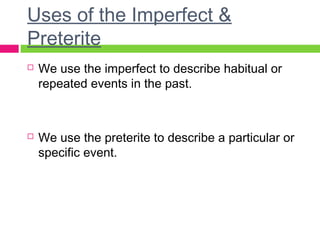
 We use the imperfect to describe habitual or
repeated events in the past.
 We use the preterite to describe a particular or
specific event.
Uses of the Imperfect & Preterite
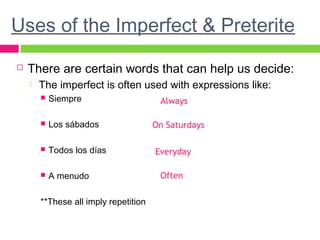
 There are certain words that can help us decide:
 The imperfect is often used with expressions like:
 Siempre
 Los sábados
 Todos los días
 A menudo
**These all imply repetition
Always
On Saturdays
Everyday
Often
Uses of the Imperfect &
Preterite
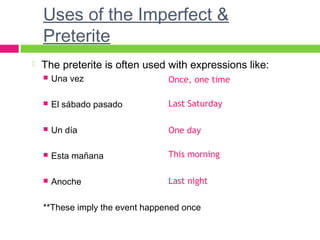
 The preterite is often used with expressions like:
 Una vez
 El sábado pasado
 Un día
 Esta mañana
 Anoche
**These imply the event happened once
Once, one time
Last Saturday
One day
This morning
Last night
Uses of the Imperfect &
Preterite
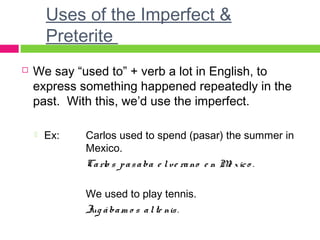
 We say “used to” + verb a lot in English, to
express something happened repeatedly in the
past. With this, we’d use the imperfect.
 Ex: Carlos used to spend (pasar) the summer in
Mexico.
Carlo s pasaba e lve rano e n Mé xico .
We used to play tennis.
Jug ábam o s alte nis.
Uses of the pret. & imperf.
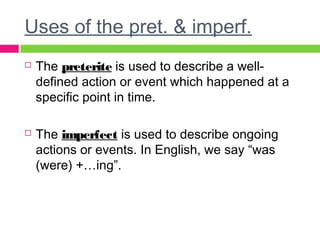
 The preterite is used to describe a well-
defined action or event which happened at a
specific point in time.
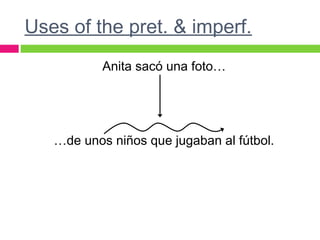
 The imperfect is used to describe ongoing
actions or events. In English, we say “was
(were) +…ing”.
Uses of the pret. & imperf.
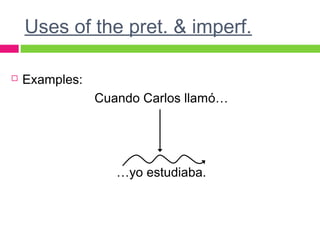
 Examples:
Cuando Carlos llamó…
…yo estudiaba.
Uses of the pret. & imperf.
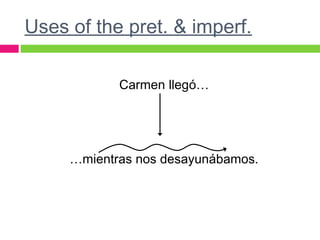
Carmen llegó…
…mientras nos desayunábamos.
Uses of the pret. & imperf.
Anita sacó una foto…
…de unos niños que jugaban al fútbol.
Preterite vs. Imperfect
 The preterite is used to describe actions in the
past.
 El año pasado mi hermano visitó México.
 Vi una escuela grande.
 Vi la escuela muy bien.
Preterite vs. Imperfect
 The imperfect is used to describe specific
circumstances:
 Time
 Era el diez de abril.
 Eran las ocho de la noche.
 Weather
 Hacía mal tiempo.
 Llovía.
Preterite vs. Imperfect
 Location
 Yo iba por la Avenida Libertad.
 Yo estaba en la escuela.
 Age
 El profesor tenía entre treinta y treinta y cinco años.
 Physical Appearance
 Era un hombre alto.
 Llevaba un súeter gris.
Preterite vs. Imperfect
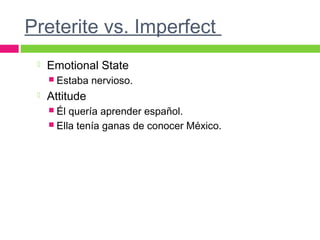
 Emotional State
 Estaba nervioso.
 Attitude
 Él quería aprender español.
 Ella tenía ganas de conocer México.
Preterite vs. Imperfect
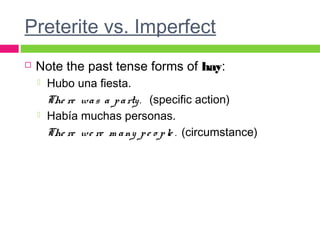
 Note the past tense forms of hay:
 Hubo una fiesta.
The re was a party. (specific action)
 Había muchas personas.
The re we re m any pe o ple . (circumstance)
Preterite vs. Imperfect
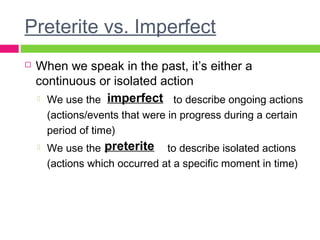
 When we speak in the past, it’s either a
continuous or isolated action
 We use the to describe ongoing actions
(actions/events that were in progress during a certain
period of time)
 We use the to describe isolated actions
(actions which occurred at a specific moment in time)
imperfect
preterite
Preterite vs. Imperfect
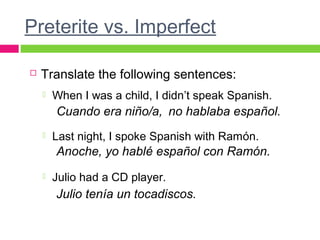
 Translate the following sentences:
 When I was a child, I didn’t speak Spanish.
 Last night, I spoke Spanish with Ramón.
 Julio had a CD player.
Cuando era niño/a, no hablaba español.
Anoche, yo hablé español con Ramón.
Julio tenía un tocadiscos.
Preterite vs. Imperfect
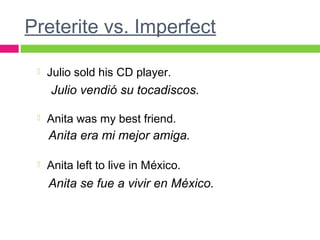
 Julio sold his CD player.
 Anita was my best friend.
 Anita left to live in México.
Julio vendió su tocadiscos.
Anita era mi mejor amiga.
Anita se fue a vivir en México.
Preterite vs. Imperfect
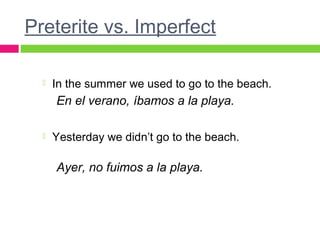
 In the summer we used to go to the beach.
 Yesterday we didn’t go to the beach.
En el verano, íbamos a la playa.
Ayer, no fuimos a la playa.
Preterite vs. Imperfect
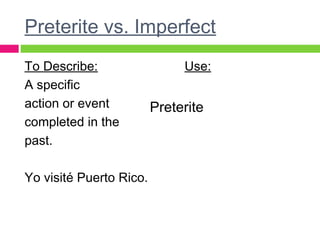
To Describe: Use:
A specific
action or event
completed in the
past.
Yo visité Puerto Rico.
Preterite
Preterite vs. Imperfect
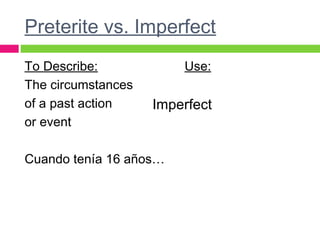
To Describe: Use:
The circumstances
of a past action
or event
Cuando tenía 16 años…
Imperfect
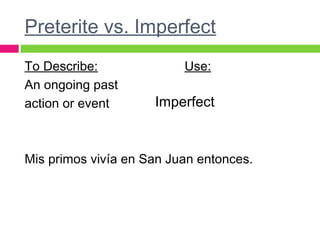
Preterite vs. Imperfect
To Describe: Use:
An ongoing past
action or event
Mis primos vivía en San Juan entonces.
Imperfect
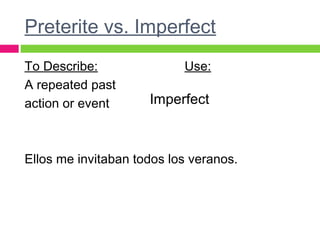
Preterite vs. Imperfect
To Describe: Use:
A repeated past
action or event
Ellos me invitaban todos los veranos.
Imperfect

Spanish 3 Notes on Preterite vs. Imperfect

  • 1.
    Uses of theImperfect & Preterite  We use the imperfect to describe habitual or repeated events in the past.  We use the preterite to describe a particular or specific event.
  • 2.
    Uses of theImperfect & Preterite  There are certain words that can help us decide:  The imperfect is often used with expressions like:  Siempre  Los sábados  Todos los días  A menudo **These all imply repetition Always On Saturdays Everyday Often
  • 3.
    Uses of theImperfect & Preterite  The preterite is often used with expressions like:  Una vez  El sábado pasado  Un día  Esta mañana  Anoche **These imply the event happened once Once, one time Last Saturday One day This morning Last night
  • 4.
    Uses of theImperfect & Preterite  We say “used to” + verb a lot in English, to express something happened repeatedly in the past. With this, we’d use the imperfect.  Ex: Carlos used to spend (pasar) the summer in Mexico. Carlo s pasaba e lve rano e n Mé xico . We used to play tennis. Jug ábam o s alte nis.
  • 5.
    Uses of thepret. & imperf.  The preterite is used to describe a well- defined action or event which happened at a specific point in time.  The imperfect is used to describe ongoing actions or events. In English, we say “was (were) +…ing”.
  • 6.
    Uses of thepret. & imperf.  Examples: Cuando Carlos llamó… …yo estudiaba.
  • 7.
    Uses of thepret. & imperf. Carmen llegó… …mientras nos desayunábamos.
  • 8.
    Uses of thepret. & imperf. Anita sacó una foto… …de unos niños que jugaban al fútbol.
  • 9.
    Preterite vs. Imperfect The preterite is used to describe actions in the past.  El año pasado mi hermano visitó México.  Vi una escuela grande.  Vi la escuela muy bien.
  • 10.
    Preterite vs. Imperfect The imperfect is used to describe specific circumstances:  Time  Era el diez de abril.  Eran las ocho de la noche.  Weather  Hacía mal tiempo.  Llovía.
  • 11.
    Preterite vs. Imperfect Location  Yo iba por la Avenida Libertad.  Yo estaba en la escuela.  Age  El profesor tenía entre treinta y treinta y cinco años.  Physical Appearance  Era un hombre alto.  Llevaba un súeter gris.
  • 12.
    Preterite vs. Imperfect Emotional State  Estaba nervioso.  Attitude  Él quería aprender español.  Ella tenía ganas de conocer México.
  • 13.
    Preterite vs. Imperfect Note the past tense forms of hay:  Hubo una fiesta. The re was a party. (specific action)  Había muchas personas. The re we re m any pe o ple . (circumstance)
  • 14.
    Preterite vs. Imperfect When we speak in the past, it’s either a continuous or isolated action  We use the to describe ongoing actions (actions/events that were in progress during a certain period of time)  We use the to describe isolated actions (actions which occurred at a specific moment in time) imperfect preterite
  • 15.
    Preterite vs. Imperfect Translate the following sentences:  When I was a child, I didn’t speak Spanish.  Last night, I spoke Spanish with Ramón.  Julio had a CD player. Cuando era niño/a, no hablaba español. Anoche, yo hablé español con Ramón. Julio tenía un tocadiscos.
  • 16.
    Preterite vs. Imperfect Julio sold his CD player.  Anita was my best friend.  Anita left to live in México. Julio vendió su tocadiscos. Anita era mi mejor amiga. Anita se fue a vivir en México.
  • 17.
    Preterite vs. Imperfect In the summer we used to go to the beach.  Yesterday we didn’t go to the beach. En el verano, íbamos a la playa. Ayer, no fuimos a la playa.
  • 18.
    Preterite vs. Imperfect ToDescribe: Use: A specific action or event completed in the past. Yo visité Puerto Rico. Preterite
  • 19.
    Preterite vs. Imperfect ToDescribe: Use: The circumstances of a past action or event Cuando tenía 16 años… Imperfect
  • 20.
    Preterite vs. Imperfect ToDescribe: Use: An ongoing past action or event Mis primos vivía en San Juan entonces. Imperfect
  • 21.
    Preterite vs. Imperfect ToDescribe: Use: A repeated past action or event Ellos me invitaban todos los veranos. Imperfect