Precast Element - Bridge
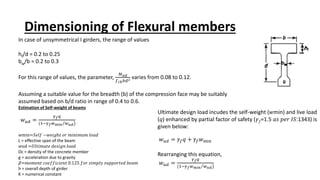
Dimensioning of Flexural members
In case of unsymmetrical I girders, the range of values
hf/d = 0.2 to 0.25
bw/b = 0.2 to 0.3
For this range of values, the parameter,
𝑀𝑢𝑑
𝑓𝑐𝑘𝑏𝑑2 varies from 0.08 to 0.12.
Assuming a suitable value for the breadth (b) of the compression face may be suitably
assumed based on b/d ratio in range of 0.4 to 0.6.
Estimation of Self-weight of beams
𝑤𝑢𝑑 =
𝛾𝑓𝑞
(1−𝛾𝑓𝑤min 𝑤𝑢𝑑
𝑤min=𝑆𝑒𝑙𝑓 −𝑤𝑒𝑖𝑔h𝑡 𝑜𝑟 𝑚𝑖𝑛𝑖𝑚𝑢𝑚 𝑙𝑜𝑎𝑑
L = effective span of the beam
𝑤ud =𝑈𝑙𝑡𝑖𝑚𝑎𝑡𝑒 𝑑𝑒𝑠𝑖𝑔𝑛 𝑙𝑜𝑎𝑑
Dc = density of the concrete member
g = acceleration due to gravity
𝛽=𝑚𝑜𝑚𝑒𝑛𝑡 𝑐𝑜𝑒𝑓𝑓𝑖𝑐𝑖𝑒𝑛𝑡 0.125 𝑓𝑜𝑟 𝑠𝑖𝑚𝑝𝑙𝑦 𝑠𝑢𝑝𝑝𝑜𝑟𝑡𝑒𝑑 𝑏𝑒𝑎𝑚
h = overall depth of girder
K = numerical constant
Ultimate design load incudes the self-weight (𝑤min) and live load
(𝑞) enhanced by partial factor of safety (𝛾𝑓=1.5 𝑎𝑠 𝑝𝑒𝑟 𝐼𝑆:1343) is
given below:
𝑤𝑢𝑑 = 𝛾𝑓𝑞 + 𝛾𝑓𝑤min
Rearranging this equation,
𝑤𝑢𝑑 =
𝛾𝑓𝑞
(1−𝛾𝑓𝑤min 𝑤𝑢𝑑
Example
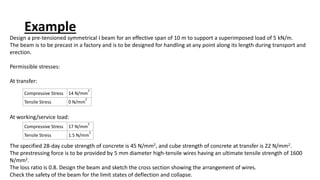
Design a pre-tensioned symmetrical I beam for an effective span of 10 m to support a superimposed load of 5 kN/m.
The beam is to be precast in a factory and is to be designed for handling at any point along its length during transport and
erection.
Permissible stresses:
At transfer:
At working/service load:
The specified 28-day cube strength of concrete is 45 N/mm2, and cube strength of concrete at transfer is 22 N/mm2.
The prestressing force is to be provided by 5 mm diameter high-tensile wires having an ultimate tensile strength of 1600
N/mm2.
The loss ratio is 0.8. Design the beam and sketch the cross section showing the arrangement of wires.
Check the safety of the beam for the limit states of deflection and collapse.
Compressive Stress 14 N/mm
2
Tensile Stress 0 N/mm
2
Compressive Stress 17 N/mm
2
Tensile Stress 1.5 N/mm
2
Prestress Concrete Beam

Prestress Concrete Beam

  • 1.
  • 2.
    Dimensioning of Flexuralmembers In case of unsymmetrical I girders, the range of values hf/d = 0.2 to 0.25 bw/b = 0.2 to 0.3 For this range of values, the parameter, 𝑀𝑢𝑑 𝑓𝑐𝑘𝑏𝑑2 varies from 0.08 to 0.12. Assuming a suitable value for the breadth (b) of the compression face may be suitably assumed based on b/d ratio in range of 0.4 to 0.6. Estimation of Self-weight of beams 𝑤𝑢𝑑 = 𝛾𝑓𝑞 (1−𝛾𝑓𝑤min 𝑤𝑢𝑑 𝑤min=𝑆𝑒𝑙𝑓 −𝑤𝑒𝑖𝑔h𝑡 𝑜𝑟 𝑚𝑖𝑛𝑖𝑚𝑢𝑚 𝑙𝑜𝑎𝑑 L = effective span of the beam 𝑤ud =𝑈𝑙𝑡𝑖𝑚𝑎𝑡𝑒 𝑑𝑒𝑠𝑖𝑔𝑛 𝑙𝑜𝑎𝑑 Dc = density of the concrete member g = acceleration due to gravity 𝛽=𝑚𝑜𝑚𝑒𝑛𝑡 𝑐𝑜𝑒𝑓𝑓𝑖𝑐𝑖𝑒𝑛𝑡 0.125 𝑓𝑜𝑟 𝑠𝑖𝑚𝑝𝑙𝑦 𝑠𝑢𝑝𝑝𝑜𝑟𝑡𝑒𝑑 𝑏𝑒𝑎𝑚 h = overall depth of girder K = numerical constant Ultimate design load incudes the self-weight (𝑤min) and live load (𝑞) enhanced by partial factor of safety (𝛾𝑓=1.5 𝑎𝑠 𝑝𝑒𝑟 𝐼𝑆:1343) is given below: 𝑤𝑢𝑑 = 𝛾𝑓𝑞 + 𝛾𝑓𝑤min Rearranging this equation, 𝑤𝑢𝑑 = 𝛾𝑓𝑞 (1−𝛾𝑓𝑤min 𝑤𝑢𝑑
  • 3.
    Example Design a pre-tensionedsymmetrical I beam for an effective span of 10 m to support a superimposed load of 5 kN/m. The beam is to be precast in a factory and is to be designed for handling at any point along its length during transport and erection. Permissible stresses: At transfer: At working/service load: The specified 28-day cube strength of concrete is 45 N/mm2, and cube strength of concrete at transfer is 22 N/mm2. The prestressing force is to be provided by 5 mm diameter high-tensile wires having an ultimate tensile strength of 1600 N/mm2. The loss ratio is 0.8. Design the beam and sketch the cross section showing the arrangement of wires. Check the safety of the beam for the limit states of deflection and collapse. Compressive Stress 14 N/mm 2 Tensile Stress 0 N/mm 2 Compressive Stress 17 N/mm 2 Tensile Stress 1.5 N/mm 2