Group Members
➢Bilal Hassan
➢Muhammad Talha
➢Muhammad Asghar
➢Muhammad Salman
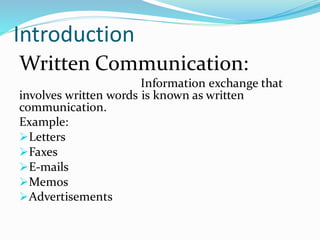
Topic
Introduction
Written Communication:
Information exchange that
involves written words is known as written
communication.
Example:
➢Letters
➢Faxes
➢E-mails
➢Memos
➢Advertisements
Why Written Communication?
➢Written communication is flexible . Spoken
words cannot be taken back but we can
rewrite something already written.
➢Record can be kept of written words . That is
why at government level, written
communication is used
➢It helps us not only in sharing of ideas or
opinions but also for presenting of view
points.
➢Written communication can also serve as a
form of acknowledgement-proof that
something
➢Writing also means that information can be
transferred without relying on memory.
➢Written works helps to clarify thoughts and
thinking processes as it allow you to
understand things at your own pace.
Tips on Written Communication
1. The Writing Process :
Following are the three
stages in writing process :
➢Planning
➢Writing
➢Editing
Planning
➢What you want to say
➢List down all the points
➢Arrange them in a logical and suitable
sequence
➢Relevant detail should not be omitted
Writing
➢Pre-writing stage
➢Move from something concrete to
something more abstract and expressive
➢Adopt a straight-forward style
➢Your message can be understood easily
Editing
➢Print your data
➢Grammatical errors should be checked
➢Smooth language flow
➢Reduce each sentence to its essential parts
➢Avoid the overuse of sub-ordinate clause
Pitfalls To Avoid
Following are the pitfalls to avoid ;
I. Confusing Language
II. Poor sentence structure
III.Information overload
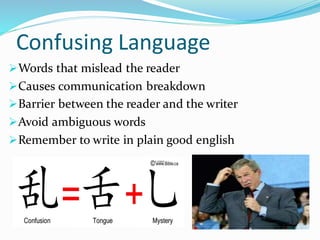
Confusing Language
➢Words that mislead the reader
➢Causes communication breakdown
➢Barrier between the reader and the writer
➢Avoid ambiguous words
➢Remember to write in plain good english
Poor Sentence Structure
➢Leads to fragmented writing
➢Impede reader’s understanding
➢Sentences should be short and concise
➢Order of words is important
Information Overload
➢Information that makes overwhelmed and
confused
➢Cause frustration
➢Casts doubt on writer’s credibility
➢Message should be clear, concise and
relevant
Advantages of written
communication
➢Permanent record
➢Legal document
➢Mass dissemination
➢Suitable for long message
➢Accountability
➢Goodwill and image building
Disadvantages of written
communication
➢Slow and time consuming
➢Lengthyand expensive
➢Lacks personal touch
➢Unsuitable for illiterate people
➢Filing
Any Questions or Suggestions
otherwise

Presentation3.pdf