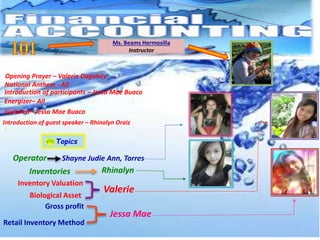
Ms. Beams Hermosilla
Instructor
Opening Prayer – Valerie Dagohoy
Energizer– All
Topics
Inventories Rhinalyn
Inventory Valuation
Biological Asset
Valerie
Gross profit
Retail Inventory Method
Jessa Mae
National Anthem - All
Introduction of participants – Jessa Mae Buaco
Guitarist– Jessa Mae Buaco
Introduction of guest speaker – Rhinalyn Oraiz
Operator Shayne Judie Ann, Torres
Inventories
Inventories -are assets which held for sale of ordinary business by
the process of production for such sale the form of materials or supplies
to be consumed in the production process the rendering of service.
Classes of inventories
• Trading concern
• Manufacturing
Kinds of Manufacturing concern
• Finished good
• Goods in process
• Raw material
A consigned is a methods of
marketing goods which
called consignor transfer
physical certain good to
agent called consignee who
sell them of the owner
behalf..
2 system in accounting for
inventories
• Periodic system
• Perpetual system
Trade discounts and cash discount
Trade discount- are deduction from the list of catalog price in order to
arrive at the invoice price which is the amount actually charged to the buyers.
Thus trade discount are not recorded.
Cash discount- are deduction from the invoice price when payment is
made within the discount period. The purpose of cash is to encourage the goods
may be resold.
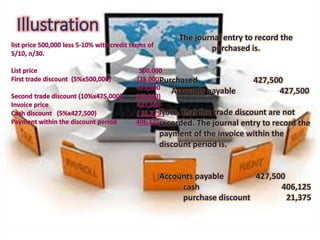
Illustration
list price 500,000 less 5-10% with credit terms of
5/10, n/30.
List price 500,000
First trade discount (5%x500,000) (25,000)
475,000
Second trade discount (10%x475,000) (47,500)
Invoice price 427,500
Cash discount (5%x427,500) ( 21,375 )
Payment within the discount period 406,125
The journal entry to record the
purchased is.
Purchased 427,500
Accounts payable 427,500
Note. that the trade discount are not
recorded. The journal entry to record the
payment of the invoice within the
discount period is.
Accounts payable 427,500
cash 406,125
purchase discount 21,375
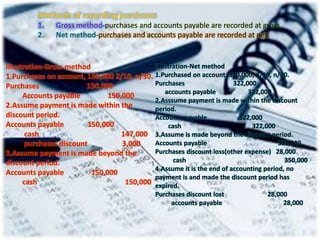
Methods of recording purchases
1. Gross method-purchases and accounts payable are recorded at gross.
2. Net method-purchases and accounts payable are recorded at net.
Illustration-Gross method
1.Purchases on account, 150,000 2/10, n/30.
Purchases 150,000
Accounts payable 150,000
2.Assume payment is made within the
discount period.
Accounts payable 150,000
cash 147,000
purchases discount 3,000
3.Assume payment is made beyond the
discount period.
Accounts payable 150,000
cash 150,000
Illustration-Net method
1.Purchased on account, 350,000, 8/10, n/30.
Purchases 322,000
accounts payable 322,000
2.Asssume payment is made within the discount
period.
Accounts payable 322,000
cash 322,000
3.Assume is made beyond the discount period.
Accounts payable 322,000
Purchases discount loss(other expense) 28,000
cash 350,000
4.Assume it is the end of accounting period, no
payment is and made the discount period has
expired.
Purchases discount lost 28,000
accounts payable 28,000
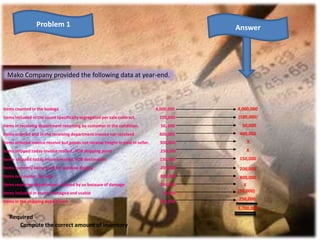
Problem 1
Mako Company provided the following data at year-end.
Items counted in the bodega 4,000,000
Items included in the count specifically segregated per sale contract. 100,000
Items in receiving department returning by customer in the condition. 50, 000
Items ordered and in the receiving department invoice nor received 400,000
Items ordered invoice receive but goods not receive freight in paid in seller. 300,000
Items shipped today invoice mailed , FOB shipping point 250,000
Items shipped today invoice mailed, FOB destination 150,000
Items currently being used for window display 200,000
Items on counter for sale 800,000
Items receiving department , refused by us because of damage 180,000
Items included in count, damaged and usable 50,000
Items in the shipping department 250,000
Required.
Compute the correct amount of inventory.
4,000,000
(100,000)
Answer
50,000
400,000
X
X
150,000
200,000
800,000
X
(50,000)
250,000
5,700,000
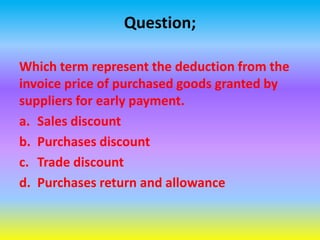
Question;
Which term represent the deduction from the
invoice price of purchased goods granted by
suppliers for early payment.
a. Sales discount
b. Purchases discount
c. Trade discount
d. Purchases return and allowance
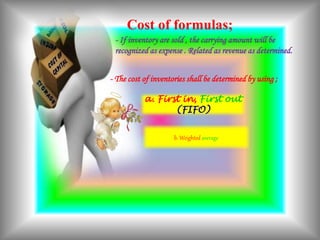
Cost of formulas;
- The cost of inventories shall be determined by using ;
a. First in, First out
(FIFO)
b. Weighted average
- If inventory are sold , the carrying amount will be
recognized as expense . Related as revenue as determined.
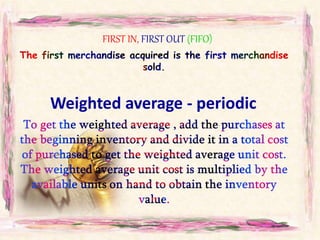
FIRST IN, FIRST OUT (FIFO)
Weighted average - periodic
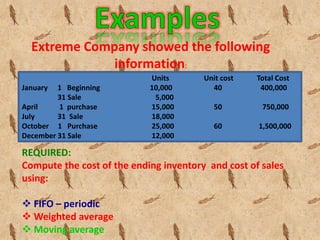
Extreme Company showed the following
information:
Units Unit cost Total Cost
January 1 Beginning 10,000 40 400,000
31 Sale 5,000
April 1 purchase 15,000 50 750,000
July 31 Sale 18,000
October 1 Purchase 25,000 60 1,500,000
December 31 Sale 12,000
REQUIRED:
Compute the cost of the ending inventory and cost of sales
using:
 FIFO – periodic
 Weighted average
 Moving average
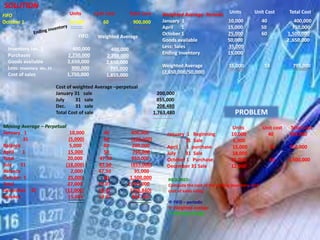
SOLUTION
Weighted Average- Periodic
January 1 10,000 40 400,000
April 1 15,000 50 750,000
October 1 25,000 60 1,500,000
Goods available 50,000 2 ,650,000
Less: Sales 35,000
Ending Inventory 15,000
Weighted Average 15,000 53 795,000
(2,650,000/50,000)
Units Unit cost Total Cost
January 1 Beginning 10,000 40 400,000
31 Sale 5,000
April 1 purchase 15,000 50 750,000
July 31 Sale 18,000
October 1 Purchase 25,000 60 1,500,000
December 31 Sale 12,000
FIFO
Inventory Jan. 1 400,000
Purchases 2,250,000
Goods available 2,650,000
Less: Inventory dec.31 900,000
Cost of sales 1,750,000
Moving Average – Perpetual
January 1 10,000 40 400,000
31 (5,000) 40 (200,000)
Balance 5,000 40 200,000
April 1 15,000 50 750,000
Total 20,000 47.50 950,000
July 31 (18,000) 47.50 (855,000)
Balance 2,000 47.50 95,000
October 1 25,000 60 1,500,000
Total 27,000 59.07 1,595,000
December 31 (12,000) 59.07 (708,840)
Balance 15,000 59.07 886,160
Cost of weighted Average –perpetual
January 31 sale 200,000
July 31 sale 855,000
Dec. 31 sale 208,480
Total Cost of sale 1,763,480 PROBLEM
Units Unit Cost Total CostFIFO
October 1 15,000 60 900,000
REQUIRED:
Compute the cost of the ending inventory and
cost of sales using:
 FIFO – periodic
 Weighted average
 Moving average
Weighted Average
400,000
2,250,000
2,650,000
795,000
1,855,000
Units Unit Cost Total Cost
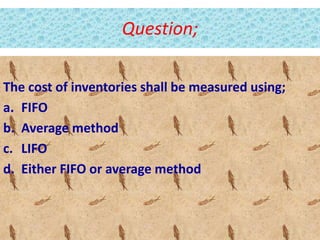
Question;
The cost of inventories shall be measured using;
a. FIFO
b. Average method
c. LIFO
d. Either FIFO or average method
BIOLOGICAL ASSETS
‘’Agricultural produce’’
‘’Government grant related to biological asset’’
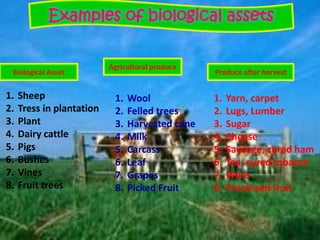
Examples of biological assets
Biological Asset
Agricultural produce
Produce after harvest
1. Sheep
2. Tress in plantation
3. Plant
4. Dairy cattle
5. Pigs
6. Bushes
7. Vines
8. Fruit trees
1. Wool
2. Felled trees
3. Harvested cane
4. Milk
5. Carcass
6. Leaf
7. Grapes
8. Picked Fruit
1. Yarn, carpet
2. Lugs, Lumber
3. Sugar
4. Cheese
5. Sausage, cured ham
6. Tea, cured tobacco
7. Wine
8. Processed fruit
At the end of the period of biological asset shall be measured at fair value less cost of
disposal
Fair value is the amount for which an asset could be exchange between knowledgeable,
willing parties in an arms length transaction.
Cost of disposal is relating to the cost of an asset that usually on in disposition.
Is measurable at fair value less cost of disposal at the point of
harvest.
Fair value of Agricultural produce;
Diary cattle P 3,000,000
Beef cattle 5,000,000
Sheep 2,000,000 P 10,000,000
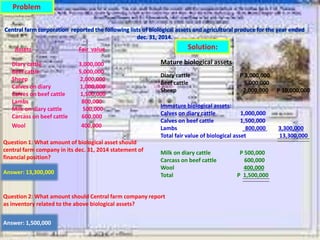
Problem
Central farm corporation reported the following lists of biological assets and agricultural produce for the year ended
dec. 31, 2014.
Assets Fair value
Diary cattle 3,000,000
Beef cattle 5,000,000
Sheep 2,000,000
Calves on diary 1,000,000
Calves on beef cattle 1,500,000
Lambs 800,000
Milk on diary cattle 500,000
Carcass on beef cattle 600,000
Wool 400,000
Question 1: What amount of biological asset should
central farm company in its dec. 31, 2014 statement of
financial position?
Answer: 13,300,000
Question 2: What amount should Central farm company report
as inventory related to the above biological assets?
Answer: 1,500,000
Mature biological assets:
Immature biological assets:
Calves on diary cattle 1,000,000
Calves on beef cattle 1,500,000
Lambs 800,000 3,300,000
Total fair value of biological asset 13,300,000
Milk on diary cattle P 500,000
Carcass on beef cattle 600,000
Wool 400,000
Total P 1,500,000
Solution:
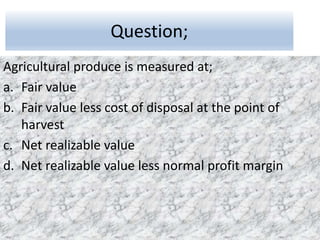
Question;
Agricultural produce is measured at;
a. Fair value
b. Fair value less cost of disposal at the point of
harvest
c. Net realizable value
d. Net realizable value less normal profit margin
GROSS
PROFIT
Based on the assumption that the
rate of gross profit and therefore
the ratio of the cost of goods sold
to net sales is relatively constant
from period to period.
b. Theft of the merchandise has occurred and
the amount of inventory is required for
insurance purposes.
Common Reasons of making an estimate of
the cost of the goods on hand:
a. The inventory is destroyed by the fire and other
catastrophe or…
C. A physical count of the goods on hand is made and it is
necessary to prove the correctness of such count by
making an estimate.
D. Interim financial statements are prepared and a physical
count of the goods on hands is not necessary
BASIC FORMULA UNDER THE GROSS
PROFIT METHOD
GOODS AVAILABLE FOR SALE (GAS) X X
Less: Cost of Sale X X
Ending Inventory X X
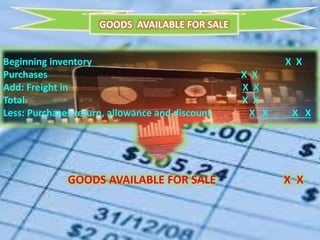
GOODS AVAILABLE FOR SALE X X
GOODS AVAILABLE FOR SALE
Beginning inventory X X
Purchases X X
Add: Freight in X X
Total X X
Less: Purchases return, allowance and discount X X X X
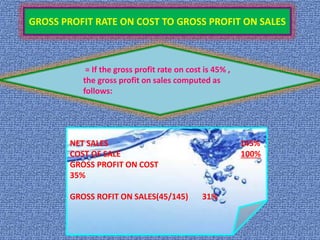
GROSS PROFIT RATE ON COST TO GROSS PROFIT ON SALES
= If the gross profit rate on cost is 45% ,
the gross profit on sales computed as
follows:
NET SALES 145%
COST OF SALE 100%
GROSS PROFIT ON COST
35%
GROSS ROFIT ON SALES(45/145) 31%
GROSS PROFIT RATE ON SALES TO GROSS PROFIT
ON COST
= If the gross profit on sales is 40% the gross profit on cost is
computed as follows:
Avarice Company has a recent gross profit history of 40% of net sales. The
following data are available from the accounting records for the three months
ended March 31, 2014.
Inventory- January 1 650,000
Purchases 3,20,0000
Net Sales 4,500,000
Purchase return 75,000
Freight in 50,000
Using the gross profit method , what is the estimated cost of the inventory on
March 31,2014?
PROBLEM
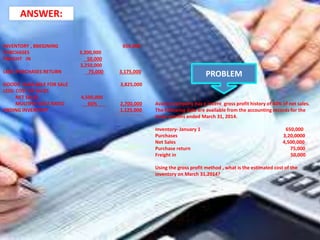
INVENTORY , BBEGINING 650,000
PURCHASES 3,200,000
FREIGHT IN 50,000
3,250,000
LESS: PURCHASES RETURN 75,000 3,175,000
GOODS AVAILABLE FOR SALE 3,825,000
LESS: COST OF SALES
NET SALES 4,500,000
MULTIPLY COST RATIO 60% 2,700,000
ENDING INVENTORY 1,125,000
ANSWER:
Avarice Company has a recent gross profit history of 40% of net sales.
The following data are available from the accounting records for the
three months ended March 31, 2014.
Inventory- January 1 650,000
Purchases 3,20,0000
Net Sales 4,500,000
Purchase return 75,000
Freight in 50,000
Using the gross profit method , what is the estimated cost of the
inventory on March 31,2014?
PROBLEM
Retail
Inventory
Method
The use of the retail inventory method required that
record to kept which must show the following.
a) Beginning inventory valued at cost and at retailed price.
b) Purchased during the period at cost and at retail price.
c) Adjustments to the original retail price such as additional mark up, mark up
cancelation, mark down and mark down cancelation.
d) Other adjustment such as department transfer, breakage, shrinkage, theft,
damaged goods and employees discount.
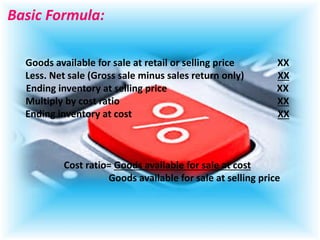
Basic Formula:
Goods available for sale at retail or selling price XX
Less. Net sale (Gross sale minus sales return only) XX
Ending inventory at selling price XX
Multiply by cost ratio XX
Ending inventory at cost XX
Cost ratio= Goods available for sale at cost
Goods available for sale at selling price
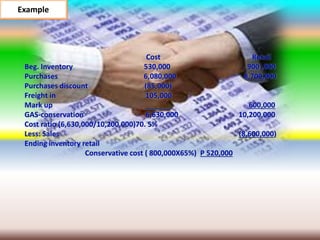
Cost Retail
Beg. Inventory 530,000 900 ,000
Purchases 6,080,000 8,700,000
Purchases discount (85,000)
Freight in 105,000
Mark up 600,000
GAS-conservation 6,630,000 10,200,000
Cost ratio (6,630,000/10,200,000)70. 5%
Less: Sales (8,600,000)
Ending inventory retail
Conservative cost ( 800,000X65%) P 520,000
Example

Presentation2

  • 1.
    Ms. Beams Hermosilla Instructor OpeningPrayer – Valerie Dagohoy Energizer– All Topics Inventories Rhinalyn Inventory Valuation Biological Asset Valerie Gross profit Retail Inventory Method Jessa Mae National Anthem - All Introduction of participants – Jessa Mae Buaco Guitarist– Jessa Mae Buaco Introduction of guest speaker – Rhinalyn Oraiz Operator Shayne Judie Ann, Torres
  • 2.
  • 3.
    Inventories -are assetswhich held for sale of ordinary business by the process of production for such sale the form of materials or supplies to be consumed in the production process the rendering of service. Classes of inventories • Trading concern • Manufacturing Kinds of Manufacturing concern • Finished good • Goods in process • Raw material
  • 4.
    A consigned isa methods of marketing goods which called consignor transfer physical certain good to agent called consignee who sell them of the owner behalf.. 2 system in accounting for inventories • Periodic system • Perpetual system
  • 5.
    Trade discounts andcash discount Trade discount- are deduction from the list of catalog price in order to arrive at the invoice price which is the amount actually charged to the buyers. Thus trade discount are not recorded. Cash discount- are deduction from the invoice price when payment is made within the discount period. The purpose of cash is to encourage the goods may be resold.
  • 6.
    Illustration list price 500,000less 5-10% with credit terms of 5/10, n/30. List price 500,000 First trade discount (5%x500,000) (25,000) 475,000 Second trade discount (10%x475,000) (47,500) Invoice price 427,500 Cash discount (5%x427,500) ( 21,375 ) Payment within the discount period 406,125 The journal entry to record the purchased is. Purchased 427,500 Accounts payable 427,500 Note. that the trade discount are not recorded. The journal entry to record the payment of the invoice within the discount period is. Accounts payable 427,500 cash 406,125 purchase discount 21,375
  • 7.
    Methods of recordingpurchases 1. Gross method-purchases and accounts payable are recorded at gross. 2. Net method-purchases and accounts payable are recorded at net. Illustration-Gross method 1.Purchases on account, 150,000 2/10, n/30. Purchases 150,000 Accounts payable 150,000 2.Assume payment is made within the discount period. Accounts payable 150,000 cash 147,000 purchases discount 3,000 3.Assume payment is made beyond the discount period. Accounts payable 150,000 cash 150,000 Illustration-Net method 1.Purchased on account, 350,000, 8/10, n/30. Purchases 322,000 accounts payable 322,000 2.Asssume payment is made within the discount period. Accounts payable 322,000 cash 322,000 3.Assume is made beyond the discount period. Accounts payable 322,000 Purchases discount loss(other expense) 28,000 cash 350,000 4.Assume it is the end of accounting period, no payment is and made the discount period has expired. Purchases discount lost 28,000 accounts payable 28,000
  • 8.
    Problem 1 Mako Companyprovided the following data at year-end. Items counted in the bodega 4,000,000 Items included in the count specifically segregated per sale contract. 100,000 Items in receiving department returning by customer in the condition. 50, 000 Items ordered and in the receiving department invoice nor received 400,000 Items ordered invoice receive but goods not receive freight in paid in seller. 300,000 Items shipped today invoice mailed , FOB shipping point 250,000 Items shipped today invoice mailed, FOB destination 150,000 Items currently being used for window display 200,000 Items on counter for sale 800,000 Items receiving department , refused by us because of damage 180,000 Items included in count, damaged and usable 50,000 Items in the shipping department 250,000 Required. Compute the correct amount of inventory. 4,000,000 (100,000) Answer 50,000 400,000 X X 150,000 200,000 800,000 X (50,000) 250,000 5,700,000
  • 9.
    Question; Which term representthe deduction from the invoice price of purchased goods granted by suppliers for early payment. a. Sales discount b. Purchases discount c. Trade discount d. Purchases return and allowance
  • 11.
    Cost of formulas; -The cost of inventories shall be determined by using ; a. First in, First out (FIFO) b. Weighted average - If inventory are sold , the carrying amount will be recognized as expense . Related as revenue as determined.
  • 12.
    FIRST IN, FIRSTOUT (FIFO) Weighted average - periodic
  • 13.
    Extreme Company showedthe following information: Units Unit cost Total Cost January 1 Beginning 10,000 40 400,000 31 Sale 5,000 April 1 purchase 15,000 50 750,000 July 31 Sale 18,000 October 1 Purchase 25,000 60 1,500,000 December 31 Sale 12,000 REQUIRED: Compute the cost of the ending inventory and cost of sales using:  FIFO – periodic  Weighted average  Moving average
  • 14.
    SOLUTION Weighted Average- Periodic January1 10,000 40 400,000 April 1 15,000 50 750,000 October 1 25,000 60 1,500,000 Goods available 50,000 2 ,650,000 Less: Sales 35,000 Ending Inventory 15,000 Weighted Average 15,000 53 795,000 (2,650,000/50,000) Units Unit cost Total Cost January 1 Beginning 10,000 40 400,000 31 Sale 5,000 April 1 purchase 15,000 50 750,000 July 31 Sale 18,000 October 1 Purchase 25,000 60 1,500,000 December 31 Sale 12,000 FIFO Inventory Jan. 1 400,000 Purchases 2,250,000 Goods available 2,650,000 Less: Inventory dec.31 900,000 Cost of sales 1,750,000 Moving Average – Perpetual January 1 10,000 40 400,000 31 (5,000) 40 (200,000) Balance 5,000 40 200,000 April 1 15,000 50 750,000 Total 20,000 47.50 950,000 July 31 (18,000) 47.50 (855,000) Balance 2,000 47.50 95,000 October 1 25,000 60 1,500,000 Total 27,000 59.07 1,595,000 December 31 (12,000) 59.07 (708,840) Balance 15,000 59.07 886,160 Cost of weighted Average –perpetual January 31 sale 200,000 July 31 sale 855,000 Dec. 31 sale 208,480 Total Cost of sale 1,763,480 PROBLEM Units Unit Cost Total CostFIFO October 1 15,000 60 900,000 REQUIRED: Compute the cost of the ending inventory and cost of sales using:  FIFO – periodic  Weighted average  Moving average Weighted Average 400,000 2,250,000 2,650,000 795,000 1,855,000 Units Unit Cost Total Cost
  • 15.
    Question; The cost ofinventories shall be measured using; a. FIFO b. Average method c. LIFO d. Either FIFO or average method
  • 16.
  • 17.
  • 18.
    Examples of biologicalassets Biological Asset Agricultural produce Produce after harvest 1. Sheep 2. Tress in plantation 3. Plant 4. Dairy cattle 5. Pigs 6. Bushes 7. Vines 8. Fruit trees 1. Wool 2. Felled trees 3. Harvested cane 4. Milk 5. Carcass 6. Leaf 7. Grapes 8. Picked Fruit 1. Yarn, carpet 2. Lugs, Lumber 3. Sugar 4. Cheese 5. Sausage, cured ham 6. Tea, cured tobacco 7. Wine 8. Processed fruit
  • 19.
    At the endof the period of biological asset shall be measured at fair value less cost of disposal Fair value is the amount for which an asset could be exchange between knowledgeable, willing parties in an arms length transaction. Cost of disposal is relating to the cost of an asset that usually on in disposition.
  • 20.
    Is measurable atfair value less cost of disposal at the point of harvest. Fair value of Agricultural produce;
  • 21.
    Diary cattle P3,000,000 Beef cattle 5,000,000 Sheep 2,000,000 P 10,000,000 Problem Central farm corporation reported the following lists of biological assets and agricultural produce for the year ended dec. 31, 2014. Assets Fair value Diary cattle 3,000,000 Beef cattle 5,000,000 Sheep 2,000,000 Calves on diary 1,000,000 Calves on beef cattle 1,500,000 Lambs 800,000 Milk on diary cattle 500,000 Carcass on beef cattle 600,000 Wool 400,000 Question 1: What amount of biological asset should central farm company in its dec. 31, 2014 statement of financial position? Answer: 13,300,000 Question 2: What amount should Central farm company report as inventory related to the above biological assets? Answer: 1,500,000 Mature biological assets: Immature biological assets: Calves on diary cattle 1,000,000 Calves on beef cattle 1,500,000 Lambs 800,000 3,300,000 Total fair value of biological asset 13,300,000 Milk on diary cattle P 500,000 Carcass on beef cattle 600,000 Wool 400,000 Total P 1,500,000 Solution:
  • 22.
    Question; Agricultural produce ismeasured at; a. Fair value b. Fair value less cost of disposal at the point of harvest c. Net realizable value d. Net realizable value less normal profit margin
  • 23.
  • 24.
    Based on theassumption that the rate of gross profit and therefore the ratio of the cost of goods sold to net sales is relatively constant from period to period.
  • 25.
    b. Theft ofthe merchandise has occurred and the amount of inventory is required for insurance purposes. Common Reasons of making an estimate of the cost of the goods on hand: a. The inventory is destroyed by the fire and other catastrophe or… C. A physical count of the goods on hand is made and it is necessary to prove the correctness of such count by making an estimate. D. Interim financial statements are prepared and a physical count of the goods on hands is not necessary
  • 26.
    BASIC FORMULA UNDERTHE GROSS PROFIT METHOD GOODS AVAILABLE FOR SALE (GAS) X X Less: Cost of Sale X X Ending Inventory X X
  • 27.
    GOODS AVAILABLE FORSALE X X GOODS AVAILABLE FOR SALE Beginning inventory X X Purchases X X Add: Freight in X X Total X X Less: Purchases return, allowance and discount X X X X
  • 28.
    GROSS PROFIT RATEON COST TO GROSS PROFIT ON SALES = If the gross profit rate on cost is 45% , the gross profit on sales computed as follows: NET SALES 145% COST OF SALE 100% GROSS PROFIT ON COST 35% GROSS ROFIT ON SALES(45/145) 31%
  • 29.
    GROSS PROFIT RATEON SALES TO GROSS PROFIT ON COST = If the gross profit on sales is 40% the gross profit on cost is computed as follows:
  • 30.
    Avarice Company hasa recent gross profit history of 40% of net sales. The following data are available from the accounting records for the three months ended March 31, 2014. Inventory- January 1 650,000 Purchases 3,20,0000 Net Sales 4,500,000 Purchase return 75,000 Freight in 50,000 Using the gross profit method , what is the estimated cost of the inventory on March 31,2014? PROBLEM
  • 31.
    INVENTORY , BBEGINING650,000 PURCHASES 3,200,000 FREIGHT IN 50,000 3,250,000 LESS: PURCHASES RETURN 75,000 3,175,000 GOODS AVAILABLE FOR SALE 3,825,000 LESS: COST OF SALES NET SALES 4,500,000 MULTIPLY COST RATIO 60% 2,700,000 ENDING INVENTORY 1,125,000 ANSWER: Avarice Company has a recent gross profit history of 40% of net sales. The following data are available from the accounting records for the three months ended March 31, 2014. Inventory- January 1 650,000 Purchases 3,20,0000 Net Sales 4,500,000 Purchase return 75,000 Freight in 50,000 Using the gross profit method , what is the estimated cost of the inventory on March 31,2014? PROBLEM
  • 32.
  • 33.
    The use ofthe retail inventory method required that record to kept which must show the following. a) Beginning inventory valued at cost and at retailed price. b) Purchased during the period at cost and at retail price. c) Adjustments to the original retail price such as additional mark up, mark up cancelation, mark down and mark down cancelation. d) Other adjustment such as department transfer, breakage, shrinkage, theft, damaged goods and employees discount.
  • 34.
    Basic Formula: Goods availablefor sale at retail or selling price XX Less. Net sale (Gross sale minus sales return only) XX Ending inventory at selling price XX Multiply by cost ratio XX Ending inventory at cost XX Cost ratio= Goods available for sale at cost Goods available for sale at selling price
  • 35.
    Cost Retail Beg. Inventory530,000 900 ,000 Purchases 6,080,000 8,700,000 Purchases discount (85,000) Freight in 105,000 Mark up 600,000 GAS-conservation 6,630,000 10,200,000 Cost ratio (6,630,000/10,200,000)70. 5% Less: Sales (8,600,000) Ending inventory retail Conservative cost ( 800,000X65%) P 520,000 Example