Inventory &
Merchandising
Operations
Learning Objectives
• Understand the nature of inventory
• Record inventory related transactions
• Understand different inventory cost assumptions
• Analyze effects of inventory errors
• Evaluate a company's retailing operations
Inventory
• Inventory is the heart of a merchandising business.
• The basic concept of identifying inventory is through cost of
goods sold or cost of sales.
Contrasting a Service company with a Merchandiser
Inventory for Manufacturers
Sales Price Vs Cost of Inventory
• Sales revenue is based on the sale price of inventory sold.
• Cost of goods sold is based on the cost of inventory sold.
• Inventory on the Balance Sheet is based on the cost of
inventory still on hand.
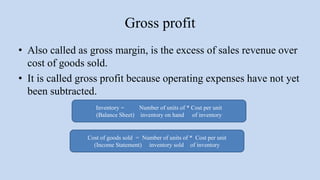
Gross profit
• Also called as gross margin, is the excess of sales revenue over
cost of goods sold.
• It is called gross profit because operating expenses have not yet
been subtracted.
Inventory = Number of units of * Cost per unit
(Balance Sheet) inventory on hand of inventory
Cost of goods sold = Number of units of * Cost per unit
(Income Statement) inventory sold of inventory
Number of Units of Inventory
➢It is determined from the accounting records.
➢Companies do not include any goods in their inventory that
they hold on consignment (because they belong to another
entity).
➢Entity will include their own inventory that is held by the other
company.
➢Includes inventory in transit from suppliers or to consumers.
Question
ACS started & completed the financial year with inventory valued
$15,000 and $20,000 respectively. Its cost of goods sold for the
period $160,000. How much was the total inventory purchased
during the period?
Solution
Remember!
Beginning inventory + Purchases =
Ending Inventory + Cost of Goods sold
Different Inventory Cost Assumptions
Specific Identification
Methods
First In First Out
Last In First Out
Weighted average cost
method
Inventory that are
not ordinarily
interchangeable
Inventory that are
ordinarily
interchangeable
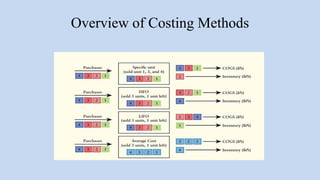
Overview of Costing Methods
Specific Identification
• Some businesses deal in unique inventory items such
as automobiles, antique furniture, jewelry and real
estate.
• These businesses cost their inventories at the specific
cost of the particular unit.
• This method is also called as specific-unit-cost
method.
First In First Out (FIFO)
• Under this method the first costs into inventory are the first costs
assigned to the cost of goods sold, therefore it is referred as First In First
Out.
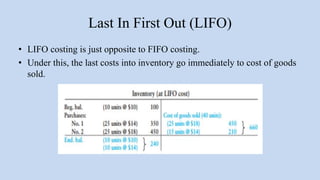
Last In First Out (LIFO)
• LIFO costing is just opposite to FIFO costing.
• Under this, the last costs into inventory go immediately to cost of goods
sold.
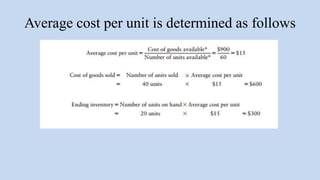
Average Cost Method
• Sometimes called weighted average method.
• It is based on the average cost of inventory during the
period.
• Unlike LIFO and FIFO, the inventory costs are no
longer relevant when the inventory is sold.
Average cost per unit is determined as follows
Uses of various inventory methods
Effects of FIFO, LIFO & Average Cost on COGS,
Gross Profit & Ending Inventory
Contrasts among FIFO & LIFO when inventory
costs are increasing
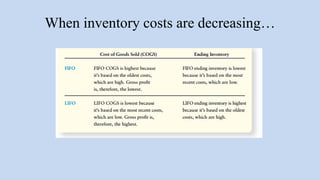
When inventory costs are decreasing…
Comparison of the Inventory Methods
• Measuring Cost of Goods sold
– LIFO assigns the most recent inventory costs to expense.
– FIFO matches older inventory costs against revenue.
– LIFO income is more realistic.
• Measuring Ending Inventory
– FIFO measures the most up-to-date inventory cost on the Balance Sheet.
– LIFO can value inventory at very old costs.
Inventory Issues
Comparability
– It states that the business should use the same accounting methods & procedure from period to
period.
– Changes if any should be able reflect a more relevant & faithful representation of an underlying
phenomenon.
LIFO not allowed under IFRS?
• Latest costs is a better measure of income, on the other hand using older
costs results in more appropriate inventory values on the Balance Sheet.
• LIFO prioritizes income measurements over that of assets & liabilities.
Net Realizable Value (NRV)
• IAS 2 requires inventories to be measured at the lower of cost or Net
Realizable Value (LCNRV)
• NRV is the estimated Selling Price in the ordinary course of business less
the estimated costs of completion & the estimated costs necessary to make
the sale.
NRV=
Estimated
Selling price
Estimated cost
of Completion
Estimated cost
to sell
Evaluating company’s retailing operations
• Owners, managers & investors use ratios to evaluate a business.
2 ratios directly related to
inventory
Inventory turnover =
COGS/Average inventory
Gross Profit Percentage
=Gross Profit/Sales
Gross Profit= Sales- cost of goods sold
Average inventory=(beginning balance
+ending balance )/2
Question
How is the inventory classified in the financial statements?
A) As a liability
B) As an expense
C) As an asset
D) As a revenue
Solution
As an asset
Question
When applying the lower of cost or Net Realizable Value, NRV
means
a) Selling price less discounts
b) Original cost plus profit margin
c) Selling price less cost to sell
d) Original cost less physical deterioration
Solution
Selling price less cost to sell
Question
During a period of rising prices, the inventory method that will
yield higher net income and asset value is
a) LIFO
b) Specific Identification
c) FIFO
d) Average Cost
Solution
c) FIFO
Question
The overstatement of ending inventory in one
period results in
a) An understatement of beginning inventory of
the next period.
b) An understatement of net income of the next
period.
c) An overstatement of net income of the next
period.
d) No effect on net income of the next period.
Solution
B) An understatement of net income of the next period.

PPT2 (1).pdf

  • 1.
  • 2.
    Learning Objectives • Understandthe nature of inventory • Record inventory related transactions • Understand different inventory cost assumptions • Analyze effects of inventory errors • Evaluate a company's retailing operations
  • 3.
    Inventory • Inventory isthe heart of a merchandising business. • The basic concept of identifying inventory is through cost of goods sold or cost of sales.
  • 4.
    Contrasting a Servicecompany with a Merchandiser
  • 5.
  • 6.
    Sales Price VsCost of Inventory • Sales revenue is based on the sale price of inventory sold. • Cost of goods sold is based on the cost of inventory sold. • Inventory on the Balance Sheet is based on the cost of inventory still on hand.
  • 7.
    Gross profit • Alsocalled as gross margin, is the excess of sales revenue over cost of goods sold. • It is called gross profit because operating expenses have not yet been subtracted. Inventory = Number of units of * Cost per unit (Balance Sheet) inventory on hand of inventory Cost of goods sold = Number of units of * Cost per unit (Income Statement) inventory sold of inventory
  • 8.
    Number of Unitsof Inventory ➢It is determined from the accounting records. ➢Companies do not include any goods in their inventory that they hold on consignment (because they belong to another entity). ➢Entity will include their own inventory that is held by the other company. ➢Includes inventory in transit from suppliers or to consumers.
  • 10.
    Question ACS started &completed the financial year with inventory valued $15,000 and $20,000 respectively. Its cost of goods sold for the period $160,000. How much was the total inventory purchased during the period?
  • 11.
    Solution Remember! Beginning inventory +Purchases = Ending Inventory + Cost of Goods sold
  • 12.
    Different Inventory CostAssumptions Specific Identification Methods First In First Out Last In First Out Weighted average cost method Inventory that are not ordinarily interchangeable Inventory that are ordinarily interchangeable
  • 13.
  • 14.
    Specific Identification • Somebusinesses deal in unique inventory items such as automobiles, antique furniture, jewelry and real estate. • These businesses cost their inventories at the specific cost of the particular unit. • This method is also called as specific-unit-cost method.
  • 15.
    First In FirstOut (FIFO) • Under this method the first costs into inventory are the first costs assigned to the cost of goods sold, therefore it is referred as First In First Out.
  • 16.
    Last In FirstOut (LIFO) • LIFO costing is just opposite to FIFO costing. • Under this, the last costs into inventory go immediately to cost of goods sold.
  • 17.
    Average Cost Method •Sometimes called weighted average method. • It is based on the average cost of inventory during the period. • Unlike LIFO and FIFO, the inventory costs are no longer relevant when the inventory is sold.
  • 18.
    Average cost perunit is determined as follows
  • 19.
    Uses of variousinventory methods
  • 20.
    Effects of FIFO,LIFO & Average Cost on COGS, Gross Profit & Ending Inventory
  • 21.
    Contrasts among FIFO& LIFO when inventory costs are increasing
  • 22.
    When inventory costsare decreasing…
  • 23.
    Comparison of theInventory Methods • Measuring Cost of Goods sold – LIFO assigns the most recent inventory costs to expense. – FIFO matches older inventory costs against revenue. – LIFO income is more realistic. • Measuring Ending Inventory – FIFO measures the most up-to-date inventory cost on the Balance Sheet. – LIFO can value inventory at very old costs.
  • 24.
    Inventory Issues Comparability – Itstates that the business should use the same accounting methods & procedure from period to period. – Changes if any should be able reflect a more relevant & faithful representation of an underlying phenomenon.
  • 25.
    LIFO not allowedunder IFRS? • Latest costs is a better measure of income, on the other hand using older costs results in more appropriate inventory values on the Balance Sheet. • LIFO prioritizes income measurements over that of assets & liabilities.
  • 26.
    Net Realizable Value(NRV) • IAS 2 requires inventories to be measured at the lower of cost or Net Realizable Value (LCNRV) • NRV is the estimated Selling Price in the ordinary course of business less the estimated costs of completion & the estimated costs necessary to make the sale. NRV= Estimated Selling price Estimated cost of Completion Estimated cost to sell
  • 27.
    Evaluating company’s retailingoperations • Owners, managers & investors use ratios to evaluate a business. 2 ratios directly related to inventory Inventory turnover = COGS/Average inventory Gross Profit Percentage =Gross Profit/Sales Gross Profit= Sales- cost of goods sold Average inventory=(beginning balance +ending balance )/2
  • 28.
    Question How is theinventory classified in the financial statements? A) As a liability B) As an expense C) As an asset D) As a revenue
  • 29.
  • 30.
    Question When applying thelower of cost or Net Realizable Value, NRV means a) Selling price less discounts b) Original cost plus profit margin c) Selling price less cost to sell d) Original cost less physical deterioration
  • 31.
  • 32.
    Question During a periodof rising prices, the inventory method that will yield higher net income and asset value is a) LIFO b) Specific Identification c) FIFO d) Average Cost
  • 33.
  • 34.
    Question The overstatement ofending inventory in one period results in a) An understatement of beginning inventory of the next period. b) An understatement of net income of the next period. c) An overstatement of net income of the next period. d) No effect on net income of the next period.
  • 35.
    Solution B) An understatementof net income of the next period.