George Grudev 11-Jan.-2008 Strategic Sourcing –  Putting  Theory into Actual Practice
Show Me Examples demonstrating unique approaches to sourcing which yielded the best customer value High Leverage China Sourcing of Antiperspirant Salt Toll Buying of Silicone Feedstock for Emulsion Production Low Leverage Single Source PPG-14 Butyl Ether
China Sourcing Antiperspirant  Salt Strategy Develop unique strategic sourcing option for aluminum-zirconium tetrachlorohydrex-gly (Zr-based antiperspirant actives are used in sticks) Large portion of the cost to produce Zr-based active is in conversion (drying) and asset base (mix tanks, spray tower, classifiers, mills) Find low cost region to place asset and produce RM costs don’t markedly change by geography (Al, ZBC, HCl, glycine) Small NA supply base (2 suppliers)  Largest single use of Zr-based active in NA where customer growth > 10% per annum sourcing from both domestic suppliers Additional competition from new entrant How Build additional capacity with key 3 rd  supplier; support future growth (2007 onward) Build back competition following demise of former 3 rd  US-based supplier in 2003 Leverage historic domestic supply base in future negotiations Target emerging market sourcing; key customer global initiative Total Sourcing Value ~ USD 6.2 MM at maximum potential
A Plan Comes Together Plan Encourage key EU supplier w/o US asset base to invest in overseas production to challenge incumbents using off-shore model Following plant start-up, customer would base-load over course of 18 months to maximize opportunity strategic supplier w.low-cost capacity to support growth and physical savings Details Supplier anxious to expand into NA market for this item – but not from existing EU asset base Supplier had existing operation in China (near ocean port) AP plant would be ‘bolt-on’ to existing infrastructure; only partial investment required China plant would reduce material ex-works cost significantly (15% +) But importation would add logistics / duty costs plus other complexities
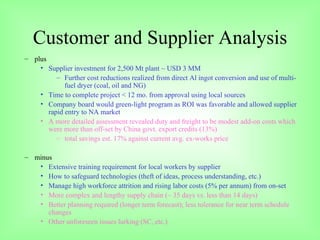
Customer and Supplier Analysis plus Supplier investment for 2,500 Mt plant ~ USD 3 MM Further cost reductions realized from direct Al ingot conversion and use of multi-fuel dryer (coal, oil and NG) Time to complete project < 12 mo. from approval using local sources Company board would green-light program as ROI was favorable and allowed supplier rapid entry to NA market A more detailed assessment revealed duty and freight to be modest add-on costs which were more than off-set by China govt. export credits (13%) total savings est. 17% against current avg. ex-works price minus Extensive training requirement for local workers by supplier How to safeguard technologies (theft of ideas, process understanding, etc.) Manage high workforce attrition and rising labor costs (5% per annum) from on-set More complex and lengthy supply chain (~ 35 days vs. less than 14 days) Better planning required (longer term forecast); less tolerance for near term schedule changes Other unforeseen issues lurking (SC, etc.)
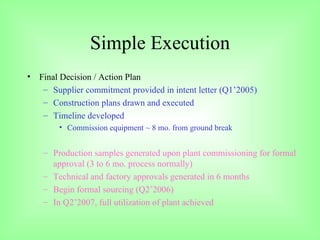
Simple Execution Final Decision / Action Plan Supplier commitment provided in intent letter (Q1’2005) Construction plans drawn and executed Timeline developed Commission equipment ~ 8 mo. from ground break Production samples generated upon plant commissioning for formal approval (3 to 6 mo. process normally) Technical and factory approvals generated in 6 months Begin formal sourcing (Q2’2006) In Q2’2007, full utilization of plant achieved
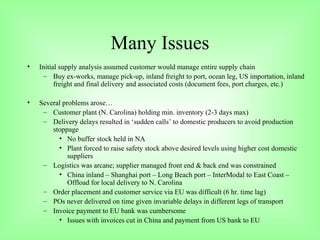
Many Issues Initial supply analysis assumed customer would manage entire supply chain Buy ex-works, manage pick-up, inland freight to port, ocean leg, US importation, inland freight and final delivery and associated costs (document fees, port charges, etc.) Several problems arose… Customer plant (N. Carolina) holding min. inventory (2-3 days max) Delivery delays resulted in ‘sudden calls’ to domestic producers to avoid production stoppage No buffer stock held in NA Plant forced to raise safety stock above desired levels using higher cost domestic suppliers Logistics was arcane; supplier managed front end & back end was constrained China inland – Shanghai port – Long Beach port – InterModal to East Coast – Offload for local delivery to N. Carolina Order placement and customer service via EU was difficult (6 hr. time lag) POs never delivered on time given invariable delays in different legs of transport Invoice payment to EU bank was cumbersome Issues with invoices cut in China and payment from US bank to EU
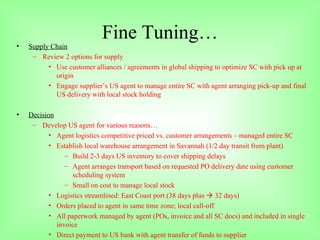
Fine Tuning… Supply Chain Review 2 options for supply Use customer alliances / agreements in global shipping to optimize SC with pick up at origin Engage supplier’s US agent to manage entire SC with agent arranging pick-up and final US delivery with local stock holding Decision Develop US agent for various reasons… Agent logistics competitive priced vs. customer arrangements – managed entire SC Establish local warehouse arrangement in Savannah (1/2 day transit from plant) Build 2-3 days US inventory to cover shipping delays Agent arranges transport based on requested PO delivery date using customer scheduling system Small on cost to manage local stock Logistics streamlined: East Coast port (38 days plus    32 days) Orders placed to agent in same time zone; local call-off All paperwork managed by agent (POs, invoice and all SC docs) and included in single invoice Direct payment to US bank with agent transfer of funds to supplier
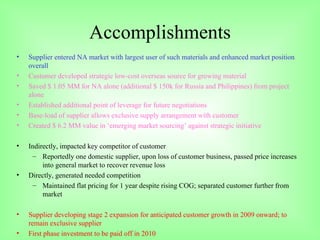
Accomplishments Supplier entered NA market with largest user of such materials and enhanced market position overall Customer developed strategic low-cost overseas source for growing material Saved $ 1.05 MM for NA alone (additional $ 150k for Russia and Philippines) from project alone Established additional point of leverage for future negotiations Base-load of supplier allows exclusive supply arrangement with customer Created $ 6.2 MM value in ‘emerging market sourcing’ against strategic initiative Indirectly, impacted key competitor of customer Reportedly one domestic supplier, upon loss of customer business, passed price increases into general market to recover revenue loss Directly, generated needed competition Maintained flat pricing for 1 year despite rising COG; separated customer further from market Supplier developing stage 2 expansion for anticipated customer growth in 2009 onward; to remain exclusive supplier First phase investment to be paid off in 2010
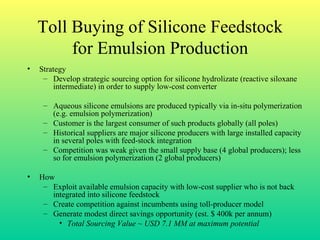
Toll Buying of Silicone Feedstock for Emulsion Production Strategy Develop strategic sourcing option for silicone hydrolizate (reactive siloxane intermediate) in order to supply low-cost converter Aqueous silicone emulsions are produced typically via in-situ polymerization (e.g. emulsion polymerization) Customer is the largest consumer of such products globally (all poles) Historical suppliers are major silicone producers with large installed capacity in several poles with feed-stock integration Competition was weak given the small supply base (4 global producers); less so for emulsion polymerization (2 global producers) How Exploit available emulsion capacity with low-cost supplier who is not back integrated into silicone feedstock Create competition against incumbents using toll-producer model Generate modest direct savings opportunity (est. $ 400k per annum) Total Sourcing Value ~ USD 7.1 MM at maximum potential
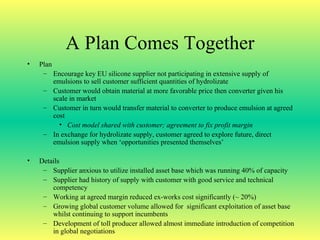
A Plan Comes Together Plan Encourage key EU silicone supplier not participating in extensive supply of emulsions to sell customer sufficient quantities of hydrolizate Customer would obtain material at more favorable price then converter given his scale in market Customer in turn would transfer material to converter to produce emulsion at agreed cost Cost model shared with customer; agreement to fix profit margin In exchange for hydrolizate supply, customer agreed to explore future, direct emulsion supply when ‘opportunities presented themselves’ Details Supplier anxious to utilize installed asset base which was running 40% of capacity Supplier had history of supply with customer with good service and technical competency Working at agreed margin reduced ex-works cost significantly (~ 20%) Growing global customer volume allowed for  significant exploitation of asset base whilst continuing to support incumbents Development of toll producer allowed almost immediate introduction of competition in global negotiations
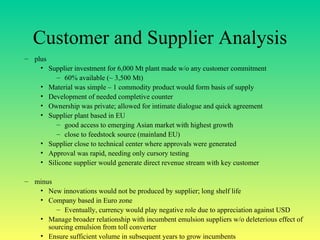
Customer and Supplier Analysis plus Supplier investment for 6,000 Mt plant made w/o any customer commitment 60% available (~ 3,500 Mt) Material was simple – 1 commodity product would form basis of supply Development of needed completive counter Ownership was private; allowed for intimate dialogue and quick agreement Supplier plant based in EU good access to emerging Asian market with highest growth close to feedstock source (mainland EU) Supplier close to technical center where approvals were generated Approval was rapid, needing only cursory testing Silicone supplier would generate direct revenue stream with key customer minus New innovations would not be produced by supplier; long shelf life Company based in Euro zone Eventually, currency would play negative role due to appreciation against USD Manage broader relationship with incumbent emulsion suppliers w/o deleterious effect of sourcing emulsion from toll converter Ensure sufficient volume in subsequent years to grow incumbents
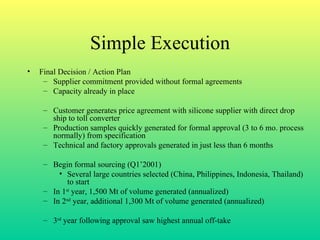
Simple Execution Final Decision / Action Plan Supplier commitment provided without formal agreements Capacity already in place Customer generates price agreement with silicone supplier with direct drop ship to toll converter Production samples quickly generated for formal approval (3 to 6 mo. process normally) from specification Technical and factory approvals generated in just less than 6 months Begin formal sourcing (Q1’2001) Several large countries selected (China, Philippines, Indonesia, Thailand) to start In 1 st  year, 1,500 Mt of volume generated (annualized) In 2 nd  year, additional 1,300 Mt of volume generated (annualized) 3 rd  year following approval saw highest annual off-take
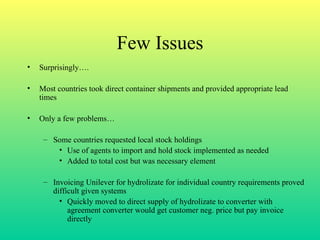
Few Issues Surprisingly…. Most countries took direct container shipments and provided appropriate lead times Only a few problems… Some countries requested local stock holdings Use of agents to import and hold stock implemented as needed Added to total cost but was necessary element Invoicing Unilever for hydrolizate for individual country requirements proved difficult given systems Quickly moved to direct supply of hydrolizate to converter with agreement converter would get customer neg. price but pay invoice directly
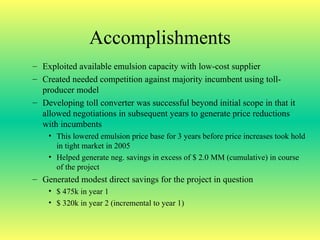
Accomplishments Exploited available emulsion capacity with low-cost supplier Created needed competition against majority incumbent using toll-producer model Developing toll converter was successful beyond initial scope in that it allowed negotiations in subsequent years to generate price reductions with incumbents This lowered emulsion price base for 3 years before price increases took hold in tight market in 2005 Helped generate neg. savings in excess of $ 2.0 MM (cumulative) in course of the project Generated modest direct savings for the project in question $ 475k in year 1 $ 320k in year 2 (incremental to year 1)
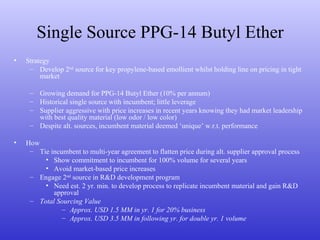
Single Source PPG-14 Butyl Ether Strategy Develop 2 nd  source for key propylene-based emollient whilst holding line on pricing in tight market Growing demand for PPG-14 Butyl Ether (10% per annum) Historical single source with incumbent; little leverage Supplier aggressive with price increases in recent years knowing they had market leadership with best quality material (low odor / low color) Despite alt. sources, incumbent material deemed ‘unique’ w.r.t. performance How Tie incumbent to multi-year agreement to flatten price during alt. supplier approval process Show commitment to incumbent for 100% volume for several years Avoid market-based price increases Engage 2 nd  source in R&D development program Need est. 2 yr. min. to develop process to replicate incumbent material and gain R&D approval Total Sourcing Value Approx. USD 1.5 MM in yr. 1 for 20% business Approx. USD 3.5 MM in following yr. for double yr. 1 volume
A Plan Comes Together Plan Encourage potential 2 nd  source to develop an under-utilized US asset to develop process to produce a clean PGG-14 Butyl Ether Potential 2 nd  supplier interested in expanding market share in this material but current market offering was low in quality Little business given poor quality of material relative to incumbent Agreed to partner with customer to develop better material Details Secured multi-year deal with incumbent Developed business case with potential supplier Agreed to price formula which would place new entrant below incumbent price at time of approval for minority share of business Agreed internal resource with R&D to manage long-term approval process est. at 2 plus yr. Provided potential supplier formal commitment to source provided they developed comparable material which gained formal R&D approval
Customer and Supplier Analysis plus No supplier investment needed Existing 20 Mt reactor unit under-utilized Supplier anxious to increase market share for PPG-14 Butyl Ether, eager to engage in program for improved material Economics favorable; supplier agreed to price below incumbent following technical approval minus Long-term R&D program needed on both customer and supplier side Supplier not integrated to propylene (unlike incumbent) Future pricing subject to volatility of feedstock Agreement structure with incumbent ideally had to cover duration of alt. approval to protect against price increases Potential for technical failure on customer end given complexity of use end application despite supplier meeting technical specification Existing specification described min. amount of parameters; material could be ‘clean’ sensorial yet fail end use application for unknown reasons
Simple Execution Final Decision / Action Plan Multi-year agreement developed  with incumbent in early 2004 Supply and price stable for 2 yr. Potential supplier and customer moved quickly to develop work program with timings Pilot process at intended production site developed to test production methods to for low odor / low color material Customer R&D engaged in iterative testing program to assess material from various process developed by potential supplier
A Few Issues A few problems surfaced… Of course… Time needed to develop ‘clean’ material was longer than estimated (3 yrs.) Additional process steps needed to be implemented to produce suitable material Incumbent agreement needed to be extended given extended time to develop / approve material Unfortunately, agreement could not be extended for only 1 yr.; Incumbent insisted on 2 yr. min. However, agreement modified to exclude 100% sourcing req.; 90% min agreed to which allowed 2 nd  source to supply immediately following approval R&D approval process was an additional 1 yr. given sensitivity to new material Normal 3 mo. R&D  approval was found to be inadequate 6 mo. approval process was needed to assess suitability of material due to oxidative stability issues in end product Luckily this time was in parallel with additional time needed by supplier
Accomplishments 2 nd  supplier formally approved in Q4’2007 Supplier ultimately develop robust process to produce clean material (odor & color) – 3 yr. from start of program ! Incumbent agreement with flat pricing runs thru Dec. 2008 New source implemented as minority supplier for 10% share as price 3% below incumbent price Allows customer to test supply chain in 2008 with min., risk before formally opening up material for bid in 2009 Price and supply during approval process was stable and secure Program took longer than expected given unforeseen technical issues 2 nd  source approval Maximize opportunity in 2009 once incumbent agreement expires

Stragetic Sourcing Examples

  • 1.
    George Grudev 11-Jan.-2008Strategic Sourcing – Putting Theory into Actual Practice
  • 2.
    Show Me Examplesdemonstrating unique approaches to sourcing which yielded the best customer value High Leverage China Sourcing of Antiperspirant Salt Toll Buying of Silicone Feedstock for Emulsion Production Low Leverage Single Source PPG-14 Butyl Ether
  • 3.
    China Sourcing Antiperspirant Salt Strategy Develop unique strategic sourcing option for aluminum-zirconium tetrachlorohydrex-gly (Zr-based antiperspirant actives are used in sticks) Large portion of the cost to produce Zr-based active is in conversion (drying) and asset base (mix tanks, spray tower, classifiers, mills) Find low cost region to place asset and produce RM costs don’t markedly change by geography (Al, ZBC, HCl, glycine) Small NA supply base (2 suppliers) Largest single use of Zr-based active in NA where customer growth > 10% per annum sourcing from both domestic suppliers Additional competition from new entrant How Build additional capacity with key 3 rd supplier; support future growth (2007 onward) Build back competition following demise of former 3 rd US-based supplier in 2003 Leverage historic domestic supply base in future negotiations Target emerging market sourcing; key customer global initiative Total Sourcing Value ~ USD 6.2 MM at maximum potential
  • 4.
    A Plan ComesTogether Plan Encourage key EU supplier w/o US asset base to invest in overseas production to challenge incumbents using off-shore model Following plant start-up, customer would base-load over course of 18 months to maximize opportunity strategic supplier w.low-cost capacity to support growth and physical savings Details Supplier anxious to expand into NA market for this item – but not from existing EU asset base Supplier had existing operation in China (near ocean port) AP plant would be ‘bolt-on’ to existing infrastructure; only partial investment required China plant would reduce material ex-works cost significantly (15% +) But importation would add logistics / duty costs plus other complexities
  • 5.
    Customer and SupplierAnalysis plus Supplier investment for 2,500 Mt plant ~ USD 3 MM Further cost reductions realized from direct Al ingot conversion and use of multi-fuel dryer (coal, oil and NG) Time to complete project < 12 mo. from approval using local sources Company board would green-light program as ROI was favorable and allowed supplier rapid entry to NA market A more detailed assessment revealed duty and freight to be modest add-on costs which were more than off-set by China govt. export credits (13%) total savings est. 17% against current avg. ex-works price minus Extensive training requirement for local workers by supplier How to safeguard technologies (theft of ideas, process understanding, etc.) Manage high workforce attrition and rising labor costs (5% per annum) from on-set More complex and lengthy supply chain (~ 35 days vs. less than 14 days) Better planning required (longer term forecast); less tolerance for near term schedule changes Other unforeseen issues lurking (SC, etc.)
  • 6.
    Simple Execution FinalDecision / Action Plan Supplier commitment provided in intent letter (Q1’2005) Construction plans drawn and executed Timeline developed Commission equipment ~ 8 mo. from ground break Production samples generated upon plant commissioning for formal approval (3 to 6 mo. process normally) Technical and factory approvals generated in 6 months Begin formal sourcing (Q2’2006) In Q2’2007, full utilization of plant achieved
  • 7.
    Many Issues Initialsupply analysis assumed customer would manage entire supply chain Buy ex-works, manage pick-up, inland freight to port, ocean leg, US importation, inland freight and final delivery and associated costs (document fees, port charges, etc.) Several problems arose… Customer plant (N. Carolina) holding min. inventory (2-3 days max) Delivery delays resulted in ‘sudden calls’ to domestic producers to avoid production stoppage No buffer stock held in NA Plant forced to raise safety stock above desired levels using higher cost domestic suppliers Logistics was arcane; supplier managed front end & back end was constrained China inland – Shanghai port – Long Beach port – InterModal to East Coast – Offload for local delivery to N. Carolina Order placement and customer service via EU was difficult (6 hr. time lag) POs never delivered on time given invariable delays in different legs of transport Invoice payment to EU bank was cumbersome Issues with invoices cut in China and payment from US bank to EU
  • 8.
    Fine Tuning… SupplyChain Review 2 options for supply Use customer alliances / agreements in global shipping to optimize SC with pick up at origin Engage supplier’s US agent to manage entire SC with agent arranging pick-up and final US delivery with local stock holding Decision Develop US agent for various reasons… Agent logistics competitive priced vs. customer arrangements – managed entire SC Establish local warehouse arrangement in Savannah (1/2 day transit from plant) Build 2-3 days US inventory to cover shipping delays Agent arranges transport based on requested PO delivery date using customer scheduling system Small on cost to manage local stock Logistics streamlined: East Coast port (38 days plus  32 days) Orders placed to agent in same time zone; local call-off All paperwork managed by agent (POs, invoice and all SC docs) and included in single invoice Direct payment to US bank with agent transfer of funds to supplier
  • 9.
    Accomplishments Supplier enteredNA market with largest user of such materials and enhanced market position overall Customer developed strategic low-cost overseas source for growing material Saved $ 1.05 MM for NA alone (additional $ 150k for Russia and Philippines) from project alone Established additional point of leverage for future negotiations Base-load of supplier allows exclusive supply arrangement with customer Created $ 6.2 MM value in ‘emerging market sourcing’ against strategic initiative Indirectly, impacted key competitor of customer Reportedly one domestic supplier, upon loss of customer business, passed price increases into general market to recover revenue loss Directly, generated needed competition Maintained flat pricing for 1 year despite rising COG; separated customer further from market Supplier developing stage 2 expansion for anticipated customer growth in 2009 onward; to remain exclusive supplier First phase investment to be paid off in 2010
  • 10.
    Toll Buying ofSilicone Feedstock for Emulsion Production Strategy Develop strategic sourcing option for silicone hydrolizate (reactive siloxane intermediate) in order to supply low-cost converter Aqueous silicone emulsions are produced typically via in-situ polymerization (e.g. emulsion polymerization) Customer is the largest consumer of such products globally (all poles) Historical suppliers are major silicone producers with large installed capacity in several poles with feed-stock integration Competition was weak given the small supply base (4 global producers); less so for emulsion polymerization (2 global producers) How Exploit available emulsion capacity with low-cost supplier who is not back integrated into silicone feedstock Create competition against incumbents using toll-producer model Generate modest direct savings opportunity (est. $ 400k per annum) Total Sourcing Value ~ USD 7.1 MM at maximum potential
  • 11.
    A Plan ComesTogether Plan Encourage key EU silicone supplier not participating in extensive supply of emulsions to sell customer sufficient quantities of hydrolizate Customer would obtain material at more favorable price then converter given his scale in market Customer in turn would transfer material to converter to produce emulsion at agreed cost Cost model shared with customer; agreement to fix profit margin In exchange for hydrolizate supply, customer agreed to explore future, direct emulsion supply when ‘opportunities presented themselves’ Details Supplier anxious to utilize installed asset base which was running 40% of capacity Supplier had history of supply with customer with good service and technical competency Working at agreed margin reduced ex-works cost significantly (~ 20%) Growing global customer volume allowed for significant exploitation of asset base whilst continuing to support incumbents Development of toll producer allowed almost immediate introduction of competition in global negotiations
  • 12.
    Customer and SupplierAnalysis plus Supplier investment for 6,000 Mt plant made w/o any customer commitment 60% available (~ 3,500 Mt) Material was simple – 1 commodity product would form basis of supply Development of needed completive counter Ownership was private; allowed for intimate dialogue and quick agreement Supplier plant based in EU good access to emerging Asian market with highest growth close to feedstock source (mainland EU) Supplier close to technical center where approvals were generated Approval was rapid, needing only cursory testing Silicone supplier would generate direct revenue stream with key customer minus New innovations would not be produced by supplier; long shelf life Company based in Euro zone Eventually, currency would play negative role due to appreciation against USD Manage broader relationship with incumbent emulsion suppliers w/o deleterious effect of sourcing emulsion from toll converter Ensure sufficient volume in subsequent years to grow incumbents
  • 13.
    Simple Execution FinalDecision / Action Plan Supplier commitment provided without formal agreements Capacity already in place Customer generates price agreement with silicone supplier with direct drop ship to toll converter Production samples quickly generated for formal approval (3 to 6 mo. process normally) from specification Technical and factory approvals generated in just less than 6 months Begin formal sourcing (Q1’2001) Several large countries selected (China, Philippines, Indonesia, Thailand) to start In 1 st year, 1,500 Mt of volume generated (annualized) In 2 nd year, additional 1,300 Mt of volume generated (annualized) 3 rd year following approval saw highest annual off-take
  • 14.
    Few Issues Surprisingly….Most countries took direct container shipments and provided appropriate lead times Only a few problems… Some countries requested local stock holdings Use of agents to import and hold stock implemented as needed Added to total cost but was necessary element Invoicing Unilever for hydrolizate for individual country requirements proved difficult given systems Quickly moved to direct supply of hydrolizate to converter with agreement converter would get customer neg. price but pay invoice directly
  • 15.
    Accomplishments Exploited availableemulsion capacity with low-cost supplier Created needed competition against majority incumbent using toll-producer model Developing toll converter was successful beyond initial scope in that it allowed negotiations in subsequent years to generate price reductions with incumbents This lowered emulsion price base for 3 years before price increases took hold in tight market in 2005 Helped generate neg. savings in excess of $ 2.0 MM (cumulative) in course of the project Generated modest direct savings for the project in question $ 475k in year 1 $ 320k in year 2 (incremental to year 1)
  • 16.
    Single Source PPG-14Butyl Ether Strategy Develop 2 nd source for key propylene-based emollient whilst holding line on pricing in tight market Growing demand for PPG-14 Butyl Ether (10% per annum) Historical single source with incumbent; little leverage Supplier aggressive with price increases in recent years knowing they had market leadership with best quality material (low odor / low color) Despite alt. sources, incumbent material deemed ‘unique’ w.r.t. performance How Tie incumbent to multi-year agreement to flatten price during alt. supplier approval process Show commitment to incumbent for 100% volume for several years Avoid market-based price increases Engage 2 nd source in R&D development program Need est. 2 yr. min. to develop process to replicate incumbent material and gain R&D approval Total Sourcing Value Approx. USD 1.5 MM in yr. 1 for 20% business Approx. USD 3.5 MM in following yr. for double yr. 1 volume
  • 17.
    A Plan ComesTogether Plan Encourage potential 2 nd source to develop an under-utilized US asset to develop process to produce a clean PGG-14 Butyl Ether Potential 2 nd supplier interested in expanding market share in this material but current market offering was low in quality Little business given poor quality of material relative to incumbent Agreed to partner with customer to develop better material Details Secured multi-year deal with incumbent Developed business case with potential supplier Agreed to price formula which would place new entrant below incumbent price at time of approval for minority share of business Agreed internal resource with R&D to manage long-term approval process est. at 2 plus yr. Provided potential supplier formal commitment to source provided they developed comparable material which gained formal R&D approval
  • 18.
    Customer and SupplierAnalysis plus No supplier investment needed Existing 20 Mt reactor unit under-utilized Supplier anxious to increase market share for PPG-14 Butyl Ether, eager to engage in program for improved material Economics favorable; supplier agreed to price below incumbent following technical approval minus Long-term R&D program needed on both customer and supplier side Supplier not integrated to propylene (unlike incumbent) Future pricing subject to volatility of feedstock Agreement structure with incumbent ideally had to cover duration of alt. approval to protect against price increases Potential for technical failure on customer end given complexity of use end application despite supplier meeting technical specification Existing specification described min. amount of parameters; material could be ‘clean’ sensorial yet fail end use application for unknown reasons
  • 19.
    Simple Execution FinalDecision / Action Plan Multi-year agreement developed with incumbent in early 2004 Supply and price stable for 2 yr. Potential supplier and customer moved quickly to develop work program with timings Pilot process at intended production site developed to test production methods to for low odor / low color material Customer R&D engaged in iterative testing program to assess material from various process developed by potential supplier
  • 20.
    A Few IssuesA few problems surfaced… Of course… Time needed to develop ‘clean’ material was longer than estimated (3 yrs.) Additional process steps needed to be implemented to produce suitable material Incumbent agreement needed to be extended given extended time to develop / approve material Unfortunately, agreement could not be extended for only 1 yr.; Incumbent insisted on 2 yr. min. However, agreement modified to exclude 100% sourcing req.; 90% min agreed to which allowed 2 nd source to supply immediately following approval R&D approval process was an additional 1 yr. given sensitivity to new material Normal 3 mo. R&D approval was found to be inadequate 6 mo. approval process was needed to assess suitability of material due to oxidative stability issues in end product Luckily this time was in parallel with additional time needed by supplier
  • 21.
    Accomplishments 2 nd supplier formally approved in Q4’2007 Supplier ultimately develop robust process to produce clean material (odor & color) – 3 yr. from start of program ! Incumbent agreement with flat pricing runs thru Dec. 2008 New source implemented as minority supplier for 10% share as price 3% below incumbent price Allows customer to test supply chain in 2008 with min., risk before formally opening up material for bid in 2009 Price and supply during approval process was stable and secure Program took longer than expected given unforeseen technical issues 2 nd source approval Maximize opportunity in 2009 once incumbent agreement expires