Submitted by:- Submitted to :-
Dileep Kumar Lecturer
Mr. Rahul Sharma
Uni. Roll No.:-
2232000030
IC ENGINE
POWERPOINT
PRESENTATION
University of Polytechnic
Department of Mechanical Engineering
ENGINE/ HEAT ENGINE
 An engine or heat engine is a device that
transforms the chemical energy of fuel into
thermal energy and utilizes this thermal
energy to perform useful work.
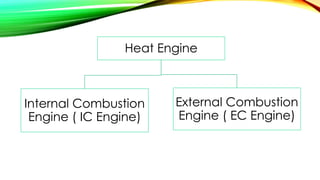
Heat Engine
Internal Combustion
Engine ( IC Engine)
External Combustion
Engine ( EC Engine)
INTERNAL COMBUSTION
ENGINE
An IC engine is a heat engine in which a
combustion of fuel (normally a fossil fuel
E.g.; Petrol, Diesel, LPG etc.) occurs with
in a combustion chamber.
CLASSIFICATION OF IC ENGINE
The internal combustion engines ( IC Engines ) are classified
depending upon
 Nature of Thermodynamic Cycle
i. Otto Cycle Engine
ii. Diesel Cycle Engine
 Type of Fuel
i. Petrol Engine
ii. Diesel Engine
iii. Gas engine
CLASSIFICATION OF IC ENGINE
The internal combustion engines ( IC Engines ) are classified
depending upon
 Number of Strokes
i. 2 Stroke Engine
ii. 4 Stroke Engine
 Types of Ignition
i. Spark Ignition (SI ) Engine
ii. Compression Ignition (CI ) Engine
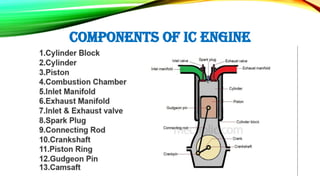
COMPONENTS OF IC ENGINE
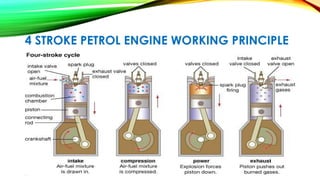
4 STROKE PETROL ENGINE WORKING PRINCIPLE
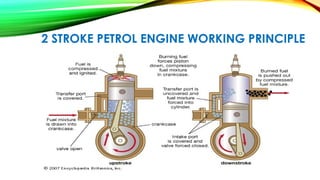
2 STROKE PETROL ENGINE WORKING PRINCIPLE
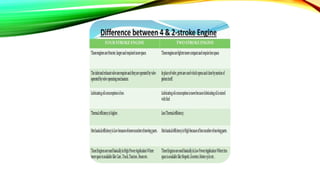
DIFFERENCE BETWEEN 4 & 2- STROKE ENGINE
ADVANTAGES & DISADVANTAGES
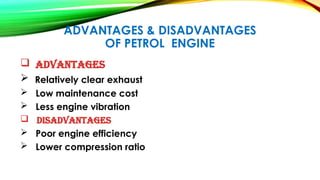
OF PETROL ENGINE
 Advantages
 Relatively clear exhaust
 Low maintenance cost
 Less engine vibration
 disadvantages
 Poor engine efficiency
 Lower compression ratio
ADVANTAGES & DISADVANTAGES OF
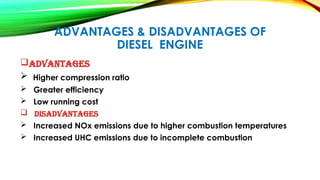
DIESEL ENGINE
Advantages
 Higher compression ratio
 Greater efficiency
 Low running cost
 disadvantages
 Increased NOx emissions due to higher combustion temperatures
 Increased UHC emissions due to incomplete combustion
THANK
YOU

Presentation1 dk 22.pptx bv

  • 1.
    Submitted by:- Submittedto :- Dileep Kumar Lecturer Mr. Rahul Sharma Uni. Roll No.:- 2232000030 IC ENGINE POWERPOINT PRESENTATION
  • 2.
    University of Polytechnic Departmentof Mechanical Engineering
  • 3.
    ENGINE/ HEAT ENGINE An engine or heat engine is a device that transforms the chemical energy of fuel into thermal energy and utilizes this thermal energy to perform useful work.
  • 4.
    Heat Engine Internal Combustion Engine( IC Engine) External Combustion Engine ( EC Engine)
  • 5.
    INTERNAL COMBUSTION ENGINE An ICengine is a heat engine in which a combustion of fuel (normally a fossil fuel E.g.; Petrol, Diesel, LPG etc.) occurs with in a combustion chamber.
  • 6.
    CLASSIFICATION OF ICENGINE The internal combustion engines ( IC Engines ) are classified depending upon  Nature of Thermodynamic Cycle i. Otto Cycle Engine ii. Diesel Cycle Engine  Type of Fuel i. Petrol Engine ii. Diesel Engine iii. Gas engine
  • 7.
    CLASSIFICATION OF ICENGINE The internal combustion engines ( IC Engines ) are classified depending upon  Number of Strokes i. 2 Stroke Engine ii. 4 Stroke Engine  Types of Ignition i. Spark Ignition (SI ) Engine ii. Compression Ignition (CI ) Engine
  • 8.
  • 9.
    4 STROKE PETROLENGINE WORKING PRINCIPLE
  • 10.
    2 STROKE PETROLENGINE WORKING PRINCIPLE
  • 11.
    DIFFERENCE BETWEEN 4& 2- STROKE ENGINE
  • 12.
    ADVANTAGES & DISADVANTAGES OFPETROL ENGINE  Advantages  Relatively clear exhaust  Low maintenance cost  Less engine vibration  disadvantages  Poor engine efficiency  Lower compression ratio
  • 13.
    ADVANTAGES & DISADVANTAGESOF DIESEL ENGINE Advantages  Higher compression ratio  Greater efficiency  Low running cost  disadvantages  Increased NOx emissions due to higher combustion temperatures  Increased UHC emissions due to incomplete combustion
  • 14.