SILIGURI INSTITUTE OF TECHNOLOGY
DEPARTMENT OF ELECTRICAL ENGINEERING
Presentation on Compartive study of different IC Engine based vehicle
Course Name Electrical & Hybrid Vehicles Course Code PC EE-602A
Presented by
Name : ARNAB CHAKRABORTY
Roll : 11901621017
Department : ELECTRICAL ENGINEERING
Semester : 6TH SEMESTER
C.I Engine –Types & Working
Topics
Introduction
Working principle of S.I Engine
Classification of IC Engine
I.C Engine Based On Number Of Strokes
Applications of internal combustion engine & external combustion Engine
Advantages and Disadvantages of internal combustion engines
conclusion
Introduction
Internal combustion engine vehicle (ICEV)
Internal combustion engine vehicle (ICEV) is a vehicle that is powered by a regular internal
combustion engine (ICE). ICEV uses fuel which combusts inside a combustion chamber with
the help of an oxidizer (typically oxygen from the air). This means that to get power, ICEVs
literally burn fuel. ICEs most commonly use fuels derived from fossil fuels. These include
petrol, diesel, jet fuel, and compressed natural gas. In addition to internal combustion engines
that use fossil fuels, there are also ICEs that are powered by biofuels (e.g., ethanol and biodiesel)
or hydrogen.
ICE is the most common engine used in cars, planes, boats and other vehicles. But fossil fuel is
not a renewable source of energy and due to incomplete combustion of fossil fuels, these
engines pollute the air around us. Because of these environmental challenges, car manufacturers
are now manufacturing more and more alternatives that do not use or use less fossil fuel. These
include electric vehicles (EVs), hybrid electric vehicles (HEVs), plug-in hybrid electric vehicles
(PHEVs) and fuel cell vehicles (FCVs).
Classification of I.C Engine
Internal combustion engines are engines in which the combustion of a fuel occurs with an oxidizer (usually air) in a
combustion chamber that is an integral part of the operating fluid flow circuit.
Within an internal combustion engine, the expansion of high-temperature and high-pressure combustion gases, direct
force is applied to any part of the engine.
Classification Of IC Engine (Internal Combustion Engines)
1. According To Type Of Ignition ( According To Method Of
Ignition )
A) SI engine :- A spark-ignition engine (SI engine) is an internal
combustion engine, usually a petrol engine, where the combustion
cycle of an air-fuel mixture is ignited by a spark plug.
Working principle of S.I Engine
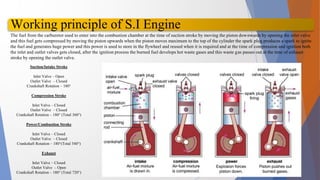
The fuel from the carburetor used to enter into the combustion chamber at the time of suction stroke by moving the piston downwards by opening the inlet valve
and this fuel gets compressed by moving the piston upwards when the piston moves maximum to the top of the cylinder the spark plug produces a spark to ignite
the fuel and generates huge power and this power is used to store in the flywheel and reused when it is required and at the time of compression and ignition both
the inlet and outlet valves gets closed, after the ignition process the burned fuel develops hot waste gases and this waste gas passes out at the time of exhaust
stroke by opening the outlet valve.
Suction/Intake Stroke
Inlet Valve – Open
Outlet Valve – Closed
Crankshaft Rotation – 180°
Compression Stroke
Inlet Valve – Closed
Outlet Valve – Closed
Crankshaft Rotation – 180° (Total 360°)
Power/Combustion Stroke
Inlet Valve – Closed
Outlet Valve – Closed
Crankshaft Rotation – 180°(Total 540°)
Exhaust
Inlet Valve – Closed
Outlet Valve – Open
Crankshaft Rotation – 180° (Total 720°)
C.I Engine –Types & Working
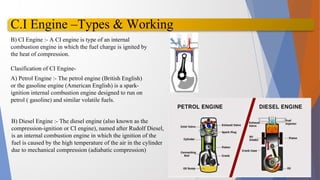
B) CI Engine :- A CI engine is type of an internal
combustion engine in which the fuel charge is ignited by
the heat of compression.
Clasification of CI Engine-
A) Petrol Engine :- The petrol engine (British English)
or the gasoline engine (American English) is a spark-
ignition internal combustion engine designed to run on
petrol ( gasoline) and similar volatile fuels.
B) Diesel Engine :- The diesel engine (also known as the
compression-ignition or CI engine), named after Rudolf Diesel,
is an internal combustion engine in which the ignition of the
fuel is caused by the high temperature of the air in the cylinder
due to mechanical compression (adiabatic compression)
I.C Engine Based On Number Of Strokes
3. Classification Of IC Engine Based On Number Of Strokes
Per Cycle (According To Cycle Of Operation )
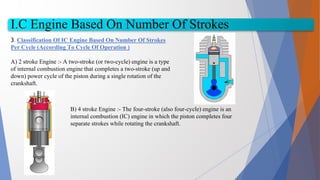
A) 2 stroke Engine :- A two-stroke (or two-cycle) engine is a type
of internal combustion engine that completes a two-stroke (up and
down) power cycle of the piston during a single rotation of the
crankshaft.
B) 4 stroke Engine :- The four-stroke (also four-cycle) engine is an
internal combustion (IC) engine in which the piston completes four
separate strokes while rotating the crankshaft.
Applications of internal combustion engine
Internal Combustion (IC) Engine
Type Application
Gasoline Engines Automotive, Marine, Aircraft
Gas Engines Industrial Power
Diesel Engines Automotive,Railways, Power, Marine
Gas Turbines Power, Aircraft, Industrial, Marine
Applications of external combustion engine
External Combustion (EC) Engine
Type Application
Steam Engines Locomotive, Marine
Stirling Engines Experimental space vehicles
Steam Turbines Power, Large Marine Closed Cycle Gas Turbine Power, Marine
Applications of internal combustion engine & external combustion Engine
Advantages and Disadvantages of internal combustion engines
Advantages of internal combustion engines
1.Size of engine is very less compared to external combustion engines
2.Power to weight ratio is high
3.Very suitable for small power requirement applications
4.Usually more portable than their counterpart external combustion engines
5.Safer to operate
6.Starting time is very less
7.High efficiency than external combustion engine
8.No chances of leakage of working fluids
9.Requires less maintenance
10.Lubricant consumption is less as compared to external combustion engines
11.In case of reciprocating internal combustion overall working temperature is low because
peak temperature is reached for only small period of time (only at detonation of fuel).
Disadvantages of internal combustion engines
1.Variety of fuels that can be used is limited to very fine quality gaseous and liquid fuel
2.Fuel used is very costly like gasoline or diesel
3.Engine emissions are generally high compared to external combustion engine
4.Not suitable of large scale power generation
5.In case of reciprocating internal combustion noise is generated due to detonation of fuel
conclusion
Internal Combustion are today widely used for transportation, and they are
highly successful in their field. Their drivability and durability are resulting in
todays locomotion. But we know very well that as it is a combustion engine so
it will produce some gases which is not good for the environment. And so this
gases are responsible in arising global warming. So, from the present situation
of our country related to IC engines based vechile it can be concluded that IC
engines have played a great role this years, but its high time to shift to EV.
Rather it can be said that the vechiles which carry heavy loads and goods can
still run in diesel engines,but private vechiles are needed to be converted to EV.
A small decision can create a large impact,lets start with ourselves and shift
our private vechiles to EV

different ic engine based vehicle types and working.pptx

  • 1.
    SILIGURI INSTITUTE OFTECHNOLOGY DEPARTMENT OF ELECTRICAL ENGINEERING Presentation on Compartive study of different IC Engine based vehicle Course Name Electrical & Hybrid Vehicles Course Code PC EE-602A Presented by Name : ARNAB CHAKRABORTY Roll : 11901621017 Department : ELECTRICAL ENGINEERING Semester : 6TH SEMESTER
  • 2.
    C.I Engine –Types& Working Topics Introduction Working principle of S.I Engine Classification of IC Engine I.C Engine Based On Number Of Strokes Applications of internal combustion engine & external combustion Engine Advantages and Disadvantages of internal combustion engines conclusion
  • 3.
    Introduction Internal combustion enginevehicle (ICEV) Internal combustion engine vehicle (ICEV) is a vehicle that is powered by a regular internal combustion engine (ICE). ICEV uses fuel which combusts inside a combustion chamber with the help of an oxidizer (typically oxygen from the air). This means that to get power, ICEVs literally burn fuel. ICEs most commonly use fuels derived from fossil fuels. These include petrol, diesel, jet fuel, and compressed natural gas. In addition to internal combustion engines that use fossil fuels, there are also ICEs that are powered by biofuels (e.g., ethanol and biodiesel) or hydrogen. ICE is the most common engine used in cars, planes, boats and other vehicles. But fossil fuel is not a renewable source of energy and due to incomplete combustion of fossil fuels, these engines pollute the air around us. Because of these environmental challenges, car manufacturers are now manufacturing more and more alternatives that do not use or use less fossil fuel. These include electric vehicles (EVs), hybrid electric vehicles (HEVs), plug-in hybrid electric vehicles (PHEVs) and fuel cell vehicles (FCVs).
  • 4.
    Classification of I.CEngine Internal combustion engines are engines in which the combustion of a fuel occurs with an oxidizer (usually air) in a combustion chamber that is an integral part of the operating fluid flow circuit. Within an internal combustion engine, the expansion of high-temperature and high-pressure combustion gases, direct force is applied to any part of the engine. Classification Of IC Engine (Internal Combustion Engines) 1. According To Type Of Ignition ( According To Method Of Ignition ) A) SI engine :- A spark-ignition engine (SI engine) is an internal combustion engine, usually a petrol engine, where the combustion cycle of an air-fuel mixture is ignited by a spark plug.
  • 5.
    Working principle ofS.I Engine The fuel from the carburetor used to enter into the combustion chamber at the time of suction stroke by moving the piston downwards by opening the inlet valve and this fuel gets compressed by moving the piston upwards when the piston moves maximum to the top of the cylinder the spark plug produces a spark to ignite the fuel and generates huge power and this power is used to store in the flywheel and reused when it is required and at the time of compression and ignition both the inlet and outlet valves gets closed, after the ignition process the burned fuel develops hot waste gases and this waste gas passes out at the time of exhaust stroke by opening the outlet valve. Suction/Intake Stroke Inlet Valve – Open Outlet Valve – Closed Crankshaft Rotation – 180° Compression Stroke Inlet Valve – Closed Outlet Valve – Closed Crankshaft Rotation – 180° (Total 360°) Power/Combustion Stroke Inlet Valve – Closed Outlet Valve – Closed Crankshaft Rotation – 180°(Total 540°) Exhaust Inlet Valve – Closed Outlet Valve – Open Crankshaft Rotation – 180° (Total 720°)
  • 6.
    C.I Engine –Types& Working B) CI Engine :- A CI engine is type of an internal combustion engine in which the fuel charge is ignited by the heat of compression. Clasification of CI Engine- A) Petrol Engine :- The petrol engine (British English) or the gasoline engine (American English) is a spark- ignition internal combustion engine designed to run on petrol ( gasoline) and similar volatile fuels. B) Diesel Engine :- The diesel engine (also known as the compression-ignition or CI engine), named after Rudolf Diesel, is an internal combustion engine in which the ignition of the fuel is caused by the high temperature of the air in the cylinder due to mechanical compression (adiabatic compression)
  • 7.
    I.C Engine BasedOn Number Of Strokes 3. Classification Of IC Engine Based On Number Of Strokes Per Cycle (According To Cycle Of Operation ) A) 2 stroke Engine :- A two-stroke (or two-cycle) engine is a type of internal combustion engine that completes a two-stroke (up and down) power cycle of the piston during a single rotation of the crankshaft. B) 4 stroke Engine :- The four-stroke (also four-cycle) engine is an internal combustion (IC) engine in which the piston completes four separate strokes while rotating the crankshaft.
  • 8.
    Applications of internalcombustion engine Internal Combustion (IC) Engine Type Application Gasoline Engines Automotive, Marine, Aircraft Gas Engines Industrial Power Diesel Engines Automotive,Railways, Power, Marine Gas Turbines Power, Aircraft, Industrial, Marine Applications of external combustion engine External Combustion (EC) Engine Type Application Steam Engines Locomotive, Marine Stirling Engines Experimental space vehicles Steam Turbines Power, Large Marine Closed Cycle Gas Turbine Power, Marine Applications of internal combustion engine & external combustion Engine
  • 9.
    Advantages and Disadvantagesof internal combustion engines Advantages of internal combustion engines 1.Size of engine is very less compared to external combustion engines 2.Power to weight ratio is high 3.Very suitable for small power requirement applications 4.Usually more portable than their counterpart external combustion engines 5.Safer to operate 6.Starting time is very less 7.High efficiency than external combustion engine 8.No chances of leakage of working fluids 9.Requires less maintenance 10.Lubricant consumption is less as compared to external combustion engines 11.In case of reciprocating internal combustion overall working temperature is low because peak temperature is reached for only small period of time (only at detonation of fuel). Disadvantages of internal combustion engines 1.Variety of fuels that can be used is limited to very fine quality gaseous and liquid fuel 2.Fuel used is very costly like gasoline or diesel 3.Engine emissions are generally high compared to external combustion engine 4.Not suitable of large scale power generation 5.In case of reciprocating internal combustion noise is generated due to detonation of fuel
  • 10.
    conclusion Internal Combustion aretoday widely used for transportation, and they are highly successful in their field. Their drivability and durability are resulting in todays locomotion. But we know very well that as it is a combustion engine so it will produce some gases which is not good for the environment. And so this gases are responsible in arising global warming. So, from the present situation of our country related to IC engines based vechile it can be concluded that IC engines have played a great role this years, but its high time to shift to EV. Rather it can be said that the vechiles which carry heavy loads and goods can still run in diesel engines,but private vechiles are needed to be converted to EV. A small decision can create a large impact,lets start with ourselves and shift our private vechiles to EV