
Towards a Formal Framework for
            Business Models:
     Identifying and Visualizing the
    Common Elements Between the
     Current Business Model Views


VMBO 2013 workshop 18/02/2013   Ben Roelens
1. Problem statement
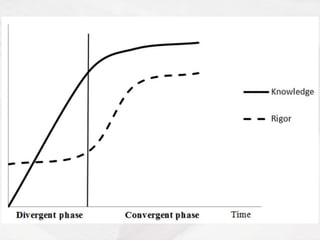
• Problem solving process:
  1. Divergence phase
     = creating new ideas
     main objective: creation of new knowledge


  2. Convergence phase
     = integrating by building upon existing knowledge
     Main objective: creation of more rigorous frameworks
1. Problem statement
2. Methodology
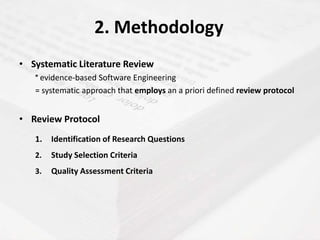
• Systematic Literature Review
   ° evidence-based Software Engineering
   = systematic approach that employs an a priori defined review protocol


• Review Protocol
   1.   Identification of Research Questions
   2.   Study Selection Criteria
   3.   Quality Assessment Criteria
2. Methodology
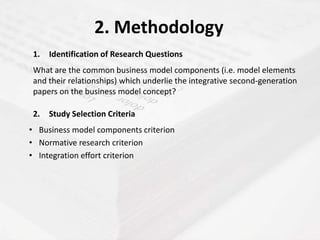
 1.   Identification of Research Questions
 What are the common business model components (i.e. model elements
 and their relationships) which underlie the integrative second-generation
 papers on the business model concept?

 2.   Study Selection Criteria
• Business model components criterion
• Normative research criterion
• Integration effort criterion
2. Methodology
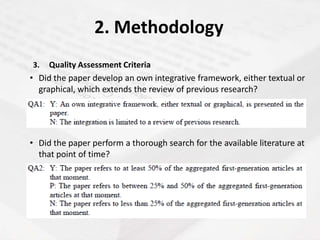
3.   Quality Assessment Criteria
• Did the paper develop an own integrative framework, either textual or
  graphical, which extends the review of previous research?


• Did the paper perform a thorough search for the available literature at
  that point of time?
3. Results
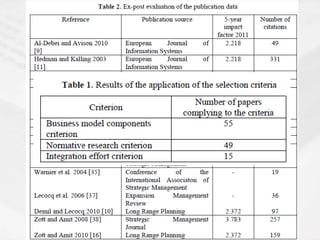
1.   Selection Results
3. Results
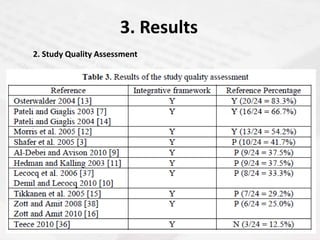
2. Study Quality Assessment
3. Results
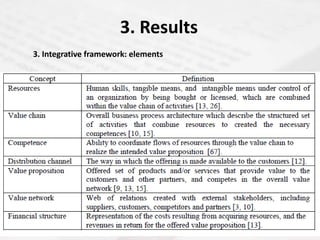
3. Integrative framework: elements
3. Results
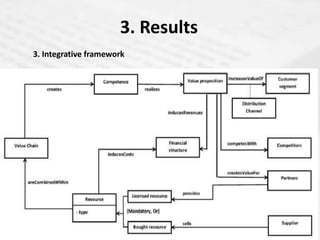
3. Integrative framework
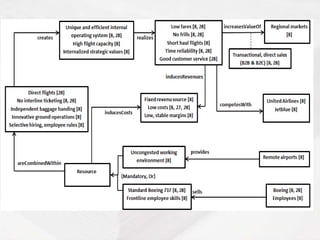
Case example: Southwest Airlines
4. Discussion / Questions

Presentation VMBO 18 2-2013

  • 1.
    Towards a FormalFramework for Business Models: Identifying and Visualizing the Common Elements Between the Current Business Model Views VMBO 2013 workshop 18/02/2013 Ben Roelens
  • 2.
    1. Problem statement •Problem solving process: 1. Divergence phase = creating new ideas main objective: creation of new knowledge 2. Convergence phase = integrating by building upon existing knowledge Main objective: creation of more rigorous frameworks
  • 3.
  • 4.
    2. Methodology • SystematicLiterature Review ° evidence-based Software Engineering = systematic approach that employs an a priori defined review protocol • Review Protocol 1. Identification of Research Questions 2. Study Selection Criteria 3. Quality Assessment Criteria
  • 5.
    2. Methodology 1. Identification of Research Questions What are the common business model components (i.e. model elements and their relationships) which underlie the integrative second-generation papers on the business model concept? 2. Study Selection Criteria • Business model components criterion • Normative research criterion • Integration effort criterion
  • 6.
    2. Methodology 3. Quality Assessment Criteria • Did the paper develop an own integrative framework, either textual or graphical, which extends the review of previous research? • Did the paper perform a thorough search for the available literature at that point of time?
  • 7.
    3. Results 1. Selection Results
  • 8.
    3. Results 2. StudyQuality Assessment
  • 9.
    3. Results 3. Integrativeframework: elements
  • 10.
  • 11.
  • 12.
    4. Discussion /Questions