Oxford Brookes consortium emerge active shared collaborative mobile fluid supported purposeful negotiated trust transparent visible reciprocity identity artefacts styles vocabulary sensibilities ecology routines social presence community project University of Essex consortium sustained communicate active UIDM Elgg toolkit KCL ALT josiefraser.com
Objectives To support the JISC’s forming of an effective and sustainable CoP To provide an appropriate infrastructure and tool kit for the CoP To support the CoP through specific activities Blended f2f and online community facilitation workshops, seminars and other events  Social software and community tools training events and materials To support the JISC in developing the next generation of learning, teaching and administration technologies through the use of the UIDM To support the CoP in understanding the value of the UIDM To support project teams in the use of the UIDM To have fun!
Guiding Principles Communities emerge, create and maintain themselves through continual re-negotiation Purpose, goals and values are key to driving the CoP formation (some provided by the JISC) Our role is to guide, support and facilitate community formation and emergence An Appreciative Inquiry led approach is adopted to allow appropriate feedback, guidance and fine tuning.
Work Packages Community Development User Engagement CoP Administration CoP Study, Assessment & Evaluation UIDM Refinement UIDM Training & Support UIDM Dissemination, Monitoring & Support Project management
Indicative Milestones Establish the platform Agree communication processes Plan, develop, deliver activity programme Interview CoP members Recruit to platform Develop success criteria and evaluation framework Develop September call Develop continuation activities
Deliverables & Outcomes Contributing to a sustainable e-Learning CoP by Building CoP specified tool kits and support mechanisms CoP Hub built on Elgg platform Reporting insights into the development & sustainability of CoP Project guides “blogged” through CoP hub and “productised” Facilitation of blended sessions and seminars with recorded outputs (websites, guides, project documentation) Scenarios Adding to e-framework knowledge base: Usage Guides: Training manuals on UIDM; UIDM Heuristics; and UIDM refinements Consistent, valid and valuable contributions from Call II and Call III projects
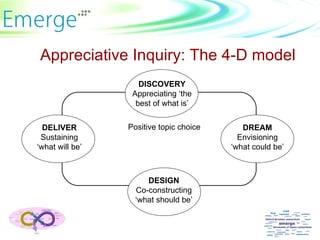
Appreciative Inquiry: The 4-D model Positive topic choice DISCOVERY Appreciating ‘the best of what is’ DREAM Envisioning ‘ what could be’ DESIGN Co-constructing ‘ what should be’ DELIVER Sustaining ‘ what will be’
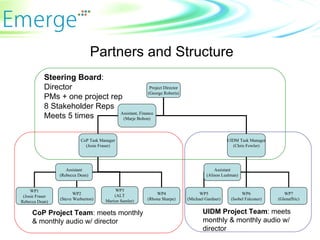
Partners and Structure Project Director (George Roberts) CoP Task Manager (Josie Fraser) UIDM Task Manager (Chris Fowler) Assistant, Finance (Marje Bolton) WP5 (Michael Gardner) WP1 (Josie Fraser Rebecca Dean) Assistant (Alison Lealman) WP2 (Steve Warburton) Assistant (Rebecca Dean) WP4 (Rhona Sharpe) WP3 (ALT Marion Samler) WP6 (Isobel Falconer) WP7 (Glenaffric) Steering Board : Director PMs + one project rep 8 Stakeholder Reps Meets 5 times CoP Project Team : meets monthly & monthly audio w/ director UIDM Project Team : meets monthly & monthly audio w/ director
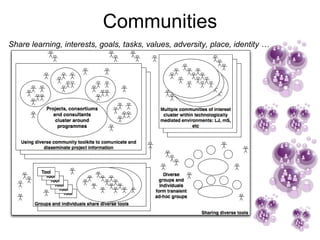
Communities Share learning, interests, goals, tasks, values, adversity, place, identity …
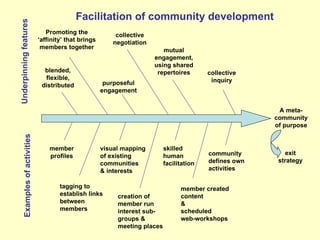
Facilitation of community development Underpinning features Examples of activities A meta-community of purpose community defines own activities Promoting the ‘affinity’ that brings members together mutual engagement, using shared repertoires collective negotiation member profiles blended, flexible, distributed collective inquiry tagging to establish links between members visual mapping of existing communities  & interests creation of member run interest sub-groups & meeting places exit strategy skilled human facilitation member created content  & scheduled  web-workshops purposeful engagement
 
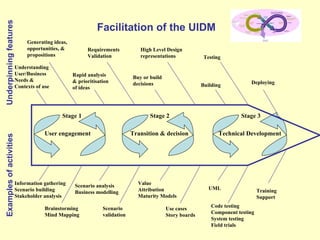
Underpinning features Examples of activities Facilitation of the UIDM  User engagement Transition & decision Technical Development Stage 1 Stage 2 Stage 3 Understanding  User/Business  Needs &  Contexts of use Generating ideas, opportunities, & propositions Rapid analysis & prioritisation of ideas Buy or build  decisions Requirements Validation  High Level Design representations Building Testing Deploying Information gathering Scenario building Stakeholder analysis Brainstorming Mind Mapping Scenario analysis Business modelling Scenario validation Value Attribution Maturity Models Use cases Story boards UML Code testing Component testing System testing Field trials Training Support
 
Oxford Brookes consortium emerge active shared collaborative mobile fluid supported purposeful negotiated trust transparent visible reciprocity identity artefacts styles vocabulary sensibilities ecology routines social presence community project University of Essex consortium sustained communicate active UIDM Elgg toolkit KCL ALT josiefraser.com questions thank you

Presentation to JISC DeL Tools Programme Meeting

  • 1.
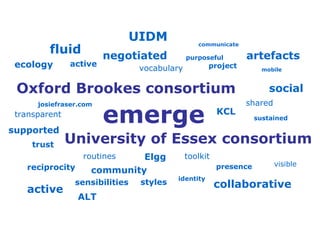
    Oxford Brookes consortiumemerge active shared collaborative mobile fluid supported purposeful negotiated trust transparent visible reciprocity identity artefacts styles vocabulary sensibilities ecology routines social presence community project University of Essex consortium sustained communicate active UIDM Elgg toolkit KCL ALT josiefraser.com
  • 2.
    Objectives To supportthe JISC’s forming of an effective and sustainable CoP To provide an appropriate infrastructure and tool kit for the CoP To support the CoP through specific activities Blended f2f and online community facilitation workshops, seminars and other events Social software and community tools training events and materials To support the JISC in developing the next generation of learning, teaching and administration technologies through the use of the UIDM To support the CoP in understanding the value of the UIDM To support project teams in the use of the UIDM To have fun!
  • 3.
    Guiding Principles Communitiesemerge, create and maintain themselves through continual re-negotiation Purpose, goals and values are key to driving the CoP formation (some provided by the JISC) Our role is to guide, support and facilitate community formation and emergence An Appreciative Inquiry led approach is adopted to allow appropriate feedback, guidance and fine tuning.
  • 4.
    Work Packages CommunityDevelopment User Engagement CoP Administration CoP Study, Assessment & Evaluation UIDM Refinement UIDM Training & Support UIDM Dissemination, Monitoring & Support Project management
  • 5.
    Indicative Milestones Establishthe platform Agree communication processes Plan, develop, deliver activity programme Interview CoP members Recruit to platform Develop success criteria and evaluation framework Develop September call Develop continuation activities
  • 6.
    Deliverables & OutcomesContributing to a sustainable e-Learning CoP by Building CoP specified tool kits and support mechanisms CoP Hub built on Elgg platform Reporting insights into the development & sustainability of CoP Project guides “blogged” through CoP hub and “productised” Facilitation of blended sessions and seminars with recorded outputs (websites, guides, project documentation) Scenarios Adding to e-framework knowledge base: Usage Guides: Training manuals on UIDM; UIDM Heuristics; and UIDM refinements Consistent, valid and valuable contributions from Call II and Call III projects
  • 7.
    Appreciative Inquiry: The4-D model Positive topic choice DISCOVERY Appreciating ‘the best of what is’ DREAM Envisioning ‘ what could be’ DESIGN Co-constructing ‘ what should be’ DELIVER Sustaining ‘ what will be’
  • 8.
    Partners and StructureProject Director (George Roberts) CoP Task Manager (Josie Fraser) UIDM Task Manager (Chris Fowler) Assistant, Finance (Marje Bolton) WP5 (Michael Gardner) WP1 (Josie Fraser Rebecca Dean) Assistant (Alison Lealman) WP2 (Steve Warburton) Assistant (Rebecca Dean) WP4 (Rhona Sharpe) WP3 (ALT Marion Samler) WP6 (Isobel Falconer) WP7 (Glenaffric) Steering Board : Director PMs + one project rep 8 Stakeholder Reps Meets 5 times CoP Project Team : meets monthly & monthly audio w/ director UIDM Project Team : meets monthly & monthly audio w/ director
  • 9.
    Communities Share learning,interests, goals, tasks, values, adversity, place, identity …
  • 10.
    Facilitation of communitydevelopment Underpinning features Examples of activities A meta-community of purpose community defines own activities Promoting the ‘affinity’ that brings members together mutual engagement, using shared repertoires collective negotiation member profiles blended, flexible, distributed collective inquiry tagging to establish links between members visual mapping of existing communities & interests creation of member run interest sub-groups & meeting places exit strategy skilled human facilitation member created content & scheduled web-workshops purposeful engagement
  • 11.
  • 12.
    Underpinning features Examplesof activities Facilitation of the UIDM User engagement Transition & decision Technical Development Stage 1 Stage 2 Stage 3 Understanding User/Business Needs & Contexts of use Generating ideas, opportunities, & propositions Rapid analysis & prioritisation of ideas Buy or build decisions Requirements Validation High Level Design representations Building Testing Deploying Information gathering Scenario building Stakeholder analysis Brainstorming Mind Mapping Scenario analysis Business modelling Scenario validation Value Attribution Maturity Models Use cases Story boards UML Code testing Component testing System testing Field trials Training Support
  • 13.
  • 14.
    Oxford Brookes consortiumemerge active shared collaborative mobile fluid supported purposeful negotiated trust transparent visible reciprocity identity artefacts styles vocabulary sensibilities ecology routines social presence community project University of Essex consortium sustained communicate active UIDM Elgg toolkit KCL ALT josiefraser.com questions thank you