1
Crime, Criminal Justice,
and Scientific Inquiry
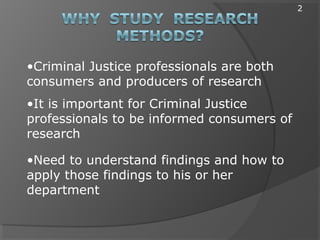
•Criminal Justice professionals are both
consumers and producers of research
•It is important for Criminal Justice
professionals to be informed consumers of
research
•Need to understand findings and how to
apply those findings to his or her
department
2
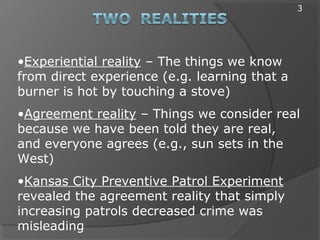
•Experiential reality – The things we know
from direct experience (e.g. learning that a
burner is hot by touching a stove)
•Agreement reality – Things we consider real
because we have been told they are real,
and everyone agrees (e.g., sun sets in the
West)
•Kansas City Preventive Patrol Experiment
revealed the agreement reality that simply
increasing patrols decreased crime was
misleading
3
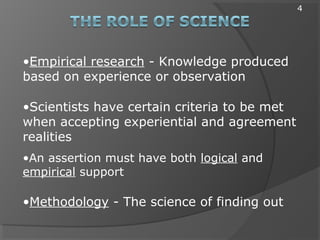
•Empirical research - Knowledge produced
based on experience or observation
•Scientists have certain criteria to be met
when accepting experiential and agreement
realities
•An assertion must have both logical and
empirical support
•Methodology - The science of finding out
4
•Future circumstances are caused or
conditioned by present ones
•We use causal and probabilistic reasoning
•The goal is to understand why certain things
are related, why patterns occur, to enable us
to make more accurate predictions
5
•Tradition – Things that “everybody knows”
•Ex: Driving on the left side of the road in the US is
dangerous
•Authority – Trusting the judgment of someone
with special expertise
•Ex: You are more likely to believe a judge
regarding your driver’s license suspension than
your parents
•Both provide us with a starting point for our
own inquiry
6
•Inaccurate Observation – Overcome by using
measurement devices
•Overgeneralization – Overcome by replicating
the study to see if you get the same results
•Selective Observation – Specify in advance
the number and types of observations
7
•Illogical Reasoning – Use systems of logic,
consciously and explicitly
•Ideology and Politics – Guard against its
influence
•To Err is Human – Take precautions to avoid
error
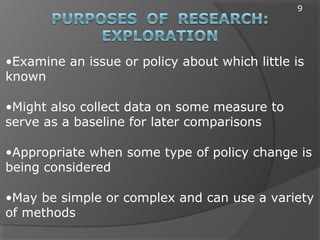
•Examine an issue or policy about which little is
known
•Might also collect data on some measure to
serve as a baseline for later comparisons
•Appropriate when some type of policy change is
being considered
•May be simple or complex and can use a variety
of methods
9
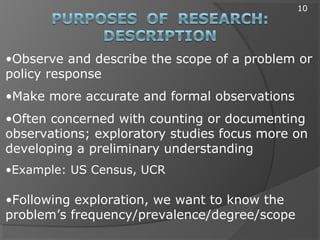
•Observe and describe the scope of a problem or
policy response
•Make more accurate and formal observations
•Often concerned with counting or documenting
observations; exploratory studies focus more on
developing a preliminary understanding
•Example: US Census, UCR
•Following exploration, we want to know the
problem’s frequency/prevalence/degree/scope
10
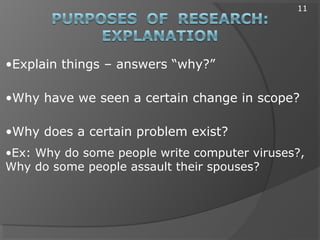
•Explain things – answers “why?”
•Why have we seen a certain change in scope?
•Why does a certain problem exist?
•Ex: Why do some people write computer viruses?,
Why do some people assault their spouses?
11
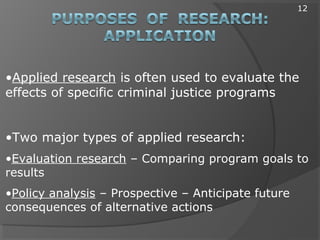
•Applied research is often used to evaluate the
effects of specific criminal justice programs
•Two major types of applied research:
•Evaluation research – Comparing program goals to
results
•Policy analysis – Prospective – Anticipate future
consequences of alternative actions
12
•One of the most difficult parts of the research
process is framing your interest into a research
question.
•Researchers often have to rework or clarify
research problems as they learn more about a topic
•Researchers should begin with their own
experiences and observations and then learn more
about the existing research
13
•Tells you what is know and what is unknown
•Keep notes of articles as you review them
•Begin with a book or article on your topic
•This is your source document
•Find sources that are cited in the source document
and find other sources that have cited your source
document
14
•Reading an article
•Start with the abstract - It will tell you if the article
is relevant to your study
•Next, read the summary and conclusions
•Skim the article paying attention to headings,
tables and graphs
•Carefully read the entire article
•Ask for help if you do not understand the article
15
•Reading a book-length report
•Start with the preface — It will tell you if the article
is relevant to your study
•Skim the book paying attention to the organization,
headings, tables, graphs, and major findings
•Read it closely while taking notes
•If you decide to read the book, repeat the process
with each chapter
16
•Research proposals describe the activities planned
and include a budget and timeline
•Certain agencies might have specific requirements
for a proposal
•Almost every proposal include some basic elements
17
•Problem or Objective — Describes what will be
studied
•Literature Review — Summarizes the prior research
on the topic
•Research Questions — Specifies what the research
will answer
•Subjects for Study — Whom or what will be studied
•Measurement — Identifies the key variables of the
study
18
•Data Collection Methods — Explains how
observations will be collected
•Analysis — Specifies how the observations will be
analyzed
•References — List of materials consulted and cited
in the proposal
•Schedule — A timeline for the various stages of the
proposal
•Budget — Specifies where money to support the
research will be spent
19

Chapter1

  • 1.
  • 2.
    •Criminal Justice professionalsare both consumers and producers of research •It is important for Criminal Justice professionals to be informed consumers of research •Need to understand findings and how to apply those findings to his or her department 2
  • 3.
    •Experiential reality –The things we know from direct experience (e.g. learning that a burner is hot by touching a stove) •Agreement reality – Things we consider real because we have been told they are real, and everyone agrees (e.g., sun sets in the West) •Kansas City Preventive Patrol Experiment revealed the agreement reality that simply increasing patrols decreased crime was misleading 3
  • 4.
    •Empirical research -Knowledge produced based on experience or observation •Scientists have certain criteria to be met when accepting experiential and agreement realities •An assertion must have both logical and empirical support •Methodology - The science of finding out 4
  • 5.
    •Future circumstances arecaused or conditioned by present ones •We use causal and probabilistic reasoning •The goal is to understand why certain things are related, why patterns occur, to enable us to make more accurate predictions 5
  • 6.
    •Tradition – Thingsthat “everybody knows” •Ex: Driving on the left side of the road in the US is dangerous •Authority – Trusting the judgment of someone with special expertise •Ex: You are more likely to believe a judge regarding your driver’s license suspension than your parents •Both provide us with a starting point for our own inquiry 6
  • 7.
    •Inaccurate Observation –Overcome by using measurement devices •Overgeneralization – Overcome by replicating the study to see if you get the same results •Selective Observation – Specify in advance the number and types of observations 7
  • 8.
    •Illogical Reasoning –Use systems of logic, consciously and explicitly •Ideology and Politics – Guard against its influence •To Err is Human – Take precautions to avoid error
  • 9.
    •Examine an issueor policy about which little is known •Might also collect data on some measure to serve as a baseline for later comparisons •Appropriate when some type of policy change is being considered •May be simple or complex and can use a variety of methods 9
  • 10.
    •Observe and describethe scope of a problem or policy response •Make more accurate and formal observations •Often concerned with counting or documenting observations; exploratory studies focus more on developing a preliminary understanding •Example: US Census, UCR •Following exploration, we want to know the problem’s frequency/prevalence/degree/scope 10
  • 11.
    •Explain things –answers “why?” •Why have we seen a certain change in scope? •Why does a certain problem exist? •Ex: Why do some people write computer viruses?, Why do some people assault their spouses? 11
  • 12.
    •Applied research isoften used to evaluate the effects of specific criminal justice programs •Two major types of applied research: •Evaluation research – Comparing program goals to results •Policy analysis – Prospective – Anticipate future consequences of alternative actions 12
  • 13.
    •One of themost difficult parts of the research process is framing your interest into a research question. •Researchers often have to rework or clarify research problems as they learn more about a topic •Researchers should begin with their own experiences and observations and then learn more about the existing research 13
  • 14.
    •Tells you whatis know and what is unknown •Keep notes of articles as you review them •Begin with a book or article on your topic •This is your source document •Find sources that are cited in the source document and find other sources that have cited your source document 14
  • 15.
    •Reading an article •Startwith the abstract - It will tell you if the article is relevant to your study •Next, read the summary and conclusions •Skim the article paying attention to headings, tables and graphs •Carefully read the entire article •Ask for help if you do not understand the article 15
  • 16.
    •Reading a book-lengthreport •Start with the preface — It will tell you if the article is relevant to your study •Skim the book paying attention to the organization, headings, tables, graphs, and major findings •Read it closely while taking notes •If you decide to read the book, repeat the process with each chapter 16
  • 17.
    •Research proposals describethe activities planned and include a budget and timeline •Certain agencies might have specific requirements for a proposal •Almost every proposal include some basic elements 17
  • 18.
    •Problem or Objective— Describes what will be studied •Literature Review — Summarizes the prior research on the topic •Research Questions — Specifies what the research will answer •Subjects for Study — Whom or what will be studied •Measurement — Identifies the key variables of the study 18
  • 19.
    •Data Collection Methods— Explains how observations will be collected •Analysis — Specifies how the observations will be analyzed •References — List of materials consulted and cited in the proposal •Schedule — A timeline for the various stages of the proposal •Budget — Specifies where money to support the research will be spent 19