Welcome to All on My
Presentation on
WORLD
ENVIRONMENT
DAY 2018
Presenting By: Md. Saiful Islam Sakib
3rd Year B. Sc.
Department of Soil Science
University of Chittagong
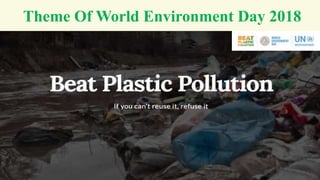
Theme Of World Environment Day 2018
Plastic
 “Plastic’’ is derived from the Greek word ''plastikos'‘.
 They are usually synthetic.
 Chains of like molecules linked together. These chains are called
polymers. Such as polyethylene, polystyrene, and polypropylene.
 Plastics capable of being molded or shaped
Facts About Plastic
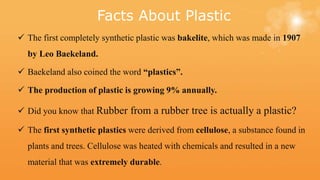
 The first completely synthetic plastic was bakelite, which was made in 1907
by Leo Baekeland.
 Baekeland also coined the word “plastics”.
 The production of plastic is growing 9% annually.
 Did you know that Rubber from a rubber tree is actually a plastic?
 The first synthetic plastics were derived from cellulose, a substance found in
plants and trees. Cellulose was heated with chemicals and resulted in a new
material that was extremely durable.
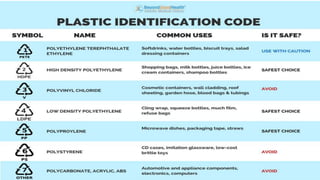
Facts About Plastic
Facts About Plastic
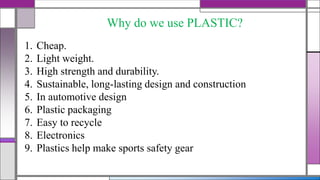
Why do we use PLASTIC?
1. Cheap.
2. Light weight.
3. High strength and durability.
4. Sustainable, long-lasting design and construction
5. In automotive design
6. Plastic packaging
7. Easy to recycle
8. Electronics
9. Plastics help make sports safety gear
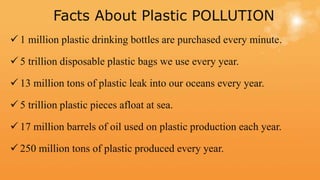
Facts About Plastic POLLUTION
 1 million plastic drinking bottles are purchased every minute.
 5 trillion disposable plastic bags we use every year.
 13 million tons of plastic leak into our oceans every year.
 5 trillion plastic pieces afloat at sea.
 17 million barrels of oil used on plastic production each year.
 250 million tons of plastic produced every year.
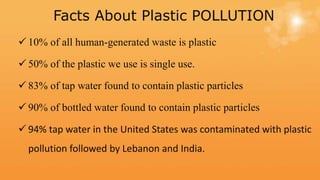
Facts About Plastic POLLUTION
 10% of all human-generated waste is plastic
 50% of the plastic we use is single use.
 83% of tap water found to contain plastic particles
 90% of bottled water found to contain plastic particles
 94% tap water in the United States was contaminated with plastic
pollution followed by Lebanon and India.
Facts About Plastic POLLUTION
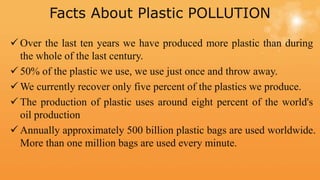
 Over the last ten years we have produced more plastic than during
the whole of the last century.
 50% of the plastic we use, we use just once and throw away.
 We currently recover only five percent of the plastics we produce.
 The production of plastic uses around eight percent of the world's
oil production
 Annually approximately 500 billion plastic bags are used worldwide.
More than one million bags are used every minute.
Facts About Plastic POLLUTION
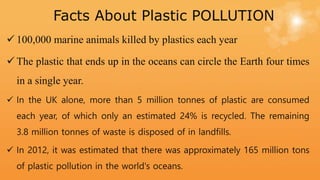
 100,000 marine animals killed by plastics each year
 The plastic that ends up in the oceans can circle the Earth four times
in a single year.
 In the UK alone, more than 5 million tonnes of plastic are consumed
each year, of which only an estimated 24% is recycled. The remaining
3.8 million tonnes of waste is disposed of in landfills.
 In 2012, it was estimated that there was approximately 165 million tons
of plastic pollution in the world's oceans.
Facts About Plastic POLLUTION
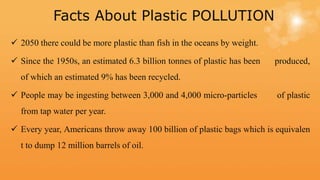
 2050 there could be more plastic than fish in the oceans by weight.
 Since the 1950s, an estimated 6.3 billion tonnes of plastic has been produced,
of which an estimated 9% has been recycled.
 People may be ingesting between 3,000 and 4,000 micro-particles of plastic
from tap water per year.
 Every year, Americans throw away 100 billion of plastic bags which is equivalen
t to dump 12 million barrels of oil.
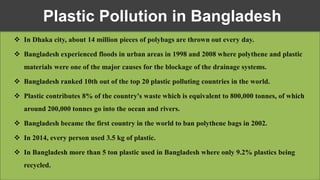
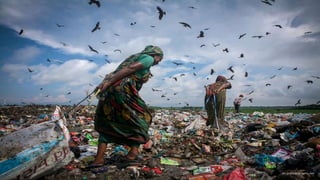
 In Dhaka city, about 14 million pieces of polybags are thrown out every day.
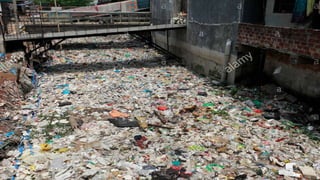
 Bangladesh experienced floods in urban areas in 1998 and 2008 where polythene and plastic
materials were one of the major causes for the blockage of the drainage systems.
 Bangladesh ranked 10th out of the top 20 plastic polluting countries in the world.
 Plastic contributes 8% of the country's waste which is equivalent to 800,000 tonnes, of which
around 200,000 tonnes go into the ocean and rivers.
 Bangladesh became the first country in the world to ban polythene bags in 2002.
 In 2014, every person used 3.5 kg of plastic.
 In Bangladesh more than 5 ton plastic used in Bangladesh where only 9.2% plastics being
recycled.
Plastic Pollution in Bangladesh
 According ESDO study finding, three major cities of Bangladesh, Dhaka, Chittagong and
Sylhet city dwellers release huge quantity of microbeads every month.
 Microbeads are really tiny plastic particles usually smaller than two millimeters.
 Plastic microbeads are in face soaps, body washes, and even toothpastes.
 Around 6628.46 billions of microbeads from Dhaka, 1087.18 billion of microbeads from
Chittagong and 212.38 billion of microbeads from Sylhet city are dumped in to the water
bodies and wetland per month.
Plastic Pollution in Bangladesh
Why Plastic Is Harmful?
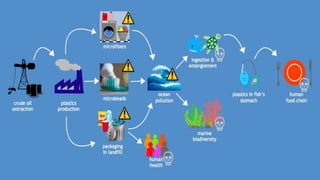
Plastic never goes away
• Plastic cannot biodegrade.
• It breaks down into smaller and smaller pieces.
• It can take anywhere between 450 and 1000 years to decompose fully.
Plastic affects human health.
• Plastics are made out of refined crude oil and contain chemicals such as BPA (Bisphenol-A) &
polystyrene
• When plastic is used to store or heat a dish, chemicals from the container can leach into the food.
• High doses of BPA disrupt reproductive development and functions.
• People who had high levels of BPA in their system had increased rates of a number of serious health
issues including diabetes, heart disease liver toxicity, cancers, birth defects, impaired immunity, endocrine
disruption and other ailments.
• 93% of Americans age six or older test positive for BPA.
• The World Health Organization has shown that exposure to high concentrations of
Phthalates and BPA during pregnancy can lead to the child experiencing lung
problems or being more likely to develop asthma later in life.
• In children the high exposure to these chemicals has been linked to increased
insulin resistance and elevated blood pressure.
• 44 percent of all seabird species, 22 percent of cetaceans, all sea turtle species and a
growing list of fish species have been documented with plastic in or around their
bodies.
Why Plastic Is Harmful?
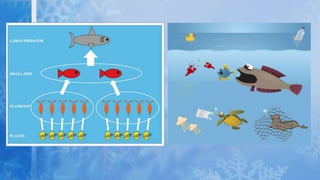
Plastic poisons our food chain.
Plastic pieces in the centre of our ocean’s gyres outnumber live marine plankton,
and are passed up the food chain to reach all marine life.
 They Kill Animals life
Why Plastic Is Harmful?
1. What Should be the Sustainable Solution of
Plastic Pollution?
2. What should be the alternatives of Plastic?
3. How can we manage plastic pollution?

Presentation on world environment day 2018 beat plastic pollution

  • 1.
    Welcome to Allon My Presentation on WORLD ENVIRONMENT DAY 2018 Presenting By: Md. Saiful Islam Sakib 3rd Year B. Sc. Department of Soil Science University of Chittagong
  • 2.
    Theme Of WorldEnvironment Day 2018
  • 4.
    Plastic  “Plastic’’ isderived from the Greek word ''plastikos'‘.  They are usually synthetic.  Chains of like molecules linked together. These chains are called polymers. Such as polyethylene, polystyrene, and polypropylene.  Plastics capable of being molded or shaped
  • 7.
    Facts About Plastic The first completely synthetic plastic was bakelite, which was made in 1907 by Leo Baekeland.  Baekeland also coined the word “plastics”.  The production of plastic is growing 9% annually.  Did you know that Rubber from a rubber tree is actually a plastic?  The first synthetic plastics were derived from cellulose, a substance found in plants and trees. Cellulose was heated with chemicals and resulted in a new material that was extremely durable.
  • 8.
  • 9.
  • 10.
    Why do weuse PLASTIC? 1. Cheap. 2. Light weight. 3. High strength and durability. 4. Sustainable, long-lasting design and construction 5. In automotive design 6. Plastic packaging 7. Easy to recycle 8. Electronics 9. Plastics help make sports safety gear
  • 11.
    Facts About PlasticPOLLUTION  1 million plastic drinking bottles are purchased every minute.  5 trillion disposable plastic bags we use every year.  13 million tons of plastic leak into our oceans every year.  5 trillion plastic pieces afloat at sea.  17 million barrels of oil used on plastic production each year.  250 million tons of plastic produced every year.
  • 12.
    Facts About PlasticPOLLUTION  10% of all human-generated waste is plastic  50% of the plastic we use is single use.  83% of tap water found to contain plastic particles  90% of bottled water found to contain plastic particles  94% tap water in the United States was contaminated with plastic pollution followed by Lebanon and India.
  • 13.
    Facts About PlasticPOLLUTION  Over the last ten years we have produced more plastic than during the whole of the last century.  50% of the plastic we use, we use just once and throw away.  We currently recover only five percent of the plastics we produce.  The production of plastic uses around eight percent of the world's oil production  Annually approximately 500 billion plastic bags are used worldwide. More than one million bags are used every minute.
  • 14.
    Facts About PlasticPOLLUTION  100,000 marine animals killed by plastics each year  The plastic that ends up in the oceans can circle the Earth four times in a single year.  In the UK alone, more than 5 million tonnes of plastic are consumed each year, of which only an estimated 24% is recycled. The remaining 3.8 million tonnes of waste is disposed of in landfills.  In 2012, it was estimated that there was approximately 165 million tons of plastic pollution in the world's oceans.
  • 15.
    Facts About PlasticPOLLUTION  2050 there could be more plastic than fish in the oceans by weight.  Since the 1950s, an estimated 6.3 billion tonnes of plastic has been produced, of which an estimated 9% has been recycled.  People may be ingesting between 3,000 and 4,000 micro-particles of plastic from tap water per year.  Every year, Americans throw away 100 billion of plastic bags which is equivalen t to dump 12 million barrels of oil.
  • 16.
     In Dhakacity, about 14 million pieces of polybags are thrown out every day.  Bangladesh experienced floods in urban areas in 1998 and 2008 where polythene and plastic materials were one of the major causes for the blockage of the drainage systems.  Bangladesh ranked 10th out of the top 20 plastic polluting countries in the world.  Plastic contributes 8% of the country's waste which is equivalent to 800,000 tonnes, of which around 200,000 tonnes go into the ocean and rivers.  Bangladesh became the first country in the world to ban polythene bags in 2002.  In 2014, every person used 3.5 kg of plastic.  In Bangladesh more than 5 ton plastic used in Bangladesh where only 9.2% plastics being recycled. Plastic Pollution in Bangladesh
  • 17.
     According ESDOstudy finding, three major cities of Bangladesh, Dhaka, Chittagong and Sylhet city dwellers release huge quantity of microbeads every month.  Microbeads are really tiny plastic particles usually smaller than two millimeters.  Plastic microbeads are in face soaps, body washes, and even toothpastes.  Around 6628.46 billions of microbeads from Dhaka, 1087.18 billion of microbeads from Chittagong and 212.38 billion of microbeads from Sylhet city are dumped in to the water bodies and wetland per month. Plastic Pollution in Bangladesh
  • 18.
    Why Plastic IsHarmful? Plastic never goes away • Plastic cannot biodegrade. • It breaks down into smaller and smaller pieces. • It can take anywhere between 450 and 1000 years to decompose fully. Plastic affects human health. • Plastics are made out of refined crude oil and contain chemicals such as BPA (Bisphenol-A) & polystyrene • When plastic is used to store or heat a dish, chemicals from the container can leach into the food. • High doses of BPA disrupt reproductive development and functions. • People who had high levels of BPA in their system had increased rates of a number of serious health issues including diabetes, heart disease liver toxicity, cancers, birth defects, impaired immunity, endocrine disruption and other ailments.
  • 19.
    • 93% ofAmericans age six or older test positive for BPA. • The World Health Organization has shown that exposure to high concentrations of Phthalates and BPA during pregnancy can lead to the child experiencing lung problems or being more likely to develop asthma later in life. • In children the high exposure to these chemicals has been linked to increased insulin resistance and elevated blood pressure. • 44 percent of all seabird species, 22 percent of cetaceans, all sea turtle species and a growing list of fish species have been documented with plastic in or around their bodies. Why Plastic Is Harmful?
  • 20.
    Plastic poisons ourfood chain. Plastic pieces in the centre of our ocean’s gyres outnumber live marine plankton, and are passed up the food chain to reach all marine life.  They Kill Animals life Why Plastic Is Harmful?
  • 25.
    1. What Shouldbe the Sustainable Solution of Plastic Pollution? 2. What should be the alternatives of Plastic? 3. How can we manage plastic pollution?