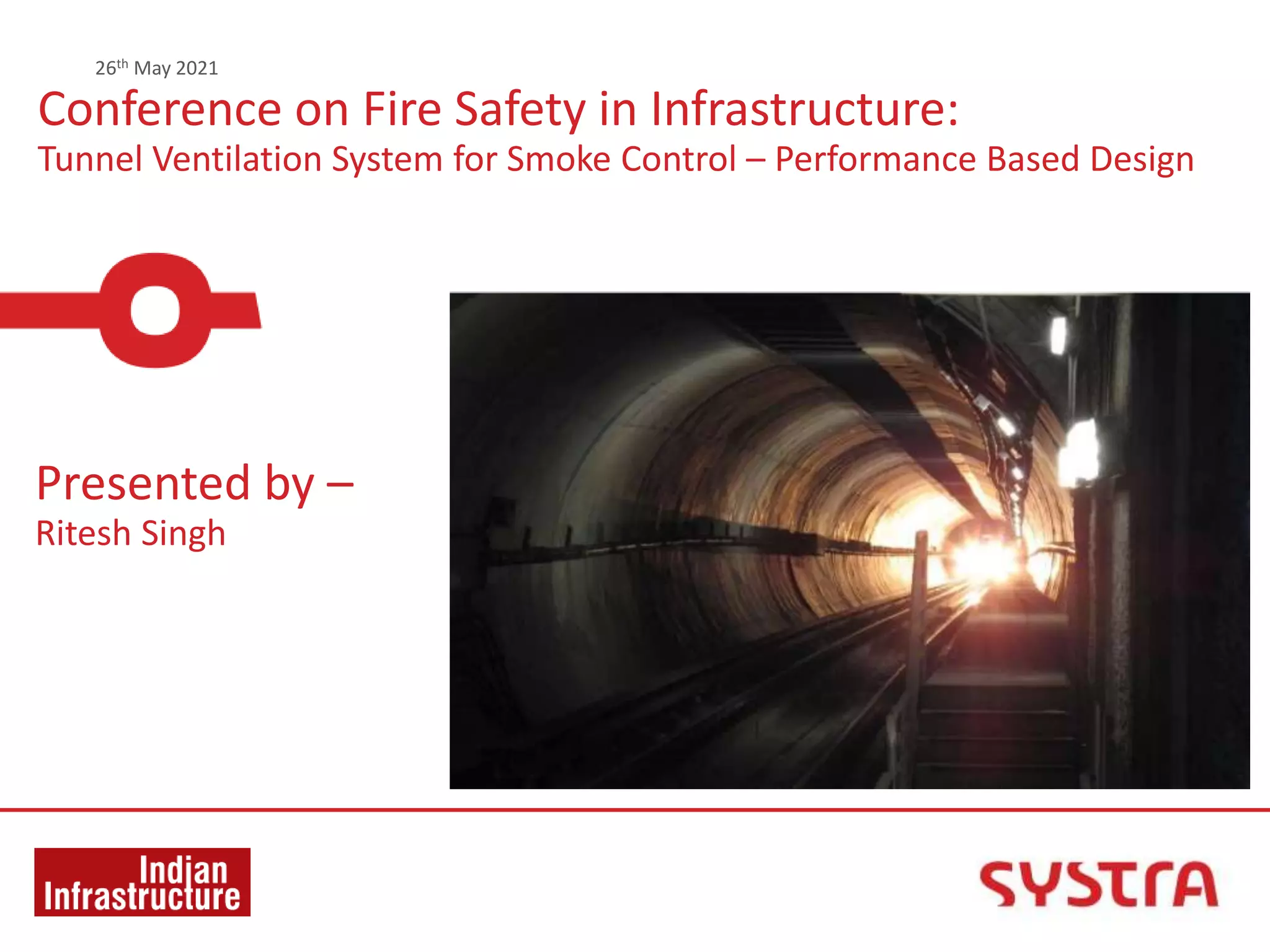
Conference on Fire Safety in Infrastructure:
Tunnel Ventilation System for Smoke Control – Performance Based Design
26th May 2021
Presented by –
Ritesh Singh
Tunnel Ventilation System for Smoke Control – Performance Based Design
Focused on Metro Tunnel and Underground Stations
26th May 2021
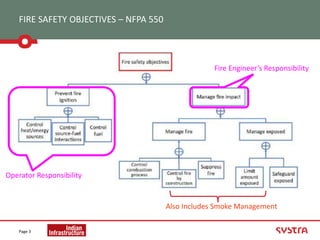
FIRE SAFETY OBJECTIVES – NFPA 550
Page 3
Operator Responsibility
Fire Engineer’s Responsibility
Also Includes Smoke Management
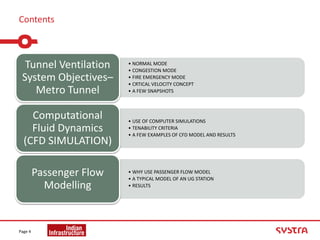
Contents
Page 4
• NORMAL MODE
• CONGESTION MODE
• FIRE EMERGENCY MODE
• CRTICAL VELOCITY CONCEPT
• A FEW SNAPSHOTS
Tunnel Ventilation
System Objectives–
Metro Tunnel
• USE OF COMPUTER SIMULATIONS
• TENABILITY CRITERIA
• A FEW EXAMPLES OF CFD MODEL AND RESULTS
Computational
Fluid Dynamics
(CFD SIMULATION)
• WHY USE PASSENGER FLOW MODEL
• A TYPICAL MODEL OF AN UG STATION
• RESULTS
Passenger Flow
Modelling
1.
Tunnel Ventilation System Objectives– Metro Tunnel
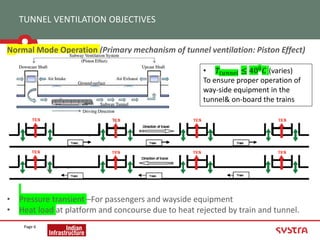
TUNNEL VENTILATION OBJECTIVES
Page 6
Normal Mode Operation (Primary mechanism of tunnel ventilation: Piston Effect)
• Pressure transient –For passengers and wayside equipment
• Heat load at platform and concourse due to heat rejected by train and tunnel.
• 𝑇𝑡𝑢𝑛𝑛𝑒𝑙 ≤ 400𝐶 (varies)
To ensure proper operation of
way-side equipment in the
tunnel& on-board the trains
TUNNEL VENTILATION OBJECTIVES
Page 7
Congested Mode Operation (No Piston Effect):
• Occurs when operational problem prevent the “normal” movement of trains
and trains may wait at stations or in the tunnel.
No threat/danger to Passengers; Evacuation not necessary;
• Operation of TVS (Push-Pull) to ensure tunnel temperature within operating
limits of the train air conditioning equipment. [ Generally, Tavg <460C].
TUNNEL VENTILATION OBJECTIVES
Page 8
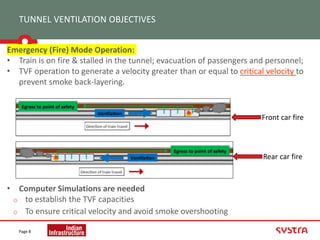
Emergency (Fire) Mode Operation:
• Train is on fire & stalled in the tunnel; evacuation of passengers and personnel;
• TVF operation to generate a velocity greater than or equal to critical velocity to
prevent smoke back-layering.
• Computer Simulations are needed
o to establish the TVF capacities
o To ensure critical velocity and avoid smoke overshooting
Front car fire
Rear car fire
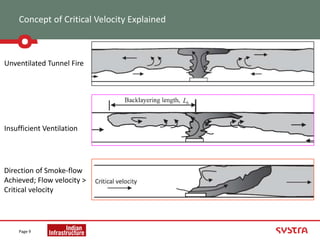
Concept of Critical Velocity Explained
Page 9
Unventilated Tunnel Fire
Insufficient Ventilation
Direction of Smoke-flow
Achieved; Flow velocity >
Critical velocity
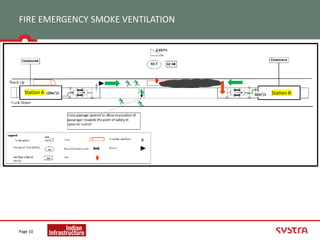
FIRE EMERGENCY SMOKE VENTILATION
Page 10
Station A Station B
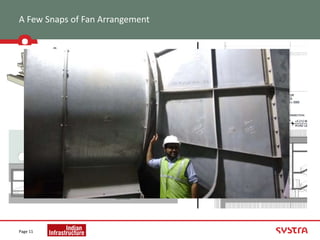
A Few Snaps of Fan Arrangement
Page 11
2.
Computational Fluid Dynamics (CFD) Simulations
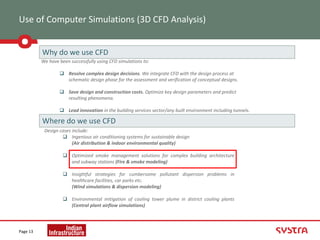
Use of Computer Simulations (3D CFD Analysis)
Page 13
Where do we use CFD
Why do we use CFD
Design cases include:
 Ingenious air conditioning systems for sustainable design
(Air distribution & indoor environmental quality)
 Optimized smoke management solutions for complex building architecture
and subway stations (Fire & smoke modeling)
 Insightful strategies for cumbersome pollutant dispersion problems in
healthcare facilities, car parks etc.
(Wind simulations & dispersion modeling)
 Environmental mitigation of cooling tower plume in district cooling plants
(Central plant airflow simulations)
We have been successfully using CFD simulations to:
 Resolve complex design decisions. We integrate CFD with the design process at
schematic design phase for the assessment and verification of conceptual designs.
 Save design and construction costs. Optimize key design parameters and predict
resulting phenomena.
 Lead innovation in the building services sector/any built environment including tunnels.
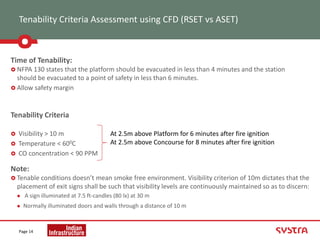
Tenability Criteria Assessment using CFD (RSET vs ASET)
Page 14
Time of Tenability:
 NFPA 130 states that the platform should be evacuated in less than 4 minutes and the station
should be evacuated to a point of safety in less than 6 minutes.
 Allow safety margin
Tenability Criteria
 Visibility > 10 m
 Temperature < 600C
 CO concentration < 90 PPM
At 2.5m above Platform for 6 minutes after fire ignition
At 2.5m above Concourse for 8 minutes after fire ignition
Note:
 Tenable conditions doesn’t mean smoke free environment. Visibility criterion of 10m dictates that the
placement of exit signs shall be such that visibility levels are continuously maintained so as to discern:
 A sign illuminated at 7.5 ft-candles (80 lx) at 30 m
 Normally illuminated doors and walls through a distance of 10 m
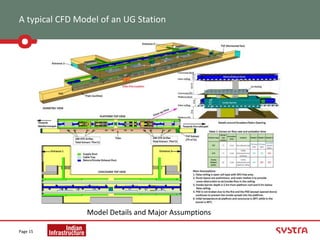
A typical CFD Model of an UG Station
Page 15
Model Details and Major Assumptions
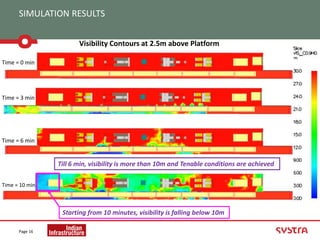
SIMULATION RESULTS
Page 16
Visibility Contours at 2.5m above Platform
Time = 3 min
Time = 6 min
Time = 0 min
Time = 10 min
Till 6 min, visibility is more than 10m and Tenable conditions are achieved
Starting from 10 minutes, visibility is falling below 10m
SIMULATION RESULTS
Page 17
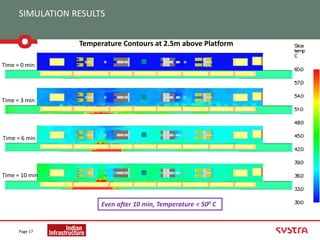
Temperature Contours at 2.5m above Platform
Time = 10 min
Time = 6 min
Time = 0 min
Time = 3 min
Even after 10 min, Temperature < 500 C
SIMULATION RESULTS
Page 18
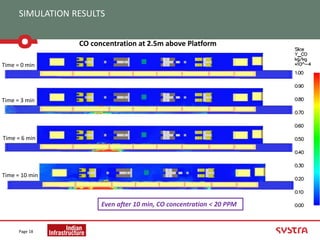
CO concentration at 2.5m above Platform
Even after 10 min, CO concentration < 20 PPM
Time = 10 min
Time = 6 min
Time = 0 min
Time = 3 min
SIMULATION RESULTS
Page 19
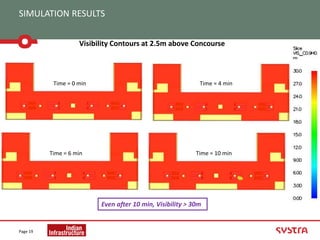
Visibility Contours at 2.5m above Concourse
Time = 6 min
Time = 0 min Time = 4 min
Time = 10 min
Even after 10 min, Visibility > 30m
SIMULATION RESULTS
Page 20
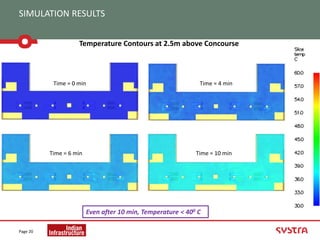
Temperature Contours at 2.5m above Concourse
Time = 6 min Time = 10 min
Time = 0 min Time = 4 min
Even after 10 min, Temperature < 400 C
SIMULATION RESULTS
Page 21
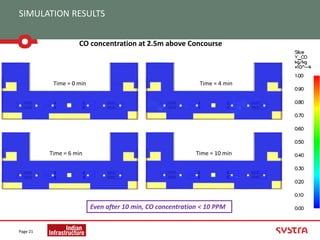
CO concentration at 2.5m above Concourse
Time = 6 min Time = 10 min
Time = 0 min Time = 4 min
Even after 10 min, CO concentration < 10 PPM
SIMULATION RESULTS
Page 22
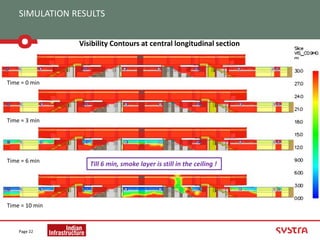
Visibility Contours at central longitudinal section
Time = 0 min
Time = 3 min
Time = 6 min
Time = 10 min
Till 6 min, smoke layer is still in the ceiling !
SIMULATION RESULTS
Page 23
Animation:
Smoke Propagation
in the Station.
Click to Play
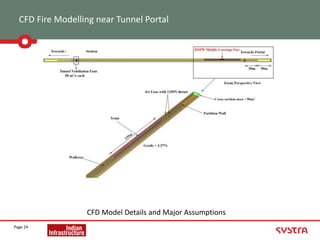
CFD Fire Modelling near Tunnel Portal
CFD Model Details and Major Assumptions
Page 24
Animation: Smoke Propagation in the Tunnel.
Page 25

Metro tunnel ventilaiton .pptx

  • 1.
    Conference on FireSafety in Infrastructure: Tunnel Ventilation System for Smoke Control – Performance Based Design 26th May 2021 Presented by – Ritesh Singh
  • 2.
    Tunnel Ventilation Systemfor Smoke Control – Performance Based Design Focused on Metro Tunnel and Underground Stations 26th May 2021
  • 3.
    FIRE SAFETY OBJECTIVES– NFPA 550 Page 3 Operator Responsibility Fire Engineer’s Responsibility Also Includes Smoke Management
  • 4.
    Contents Page 4 • NORMALMODE • CONGESTION MODE • FIRE EMERGENCY MODE • CRTICAL VELOCITY CONCEPT • A FEW SNAPSHOTS Tunnel Ventilation System Objectives– Metro Tunnel • USE OF COMPUTER SIMULATIONS • TENABILITY CRITERIA • A FEW EXAMPLES OF CFD MODEL AND RESULTS Computational Fluid Dynamics (CFD SIMULATION) • WHY USE PASSENGER FLOW MODEL • A TYPICAL MODEL OF AN UG STATION • RESULTS Passenger Flow Modelling
  • 5.
    1. Tunnel Ventilation SystemObjectives– Metro Tunnel
  • 6.
    TUNNEL VENTILATION OBJECTIVES Page6 Normal Mode Operation (Primary mechanism of tunnel ventilation: Piston Effect) • Pressure transient –For passengers and wayside equipment • Heat load at platform and concourse due to heat rejected by train and tunnel. • 𝑇𝑡𝑢𝑛𝑛𝑒𝑙 ≤ 400𝐶 (varies) To ensure proper operation of way-side equipment in the tunnel& on-board the trains
  • 7.
    TUNNEL VENTILATION OBJECTIVES Page7 Congested Mode Operation (No Piston Effect): • Occurs when operational problem prevent the “normal” movement of trains and trains may wait at stations or in the tunnel. No threat/danger to Passengers; Evacuation not necessary; • Operation of TVS (Push-Pull) to ensure tunnel temperature within operating limits of the train air conditioning equipment. [ Generally, Tavg <460C].
  • 8.
    TUNNEL VENTILATION OBJECTIVES Page8 Emergency (Fire) Mode Operation: • Train is on fire & stalled in the tunnel; evacuation of passengers and personnel; • TVF operation to generate a velocity greater than or equal to critical velocity to prevent smoke back-layering. • Computer Simulations are needed o to establish the TVF capacities o To ensure critical velocity and avoid smoke overshooting Front car fire Rear car fire
  • 9.
    Concept of CriticalVelocity Explained Page 9 Unventilated Tunnel Fire Insufficient Ventilation Direction of Smoke-flow Achieved; Flow velocity > Critical velocity
  • 10.
    FIRE EMERGENCY SMOKEVENTILATION Page 10 Station A Station B
  • 11.
    A Few Snapsof Fan Arrangement Page 11
  • 12.
  • 13.
    Use of ComputerSimulations (3D CFD Analysis) Page 13 Where do we use CFD Why do we use CFD Design cases include:  Ingenious air conditioning systems for sustainable design (Air distribution & indoor environmental quality)  Optimized smoke management solutions for complex building architecture and subway stations (Fire & smoke modeling)  Insightful strategies for cumbersome pollutant dispersion problems in healthcare facilities, car parks etc. (Wind simulations & dispersion modeling)  Environmental mitigation of cooling tower plume in district cooling plants (Central plant airflow simulations) We have been successfully using CFD simulations to:  Resolve complex design decisions. We integrate CFD with the design process at schematic design phase for the assessment and verification of conceptual designs.  Save design and construction costs. Optimize key design parameters and predict resulting phenomena.  Lead innovation in the building services sector/any built environment including tunnels.
  • 14.
    Tenability Criteria Assessmentusing CFD (RSET vs ASET) Page 14 Time of Tenability:  NFPA 130 states that the platform should be evacuated in less than 4 minutes and the station should be evacuated to a point of safety in less than 6 minutes.  Allow safety margin Tenability Criteria  Visibility > 10 m  Temperature < 600C  CO concentration < 90 PPM At 2.5m above Platform for 6 minutes after fire ignition At 2.5m above Concourse for 8 minutes after fire ignition Note:  Tenable conditions doesn’t mean smoke free environment. Visibility criterion of 10m dictates that the placement of exit signs shall be such that visibility levels are continuously maintained so as to discern:  A sign illuminated at 7.5 ft-candles (80 lx) at 30 m  Normally illuminated doors and walls through a distance of 10 m
  • 15.
    A typical CFDModel of an UG Station Page 15 Model Details and Major Assumptions
  • 16.
    SIMULATION RESULTS Page 16 VisibilityContours at 2.5m above Platform Time = 3 min Time = 6 min Time = 0 min Time = 10 min Till 6 min, visibility is more than 10m and Tenable conditions are achieved Starting from 10 minutes, visibility is falling below 10m
  • 17.
    SIMULATION RESULTS Page 17 TemperatureContours at 2.5m above Platform Time = 10 min Time = 6 min Time = 0 min Time = 3 min Even after 10 min, Temperature < 500 C
  • 18.
    SIMULATION RESULTS Page 18 COconcentration at 2.5m above Platform Even after 10 min, CO concentration < 20 PPM Time = 10 min Time = 6 min Time = 0 min Time = 3 min
  • 19.
    SIMULATION RESULTS Page 19 VisibilityContours at 2.5m above Concourse Time = 6 min Time = 0 min Time = 4 min Time = 10 min Even after 10 min, Visibility > 30m
  • 20.
    SIMULATION RESULTS Page 20 TemperatureContours at 2.5m above Concourse Time = 6 min Time = 10 min Time = 0 min Time = 4 min Even after 10 min, Temperature < 400 C
  • 21.
    SIMULATION RESULTS Page 21 COconcentration at 2.5m above Concourse Time = 6 min Time = 10 min Time = 0 min Time = 4 min Even after 10 min, CO concentration < 10 PPM
  • 22.
    SIMULATION RESULTS Page 22 VisibilityContours at central longitudinal section Time = 0 min Time = 3 min Time = 6 min Time = 10 min Till 6 min, smoke layer is still in the ceiling !
  • 23.
    SIMULATION RESULTS Page 23 Animation: SmokePropagation in the Station. Click to Play
  • 24.
    CFD Fire Modellingnear Tunnel Portal CFD Model Details and Major Assumptions Page 24
  • 25.
    Animation: Smoke Propagationin the Tunnel. Page 25

Editor's Notes

  • #4 Control fire or smoke by construction and Limit amount exposed includes smoke ventilation