
1
2
3
Template

concept can be use in two
different concepts
i.
Function template
ii.
Class template

4
The

body of the function template is
written in the same way in each case
as function is written but the difference
is that they can handle arguments and
return value of different types.

5
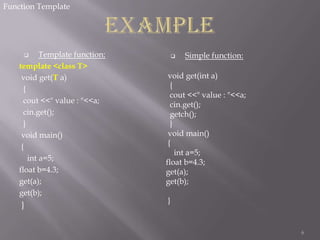
Function Template

Template function:
template <class T>
void get(T a)
{
cout <<" value : "<<a;
cin.get();
}
void main()
{
int a=5;
float b=4.3;
get(a);
get(b);


}



Simple function:

void get(int a)
{
cout <<" value : "<<a;
cin.get();
getch();
}
void main()
{
int a=5;
float b=4.3;
get(a);
get(b);
}

6
Continued…



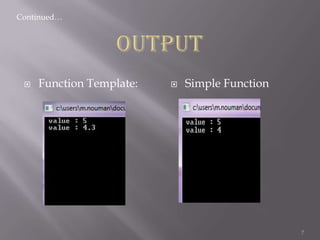
Function Template:



Simple Function

7
template <class T>
T square(T value)
{
return value*value;
}
int main()
{
int a=5;
float b=7.5;
long c=50000900000;
double d=784848.33;
cout<<"square of int variable is :
"<<square(a)<<endl;
cout<<"square of long variable is :
"<<square(b)<<endl;
cout<<"square of long variable is : "<<square
(c)<<endl;
cout<<"square of double variable is :
"<<square(d)<<endl;
cin.get();
getch();

8
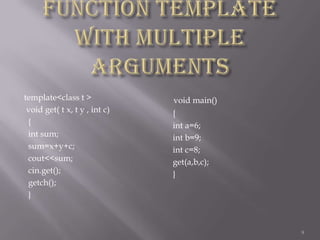
template<class t >
void get( t x, t y , int c)
{
int sum;
sum=x+y+c;
cout<<sum;
cin.get();
getch();
}

void main()
{
int a=6;
int b=9;
int c=8;
get(a,b,c);
}

9
Function Template

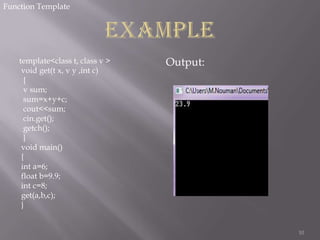
template<class t, class v >
void get(t x, v y ,int c)
{
v sum;
sum=x+y+c;
cout<<sum;
cin.get();
getch();
}
void main()
{
int a=6;
float b=9.9;
int c=8;
get(a,b,c);
}

Output:

10
Class

template definition does not

change
Class template work for variable of all
types instead of single basic type

11
Class Template

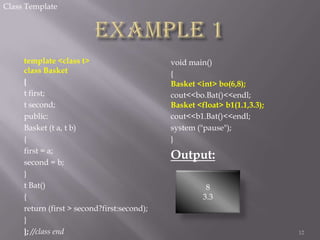
template <class t>
class Basket
{
t first;
t second;
public:
Basket (t a, t b)
{
first = a;
second = b;
}
t Bat()
{
return (first > second?first:second);
}
}; //class end

void main()
{
Basket <int> bo(6,8);
cout<<bo.Bat()<<endl;
Basket <float> b1(1.1,3.3);
cout<<b1.Bat()<<endl;
system ("pause");
}

Output:
8
3.3

12
Continued…

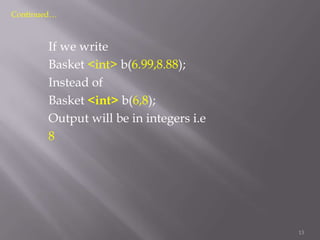
If we write
Basket <int> b(6.99,8.88);
Instead of
Basket <int> b(6,8);
Output will be in integers i.e
8

13
Class Template

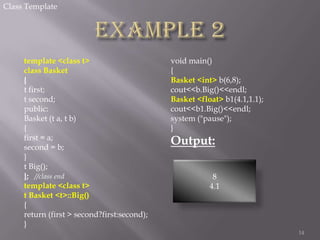
template <class t>
class Basket
{
t first;
t second;
public:
Basket (t a, t b)
{
first = a;
second = b;
}
t Big();
}; //class end
template <class t>
t Basket <t>::Big()
{
return (first > second?first:second);
}

void main()
{
Basket <int> b(6,8);
cout<<b.Big()<<endl;
Basket <float> b1(4.1,1.1);
cout<<b1.Big()<<endl;
system ("pause");
}

Output:
8
4.1

14
Continued…

template <class t>
t Basket <t>::Big()
{
return (first > second?first:second);

}
The

name Basket<t> is used to identify the
class of which Big() is a member function . In
a normal non-template member function the
name Basket alone would suffice.
Void Basket :: Big()
{
return (first > second?first:second);

}

15
Continued…

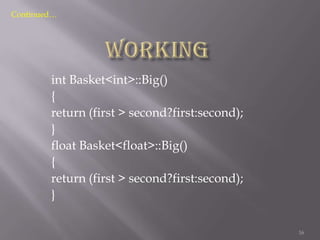
int Basket<int>::Big()
{
return (first > second?first:second);
}
float Basket<float>::Big()
{
return (first > second?first:second);
}
16
template<class TYPE>
struct link
{
TYPE data;
link* next;
};
template<class TYPE>
class linklist
{
private:
link<TYPE>* first;
public:
linklist()
{ first = NULL; }
void additem(TYPE d);
void display();
};

template<class TYPE>
void
linklist<TYPE>::additem(TYPE
d)
{
link<TYPE>* newlink = new
link<TYPE>;
newlink->data = d;
newlink->next = first;
first = newlink;
}
template<class TYPE>
void linklist<TYPE>::display()
{
link<TYPE>* current = first;
while( current != NULL )
17
Continued…

{

linklist<char> lch;

cout << endl << current->data;
current = current->next;
}
}

lch.additem('a');
lch.additem('b');
lch.additem('c');
lch.display();
cout << endl;
system("pause");

int main()
{
linklist<double> ld;
ld.additem(151.5);
ld.additem(262.6);
ld.additem(373.7);
ld.display();

}
OUTPUT
373.7
262.6
151.5
c
b
a

18
An

exception is a condition that
occurs at execution time and make
normal continuation of program
impossible.
When

an exception occurs, the
program must either terminate or jump
to special code for handling the
exception.
 Divide by zero errors.
 Accessing the element of an array beyond its
range
 Invalid input
 Hard disk crash
 Opening a non existent file
19
The

way of handling anomalous situations in a
program-run is known as exception handling.
Its advantage are:





Exception handling separate error-handling code from normal code.
It clarifies the code and enhances readability
Catch error s before it occurs.
It makes for clear, robust and fault -tolerant program s.

20






Tries a block of code that may contain
exception
Throws an exception when one is detected
Catches the exception and handles it
Thus there are three concepts
i. The try block
ii.The throwing of the exception
iii.The catch block

21


A block which includes the code that may
generate the error(an exception)
try { ….
}






Can be followed by one or more catch blocks
which handles the exception
Control of the program passes from the
statements in the try block ,to the appropriate
catch block.
Functions called try block, directly or
indirectly, could test for the presence of the
error
22




Used to indicate that an exception has occurred
Will be caught by closest exception handler
Syntax:if ( // error)
{
Throw error();
}

23
Contain the exception handler.
 These know what to do with the exceptiontypically print out that a type of error has
occurred.
 Catch blocks are typically located right after
the try block that could throw the exception
Syntax:catch()
{
…..
}


24
25
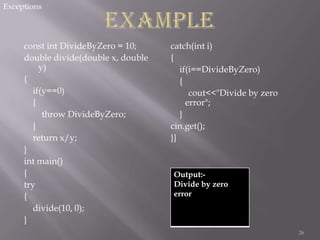
Exceptions

const int DivideByZero = 10;
double divide(double x, double
y)
{
if(y==0)
{
throw DivideByZero;
}
return x/y;
}
int main()
{
try
{
divide(10, 0);
}

catch(int i)
{
if(i==DivideByZero)
{
cout<<"Divide by zero
error";
}
cin.get();
}}

Output:Divide by zero
error

26
















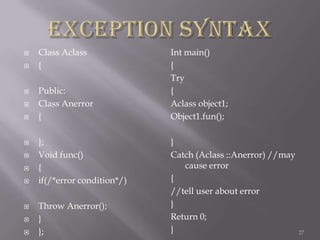
Class Aclass
{
Public:
Class Anerror
{
};
Void func()
{
if(/*error condition*/)
Throw Anerror();
}
};

Int main()
{
Try
{
Aclass object1;
Object1.fun();
}
Catch (Aclass ::Anerror) //may
cause error
{
//tell user about error
}
Return 0;
}

27
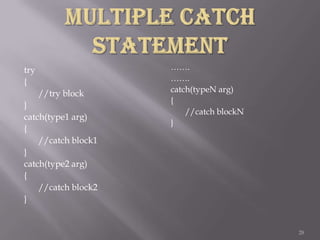
try
{
//try block
}
catch(type1 arg)
{
//catch block1
}
catch(type2 arg)
{
//catch block2
}

…….
…….
catch(typeN arg)
{
//catch blockN
}

28
Multiple Exceptions

const int Max=3;
class stack
{private:
int st[Max],top;
public:
class full
{};
Class empty
{};
stack()
{top=-1;
}

void push(int var)
{
if(top>=Max-1)
throw full();
st[++top]=var;
}
Int pop()
{if(top<0)
Throw empty();
Return st [top--];
}
};
29
Continued…

int main()
{stack s1;
try
{
s1.push(11); s1.push(22);
s1.push(33); s1.push(44);
S1.pop();
s1.pop();
S1.pop();
s1.pop();
}
catch(stack::full)
{
cout<<"exception :stack
full"<<endl;
}

Catch(stack::empty)
{
Cout<<“exception: stack
empty”<<endl;
}
cin.get();
}

30
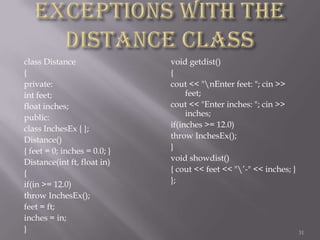
class Distance
{
private:
int feet;
float inches;
public:
class InchesEx { };
Distance()
{ feet = 0; inches = 0.0; }
Distance(int ft, float in)
{
if(in >= 12.0)
throw InchesEx();
feet = ft;
inches = in;
}

void getdist()
{
cout << "nEnter feet: "; cin >>
feet;
cout << "Enter inches: "; cin >>
inches;
if(inches >= 12.0)
throw InchesEx();
}
void showdist()
{ cout << feet << "’-" << inches; }
};

31
Continued…
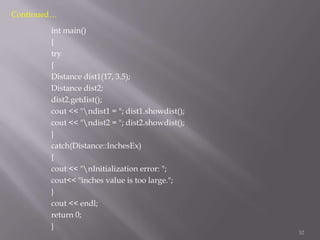
int main()
{
try
{
Distance dist1(17, 3.5);
Distance dist2;
dist2.getdist();
cout << "ndist1 = "; dist1.showdist();
cout << "ndist2 = "; dist2.showdist();
}
catch(Distance::InchesEx)
{
cout << "nInitialization error: ";
cout<< "inches value is too large.";
}
cout << endl;
return 0;
}

32
class Distance
{
private:
int feet;
float inches;
public:
class InchesEx
{
public:
string origin;
float iValue;
InchesEx(string or, float in)
{
origin = or;
iValue = in;
}
};

Distance()
{ feet = 0; inches = 0.0; }
Distance(int ft, float in)
{
if(in >= 12.0)
throw InchesEx("2-arg
constructor", in);
feet = ft;
inches = in;
}
void getdist()
{
cout << "nEnter feet: "; cin >>
feet;
cout << "Enter inches: "; cin >>
inches;
33
Continued…

if(inches >= 12.0)
throw InchesEx("getdist()
function", inches);
}
void showdist()
{ cout << feet << "’-" << inches;
}
};
void main()
{
try
{
Distance dist1(17, 3.5);
Distance dist2;

dist2.getdist();
cout << "ndist1 = ";
dist1.showdist();
cout << "ndist2 = ";
dist2.showdist();
}
catch(Distance::InchesEx ix)
{
cout << "nInitialization error in
" << ix.origin
<< ".n Inches value of " <<
ix.iValue
<< " is too large.";
}
34
class InchesEx
{
public:
string origin;
float iValue;
InchesEx(string or, float in)
{
origin = or;
iValue = in;
}
};
35


Extracting data from the exception object
int main()
{
const unsigned long SIZE = 10000;
char* ptr;
try
{
ptr = new char[SIZE];
}
catch(bad_alloc)
{
cout << “nbad_alloc exception: can’t
allocate memory.n”;
return(1);
}
delete[] ptr; //deallocate memory
cout << “nMemory use is successful.n”;
return 0;
}

36

Presentation on template and exception

  • 1.
  • 2.
  • 3.
  • 4.
    Template concept can beuse in two different concepts i. Function template ii. Class template 4
  • 5.
    The body of thefunction template is written in the same way in each case as function is written but the difference is that they can handle arguments and return value of different types. 5
  • 6.
    Function Template Template function: template<class T> void get(T a) { cout <<" value : "<<a; cin.get(); } void main() { int a=5; float b=4.3; get(a); get(b);  }  Simple function: void get(int a) { cout <<" value : "<<a; cin.get(); getch(); } void main() { int a=5; float b=4.3; get(a); get(b); } 6
  • 7.
  • 8.
    template <class T> Tsquare(T value) { return value*value; } int main() { int a=5; float b=7.5; long c=50000900000; double d=784848.33; cout<<"square of int variable is : "<<square(a)<<endl; cout<<"square of long variable is : "<<square(b)<<endl; cout<<"square of long variable is : "<<square (c)<<endl; cout<<"square of double variable is : "<<square(d)<<endl; cin.get(); getch(); 8
  • 9.
    template<class t > voidget( t x, t y , int c) { int sum; sum=x+y+c; cout<<sum; cin.get(); getch(); } void main() { int a=6; int b=9; int c=8; get(a,b,c); } 9
  • 10.
    Function Template template<class t,class v > void get(t x, v y ,int c) { v sum; sum=x+y+c; cout<<sum; cin.get(); getch(); } void main() { int a=6; float b=9.9; int c=8; get(a,b,c); } Output: 10
  • 11.
    Class template definition doesnot change Class template work for variable of all types instead of single basic type 11
  • 12.
    Class Template template <classt> class Basket { t first; t second; public: Basket (t a, t b) { first = a; second = b; } t Bat() { return (first > second?first:second); } }; //class end void main() { Basket <int> bo(6,8); cout<<bo.Bat()<<endl; Basket <float> b1(1.1,3.3); cout<<b1.Bat()<<endl; system ("pause"); } Output: 8 3.3 12
  • 13.
    Continued… If we write Basket<int> b(6.99,8.88); Instead of Basket <int> b(6,8); Output will be in integers i.e 8 13
  • 14.
    Class Template template <classt> class Basket { t first; t second; public: Basket (t a, t b) { first = a; second = b; } t Big(); }; //class end template <class t> t Basket <t>::Big() { return (first > second?first:second); } void main() { Basket <int> b(6,8); cout<<b.Big()<<endl; Basket <float> b1(4.1,1.1); cout<<b1.Big()<<endl; system ("pause"); } Output: 8 4.1 14
  • 15.
    Continued… template <class t> tBasket <t>::Big() { return (first > second?first:second); } The name Basket<t> is used to identify the class of which Big() is a member function . In a normal non-template member function the name Basket alone would suffice. Void Basket :: Big() { return (first > second?first:second); } 15
  • 16.
    Continued… int Basket<int>::Big() { return (first> second?first:second); } float Basket<float>::Big() { return (first > second?first:second); } 16
  • 17.
    template<class TYPE> struct link { TYPEdata; link* next; }; template<class TYPE> class linklist { private: link<TYPE>* first; public: linklist() { first = NULL; } void additem(TYPE d); void display(); }; template<class TYPE> void linklist<TYPE>::additem(TYPE d) { link<TYPE>* newlink = new link<TYPE>; newlink->data = d; newlink->next = first; first = newlink; } template<class TYPE> void linklist<TYPE>::display() { link<TYPE>* current = first; while( current != NULL ) 17
  • 18.
    Continued… { linklist<char> lch; cout <<endl << current->data; current = current->next; } } lch.additem('a'); lch.additem('b'); lch.additem('c'); lch.display(); cout << endl; system("pause"); int main() { linklist<double> ld; ld.additem(151.5); ld.additem(262.6); ld.additem(373.7); ld.display(); } OUTPUT 373.7 262.6 151.5 c b a 18
  • 19.
    An exception is acondition that occurs at execution time and make normal continuation of program impossible. When an exception occurs, the program must either terminate or jump to special code for handling the exception.  Divide by zero errors.  Accessing the element of an array beyond its range  Invalid input  Hard disk crash  Opening a non existent file 19
  • 20.
    The way of handlinganomalous situations in a program-run is known as exception handling. Its advantage are:     Exception handling separate error-handling code from normal code. It clarifies the code and enhances readability Catch error s before it occurs. It makes for clear, robust and fault -tolerant program s. 20
  • 21.
        Tries a blockof code that may contain exception Throws an exception when one is detected Catches the exception and handles it Thus there are three concepts i. The try block ii.The throwing of the exception iii.The catch block 21
  • 22.
     A block whichincludes the code that may generate the error(an exception) try { …. }    Can be followed by one or more catch blocks which handles the exception Control of the program passes from the statements in the try block ,to the appropriate catch block. Functions called try block, directly or indirectly, could test for the presence of the error 22
  • 23.
       Used to indicatethat an exception has occurred Will be caught by closest exception handler Syntax:if ( // error) { Throw error(); } 23
  • 24.
    Contain the exceptionhandler.  These know what to do with the exceptiontypically print out that a type of error has occurred.  Catch blocks are typically located right after the try block that could throw the exception Syntax:catch() { ….. }  24
  • 25.
  • 26.
    Exceptions const int DivideByZero= 10; double divide(double x, double y) { if(y==0) { throw DivideByZero; } return x/y; } int main() { try { divide(10, 0); } catch(int i) { if(i==DivideByZero) { cout<<"Divide by zero error"; } cin.get(); }} Output:Divide by zero error 26
  • 27.
                Class Aclass { Public: Class Anerror { }; Voidfunc() { if(/*error condition*/) Throw Anerror(); } }; Int main() { Try { Aclass object1; Object1.fun(); } Catch (Aclass ::Anerror) //may cause error { //tell user about error } Return 0; } 27
  • 28.
    try { //try block } catch(type1 arg) { //catchblock1 } catch(type2 arg) { //catch block2 } ……. ……. catch(typeN arg) { //catch blockN } 28
  • 29.
    Multiple Exceptions const intMax=3; class stack {private: int st[Max],top; public: class full {}; Class empty {}; stack() {top=-1; } void push(int var) { if(top>=Max-1) throw full(); st[++top]=var; } Int pop() {if(top<0) Throw empty(); Return st [top--]; } }; 29
  • 30.
    Continued… int main() {stack s1; try { s1.push(11);s1.push(22); s1.push(33); s1.push(44); S1.pop(); s1.pop(); S1.pop(); s1.pop(); } catch(stack::full) { cout<<"exception :stack full"<<endl; } Catch(stack::empty) { Cout<<“exception: stack empty”<<endl; } cin.get(); } 30
  • 31.
    class Distance { private: int feet; floatinches; public: class InchesEx { }; Distance() { feet = 0; inches = 0.0; } Distance(int ft, float in) { if(in >= 12.0) throw InchesEx(); feet = ft; inches = in; } void getdist() { cout << "nEnter feet: "; cin >> feet; cout << "Enter inches: "; cin >> inches; if(inches >= 12.0) throw InchesEx(); } void showdist() { cout << feet << "’-" << inches; } }; 31
  • 32.
    Continued… int main() { try { Distance dist1(17,3.5); Distance dist2; dist2.getdist(); cout << "ndist1 = "; dist1.showdist(); cout << "ndist2 = "; dist2.showdist(); } catch(Distance::InchesEx) { cout << "nInitialization error: "; cout<< "inches value is too large."; } cout << endl; return 0; } 32
  • 33.
    class Distance { private: int feet; floatinches; public: class InchesEx { public: string origin; float iValue; InchesEx(string or, float in) { origin = or; iValue = in; } }; Distance() { feet = 0; inches = 0.0; } Distance(int ft, float in) { if(in >= 12.0) throw InchesEx("2-arg constructor", in); feet = ft; inches = in; } void getdist() { cout << "nEnter feet: "; cin >> feet; cout << "Enter inches: "; cin >> inches; 33
  • 34.
    Continued… if(inches >= 12.0) throwInchesEx("getdist() function", inches); } void showdist() { cout << feet << "’-" << inches; } }; void main() { try { Distance dist1(17, 3.5); Distance dist2; dist2.getdist(); cout << "ndist1 = "; dist1.showdist(); cout << "ndist2 = "; dist2.showdist(); } catch(Distance::InchesEx ix) { cout << "nInitialization error in " << ix.origin << ".n Inches value of " << ix.iValue << " is too large."; } 34
  • 35.
    class InchesEx { public: string origin; floatiValue; InchesEx(string or, float in) { origin = or; iValue = in; } }; 35
  • 36.
     Extracting data fromthe exception object int main() { const unsigned long SIZE = 10000; char* ptr; try { ptr = new char[SIZE]; } catch(bad_alloc) { cout << “nbad_alloc exception: can’t allocate memory.n”; return(1); } delete[] ptr; //deallocate memory cout << “nMemory use is successful.n”; return 0; } 36