Introduction to C 
Tom Chao Zhou 
CSC2100B Data Structures Tutorial 1
Outline 
 Information 
 Introduction to C 
 Basics 
 If Statement 
 Loops 
 Functions 
 Switch case 
 Pointers 
 Structures 
 File I/O
Information 
 Your TA Team: 
 Jianye Hao 
 jyhao AT cse.cuhk.edu.hk 
 Tom Chao Zhou 
 czhou AT cse.cuhk.edu.hk 
 Xin Xin 
 xxin AT cse.cuhk.edu.hk 
 Haifeng Wan 
 hfwan AT cse.cuhk.edu.hk
Information 
 Course Information: 
 Web Page: 
 http://wiki.cse.cuhk.edu.hk/irwin.king/teaching/csc2100b/2010 
 Tutorial Page: 
 http://wiki.cse.cuhk.edu.hk/irwin.king/teaching/csc2100b/tutorials 
 Anti-plagiarism Policy: 
 http://www.cuhk.edu.hk/policy/academichonesty/
Information 
 Assignment 
 There will be both written and programming parts in assignments. 
 Written part: submit to the assignment box in 10/F SHB. 
 Programming part: via Online Judge systems. (Will be introduced next week) 
 You will receive your login Id for CSC2100B online judge via your 
sxxxxxxx@mailserv.cuhk.edu.hk email account. (A few days later). 
 Keep it safe and do not disclose it.
Introduction to C 
 Basics 
 If Statement 
 Loops 
 Functions 
 Switch case 
 Pointers 
 Structures 
 File I/O
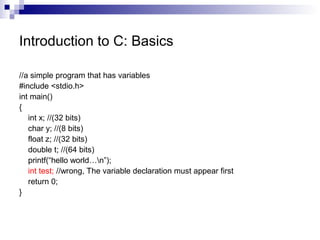
Introduction to C: Basics 
//a simple program that has variables 
#include <stdio.h> 
int main() 
{ 
int x; //(32 bits) 
char y; //(8 bits) 
float z; //(32 bits) 
double t; //(64 bits) 
printf(“hello world…n”); 
int test; //wrong, The variable declaration must appear first 
return 0; 
}
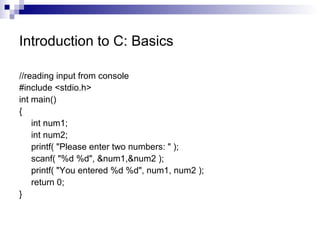
Introduction to C: Basics 
//reading input from console 
#include <stdio.h> 
int main() 
{ 
int num1; 
int num2; 
printf( "Please enter two numbers: " ); 
scanf( "%d %d", &num1,&num2 ); 
printf( "You entered %d %d", num1, num2 ); 
return 0; 
}
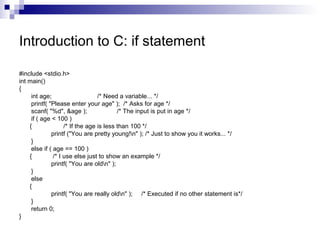
Introduction to C: if statement 
#include <stdio.h> 
int main() 
{ 
int age; /* Need a variable... */ 
printf( "Please enter your age" ); /* Asks for age */ 
scanf( "%d", &age ); /* The input is put in age */ 
if ( age < 100 ) 
{ /* If the age is less than 100 */ 
printf ("You are pretty young!n" ); /* Just to show you it works... */ 
} 
else if ( age == 100 ) 
{ /* I use else just to show an example */ 
printf( "You are oldn" ); 
} 
else 
{ 
printf( "You are really oldn" ); /* Executed if no other statement is*/ 
} return 0; 
}
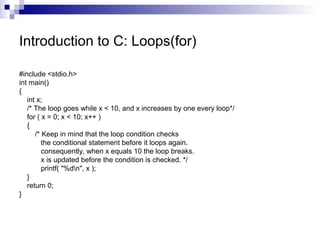
Introduction to C: Loops(for) 
#include <stdio.h> 
int main() 
{ 
int x; 
/* The loop goes while x < 10, and x increases by one every loop*/ 
for ( x = 0; x < 10; x++ ) 
{ 
/* Keep in mind that the loop condition checks 
the conditional statement before it loops again. 
consequently, when x equals 10 the loop breaks. 
x is updated before the condition is checked. */ 
printf( "%dn", x ); 
} 
return 0; 
}
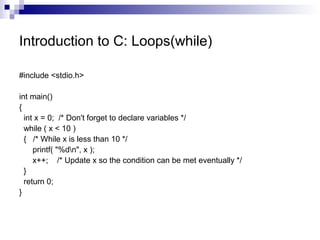
Introduction to C: Loops(while) 
#include <stdio.h> 
int main() 
{ 
int x = 0; /* Don't forget to declare variables */ 
while ( x < 10 ) 
{ /* While x is less than 10 */ 
printf( "%dn", x ); 
x++; /* Update x so the condition can be met eventually */ 
} 
return 0; 
}
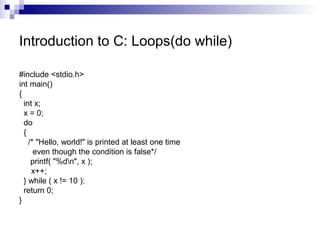
Introduction to C: Loops(do while) 
#include <stdio.h> 
int main() 
{ 
int x; 
x = 0; 
do 
{ 
/* "Hello, world!" is printed at least one time 
even though the condition is false*/ 
printf( "%dn", x ); 
x++; 
} while ( x != 10 ); 
return 0; 
}
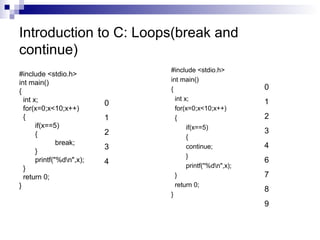
Introduction to C: Loops(break and 
continue) 
#include <stdio.h> 
int main() 
{ 
int x; 
for(x=0;x<10;x++) 
{ 
if(x==5) 
{ 
break; 
} 
printf("%dn",x); 
} 
return 0; 
} 
#include <stdio.h> 
int main() 
{ 
int x; 
for(x=0;x<10;x++) 
{ 
if(x==5) 
{ 
continue; 
} 
printf("%dn",x); 
} 
return 0; 
} 
0 
1 
2 
3 
4 
0 
1 
2 
3 
4 
6 
7 
8 
9
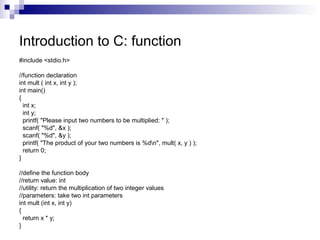
Introduction to C: function 
#include <stdio.h> 
//function declaration 
int mult ( int x, int y ); 
int main() 
{ 
int x; 
int y; 
printf( "Please input two numbers to be multiplied: " ); 
scanf( "%d", &x ); 
scanf( "%d", &y ); 
printf( "The product of your two numbers is %dn", mult( x, y ) ); 
return 0; 
} 
//define the function body 
//return value: int 
//utility: return the multiplication of two integer values 
//parameters: take two int parameters 
int mult (int x, int y) 
{ 
return x * y; 
}
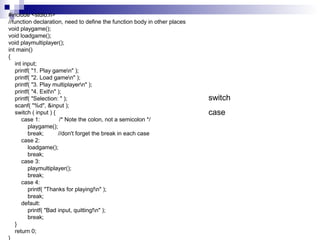
#include <stdio.h> 
//function declaration, need to define the function body in other places 
void playgame(); 
void loadgame(); 
void playmultiplayer(); 
int main() 
{ 
int input; 
printf( "1. Play gamen" ); 
printf( "2. Load gamen" ); 
printf( "3. Play multiplayern" ); 
printf( "4. Exitn" ); 
printf( "Selection: " ); 
scanf( "%d", &input ); 
switch ( input ) { 
case 1: /* Note the colon, not a semicolon */ 
playgame(); 
break; //don't forget the break in each case 
case 2: 
loadgame(); 
break; 
case 3: 
playmultiplayer(); 
break; 
case 4: 
printf( "Thanks for playing!n" ); 
break; 
default: 
printf( "Bad input, quitting!n" ); 
break; 
} 
return 0; 
} 
switch 
case
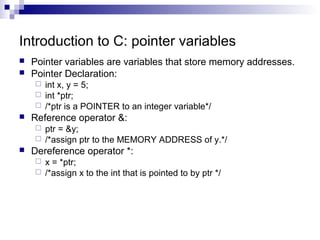
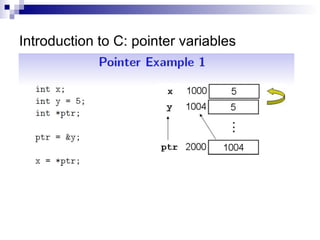
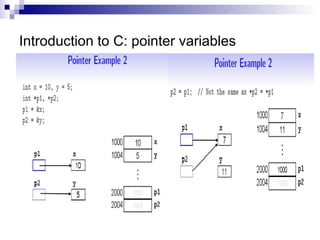
Introduction to C: pointer variables 
 Pointer variables are variables that store memory addresses. 
 Pointer Declaration: 
 int x, y = 5; 
 int *ptr; 
 /*ptr is a POINTER to an integer variable*/ 
 Reference operator &: 
 ptr = &y; 
 /*assign ptr to the MEMORY ADDRESS of y.*/ 
 Dereference operator *: 
 x = *ptr; 
 /*assign x to the int that is pointed to by ptr */
Introduction to C: pointer variables
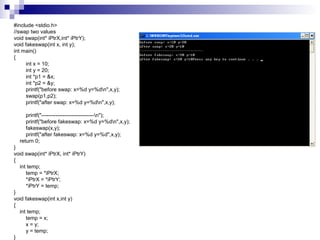
#include <stdio.h> 
//swap two values 
void swap(int* iPtrX,int* iPtrY); 
void fakeswap(int x, int y); 
int main() 
{ 
int x = 10; 
int y = 20; 
int *p1 = &x; 
int *p2 = &y; 
printf("before swap: x=%d y=%dn",x,y); 
swap(p1,p2); 
printf("after swap: x=%d y=%dn",x,y); 
printf("------------------------------n"); 
printf("before fakeswap: x=%d y=%dn",x,y); 
fakeswap(x,y); 
printf("after fakeswap: x=%d y=%d",x,y); 
return 0; 
} 
void swap(int* iPtrX, int* iPtrY) 
{ 
int temp; 
temp = *iPtrX; 
*iPtrX = *iPtrY; 
*iPtrY = temp; 
} 
void fakeswap(int x,int y) 
{ 
int temp; 
temp = x; 
x = y; 
y = temp; 
}
Introduction to C: struct 
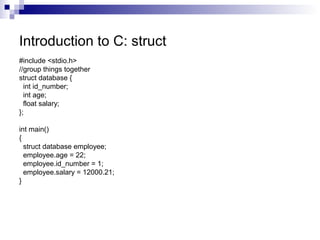
#include <stdio.h> 
//group things together 
struct database { 
int id_number; 
int age; 
float salary; 
}; 
int main() 
{ 
struct database employee; 
employee.age = 22; 
employee.id_number = 1; 
employee.salary = 12000.21; 
}
//content in in.list 
//foo 70 
//bar 98 
//biz 100 
#include <stdio.h> 
int main() 
{ 
FILE *ifp, *ofp; 
char *mode = "r"; 
char outputFilename[] = "out.list"; 
char username[9]; 
int score; 
ifp = fopen("in.list", mode); 
if (ifp == NULL) { 
fprintf(stderr, "Can't open input file in.list!n"); 
exit(1); 
} 
ofp = fopen(outputFilename, "w"); 
if (ofp == NULL) { 
fprintf(stderr, "Can't open output file %s!n", outputFilename); 
exit(1); 
} 
while (fscanf(ifp, "%s %d", username, &score) == 2) { 
fprintf(ofp, "%s %dn", username, score+10); 
} 
fclose(ifp); 
fclose(ofp); 
return 0; 
} 
mode: 
r - open for reading 
w - open for writing (file need not exist) 
a - open for appending (file need not exist) 
r+ - open for reading and writing, start at beginning 
w+ - open for reading and writing (overwrite file) 
a+ - open for reading and writing (append if file 
exists) 
File I/O
Q & A

Tu1

  • 1.
    Introduction to C Tom Chao Zhou CSC2100B Data Structures Tutorial 1
  • 2.
    Outline  Information  Introduction to C  Basics  If Statement  Loops  Functions  Switch case  Pointers  Structures  File I/O
  • 3.
    Information  YourTA Team:  Jianye Hao  jyhao AT cse.cuhk.edu.hk  Tom Chao Zhou  czhou AT cse.cuhk.edu.hk  Xin Xin  xxin AT cse.cuhk.edu.hk  Haifeng Wan  hfwan AT cse.cuhk.edu.hk
  • 4.
    Information  CourseInformation:  Web Page:  http://wiki.cse.cuhk.edu.hk/irwin.king/teaching/csc2100b/2010  Tutorial Page:  http://wiki.cse.cuhk.edu.hk/irwin.king/teaching/csc2100b/tutorials  Anti-plagiarism Policy:  http://www.cuhk.edu.hk/policy/academichonesty/
  • 5.
    Information  Assignment  There will be both written and programming parts in assignments.  Written part: submit to the assignment box in 10/F SHB.  Programming part: via Online Judge systems. (Will be introduced next week)  You will receive your login Id for CSC2100B online judge via your sxxxxxxx@mailserv.cuhk.edu.hk email account. (A few days later).  Keep it safe and do not disclose it.
  • 6.
    Introduction to C  Basics  If Statement  Loops  Functions  Switch case  Pointers  Structures  File I/O
  • 8.
    Introduction to C:Basics //a simple program that has variables #include <stdio.h> int main() { int x; //(32 bits) char y; //(8 bits) float z; //(32 bits) double t; //(64 bits) printf(“hello world…n”); int test; //wrong, The variable declaration must appear first return 0; }
  • 9.
    Introduction to C:Basics //reading input from console #include <stdio.h> int main() { int num1; int num2; printf( "Please enter two numbers: " ); scanf( "%d %d", &num1,&num2 ); printf( "You entered %d %d", num1, num2 ); return 0; }
  • 10.
    Introduction to C:if statement #include <stdio.h> int main() { int age; /* Need a variable... */ printf( "Please enter your age" ); /* Asks for age */ scanf( "%d", &age ); /* The input is put in age */ if ( age < 100 ) { /* If the age is less than 100 */ printf ("You are pretty young!n" ); /* Just to show you it works... */ } else if ( age == 100 ) { /* I use else just to show an example */ printf( "You are oldn" ); } else { printf( "You are really oldn" ); /* Executed if no other statement is*/ } return 0; }
  • 11.
    Introduction to C:Loops(for) #include <stdio.h> int main() { int x; /* The loop goes while x < 10, and x increases by one every loop*/ for ( x = 0; x < 10; x++ ) { /* Keep in mind that the loop condition checks the conditional statement before it loops again. consequently, when x equals 10 the loop breaks. x is updated before the condition is checked. */ printf( "%dn", x ); } return 0; }
  • 12.
    Introduction to C:Loops(while) #include <stdio.h> int main() { int x = 0; /* Don't forget to declare variables */ while ( x < 10 ) { /* While x is less than 10 */ printf( "%dn", x ); x++; /* Update x so the condition can be met eventually */ } return 0; }
  • 13.
    Introduction to C:Loops(do while) #include <stdio.h> int main() { int x; x = 0; do { /* "Hello, world!" is printed at least one time even though the condition is false*/ printf( "%dn", x ); x++; } while ( x != 10 ); return 0; }
  • 14.
    Introduction to C:Loops(break and continue) #include <stdio.h> int main() { int x; for(x=0;x<10;x++) { if(x==5) { break; } printf("%dn",x); } return 0; } #include <stdio.h> int main() { int x; for(x=0;x<10;x++) { if(x==5) { continue; } printf("%dn",x); } return 0; } 0 1 2 3 4 0 1 2 3 4 6 7 8 9
  • 15.
    Introduction to C:function #include <stdio.h> //function declaration int mult ( int x, int y ); int main() { int x; int y; printf( "Please input two numbers to be multiplied: " ); scanf( "%d", &x ); scanf( "%d", &y ); printf( "The product of your two numbers is %dn", mult( x, y ) ); return 0; } //define the function body //return value: int //utility: return the multiplication of two integer values //parameters: take two int parameters int mult (int x, int y) { return x * y; }
  • 16.
    #include <stdio.h> //functiondeclaration, need to define the function body in other places void playgame(); void loadgame(); void playmultiplayer(); int main() { int input; printf( "1. Play gamen" ); printf( "2. Load gamen" ); printf( "3. Play multiplayern" ); printf( "4. Exitn" ); printf( "Selection: " ); scanf( "%d", &input ); switch ( input ) { case 1: /* Note the colon, not a semicolon */ playgame(); break; //don't forget the break in each case case 2: loadgame(); break; case 3: playmultiplayer(); break; case 4: printf( "Thanks for playing!n" ); break; default: printf( "Bad input, quitting!n" ); break; } return 0; } switch case
  • 17.
    Introduction to C:pointer variables  Pointer variables are variables that store memory addresses.  Pointer Declaration:  int x, y = 5;  int *ptr;  /*ptr is a POINTER to an integer variable*/  Reference operator &:  ptr = &y;  /*assign ptr to the MEMORY ADDRESS of y.*/  Dereference operator *:  x = *ptr;  /*assign x to the int that is pointed to by ptr */
  • 18.
    Introduction to C:pointer variables
  • 19.
    Introduction to C:pointer variables
  • 20.
    #include <stdio.h> //swaptwo values void swap(int* iPtrX,int* iPtrY); void fakeswap(int x, int y); int main() { int x = 10; int y = 20; int *p1 = &x; int *p2 = &y; printf("before swap: x=%d y=%dn",x,y); swap(p1,p2); printf("after swap: x=%d y=%dn",x,y); printf("------------------------------n"); printf("before fakeswap: x=%d y=%dn",x,y); fakeswap(x,y); printf("after fakeswap: x=%d y=%d",x,y); return 0; } void swap(int* iPtrX, int* iPtrY) { int temp; temp = *iPtrX; *iPtrX = *iPtrY; *iPtrY = temp; } void fakeswap(int x,int y) { int temp; temp = x; x = y; y = temp; }
  • 21.
    Introduction to C:struct #include <stdio.h> //group things together struct database { int id_number; int age; float salary; }; int main() { struct database employee; employee.age = 22; employee.id_number = 1; employee.salary = 12000.21; }
  • 22.
    //content in in.list //foo 70 //bar 98 //biz 100 #include <stdio.h> int main() { FILE *ifp, *ofp; char *mode = "r"; char outputFilename[] = "out.list"; char username[9]; int score; ifp = fopen("in.list", mode); if (ifp == NULL) { fprintf(stderr, "Can't open input file in.list!n"); exit(1); } ofp = fopen(outputFilename, "w"); if (ofp == NULL) { fprintf(stderr, "Can't open output file %s!n", outputFilename); exit(1); } while (fscanf(ifp, "%s %d", username, &score) == 2) { fprintf(ofp, "%s %dn", username, score+10); } fclose(ifp); fclose(ofp); return 0; } mode: r - open for reading w - open for writing (file need not exist) a - open for appending (file need not exist) r+ - open for reading and writing, start at beginning w+ - open for reading and writing (overwrite file) a+ - open for reading and writing (append if file exists) File I/O
  • 23.