Hidden Gems
in Swift
@akashivskyy
Agenda
‣ Literal Convertibles
‣ String Interpolation
‣ Pattern Matching
‣ Reflection
‣ Objective-C Bridging
Literal
Convertibles
Literal convertibles
struct RegularExpression {
let pattern: String
init(pattern: String)
}
let emailRegex = RegularExpression(
pattern: "^[A-Z0-9._%+-]+@[A-Z0-9.-]+.[A-Z]{2,4}$"
)
// would be nice
let emailRegex = "^[A-Z0-9._%+-]+@[A-Z0-9.-]+.[A-Z]{2,4}$"
1.0
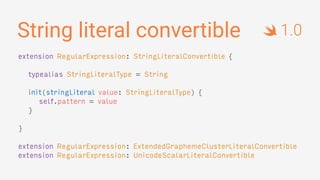
String literal convertible
extension RegularExpression: StringLiteralConvertible {
typealias StringLiteralType = String
init(stringLiteral value: StringLiteralType) {
self.pattern = value
}
}
extension RegularExpression: ExtendedGraphemeClusterLiteralConvertible
extension RegularExpression: UnicodeScalarLiteralConvertible
1.0
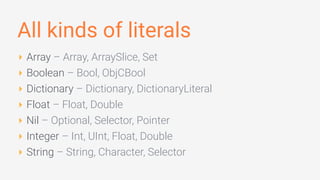
All kinds of literals
‣ Array – Array, ArraySlice, Set
‣ Boolean – Bool, ObjCBool
‣ Dictionary – Dictionary, DictionaryLiteral
‣ Float – Float, Double
‣ Nil – Optional, Selector, Pointer
‣ Integer – Int, UInt, Float, Double
‣ String – String, Character, Selector
String
Interpolation
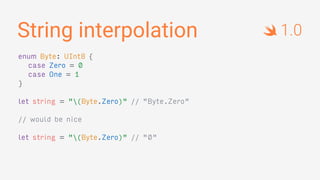
String interpolation
enum Byte: UInt8 {
case Zero = 0
case One = 1
}
let string = "(Byte.Zero)" // "Byte.Zero"
// would be nice
let string = "(Byte.Zero)" // "0"
1.0
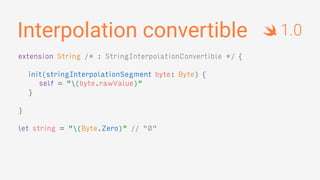
Interpolation convertible
extension String /* : StringInterpolationConvertible */ {
init(stringInterpolationSegment byte: Byte) {
self = "(byte.rawValue)"
}
}
let string = "(Byte.Zero)" // "0"
1.0
Pattern

Matching
What are patterns?
‣ Enumeration cases
‣ Single equatable values
‣ Ranges and intervals
‣ Value bindings
‣ Type casts
‣ func ~= <T, U> (lhs: T, rhs: U) -> Bool
‣ Tuples of anything above
What are patterns?
‣ Enumeration cases
‣ Single equatable values
‣ Ranges and intervals
‣ Value bindings
‣ Type casts
‣ func ~= <T, U> (lhs: T, rhs: U) -> Bool
‣ Tuples of anything above
Where do we use them?
‣ Switch statements
‣ If-let bindings
‣ For-in loops
‣ Catch statements
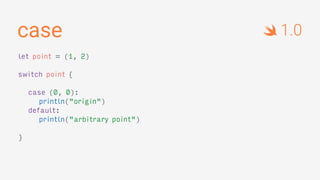
case
let point = (1, 2)
switch point {
case (0, 0):
println("origin")
default:
println("arbitrary point")
}
1.0
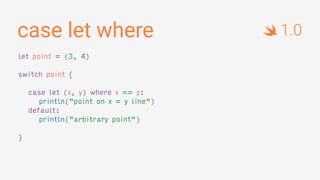
case let where
let point = (3, 4)
switch point {
case let (x, y) where x == y:
println("point on x = y line")
default:
println("arbitrary point")
}
1.0
if let where
let point: (Int, Int)? = maybePoint()
if let (_, y) = point where y > 0 {
println("point above x axis")
}
1.2
for in where
let points = [
(1, 2),
(-3, 4),
(5, -6),
(-7, -8),
(9, 10)
]
for (x, y) in points where x > 0 && y > 0 {
println("point in 1st quadrant: ((x), (y))")
}
1.2
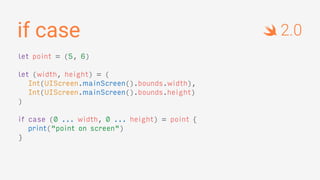
if case
let point = (5, 6)
let (width, height) = (
Int(UIScreen.mainScreen().bounds.width),
Int(UIScreen.mainScreen().bounds.height)
)
if case (0 ... width, 0 ... height) = point {
print("point on screen")
}
2.0
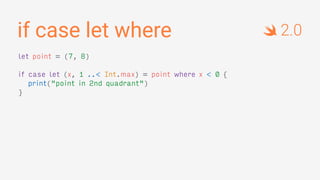
if case let where
let point = (7, 8)
if case let (x, 1 ..< Int.max) = point where x < 0 {
print("point in 2nd quadrant")
}
2.0
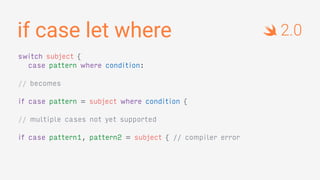
if case let where
switch subject {
case pattern where condition:
// becomes
if case pattern = subject where condition {
// multiple cases not yet supported
if case pattern1, pattern2 = subject { // compiler error
2.0
for case let in where
let points: [(Int, Int)?] = maybePoints()
for case .Some(let (x, y)) in points where x < 0 && y < 0 {
print("point in 3rd quadrant: ((x), (y))")
}
2.0
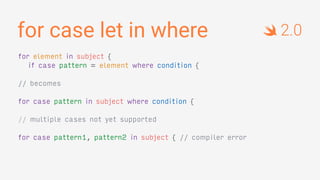
for case let in where
for element in subject {
if case pattern = element where condition {
// becomes
for case pattern in subject where condition {
// multiple cases not yet supported
for case pattern1, pattern2 in subject { // compiler error
2.0
Reflection
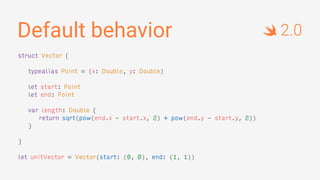
Default behavior
struct Vector {
typealias Point = (x: Double, y: Double)
let start: Point
let end: Point
var length: Double {
return sqrt(pow(end.x - start.x, 2) + pow(end.y - start.y, 2))
}
}
let unitVector = Vector(start: (0, 0), end: (1, 1))
2.0
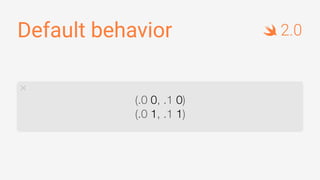
Default behavior 2.0
(.0 0, .1 0)
(.0 1, .1 1)
Reflection methods
‣ Custom description
‣ Custom children tree
‣ Custom Quick Look preview
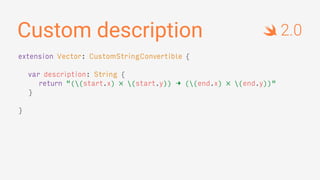
Custom description
extension Vector: CustomStringConvertible {
var description: String {
return "((start.x) × (start.y)) → ((end.x) × (end.y))"
}
}
2.0
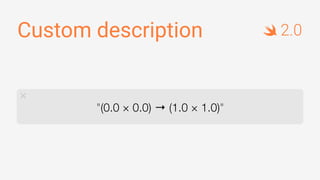
Custom description 2.0
"(0.0 × 0.0) → (1.0 × 1.0)"
Custom mirror
extension Vector: CustomReflectable {
func customMirror() -> Mirror {
return Mirror(self, children: [
"start": "(start.x) × (start.y)",
"end": "(end.x) × (end.y)",
"length": length
])
}
}
2.0
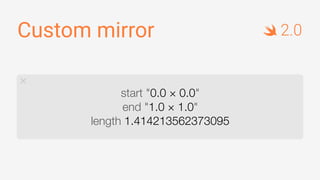
Custom mirror 2.0
start "0.0 × 0.0"
end "1.0 × 1.0"
length 1.414213562373095
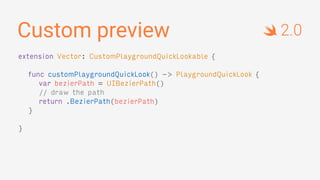
Custom preview
extension Vector: CustomPlaygroundQuickLookable {
func customPlaygroundQuickLook() -> PlaygroundQuickLook {
var bezierPath = UIBezierPath()
// draw the path
return .BezierPath(bezierPath)
}
}
2.0
Custom preview 2.0
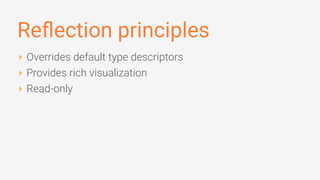
Reflection principles
‣ Overrides default type descriptors
‣ Provides rich visualization
‣ Read-only
Objective-C
Bridging
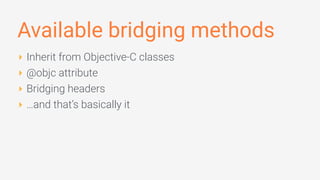
Available bridging methods
‣ Inherit from Objective-C classes
‣ @objc attribute
‣ Bridging headers
‣ …and that’s basically it
Or is it?
@interface NSArray<Element> : NSObject // objective-c class
@end
struct Array<Element> { // generic swift struct
}
let swiftArray: [Int]
let objcArray = swiftArray as NSArray // no problem
2.0
Or is it?
@interface NSArray : NSObject
@end
struct Array<Element>: _ObjectiveCBridgeable {
}
let swiftArray: [Int]
let objcArray = swiftArray as NSArray
2.0
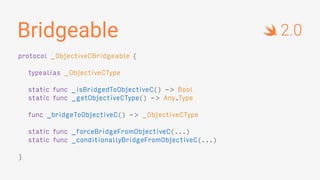
Bridgeable
protocol _ObjectiveCBridgeable {
typealias _ObjectiveCType
static func _isBridgedToObjectiveC() -> Bool
static func _getObjectiveCType() -> Any.Type
func _bridgeToObjectiveC() -> _ObjectiveCType
static func _forceBridgeFromObjectiveC(...)
static func _conditionallyBridgeFromObjectiveC(...)
}
2.0
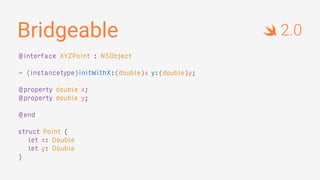
Bridgeable
@interface XYZPoint : NSObject
- (instancetype)initWithX:(double)x y:(double)y;
@property double x;
@property double y;
@end
struct Point {
let x: Double
let y: Double
}
2.0
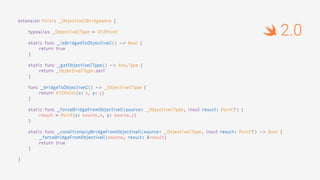
extension Point: _ObjectiveCBridgeable {
typealias _ObjectiveCType = XYZPoint
static func _isBridgedToObjectiveC() -> Bool {
return true
}
static func _getObjectiveCType() -> Any.Type {
return _ObjectiveCType.self
}
func _bridgeToObjectiveC() -> _ObjectiveCType {
return XYZPoint(x: x, y: y)
}
static func _forceBridgeFromObjectiveC(source: _ObjectiveCType, inout result: Point?) {
result = Point(x: source.x, y: source.y)
}
static func _conditionallyBridgeFromObjectiveC(source: _ObjectiveCType, inout result: Point?) -> Bool {
_forceBridgeFromObjectiveC(source, result: &result)
return true
}
}
2.0
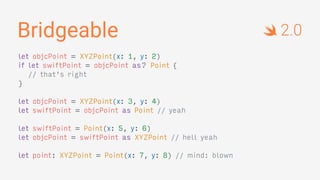
Bridgeable
let objcPoint = XYZPoint(x: 1, y: 2)
if let swiftPoint = objcPoint as? Point {
// that's right
}
let objcPoint = XYZPoint(x: 3, y: 4)
let swiftPoint = objcPoint as Point // yeah
let swiftPoint = Point(x: 5, y: 6)
let objcPoint = swiftPoint as XYZPoint // hell yeah
let point: XYZPoint = Point(x: 7, y: 8) // mind: blown
2.0
Recap
‣ Literal Convertibles
‣ String Interpolation
‣ Pattern Matching
‣ Reflection
‣ Objective-C Bridging
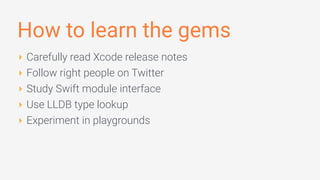
How to learn the gems
‣ Carefully read Xcode release notes
‣ Follow right people on Twitter
‣ Study Swift module interface
‣ Use LLDB type lookup
‣ Experiment in playgrounds
Questions?
@akashivskyy
github.com/akashivskyy/talks
Thanks! 🍻
@akashivskyy
github.com/akashivskyy/talks

Hidden Gems in Swift

  • 1.
  • 2.
  • 3.
    Agenda ‣ Literal Convertibles ‣String Interpolation ‣ Pattern Matching ‣ Reflection ‣ Objective-C Bridging
  • 4.
  • 5.
    Literal convertibles struct RegularExpression{ let pattern: String init(pattern: String) } let emailRegex = RegularExpression( pattern: "^[A-Z0-9._%+-]+@[A-Z0-9.-]+.[A-Z]{2,4}$" ) // would be nice let emailRegex = "^[A-Z0-9._%+-]+@[A-Z0-9.-]+.[A-Z]{2,4}$" 1.0
  • 6.
    String literal convertible extensionRegularExpression: StringLiteralConvertible { typealias StringLiteralType = String init(stringLiteral value: StringLiteralType) { self.pattern = value } } extension RegularExpression: ExtendedGraphemeClusterLiteralConvertible extension RegularExpression: UnicodeScalarLiteralConvertible 1.0
  • 7.
    All kinds ofliterals ‣ Array – Array, ArraySlice, Set ‣ Boolean – Bool, ObjCBool ‣ Dictionary – Dictionary, DictionaryLiteral ‣ Float – Float, Double ‣ Nil – Optional, Selector, Pointer ‣ Integer – Int, UInt, Float, Double ‣ String – String, Character, Selector
  • 8.
  • 9.
    String interpolation enum Byte:UInt8 { case Zero = 0 case One = 1 } let string = "(Byte.Zero)" // "Byte.Zero" // would be nice let string = "(Byte.Zero)" // "0" 1.0
  • 10.
    Interpolation convertible extension String/* : StringInterpolationConvertible */ { init(stringInterpolationSegment byte: Byte) { self = "(byte.rawValue)" } } let string = "(Byte.Zero)" // "0" 1.0
  • 11.
  • 12.
    What are patterns? ‣Enumeration cases ‣ Single equatable values ‣ Ranges and intervals ‣ Value bindings ‣ Type casts ‣ func ~= <T, U> (lhs: T, rhs: U) -> Bool ‣ Tuples of anything above
  • 14.
    What are patterns? ‣Enumeration cases ‣ Single equatable values ‣ Ranges and intervals ‣ Value bindings ‣ Type casts ‣ func ~= <T, U> (lhs: T, rhs: U) -> Bool ‣ Tuples of anything above
  • 15.
    Where do weuse them? ‣ Switch statements ‣ If-let bindings ‣ For-in loops ‣ Catch statements
  • 16.
    case let point =(1, 2) switch point { case (0, 0): println("origin") default: println("arbitrary point") } 1.0
  • 17.
    case let where letpoint = (3, 4) switch point { case let (x, y) where x == y: println("point on x = y line") default: println("arbitrary point") } 1.0
  • 18.
    if let where letpoint: (Int, Int)? = maybePoint() if let (_, y) = point where y > 0 { println("point above x axis") } 1.2
  • 19.
    for in where letpoints = [ (1, 2), (-3, 4), (5, -6), (-7, -8), (9, 10) ] for (x, y) in points where x > 0 && y > 0 { println("point in 1st quadrant: ((x), (y))") } 1.2
  • 20.
    if case let point= (5, 6) let (width, height) = ( Int(UIScreen.mainScreen().bounds.width), Int(UIScreen.mainScreen().bounds.height) ) if case (0 ... width, 0 ... height) = point { print("point on screen") } 2.0
  • 21.
    if case letwhere let point = (7, 8) if case let (x, 1 ..< Int.max) = point where x < 0 { print("point in 2nd quadrant") } 2.0
  • 22.
    if case letwhere switch subject { case pattern where condition: // becomes if case pattern = subject where condition { // multiple cases not yet supported if case pattern1, pattern2 = subject { // compiler error 2.0
  • 23.
    for case letin where let points: [(Int, Int)?] = maybePoints() for case .Some(let (x, y)) in points where x < 0 && y < 0 { print("point in 3rd quadrant: ((x), (y))") } 2.0
  • 24.
    for case letin where for element in subject { if case pattern = element where condition { // becomes for case pattern in subject where condition { // multiple cases not yet supported for case pattern1, pattern2 in subject { // compiler error 2.0
  • 25.
  • 26.
    Default behavior struct Vector{ typealias Point = (x: Double, y: Double) let start: Point let end: Point var length: Double { return sqrt(pow(end.x - start.x, 2) + pow(end.y - start.y, 2)) } } let unitVector = Vector(start: (0, 0), end: (1, 1)) 2.0
  • 27.
    Default behavior 2.0 (.00, .1 0) (.0 1, .1 1)
  • 28.
    Reflection methods ‣ Customdescription ‣ Custom children tree ‣ Custom Quick Look preview
  • 29.
    Custom description extension Vector:CustomStringConvertible { var description: String { return "((start.x) × (start.y)) → ((end.x) × (end.y))" } } 2.0
  • 30.
    Custom description 2.0 "(0.0× 0.0) → (1.0 × 1.0)"
  • 31.
    Custom mirror extension Vector:CustomReflectable { func customMirror() -> Mirror { return Mirror(self, children: [ "start": "(start.x) × (start.y)", "end": "(end.x) × (end.y)", "length": length ]) } } 2.0
  • 32.
    Custom mirror 2.0 start"0.0 × 0.0" end "1.0 × 1.0" length 1.414213562373095
  • 33.
    Custom preview extension Vector:CustomPlaygroundQuickLookable { func customPlaygroundQuickLook() -> PlaygroundQuickLook { var bezierPath = UIBezierPath() // draw the path return .BezierPath(bezierPath) } } 2.0
  • 34.
  • 35.
    Reflection principles ‣ Overridesdefault type descriptors ‣ Provides rich visualization ‣ Read-only
  • 36.
  • 37.
    Available bridging methods ‣Inherit from Objective-C classes ‣ @objc attribute ‣ Bridging headers ‣ …and that’s basically it
  • 38.
    Or is it? @interfaceNSArray<Element> : NSObject // objective-c class @end struct Array<Element> { // generic swift struct } let swiftArray: [Int] let objcArray = swiftArray as NSArray // no problem 2.0
  • 39.
    Or is it? @interfaceNSArray : NSObject @end struct Array<Element>: _ObjectiveCBridgeable { } let swiftArray: [Int] let objcArray = swiftArray as NSArray 2.0
  • 40.
    Bridgeable protocol _ObjectiveCBridgeable { typealias_ObjectiveCType static func _isBridgedToObjectiveC() -> Bool static func _getObjectiveCType() -> Any.Type func _bridgeToObjectiveC() -> _ObjectiveCType static func _forceBridgeFromObjectiveC(...) static func _conditionallyBridgeFromObjectiveC(...) } 2.0
  • 41.
    Bridgeable @interface XYZPoint :NSObject - (instancetype)initWithX:(double)x y:(double)y; @property double x; @property double y; @end struct Point { let x: Double let y: Double } 2.0
  • 42.
    extension Point: _ObjectiveCBridgeable{ typealias _ObjectiveCType = XYZPoint static func _isBridgedToObjectiveC() -> Bool { return true } static func _getObjectiveCType() -> Any.Type { return _ObjectiveCType.self } func _bridgeToObjectiveC() -> _ObjectiveCType { return XYZPoint(x: x, y: y) } static func _forceBridgeFromObjectiveC(source: _ObjectiveCType, inout result: Point?) { result = Point(x: source.x, y: source.y) } static func _conditionallyBridgeFromObjectiveC(source: _ObjectiveCType, inout result: Point?) -> Bool { _forceBridgeFromObjectiveC(source, result: &result) return true } } 2.0
  • 43.
    Bridgeable let objcPoint =XYZPoint(x: 1, y: 2) if let swiftPoint = objcPoint as? Point { // that's right } let objcPoint = XYZPoint(x: 3, y: 4) let swiftPoint = objcPoint as Point // yeah let swiftPoint = Point(x: 5, y: 6) let objcPoint = swiftPoint as XYZPoint // hell yeah let point: XYZPoint = Point(x: 7, y: 8) // mind: blown 2.0
  • 44.
    Recap ‣ Literal Convertibles ‣String Interpolation ‣ Pattern Matching ‣ Reflection ‣ Objective-C Bridging
  • 45.
    How to learnthe gems ‣ Carefully read Xcode release notes ‣ Follow right people on Twitter ‣ Study Swift module interface ‣ Use LLDB type lookup ‣ Experiment in playgrounds
  • 46.
  • 47.