MORE ON CLASSES
AND OBJECTS
Chapter 4
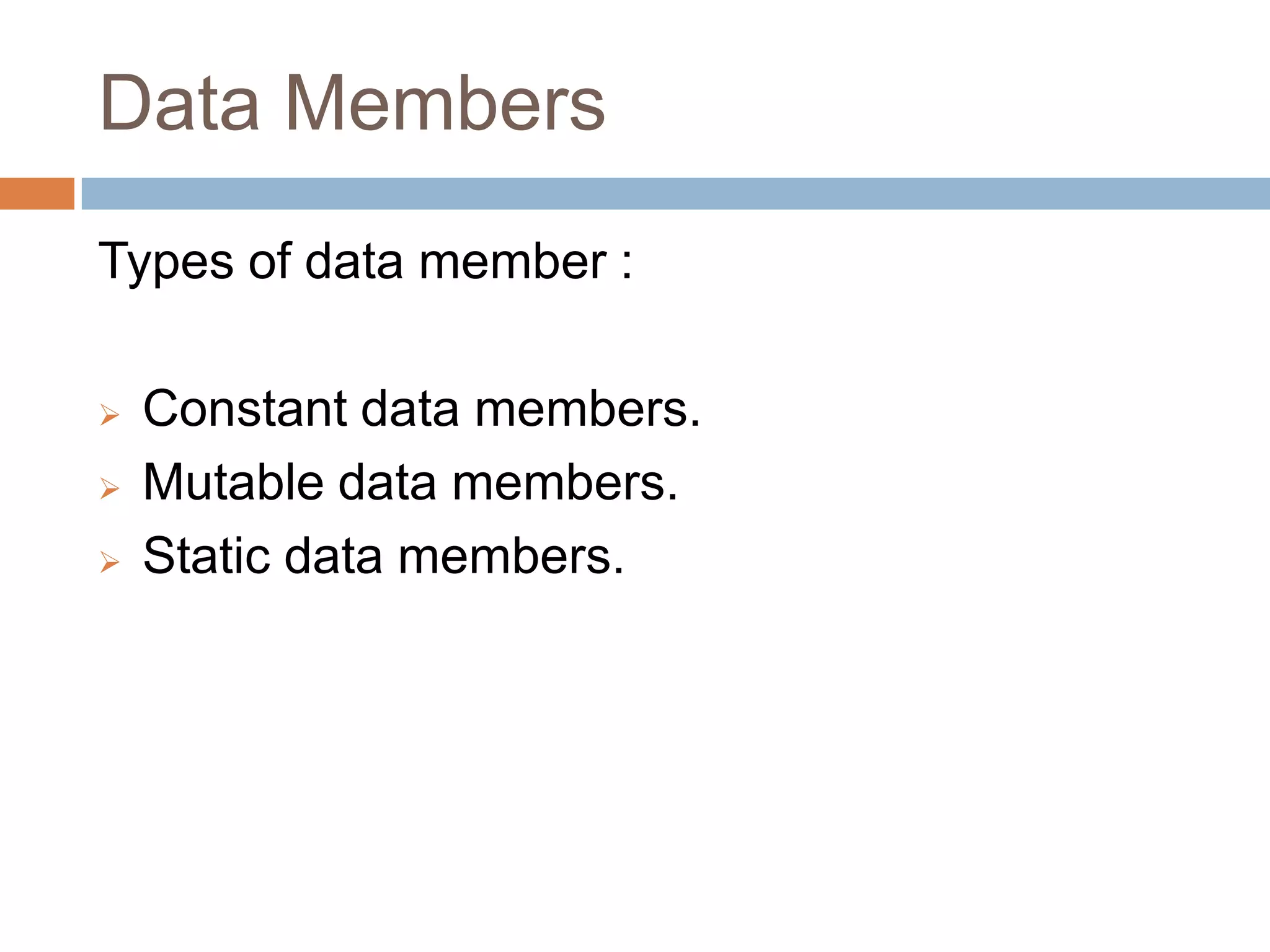
Data Members
Types of data member :

   Constant data members.
   Mutable data members.
   Static data members.
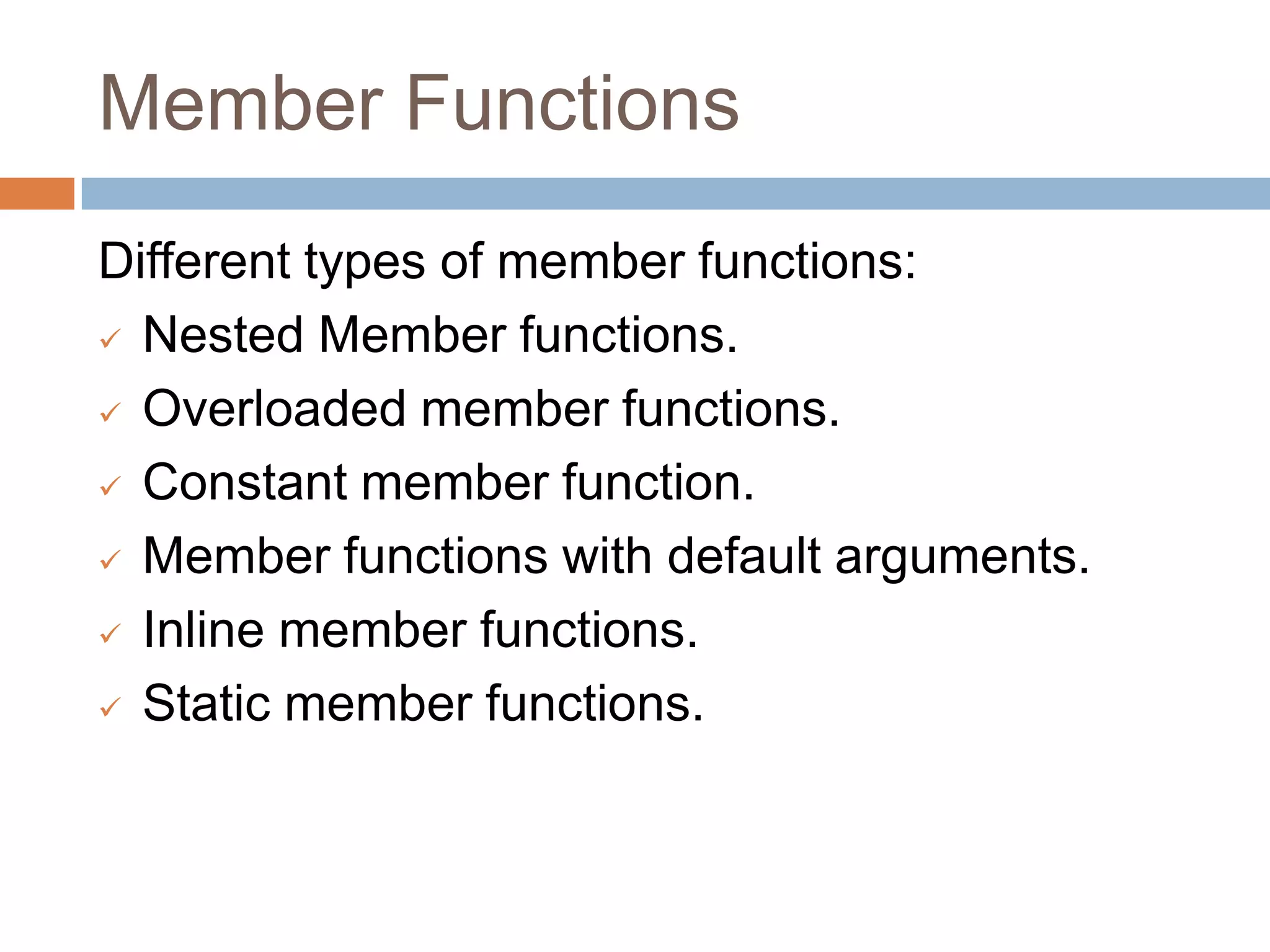
Member Functions
Different types of member functions:
 Nested Member functions.

 Overloaded member functions.

 Constant member function.

 Member functions with default arguments.

 Inline member functions.

 Static member functions.
Constant data members
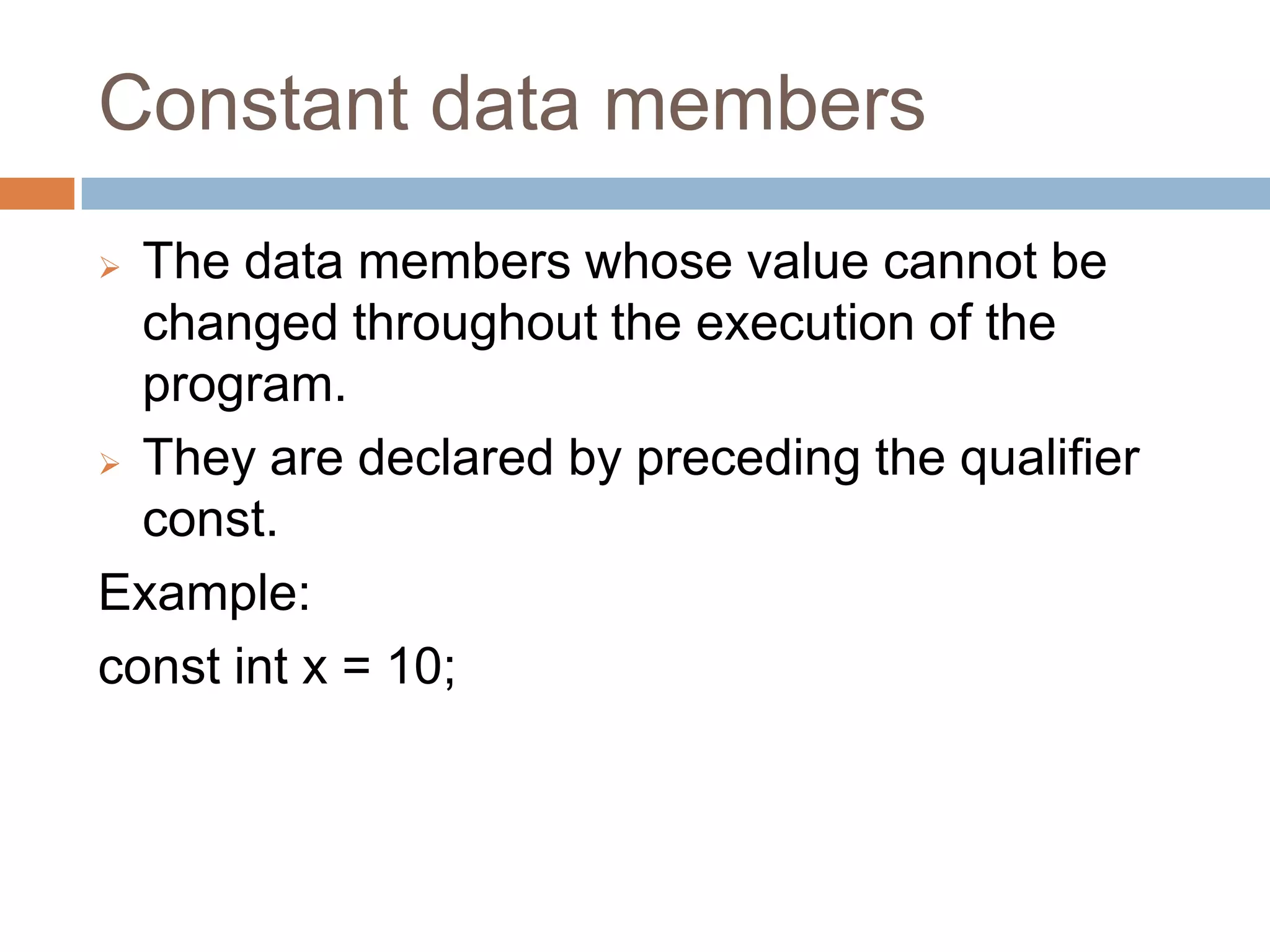
 The data members whose value cannot be
  changed throughout the execution of the
  program.
 They are declared by preceding the qualifier
  const.
Example:
const int x = 10;
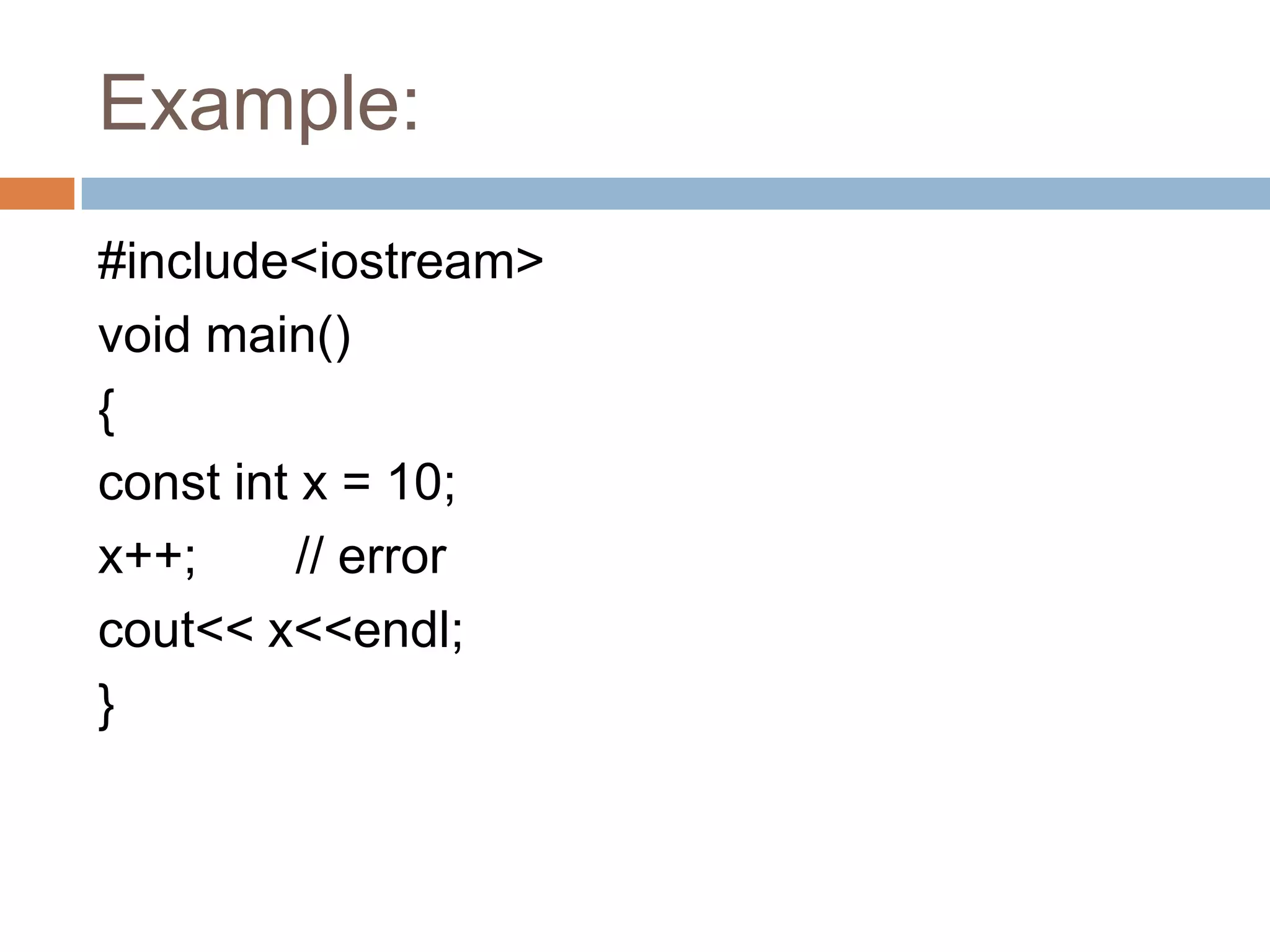
Example:
#include<iostream>
void main()
{
const int x = 10;
x++;      // error
cout<< x<<endl;
}
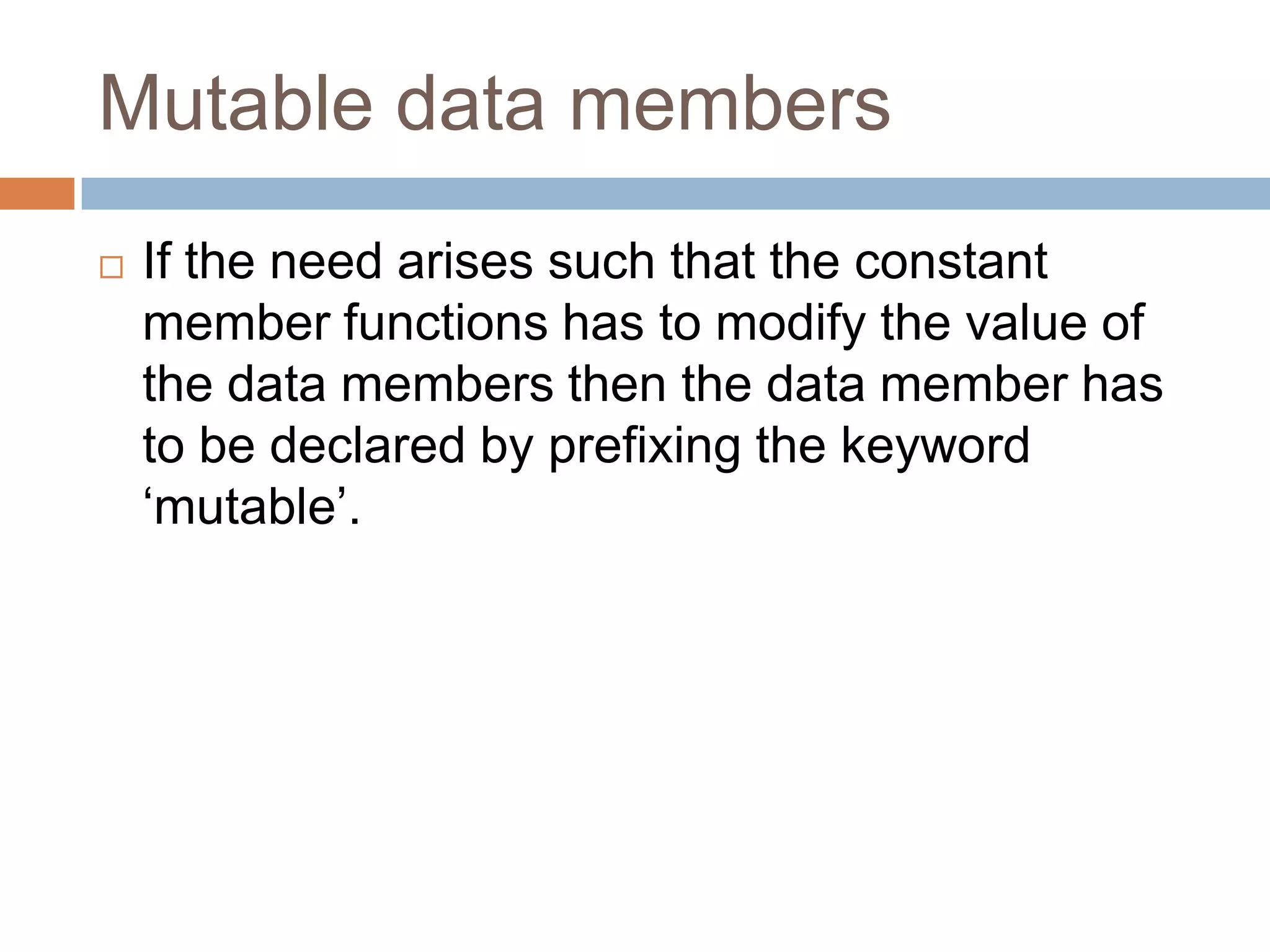
Mutable data members
   If the need arises such that the constant
    member functions has to modify the value of
    the data members then the data member has
    to be declared by prefixing the keyword
    „mutable‟.
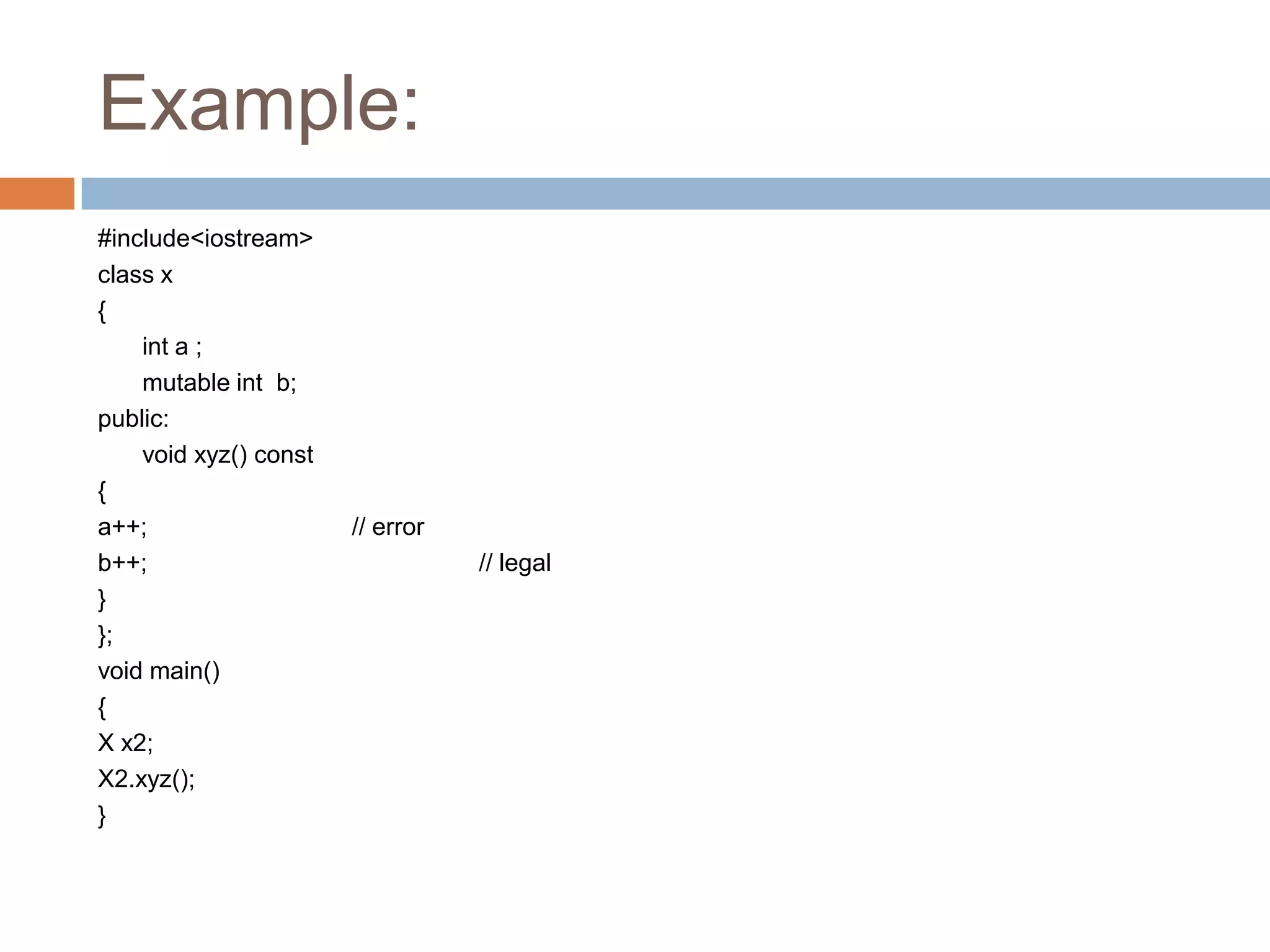
Example:
#include<iostream>
class x
{
    int a ;
    mutable int b;
public:
    void xyz() const
{
a++;                   // error
b++;                              // legal
}
};
void main()
{
X x2;
X2.xyz();
}
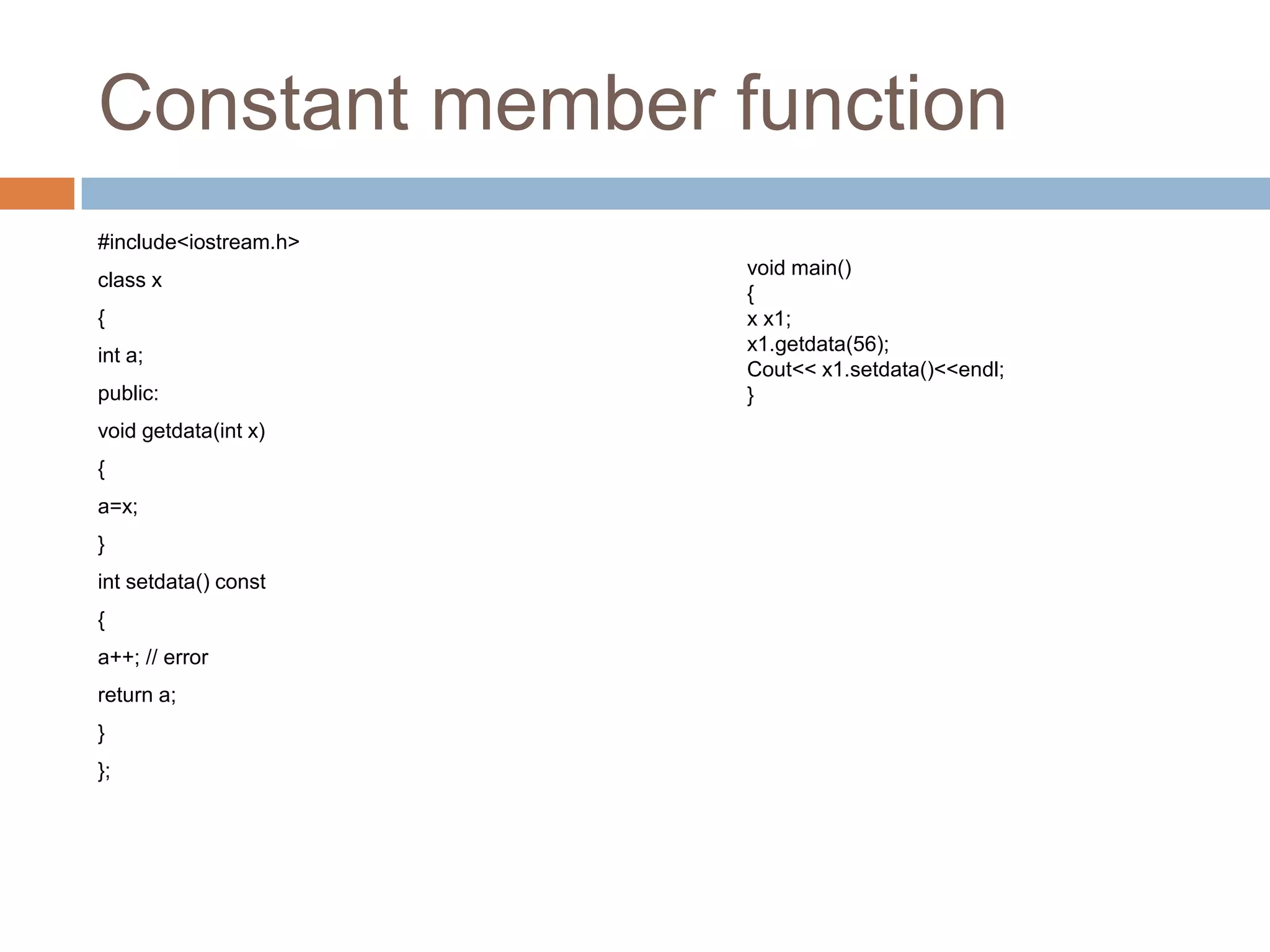
Constant member function
#include<iostream.h>
                       void main()
class x
                       {
{                      x x1;
                       x1.getdata(56);
int a;
                       Cout<< x1.setdata()<<endl;
public:                }
void getdata(int x)
{
a=x;
}
int setdata() const
{
a++; // error
return a;
}
};
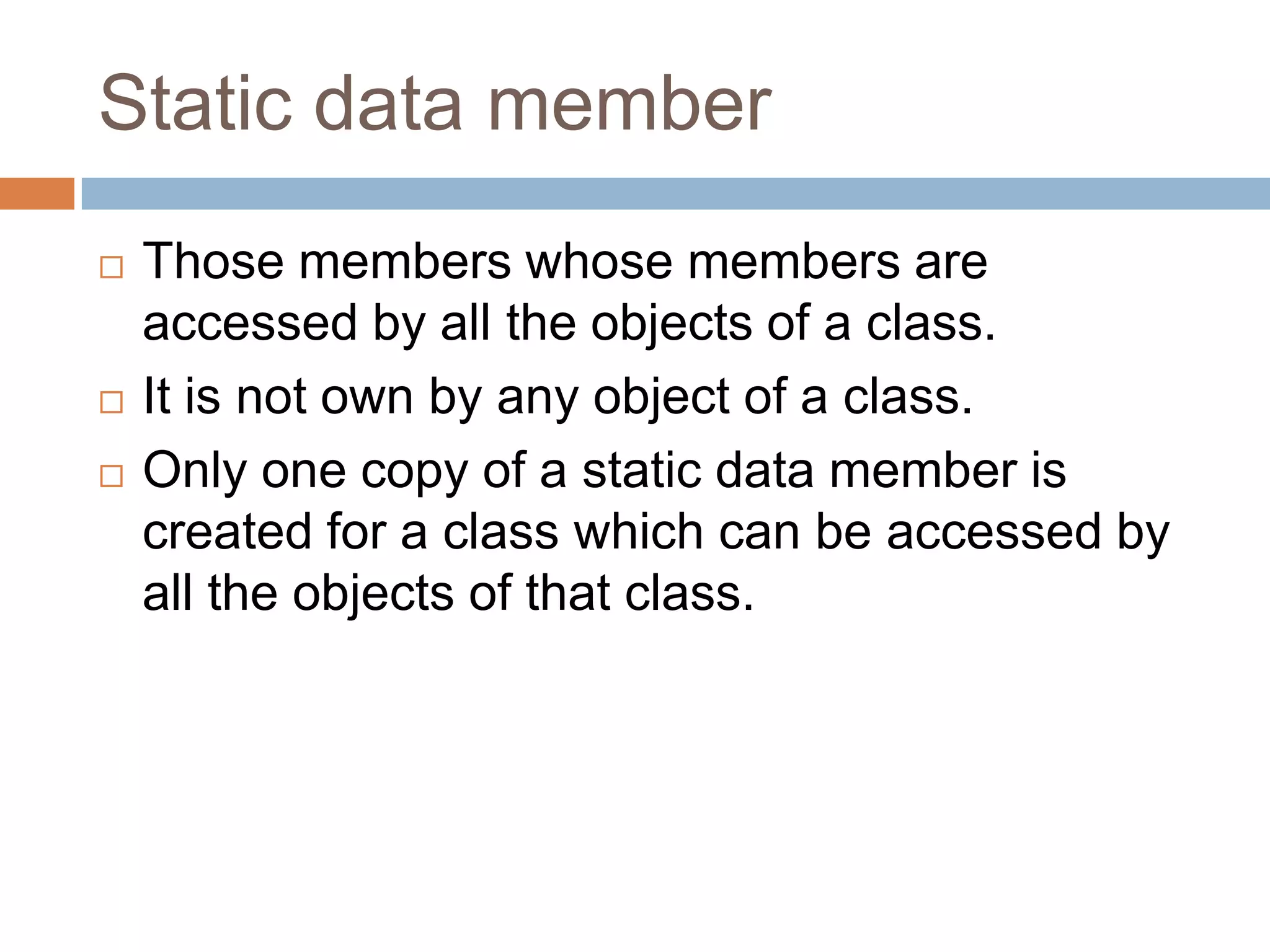
Static data member
   Those members whose members are
    accessed by all the objects of a class.
   It is not own by any object of a class.
   Only one copy of a static data member is
    created for a class which can be accessed by
    all the objects of that class.
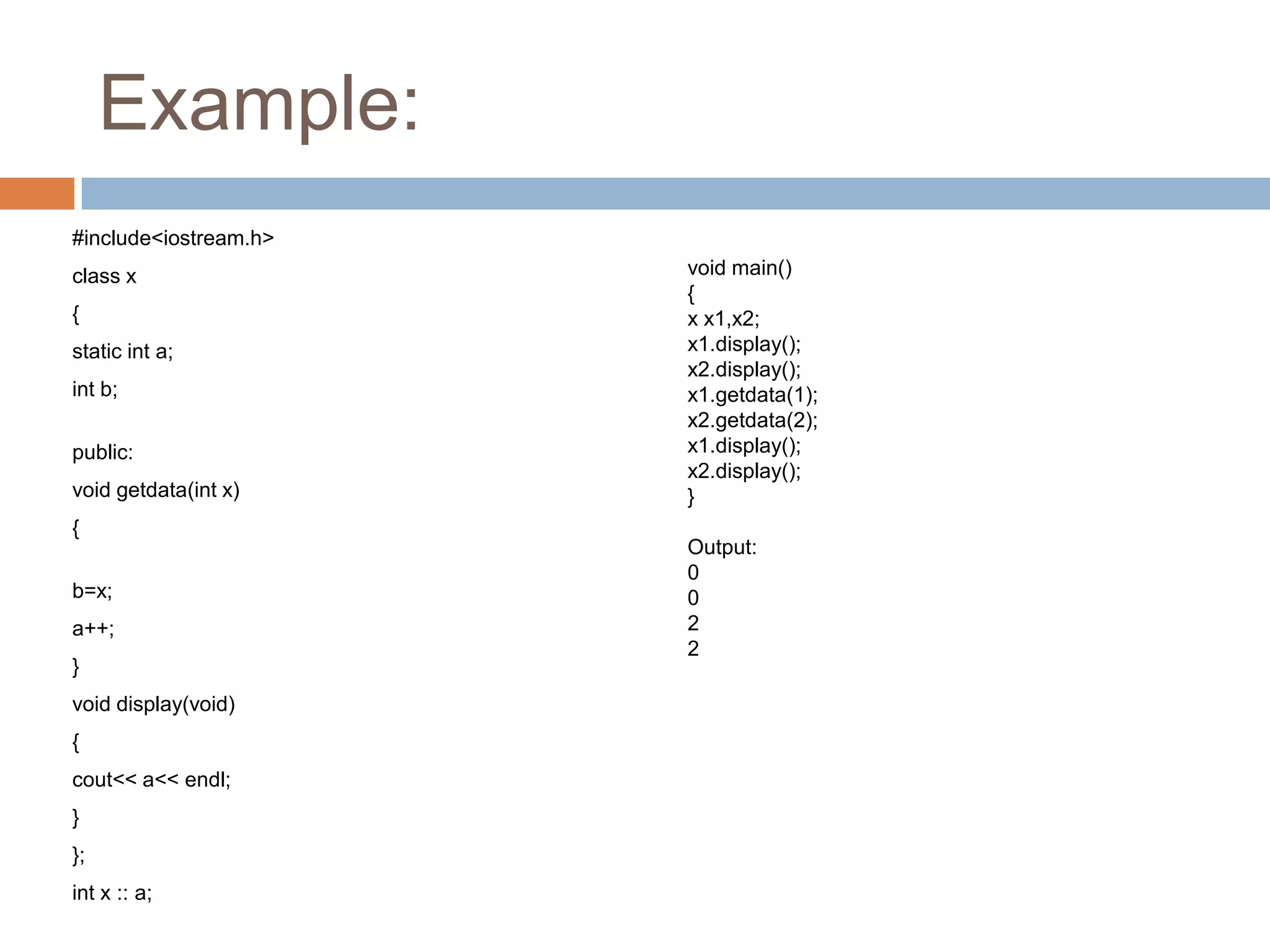
Example:
#include<iostream.h>
class x                void main()
                       {
{                      x x1,x2;
static int a;          x1.display();
                       x2.display();
int b;                 x1.getdata(1);
                       x2.getdata(2);
public:                x1.display();
                       x2.display();
void getdata(int x)    }
{
                       Output:
                       0
b=x;                   0
a++;                   2
                       2
}
void display(void)
{
cout<< a<< endl;
}
};
int x :: a;
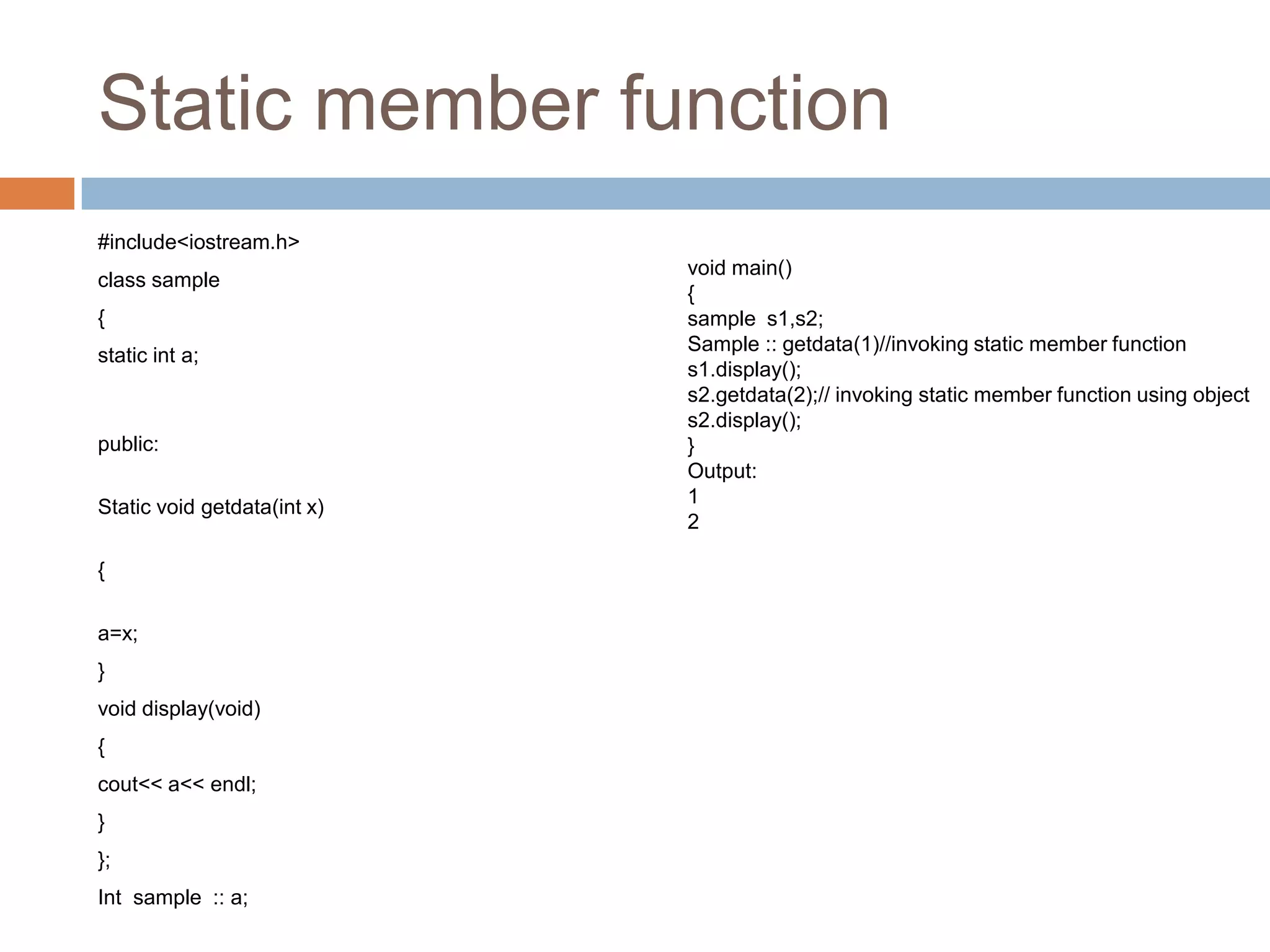
Static member function
#include<iostream.h>
                             void main()
class sample
                             {
{                            sample s1,s2;
                             Sample :: getdata(1)//invoking static member function
static int a;
                             s1.display();
                             s2.getdata(2);// invoking static member function using object
                             s2.display();
public:                      }
                             Output:
                             1
Static void getdata(int x)
                             2

{

a=x;
}
void display(void)
{
cout<< a<< endl;
}
};
Int sample :: a;
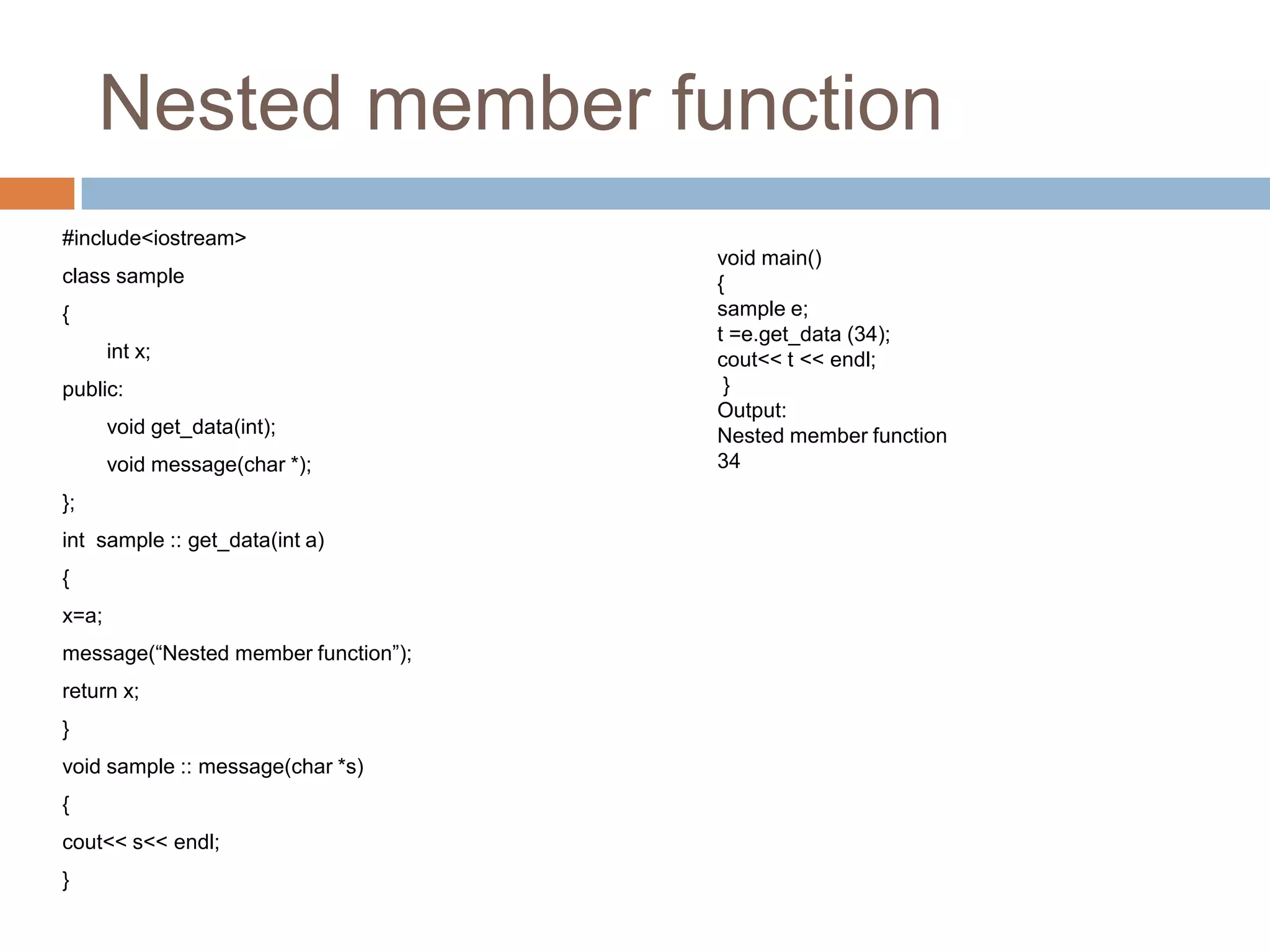
Nested member function
#include<iostream>
                                     void main()
class sample                         {
{                                    sample e;
                                     t =e.get_data (34);
       int x;                        cout<< t << endl;
public:                               }
                                     Output:
       void get_data(int);           Nested member function
       void message(char *);         34
};
int sample :: get_data(int a)
{
x=a;
message(“Nested member function”);
return x;
}
void sample :: message(char *s)
{
cout<< s<< endl;
}
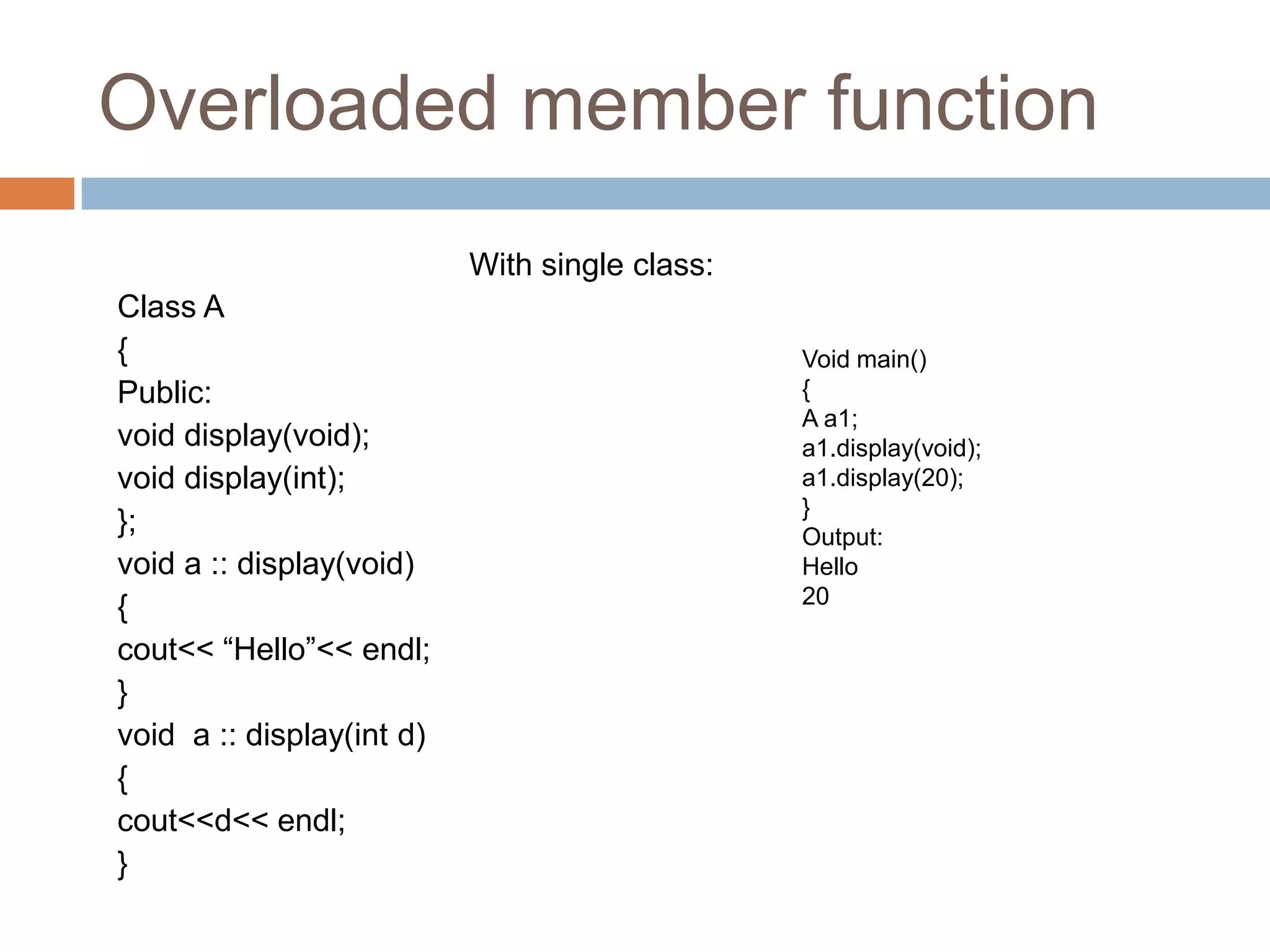
Overloaded member function
                           With single class:
Class A
{                                               Void main()
Public:                                         {
                                                A a1;
void display(void);                             a1.display(void);
void display(int);                              a1.display(20);
                                                }
};                                              Output:
void a :: display(void)                         Hello
{                                               20

cout<< “Hello”<< endl;
}
void a :: display(int d)
{
cout<<d<< endl;
}
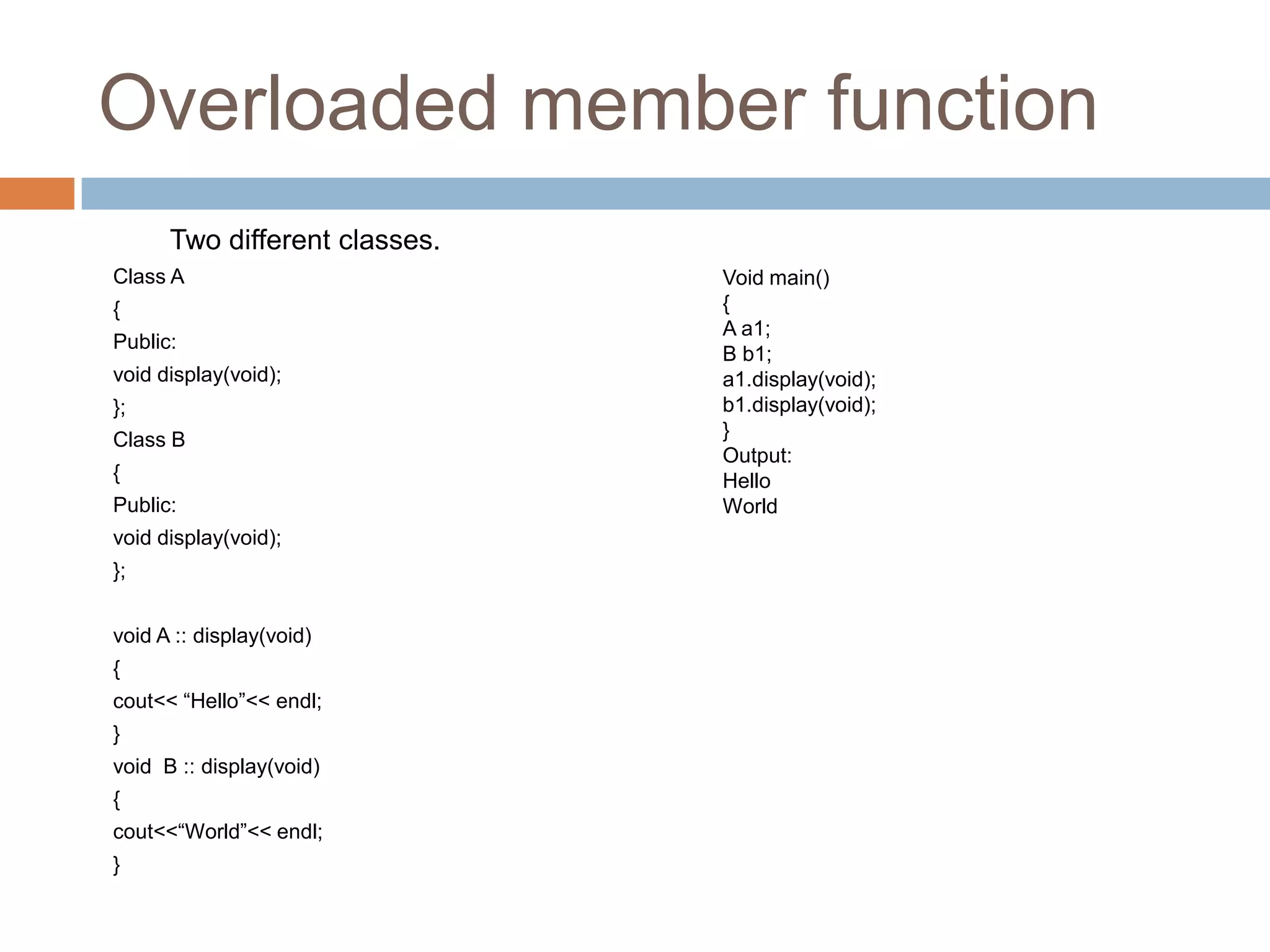
Overloaded member function
      Two different classes.
Class A                        Void main()
{                              {
                               A a1;
Public:
                               B b1;
void display(void);            a1.display(void);
};                             b1.display(void);
Class B                        }
                               Output:
{                              Hello
Public:                        World
void display(void);
};


void A :: display(void)
{
cout<< “Hello”<< endl;
}
void B :: display(void)
{
cout<<“World”<< endl;
}
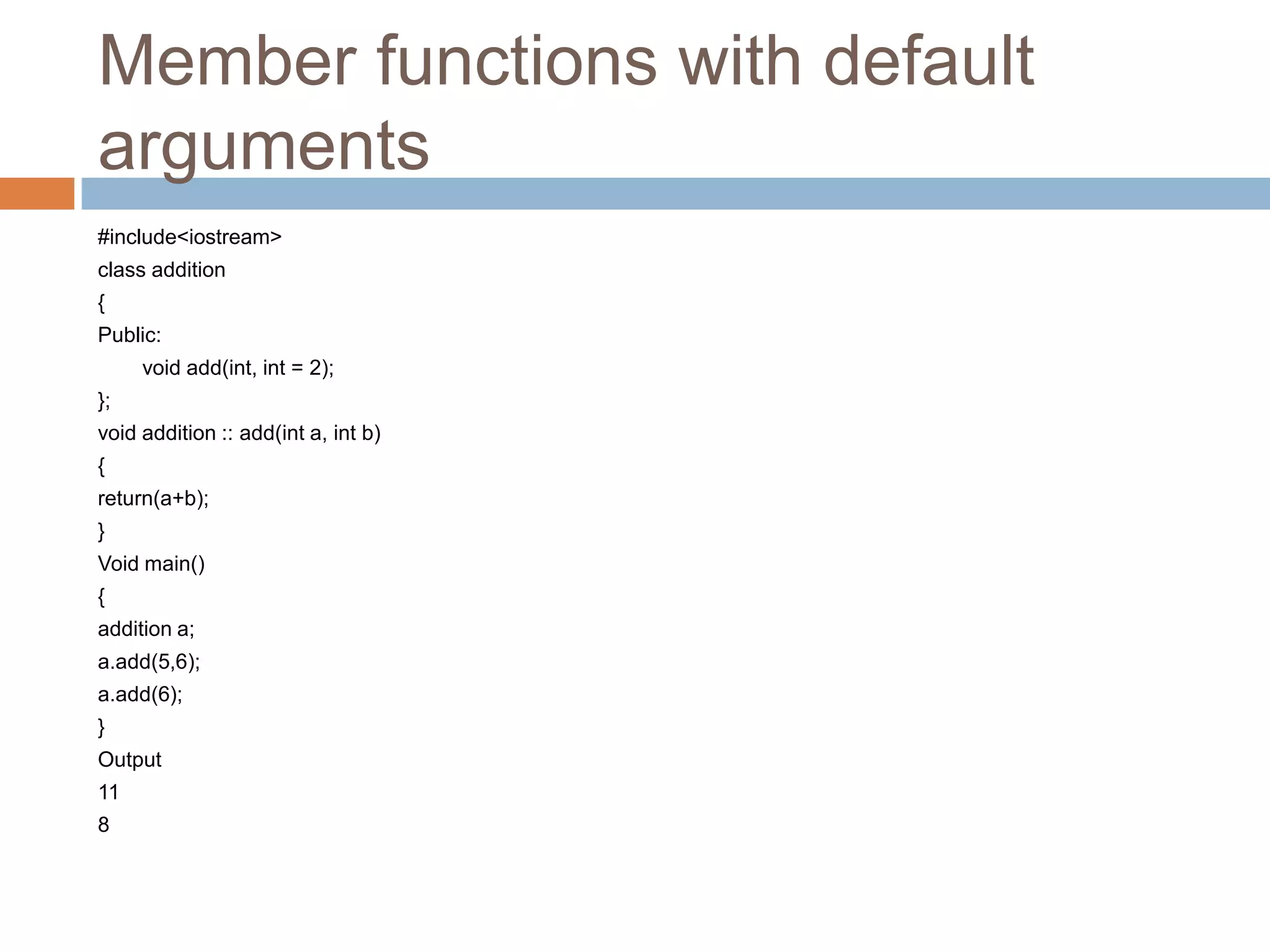
Member functions with default
arguments
#include<iostream>
class addition
{
Public:
     void add(int, int = 2);
};
void addition :: add(int a, int b)
{
return(a+b);
}
Void main()
{
addition a;
a.add(5,6);
a.add(6);
}
Output
11
8
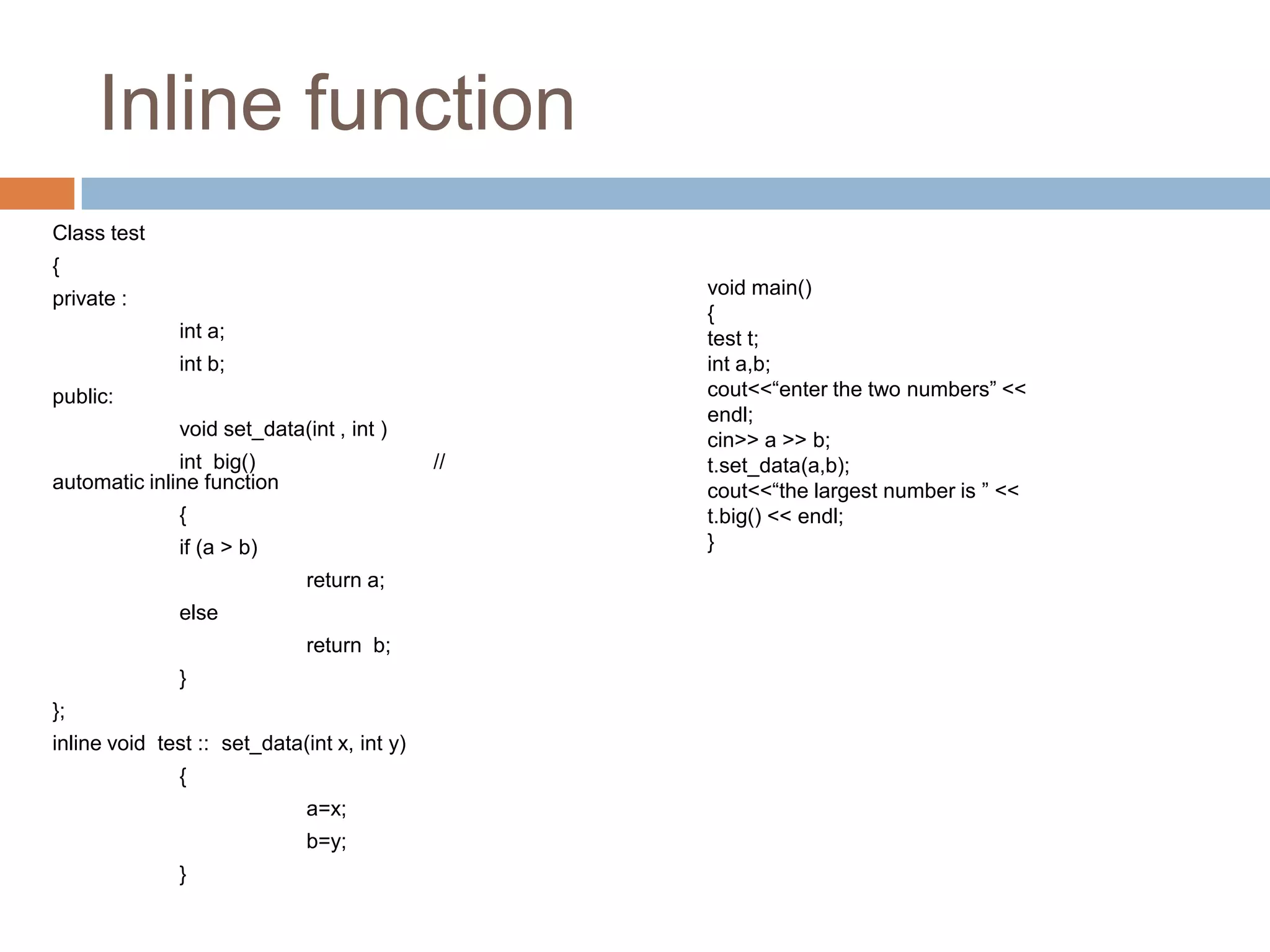
Inline function
Class test
{
                                                  void main()
private :
                                                  {
               int a;                             test t;
               int b;                             int a,b;
public:                                           cout<<“enter the two numbers” <<
                                                  endl;
               void set_data(int , int )
                                                  cin>> a >> b;
              int big()                      //   t.set_data(a,b);
automatic inline function                         cout<<“the largest number is ” <<
               {                                  t.big() << endl;
               if (a > b)                         }
                              return a;
               else
                              return b;
               }
};
inline void test :: set_data(int x, int y)
               {
                              a=x;
                              b=y;
               }
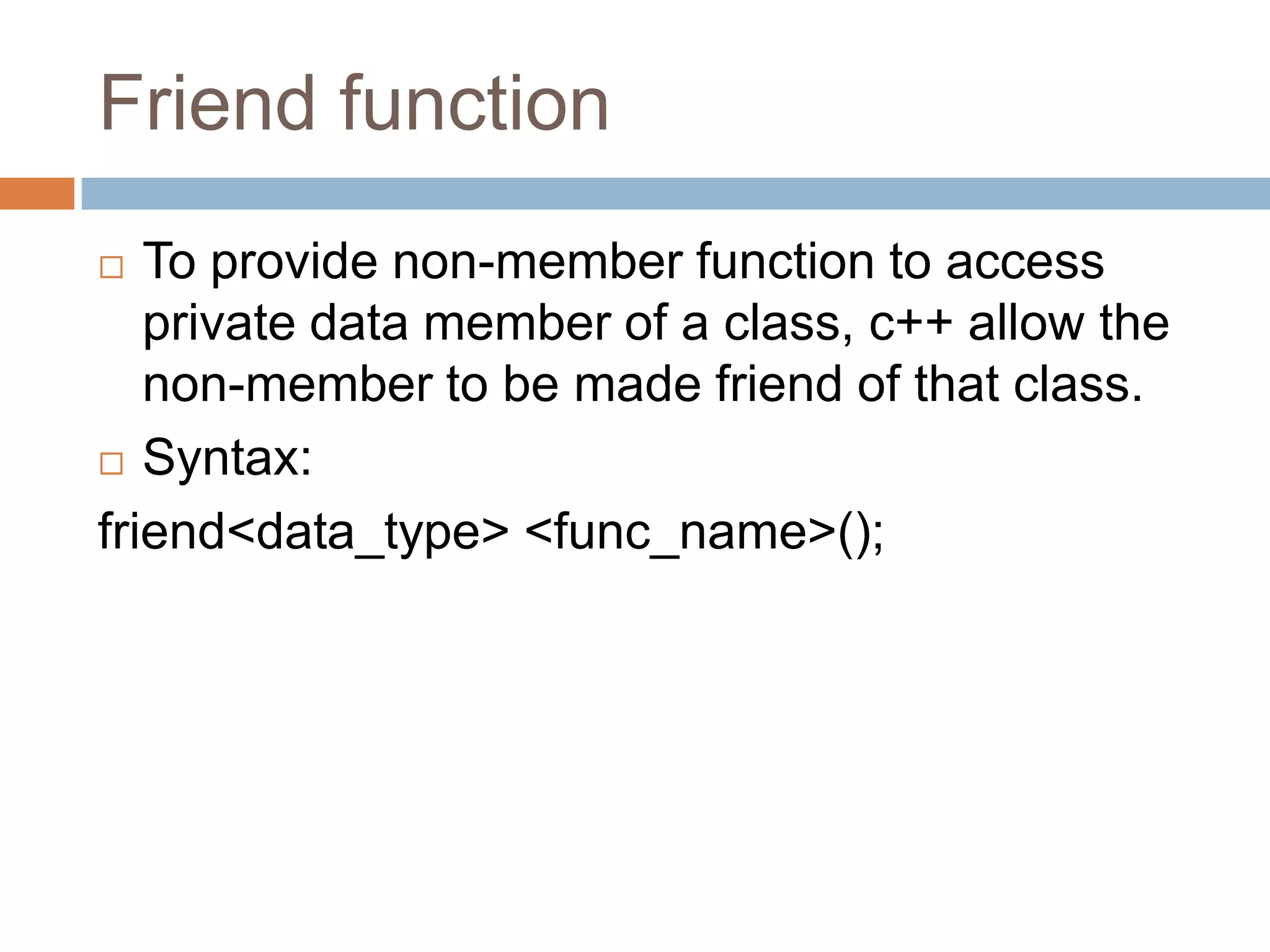
Friend function
  To provide non-member function to access
   private data member of a class, c++ allow the
   non-member to be made friend of that class.
 Syntax:

friend<data_type> <func_name>();
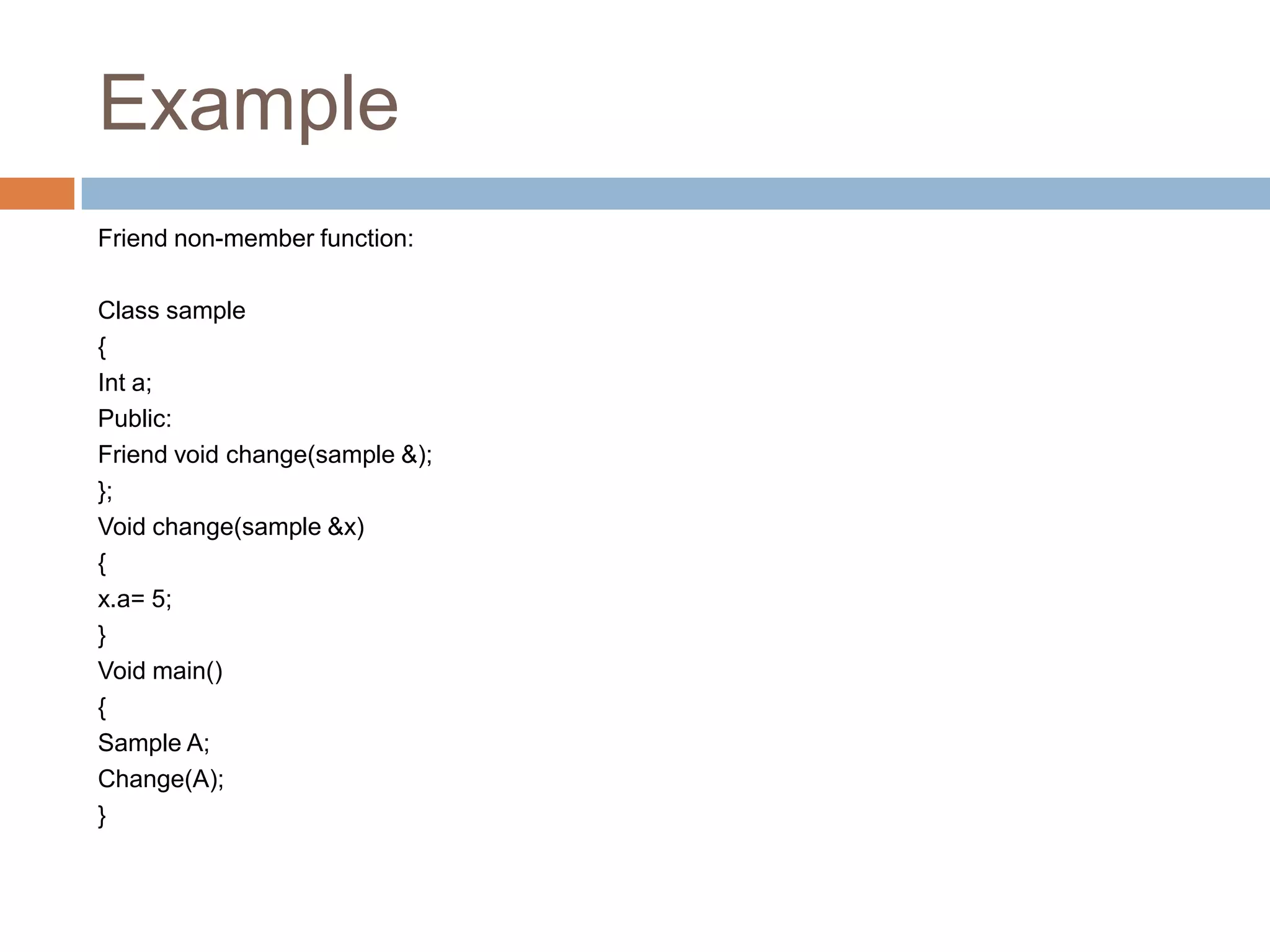
Example
Friend non-member function:

Class sample
{
Int a;
Public:
Friend void change(sample &);
};
Void change(sample &x)
{
x.a= 5;
}
Void main()
{
Sample A;
Change(A);
}
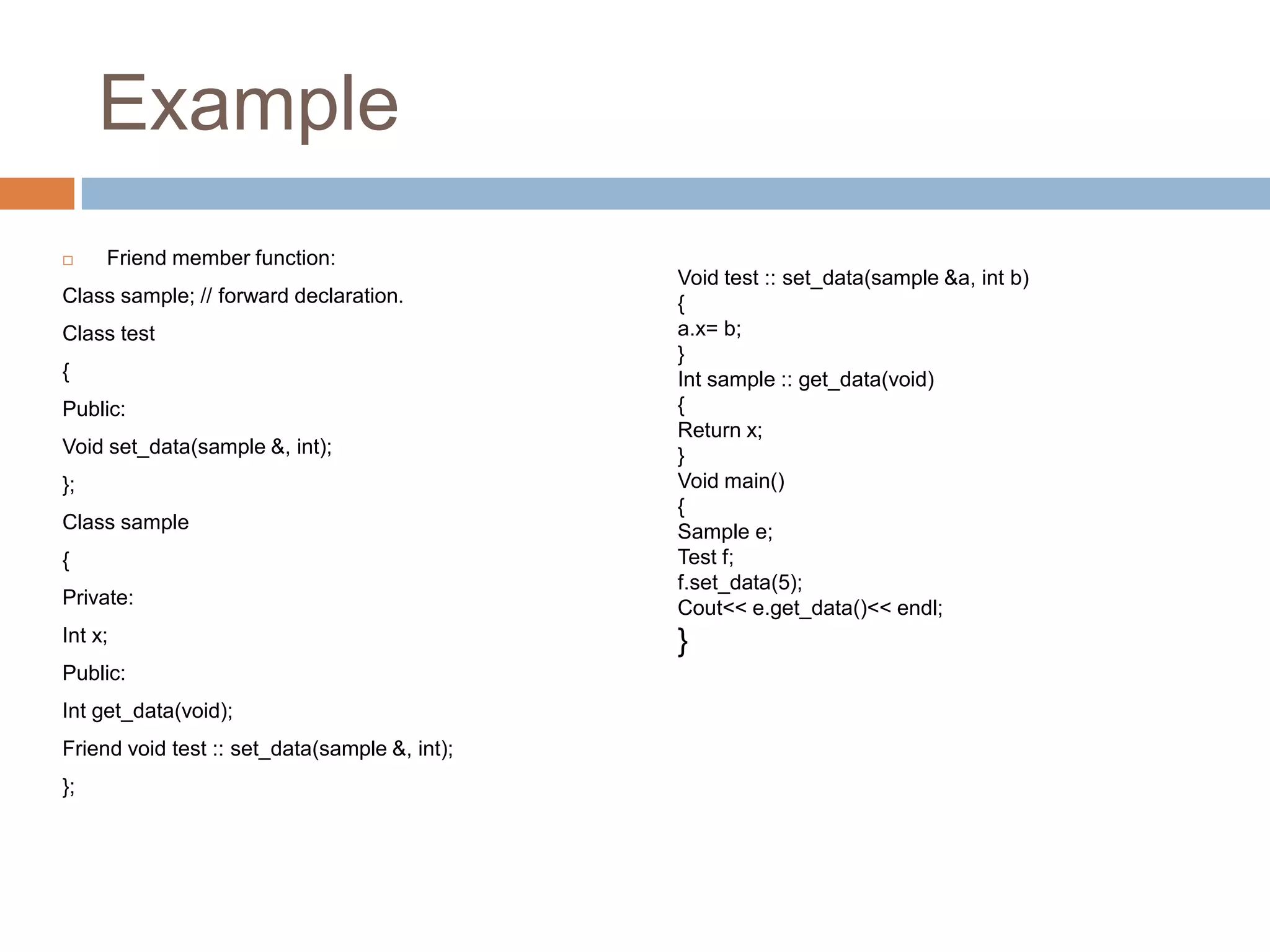
Example
    Friend member function:
                                               Void test :: set_data(sample &a, int b)
Class sample; // forward declaration.          {
Class test                                     a.x= b;
                                               }
{                                              Int sample :: get_data(void)
Public:                                        {
                                               Return x;
Void set_data(sample &, int);                  }
};                                             Void main()
                                               {
Class sample                                   Sample e;
{                                              Test f;
                                               f.set_data(5);
Private:                                       Cout<< e.get_data()<< endl;
Int x;                                         }
Public:
Int get_data(void);
Friend void test :: set_data(sample &, int);
};
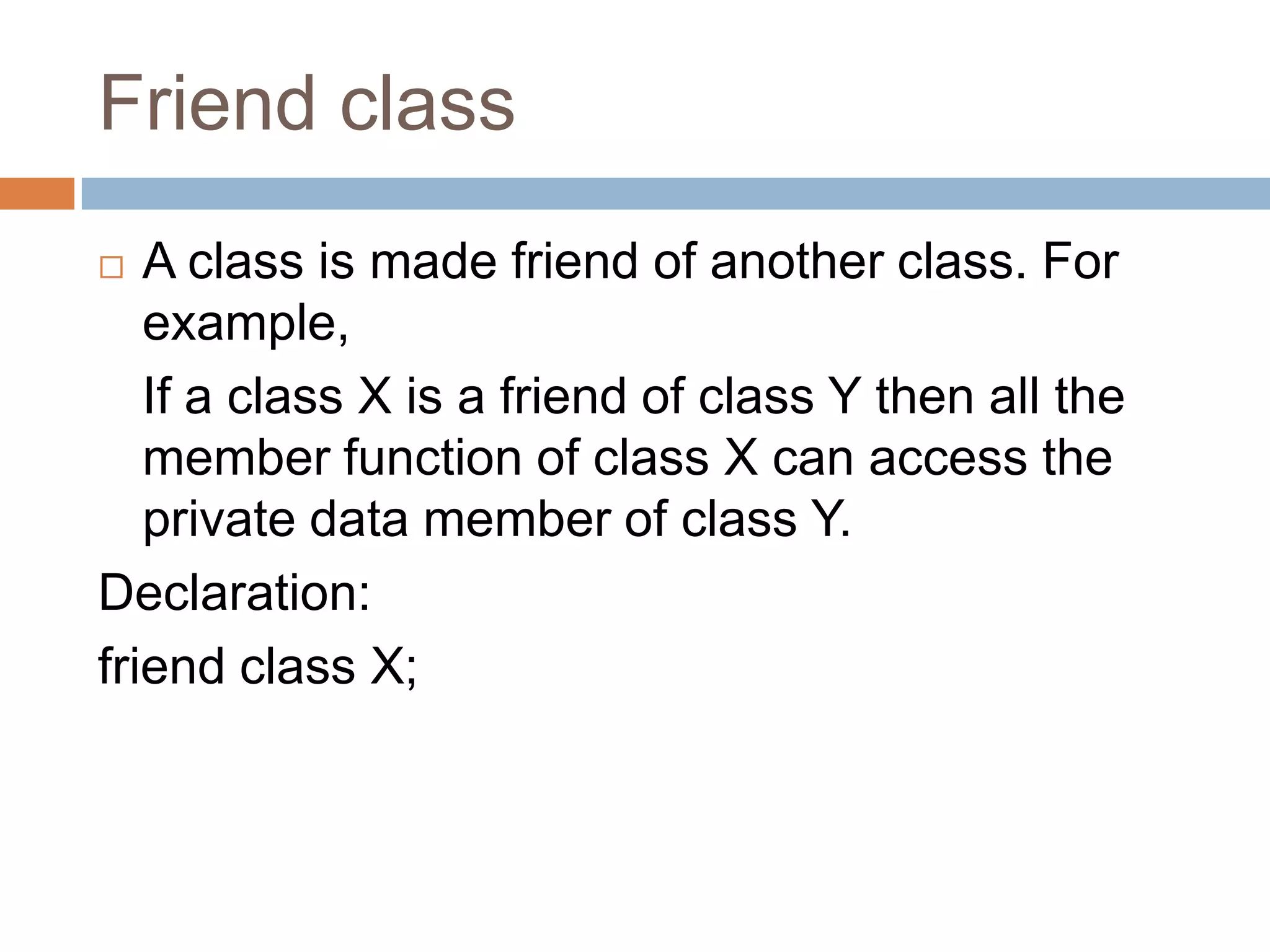
Friend class
  A class is made friend of another class. For
   example,
   If a class X is a friend of class Y then all the
   member function of class X can access the
   private data member of class Y.
Declaration:
friend class X;
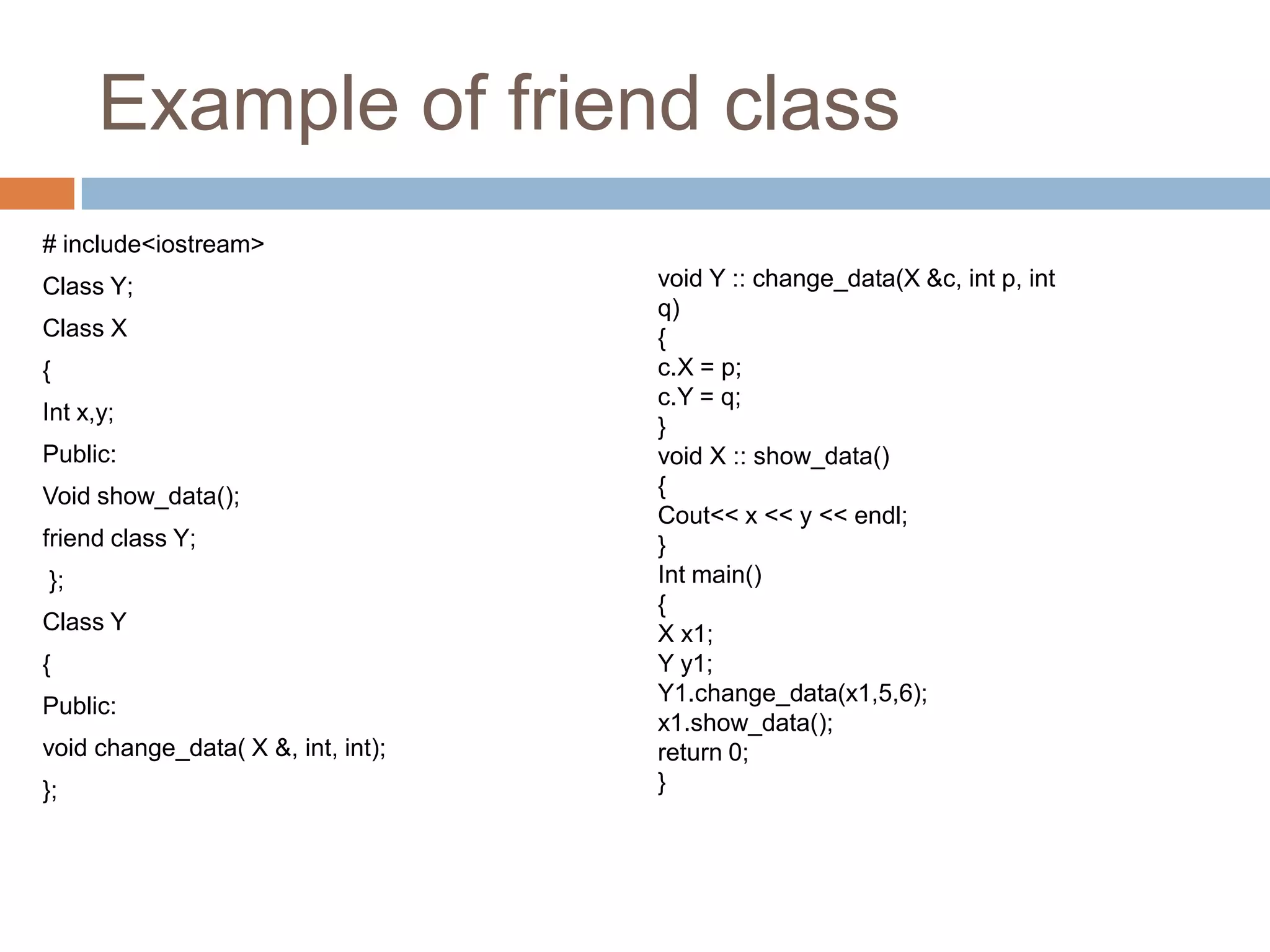
Example of friend class
# include<iostream>
Class Y;                            void Y :: change_data(X &c, int p, int
                                    q)
Class X                             {
{                                   c.X = p;
                                    c.Y = q;
Int x,y;
                                    }
Public:                             void X :: show_data()
Void show_data();                   {
                                    Cout<< x << y << endl;
friend class Y;                     }
};                                  Int main()
                                    {
Class Y                             X x1;
{                                   Y y1;
                                    Y1.change_data(x1,5,6);
Public:
                                    x1.show_data();
void change_data( X &, int, int);   return 0;
};                                  }
Array of class objects
  Array of class objects is similar to the array of
   structures.
 Syntax:

Class <class_name>
{
// class body
};
<class_name><object_name[size]>;
Example:
Class Employee
{
Char name[20];
Float salary;
Public:
Void getdata();
Void display();
};
Employee e[5];
Passing object to functions
   By value
   By reference
   By pointer
By value
Here only the copy of the object is passed to the
 function definition.
The modification on objects made in the called
 function will not be reflected in the calling
 function.
By reference
Here when the object is passed to the function
 definition, the formal argument shares the
 memory location of the actual arguments.
Hence the modification on objects made in the
 called function will be reflected in the calling
 function.
By pointer
Here pointer to the object is passed. The
 member of the objects passed are accessed
 by the arrow operator(->).
The modification on objects made in the called
 function will be reflected in the calling function.
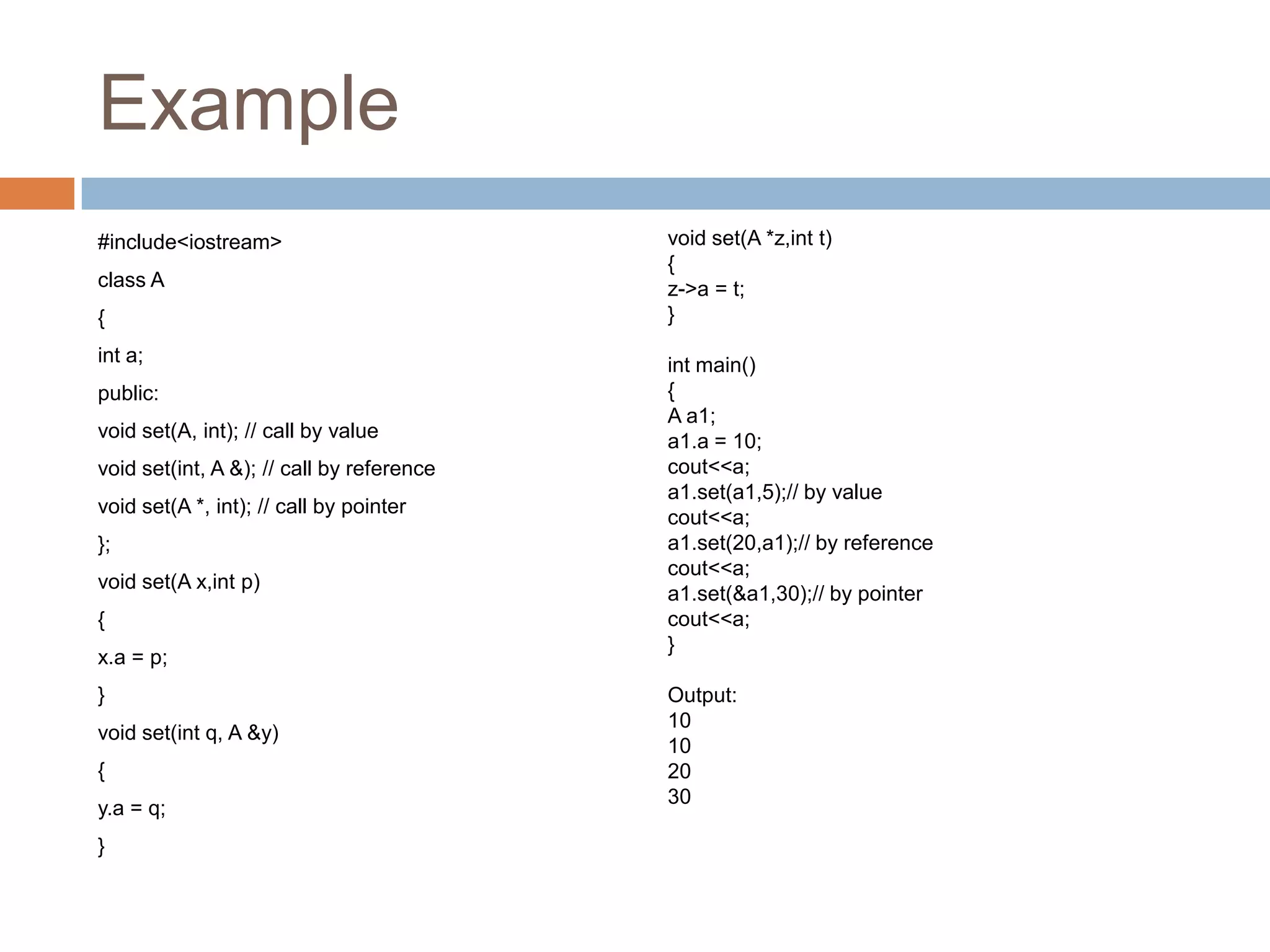
Example
#include<iostream>                         void set(A *z,int t)
                                           {
class A                                    z->a = t;
{                                          }
int a;                                     int main()
public:                                    {
                                           A a1;
void set(A, int); // call by value         a1.a = 10;
void set(int, A &); // call by reference   cout<<a;
                                           a1.set(a1,5);// by value
void set(A *, int); // call by pointer
                                           cout<<a;
};                                         a1.set(20,a1);// by reference
                                           cout<<a;
void set(A x,int p)
                                           a1.set(&a1,30);// by pointer
{                                          cout<<a;
                                           }
x.a = p;
}                                          Output:
                                           10
void set(int q, A &y)
                                           10
{                                          20
                                           30
y.a = q;
}
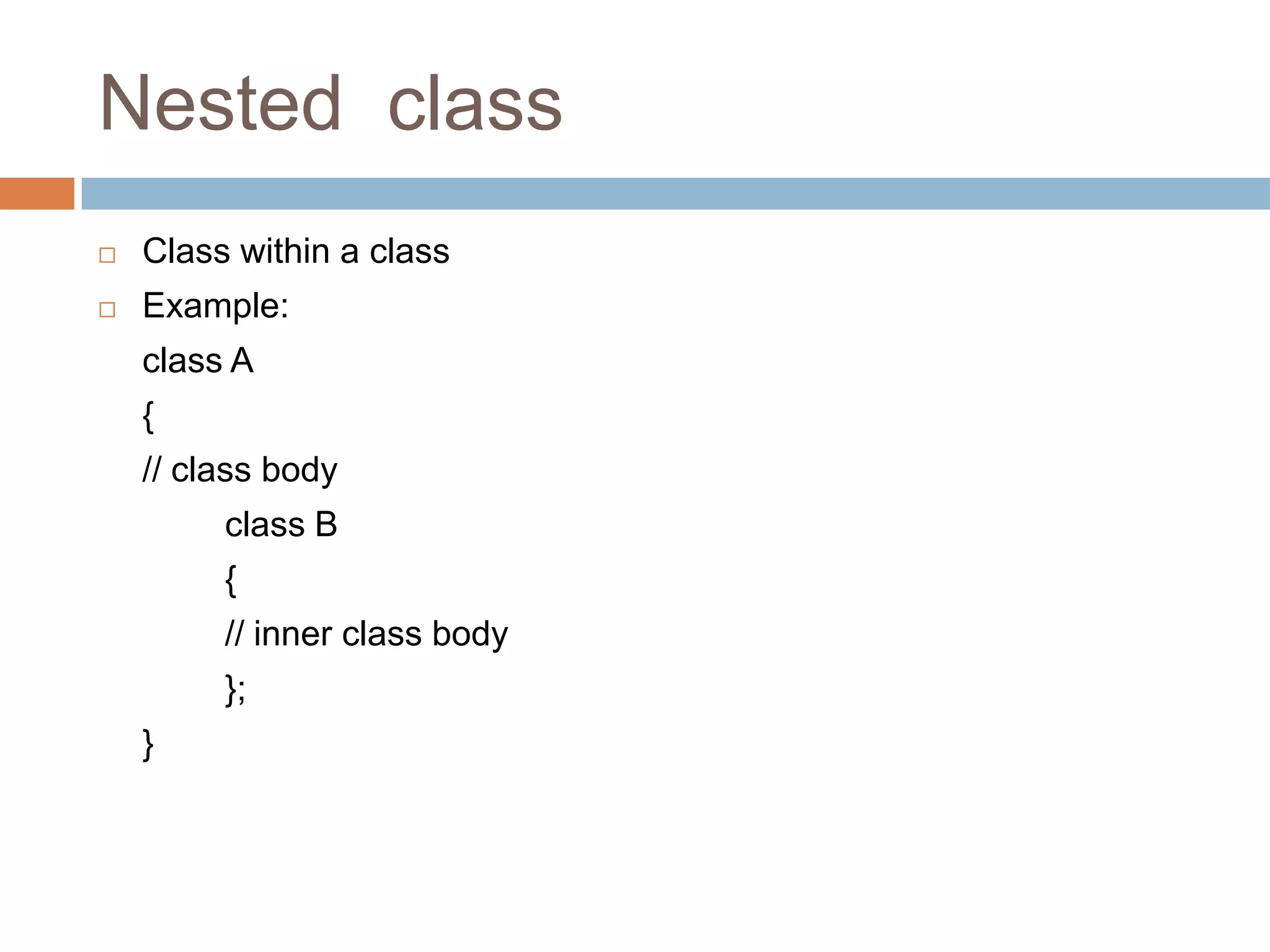
Nested class
   Class within a class
   Example:
    class A
    {
    // class body
         class B
         {
         // inner class body
         };
    }

More on Classes and Objects

  • 1.
    MORE ON CLASSES ANDOBJECTS Chapter 4
  • 2.
    Data Members Types ofdata member :  Constant data members.  Mutable data members.  Static data members.
  • 3.
    Member Functions Different typesof member functions:  Nested Member functions.  Overloaded member functions.  Constant member function.  Member functions with default arguments.  Inline member functions.  Static member functions.
  • 4.
    Constant data members The data members whose value cannot be changed throughout the execution of the program.  They are declared by preceding the qualifier const. Example: const int x = 10;
  • 5.
    Example: #include<iostream> void main() { const intx = 10; x++; // error cout<< x<<endl; }
  • 6.
    Mutable data members  If the need arises such that the constant member functions has to modify the value of the data members then the data member has to be declared by prefixing the keyword „mutable‟.
  • 7.
    Example: #include<iostream> class x { int a ; mutable int b; public: void xyz() const { a++; // error b++; // legal } }; void main() { X x2; X2.xyz(); }
  • 8.
    Constant member function #include<iostream.h> void main() class x { { x x1; x1.getdata(56); int a; Cout<< x1.setdata()<<endl; public: } void getdata(int x) { a=x; } int setdata() const { a++; // error return a; } };
  • 9.
    Static data member  Those members whose members are accessed by all the objects of a class.  It is not own by any object of a class.  Only one copy of a static data member is created for a class which can be accessed by all the objects of that class.
  • 10.
    Example: #include<iostream.h> class x void main() { { x x1,x2; static int a; x1.display(); x2.display(); int b; x1.getdata(1); x2.getdata(2); public: x1.display(); x2.display(); void getdata(int x) } { Output: 0 b=x; 0 a++; 2 2 } void display(void) { cout<< a<< endl; } }; int x :: a;
  • 11.
    Static member function #include<iostream.h> void main() class sample { { sample s1,s2; Sample :: getdata(1)//invoking static member function static int a; s1.display(); s2.getdata(2);// invoking static member function using object s2.display(); public: } Output: 1 Static void getdata(int x) 2 { a=x; } void display(void) { cout<< a<< endl; } }; Int sample :: a;
  • 12.
    Nested member function #include<iostream> void main() class sample { { sample e; t =e.get_data (34); int x; cout<< t << endl; public: } Output: void get_data(int); Nested member function void message(char *); 34 }; int sample :: get_data(int a) { x=a; message(“Nested member function”); return x; } void sample :: message(char *s) { cout<< s<< endl; }
  • 13.
    Overloaded member function With single class: Class A { Void main() Public: { A a1; void display(void); a1.display(void); void display(int); a1.display(20); } }; Output: void a :: display(void) Hello { 20 cout<< “Hello”<< endl; } void a :: display(int d) { cout<<d<< endl; }
  • 14.
    Overloaded member function Two different classes. Class A Void main() { { A a1; Public: B b1; void display(void); a1.display(void); }; b1.display(void); Class B } Output: { Hello Public: World void display(void); }; void A :: display(void) { cout<< “Hello”<< endl; } void B :: display(void) { cout<<“World”<< endl; }
  • 15.
    Member functions withdefault arguments #include<iostream> class addition { Public: void add(int, int = 2); }; void addition :: add(int a, int b) { return(a+b); } Void main() { addition a; a.add(5,6); a.add(6); } Output 11 8
  • 16.
    Inline function Class test { void main() private : { int a; test t; int b; int a,b; public: cout<<“enter the two numbers” << endl; void set_data(int , int ) cin>> a >> b; int big() // t.set_data(a,b); automatic inline function cout<<“the largest number is ” << { t.big() << endl; if (a > b) } return a; else return b; } }; inline void test :: set_data(int x, int y) { a=x; b=y; }
  • 17.
    Friend function  To provide non-member function to access private data member of a class, c++ allow the non-member to be made friend of that class.  Syntax: friend<data_type> <func_name>();
  • 18.
    Example Friend non-member function: Classsample { Int a; Public: Friend void change(sample &); }; Void change(sample &x) { x.a= 5; } Void main() { Sample A; Change(A); }
  • 19.
    Example  Friend member function: Void test :: set_data(sample &a, int b) Class sample; // forward declaration. { Class test a.x= b; } { Int sample :: get_data(void) Public: { Return x; Void set_data(sample &, int); } }; Void main() { Class sample Sample e; { Test f; f.set_data(5); Private: Cout<< e.get_data()<< endl; Int x; } Public: Int get_data(void); Friend void test :: set_data(sample &, int); };
  • 20.
    Friend class  A class is made friend of another class. For example, If a class X is a friend of class Y then all the member function of class X can access the private data member of class Y. Declaration: friend class X;
  • 21.
    Example of friendclass # include<iostream> Class Y; void Y :: change_data(X &c, int p, int q) Class X { { c.X = p; c.Y = q; Int x,y; } Public: void X :: show_data() Void show_data(); { Cout<< x << y << endl; friend class Y; } }; Int main() { Class Y X x1; { Y y1; Y1.change_data(x1,5,6); Public: x1.show_data(); void change_data( X &, int, int); return 0; }; }
  • 22.
    Array of classobjects  Array of class objects is similar to the array of structures.  Syntax: Class <class_name> { // class body }; <class_name><object_name[size]>;
  • 23.
    Example: Class Employee { Char name[20]; Floatsalary; Public: Void getdata(); Void display(); }; Employee e[5];
  • 24.
    Passing object tofunctions  By value  By reference  By pointer
  • 25.
    By value Here onlythe copy of the object is passed to the function definition. The modification on objects made in the called function will not be reflected in the calling function.
  • 26.
    By reference Here whenthe object is passed to the function definition, the formal argument shares the memory location of the actual arguments. Hence the modification on objects made in the called function will be reflected in the calling function.
  • 27.
    By pointer Here pointerto the object is passed. The member of the objects passed are accessed by the arrow operator(->). The modification on objects made in the called function will be reflected in the calling function.
  • 28.
    Example #include<iostream> void set(A *z,int t) { class A z->a = t; { } int a; int main() public: { A a1; void set(A, int); // call by value a1.a = 10; void set(int, A &); // call by reference cout<<a; a1.set(a1,5);// by value void set(A *, int); // call by pointer cout<<a; }; a1.set(20,a1);// by reference cout<<a; void set(A x,int p) a1.set(&a1,30);// by pointer { cout<<a; } x.a = p; } Output: 10 void set(int q, A &y) 10 { 20 30 y.a = q; }
  • 29.
    Nested class  Class within a class  Example: class A { // class body class B { // inner class body }; }