TEAM SPLENDID
1.Iftear Alam Sakib (161-15-
2.Shahriya Siddque Anik (161-15-
3.Samiullah Hossain (161-15-
4.Jobayer Ahmed (161-15-
5.Shahriyar Nawal Shoumik (161-15-
6.Monjur Bin Shams (161-15-
PARALLEL CIRCUIT
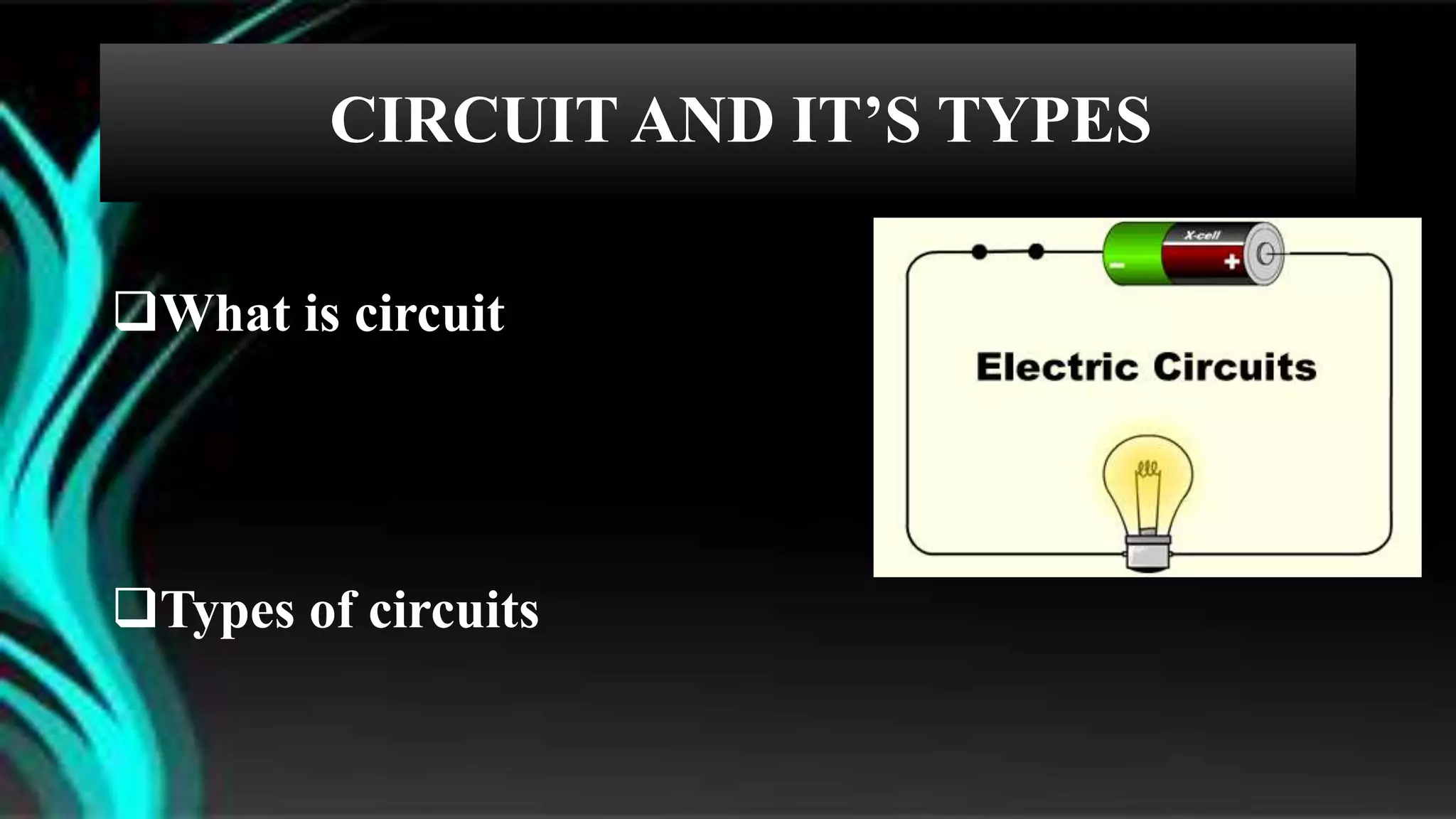
CIRCUIT AND IT’S TYPES
What is circuit
Types of circuits
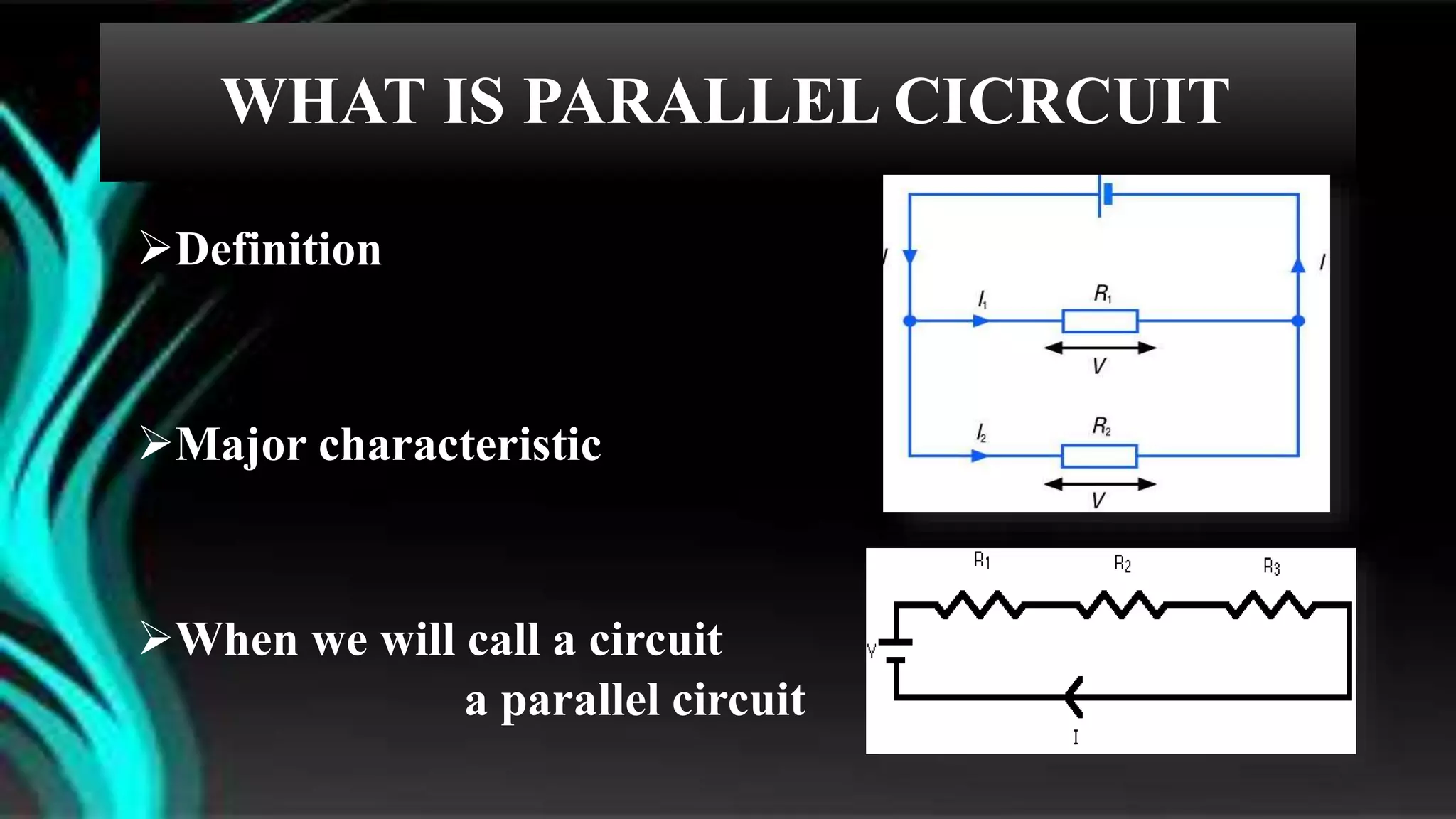
WHAT IS PARALLEL CICRCUIT
Definition
Major characteristic
When we will call a circuit
a parallel circuit
BASIC CHARECTERISTICS OF PARALLEL CIRCUIT
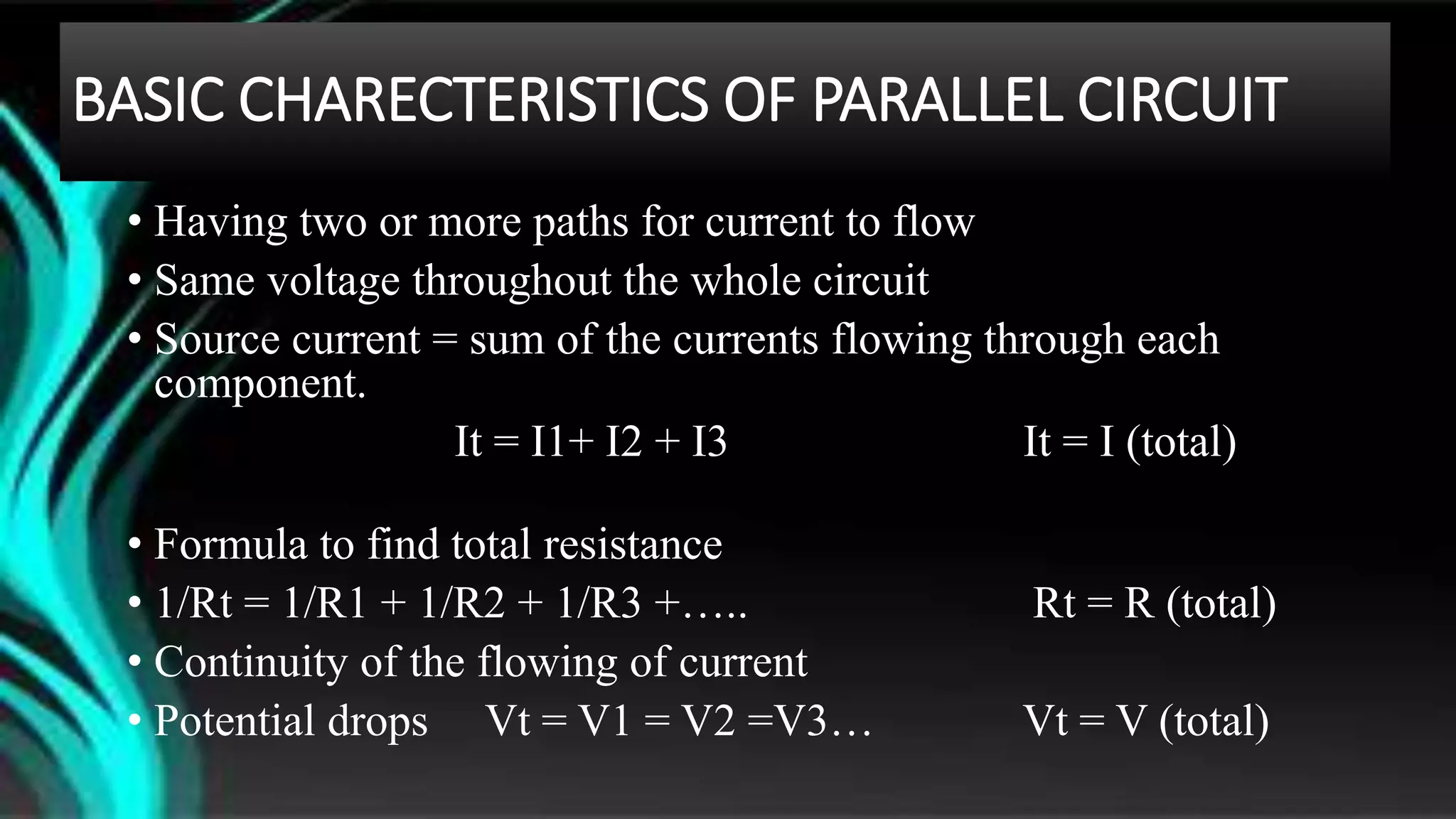
• Having two or more paths for current to flow
• Same voltage throughout the whole circuit
• Source current = sum of the currents flowing through each
component.
It = I1+ I2 + I3 It = I (total)
• Formula to find total resistance
• 1/Rt = 1/R1 + 1/R2 + 1/R3 +….. Rt = R (total)
• Continuity of the flowing of current
• Potential drops Vt = V1 = V2 =V3… Vt = V (total)
SOME OTHER FUNCTIONALITIES OF PARALLEL
CIRCUIT
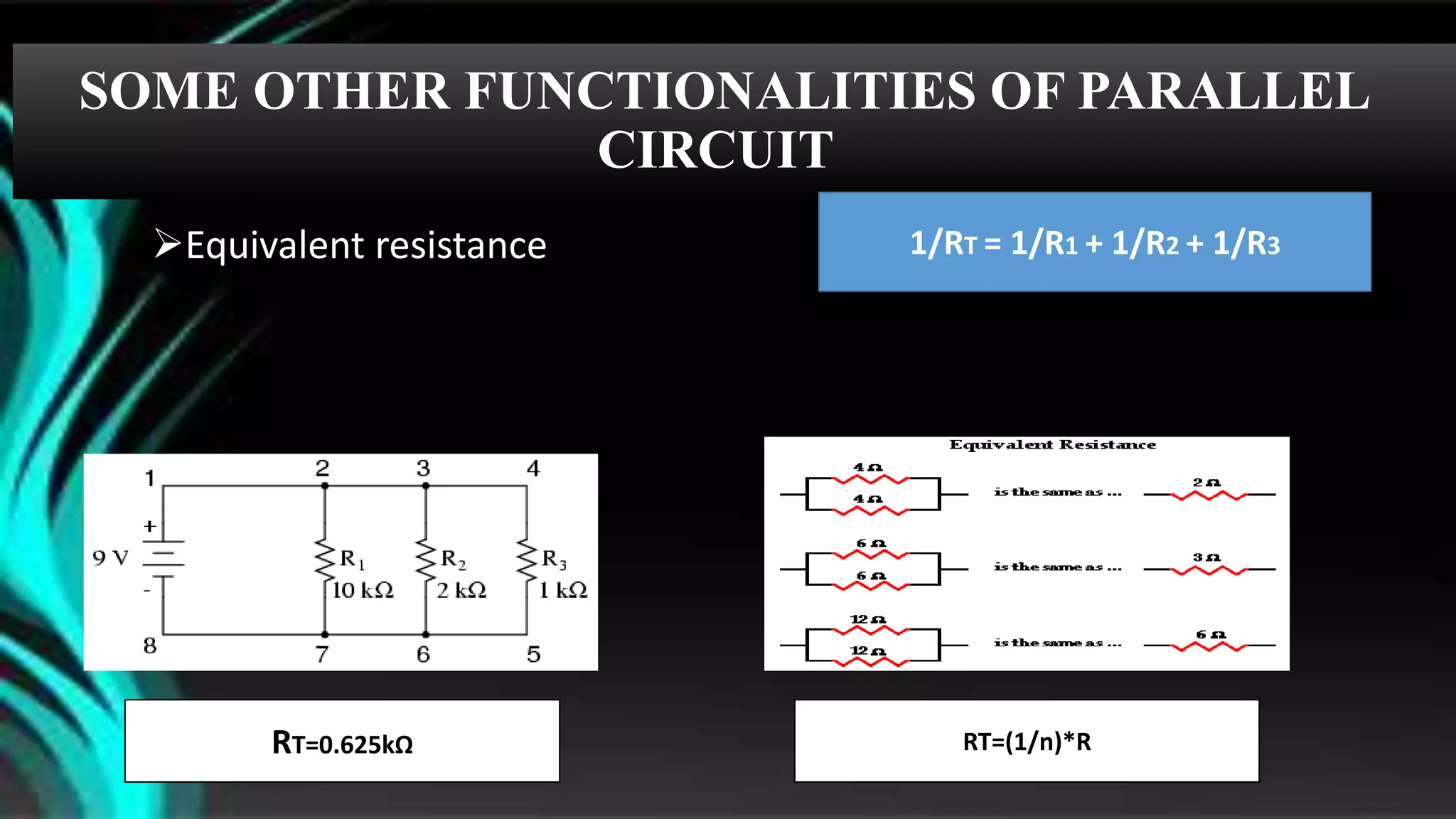
Equivalent resistance 1/RT = 1/R1 + 1/R2 + 1/R3
RT=0.625kΩ RT=(1/n)*R
SOME OTHER FUNCTIONALITIES OF PARALLEL
CIRCUIT
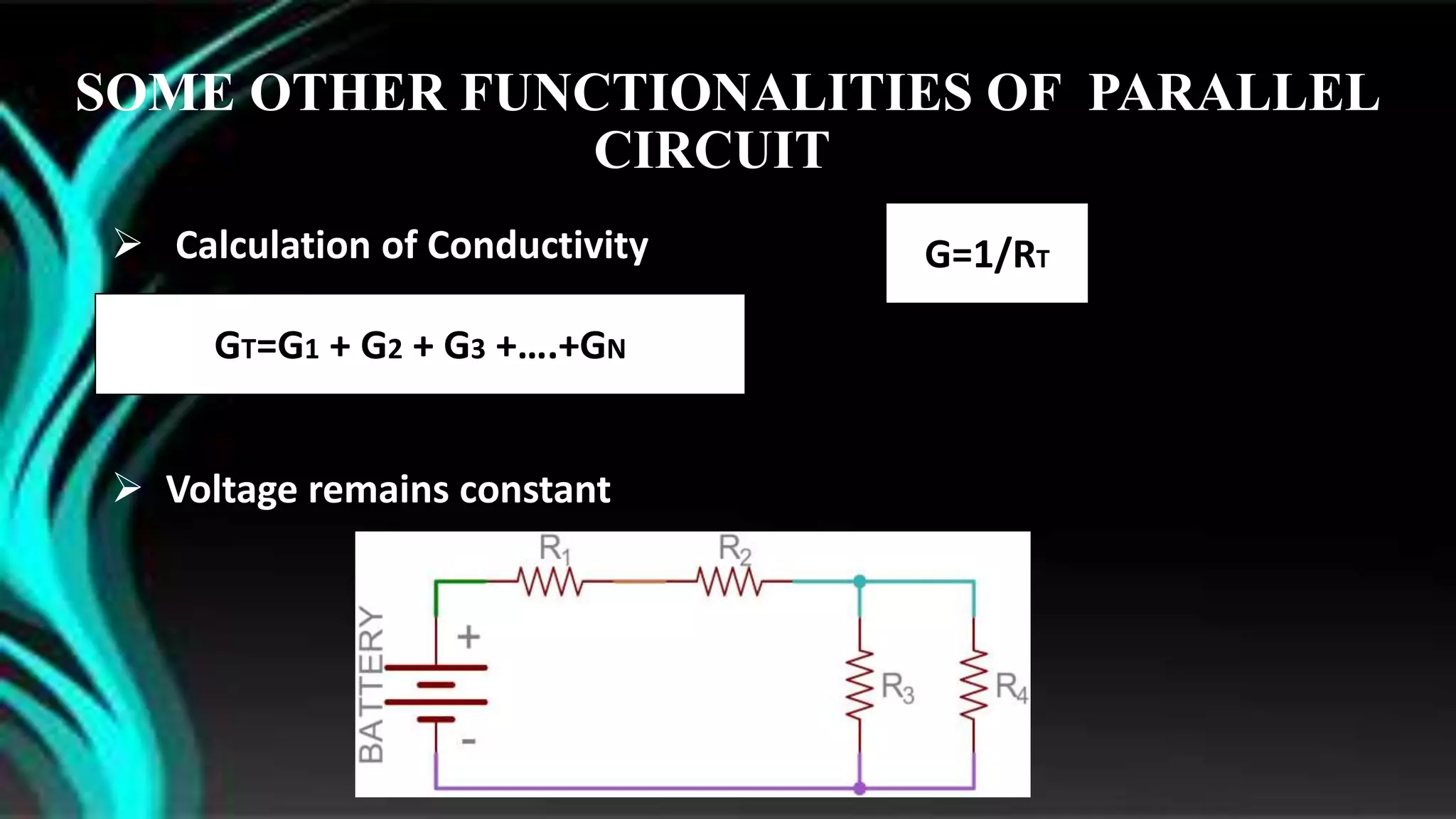
 Calculation of Conductivity
 Voltage remains constant
G=1/RT
GT=G1 + G2 + G3 +….+GN
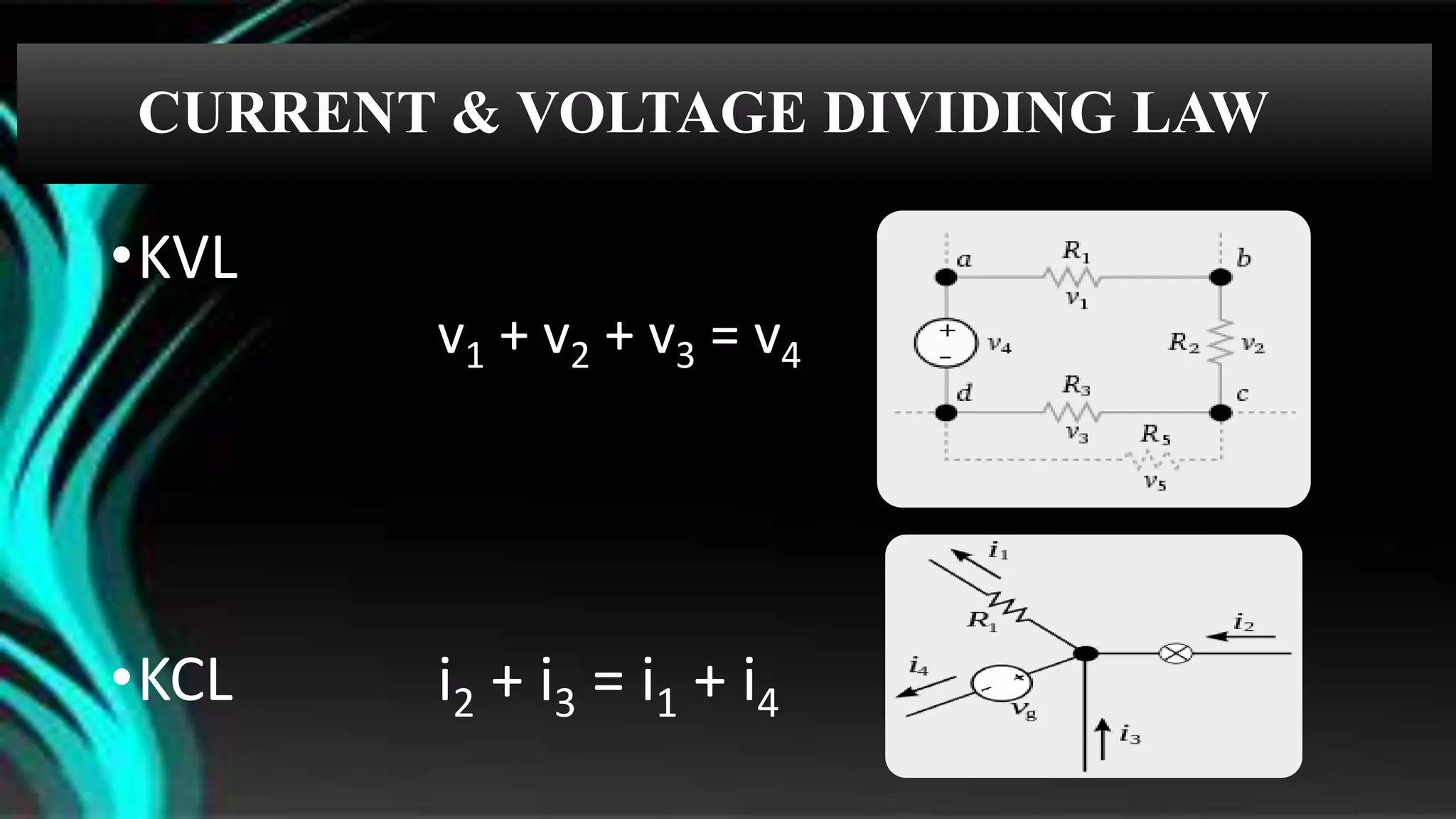
CURRENT & VOLTAGE DIVIDING LAW
•KVL
v1 + v2 + v3 = v4
•KCL i2 + i3 = i1 + i4
Kirchhoff’s Current Law
I1 =
I ∗ R23
(R1+R23 )
It=I1+I2+I3+I4
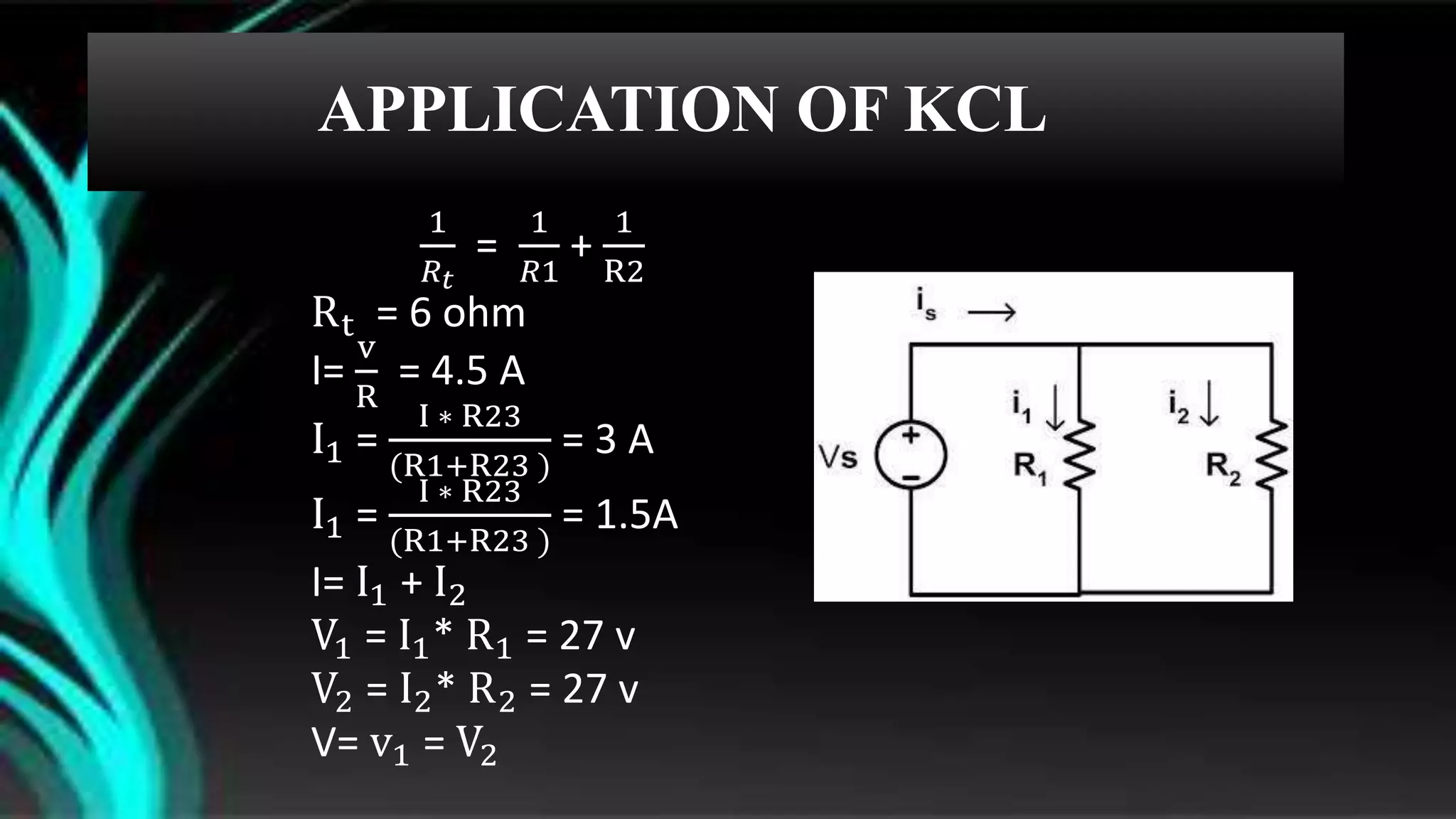
APPLICATION OF KCL
1
𝑅 𝑡
=
1
𝑅1
+
1
R2
Rt = 6 ohm
I=
v
R
= 4.5 A
I1 =
I ∗ R23
(R1+R23 )
= 3 A
I1 =
I ∗ R23
(R1+R23 )
= 1.5A
I= I1 + I2
V1 = I1* R1 = 27 v
V2 = I2* R2 = 27 v
V= v1 = V2
1
𝑅 𝑡
=
1
𝑅1
+
1
R2
+
1
R3
Rt = 0.54
I=
v
R
= 11.11 A
I1 =
I ∗ R23
(R1+R23 )
= 6.06
I23 = (I - I1) = 5.05
I2 =
I23 ∗ R2
(R2+R3 )
= 2.02
I3 = (I23 - I2 ) = 3.03
I= I1 + I2 + I3
V1 = I1* R1 = 6.06
V2 = I2* R2 = 6.06
V3 = I3* R3 = 6.06
APPLICATION OF KCL
DISTINGUISHES BETWEEN SERIES AND
PARALLEL CIRCUITS
• JUNCTION POINTS OR NODES
• KVL AND KCL THEORY
• VOLTAGE AND CURRENT
• DIFFERENCES TO DETERMINE THE VALUE OF THE COMPONENTS
• USAGE
APPLICATIONS OF PARALLEL CIRCUIT IN OUR DAILY
LIFE
• Electrical connections
• Computer analysis
• Car system
• LED
• Device

Presentation on Parallel Circuit Analysis

  • 1.
    TEAM SPLENDID 1.Iftear AlamSakib (161-15- 2.Shahriya Siddque Anik (161-15- 3.Samiullah Hossain (161-15- 4.Jobayer Ahmed (161-15- 5.Shahriyar Nawal Shoumik (161-15- 6.Monjur Bin Shams (161-15- PARALLEL CIRCUIT
  • 2.
    CIRCUIT AND IT’STYPES What is circuit Types of circuits
  • 3.
    WHAT IS PARALLELCICRCUIT Definition Major characteristic When we will call a circuit a parallel circuit
  • 4.
    BASIC CHARECTERISTICS OFPARALLEL CIRCUIT • Having two or more paths for current to flow • Same voltage throughout the whole circuit • Source current = sum of the currents flowing through each component. It = I1+ I2 + I3 It = I (total) • Formula to find total resistance • 1/Rt = 1/R1 + 1/R2 + 1/R3 +….. Rt = R (total) • Continuity of the flowing of current • Potential drops Vt = V1 = V2 =V3… Vt = V (total)
  • 5.
    SOME OTHER FUNCTIONALITIESOF PARALLEL CIRCUIT Equivalent resistance 1/RT = 1/R1 + 1/R2 + 1/R3 RT=0.625kΩ RT=(1/n)*R
  • 6.
    SOME OTHER FUNCTIONALITIESOF PARALLEL CIRCUIT  Calculation of Conductivity  Voltage remains constant G=1/RT GT=G1 + G2 + G3 +….+GN
  • 7.
    CURRENT & VOLTAGEDIVIDING LAW •KVL v1 + v2 + v3 = v4 •KCL i2 + i3 = i1 + i4
  • 8.
    Kirchhoff’s Current Law I1= I ∗ R23 (R1+R23 ) It=I1+I2+I3+I4
  • 9.
    APPLICATION OF KCL 1 𝑅𝑡 = 1 𝑅1 + 1 R2 Rt = 6 ohm I= v R = 4.5 A I1 = I ∗ R23 (R1+R23 ) = 3 A I1 = I ∗ R23 (R1+R23 ) = 1.5A I= I1 + I2 V1 = I1* R1 = 27 v V2 = I2* R2 = 27 v V= v1 = V2
  • 10.
    1 𝑅 𝑡 = 1 𝑅1 + 1 R2 + 1 R3 Rt =0.54 I= v R = 11.11 A I1 = I ∗ R23 (R1+R23 ) = 6.06 I23 = (I - I1) = 5.05 I2 = I23 ∗ R2 (R2+R3 ) = 2.02 I3 = (I23 - I2 ) = 3.03 I= I1 + I2 + I3 V1 = I1* R1 = 6.06 V2 = I2* R2 = 6.06 V3 = I3* R3 = 6.06 APPLICATION OF KCL
  • 11.
    DISTINGUISHES BETWEEN SERIESAND PARALLEL CIRCUITS • JUNCTION POINTS OR NODES • KVL AND KCL THEORY • VOLTAGE AND CURRENT • DIFFERENCES TO DETERMINE THE VALUE OF THE COMPONENTS • USAGE
  • 12.
    APPLICATIONS OF PARALLELCIRCUIT IN OUR DAILY LIFE • Electrical connections • Computer analysis • Car system • LED • Device