GST
Goods and Service tax
Siddaraju SK
Hanish and Associates
Points to be Discussed
1. Background of GST
2. What is GST?
3. How GST works?
4. Concept of GST
5. Major taxes that are Subsumed.
6. Certain Important Definitions.
7. Section 3 – Meaning and Scope of Supply
8. Levy of, and Exemption from Tax
9. Time and Value of supply
10. Input Tax Credit
11. Utilization of Input Credit
12. Registration
13. Returns
14. Section 29A - Matching, reversal and reclaim of input tax credit
15. Levy of late fee
16. Payment of Tax
17. Offences And Penalties
18. Benefits of GST
19. Conclusion
Background
• In 2003, “Kelkar Task Force” – had suggested
GST based on VAT Principle
• Proposal introduced in 2006-07 budget by P.
Chidambaram
• GST draft bill announced in June 2016
• “Compensation to the state for loss of
revenue arising on implementation of GST”
one of major feature of constitutional bill,
2014
What is GST..?
• GST is one indirect tax for the whole
nation,
• The Goods and Service Tax (GST) - By
amalgamating a large number of Central
and State taxes into a single tax
How GST Work..?
• Tax only on Value addition
• Credit of Input tax paid is available in each
level
• The final consumer will bear GST charged
Concept of GST
• Intra state Transaction – SGST and CGST will be
applicable
• Interstate transaction – IGST will be applicable
• GST will be applicable on all goods and services
– Except Alcohol for human Consumption,
Electricity and Real Estate
• Petroleum products and tobacco products would
be subject to GST
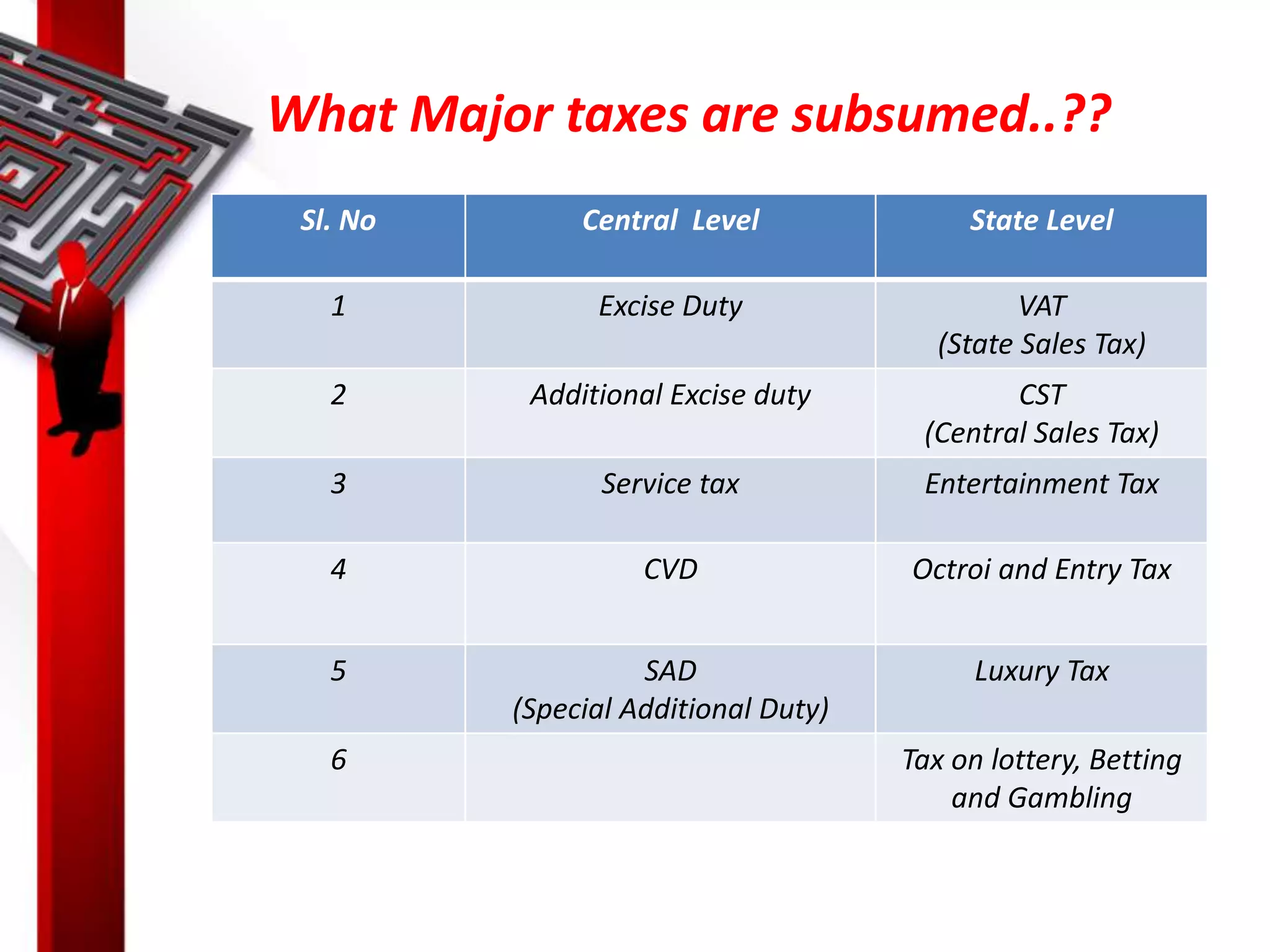
What Major taxes are subsumed..??
Sl. No Central Level State Level
1 Excise Duty VAT
(State Sales Tax)
2 Additional Excise duty CST
(Central Sales Tax)
3 Service tax Entertainment Tax
4 CVD Octroi and Entry Tax
5 SAD
(Special Additional Duty)
Luxury Tax
6 Tax on lottery, Betting
and Gambling
Important Definition
• Aggregate turnover – Taxable, Non Taxable,
Exempt and Exports (Excluding Tax)
• Taxable person – Person who carries any business
at any place in India , who is registered or liable to
register
• India means – Includes Jammu and Kashmir
• RCM – Service provided by Government
(categories of supplies will be notified)
• Services – anything other than goods; includes
Intangible assets, Actionable claims
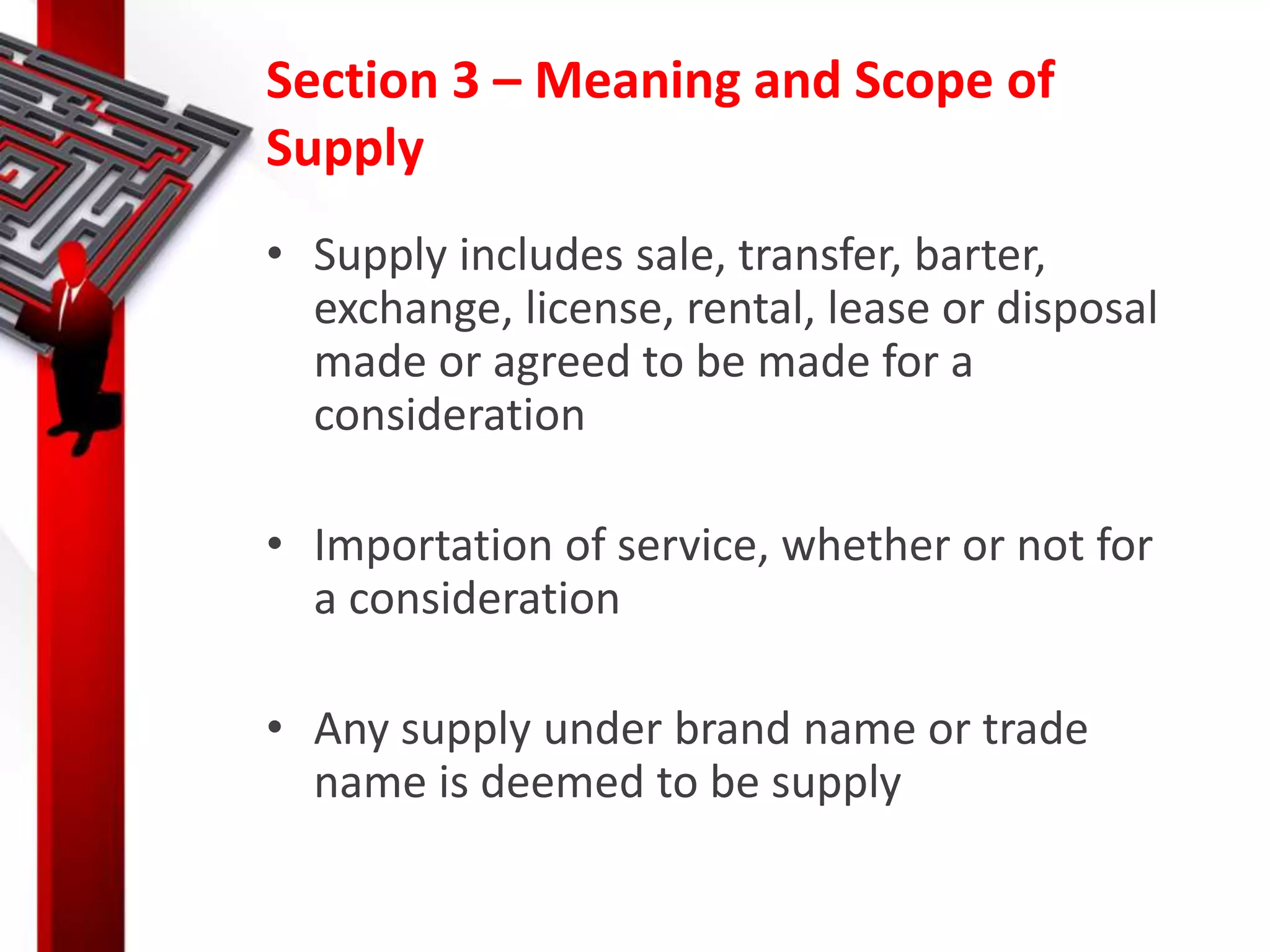
Section 3 – Meaning and Scope of
Supply
• Supply includes sale, transfer, barter,
exchange, license, rental, lease or disposal
made or agreed to be made for a
consideration
• Importation of service, whether or not for
a consideration
• Any supply under brand name or trade
name is deemed to be supply
CHAPTER III
LEVY OF, AND EXEMPTION FROM, TAX
SL. No Type of Levy Applicability
1 SGST and CGST Intra state Transaction
2 IGST Interstate transaction*
3 Composition Levy For Composition Dealer who
will not avail any Input credit
*Note: Integrated levy includes Imports
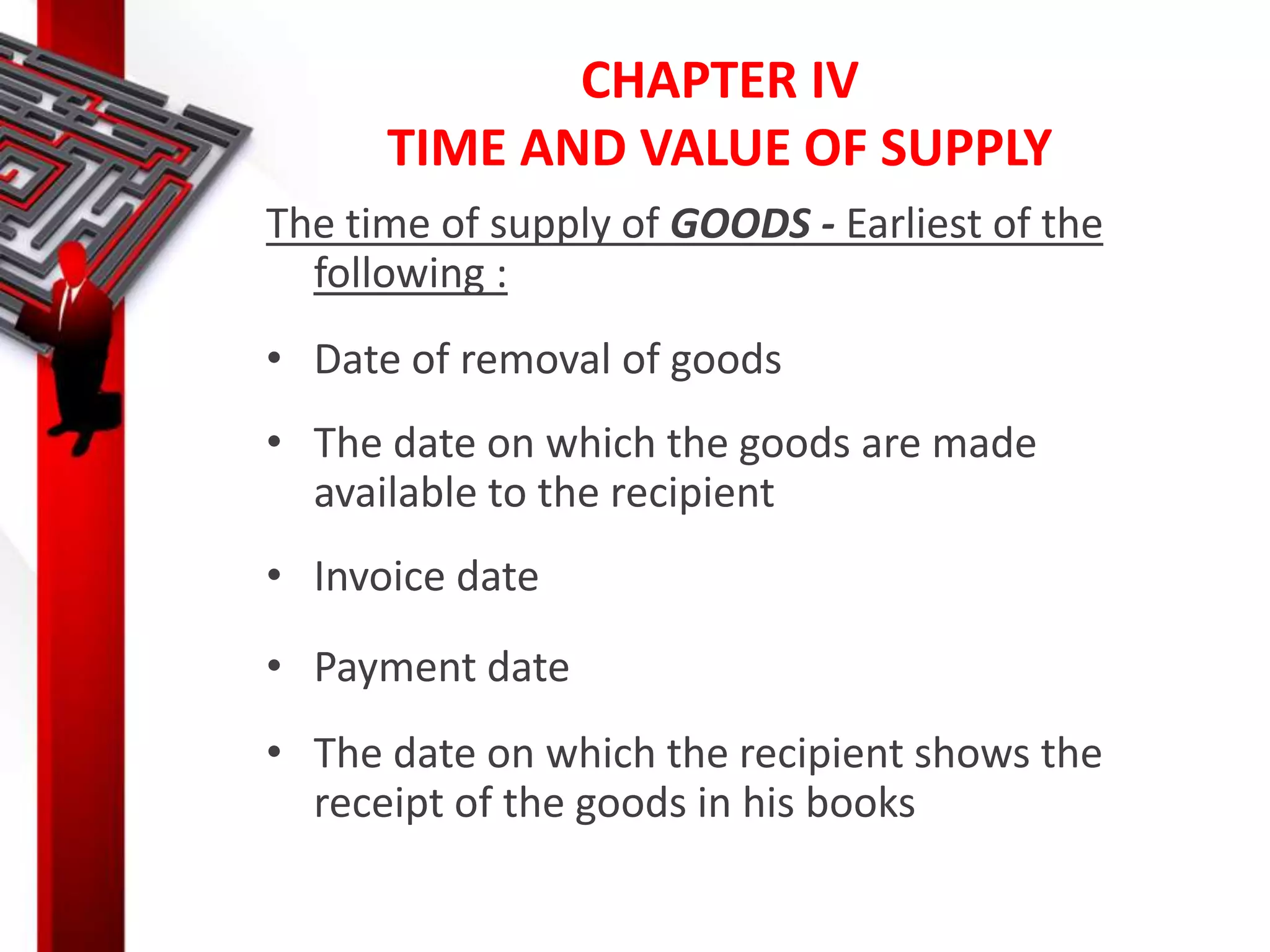
CHAPTER IV
TIME AND VALUE OF SUPPLY
The time of supply of GOODS - Earliest of the
following :
• Date of removal of goods
• The date on which the goods are made
available to the recipient
• Invoice date
• Payment date
• The date on which the recipient shows the
receipt of the goods in his books
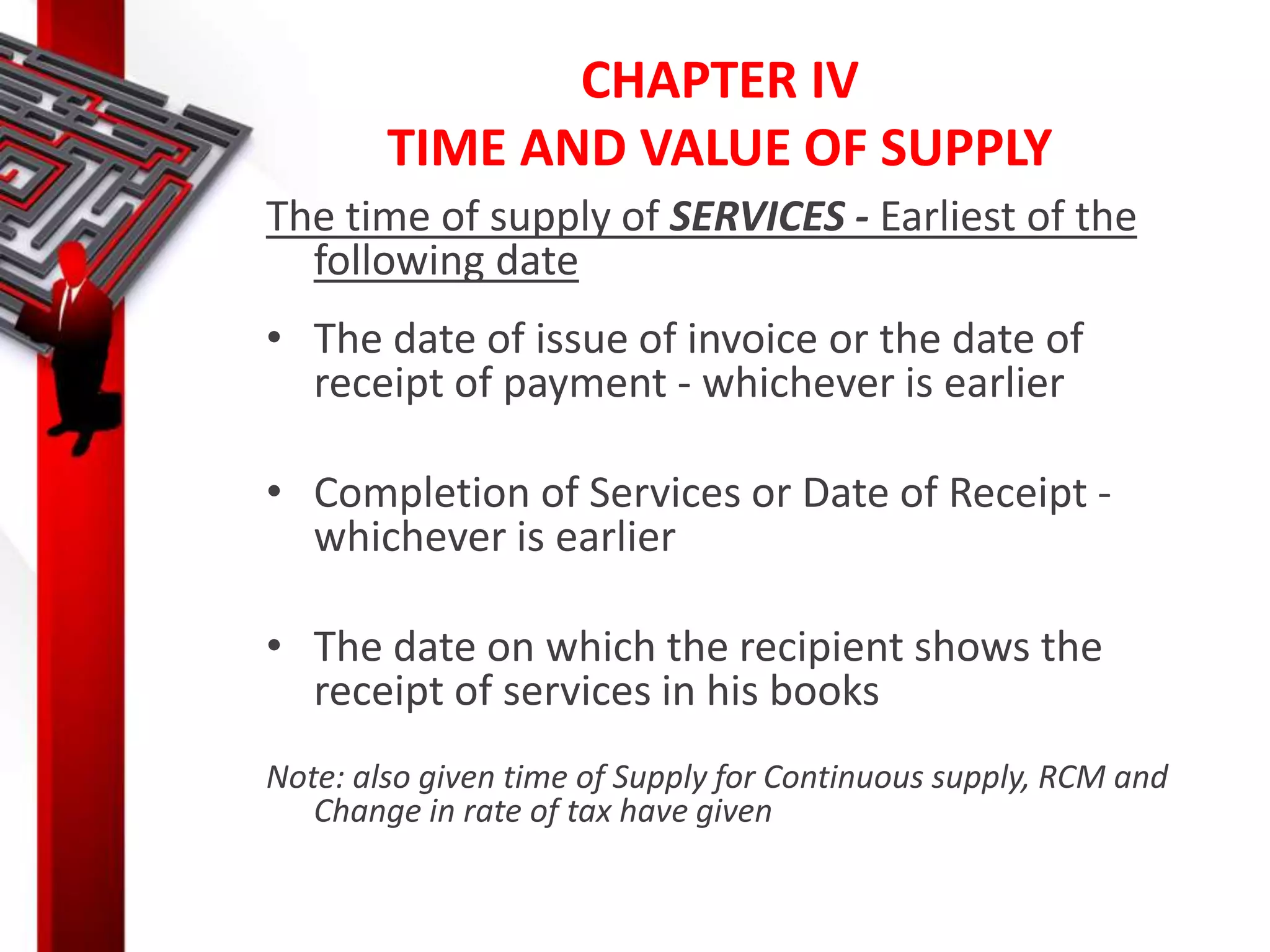
CHAPTER IV
TIME AND VALUE OF SUPPLY
The time of supply of SERVICES - Earliest of the
following date
• The date of issue of invoice or the date of
receipt of payment - whichever is earlier
• Completion of Services or Date of Receipt -
whichever is earlier
• The date on which the recipient shows the
receipt of services in his books
Note: also given time of Supply for Continuous supply, RCM and
Change in rate of tax have given
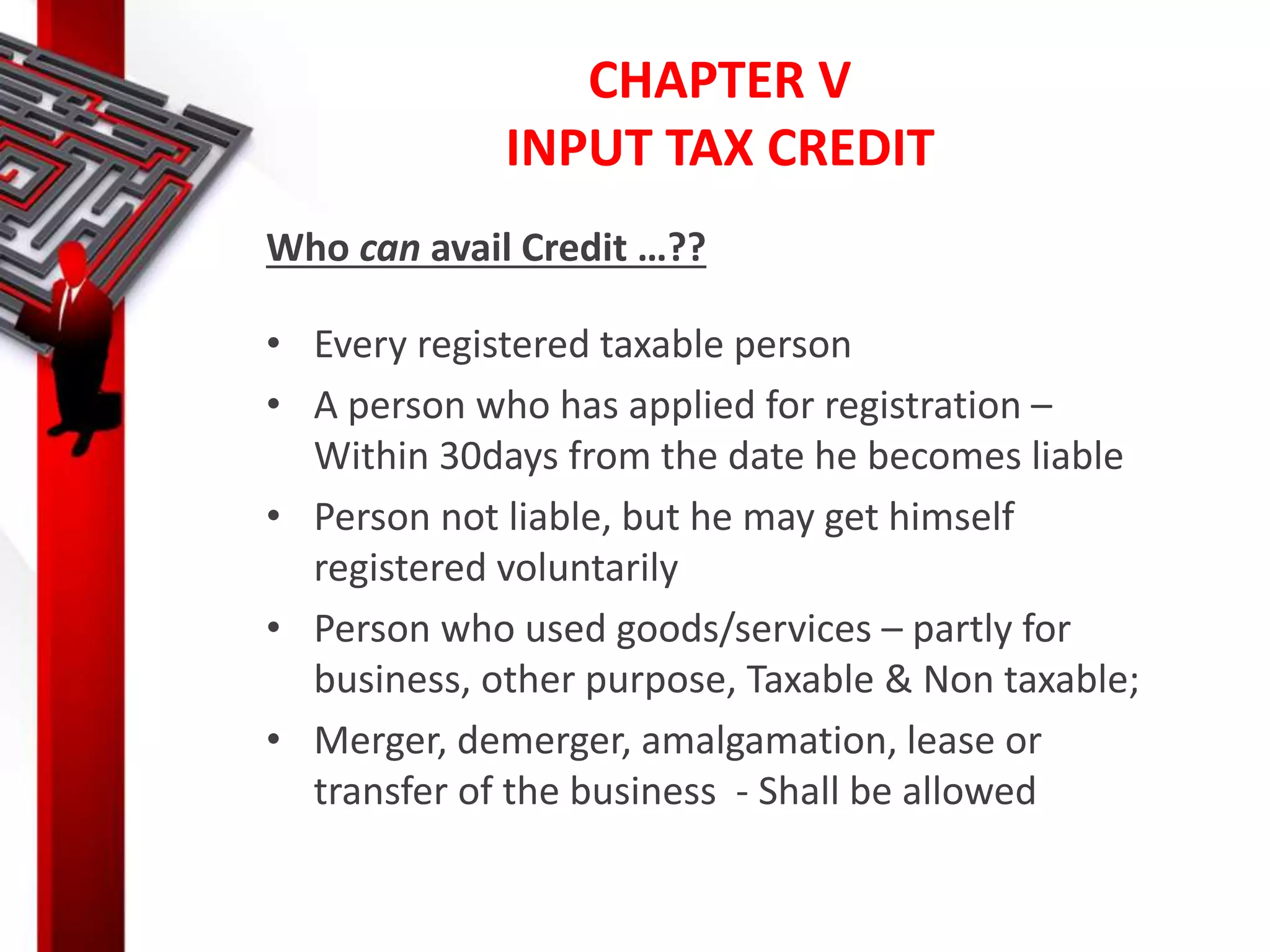
CHAPTER V
INPUT TAX CREDIT
Who can avail Credit …??
• Every registered taxable person
• A person who has applied for registration –
Within 30days from the date he becomes liable
• Person not liable, but he may get himself
registered voluntarily
• Person who used goods/services – partly for
business, other purpose, Taxable & Non taxable;
• Merger, demerger, amalgamation, lease or
transfer of the business - Shall be allowed
CHAPTER V
INPUT TAX CREDIT
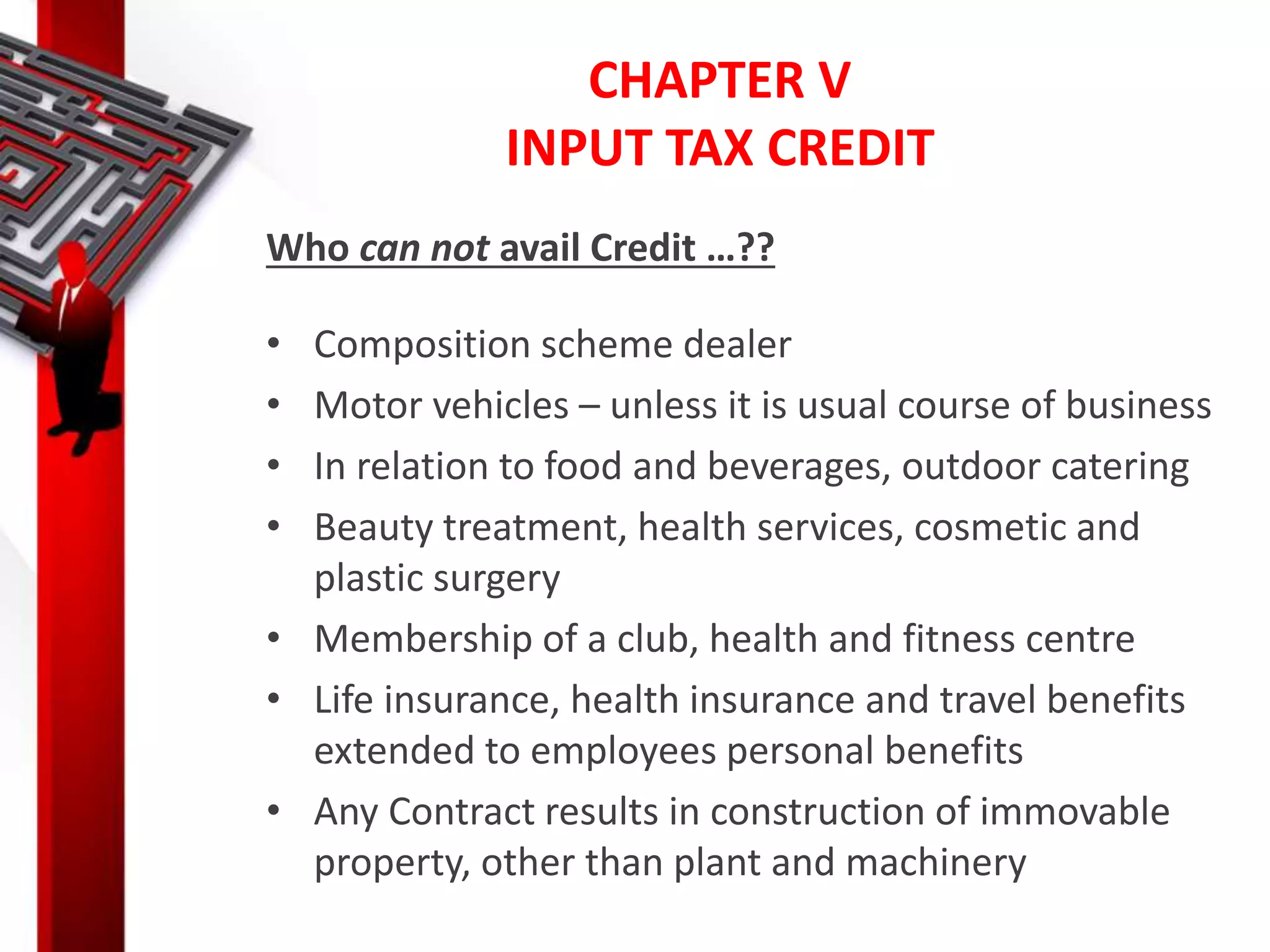
Who can not avail Credit …??
• Composition scheme dealer
• Motor vehicles – unless it is usual course of business
• In relation to food and beverages, outdoor catering
• Beauty treatment, health services, cosmetic and
plastic surgery
• Membership of a club, health and fitness centre
• Life insurance, health insurance and travel benefits
extended to employees personal benefits
• Any Contract results in construction of immovable
property, other than plant and machinery
CHAPTER V
INPUT TAX CREDIT
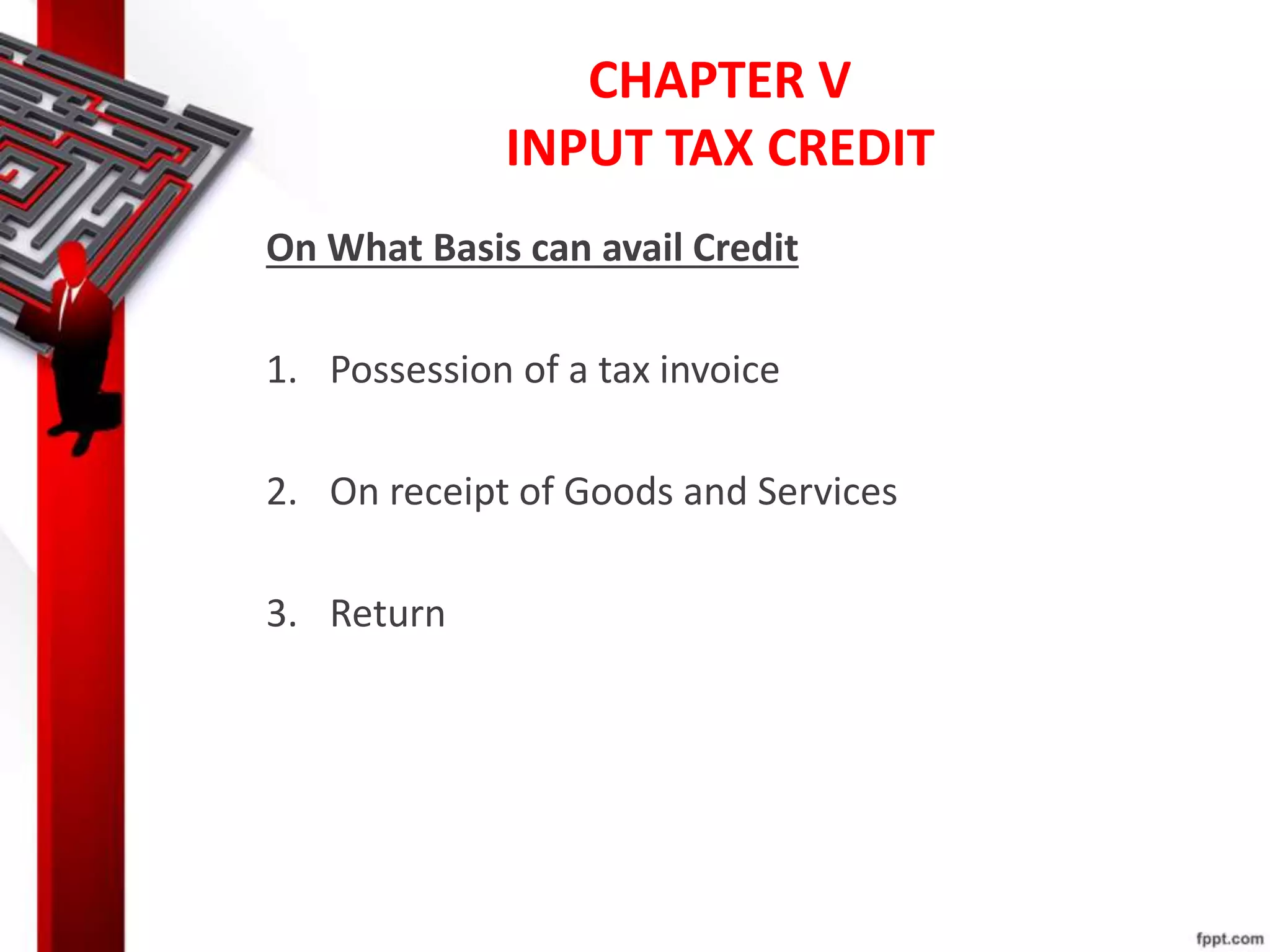
On What Basis can avail Credit
1. Possession of a tax invoice
2. On receipt of Goods and Services
3. Return
CHAPTER - VI
REGISTRATION
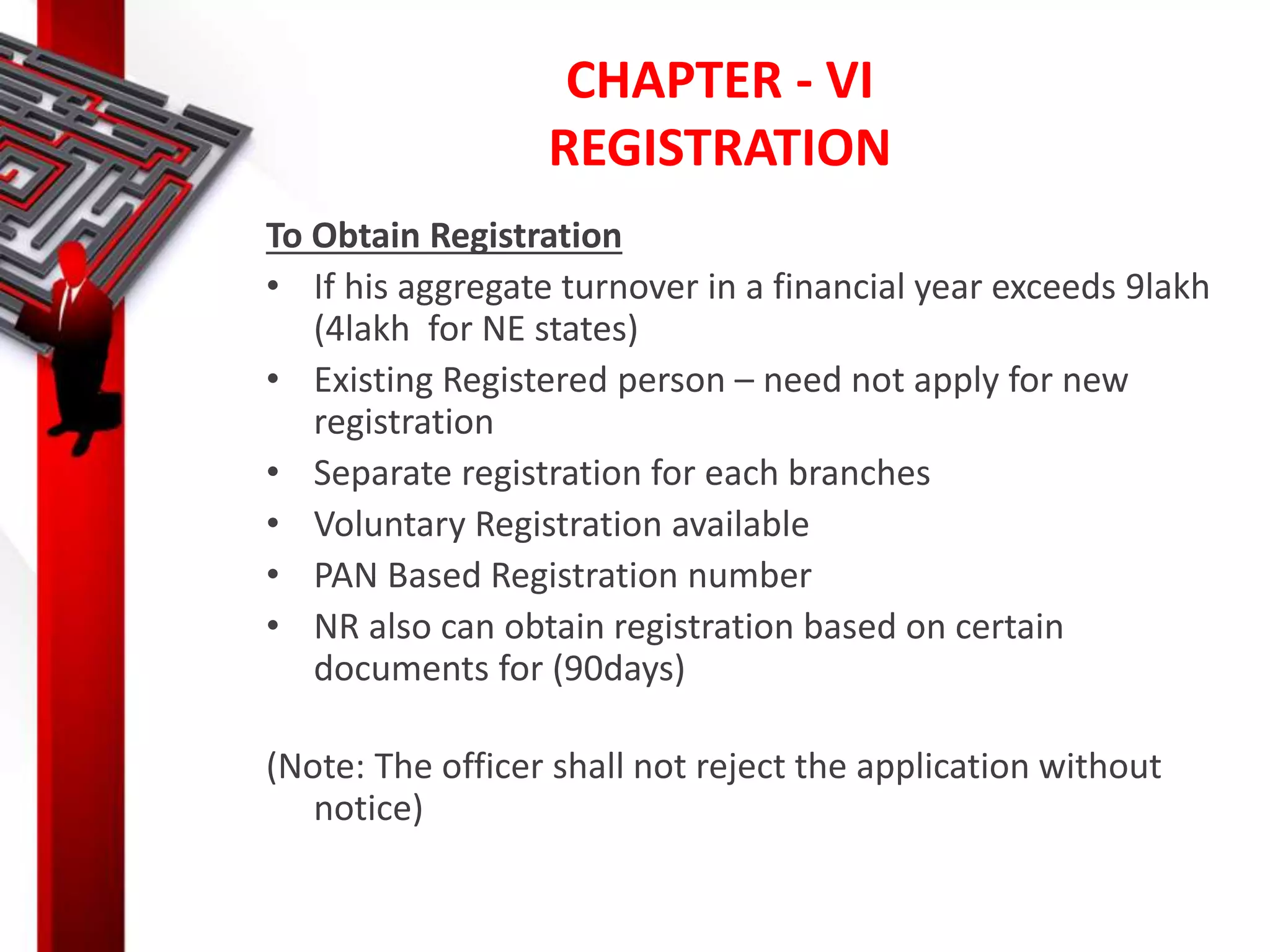
To Obtain Registration
• If his aggregate turnover in a financial year exceeds 9lakh
(4lakh for NE states)
• Existing Registered person – need not apply for new
registration
• Separate registration for each branches
• Voluntary Registration available
• PAN Based Registration number
• NR also can obtain registration based on certain
documents for (90days)
(Note: The officer shall not reject the application without
notice)
CHAPTER - VI
REGISTRATION
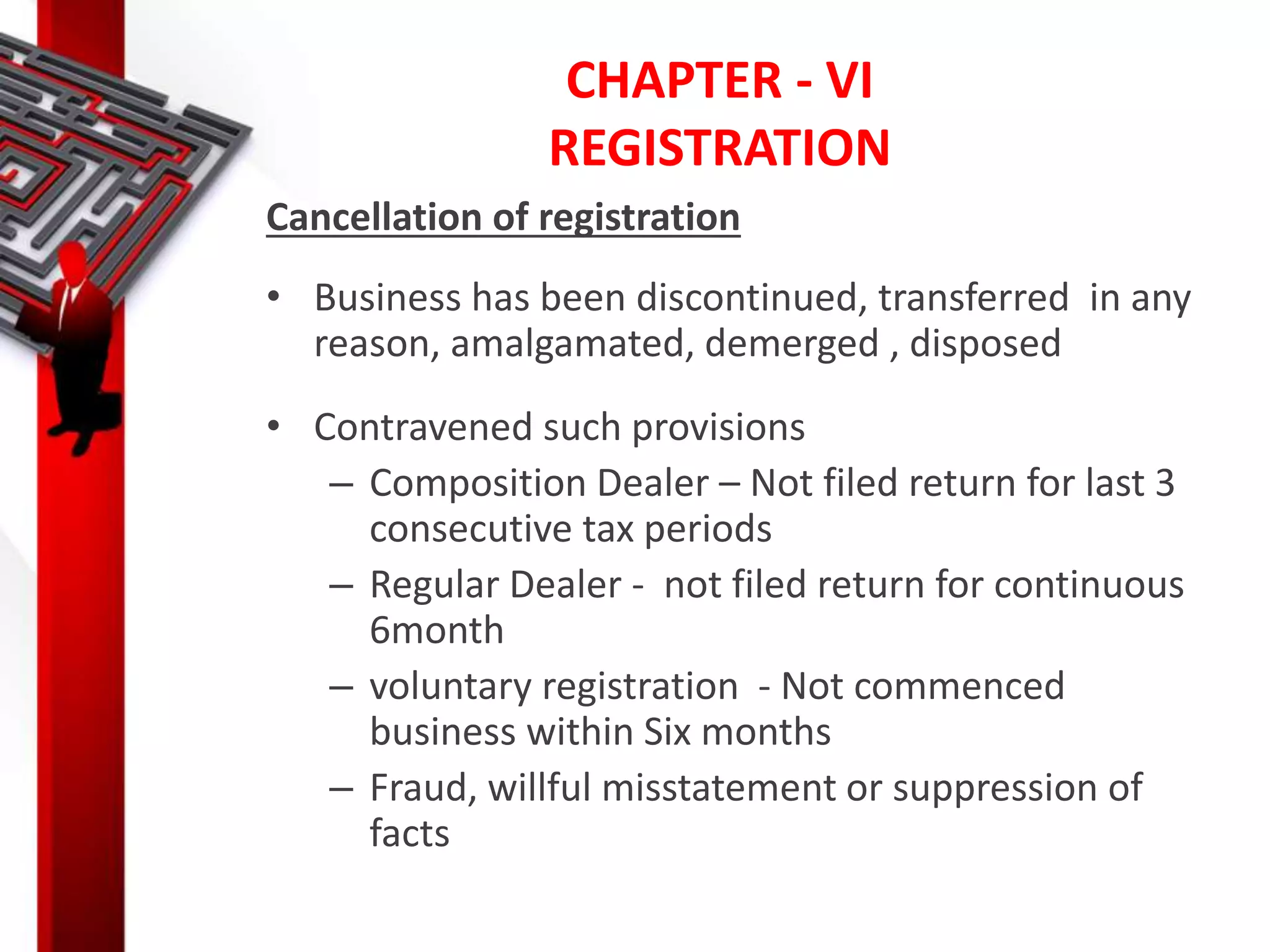
Cancellation of registration
• Business has been discontinued, transferred in any
reason, amalgamated, demerged , disposed
• Contravened such provisions
– Composition Dealer – Not filed return for last 3
consecutive tax periods
– Regular Dealer - not filed return for continuous
6month
– voluntary registration - Not commenced
business within Six months
– Fraud, willful misstatement or suppression of
facts
CHAPTER - VI
REGISTRATION
Contd….!!!
CGST Cancellation deemed to be SGST Cancellation
Revocation of cancellation of registration
Revocation within 30days with sufficient reason
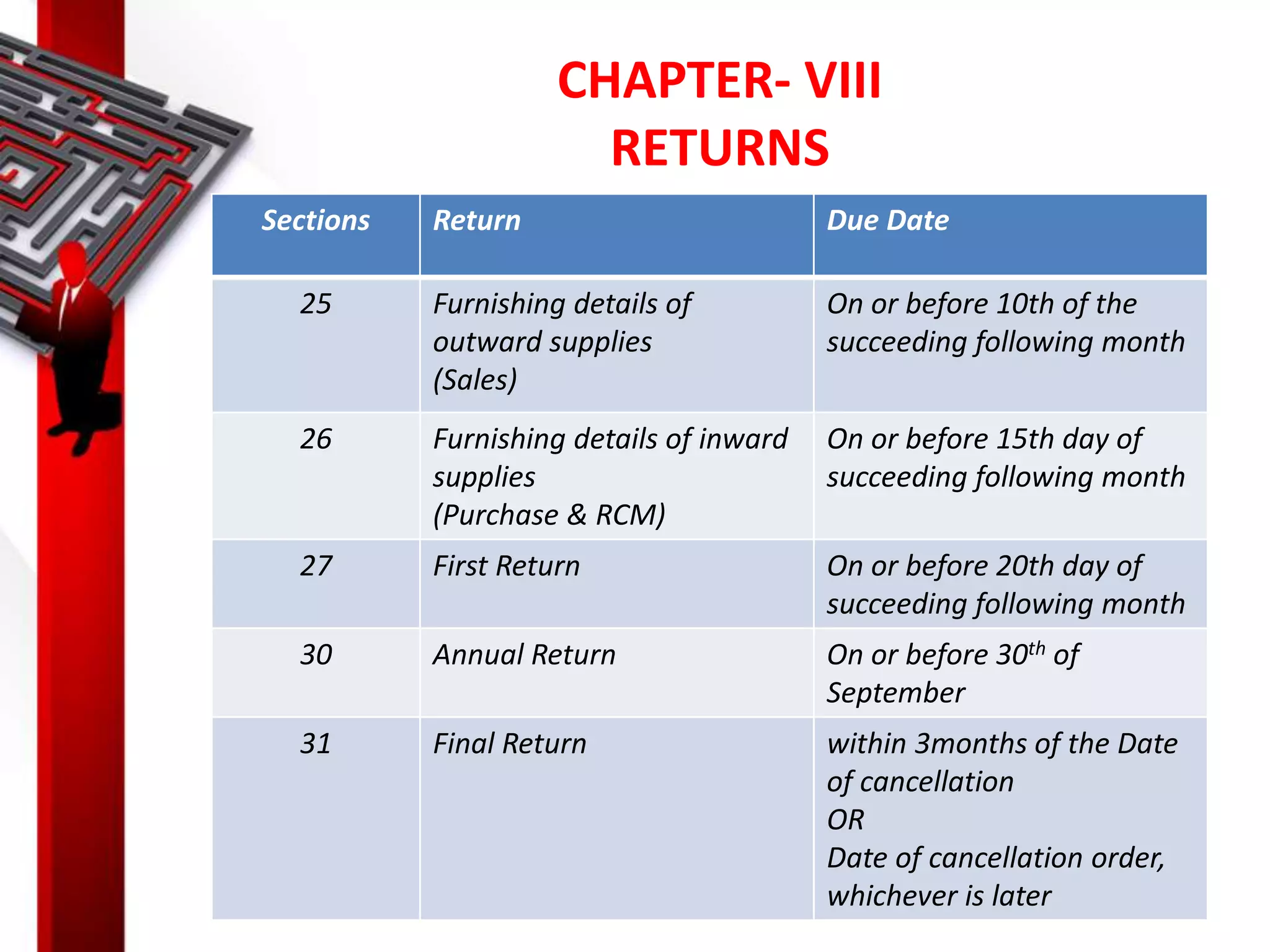
CHAPTER- VIII
RETURNS
Sections Return Due Date
25 Furnishing details of
outward supplies
(Sales)
On or before 10th of the
succeeding following month
26 Furnishing details of inward
supplies
(Purchase & RCM)
On or before 15th day of
succeeding following month
27 First Return On or before 20th day of
succeeding following month
30 Annual Return On or before 30th of
September
31 Final Return within 3months of the Date
of cancellation
OR
Date of cancellation order,
whichever is later
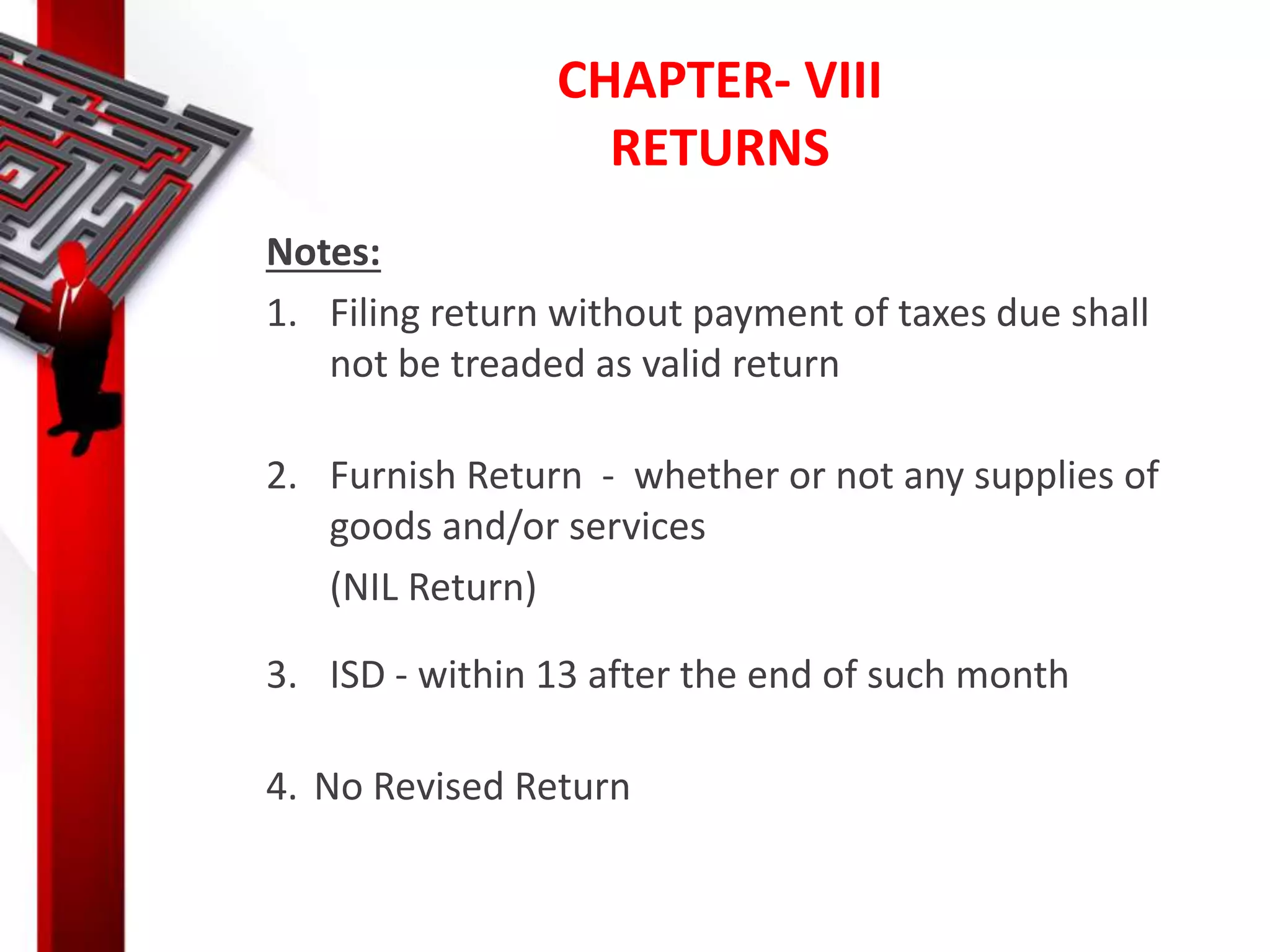
CHAPTER- VIII
RETURNS
Notes:
1. Filing return without payment of taxes due shall
not be treaded as valid return
2. Furnish Return - whether or not any supplies of
goods and/or services
(NIL Return)
3. ISD - within 13 after the end of such month
4. No Revised Return
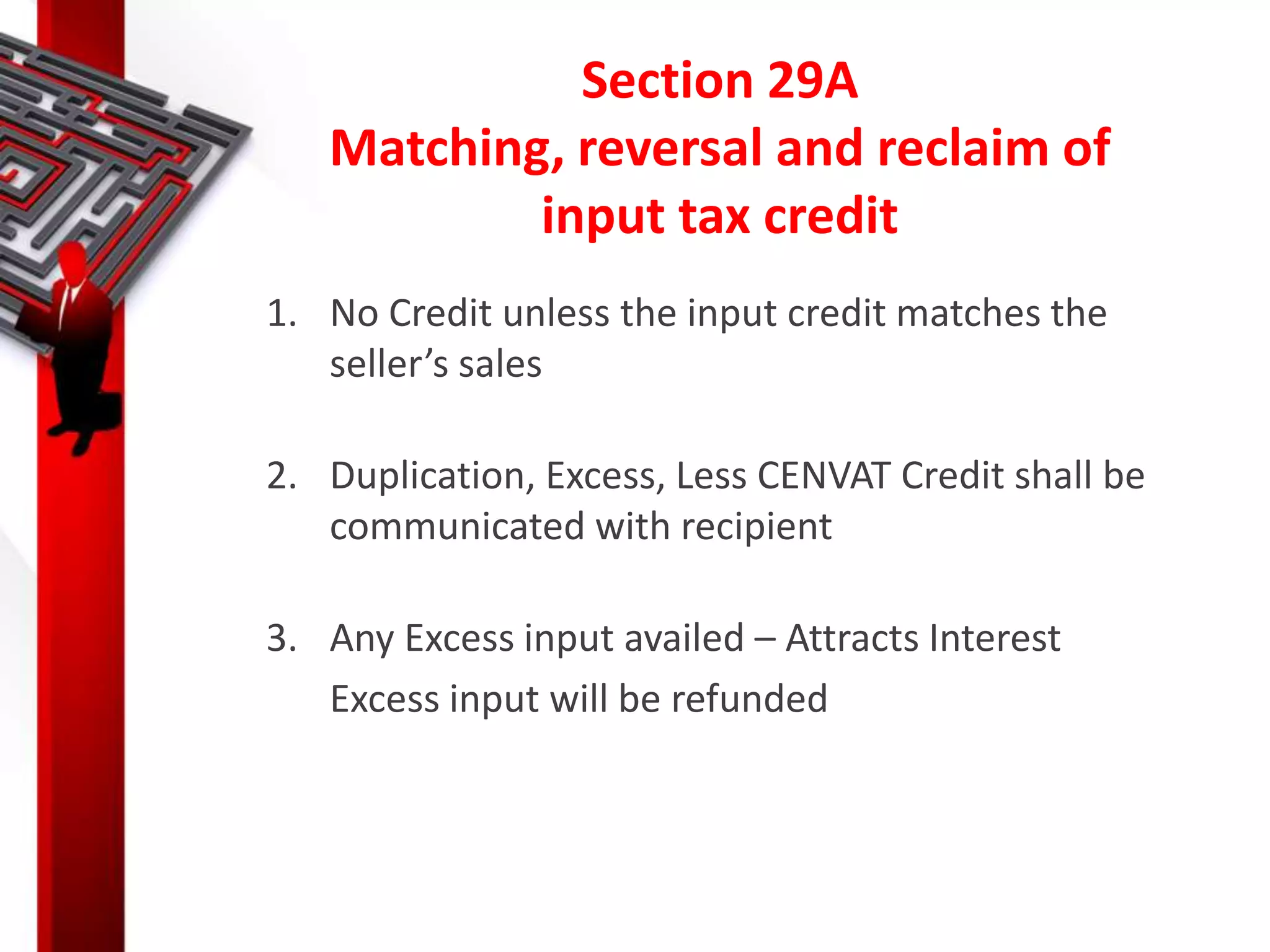
Section 29A
Matching, reversal and reclaim of
input tax credit
1. No Credit unless the input credit matches the
seller’s sales
2. Duplication, Excess, Less CENVAT Credit shall be
communicated with recipient
3. Any Excess input availed – Attracts Interest
Excess input will be refunded
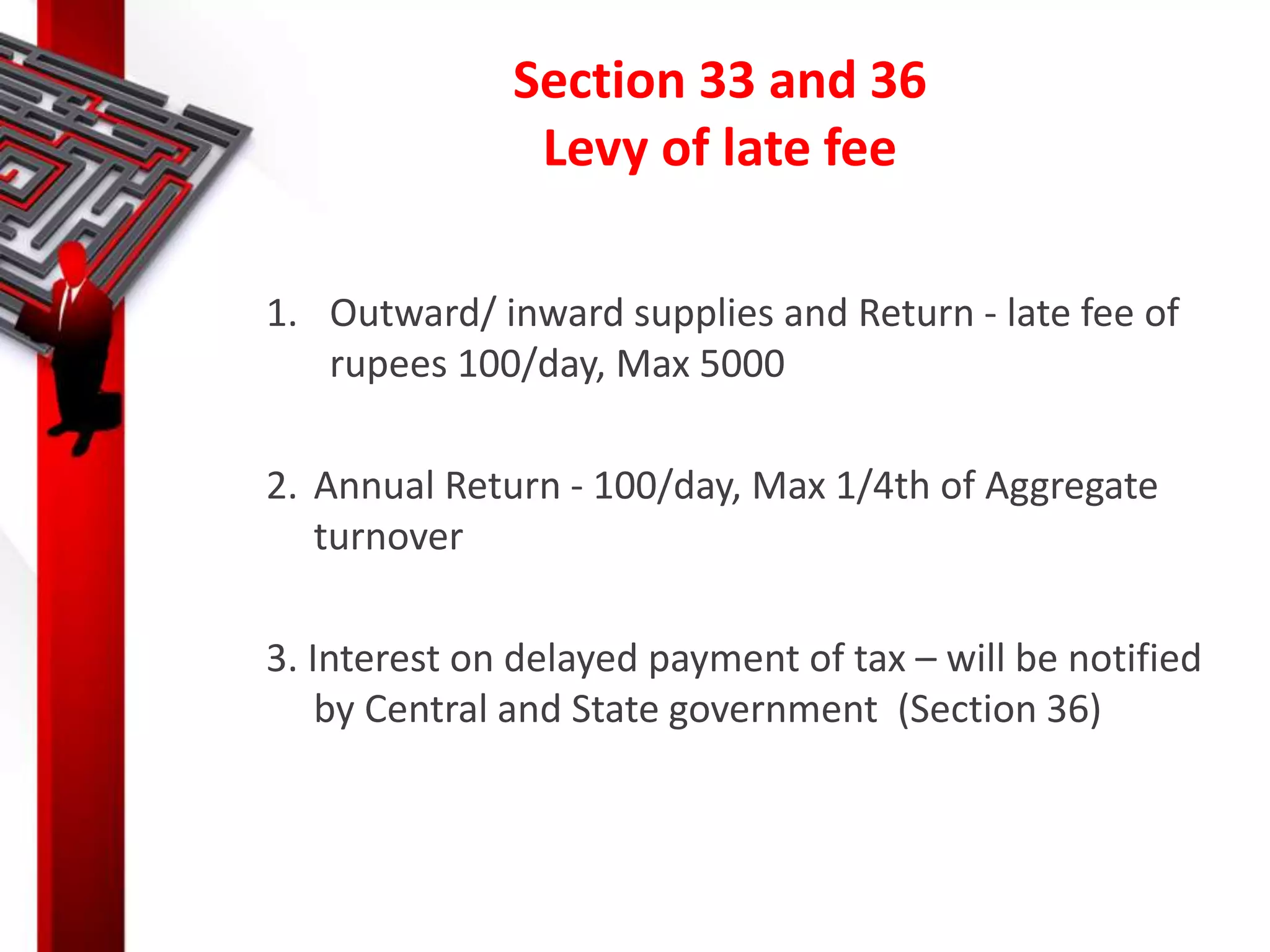
Section 33 and 36
Levy of late fee
1. Outward/ inward supplies and Return - late fee of
rupees 100/day, Max 5000
2. Annual Return - 100/day, Max 1/4th of Aggregate
turnover
3. Interest on delayed payment of tax – will be notified
by Central and State government (Section 36)
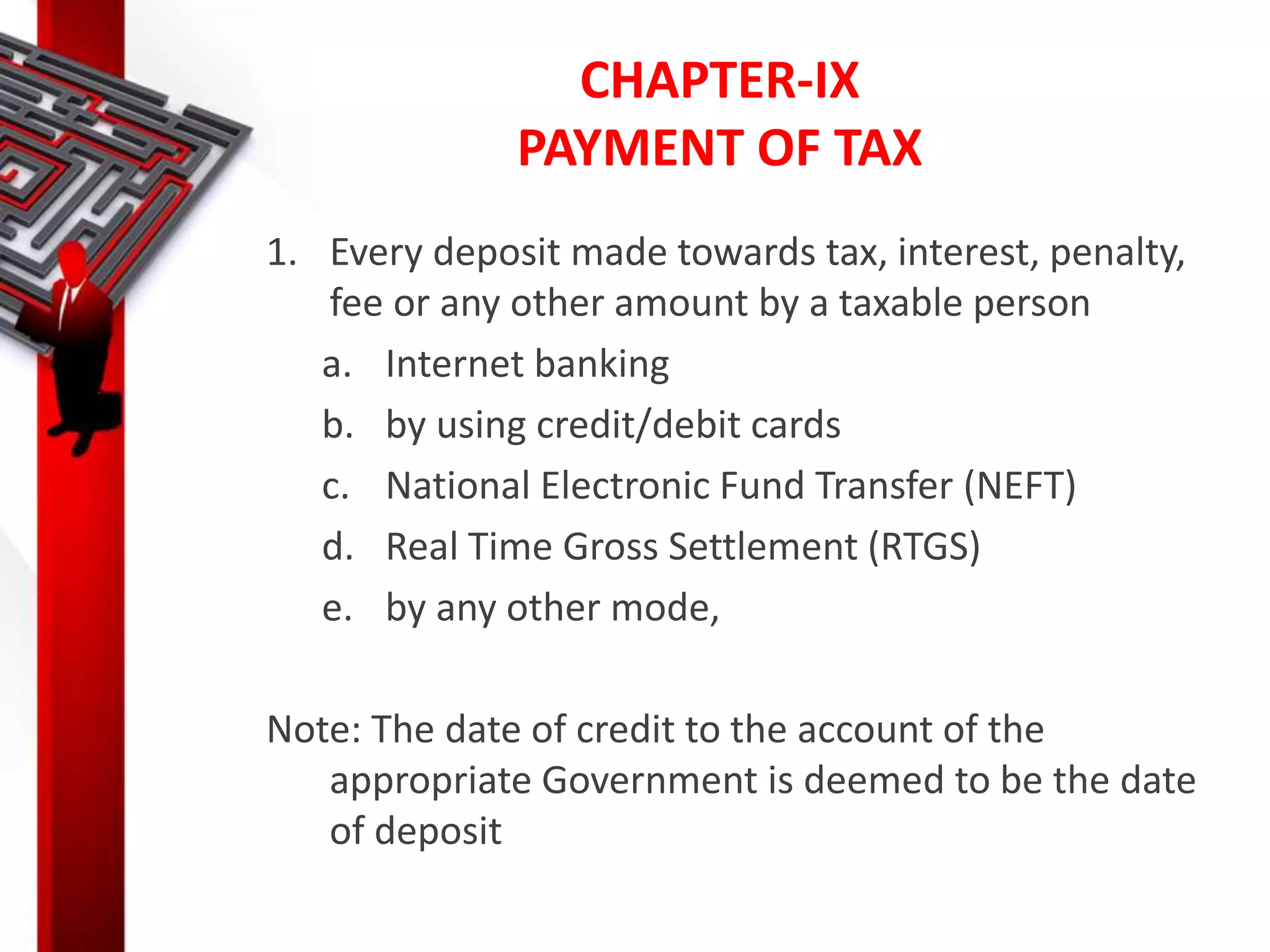
CHAPTER-IX
PAYMENT OF TAX
1. Every deposit made towards tax, interest, penalty,
fee or any other amount by a taxable person
a. Internet banking
b. by using credit/debit cards
c. National Electronic Fund Transfer (NEFT)
d. Real Time Gross Settlement (RTGS)
e. by any other mode,
Note: The date of credit to the account of the
appropriate Government is deemed to be the date
of deposit
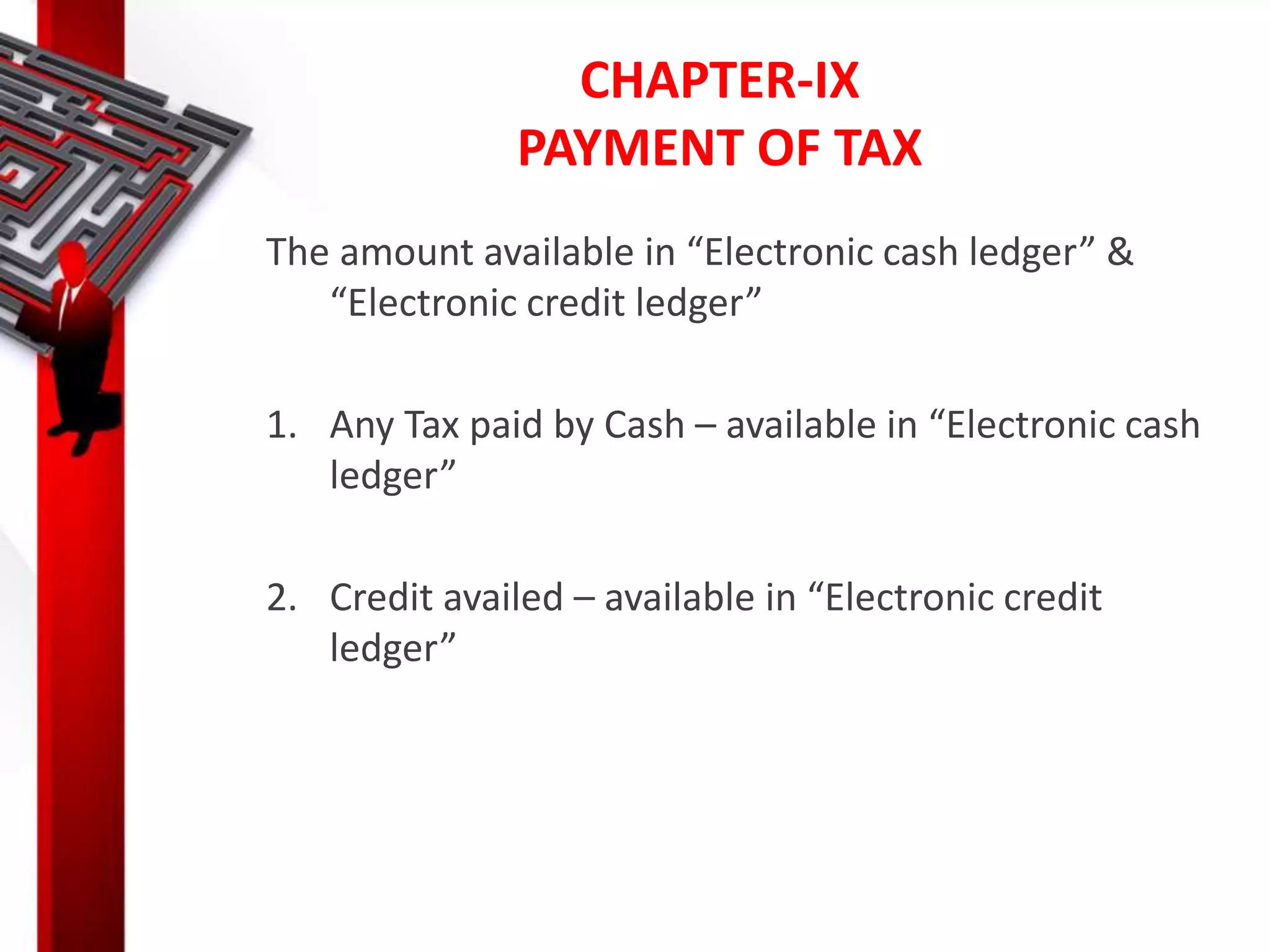
CHAPTER-IX
PAYMENT OF TAX
The amount available in “Electronic cash ledger” &
“Electronic credit ledger”
1. Any Tax paid by Cash – available in “Electronic cash
ledger”
2. Credit availed – available in “Electronic credit
ledger”
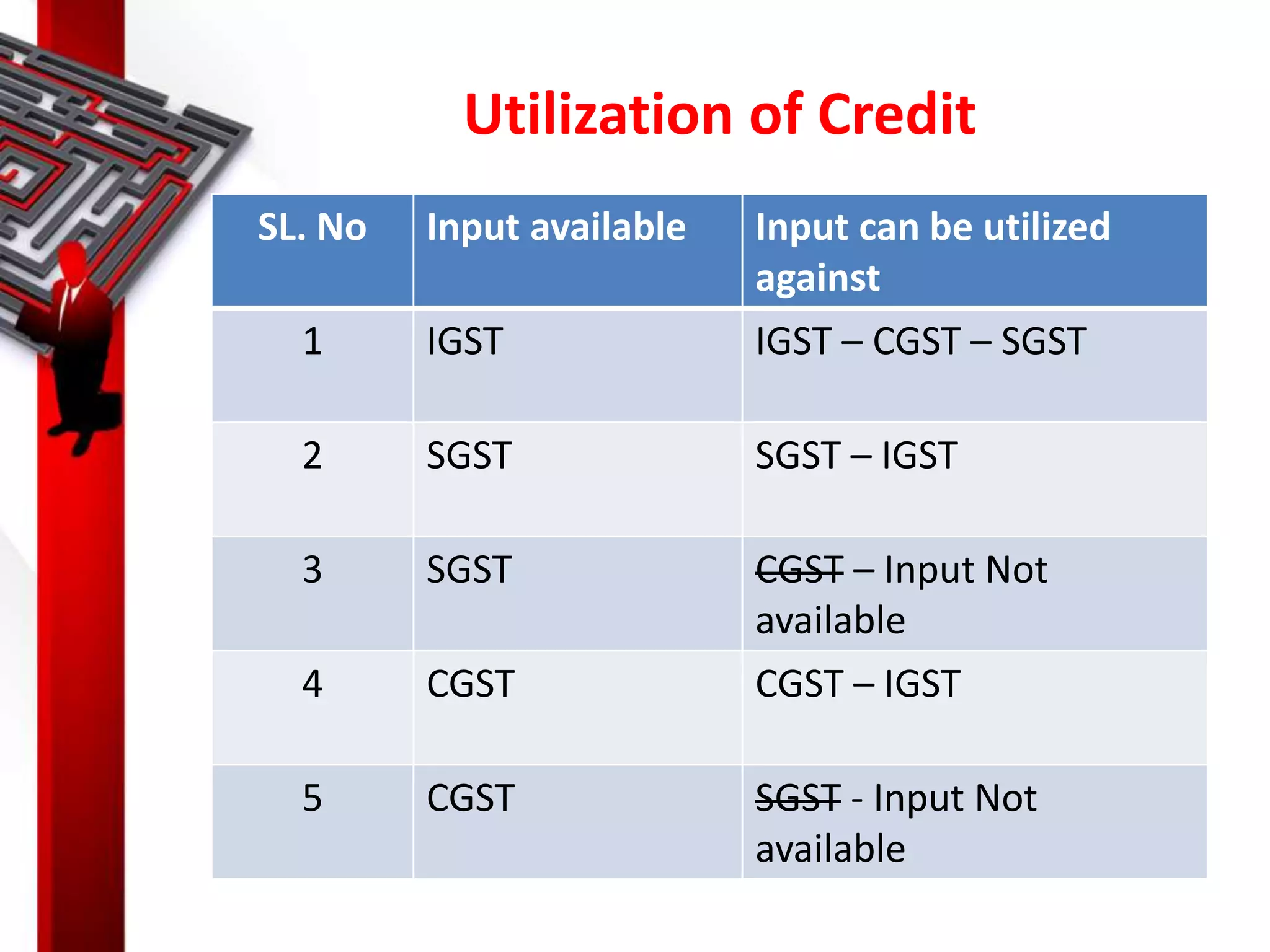
Utilization of Credit
SL. No Input available Input can be utilized
against
1 IGST IGST – CGST – SGST
2 SGST SGST – IGST
3 SGST CGST – Input Not
available
4 CGST CGST – IGST
5 CGST SGST - Input Not
available
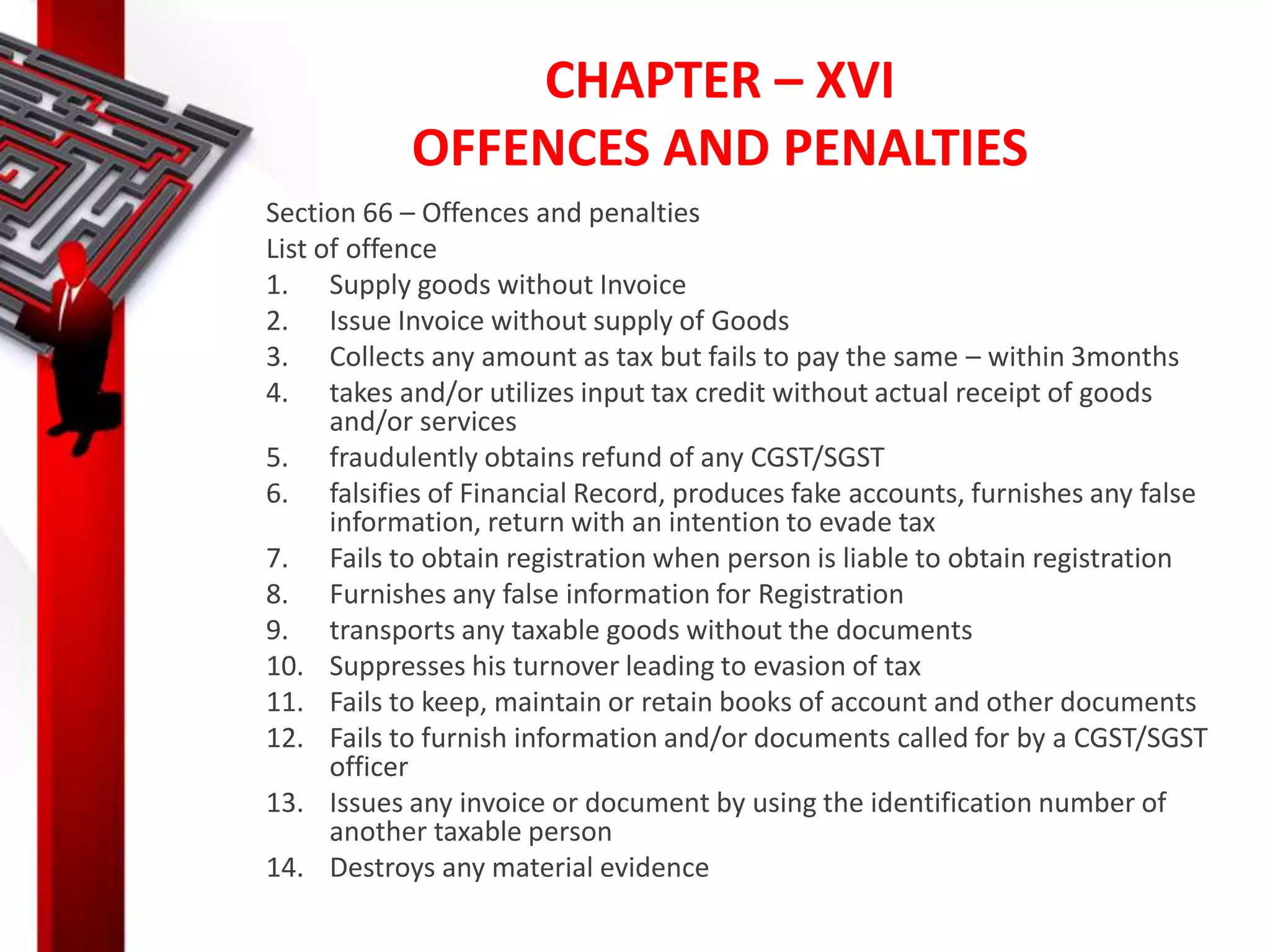
CHAPTER – XVI
OFFENCES AND PENALTIES
Section 66 – Offences and penalties
List of offence
1. Supply goods without Invoice
2. Issue Invoice without supply of Goods
3. Collects any amount as tax but fails to pay the same – within 3months
4. takes and/or utilizes input tax credit without actual receipt of goods
and/or services
5. fraudulently obtains refund of any CGST/SGST
6. falsifies of Financial Record, produces fake accounts, furnishes any false
information, return with an intention to evade tax
7. Fails to obtain registration when person is liable to obtain registration
8. Furnishes any false information for Registration
9. transports any taxable goods without the documents
10. Suppresses his turnover leading to evasion of tax
11. Fails to keep, maintain or retain books of account and other documents
12. Fails to furnish information and/or documents called for by a CGST/SGST
officer
13. Issues any invoice or document by using the identification number of
another taxable person
14. Destroys any material evidence
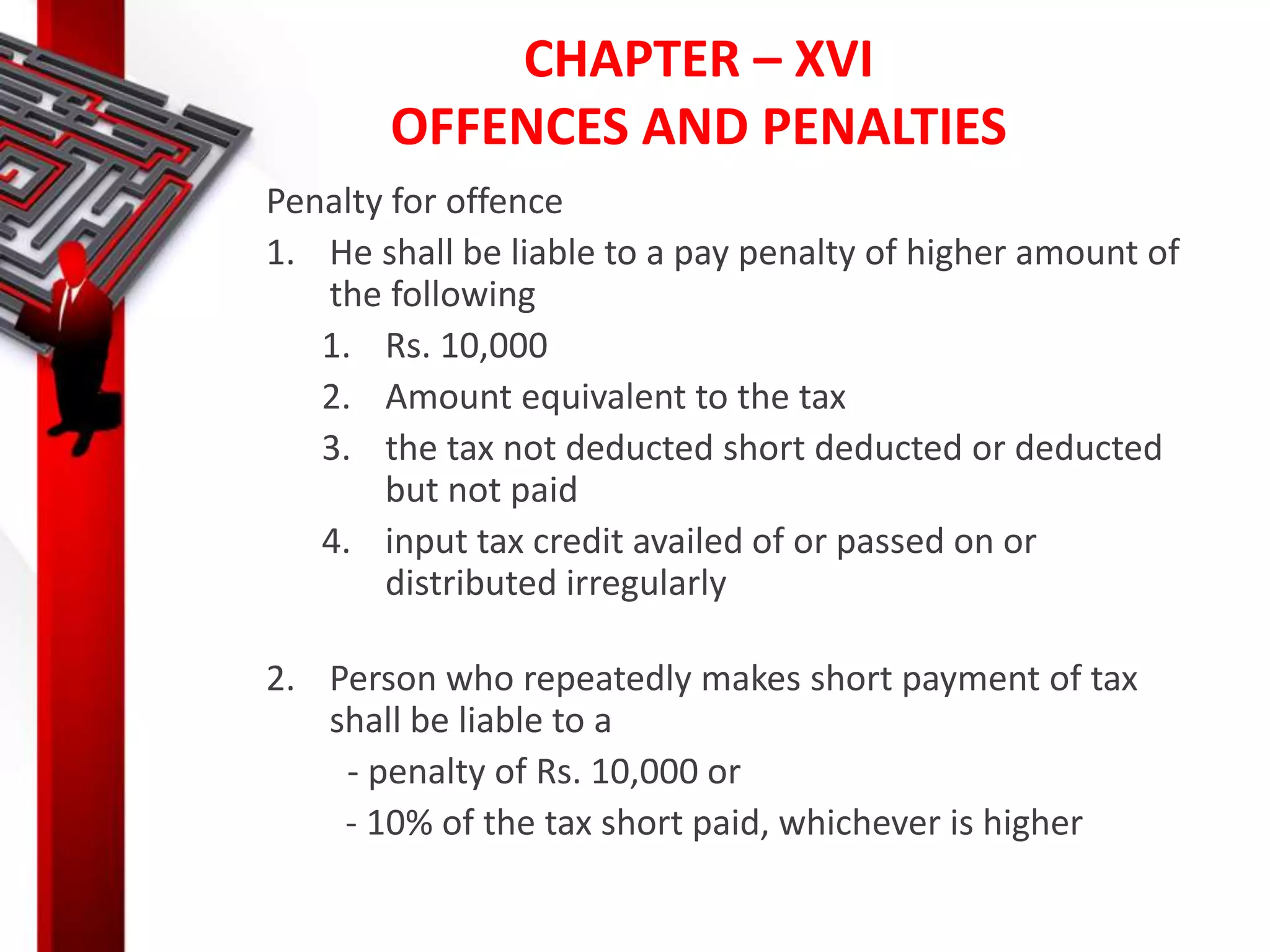
CHAPTER – XVI
OFFENCES AND PENALTIES
Penalty for offence
1. He shall be liable to a pay penalty of higher amount of
the following
1. Rs. 10,000
2. Amount equivalent to the tax
3. the tax not deducted short deducted or deducted
but not paid
4. input tax credit availed of or passed on or
distributed irregularly
2. Person who repeatedly makes short payment of tax
shall be liable to a
- penalty of Rs. 10,000 or
- 10% of the tax short paid, whichever is higher
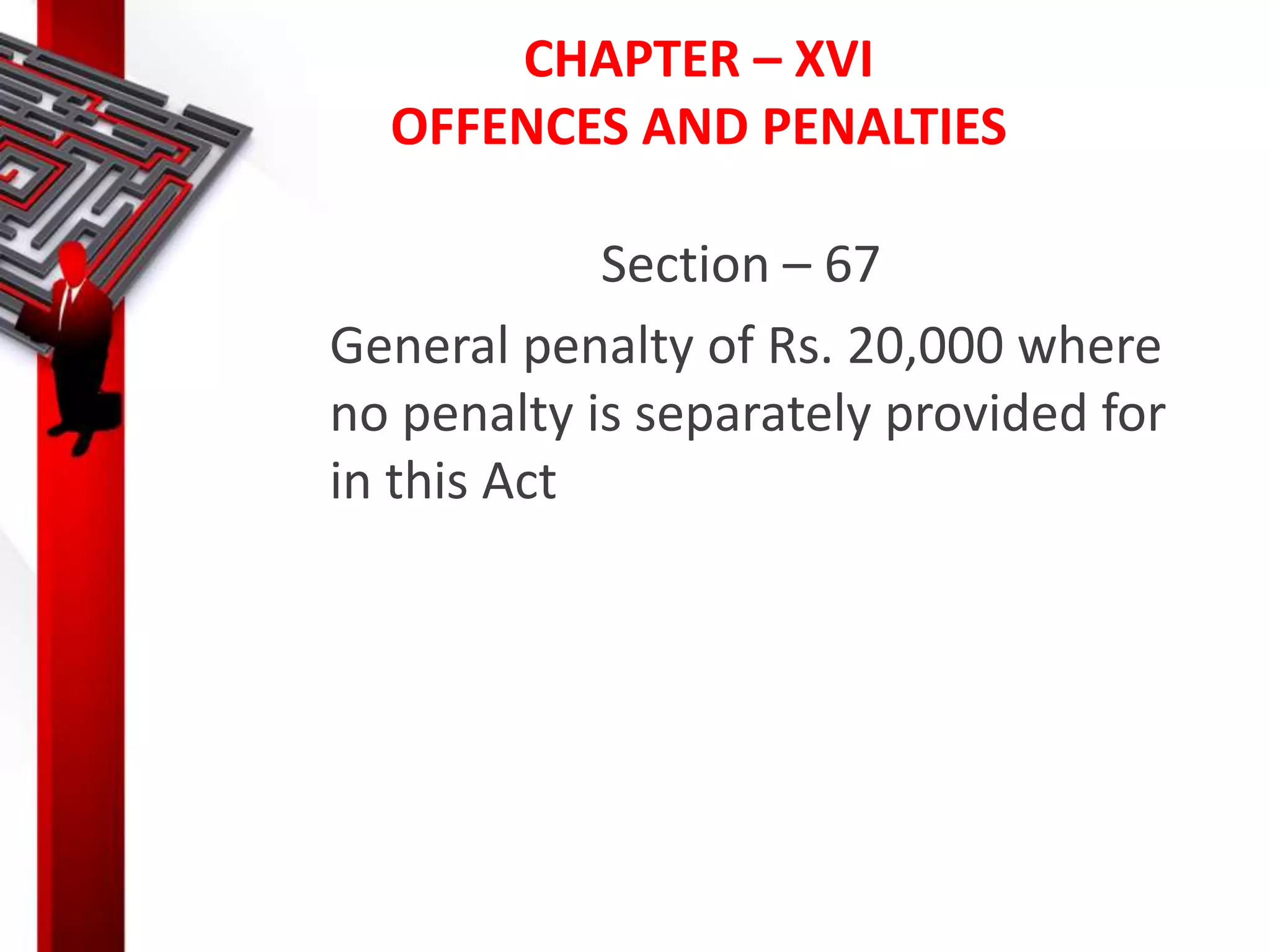
CHAPTER – XVI
OFFENCES AND PENALTIES
Section – 67
General penalty of Rs. 20,000 where
no penalty is separately provided for
in this Act
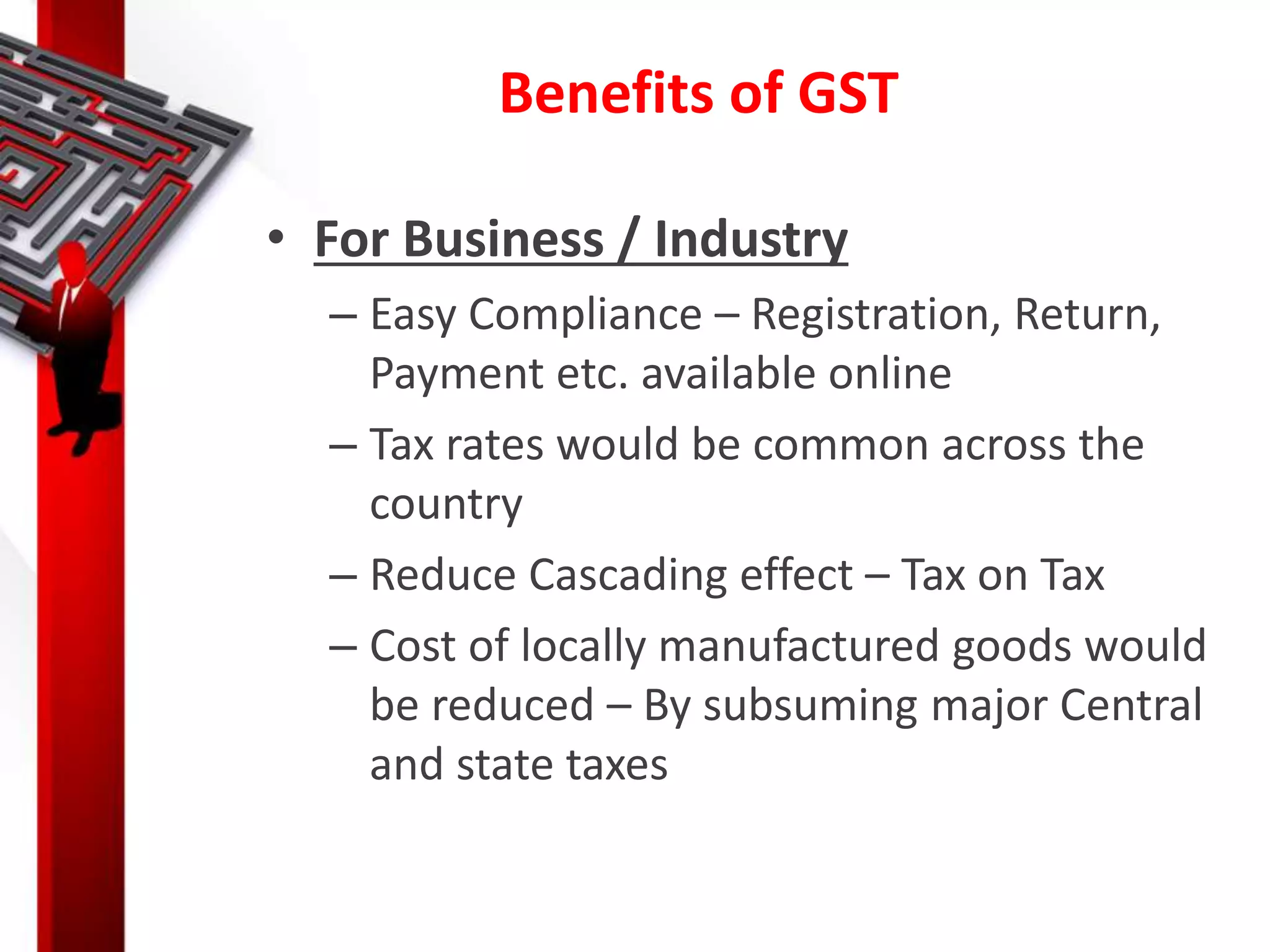
Benefits of GST
• For Business / Industry
– Easy Compliance – Registration, Return,
Payment etc. available online
– Tax rates would be common across the
country
– Reduce Cascading effect – Tax on Tax
– Cost of locally manufactured goods would
be reduced – By subsuming major Central
and state taxes
Benefits of GST
• For Central / State Government
– Simple and Easy to administrate –
Multiple taxes subsumed by GST and all
compliances will be done through online
– Reduction in fraudulence
– GDP growth will be increased
Conclusion
Under GST, the taxation burden will
be divided equitably between
manufacturing and services and It is
expected to help build a transparent
and corruption-free tax
administration.
Hence, Let us welcome GST
Presentation on Model GST Law

Presentation on Model GST Law

  • 1.
    GST Goods and Servicetax Siddaraju SK Hanish and Associates
  • 2.
    Points to beDiscussed 1. Background of GST 2. What is GST? 3. How GST works? 4. Concept of GST 5. Major taxes that are Subsumed. 6. Certain Important Definitions. 7. Section 3 – Meaning and Scope of Supply 8. Levy of, and Exemption from Tax 9. Time and Value of supply 10. Input Tax Credit 11. Utilization of Input Credit 12. Registration 13. Returns 14. Section 29A - Matching, reversal and reclaim of input tax credit 15. Levy of late fee 16. Payment of Tax 17. Offences And Penalties 18. Benefits of GST 19. Conclusion
  • 3.
    Background • In 2003,“Kelkar Task Force” – had suggested GST based on VAT Principle • Proposal introduced in 2006-07 budget by P. Chidambaram • GST draft bill announced in June 2016 • “Compensation to the state for loss of revenue arising on implementation of GST” one of major feature of constitutional bill, 2014
  • 4.
    What is GST..? •GST is one indirect tax for the whole nation, • The Goods and Service Tax (GST) - By amalgamating a large number of Central and State taxes into a single tax
  • 5.
    How GST Work..? •Tax only on Value addition • Credit of Input tax paid is available in each level • The final consumer will bear GST charged
  • 6.
    Concept of GST •Intra state Transaction – SGST and CGST will be applicable • Interstate transaction – IGST will be applicable • GST will be applicable on all goods and services – Except Alcohol for human Consumption, Electricity and Real Estate • Petroleum products and tobacco products would be subject to GST
  • 7.
    What Major taxesare subsumed..?? Sl. No Central Level State Level 1 Excise Duty VAT (State Sales Tax) 2 Additional Excise duty CST (Central Sales Tax) 3 Service tax Entertainment Tax 4 CVD Octroi and Entry Tax 5 SAD (Special Additional Duty) Luxury Tax 6 Tax on lottery, Betting and Gambling
  • 8.
    Important Definition • Aggregateturnover – Taxable, Non Taxable, Exempt and Exports (Excluding Tax) • Taxable person – Person who carries any business at any place in India , who is registered or liable to register • India means – Includes Jammu and Kashmir • RCM – Service provided by Government (categories of supplies will be notified) • Services – anything other than goods; includes Intangible assets, Actionable claims
  • 9.
    Section 3 –Meaning and Scope of Supply • Supply includes sale, transfer, barter, exchange, license, rental, lease or disposal made or agreed to be made for a consideration • Importation of service, whether or not for a consideration • Any supply under brand name or trade name is deemed to be supply
  • 10.
    CHAPTER III LEVY OF,AND EXEMPTION FROM, TAX SL. No Type of Levy Applicability 1 SGST and CGST Intra state Transaction 2 IGST Interstate transaction* 3 Composition Levy For Composition Dealer who will not avail any Input credit *Note: Integrated levy includes Imports
  • 11.
    CHAPTER IV TIME ANDVALUE OF SUPPLY The time of supply of GOODS - Earliest of the following : • Date of removal of goods • The date on which the goods are made available to the recipient • Invoice date • Payment date • The date on which the recipient shows the receipt of the goods in his books
  • 12.
    CHAPTER IV TIME ANDVALUE OF SUPPLY The time of supply of SERVICES - Earliest of the following date • The date of issue of invoice or the date of receipt of payment - whichever is earlier • Completion of Services or Date of Receipt - whichever is earlier • The date on which the recipient shows the receipt of services in his books Note: also given time of Supply for Continuous supply, RCM and Change in rate of tax have given
  • 13.
    CHAPTER V INPUT TAXCREDIT Who can avail Credit …?? • Every registered taxable person • A person who has applied for registration – Within 30days from the date he becomes liable • Person not liable, but he may get himself registered voluntarily • Person who used goods/services – partly for business, other purpose, Taxable & Non taxable; • Merger, demerger, amalgamation, lease or transfer of the business - Shall be allowed
  • 14.
    CHAPTER V INPUT TAXCREDIT Who can not avail Credit …?? • Composition scheme dealer • Motor vehicles – unless it is usual course of business • In relation to food and beverages, outdoor catering • Beauty treatment, health services, cosmetic and plastic surgery • Membership of a club, health and fitness centre • Life insurance, health insurance and travel benefits extended to employees personal benefits • Any Contract results in construction of immovable property, other than plant and machinery
  • 15.
    CHAPTER V INPUT TAXCREDIT On What Basis can avail Credit 1. Possession of a tax invoice 2. On receipt of Goods and Services 3. Return
  • 16.
    CHAPTER - VI REGISTRATION ToObtain Registration • If his aggregate turnover in a financial year exceeds 9lakh (4lakh for NE states) • Existing Registered person – need not apply for new registration • Separate registration for each branches • Voluntary Registration available • PAN Based Registration number • NR also can obtain registration based on certain documents for (90days) (Note: The officer shall not reject the application without notice)
  • 17.
    CHAPTER - VI REGISTRATION Cancellationof registration • Business has been discontinued, transferred in any reason, amalgamated, demerged , disposed • Contravened such provisions – Composition Dealer – Not filed return for last 3 consecutive tax periods – Regular Dealer - not filed return for continuous 6month – voluntary registration - Not commenced business within Six months – Fraud, willful misstatement or suppression of facts
  • 18.
    CHAPTER - VI REGISTRATION Contd….!!! CGSTCancellation deemed to be SGST Cancellation Revocation of cancellation of registration Revocation within 30days with sufficient reason
  • 19.
    CHAPTER- VIII RETURNS Sections ReturnDue Date 25 Furnishing details of outward supplies (Sales) On or before 10th of the succeeding following month 26 Furnishing details of inward supplies (Purchase & RCM) On or before 15th day of succeeding following month 27 First Return On or before 20th day of succeeding following month 30 Annual Return On or before 30th of September 31 Final Return within 3months of the Date of cancellation OR Date of cancellation order, whichever is later
  • 20.
    CHAPTER- VIII RETURNS Notes: 1. Filingreturn without payment of taxes due shall not be treaded as valid return 2. Furnish Return - whether or not any supplies of goods and/or services (NIL Return) 3. ISD - within 13 after the end of such month 4. No Revised Return
  • 21.
    Section 29A Matching, reversaland reclaim of input tax credit 1. No Credit unless the input credit matches the seller’s sales 2. Duplication, Excess, Less CENVAT Credit shall be communicated with recipient 3. Any Excess input availed – Attracts Interest Excess input will be refunded
  • 22.
    Section 33 and36 Levy of late fee 1. Outward/ inward supplies and Return - late fee of rupees 100/day, Max 5000 2. Annual Return - 100/day, Max 1/4th of Aggregate turnover 3. Interest on delayed payment of tax – will be notified by Central and State government (Section 36)
  • 23.
    CHAPTER-IX PAYMENT OF TAX 1.Every deposit made towards tax, interest, penalty, fee or any other amount by a taxable person a. Internet banking b. by using credit/debit cards c. National Electronic Fund Transfer (NEFT) d. Real Time Gross Settlement (RTGS) e. by any other mode, Note: The date of credit to the account of the appropriate Government is deemed to be the date of deposit
  • 24.
    CHAPTER-IX PAYMENT OF TAX Theamount available in “Electronic cash ledger” & “Electronic credit ledger” 1. Any Tax paid by Cash – available in “Electronic cash ledger” 2. Credit availed – available in “Electronic credit ledger”
  • 25.
    Utilization of Credit SL.No Input available Input can be utilized against 1 IGST IGST – CGST – SGST 2 SGST SGST – IGST 3 SGST CGST – Input Not available 4 CGST CGST – IGST 5 CGST SGST - Input Not available
  • 26.
    CHAPTER – XVI OFFENCESAND PENALTIES Section 66 – Offences and penalties List of offence 1. Supply goods without Invoice 2. Issue Invoice without supply of Goods 3. Collects any amount as tax but fails to pay the same – within 3months 4. takes and/or utilizes input tax credit without actual receipt of goods and/or services 5. fraudulently obtains refund of any CGST/SGST 6. falsifies of Financial Record, produces fake accounts, furnishes any false information, return with an intention to evade tax 7. Fails to obtain registration when person is liable to obtain registration 8. Furnishes any false information for Registration 9. transports any taxable goods without the documents 10. Suppresses his turnover leading to evasion of tax 11. Fails to keep, maintain or retain books of account and other documents 12. Fails to furnish information and/or documents called for by a CGST/SGST officer 13. Issues any invoice or document by using the identification number of another taxable person 14. Destroys any material evidence
  • 27.
    CHAPTER – XVI OFFENCESAND PENALTIES Penalty for offence 1. He shall be liable to a pay penalty of higher amount of the following 1. Rs. 10,000 2. Amount equivalent to the tax 3. the tax not deducted short deducted or deducted but not paid 4. input tax credit availed of or passed on or distributed irregularly 2. Person who repeatedly makes short payment of tax shall be liable to a - penalty of Rs. 10,000 or - 10% of the tax short paid, whichever is higher
  • 28.
    CHAPTER – XVI OFFENCESAND PENALTIES Section – 67 General penalty of Rs. 20,000 where no penalty is separately provided for in this Act
  • 29.
    Benefits of GST •For Business / Industry – Easy Compliance – Registration, Return, Payment etc. available online – Tax rates would be common across the country – Reduce Cascading effect – Tax on Tax – Cost of locally manufactured goods would be reduced – By subsuming major Central and state taxes
  • 30.
    Benefits of GST •For Central / State Government – Simple and Easy to administrate – Multiple taxes subsumed by GST and all compliances will be done through online – Reduction in fraudulence – GDP growth will be increased
  • 31.
    Conclusion Under GST, thetaxation burden will be divided equitably between manufacturing and services and It is expected to help build a transparent and corruption-free tax administration. Hence, Let us welcome GST