Mizan: A System for Dynamic Load
       Balancing in Large-scale Graph Processing

       Zuhair Khayyat1          Karim Awara1    Amani Alonazi1
        Hani Jamjoom2           Dan Williams2   Panos Kalnis1
         1
             King Abdullah University of Science and Technology
                            Thuwal, Saudi Arabia
                      2
                          IBM Watson Research Center
                             Yorktown Heights, NY


1/34
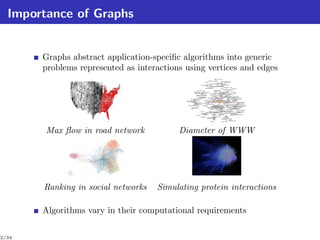
Importance of Graphs


       Graphs abstract application-specific algorithms into generic
       problems represented as interactions using vertices and edges


        Max flow in road network           Diameter of WWW


       Ranking in social networks   Simulating protein interactions

       Algorithms vary in their computational requirements

2/34
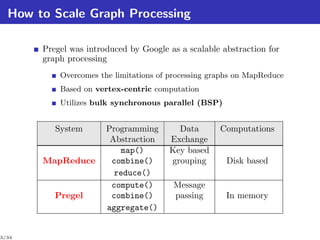
How to Scale Graph Processing

       Pregel was introduced by Google as a scalable abstraction for
       graph processing
           Overcomes the limitations of processing graphs on MapReduce
           Based on vertex-centric computation
           Utilizes bulk synchronous parallel (BSP)


          System       Programming       Data        Computations
                        Abstraction    Exchange
                           map()       Key based
       MapReduce        combine()      grouping       Disk based
                         reduce()
                        compute()       Message
          Pregel        combine()       passing       In memory
                       aggregate()


3/34
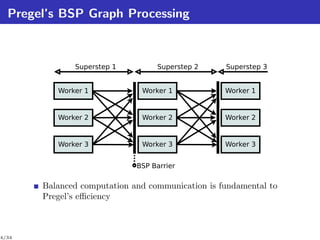
Pregel’s BSP Graph Processing


              Superstep 1         Superstep 2     Superstep 3


          Worker 1            Worker 1            Worker 1


          Worker 2            Worker 2            Worker 2


          Worker 3            Worker 3            Worker 3


                             BSP Barrier

       Balanced computation and communication is fundamental to
       Pregel’s efficiency


4/34
Optimizing Graph Processing


       Existing work focus on optimizing for graph structure (static
       optimization):
           Optimize graph partitioning:
               Simple graph partitioning schemes (e.g., hash or range): Giraph
               User-defined partitioning function: Pregel
               Sophisticated partitioning techniques (e.g., min-cuts): GraphLab,
               PowerGraph, GoldenOrb and Surfer
           Optimize graph data access:
               Distributed data stores and graph indexing: GoldenOrb, Hama
               and Trinity


5/34
Optimizing Graph Processing


       Existing work focus on optimizing for graph structure (static
       optimization):
           Optimize graph partitioning:
               Simple graph partitioning schemes (e.g., hash or range): Giraph
               User-defined partitioning function: Pregel
               Sophisticated partitioning techniques (e.g., min-cuts): GraphLab,
               PowerGraph, GoldenOrb and Surfer
           Optimize graph data access:
               Distributed data stores and graph indexing: GoldenOrb, Hama
               and Trinity
       What about algorithm behavior?
           Pregel provides coarse-grained load balancing, is it enough?


5/34
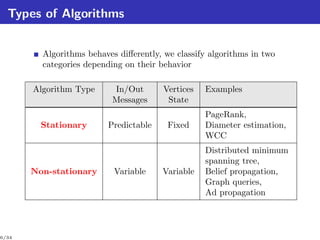
Types of Algorithms


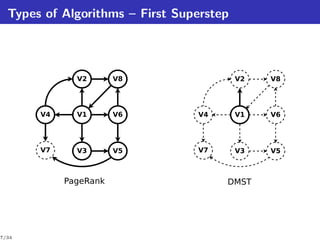
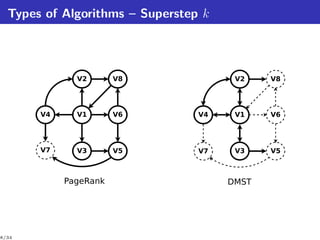
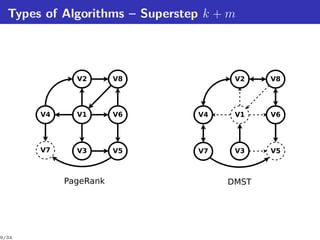
         Algorithms behaves differently, we classify algorithms in two
         categories depending on their behavior

       Algorithm Type     In/Out        Vertices   Examples
                          Messages       State
                                                   PageRank,
         Stationary      Predictable     Fixed     Diameter estimation,
                                                   WCC
                                                   Distributed minimum
                                                   spanning tree,
       Non-stationary      Variable    Variable    Belief propagation,
                                                   Graph queries,
                                                   Ad propagation


6/34
Types of Algorithms – First Superstep


              V2       V8                 V2   V8


       V4     V1       V6        V4       V1   V6


       V7     V3       V5        V7       V3   V5


            PageRank                  DMST


7/34
Types of Algorithms – Superstep k


              V2       V8              V2    V8


       V4     V1       V6        V4    V1    V6


       V7     V3       V5        V7    V3    V5


            PageRank                  DMST


8/34
Types of Algorithms – Superstep k + m


              V2       V8             V2    V8


       V4     V1       V6       V4    V1    V6


       V7     V3       V5       V7    V3    V5


            PageRank                 DMST


9/34
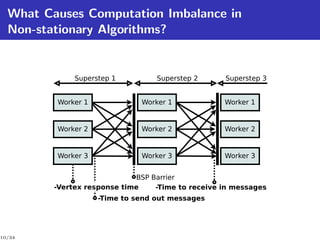
What Causes Computation Imbalance in
  Non-stationary Algorithms?


              Superstep 1         Superstep 2      Superstep 3


         Worker 1             Worker 1             Worker 1


         Worker 2             Worker 2             Worker 2


         Worker 3             Worker 3             Worker 3


                             BSP Barrier
         -Vertex response time    -Time to receive in messages
                    -Time to send out messages


10/34
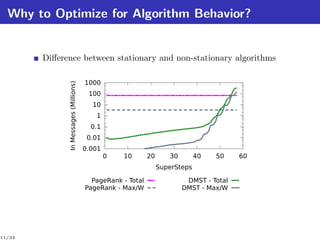
Why to Optimize for Algorithm Behavior?


        Difference between stationary and non-stationary algorithms

                                       1000
              In Messages (Millions)


                                        100
                                         10
                                          1
                                         0.1
                                        0.01
                                       0.001
                                               0   10       20      30        40   50    60
                                                                 SuperSteps

                                         PageRank - Total                 DMST - Total
                                       PageRank - Max/W                  DMST - Max/W


11/34
What is Mizan?


        BSP-based graph processing framework

        Uses runtime fine-grained vertex migrations to balance
        computation and communication

        Follows the Pregel programming model

        Open source, written in C++


12/34
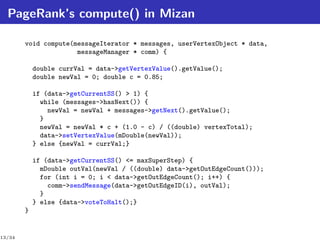
PageRank’s compute() in Mizan

        void compute(messageIterator * messages, userVertexObject * data,
                      messageManager * comm) {

            double currVal = data->getVertexValue().getValue();
            double newVal = 0; double c = 0.85;

            if (data->getCurrentSS() > 1) {
              while (messages->hasNext()) {
                newVal = newVal + messages->getNext().getValue();
              }
              newVal = newVal * c + (1.0 - c) / ((double) vertexTotal);
              data->setVertexValue(mDouble(newVal));
            } else {newVal = currVal;}

            if (data->getCurrentSS() <= maxSuperStep) {
              mDouble outVal(newVal / ((double) data->getOutEdgeCount()));
              for (int i = 0; i < data->getOutEdgeCount(); i++) {
                comm->sendMessage(data->getOutEdgeID(i), outVal);
              }
            } else {data->voteToHalt();}
        }


13/34
Migration Planning Objectives


        Decentralized
        Simple
        Transparent
           No need to change Pregel’s API
           Does not assume any a priori knowledge to graph structure or
           algorithm


14/34
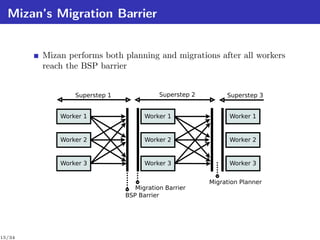
Mizan’s Migration Barrier


        Mizan performs both planning and migrations after all workers
        reach the BSP barrier


                Superstep 1              Superstep 2        Superstep 3


            Worker 1                Worker 1                 Worker 1


            Worker 2                Worker 2                 Worker 2


            Worker 3                Worker 3                 Worker 3


                                                       Migration Planner
                                 Migration Barrier
                              BSP Barrier


15/34
Mizan’s Migration Planning Steps
        1   Identify the source of imbalance: By comparing the worker’s
            execution time against a normal distribution and flagging outliers


16/34
Mizan’s Migration Planning Steps
        1   Identify the source of imbalance: By comparing the worker’s
            execution time against a normal distribution and flagging outliers

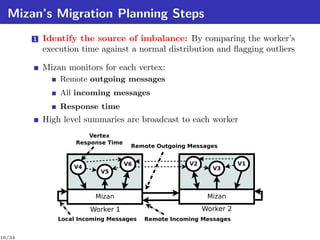
            Mizan monitors for each vertex:
                Remote outgoing messages
                All incoming messages
                Response time
            High level summaries are broadcast to each worker
                        Vertex
                    Response Time
                                     Remote Outgoing Messages


                                    V6               V2              V1
                    V4                                      V3
                           V5


                          Mizan                            Mizan

                         Worker 1                         Worker 2
               Local Incoming Messages   Remote Incoming Messages


16/34
Mizan’s Migration Planning Steps

        1   Identify the source of imbalance
        2   Select the migration objective:
               Mizan finds the strongest cause of workload imbalance by
               comparing statistics for outgoing messages and incoming
               messages of all workers with the worker’s execution time


17/34
Mizan’s Migration Planning Steps

        1   Identify the source of imbalance
        2   Select the migration objective:
               Mizan finds the strongest cause of workload imbalance by
               comparing statistics for outgoing messages and incoming
               messages of all workers with the worker’s execution time
               The migration objective is either:
                    Optimize for outgoing messages, or
                    Optimize for incoming messages, or
                    Optimize for response time


17/34
Mizan’s Migration Planning Steps


        1   Identify the source of imbalance
        2   Select the migration objective
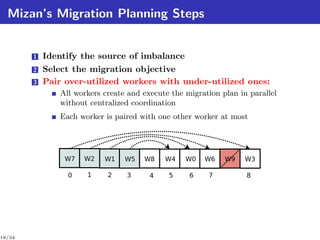
        3   Pair over-utilized workers with under-utilized ones:
                All workers create and execute the migration plan in parallel
                without centralized coordination
                Each worker is paired with one other worker at most


                 W7   W2    W1    W5   W8    W4    W0   W6    W9    W3

                  0    1     2    3      4    5     6    7          8


18/34
Mizan’s Migration Planning Steps

        1   Identify the source of imbalance
        2   Select the migration objective
        3   Pair over-utilized workers with under-utilized ones
        4   Select vertices to migrate: Depending on the migration
            objective


19/34
Mizan’s Migration Planning Steps

        1   Identify the source of imbalance
        2   Select the migration objective
        3   Pair over-utilized workers with under-utilized ones
        4   Select vertices to migrate
        5   Migrate vertices:
                How to migrate vertices freely across workers while maintaining
                vertex ownership and fast updates?
                How to minimize migration costs for large vertices?


20/34
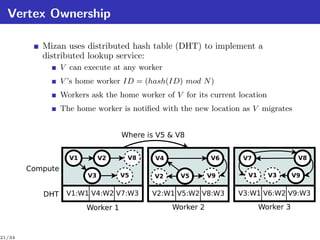
Vertex Ownership

           Mizan uses distributed hash table (DHT) to implement a
           distributed lookup service:
                  V can execute at any worker
                  V ’s home worker ID = (hash(ID) mod N )
                  Workers ask the home worker of V for its current location
                  The home worker is notified with the new location as V migrates


                                    Where is V5 & V8


                    V1        V2     V8     V4              V6      V7                V8
        Compute
                         V3         V5      V2     V5       V9       V1       V3     V9


           DHT     V1:W1 V4:W2 V7:W3       V2:W1 V5:W2 V8:W3       V3:W1 V6:W2 V9:W3

                         Worker 1                Worker 2                 Worker 3


21/34
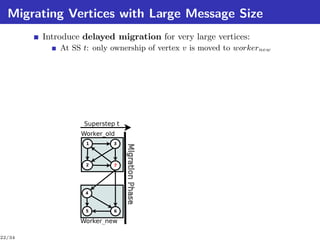
Migrating Vertices with Large Message Size
        Introduce delayed migration for very large vertices:
            At SS t: only ownership of vertex v is moved to workernew


                  Superstep t   Superstep t+1   Superstep t+2
                 Worker_old      Worker_old       Worker_old
                   1       3      1       3        1       3


                  2        7      2       7        2


                  4               4       '7       4       7


                  5        6      5       6        5       6

                 Worker_new      Worker_new       Worker_new

22/34
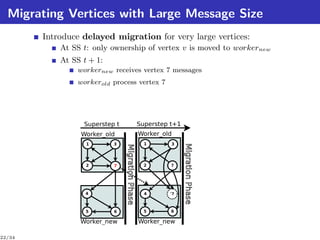
Migrating Vertices with Large Message Size
        Introduce delayed migration for very large vertices:
            At SS t: only ownership of vertex v is moved to workernew
            At SS t + 1:
                workernew receives vertex 7 messages
                workerold process vertex 7


                  Superstep t    Superstep t+1
                 Worker_old      Worker_old       Worker_old
                   1       3       1         3         1   3


                   2       7       2         7         2


                   4               4         '7        4   7


                   5       6       5         6         5   6

                 Worker_new      Worker_new       Worker_new

22/34
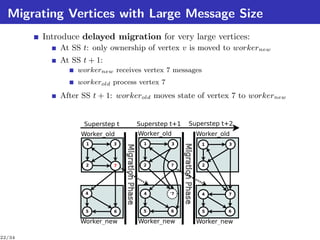
Migrating Vertices with Large Message Size
        Introduce delayed migration for very large vertices:
            At SS t: only ownership of vertex v is moved to workernew
            At SS t + 1:
                workernew receives vertex 7 messages
                workerold process vertex 7
            After SS t + 1: workerold moves state of vertex 7 to workernew


                  Superstep t    Superstep t+1    Superstep t+2
                 Worker_old      Worker_old         Worker_old
                   1       3       1         3         1     3


                   2       7       2         7         2


                   4               4         '7        4     7


                   5       6       5         6         5     6

                 Worker_new      Worker_new         Worker_new

22/34
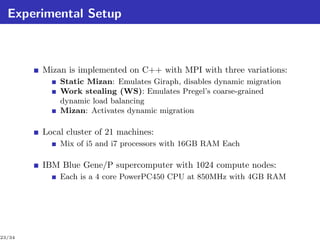
Experimental Setup


        Mizan is implemented on C++ with MPI with three variations:
            Static Mizan: Emulates Giraph, disables dynamic migration
            Work stealing (WS): Emulates Pregel’s coarse-grained
            dynamic load balancing
            Mizan: Activates dynamic migration

        Local cluster of 21 machines:
            Mix of i5 and i7 processors with 16GB RAM Each

        IBM Blue Gene/P supercomputer with 1024 compute nodes:
            Each is a 4 core PowerPC450 CPU at 850MHz with 4GB RAM


23/34
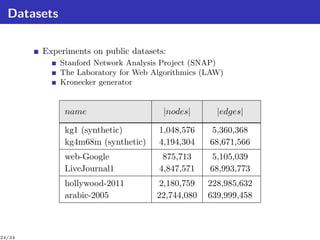
Datasets

        Experiments on public datasets:
             Stanford Network Analysis Project (SNAP)
             The Laboratory for Web Algorithmics (LAW)
             Kronecker generator


              name                    |nodes|       |edges|

              kg1 (synthetic)        1,048,576    5,360,368
              kg4m68m (synthetic)    4,194,304    68,671,566
              web-Google              875,713     5,105,039
              LiveJournal1           4,847,571    68,993,773
              hollywood-2011         2,180,759    228,985,632
              arabic-2005            22,744,080   639,999,458


24/34
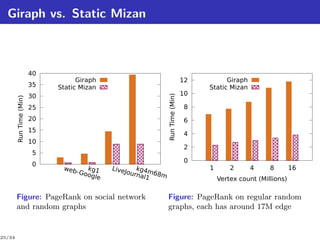
Giraph vs. Static Mizan


                         40
                                    Giraph                                        12         Giraph
                         35   Static Mizan                                             Static Mizan
                         30                                                       10


                                                                 Run Time (Min)
        Run Time (Min)


                         25                                                        8
                         20                                                        6
                         15
                                                                                   4
                         10
                                                                                   2
                          5
                                                                                   0
                          0
                               web     k      Live    k                                1       2      4     8        16
                                   - Goo g1       Jour g4m68
                                                      nal1
                                        gle                  m
                                                                                           Vertex count (Millions)

        Figure: PageRank on social network                       Figure: PageRank on regular random
        and random graphs                                        graphs, each has around 17M edge


25/34
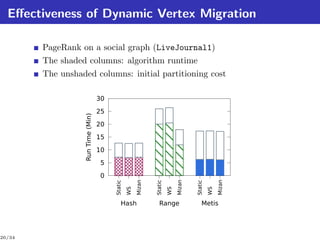
Effectiveness of Dynamic Vertex Migration

        PageRank on a social graph (LiveJournal1)
        The shaded columns: algorithm runtime
        The unshaded columns: initial partitioning cost

                                   30

                                   25
                  Run Time (Min)


                                   20

                                   15

                                   10

                                    5

                                    0
                                                      Mizan


                                                                            Mizan


                                                                                                  Mizan
                                        Static


                                                              Static


                                                                                    Static
                                                 WS


                                                                       WS


                                                                                             WS
                                             Hash                Range                  Metis


26/34
Effectiveness of Dynamic Vertex Migration

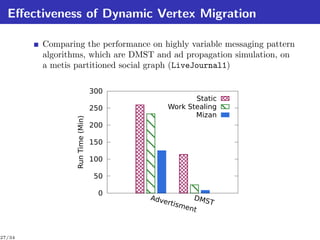
        Comparing the performance on highly variable messaging pattern
        algorithms, which are DMST and ad propagation simulation, on
        a metis partitioned social graph (LiveJournal1)

                                 300
                                                  Static
                                 250       Work Stealing
                                                  Mizan
                Run Time (Min)


                                 200

                                 150

                                 100

                                  50

                                   0
                                       Adve             DMS
                                           r   tism         T
                                                      ent


27/34
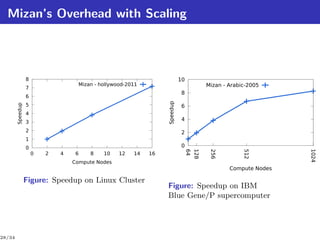
Mizan’s Overhead with Scaling


                  8                                                         10
                                    Mizan - hollywood-2011                                  Mizan - Arabic-2005
                  7
                                                                             8
                  6


                                                                  Speedup
                  5
        Speedup


                                                                             6
                  4
                                                                             4
                  3
                  2                                                          2
                  1
                  0                                                          0


                                                                                 64
                                                                                      128


                                                                                             256


                                                                                                         512


                                                                                                                    1024
                      0   2   4    6    8    10    12   14   16
                                  Compute Nodes
                                                                                                    Compute Nodes

                  Figure: Speedup on Linux Cluster
                                                                  Figure: Speedup on IBM
                                                                  Blue Gene/P supercomputer


28/34
Future Work


        Work with skewed graphs
        Improving Pregel’s fault tolerance


29/34
Conclusion


        Mizan is a Pregel system that uses fine-grained vertex migration
        to load balance computation and communication across
        supersteps
        Mizan is an open source project developed within InfoCloud
        group in KAUST in collaboration with IBM, programmed in
        C++ with MPI
        Mizan scales up to thousands of workers
        Mizan improves the overall computation cost between 40% up to
        two order of magnitudes with less than 10% migration overhead
        Download it at: http://cloud.kaust.edu.sa
        Try it on EC2 (ami-52ed743b)


30/34
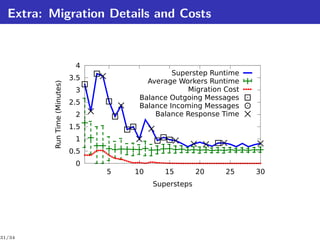
Extra: Migration Details and Costs


                               4
                                                  Superstep Runtime
                              3.5          Average Workers Runtime
         Run Time (Minutes)


                               3                      Migration Cost
                                         Balance Outgoing Messages
                              2.5        Balance Incoming Messages
                               2             Balance Response Time
                              1.5
                               1
                              0.5
                               0
                                    5   10      15        20    25     30
                                             Supersteps


31/34
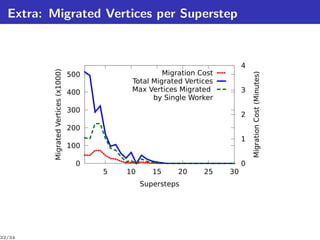
Extra: Migrated Vertices per Superstep


                                                                               4
         Migrated Vertices (x1000)

                                     500                 Migration Cost


                                                                                   Migration Cost (Minutes)
                                                Total Migrated Vertices
                                     400        Max Vertices Migrated          3
                                                      by Single Worker
                                     300
                                                                               2
                                     200
                                                                               1
                                     100

                                       0                                       0
                                           5   10      15    20     25    30
                                                    Supersteps


32/34
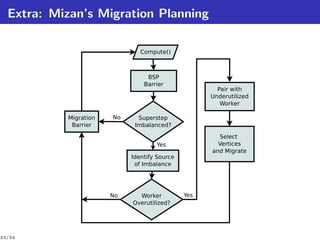
Extra: Mizan’s Migration Planning

                               Compute()


                                 BSP
                                Barrier
                                                      Pair with
                                                    Underutilized
                                                       Worker

           Migration   No     Superstep
            Barrier          Imbalanced?

                                                      Select
                                    Yes               Vertices
                                                    and Migrate
                            Identify Source
                             of Imbalance


                       No     Worker          Yes
                            Overutilized?


33/34
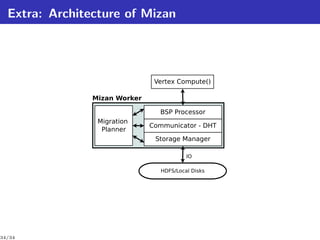
Extra: Architecture of Mizan


                                Vertex Compute()

                Mizan Worker

                                 BSP Processor
                 Migration
                               Communicator - DHT
                  Planner
                                Storage Manager

                                           IO

                                  HDFS/Local Disks


34/34

Presentation on "Mizan: A System for Dynamic Load Balancing in Large-scale Graph Processing"

  • 1.
    Mizan: A Systemfor Dynamic Load Balancing in Large-scale Graph Processing Zuhair Khayyat1 Karim Awara1 Amani Alonazi1 Hani Jamjoom2 Dan Williams2 Panos Kalnis1 1 King Abdullah University of Science and Technology Thuwal, Saudi Arabia 2 IBM Watson Research Center Yorktown Heights, NY 1/34
  • 2.
    Importance of Graphs Graphs abstract application-specific algorithms into generic problems represented as interactions using vertices and edges Max flow in road network Diameter of WWW Ranking in social networks Simulating protein interactions Algorithms vary in their computational requirements 2/34
  • 3.
    How to ScaleGraph Processing Pregel was introduced by Google as a scalable abstraction for graph processing Overcomes the limitations of processing graphs on MapReduce Based on vertex-centric computation Utilizes bulk synchronous parallel (BSP) System Programming Data Computations Abstraction Exchange map() Key based MapReduce combine() grouping Disk based reduce() compute() Message Pregel combine() passing In memory aggregate() 3/34
  • 4.
    Pregel’s BSP GraphProcessing Superstep 1 Superstep 2 Superstep 3 Worker 1 Worker 1 Worker 1 Worker 2 Worker 2 Worker 2 Worker 3 Worker 3 Worker 3 BSP Barrier Balanced computation and communication is fundamental to Pregel’s efficiency 4/34
  • 5.
    Optimizing Graph Processing Existing work focus on optimizing for graph structure (static optimization): Optimize graph partitioning: Simple graph partitioning schemes (e.g., hash or range): Giraph User-defined partitioning function: Pregel Sophisticated partitioning techniques (e.g., min-cuts): GraphLab, PowerGraph, GoldenOrb and Surfer Optimize graph data access: Distributed data stores and graph indexing: GoldenOrb, Hama and Trinity 5/34
  • 6.
    Optimizing Graph Processing Existing work focus on optimizing for graph structure (static optimization): Optimize graph partitioning: Simple graph partitioning schemes (e.g., hash or range): Giraph User-defined partitioning function: Pregel Sophisticated partitioning techniques (e.g., min-cuts): GraphLab, PowerGraph, GoldenOrb and Surfer Optimize graph data access: Distributed data stores and graph indexing: GoldenOrb, Hama and Trinity What about algorithm behavior? Pregel provides coarse-grained load balancing, is it enough? 5/34
  • 7.
    Types of Algorithms Algorithms behaves differently, we classify algorithms in two categories depending on their behavior Algorithm Type In/Out Vertices Examples Messages State PageRank, Stationary Predictable Fixed Diameter estimation, WCC Distributed minimum spanning tree, Non-stationary Variable Variable Belief propagation, Graph queries, Ad propagation 6/34
  • 8.
    Types of Algorithms– First Superstep V2 V8 V2 V8 V4 V1 V6 V4 V1 V6 V7 V3 V5 V7 V3 V5 PageRank DMST 7/34
  • 9.
    Types of Algorithms– Superstep k V2 V8 V2 V8 V4 V1 V6 V4 V1 V6 V7 V3 V5 V7 V3 V5 PageRank DMST 8/34
  • 10.
    Types of Algorithms– Superstep k + m V2 V8 V2 V8 V4 V1 V6 V4 V1 V6 V7 V3 V5 V7 V3 V5 PageRank DMST 9/34
  • 11.
    What Causes ComputationImbalance in Non-stationary Algorithms? Superstep 1 Superstep 2 Superstep 3 Worker 1 Worker 1 Worker 1 Worker 2 Worker 2 Worker 2 Worker 3 Worker 3 Worker 3 BSP Barrier -Vertex response time -Time to receive in messages -Time to send out messages 10/34
  • 12.
    Why to Optimizefor Algorithm Behavior? Difference between stationary and non-stationary algorithms 1000 In Messages (Millions) 100 10 1 0.1 0.01 0.001 0 10 20 30 40 50 60 SuperSteps PageRank - Total DMST - Total PageRank - Max/W DMST - Max/W 11/34
  • 13.
    What is Mizan? BSP-based graph processing framework Uses runtime fine-grained vertex migrations to balance computation and communication Follows the Pregel programming model Open source, written in C++ 12/34
  • 14.
    PageRank’s compute() inMizan void compute(messageIterator * messages, userVertexObject * data, messageManager * comm) { double currVal = data->getVertexValue().getValue(); double newVal = 0; double c = 0.85; if (data->getCurrentSS() > 1) { while (messages->hasNext()) { newVal = newVal + messages->getNext().getValue(); } newVal = newVal * c + (1.0 - c) / ((double) vertexTotal); data->setVertexValue(mDouble(newVal)); } else {newVal = currVal;} if (data->getCurrentSS() <= maxSuperStep) { mDouble outVal(newVal / ((double) data->getOutEdgeCount())); for (int i = 0; i < data->getOutEdgeCount(); i++) { comm->sendMessage(data->getOutEdgeID(i), outVal); } } else {data->voteToHalt();} } 13/34
  • 15.
    Migration Planning Objectives Decentralized Simple Transparent No need to change Pregel’s API Does not assume any a priori knowledge to graph structure or algorithm 14/34
  • 16.
    Mizan’s Migration Barrier Mizan performs both planning and migrations after all workers reach the BSP barrier Superstep 1 Superstep 2 Superstep 3 Worker 1 Worker 1 Worker 1 Worker 2 Worker 2 Worker 2 Worker 3 Worker 3 Worker 3 Migration Planner Migration Barrier BSP Barrier 15/34
  • 17.
    Mizan’s Migration PlanningSteps 1 Identify the source of imbalance: By comparing the worker’s execution time against a normal distribution and flagging outliers 16/34
  • 18.
    Mizan’s Migration PlanningSteps 1 Identify the source of imbalance: By comparing the worker’s execution time against a normal distribution and flagging outliers Mizan monitors for each vertex: Remote outgoing messages All incoming messages Response time High level summaries are broadcast to each worker Vertex Response Time Remote Outgoing Messages V6 V2 V1 V4 V3 V5 Mizan Mizan Worker 1 Worker 2 Local Incoming Messages Remote Incoming Messages 16/34
  • 19.
    Mizan’s Migration PlanningSteps 1 Identify the source of imbalance 2 Select the migration objective: Mizan finds the strongest cause of workload imbalance by comparing statistics for outgoing messages and incoming messages of all workers with the worker’s execution time 17/34
  • 20.
    Mizan’s Migration PlanningSteps 1 Identify the source of imbalance 2 Select the migration objective: Mizan finds the strongest cause of workload imbalance by comparing statistics for outgoing messages and incoming messages of all workers with the worker’s execution time The migration objective is either: Optimize for outgoing messages, or Optimize for incoming messages, or Optimize for response time 17/34
  • 21.
    Mizan’s Migration PlanningSteps 1 Identify the source of imbalance 2 Select the migration objective 3 Pair over-utilized workers with under-utilized ones: All workers create and execute the migration plan in parallel without centralized coordination Each worker is paired with one other worker at most W7 W2 W1 W5 W8 W4 W0 W6 W9 W3 0 1 2 3 4 5 6 7 8 18/34
  • 22.
    Mizan’s Migration PlanningSteps 1 Identify the source of imbalance 2 Select the migration objective 3 Pair over-utilized workers with under-utilized ones 4 Select vertices to migrate: Depending on the migration objective 19/34
  • 23.
    Mizan’s Migration PlanningSteps 1 Identify the source of imbalance 2 Select the migration objective 3 Pair over-utilized workers with under-utilized ones 4 Select vertices to migrate 5 Migrate vertices: How to migrate vertices freely across workers while maintaining vertex ownership and fast updates? How to minimize migration costs for large vertices? 20/34
  • 24.
    Vertex Ownership Mizan uses distributed hash table (DHT) to implement a distributed lookup service: V can execute at any worker V ’s home worker ID = (hash(ID) mod N ) Workers ask the home worker of V for its current location The home worker is notified with the new location as V migrates Where is V5 & V8 V1 V2 V8 V4 V6 V7 V8 Compute V3 V5 V2 V5 V9 V1 V3 V9 DHT V1:W1 V4:W2 V7:W3 V2:W1 V5:W2 V8:W3 V3:W1 V6:W2 V9:W3 Worker 1 Worker 2 Worker 3 21/34
  • 25.
    Migrating Vertices withLarge Message Size Introduce delayed migration for very large vertices: At SS t: only ownership of vertex v is moved to workernew Superstep t Superstep t+1 Superstep t+2 Worker_old Worker_old Worker_old 1 3 1 3 1 3 2 7 2 7 2 4 4 '7 4 7 5 6 5 6 5 6 Worker_new Worker_new Worker_new 22/34
  • 26.
    Migrating Vertices withLarge Message Size Introduce delayed migration for very large vertices: At SS t: only ownership of vertex v is moved to workernew At SS t + 1: workernew receives vertex 7 messages workerold process vertex 7 Superstep t Superstep t+1 Worker_old Worker_old Worker_old 1 3 1 3 1 3 2 7 2 7 2 4 4 '7 4 7 5 6 5 6 5 6 Worker_new Worker_new Worker_new 22/34
  • 27.
    Migrating Vertices withLarge Message Size Introduce delayed migration for very large vertices: At SS t: only ownership of vertex v is moved to workernew At SS t + 1: workernew receives vertex 7 messages workerold process vertex 7 After SS t + 1: workerold moves state of vertex 7 to workernew Superstep t Superstep t+1 Superstep t+2 Worker_old Worker_old Worker_old 1 3 1 3 1 3 2 7 2 7 2 4 4 '7 4 7 5 6 5 6 5 6 Worker_new Worker_new Worker_new 22/34
  • 28.
    Experimental Setup Mizan is implemented on C++ with MPI with three variations: Static Mizan: Emulates Giraph, disables dynamic migration Work stealing (WS): Emulates Pregel’s coarse-grained dynamic load balancing Mizan: Activates dynamic migration Local cluster of 21 machines: Mix of i5 and i7 processors with 16GB RAM Each IBM Blue Gene/P supercomputer with 1024 compute nodes: Each is a 4 core PowerPC450 CPU at 850MHz with 4GB RAM 23/34
  • 29.
    Datasets Experiments on public datasets: Stanford Network Analysis Project (SNAP) The Laboratory for Web Algorithmics (LAW) Kronecker generator name |nodes| |edges| kg1 (synthetic) 1,048,576 5,360,368 kg4m68m (synthetic) 4,194,304 68,671,566 web-Google 875,713 5,105,039 LiveJournal1 4,847,571 68,993,773 hollywood-2011 2,180,759 228,985,632 arabic-2005 22,744,080 639,999,458 24/34
  • 30.
    Giraph vs. StaticMizan 40 Giraph 12 Giraph 35 Static Mizan Static Mizan 30 10 Run Time (Min) Run Time (Min) 25 8 20 6 15 4 10 2 5 0 0 web k Live k 1 2 4 8 16 - Goo g1 Jour g4m68 nal1 gle m Vertex count (Millions) Figure: PageRank on social network Figure: PageRank on regular random and random graphs graphs, each has around 17M edge 25/34
  • 31.
    Effectiveness of DynamicVertex Migration PageRank on a social graph (LiveJournal1) The shaded columns: algorithm runtime The unshaded columns: initial partitioning cost 30 25 Run Time (Min) 20 15 10 5 0 Mizan Mizan Mizan Static Static Static WS WS WS Hash Range Metis 26/34
  • 32.
    Effectiveness of DynamicVertex Migration Comparing the performance on highly variable messaging pattern algorithms, which are DMST and ad propagation simulation, on a metis partitioned social graph (LiveJournal1) 300 Static 250 Work Stealing Mizan Run Time (Min) 200 150 100 50 0 Adve DMS r tism T ent 27/34
  • 33.
    Mizan’s Overhead withScaling 8 10 Mizan - hollywood-2011 Mizan - Arabic-2005 7 8 6 Speedup 5 Speedup 6 4 4 3 2 2 1 0 0 64 128 256 512 1024 0 2 4 6 8 10 12 14 16 Compute Nodes Compute Nodes Figure: Speedup on Linux Cluster Figure: Speedup on IBM Blue Gene/P supercomputer 28/34
  • 34.
    Future Work Work with skewed graphs Improving Pregel’s fault tolerance 29/34
  • 35.
    Conclusion Mizan is a Pregel system that uses fine-grained vertex migration to load balance computation and communication across supersteps Mizan is an open source project developed within InfoCloud group in KAUST in collaboration with IBM, programmed in C++ with MPI Mizan scales up to thousands of workers Mizan improves the overall computation cost between 40% up to two order of magnitudes with less than 10% migration overhead Download it at: http://cloud.kaust.edu.sa Try it on EC2 (ami-52ed743b) 30/34
  • 36.
    Extra: Migration Detailsand Costs 4 Superstep Runtime 3.5 Average Workers Runtime Run Time (Minutes) 3 Migration Cost Balance Outgoing Messages 2.5 Balance Incoming Messages 2 Balance Response Time 1.5 1 0.5 0 5 10 15 20 25 30 Supersteps 31/34
  • 37.
    Extra: Migrated Verticesper Superstep 4 Migrated Vertices (x1000) 500 Migration Cost Migration Cost (Minutes) Total Migrated Vertices 400 Max Vertices Migrated 3 by Single Worker 300 2 200 1 100 0 0 5 10 15 20 25 30 Supersteps 32/34
  • 38.
    Extra: Mizan’s MigrationPlanning Compute() BSP Barrier Pair with Underutilized Worker Migration No Superstep Barrier Imbalanced? Select Yes Vertices and Migrate Identify Source of Imbalance No Worker Yes Overutilized? 33/34
  • 39.
    Extra: Architecture ofMizan Vertex Compute() Mizan Worker BSP Processor Migration Communicator - DHT Planner Storage Manager IO HDFS/Local Disks 34/34