King Abdullah University of Science and
             Technology

       CS348: Cloud Computing

    Large-Scale Graph Processing


               Zuhair Khayyat
               10/March/2013
The Importance of Graphs
     ●   A graph is a mathematical structure that represents pairwise
         relations between entities or objects. Such as:

               –   Physical communication networks

               –   Web pages links

               –   Social interaction graphs

               –   Protein-to-protein interactions

     ●   Graphs are used to abstract application-specific features into a
         generic problem, which makes Graph Algorithms applicable to
         a wide variety of applications*.
*http://11011110.livejournal.com/164613.html
Graph algorithm characteristics*
    ●   Data-Drivin Computations: Computations in graph
        algorithms depends on the structure of the graph. It is hard to
        predict the algorithm behavior

    ●   Unstructured Problems: Different graph distributions
        requires distinct load balancing techniques.

    ●   Poor Data Locality.

    ●   High Data Access to Computation Ratio: Runtime can be
        dominated by waiting memory fetches.


*Lumsdaine et. al, Challenges in Parallel Graph Processing
Challenges in Graph processing
    ●   Graphs grows fast; a single computer either cannot fit a large
        graph into memory or it fits the large graph with huge cost.

    ●   Custom implementations for a single graph algorithm requires
        time and effort and cannot be used on other algorithms

    ●   Scientific parallel applications (i.e. parallel PDE solvers)
        cannot fully adapt to the computational requirements of graph
        algorithms*.

    ●   Fault tolerance is required to support large scale processing.


*Lumsdaine et. al, Challenges in Parallel Graph Processing
Why Cloud in Graph Processing
●   Easy to scale up and down; provision machines
    depending on your graph size.
●   Cheaper than buying a physical large cluster.
●   Can be used in the cloud as “Software as a services” to
    support online social networks.
Large Scale Graph Processing
●   Systems that tries to solve the problem of processing large
    graphs in parallel:
          –   MapReduce – auto task scheduling, distributed disk
               based computations:
                   ●  Pegasus
                   ● X-Rime


          –   Pregel - Bulk Synchronous Parallel Graph Processing:
                   ● Giraph
                   ● GPS


                   ● Mizan


          –   GraphLab – Asynchronous Parallel Graph Processing.
Pregel* Graph Processing
   ●   Consists of a series of synchronized iterations
       (supersteps); based on Bulk Synchronous Parallel
       computing model. Each superstep consists of:
             –   Concurrent computations
             –   Communication
             –   Synchronization barrier
   ●   Vertex centric computation, the user's compute() function
       is applied individually on each vertex, which is able to:
             –   Send message to vertices in the next superstep
             –   Receive messages from the previous superstep

*Malewicz et. al., Pregel: A System for Large-Scale Graph Processing
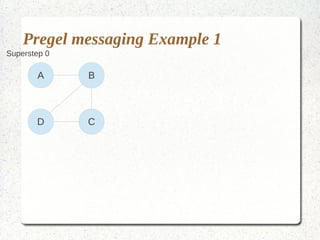
Pregel messaging Example 1
Superstep 0

       A      B


       D      C
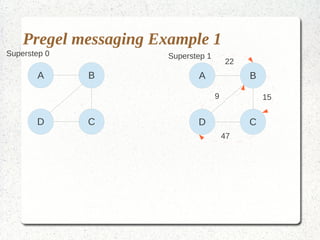
Pregel messaging Example 1
Superstep 0            Superstep 1
                                         22
       A      B               A               B

                                     9            15


       D      C               D               C
                                         47
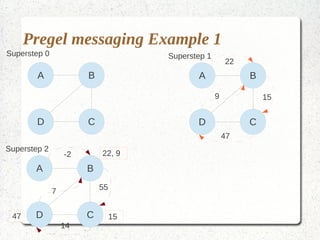
Pregel messaging Example 1
Superstep 0                          Superstep 1
                                                       22
        A              B                    A               B

                                                   9            15


        D              C                    D               C
                                                       47
Superstep 2
                  -2       22, 9
       A               B

              7            55


 47    D               C        15
                  14
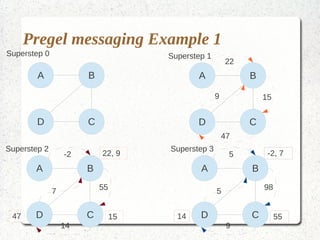
Pregel messaging Example 1
Superstep 0                          Superstep 1
                                                       22
        A              B                    A               B

                                                   9            15


        D              C                    D               C
                                                       47
Superstep 2                          Superstep 3
                  -2       22, 9                        5        -2, 7
       A               B                     A              B

              7            55                      5            98


 47    D               C        15     14    D              C        55
                  14                                    9
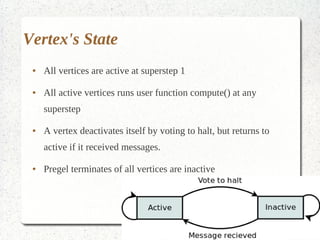
Vertex's State
 ●   All vertices are active at superstep 1

 ●   All active vertices runs user function compute() at any
     superstep

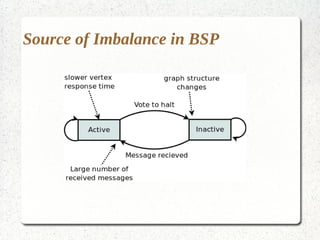
 ●   A vertex deactivates itself by voting to halt, but returns to
     active if it received messages.

 ●   Pregel terminates of all vertices are inactive
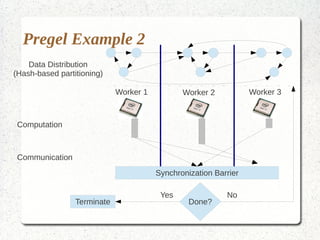
Pregel Example 2
    Data Distribution
(Hash-based partitioning)

                             Worker 1          Worker 2           Worker 3


 Computation


 Communication
                                        Synchronization Barrier

                                         Yes               No
                 Terminate                       Done?
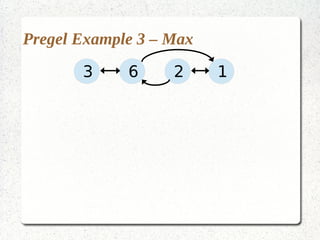
Pregel Example 3 – Max
       3     6     2     1
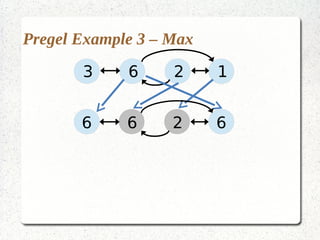
Pregel Example 3 – Max
       3     6     2     1


       6     6     2     6
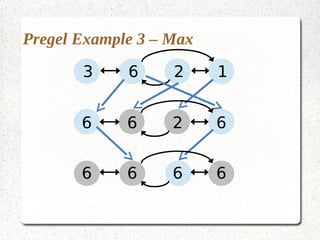
Pregel Example 3 – Max
       3     6     2     1


       6     6     2     6


       6     6     6     6
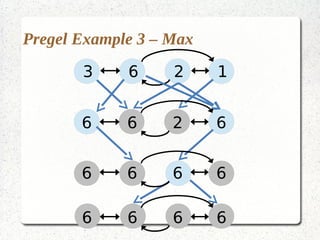
Pregel Example 3 – Max
       3     6     2     1


       6     6     2     6


       6     6     6     6

       6     6     6     6
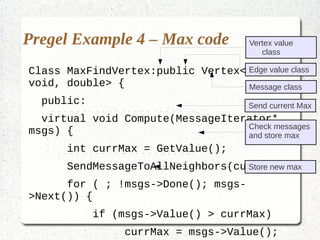
Pregel Example 4 – Max code                                 Vertex value
                                                               class
Class MaxFindVertex:public Vertex<double, void, double> {   Edge value class
  public:
                                                            Message class
  virtual void Compute(MessageIterator* msgs) {

      int currMax = GetValue();                             Send current Max
      SendMessageToAllNeighbors(currMax);
                                                            Check messages
      for ( ; !msgs­>Done(); msgs­>Next()) {                and store max
          if (msgs­>Value() > currMax)

               currMax = msgs­>Value();
                                                            Store new max
      }

      if (currMax > GetValue())

         *MutableValue() = currMax;

      else VoteToHalt();

  }

};
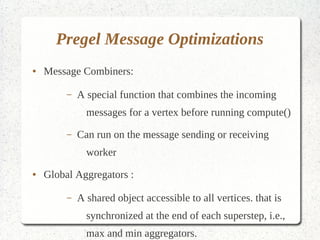
Pregel Message Optimizations
●   Message Combiners:

         –   A special function that combines the incoming
               messages for a vertex before running compute()

         –   Can run on the message sending or receiving worker
●   Global Aggregators :

         –   A shared object accessible to all vertices. that is
               synchronized at the end of each superstep, i.e., max
               and min aggregators.
Pregel Guarantees
 ●   Scalability: process vertices in parallel, overlap
     computation and communication.
 ●   Messages will be received without duplication in any
     order.
 ●   Fault tolerance through check points
Pregel's Limitations
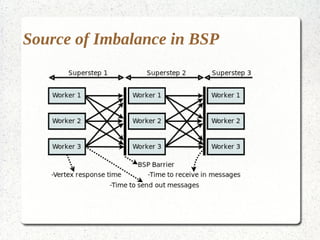
 ●   Pregel's superstep waits for all workers to finish at the
     synchronization barrier. That is, it waits for the slowest
     worker to finish.
 ●   Smart partitioning can solve the load balancing problem
     for static algorithms. However not all algorithms are
     static, algorithms can have a variable execution behaviors
     which leads to an unbalanced supersteps.
Mizan* Graph Processing
      ●   Mizan is an open source graph processing system, similar
          to Pregel, developed locally at KAUST.
      ●   Mizan employs dynamic graph repartitioning without
          affecting the correctness of graph processing to
          rebalanced the execution of the supersteps for all types of
          workloads.


*Khayyat et. al., Mizan: A System for Dynamic Load Balancing in Large-scale
Graph Processing
Source of Imbalance in BSP
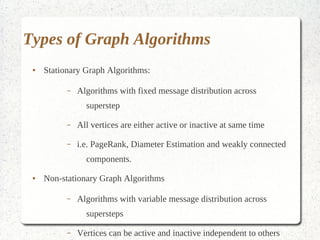
Types of Graph Algorithms
 ●   Stationary Graph Algorithms:

           –   Algorithms with fixed message distribution across superstep

           –   All vertices are either active or inactive at same time

           –   i.e. PageRank, Diameter Estimation and weakly connected
                 components.

 ●   Non-stationary Graph Algorithms

           –   Algorithms with variable message distribution across supersteps

           –   Vertices can be active and inactive independent to others

           –   i.e. Distributed Minimal spanning tree
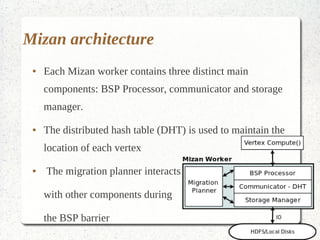
Mizan architecture
 ●   Each Mizan worker contains three distinct main
     components: BSP Processor, communicator and storage
     manager.
 ●   The distributed hash table (DHT) is used to maintain the
     location of each vertex
 ●   The migration planner interacts

     with other components during

     the BSP barrier
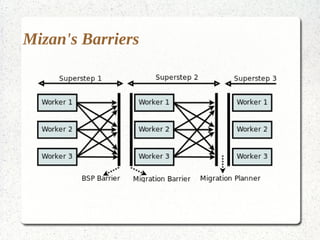
Mizan's Barriers
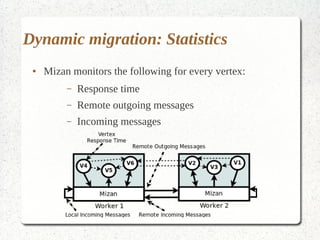
Dynamic migration: Statistics
 ●   Mizan monitors the following for every vertex:
          –   Response time
          –   Remote outgoing messages
          –   Incoming messages
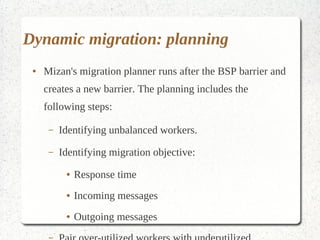
Dynamic migration: planning
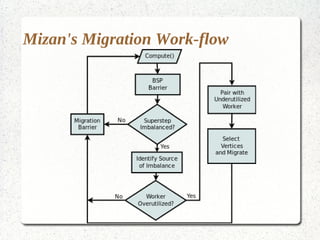
 ●   Mizan's migration planner runs after the BSP barrier and creates a
     new barrier. The planning includes the following steps:

      –   Identifying unbalanced workers.

      –   Identifying migration objective:
            ●   Response time
            ●   Incoming messages
            ●   Outgoing messages
      –   Pair over-utilized workers with underutilized

      –   Select vertices to migrate
Mizan's Migration Work-flow
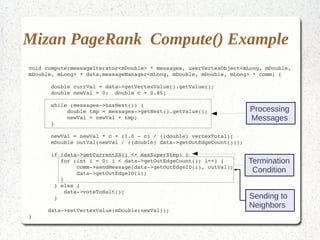
Mizan PageRank Compute() Example
void compute(messageIterator<mDouble> * messages, userVertexObject<mLong, mDouble, 
mDouble, mLong> * data,messageManager<mLong, mDouble, mDouble, mLong> * comm) {

       double currVal = data­>getVertexValue().getValue();
       double newVal = 0;  double c = 0.85;

       while (messages­>hasNext()) {
            double tmp = messages­>getNext().getValue();              Processing
            newVal = newVal + tmp;                                    Messages
       }

       newVal = newVal * c + (1.0 ­ c) / ((double) vertexTotal);
       mDouble outVal(newVal / ((double) data­>getOutEdgeCount()));

       if (data­>getCurrentSS() <= maxSuperStep) {
          for (int i = 0; i < data­>getOutEdgeCount(); i++) {         Termination
               comm­>sendMessage(data­>getOutEdgeID(i), outVal);
               data­>getOutEdgeID(i);                                  Condition
          }
        } else {
           data­>voteToHalt();
        }                                                             Sending to
                                                                      Neighbors
      data­>setVertexValue(mDouble(newVal));
}
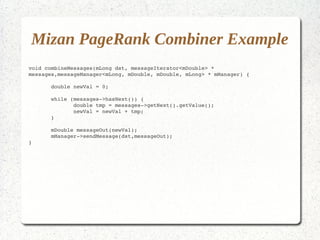
Mizan PageRank Combiner Example
void combineMessages(mLong dst, messageIterator<mDouble> * 
messages,messageManager<mLong, mDouble, mDouble, mLong> * mManager) {

       double newVal = 0;

       while (messages­>hasNext()) {
              double tmp = messages­>getNext().getValue();
              newVal = newVal + tmp;
       }

       mDouble messageOut(newVal);
       mManager­>sendMessage(dst,messageOut);
}
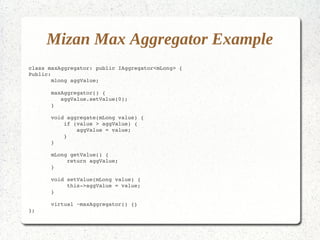
Mizan Max Aggregator Example
class maxAggregator: public IAggregator<mLong> {
Public:
       mlong aggValue;

       maxAggregator() {
          aggValue.setValue(0);
       }

       void aggregate(mLong value) {
           if (value > aggValue) {
               aggValue = value;
           }
       }

       mLong getValue() {
            return aggValue;
       }

       void setValue(mLong value) {
            this­>aggValue = value;
       }
       
       virtual ~maxAggregator() {}
};
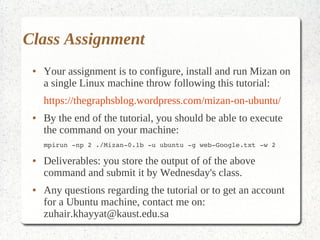
Class Assignment
 ●   Your assignment is to configure, install and run Mizan on
     a single Linux machine throw following this tutorial:
     https://thegraphsblog.wordpress.com/mizan-on-ubuntu/
 ●   By the end of the tutorial, you should be able to execute
     the command on your machine:
     mpirun ­np 2 ./Mizan­0.1b ­u ubuntu ­g web­Google.txt ­w 2

 ●   Deliverables: you store the output of of the above
     command and submit it by Wednesday's class.
 ●   Any questions regarding the tutorial or to get an account
     for a Ubuntu machine, contact me on:
     zuhair.khayyat@kaust.edu.sa

Large Graph Processing

  • 1.
    King Abdullah Universityof Science and Technology CS348: Cloud Computing Large-Scale Graph Processing Zuhair Khayyat 10/March/2013
  • 2.
    The Importance ofGraphs ● A graph is a mathematical structure that represents pairwise relations between entities or objects. Such as: – Physical communication networks – Web pages links – Social interaction graphs – Protein-to-protein interactions ● Graphs are used to abstract application-specific features into a generic problem, which makes Graph Algorithms applicable to a wide variety of applications*. *http://11011110.livejournal.com/164613.html
  • 3.
    Graph algorithm characteristics* ● Data-Drivin Computations: Computations in graph algorithms depends on the structure of the graph. It is hard to predict the algorithm behavior ● Unstructured Problems: Different graph distributions requires distinct load balancing techniques. ● Poor Data Locality. ● High Data Access to Computation Ratio: Runtime can be dominated by waiting memory fetches. *Lumsdaine et. al, Challenges in Parallel Graph Processing
  • 4.
    Challenges in Graphprocessing ● Graphs grows fast; a single computer either cannot fit a large graph into memory or it fits the large graph with huge cost. ● Custom implementations for a single graph algorithm requires time and effort and cannot be used on other algorithms ● Scientific parallel applications (i.e. parallel PDE solvers) cannot fully adapt to the computational requirements of graph algorithms*. ● Fault tolerance is required to support large scale processing. *Lumsdaine et. al, Challenges in Parallel Graph Processing
  • 5.
    Why Cloud inGraph Processing ● Easy to scale up and down; provision machines depending on your graph size. ● Cheaper than buying a physical large cluster. ● Can be used in the cloud as “Software as a services” to support online social networks.
  • 6.
    Large Scale GraphProcessing ● Systems that tries to solve the problem of processing large graphs in parallel: – MapReduce – auto task scheduling, distributed disk based computations: ● Pegasus ● X-Rime – Pregel - Bulk Synchronous Parallel Graph Processing: ● Giraph ● GPS ● Mizan – GraphLab – Asynchronous Parallel Graph Processing.
  • 7.
    Pregel* Graph Processing ● Consists of a series of synchronized iterations (supersteps); based on Bulk Synchronous Parallel computing model. Each superstep consists of: – Concurrent computations – Communication – Synchronization barrier ● Vertex centric computation, the user's compute() function is applied individually on each vertex, which is able to: – Send message to vertices in the next superstep – Receive messages from the previous superstep *Malewicz et. al., Pregel: A System for Large-Scale Graph Processing
  • 8.
    Pregel messaging Example1 Superstep 0 A B D C
  • 9.
    Pregel messaging Example1 Superstep 0 Superstep 1 22 A B A B 9 15 D C D C 47
  • 10.
    Pregel messaging Example1 Superstep 0 Superstep 1 22 A B A B 9 15 D C D C 47 Superstep 2 -2 22, 9 A B 7 55 47 D C 15 14
  • 11.
    Pregel messaging Example1 Superstep 0 Superstep 1 22 A B A B 9 15 D C D C 47 Superstep 2 Superstep 3 -2 22, 9 5 -2, 7 A B A B 7 55 5 98 47 D C 15 14 D C 55 14 9
  • 12.
    Vertex's State ● All vertices are active at superstep 1 ● All active vertices runs user function compute() at any superstep ● A vertex deactivates itself by voting to halt, but returns to active if it received messages. ● Pregel terminates of all vertices are inactive
  • 13.
    Pregel Example 2 Data Distribution (Hash-based partitioning) Worker 1 Worker 2 Worker 3 Computation Communication Synchronization Barrier Yes No Terminate Done?
  • 14.
    Pregel Example 3– Max 3 6 2 1
  • 15.
    Pregel Example 3– Max 3 6 2 1 6 6 2 6
  • 16.
    Pregel Example 3– Max 3 6 2 1 6 6 2 6 6 6 6 6
  • 17.
    Pregel Example 3– Max 3 6 2 1 6 6 2 6 6 6 6 6 6 6 6 6
  • 18.
    Pregel Example 4– Max code Vertex value class Class MaxFindVertex:public Vertex<double, void, double> { Edge value class   public: Message class   virtual void Compute(MessageIterator* msgs) {       int currMax = GetValue(); Send current Max       SendMessageToAllNeighbors(currMax); Check messages       for ( ; !msgs­>Done(); msgs­>Next()) { and store max           if (msgs­>Value() > currMax)                currMax = msgs­>Value(); Store new max       }       if (currMax > GetValue())          *MutableValue() = currMax;       else VoteToHalt();   } };
  • 19.
    Pregel Message Optimizations ● Message Combiners: – A special function that combines the incoming messages for a vertex before running compute() – Can run on the message sending or receiving worker ● Global Aggregators : – A shared object accessible to all vertices. that is synchronized at the end of each superstep, i.e., max and min aggregators.
  • 20.
    Pregel Guarantees ● Scalability: process vertices in parallel, overlap computation and communication. ● Messages will be received without duplication in any order. ● Fault tolerance through check points
  • 21.
    Pregel's Limitations ● Pregel's superstep waits for all workers to finish at the synchronization barrier. That is, it waits for the slowest worker to finish. ● Smart partitioning can solve the load balancing problem for static algorithms. However not all algorithms are static, algorithms can have a variable execution behaviors which leads to an unbalanced supersteps.
  • 22.
    Mizan* Graph Processing ● Mizan is an open source graph processing system, similar to Pregel, developed locally at KAUST. ● Mizan employs dynamic graph repartitioning without affecting the correctness of graph processing to rebalanced the execution of the supersteps for all types of workloads. *Khayyat et. al., Mizan: A System for Dynamic Load Balancing in Large-scale Graph Processing
  • 23.
  • 24.
  • 25.
    Types of GraphAlgorithms ● Stationary Graph Algorithms: – Algorithms with fixed message distribution across superstep – All vertices are either active or inactive at same time – i.e. PageRank, Diameter Estimation and weakly connected components. ● Non-stationary Graph Algorithms – Algorithms with variable message distribution across supersteps – Vertices can be active and inactive independent to others – i.e. Distributed Minimal spanning tree
  • 26.
    Mizan architecture ● Each Mizan worker contains three distinct main components: BSP Processor, communicator and storage manager. ● The distributed hash table (DHT) is used to maintain the location of each vertex ● The migration planner interacts with other components during the BSP barrier
  • 27.
  • 28.
    Dynamic migration: Statistics ● Mizan monitors the following for every vertex: – Response time – Remote outgoing messages – Incoming messages
  • 29.
    Dynamic migration: planning ● Mizan's migration planner runs after the BSP barrier and creates a new barrier. The planning includes the following steps: – Identifying unbalanced workers. – Identifying migration objective: ● Response time ● Incoming messages ● Outgoing messages – Pair over-utilized workers with underutilized – Select vertices to migrate
  • 30.
  • 31.
    Mizan PageRank Compute()Example void compute(messageIterator<mDouble> * messages, userVertexObject<mLong, mDouble,  mDouble, mLong> * data,messageManager<mLong, mDouble, mDouble, mLong> * comm) {        double currVal = data­>getVertexValue().getValue();        double newVal = 0;  double c = 0.85;        while (messages­>hasNext()) {             double tmp = messages­>getNext().getValue(); Processing             newVal = newVal + tmp; Messages        }        newVal = newVal * c + (1.0 ­ c) / ((double) vertexTotal);        mDouble outVal(newVal / ((double) data­>getOutEdgeCount()));        if (data­>getCurrentSS() <= maxSuperStep) {           for (int i = 0; i < data­>getOutEdgeCount(); i++) { Termination                comm­>sendMessage(data­>getOutEdgeID(i), outVal);                data­>getOutEdgeID(i); Condition           }         } else {            data­>voteToHalt();         } Sending to         Neighbors       data­>setVertexValue(mDouble(newVal)); }
  • 32.
    Mizan PageRank CombinerExample void combineMessages(mLong dst, messageIterator<mDouble> *  messages,messageManager<mLong, mDouble, mDouble, mLong> * mManager) {        double newVal = 0;        while (messages­>hasNext()) {               double tmp = messages­>getNext().getValue();               newVal = newVal + tmp;        }        mDouble messageOut(newVal);        mManager­>sendMessage(dst,messageOut); }
  • 33.
    Mizan Max AggregatorExample class maxAggregator: public IAggregator<mLong> { Public:        mlong aggValue;        maxAggregator() {           aggValue.setValue(0);        }        void aggregate(mLong value) {            if (value > aggValue) {                aggValue = value;            }        }        mLong getValue() {             return aggValue;        }        void setValue(mLong value) {             this­>aggValue = value;        }                virtual ~maxAggregator() {} };
  • 34.
    Class Assignment ● Your assignment is to configure, install and run Mizan on a single Linux machine throw following this tutorial: https://thegraphsblog.wordpress.com/mizan-on-ubuntu/ ● By the end of the tutorial, you should be able to execute the command on your machine: mpirun ­np 2 ./Mizan­0.1b ­u ubuntu ­g web­Google.txt ­w 2 ● Deliverables: you store the output of of the above command and submit it by Wednesday's class. ● Any questions regarding the tutorial or to get an account for a Ubuntu machine, contact me on: zuhair.khayyat@kaust.edu.sa