Kineograph: Taking the Pulse of a
Fast-Changing and Connected World

           EuroSys '12


          Zuhair Khayyat
What is Kineograph
●   A distributed system for processing a continuously
    changing graph.
●   Input: stream of incoming data
●   Main contribution: Distributed in-memory storage that
    supports:
        –   Incremental graph algorithms that extracts
              important information on the fast changing
              graph structure.
        –   Maintain consistency for static structures
             graph algorithms.
Applications on top of Kinograph
●   Time sensitive applications: Trends & breaking news
●   Small data rich connectivity
●   Input data: Twitter feed including user interactions
    and hashtags
●   Algorithms:
        –   User ranking
        –   Approximate shortest paths
        –   Controversial topic detection
●   Claim that Kinograph can process 100K tweets per
    second on 40 machine cluster
Application Challenges
●   Handling fast updates and produce timely
    results.
●   Distributed flexible graph structure to capture
    relations.
●   Handle updates and static algorithms
    consistency.
●   Appropriate fault tolerance.
Kineograph design
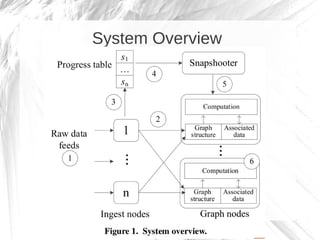
●   Separate graph processing and graph updates
●   Provide consistent periodic graph snapshots
●   Distributed updates: multiple workers (Ingest
    nodes) receives twitter feed.
●   Updates to the graph are transformed into
    sequenced transactions.
System Overview
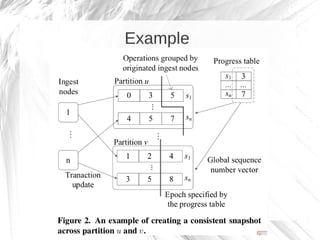
Consistent Distributed snapshots
●   Key/Value based storage system
●   Graph partition based on hashing, multiple partitions
    on a physical machine
●   An incoming record is converted to an update
    transaction which can span to multiple partitions.
●   Each transaction has a unique sequence number,
    which are used for system synchronization (global
    logical timestamp)
●   The global progress table keep track of updates
●   Snapshot and applying update transactions are
    overlapped.
Example
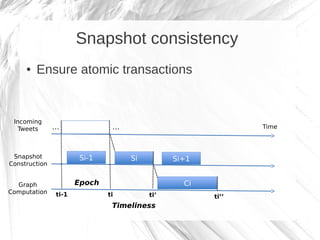
Snapshot consistency
     ●   Ensure atomic transactions


 Incoming
  Tweets       …               …                            Time


 Snapshot             Si-1         Si         Si+1
Construction


  Graph               Epoch                     Ci
Computation    ti-1           ti        ti’          ti’’
                               Timeliness
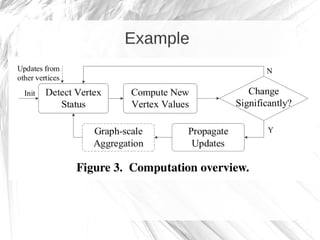
Incremental computations
●   The user provides:
        –   Rule to check if vertex changed
        –   User function to compute new values
        –   Support aggregations, push and pull
●   No need for consistency model.
●   Vertex-centric computations.
●   Supports supersteps like GraphLab and Pregel
●   Functions:
        –   Initialize, updateFunction, trigger, accululator,
              vertex-request
Example
Fault Tolerance
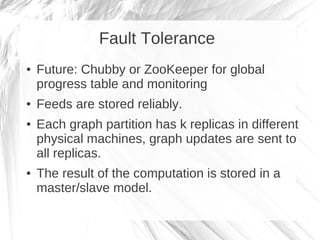
●   Future: Chubby or ZooKeeper for global
    progress table and monitoring
●   Feeds are stored reliably.
●   Each graph partition has k replicas in different
    physical machines, graph updates are sent to
    all replicas.
●   The result of the computation is stored in a
    master/slave model.
Evaluation
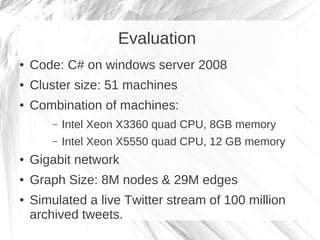
●   Code: C# on windows server 2008
●   Cluster size: 51 machines
●   Combination of machines:
        –   Intel Xeon X3360 quad CPU, 8GB memory
        –   Intel Xeon X5550 quad CPU, 12 GB memory
●   Gigabit network
●   Graph Size: 8M nodes & 29M edges
●   Simulated a live Twitter stream of 100 million
    archived tweets.
Graph update throughput
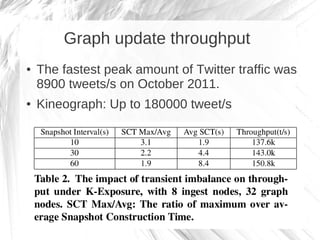
●   The fastest peak amount of Twitter traffic was
    8900 tweets/s on October 2011.
●   Kineograph: Up to 180000 tweet/s
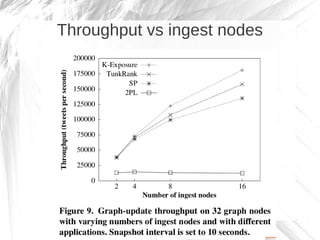
Throughput vs ingest nodes
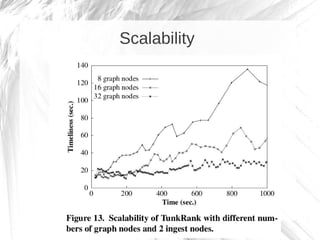
Scalability
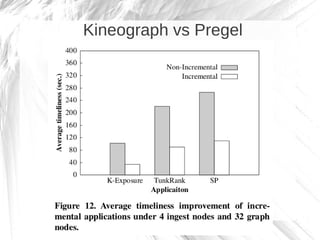
Kineograph vs Pregel
Questions

Kineograph

  • 1.
    Kineograph: Taking thePulse of a Fast-Changing and Connected World EuroSys '12 Zuhair Khayyat
  • 2.
    What is Kineograph ● A distributed system for processing a continuously changing graph. ● Input: stream of incoming data ● Main contribution: Distributed in-memory storage that supports: – Incremental graph algorithms that extracts important information on the fast changing graph structure. – Maintain consistency for static structures graph algorithms.
  • 3.
    Applications on topof Kinograph ● Time sensitive applications: Trends & breaking news ● Small data rich connectivity ● Input data: Twitter feed including user interactions and hashtags ● Algorithms: – User ranking – Approximate shortest paths – Controversial topic detection ● Claim that Kinograph can process 100K tweets per second on 40 machine cluster
  • 4.
    Application Challenges ● Handling fast updates and produce timely results. ● Distributed flexible graph structure to capture relations. ● Handle updates and static algorithms consistency. ● Appropriate fault tolerance.
  • 5.
    Kineograph design ● Separate graph processing and graph updates ● Provide consistent periodic graph snapshots ● Distributed updates: multiple workers (Ingest nodes) receives twitter feed. ● Updates to the graph are transformed into sequenced transactions.
  • 6.
  • 7.
    Consistent Distributed snapshots ● Key/Value based storage system ● Graph partition based on hashing, multiple partitions on a physical machine ● An incoming record is converted to an update transaction which can span to multiple partitions. ● Each transaction has a unique sequence number, which are used for system synchronization (global logical timestamp) ● The global progress table keep track of updates ● Snapshot and applying update transactions are overlapped.
  • 8.
  • 9.
    Snapshot consistency ● Ensure atomic transactions Incoming Tweets … … Time Snapshot Si-1 Si Si+1 Construction Graph Epoch Ci Computation ti-1 ti ti’ ti’’ Timeliness
  • 10.
    Incremental computations ● The user provides: – Rule to check if vertex changed – User function to compute new values – Support aggregations, push and pull ● No need for consistency model. ● Vertex-centric computations. ● Supports supersteps like GraphLab and Pregel ● Functions: – Initialize, updateFunction, trigger, accululator, vertex-request
  • 11.
  • 12.
    Fault Tolerance ● Future: Chubby or ZooKeeper for global progress table and monitoring ● Feeds are stored reliably. ● Each graph partition has k replicas in different physical machines, graph updates are sent to all replicas. ● The result of the computation is stored in a master/slave model.
  • 13.
    Evaluation ● Code: C# on windows server 2008 ● Cluster size: 51 machines ● Combination of machines: – Intel Xeon X3360 quad CPU, 8GB memory – Intel Xeon X5550 quad CPU, 12 GB memory ● Gigabit network ● Graph Size: 8M nodes & 29M edges ● Simulated a live Twitter stream of 100 million archived tweets.
  • 14.
    Graph update throughput ● The fastest peak amount of Twitter traffic was 8900 tweets/s on October 2011. ● Kineograph: Up to 180000 tweet/s
  • 15.
  • 16.
  • 17.
  • 18.