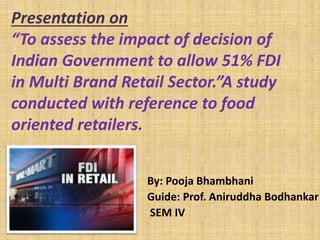
Presentation on
“To assess the impact of decision of
Indian Government to allow 51% FDI
in Multi Brand Retail Sector.”A study
conducted with reference to food
oriented retailers.
By: Pooja Bhambhani
Guide: Prof. Aniruddha Bodhankar
SEM IV
Introduction
Foreign direct investment is a investment by
a company in a country other than that in which
the company is based.
Foreign direct investment (FDI) is a direct
investment into production or business in a
country by a company in another country, either
by buying a company in the target country or by
expanding operations of an existing business in
that country.
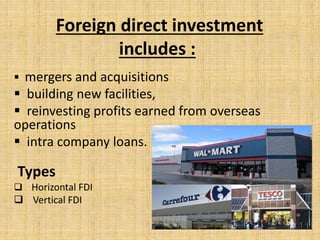
Foreign direct investment
includes :
 mergers and acquisitions
 building new facilities,
 reinvesting profits earned from overseas
operations
 intra company loans.
Types
 Horizontal FDI
 Vertical FDI
Methods
The foreign direct investor may acquire voting
power of an enterprise in an economy through
any of the following methods:
1. by incorporating a wholly owned subsidiary or
company anywhere
2. by acquiring shares in an associated enterprise
3. through a merger or an acquisition of an
unrelated enterprise
4. participating in an equity joint venture with
another investor or enterprise
Foreign direct investment in India
 Foreign investment was introduced in 1991 as
Foreign Exchange Management Act (FEMA), driven
by Finance minister Manmohan Singh.
 The sectors that attracted higher inflows were
services, telecommunication, construction
activities and computer software and hardware.
 Mauritius, Singapore, US and UK were among
the leading sources of FDI.
Foreign direct investment in India
 The Ministry of Commerce and Industry,
Government of India is the nodal agency for
monitoring and reviewing the FDI policy on
continued basis and changes in sectoral policy/
sectoral equity cap.
 The FDI policy is notified through Press Notes
by the Secretariat for Industrial Assistance (SIA),
Department of Industrial Policy and Promotion
(DIPP).
Retailing in INDIA
 Until 2011, Indian Central Gov. denied FDI in MBR.
SBR was limited to 51% ownership.
 In January 2012, India approved reforms for single-
brand stores with 100% ownership and imposed
requirement that SBR source 30% of its goods from
India.
 On 7 December 2012, the Federal Government of
India allowed 51% FDI in multi-brand retail in India.
OBJECTIVES
 to investigate and review current policy and
regulations with regards to foreign investors
 to gain an understanding of the current position on
FDI
 to assess the key factors to be considered in making
policy changes in the future and to compare the
thoughts and opinions of people.
Method of Data Collection:-
I. Primary Data Collection Tools: Questionnaire
II. Secondary Data collection Sources: Through published data in
newspapers.
Advantages
Allowing FDI in multi-brand retail will bring about :
supply chain improvement
 investment in technology
manpower & skill development
 upgrade in the agriculture sector
benefits to the government through greater GDP and tax
income.
 The organized sector will also lay stress on producing more
and will generate more employment in production as well as
retail industry.
ANALYSIS
1. The 100% FDI in MBR will have a strong
effect(adverse effect) on Organized Retail, it will
have a positive impact on India’s Capital account,
Rural sector, Currency Appreciation
2. However the 100% FDI in MBR will have no impact
on purchasing power of consumers, unorganized
retailers , small retailers (basically food oriented
retailers).
3. The KMO test (0.624) shows the adequacy of
sampling and the Bartlett’s test shows that there is
no sufficient evidence for rejecting the null
hypothesis thereby the null hypothesis cannot be
rejected.
ANALYSIS
4. The Scree plot shows that two rescaled principal
components can be extracted which can be named as
economic factors and local factors. The economic
factors shows that the FDI in MBR will have 92.4%
impact on organized retail sector.
5. The economic factors also shows that the FDI in MBR
will force the government (impact factor -90%) to
appreciate the currency .
6. Rural Retail sector will be affected (83.3%).
ANALYSIS
7. Positive impact on capital account (78.5%).
8. The local factors such as increase in purchasing
power and unorganized food retailers will have
moderate impact.
9. The impact on small food oriented retailers will
be very negligible (only 52%).
SUGGESTIONS
 The government should impose local employment
quotas on foreign retailers, firstly to reduce the
effects of any potential labour displacement , and
secondly to encourage foreign retailers to provide
training ,skills and development to local people who
without it would not be able to transfer to the
organised retail sector’ or back end services.
 The government should reform price control policies
to ensure that foreign retailers cannot sell a below
minimum price, rather than the current maximum
retail price(MRP).
 Rules on re – patriation of foreign profits should be
revised, to discourage 100% of profits from leaving
India.
CONCLUSION
The domestic retailers who responded believe
that FDI in retail will bring the benefit of skills
transfer, technology, innovation and best
practises as well as supply chain, infrastructure
and logistics improvements. They also thought
that it would increase employment and economic
growth and draw more investment in to the
domestic sector and sub-sectors. Overall, 70% of
people believe that it would have a positive
impact.

Presentation on FDI

  • 1.
    Presentation on “To assessthe impact of decision of Indian Government to allow 51% FDI in Multi Brand Retail Sector.”A study conducted with reference to food oriented retailers. By: Pooja Bhambhani Guide: Prof. Aniruddha Bodhankar SEM IV
  • 2.
    Introduction Foreign direct investmentis a investment by a company in a country other than that in which the company is based. Foreign direct investment (FDI) is a direct investment into production or business in a country by a company in another country, either by buying a company in the target country or by expanding operations of an existing business in that country.
  • 3.
    Foreign direct investment includes:  mergers and acquisitions  building new facilities,  reinvesting profits earned from overseas operations  intra company loans. Types  Horizontal FDI  Vertical FDI
  • 4.
    Methods The foreign directinvestor may acquire voting power of an enterprise in an economy through any of the following methods: 1. by incorporating a wholly owned subsidiary or company anywhere 2. by acquiring shares in an associated enterprise 3. through a merger or an acquisition of an unrelated enterprise 4. participating in an equity joint venture with another investor or enterprise
  • 5.
    Foreign direct investmentin India  Foreign investment was introduced in 1991 as Foreign Exchange Management Act (FEMA), driven by Finance minister Manmohan Singh.  The sectors that attracted higher inflows were services, telecommunication, construction activities and computer software and hardware.  Mauritius, Singapore, US and UK were among the leading sources of FDI.
  • 6.
    Foreign direct investmentin India  The Ministry of Commerce and Industry, Government of India is the nodal agency for monitoring and reviewing the FDI policy on continued basis and changes in sectoral policy/ sectoral equity cap.  The FDI policy is notified through Press Notes by the Secretariat for Industrial Assistance (SIA), Department of Industrial Policy and Promotion (DIPP).
  • 7.
    Retailing in INDIA Until 2011, Indian Central Gov. denied FDI in MBR. SBR was limited to 51% ownership.  In January 2012, India approved reforms for single- brand stores with 100% ownership and imposed requirement that SBR source 30% of its goods from India.  On 7 December 2012, the Federal Government of India allowed 51% FDI in multi-brand retail in India.
  • 8.
    OBJECTIVES  to investigateand review current policy and regulations with regards to foreign investors  to gain an understanding of the current position on FDI  to assess the key factors to be considered in making policy changes in the future and to compare the thoughts and opinions of people. Method of Data Collection:- I. Primary Data Collection Tools: Questionnaire II. Secondary Data collection Sources: Through published data in newspapers.
  • 9.
    Advantages Allowing FDI inmulti-brand retail will bring about : supply chain improvement  investment in technology manpower & skill development  upgrade in the agriculture sector benefits to the government through greater GDP and tax income.  The organized sector will also lay stress on producing more and will generate more employment in production as well as retail industry.
  • 10.
    ANALYSIS 1. The 100%FDI in MBR will have a strong effect(adverse effect) on Organized Retail, it will have a positive impact on India’s Capital account, Rural sector, Currency Appreciation 2. However the 100% FDI in MBR will have no impact on purchasing power of consumers, unorganized retailers , small retailers (basically food oriented retailers). 3. The KMO test (0.624) shows the adequacy of sampling and the Bartlett’s test shows that there is no sufficient evidence for rejecting the null hypothesis thereby the null hypothesis cannot be rejected.
  • 11.
    ANALYSIS 4. The Screeplot shows that two rescaled principal components can be extracted which can be named as economic factors and local factors. The economic factors shows that the FDI in MBR will have 92.4% impact on organized retail sector. 5. The economic factors also shows that the FDI in MBR will force the government (impact factor -90%) to appreciate the currency . 6. Rural Retail sector will be affected (83.3%).
  • 12.
    ANALYSIS 7. Positive impacton capital account (78.5%). 8. The local factors such as increase in purchasing power and unorganized food retailers will have moderate impact. 9. The impact on small food oriented retailers will be very negligible (only 52%).
  • 13.
    SUGGESTIONS  The governmentshould impose local employment quotas on foreign retailers, firstly to reduce the effects of any potential labour displacement , and secondly to encourage foreign retailers to provide training ,skills and development to local people who without it would not be able to transfer to the organised retail sector’ or back end services.  The government should reform price control policies to ensure that foreign retailers cannot sell a below minimum price, rather than the current maximum retail price(MRP).  Rules on re – patriation of foreign profits should be revised, to discourage 100% of profits from leaving India.
  • 14.
    CONCLUSION The domestic retailerswho responded believe that FDI in retail will bring the benefit of skills transfer, technology, innovation and best practises as well as supply chain, infrastructure and logistics improvements. They also thought that it would increase employment and economic growth and draw more investment in to the domestic sector and sub-sectors. Overall, 70% of people believe that it would have a positive impact.