PRESENTATION OF ILP
SAM -1ST RE –APPER
PRESENTED BY
NAVEEN KUMAR
CUN110501060
FDI or Foreign Direct Investment

  • FDI or Foreign Direct
    Investment A company from
    one country making a
    physical investment into
    building a factory in another
    country.
  • FDI has come to play a major
    role in the
    internationalization of
    business
Foreign Direct Investment

 What is FDI ?
 Foreign direct investment ( FDI ) is direct investment by a
  company in production located in another country either by
  buying a company in the country or by expanding operations
  of an existing business in the country.
 Why FDI ?
 To take advantage of cheaper wages in the country.
 Special investment privileges such as tax exemptions offered
  by the country .
 To gain tariff-free access to the markets of the country or the
  region.
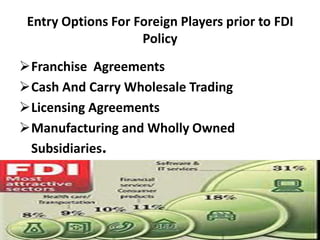
Entry Options For Foreign Players prior to FDI
                    Policy
Franchise Agreements
Cash And Carry Wholesale Trading
Licensing Agreements
Manufacturing and Wholly Owned
 Subsidiaries.
FDI Policy for Retail Sector
                     in India
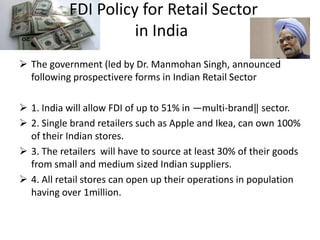
 The government (led by Dr. Manmohan Singh, announced
  following prospectivere forms in Indian Retail Sector

 1. India will allow FDI of up to 51% in ―multi-brand‖ sector.
 2. Single brand retailers such as Apple and Ikea, can own 100%
  of their Indian stores.
 3. The retailers will have to source at least 30% of their goods
  from small and medium sized Indian suppliers.
 4. All retail stores can open up their operations in population
  having over 1million.
Types of FDI

 Horizontal FDI- arises when a firm duplicates its
 home country-based activities at the same value
 chain stage in a host country through FDI.
 Platform FDI
 Vertical FDI- takes place when a firm through
 FDI moves upstream or downstream in different
 value chains .
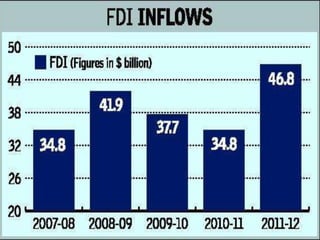
FDI in India

• India is the second most important FDI destination (after
  China) for transnational corporations during 2010–2012.
• Sectors which attracted higher inflows were
  services, telecommunication, construction activities and
  computer software and hardware.
• Mauritius, Singapore, the US and the UK were among
  the leading sources of FDI. FDI in India in 2010 was
  $44.8 billion, and in 2011 experienced an increase of
  25% to $50.8 billion .
. What does 51% FDI in multi-brand
               retail ?
 Minimum investment of $100 million.
 50% of the investment is to be in backend
  infrastructure development.
 30% of all raw material has be procured from Indian
  small and medium industries.
 Permission to set up malls only in cities with a
  minimum population of 10 lakhs.
 Government has the first right to procure material
  from the farmers.
 Foreign investor should be the owner of the brand.
FDI
            advantage and disadvantage
 Inflow of equipment and
  technology.
                                   Crowding of local
                                    industry.
 Competitive advantage &
  innovation.                      Conflicts of laws.
 Financial resources for          Loss of control.
  expansion.
                                   Effect on natural
 employment generation.
                                    Environment
  environment.
 Contribution to exports growth.  Effect on local culture.
 Improved consumer welfare
  through reduced cost , wider
  choice and improved quality
Diverse foreign direct investment in indian
 retail is greatly cherished by most of the major
 and leading including:-

Walmart (USA) Rs 455.80 crore
Tesco (UK) £1bn
 Metro (Germany)about Rs 650 crore
 Carrefour (France)488 crore
FDI in Retail sector:

 FDI in Retail sector FDI in retail sector is not allowed.

 100 % FDI is allowed in cash and carry wholesale and
  export trading, both wall mart and Carrefour have already
  entered in India in this segment .

 FDI in retail sector will have both positive and negative
  effect if allowed. Both organized and unorganized sector
  will face adverse competition from global players. Wal-Mart
  has a turnover of $256 billion and growing at an average of
  12 -13 % annually. Average size of its stores is 85000sq ft
  and average turnover is $51 million
Single Brand Retailing
 only single brand products would be sold (i.e., retail of goods
  of multi-brand even if produced by the same manufacturer
  would not be allowed),
 products should be sold under the same brand
  internationally,
 single-brand product retail would only cover products which
  are branded during manufacturing.

 any addition to product categories to be sold under ―single-
  brand‖ would require fresh approval from the government.
FDI in Multi-Brand Retail
•   The government has also not defined the term Multi Brand. FDI in Multi Brand
    retail
•   implies that a retail store with a foreign investment can sell multiple brands under
•   one roof.
•   In July 2010, Department of Industrial Policy and Promotion (DIPP), Ministry of
•   Commerce circulated a discussion paper [14] on allowing FDI in multi-brand retail.
•   The paper doesn‘t suggest any upper limit on FDI in multi-brand retail. If
•   implemented, it would open the doors for global retail giants to enter and
    establish
•   their footprints on the retail landscape of India. Opening up FDI in multi-brand
    retail
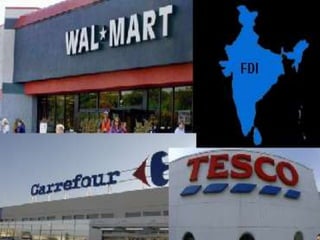
•   will mean that global retailers including Wal-Mart, Carrefour and Tesco can open
•   stores offering a range of household items and grocery directly to consumers in
    the
•   same way as the ubiquitous ‘kirana’ store.
FDI in retail: Positive and Negative impact
• Positive impact

•  Job opportunities in areas like marketing, agro-
  processing, packaging, transportation, etc. will be created.
• Farmers will get a good price for their crops and their exploitation will stop.
• Infrastructure facilities, refrigeration technology, transportation, etc. will be
  renovated.
• Foreign companies will also create a supply-chain in the India market.

• Negative impact
   Small retailers and other small ‘ Kirana store owners’ will suffer a large loss.
• Giant retailers and will displace small retailers.
• foreign giants will purchase their goods from the international market and
  not from domestic sources.
• Affect will be on consumers ,retailers ,wholesalers ,farmers (producers).
Division of Retail Industry
Organised
 licensed retailers,
 who are registered for sales tax, income tax,
 Unorganised
 traditional formats of low-cost retailing,
Why do we need it:
• We are the second highest producer of fruits and
  vegetables in the world but still we are not able to
  utilize is properly because of inadequate infrastructure
  facilities.
• It will reduce pre-harvest wastage/losses and thus help
  control food inflation.
• It will create 1.5 million more jobs in 5 years. Apart
  from the huge number of indirect employment.
• It will increase competition which is always beneficial
  for the customer.
• It will remove the middleman from the equation. It will
  reduce costs which in turn will reduce prices.
Presentation1

Presentation1

  • 1.
    PRESENTATION OF ILP SAM-1ST RE –APPER PRESENTED BY NAVEEN KUMAR CUN110501060
  • 2.
    FDI or ForeignDirect Investment • FDI or Foreign Direct Investment A company from one country making a physical investment into building a factory in another country. • FDI has come to play a major role in the internationalization of business
  • 3.
    Foreign Direct Investment What is FDI ?  Foreign direct investment ( FDI ) is direct investment by a company in production located in another country either by buying a company in the country or by expanding operations of an existing business in the country.  Why FDI ?  To take advantage of cheaper wages in the country.  Special investment privileges such as tax exemptions offered by the country .  To gain tariff-free access to the markets of the country or the region.
  • 4.
    Entry Options ForForeign Players prior to FDI Policy Franchise Agreements Cash And Carry Wholesale Trading Licensing Agreements Manufacturing and Wholly Owned Subsidiaries.
  • 6.
    FDI Policy forRetail Sector in India  The government (led by Dr. Manmohan Singh, announced following prospectivere forms in Indian Retail Sector  1. India will allow FDI of up to 51% in ―multi-brand‖ sector.  2. Single brand retailers such as Apple and Ikea, can own 100% of their Indian stores.  3. The retailers will have to source at least 30% of their goods from small and medium sized Indian suppliers.  4. All retail stores can open up their operations in population having over 1million.
  • 7.
    Types of FDI Horizontal FDI- arises when a firm duplicates its home country-based activities at the same value chain stage in a host country through FDI.  Platform FDI  Vertical FDI- takes place when a firm through FDI moves upstream or downstream in different value chains .
  • 8.
    FDI in India •India is the second most important FDI destination (after China) for transnational corporations during 2010–2012. • Sectors which attracted higher inflows were services, telecommunication, construction activities and computer software and hardware. • Mauritius, Singapore, the US and the UK were among the leading sources of FDI. FDI in India in 2010 was $44.8 billion, and in 2011 experienced an increase of 25% to $50.8 billion .
  • 10.
    . What does51% FDI in multi-brand retail ?  Minimum investment of $100 million.  50% of the investment is to be in backend infrastructure development.  30% of all raw material has be procured from Indian small and medium industries.  Permission to set up malls only in cities with a minimum population of 10 lakhs.  Government has the first right to procure material from the farmers.  Foreign investor should be the owner of the brand.
  • 11.
    FDI advantage and disadvantage  Inflow of equipment and technology.  Crowding of local industry.  Competitive advantage & innovation.  Conflicts of laws.  Financial resources for  Loss of control. expansion.  Effect on natural  employment generation. Environment environment.  Contribution to exports growth.  Effect on local culture.  Improved consumer welfare through reduced cost , wider choice and improved quality
  • 12.
    Diverse foreign directinvestment in indian retail is greatly cherished by most of the major and leading including:- Walmart (USA) Rs 455.80 crore Tesco (UK) £1bn  Metro (Germany)about Rs 650 crore  Carrefour (France)488 crore
  • 13.
    FDI in Retailsector:  FDI in Retail sector FDI in retail sector is not allowed.  100 % FDI is allowed in cash and carry wholesale and export trading, both wall mart and Carrefour have already entered in India in this segment .  FDI in retail sector will have both positive and negative effect if allowed. Both organized and unorganized sector will face adverse competition from global players. Wal-Mart has a turnover of $256 billion and growing at an average of 12 -13 % annually. Average size of its stores is 85000sq ft and average turnover is $51 million
  • 14.
    Single Brand Retailing only single brand products would be sold (i.e., retail of goods of multi-brand even if produced by the same manufacturer would not be allowed),  products should be sold under the same brand internationally,  single-brand product retail would only cover products which are branded during manufacturing.  any addition to product categories to be sold under ―single- brand‖ would require fresh approval from the government.
  • 15.
    FDI in Multi-BrandRetail • The government has also not defined the term Multi Brand. FDI in Multi Brand retail • implies that a retail store with a foreign investment can sell multiple brands under • one roof. • In July 2010, Department of Industrial Policy and Promotion (DIPP), Ministry of • Commerce circulated a discussion paper [14] on allowing FDI in multi-brand retail. • The paper doesn‘t suggest any upper limit on FDI in multi-brand retail. If • implemented, it would open the doors for global retail giants to enter and establish • their footprints on the retail landscape of India. Opening up FDI in multi-brand retail • will mean that global retailers including Wal-Mart, Carrefour and Tesco can open • stores offering a range of household items and grocery directly to consumers in the • same way as the ubiquitous ‘kirana’ store.
  • 16.
    FDI in retail:Positive and Negative impact • Positive impact • Job opportunities in areas like marketing, agro- processing, packaging, transportation, etc. will be created. • Farmers will get a good price for their crops and their exploitation will stop. • Infrastructure facilities, refrigeration technology, transportation, etc. will be renovated. • Foreign companies will also create a supply-chain in the India market. • Negative impact Small retailers and other small ‘ Kirana store owners’ will suffer a large loss. • Giant retailers and will displace small retailers. • foreign giants will purchase their goods from the international market and not from domestic sources. • Affect will be on consumers ,retailers ,wholesalers ,farmers (producers).
  • 17.
    Division of RetailIndustry Organised  licensed retailers,  who are registered for sales tax, income tax,  Unorganised  traditional formats of low-cost retailing,
  • 18.
    Why do weneed it: • We are the second highest producer of fruits and vegetables in the world but still we are not able to utilize is properly because of inadequate infrastructure facilities. • It will reduce pre-harvest wastage/losses and thus help control food inflation. • It will create 1.5 million more jobs in 5 years. Apart from the huge number of indirect employment. • It will increase competition which is always beneficial for the customer. • It will remove the middleman from the equation. It will reduce costs which in turn will reduce prices.