Business Climate 
Survey Project 
- Armaan Grewal & Anya Bharadwaj
Project Background 
• Project is based on information collected from Business 
Climate Surveys (2008-2013) answered by Swedish companies 
operating in India 
• Conducted by the Swedish Chamber, the objective of Business 
Climate Survey’s (BCS) are - 
• Gather thoughts of Swedish companies doing business in India 
• Understand business climate perception in India by these 
companies 
• Help in future establishment of Swedish companies in India 
• Project team is Anya Bharadwaj & Armaan Grewal as handed 
over by Sara Larson of the Swedish Chamber
Project Description 
• This project has the following aims – 
• Highlight major concerns and advantages faced by Swedish 
companies doing business in India 
• A trend report of the main business risks and the areas of 
concern over the years pointed out in the BCS 
• Study policies, governmental structure & events to explain these 
trends 
• Forecast the future scenario on the basis of the changing 
government and their promised mandate 
• Identify possibly emerging trends and the affect these may have 
on Swedish companies
Approach 
• The findings and documents provided prior to this project were the 
Business Climate Survey’s (BCS) of Swedish Companies in India for the 
past 6 years (2008-2013). Using this information and through extensive 
research the following information was compiled and observations were 
made regarding the present and future business climate in India for 
Swedish companies. 
• Through this study and analysis of the BCS the main areas of concern (as identified 
by Swedish companies doing business in India) were noted and these were 
categorized 
• Based on the identified trends and perception of the Indian market by Swedish 
companies various conclusions were drawn. 
• Next, a close look was taken at the policies of the Indian government and how 
these possibly influenced or resulted in the identified trends. 
• Next, a study of India’s new BJP led government, their policies and recently 
announced budget was done to understand the possible changes India’s business 
environment. 
• This helped gain an insight as to how the activities and ease of doing 
business for Swedish Companies in India would change. Applying of the 
new laws and predicting the changes in trends led to conclusions being 
drawn for the future Business Climate in India.
Challenges & Advantages 
• Corruption, red tape, the uncertain tax regime and deficient 
infrastructure. 
• An added benefits to doing business in India is cheap and 
talented labor force and lower production costs. 
• Swedish companies mentioned various competitive 
advantages that they hold over domestic producers in India 
like product design, quality and superior technology, brand 
name and better management.
Favorable Sectors/Activities 
35% 
30% 
25% 
20% 
15% 
10% 
5% 
0% 
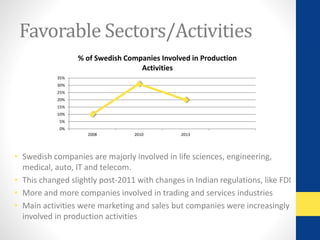
% of Swedish Companies Involved in Production 
Activities 
2008 2010 2013 
• Swedish companies are majorly involved in life sciences, engineering, 
medical, auto, IT and telecom. 
• This changed slightly post-2011 with changes in Indian regulations, like FDI 
• More and more companies involved in trading and services industries 
• Main activities were marketing and sales but companies were increasingly 
involved in production activities
Drivers to enter Indian Market 
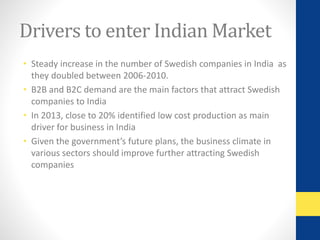
• Steady increase in the number of Swedish companies in India as 
they doubled between 2006-2010. 
• B2B and B2C demand are the main factors that attract Swedish 
companies to India 
• In 2013, close to 20% identified low cost production as main 
driver for business in India 
• Given the government’s future plans, the business climate in 
various sectors should improve further attracting Swedish 
companies
Business Climate Perception 
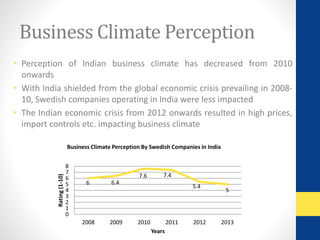
• Perception of Indian business climate has decreased from 2010 
onwards 
• With India shielded from the global economic crisis prevailing in 2008- 
10, Swedish companies operating in India were less impacted 
• The Indian economic crisis from 2012 onwards resulted in high prices, 
import controls etc. impacting business climate 
Business Climate Perception By Swedish Companies in India 
6 6.4 
7.6 7.4 
5.4 
5 
0 1 2 3 4 5 6 7 8 
2008 2009 2010 2011 2012 2013 
Rating (1-10) 
Years
Change in Governance 
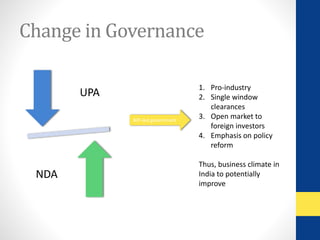
UPA 
NDA 
BJP-led government 
1. Pro-industry 
2. Single window 
clearances 
3. Open market to 
foreign investors 
4. Emphasis on policy 
reform 
Thus, business climate in 
India to potentially 
improve
Indian Market 
• When talking about B2B and B2C consumer demand in India it 
is safe to say that in the coming years this is going to continue 
to increase significantly. 
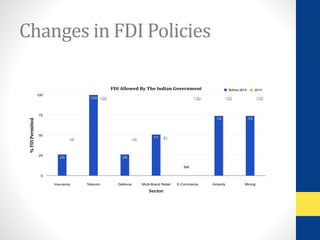
• At present, 100% FDI in B2B e-commerce is permitted 
however not in B2C e-commerce. 
• Although the BJP has spoken publicly about its opposition to 
FDI in multi-brand retail, the government has decided against 
reversing the 51% limit for FDI in multi-brand retail. This will 
come as a relief to Swedish retail houses planning to enter the 
Indian market as it was 
• The government has also opened up FDI opportunities in the 
railway sector. This again provides opportunities to Swedish 
companies looking to invest in this area.
Changes in FDI Policies 
FDI	Allowed	By	The	Indian	Government 
%	FDI	Permitted 
100 
75 
50 
25 
0 
Insurance Telecom Defence Multi-Brand Retail E-Commerce Airports Mining 
Sector 
100 100 100 
49 51 
100 
49 
74 74 
51 
26 
100 
26 
NA
Labor Laws 
• Proposed changes by BJP will allow industries to hire 
apprentices more easily. 
• India has just 300,000 apprentices. This reform will help 
incorporate up to 10 million youths and develop them into job 
ready individuals. The proposed reform will see the state bear 
half the cost for firms with less than 250 workers and hiring 
apprentices. Above this ceiling it will absorb 1/4th of the cost. 
• The ministry of labor recently announced that the government 
is also exploring how to revamp the vocational training and 
national career service. This bodes well for the future and 
labor laws are sure to be relaxed in the coming months.
No. of Local 
Workers 
Employed 
Employment 
Table 1 
2005 9800 
2008 28100 
2009 34300 
2010 38100 
2011 49100 
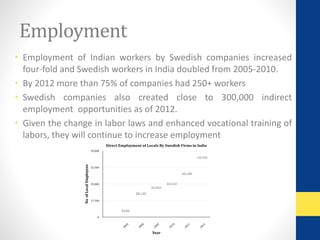
• Employment of Indian 2012 65966 
workers by Swedish companies increased 
four-fold and Swedish workers in India doubled from 2005-2010. 
• By 2012 more than 75% of companies had 250+ workers 
• Swedish companies also created close to 300,000 indirect 
employment opportunities as of 2012. 
• Given the change in labor laws and enhanced vocational training of 
labors, they will continue to increase employment 
Direct	Employment	of	Locals	By	Swedish	Firms	in	India 
No.	of	Local	Employees 
70,000 
52,500 
35,000 
17,500 
0 
2005 
2008 
2009 
2010 
2011 
2012 
Year 
65,966 
49,100 
38,100 
34,300 
28,100 
9,800
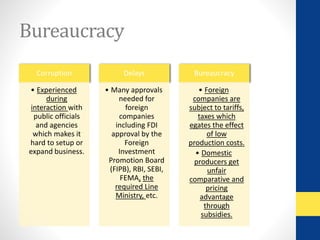
Bureaucracy 
Corruption 
• Experienced 
during 
interaction with 
public officials 
and agencies 
which makes it 
hard to setup or 
expand business. 
Delays 
• Many approvals 
needed for 
foreign 
companies 
including FDI 
approval by the 
Foreign 
Investment 
Promotion Board 
(FIPB), RBI, SEBI, 
FEMA, the 
required Line 
Ministry, etc. 
Bureaucracy 
• Foreign 
companies are 
subject to tariffs, 
taxes which 
egates the effect 
of low 
production costs. 
• Domestic 
producers get 
unfair 
comparative and 
pricing 
advantage 
through 
subsidies.
Changes in Indian Bureaucracy 
• The new BJP-led government has also, proposed measures to 
reduce the regulation and bureaucracy in industry. 
• The new Government of Tamil Nadu, for instance, has 
established a Single Window System to accord all such pre-project 
clearances at the State Government level. 
• The Guidance Bureau will work on providing quick clearances 
thus, making it easier for Swedish companies to 
conduct/expand business activities in India. 
• This will result in immediate improvement in the speed at 
which clearances/licenses are granted.
Taxation 
• Since foreign investment generally comes in the form of a 
two-tier structure it attracts a double burden of taxes. 
• Portfolio investors from abroad will now have to pay 15% tax 
on derivative transactions as income from derivatives is now 
classified as capital gains. 
• This will have a negative impact on Swedish companies hoping 
to invest in India.
Changes in Taxation 
• In the recent budget announcement, the government said not 
resort to retrospective taxation in the future and this law 
would not be reversed. 
• He also aims to create a uniform taxation regime. This will 
have a positive impact on Swedish companies – reducing the 
risk of them being subject to a complicated tax procedures 
and retrospectively imposed taxes. 
• The new government is in the process of implementing the 
GST (goods and services) tax in the coming months. This will 
result in the removal of various indirect taxes like luxury tax, 
state surcharges etc. It will reduce the tax burden on Swedish 
companies and will potentially lead to an efficient tax regime.
Infrastructure 
• These infrastructure deficiencies add to the cost of Swedish Companies doing 
business in India. 
• The 12th Five Year Plan of the government has targeted the following through Public 
Private Partnerships (PPP): 
• $1 trillion on infrastructure. 
• Additional 180 airports 
• 6000 miles of new Highways 
• $60 billion investment in Ports 
• In fact the Indian Government is also focusing on increasing the private sector 
investment to 50% that would give an opportunity to Swedish Companies to 
participate. 
• The new government has also announced a number of initiatives and policies such as 
a focus on access to financing, efficient land acquisition and environmental 
clearances, progressive tax reliefs to incentivize developers and equipment suppliers 
in order to boost infrastructure development in India. 
• BJP Government is focused on the Country’s investment in infrastructure to increase 
to 10% of its GDP by 2017 to achieve and sustain 8 to 9% GDP growth over a 5-year 
period. 
• If this happens the ease and quality of doing business in India will improve 
significantly for Swedish companies.
Labor Force 
India, with the second largest (after China) and one of the youngest labor 
forces in the world, has an abundance of labor ready to be employed in a 
variety of blue and white-collar jobs by Swedish companies. 
• In 2011, the Indian workers directly and indirectly employed by Swedish 
companies stood at half a million (5 times more than 2006). 
• Low labor costs are a benefit of doing business in India and an 
appreciating rupee vs. the dollar further reduces labor costs relative to 
other countries. 
• India has a complicated minimum wage structure – varying from state to 
state and by occupation. 
• Swedish companies in India pointed to the access to high quality white-collar 
labor and English-speaking workers as benefits of business in 
India. 
• The BJP in its manifesto discussed vocational programs (National Multi- 
Skill Mission) and development of women’s entrepreneurial clusters. If 
implemented properly, these steps should give Swedish companies in 
India benefits in the long term.
Low Cost Production 
• India is considered a LCC or a low cost country for production. 
The costs of entering the Indian market are extremely high 
thus Swedish companies in India don’t recognize the 
comparative cost advantage of doing business in India initially. 
• In the long-term however, companies see the comparative 
cost advantage in India as an attractive reason to set up 
business in the country. 
• Low labor costs and easy access to raw materials bring the 
cost of production down. However, Swedish companies have 
not realized the cost advantage in India to its full extent. 
• As previously mentioned, firms are forced to spend large sums 
on paying tariffs, obtaining licenses etc. and thus the 
advantage of low cost production is often negated.
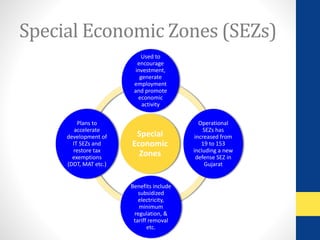
Special Economic Zones (SEZs) 
Used to 
encourage 
investment, 
generate 
employment 
and promote 
economic 
activity 
Special 
Economic 
Zones 
Operational 
SEZs has 
increased from 
19 to 153 
including a new 
defense SEZ in 
Gujarat 
Benefits include 
subsidized 
electricity, 
minimum 
regulation, & 
tariff removal 
etc. 
Plans to 
accelerate 
development of 
IT SEZs and 
restore tax 
exemptions 
(DDT, MAT etc.)
Financing and Banking 
• A big advantage that Swedish companies highlighted about 
business in India was the access to financing. 
• India has an extensive financing system for large Swedish firms 
including both traditional and alternative channels of funding. 
• Sources of financing include domestic debt capital markets 
(bonds, debentures etc.), equity capital market (domestic 
listings, private equity players), external commercial 
borrowings and both short and long term rupee funding from 
domestic and foreign banks.
Changes in Financing 
• The RBI recently gave out two new banking licenses for the 
first time since 2004 and there is hope that there will be a 
further expansion of India’s banking system in the years to 
come. 
• RBI governor, Raghuram Rajan, is also expected to announce 
policy measure that allow firms to obtain banking licenses ‘on 
tap’ if they meet certain regulations. 
• For the last few years till 2013, foreign banks were only 
allowed to set up branches in India. However, the RBI also 
announced in late 2013 that foreign banks would escape many 
regulatory measures if they operate as ‘wholly owned 
subsidiaries.’
Land Availability & Office Space 
• This area being less of a challenge for Swedish companies can be 
attributed to the changes in FDI policies along with measures that 
make it easier for foreign companies to set up office branches, 
production units etc. 
• According to FEMA (Foreign Exchange Management) Rules (2000), 
foreign companies can buy land to set up branches or other places 
of business to carry out a permitted activity and not for anything 
else. 
• Amendments to the Land Acquisition Act in 2013 made it much 
easier for the government to acquire land all over the country. 
• The government will now look to acquire non-cultivable land to 
hand it out for industrial and research projects. 
• These proposed measures along with the continued development of 
infrastructure will lead to an easier process for Swedish companies 
when attempting to buy land and new office space in India.
Investment/Expansion Plans 
• Despite the decreasing perception of the business climate 
Swedish companies have a long term operating plans 
• Less than 10% of the Swedish companies experienced a loss of 
revenue, resources during the years of Indian economic 
slowdown (2010-2012) 
• In 2013 over 30% companies were looking to increase their 
investments by >21%.
Conclusion 
• On the whole Swedish companies enjoy doing business in India for a 
number of reasons. 
• They hold competitive advantages in terms of product quality, 
design, management and brand name. The companies experience 
an increasing demand for their products and despite the increasing 
costs of production. Swedish companies in India continue to 
generate large profits. 
• There are a number of factors that point to longer-term 
commitment of Swedish companies. These include the increasing 
employment of local workers; only 4% of the companies as of 2013 
were planning to decrease future activities and an increasing 
number of companies with multiple offices across the country. 
Companies have come with the message of ‘Think global, act local’ 
by putting an emphasis on hiring Indian workers and adapting their 
business models.
Conclusion (cont.) 
• As India undergoes a huge change in its government and foreign 
policies, Swedish Companies are likely to increase business activity in 
the Indian Market. With a pro-industry regime, many benefits are being 
provided to foreign investors such as single window clearances, 
increased FDI in defense, e-commerce and insurance, no retrospective 
taxation and easier taxation policies. 
• A better-developed and more skilled workforce will improve the quality 
of doing business activity in India. 
• The government is now prioritizing infrastructure development, which is 
a major challenge currently to business in India. This is being done 
through PPP which is an advantage for Swedish companies. 
• Despite the general trend of decreasing perception of business climate 
in India as reflected by Swedish companies in the Business Climate 
Surveys of 2008-2013, it has been concluded that this is likely to change 
in the new future. 
• After years of policy paralysis and economic slowdown affecting the 
Indian economy, the coming of the new government and emphasis on 
investor friendly policies will potentially result in the significant 
improvement of the ease of doing business in India in the coming years.

Business Climate Survey Analysis

  • 1.
    Business Climate SurveyProject - Armaan Grewal & Anya Bharadwaj
  • 2.
    Project Background •Project is based on information collected from Business Climate Surveys (2008-2013) answered by Swedish companies operating in India • Conducted by the Swedish Chamber, the objective of Business Climate Survey’s (BCS) are - • Gather thoughts of Swedish companies doing business in India • Understand business climate perception in India by these companies • Help in future establishment of Swedish companies in India • Project team is Anya Bharadwaj & Armaan Grewal as handed over by Sara Larson of the Swedish Chamber
  • 3.
    Project Description •This project has the following aims – • Highlight major concerns and advantages faced by Swedish companies doing business in India • A trend report of the main business risks and the areas of concern over the years pointed out in the BCS • Study policies, governmental structure & events to explain these trends • Forecast the future scenario on the basis of the changing government and their promised mandate • Identify possibly emerging trends and the affect these may have on Swedish companies
  • 4.
    Approach • Thefindings and documents provided prior to this project were the Business Climate Survey’s (BCS) of Swedish Companies in India for the past 6 years (2008-2013). Using this information and through extensive research the following information was compiled and observations were made regarding the present and future business climate in India for Swedish companies. • Through this study and analysis of the BCS the main areas of concern (as identified by Swedish companies doing business in India) were noted and these were categorized • Based on the identified trends and perception of the Indian market by Swedish companies various conclusions were drawn. • Next, a close look was taken at the policies of the Indian government and how these possibly influenced or resulted in the identified trends. • Next, a study of India’s new BJP led government, their policies and recently announced budget was done to understand the possible changes India’s business environment. • This helped gain an insight as to how the activities and ease of doing business for Swedish Companies in India would change. Applying of the new laws and predicting the changes in trends led to conclusions being drawn for the future Business Climate in India.
  • 5.
    Challenges & Advantages • Corruption, red tape, the uncertain tax regime and deficient infrastructure. • An added benefits to doing business in India is cheap and talented labor force and lower production costs. • Swedish companies mentioned various competitive advantages that they hold over domestic producers in India like product design, quality and superior technology, brand name and better management.
  • 6.
    Favorable Sectors/Activities 35% 30% 25% 20% 15% 10% 5% 0% % of Swedish Companies Involved in Production Activities 2008 2010 2013 • Swedish companies are majorly involved in life sciences, engineering, medical, auto, IT and telecom. • This changed slightly post-2011 with changes in Indian regulations, like FDI • More and more companies involved in trading and services industries • Main activities were marketing and sales but companies were increasingly involved in production activities
  • 7.
    Drivers to enterIndian Market • Steady increase in the number of Swedish companies in India as they doubled between 2006-2010. • B2B and B2C demand are the main factors that attract Swedish companies to India • In 2013, close to 20% identified low cost production as main driver for business in India • Given the government’s future plans, the business climate in various sectors should improve further attracting Swedish companies
  • 8.
    Business Climate Perception • Perception of Indian business climate has decreased from 2010 onwards • With India shielded from the global economic crisis prevailing in 2008- 10, Swedish companies operating in India were less impacted • The Indian economic crisis from 2012 onwards resulted in high prices, import controls etc. impacting business climate Business Climate Perception By Swedish Companies in India 6 6.4 7.6 7.4 5.4 5 0 1 2 3 4 5 6 7 8 2008 2009 2010 2011 2012 2013 Rating (1-10) Years
  • 9.
    Change in Governance UPA NDA BJP-led government 1. Pro-industry 2. Single window clearances 3. Open market to foreign investors 4. Emphasis on policy reform Thus, business climate in India to potentially improve
  • 10.
    Indian Market •When talking about B2B and B2C consumer demand in India it is safe to say that in the coming years this is going to continue to increase significantly. • At present, 100% FDI in B2B e-commerce is permitted however not in B2C e-commerce. • Although the BJP has spoken publicly about its opposition to FDI in multi-brand retail, the government has decided against reversing the 51% limit for FDI in multi-brand retail. This will come as a relief to Swedish retail houses planning to enter the Indian market as it was • The government has also opened up FDI opportunities in the railway sector. This again provides opportunities to Swedish companies looking to invest in this area.
  • 11.
    Changes in FDIPolicies FDI Allowed By The Indian Government % FDI Permitted 100 75 50 25 0 Insurance Telecom Defence Multi-Brand Retail E-Commerce Airports Mining Sector 100 100 100 49 51 100 49 74 74 51 26 100 26 NA
  • 12.
    Labor Laws •Proposed changes by BJP will allow industries to hire apprentices more easily. • India has just 300,000 apprentices. This reform will help incorporate up to 10 million youths and develop them into job ready individuals. The proposed reform will see the state bear half the cost for firms with less than 250 workers and hiring apprentices. Above this ceiling it will absorb 1/4th of the cost. • The ministry of labor recently announced that the government is also exploring how to revamp the vocational training and national career service. This bodes well for the future and labor laws are sure to be relaxed in the coming months.
  • 13.
    No. of Local Workers Employed Employment Table 1 2005 9800 2008 28100 2009 34300 2010 38100 2011 49100 • Employment of Indian 2012 65966 workers by Swedish companies increased four-fold and Swedish workers in India doubled from 2005-2010. • By 2012 more than 75% of companies had 250+ workers • Swedish companies also created close to 300,000 indirect employment opportunities as of 2012. • Given the change in labor laws and enhanced vocational training of labors, they will continue to increase employment Direct Employment of Locals By Swedish Firms in India No. of Local Employees 70,000 52,500 35,000 17,500 0 2005 2008 2009 2010 2011 2012 Year 65,966 49,100 38,100 34,300 28,100 9,800
  • 14.
    Bureaucracy Corruption •Experienced during interaction with public officials and agencies which makes it hard to setup or expand business. Delays • Many approvals needed for foreign companies including FDI approval by the Foreign Investment Promotion Board (FIPB), RBI, SEBI, FEMA, the required Line Ministry, etc. Bureaucracy • Foreign companies are subject to tariffs, taxes which egates the effect of low production costs. • Domestic producers get unfair comparative and pricing advantage through subsidies.
  • 15.
    Changes in IndianBureaucracy • The new BJP-led government has also, proposed measures to reduce the regulation and bureaucracy in industry. • The new Government of Tamil Nadu, for instance, has established a Single Window System to accord all such pre-project clearances at the State Government level. • The Guidance Bureau will work on providing quick clearances thus, making it easier for Swedish companies to conduct/expand business activities in India. • This will result in immediate improvement in the speed at which clearances/licenses are granted.
  • 16.
    Taxation • Sinceforeign investment generally comes in the form of a two-tier structure it attracts a double burden of taxes. • Portfolio investors from abroad will now have to pay 15% tax on derivative transactions as income from derivatives is now classified as capital gains. • This will have a negative impact on Swedish companies hoping to invest in India.
  • 17.
    Changes in Taxation • In the recent budget announcement, the government said not resort to retrospective taxation in the future and this law would not be reversed. • He also aims to create a uniform taxation regime. This will have a positive impact on Swedish companies – reducing the risk of them being subject to a complicated tax procedures and retrospectively imposed taxes. • The new government is in the process of implementing the GST (goods and services) tax in the coming months. This will result in the removal of various indirect taxes like luxury tax, state surcharges etc. It will reduce the tax burden on Swedish companies and will potentially lead to an efficient tax regime.
  • 18.
    Infrastructure • Theseinfrastructure deficiencies add to the cost of Swedish Companies doing business in India. • The 12th Five Year Plan of the government has targeted the following through Public Private Partnerships (PPP): • $1 trillion on infrastructure. • Additional 180 airports • 6000 miles of new Highways • $60 billion investment in Ports • In fact the Indian Government is also focusing on increasing the private sector investment to 50% that would give an opportunity to Swedish Companies to participate. • The new government has also announced a number of initiatives and policies such as a focus on access to financing, efficient land acquisition and environmental clearances, progressive tax reliefs to incentivize developers and equipment suppliers in order to boost infrastructure development in India. • BJP Government is focused on the Country’s investment in infrastructure to increase to 10% of its GDP by 2017 to achieve and sustain 8 to 9% GDP growth over a 5-year period. • If this happens the ease and quality of doing business in India will improve significantly for Swedish companies.
  • 19.
    Labor Force India,with the second largest (after China) and one of the youngest labor forces in the world, has an abundance of labor ready to be employed in a variety of blue and white-collar jobs by Swedish companies. • In 2011, the Indian workers directly and indirectly employed by Swedish companies stood at half a million (5 times more than 2006). • Low labor costs are a benefit of doing business in India and an appreciating rupee vs. the dollar further reduces labor costs relative to other countries. • India has a complicated minimum wage structure – varying from state to state and by occupation. • Swedish companies in India pointed to the access to high quality white-collar labor and English-speaking workers as benefits of business in India. • The BJP in its manifesto discussed vocational programs (National Multi- Skill Mission) and development of women’s entrepreneurial clusters. If implemented properly, these steps should give Swedish companies in India benefits in the long term.
  • 20.
    Low Cost Production • India is considered a LCC or a low cost country for production. The costs of entering the Indian market are extremely high thus Swedish companies in India don’t recognize the comparative cost advantage of doing business in India initially. • In the long-term however, companies see the comparative cost advantage in India as an attractive reason to set up business in the country. • Low labor costs and easy access to raw materials bring the cost of production down. However, Swedish companies have not realized the cost advantage in India to its full extent. • As previously mentioned, firms are forced to spend large sums on paying tariffs, obtaining licenses etc. and thus the advantage of low cost production is often negated.
  • 21.
    Special Economic Zones(SEZs) Used to encourage investment, generate employment and promote economic activity Special Economic Zones Operational SEZs has increased from 19 to 153 including a new defense SEZ in Gujarat Benefits include subsidized electricity, minimum regulation, & tariff removal etc. Plans to accelerate development of IT SEZs and restore tax exemptions (DDT, MAT etc.)
  • 22.
    Financing and Banking • A big advantage that Swedish companies highlighted about business in India was the access to financing. • India has an extensive financing system for large Swedish firms including both traditional and alternative channels of funding. • Sources of financing include domestic debt capital markets (bonds, debentures etc.), equity capital market (domestic listings, private equity players), external commercial borrowings and both short and long term rupee funding from domestic and foreign banks.
  • 23.
    Changes in Financing • The RBI recently gave out two new banking licenses for the first time since 2004 and there is hope that there will be a further expansion of India’s banking system in the years to come. • RBI governor, Raghuram Rajan, is also expected to announce policy measure that allow firms to obtain banking licenses ‘on tap’ if they meet certain regulations. • For the last few years till 2013, foreign banks were only allowed to set up branches in India. However, the RBI also announced in late 2013 that foreign banks would escape many regulatory measures if they operate as ‘wholly owned subsidiaries.’
  • 24.
    Land Availability &Office Space • This area being less of a challenge for Swedish companies can be attributed to the changes in FDI policies along with measures that make it easier for foreign companies to set up office branches, production units etc. • According to FEMA (Foreign Exchange Management) Rules (2000), foreign companies can buy land to set up branches or other places of business to carry out a permitted activity and not for anything else. • Amendments to the Land Acquisition Act in 2013 made it much easier for the government to acquire land all over the country. • The government will now look to acquire non-cultivable land to hand it out for industrial and research projects. • These proposed measures along with the continued development of infrastructure will lead to an easier process for Swedish companies when attempting to buy land and new office space in India.
  • 25.
    Investment/Expansion Plans •Despite the decreasing perception of the business climate Swedish companies have a long term operating plans • Less than 10% of the Swedish companies experienced a loss of revenue, resources during the years of Indian economic slowdown (2010-2012) • In 2013 over 30% companies were looking to increase their investments by >21%.
  • 26.
    Conclusion • Onthe whole Swedish companies enjoy doing business in India for a number of reasons. • They hold competitive advantages in terms of product quality, design, management and brand name. The companies experience an increasing demand for their products and despite the increasing costs of production. Swedish companies in India continue to generate large profits. • There are a number of factors that point to longer-term commitment of Swedish companies. These include the increasing employment of local workers; only 4% of the companies as of 2013 were planning to decrease future activities and an increasing number of companies with multiple offices across the country. Companies have come with the message of ‘Think global, act local’ by putting an emphasis on hiring Indian workers and adapting their business models.
  • 27.
    Conclusion (cont.) •As India undergoes a huge change in its government and foreign policies, Swedish Companies are likely to increase business activity in the Indian Market. With a pro-industry regime, many benefits are being provided to foreign investors such as single window clearances, increased FDI in defense, e-commerce and insurance, no retrospective taxation and easier taxation policies. • A better-developed and more skilled workforce will improve the quality of doing business activity in India. • The government is now prioritizing infrastructure development, which is a major challenge currently to business in India. This is being done through PPP which is an advantage for Swedish companies. • Despite the general trend of decreasing perception of business climate in India as reflected by Swedish companies in the Business Climate Surveys of 2008-2013, it has been concluded that this is likely to change in the new future. • After years of policy paralysis and economic slowdown affecting the Indian economy, the coming of the new government and emphasis on investor friendly policies will potentially result in the significant improvement of the ease of doing business in India in the coming years.