Current state of India's economy
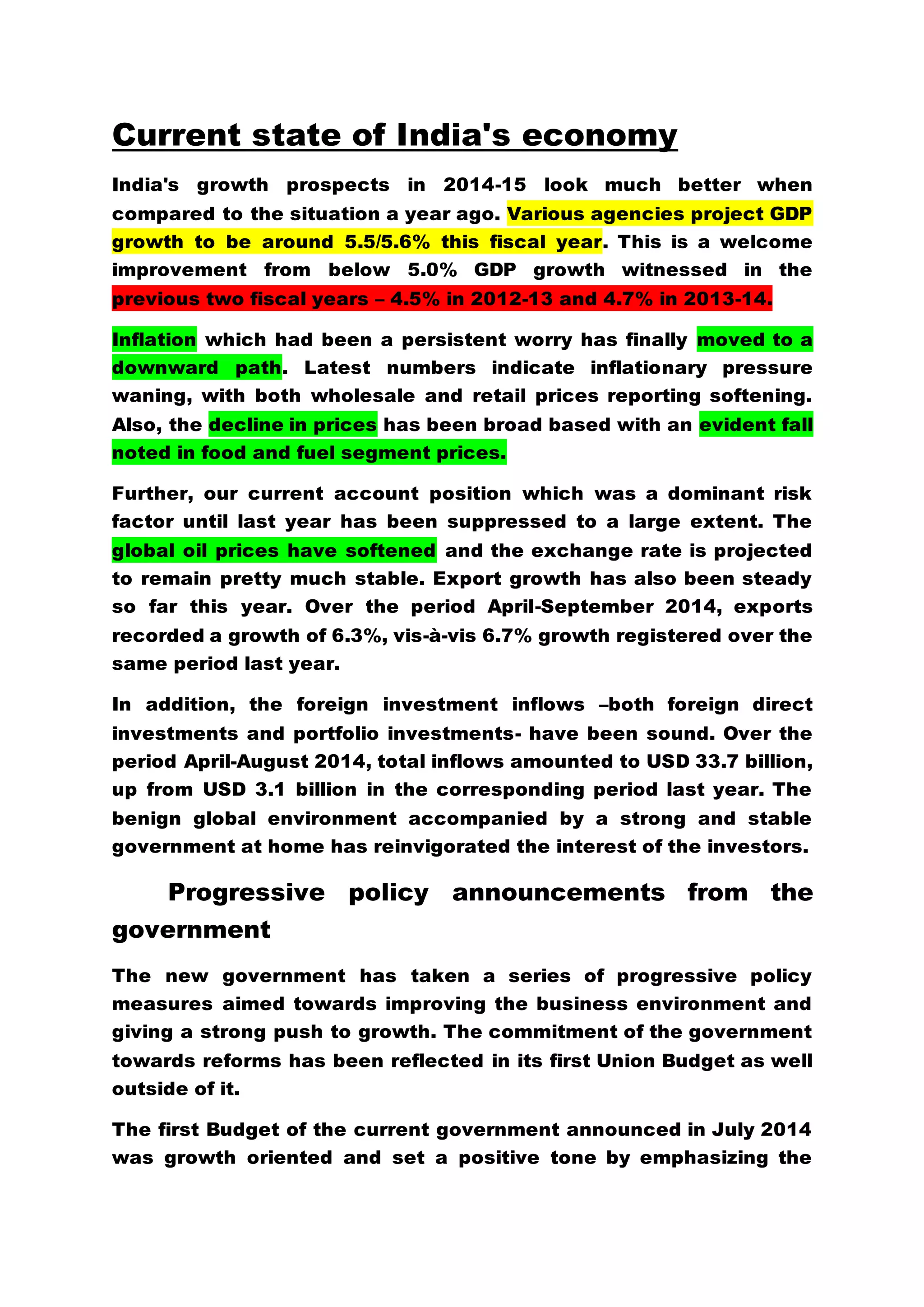
India's growth prospects in 2014-15 look much better when
compared to the situation a year ago. Various agencies project GDP
growth to be around 5.5/5.6% this fiscal year. This is a welcome
improvement from below 5.0% GDP growth witnessed in the
previous two fiscal years – 4.5% in 2012-13 and 4.7% in 2013-14.
Inflation which had been a persistent worry has finally moved to a
downward path. Latest numbers indicate inflationary pressure
waning, with both wholesale and retail prices reporting softening.
Also, the decline in prices has been broad based with an evident fall
noted in food and fuel segment prices.
Further, our current account position which was a dominant risk
factor until last year has been suppressed to a large extent. The
global oil prices have softened and the exchange rate is projected
to remain pretty much stable. Export growth has also been steady
so far this year. Over the period April-September 2014, exports
recorded a growth of 6.3%, vis-à-vis 6.7% growth registered over the
same period last year.
In addition, the foreign investment inflows –both foreign direct
investments and portfolio investments- have been sound. Over the
period April-August 2014, total inflows amounted to USD 33.7 billion,
up from USD 3.1 billion in the corresponding period last year. The
benign global environment accompanied by a strong and stable
government at home has reinvigorated the interest of the investors.
Progressive policy announcements from the
government
The new government has taken a series of progressive policy
measures aimed towards improving the business environment and
giving a strong push to growth. The commitment of the government
towards reforms has been reflected in its first Union Budget as well
outside of it.
The first Budget of the current government announced in July 2014
was growth oriented and set a positive tone by emphasizing the
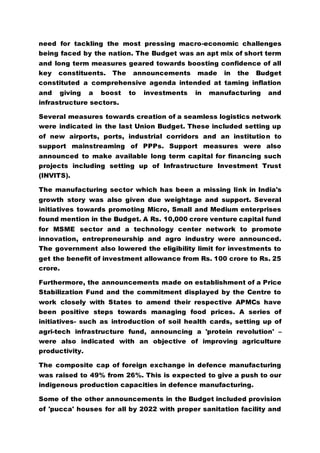
need for tackling the most pressing macro-economic challenges
being faced by the nation. The Budget was an apt mix of short term
and long term measures geared towards boosting confidence of all
key constituents. The announcements made in the Budget
constituted a comprehensive agenda intended at taming inflation
and giving a boost to investments in manufacturing and
infrastructure sectors.
Several measures towards creation of a seamless logistics network
were indicated in the last Union Budget. These included setting up
of new airports, ports, industrial corridors and an institution to
support mainstreaming of PPPs. Support measures were also
announced to make available long term capital for financing such
projects including setting up of Infrastructure Investment Trust
(INVITS).
The manufacturing sector which has been a missing link in India's
growth story was also given due weightage and support. Several
initiatives towards promoting Micro, Small and Medium enterprises
found mention in the Budget. A Rs. 10,000 crore venture capital fund
for MSME sector and a technology center network to promote
innovation, entrepreneurship and agro industry were announced.
The government also lowered the eligibility limit for investments to
get the benefit of investment allowance from Rs. 100 crore to Rs. 25
crore.
Furthermore, the announcements made on establishment of a Price
Stabilization Fund and the commitment displayed by the Centre to
work closely with States to amend their respective APMCs have
been positive steps towards managing food prices. A series of
initiatives- such as introduction of soil health cards, setting up of
agri-tech infrastructure fund, announcing a 'protein revolution' –
were also indicated with an objective of improving agriculture
productivity.
The composite cap of foreign exchange in defence manufacturing
was raised to 49% from 26%. This is expected to give a push to our
indigenous production capacities in defence manufacturing.
Some of the other announcements in the Budget included provision
of 'pucca' houses for all by 2022 with proper sanitation facility and
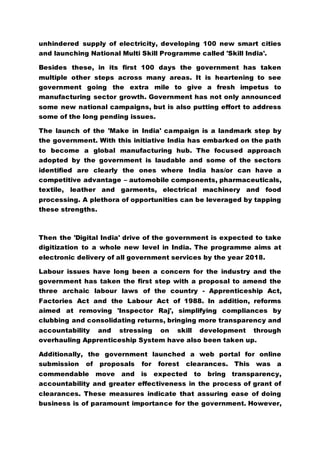
unhindered supply of electricity, developing 100 new smart cities
and launching National Multi Skill Programme called 'Skill India'.
Besides these, in its first 100 days the government has taken
multiple other steps across many areas. It is heartening to see
government going the extra mile to give a fresh impetus to
manufacturing sector growth. Government has not only announced
some new national campaigns, but is also putting effort to address
some of the long pending issues.
The launch of the 'Make in India' campaign is a landmark step by
the government. With this initiative India has embarked on the path
to become a global manufacturing hub. The focused approach
adopted by the government is laudable and some of the sectors
identified are clearly the ones where India has/or can have a
competitive advantage – automobile components, pharmaceuticals,
textile, leather and garments, electrical machinery and food
processing. A plethora of opportunities can be leveraged by tapping
these strengths.
Then the 'Digital India' drive of the government is expected to take
digitization to a whole new level in India. The programme aims at
electronic delivery of all government services by the year 2018.
Labour issues have long been a concern for the industry and the
government has taken the first step with a proposal to amend the
three archaic labour laws of the country - Apprenticeship Act,
Factories Act and the Labour Act of 1988. In addition, reforms
aimed at removing 'Inspector Raj', simplifying compliances by
clubbing and consolidating returns, bringing more transparency and
accountability and stressing on skill development through
overhauling Apprenticeship System have also been taken up.
Additionally, the government launched a web portal for online
submission of proposals for forest clearances. This was a
commendable move and is expected to bring transparency,
accountability and greater effectiveness in the process of grant of
clearances. These measures indicate that assuring ease of doing
business is of paramount importance for the government. However,
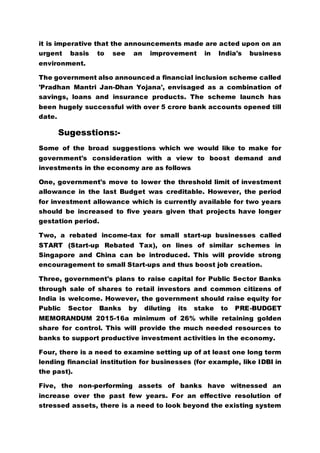
it is imperative that the announcements made are acted upon on an
urgent basis to see an improvement in India's business
environment.
The government also announced a financial inclusion scheme called
'Pradhan Mantri Jan-Dhan Yojana', envisaged as a combination of
savings, loans and insurance products. The scheme launch has
been hugely successful with over 5 crore bank accounts opened till
date.
Sugesstions:-
Some of the broad suggestions which we would like to make for
government's consideration with a view to boost demand and
investments in the economy are as follows
One, government's move to lower the threshold limit of investment
allowance in the last Budget was creditable. However, the period
for investment allowance which is currently available for two years
should be increased to five years given that projects have longer
gestation period.
Two, a rebated income-tax for small start-up businesses called
START (Start-up Rebated Tax), on lines of similar schemes in
Singapore and China can be introduced. This will provide strong
encouragement to small Start-ups and thus boost job creation.
Three, government's plans to raise capital for Public Sector Banks
through sale of shares to retail investors and common citizens of
India is welcome. However, the government should raise equity for
Public Sector Banks by diluting its stake to PRE-BUDGET
MEMORANDUM 2015-16a minimum of 26% while retaining golden
share for control. This will provide the much needed resources to
banks to support productive investment activities in the economy.
Four, there is a need to examine setting up of at least one long term
lending financial institution for businesses (for example, like IDBI in
the past).
Five, the non-performing assets of banks have witnessed an
increase over the past few years. For an effective resolution of
stressed assets, there is a need to look beyond the existing system
and address the specific nature of the problem through a
specialized ARC framework. FICCI suggests creation of a
specialized entity called National Asset Management Company
(NAMCO) to effectively tackle the issue of large NPAs.
Lastly, implementation of Goods and Services Tax (GST) can be a
game changer for the economy. Though the government is working
on ironing out issues in GST framework, it is important that the
process of building a consensus is expedited and the government is
able to stick to the targeted date of 1st April, 2016 for making GST
operational.
SECTORIAL ISSUES
AGRICULTURE
 Exemption for Services related to Agricultural Produce
As per extant Service Tax laws the agro-sector has been supported
by keeping a bulk of services relating to agriculture or agricultural
produce in the Negative List or in the list of exempted services.
However, there are some services like Warehouse Management
Services, Security Services, and Laboratory Testing Services etc.
which are essential to secure storage of agri-produce and to
determine quality of the agri-produce but which are subjected to
Service Tax.
It is recommended that all services provided for agricultural
produce be exempted from service tax.
 Priority lending for purchase of Micro Irrigation
equipment/systems
The ultimate irrigation potential for the country has been assessed
to be about 139.9 million hectare (Mha). As per the available
information, about 93.95 Mha (till end of Eleventh Five Year Plan) of
irrigation potential has been created so far. Secondly, only 3.5
million hectares of the 87.2 million hectare irrigated area use micro
and sprinkler irrigation in India.
The purchase of Micro Irrigation equipment/systems by farmers
should be eligible for priority lending by the banks within the ambit
of 'priority sector lending to agriculture'.
 Agriculture Warehousing
Following recommendations to give fillip to the agriculture
warehousing sector may be considered:-
(a) Increase the subsidy under Grameen Bhandaran Yojna to 35%
(25% at present). For Hilly areas, SC/ST entrepreneurs and their
cooperatives and women farmers, the subsidy should be increased
to 40% (33.33% at present). Subsidy for smaller godowns of 50 MT
size in general and of 25 MT in hilly areas as permitted, be also
increased to 50% to increase the capacity of warehouse. This
should be subject to construction as per the norms laid by NABARD
and should be available to only rural areas, accessible by motorable
roads throughout the year.
(b) Construction of godowns under Private Entrepreneurs Guarantee
(PEG) scheme formulated by FCI for guaranteeing the storage
should be enhanced to 15 years (for escrowing the repayments), so
as to have lower EMI for the entrepreneurs who plan to get their
projects financed by the banks. Financing to this sector should be
considered for lower capital adequacy requirements for banks
besides permission to have special dispensation to grant term loans
beyond 10 years tenure.
(c) Banks should get direct lending tag under priority sector
benchmark towards the loans given for construction of godowns
both under PEG and Grameen Bhandaran Yojna as against indirect
lending under priority sector at present.
CHEMICALS AND PETROCHEMICALS
Background The Indian chemical and petrochemical industry
currently stands at USD 134 billion and is expected to grow at a
CAGR of 8% for the next five years. The share of this sector in the
manufacturing GDP was 15% during 2012-13 and it accounted for
~9% of the total India's exports. Together, Gujarat, Maharashtra and
Uttar Pradesh account for more than 50% of Gross Value Add (GVA)
and Gross Output of the chemical and petrochemical industry.
The current low per capita consumption across industries and
segments and strong growth outlook for the key end use are the key
growth drivers for this industry. Net imports have grown at ~20%
between FY09 and FY13 where in the same period the domestic
output has grown by ~4%. The Government has set an ambitious
plan of increasing the share of manufacturing in GDP from 16% to
25% by 2022.
To meet this increasing demand either the local production will
have to ramp up or the imports will have to go up. As import duties
have fallen across South and Southeast Asia, large global
manufacturers have set up transnational supply chains in countries
with better infrastructure, ports and friendly regulatory regimes.
This has led to global players shifting from manufacturing to
assembly and, subsequently, to outright imports into India. Our view
is that sustained growth is more likely to stem from the rise of
domestic manufacturing, rather than relying on international
companies. Besides simplifying regulatory processes and
compliance related issues, the government will have to look at
policies specific to the chemical manufacturing sector to generate
sizable impact. Industry feels Free Trade Agreements (FTAs) are
having a negative impact on business. FTAs create an 'inverted duty
structure' making it cheaper to import a finished product rather than
manufacturing or assembling it in India.
There is need to give focus to and provide support to Knowledge
based segments of the chemical industry namely Speciality
Chemicals. This is in view of the large talent pool in the country,
coupled with huge emerging market resulting from massive
urbanization, infra building and increasing aspirations of emerging
middle class. Agrochemicals, Dyes, personal care chemicals are
some of such segments.
Adoption of integrated cluster in cluster approach can enhance the
competitiveness of domestic manufacturing for both domestic and
multinationals. Government has planned some dedicated chemical
and petrochemical regions through PCPIRs Policy. However the
progress of PCPIRs till date has not been so promising. They have
not been able to create value chains of downstream industry. The
policy needs a re-look to make it play the role of a facilitator. There
is also a need to facilitate small clusters to come up with common
infra facilities. That will result in lowering cost of production and
making the output more competitive.
Agrochemicals
Agrochemicals / Pesticides are an important ingredient for the
agriculture sector along with good seeds and fertilizers. They need
similar treatment for the purposes of levy of excise duty, as the
fertilizer sector. Excise duty on pesticides needs to be brought on
par with the duty on fertilizers. Excise duty on technical grade
pesticide and formulations is 12.36%. If this duty is reduced to 8% it
will bring down the cost of pesticides to farmers and encourage
country wide production leading to lower logistics costs. The
Agrochemicals Industry is adversely affected by non-uniform VAT
structure on pesticides. The VAT on Pesticides in Punjab, Haryana,
and Tamil Nadu is Nil whereas in other states it ranges from 1% to
5%. This leads to illegal movement of pesticides between states.
VAT should not apply to pesticides or a uniform VAT @ 2% should be
applicable to pesticides nationwide.
Technology up-gradation Fund for Chemicals Industry
To remain globally competitive and comply with requirements of
international conventions, Indian chemical industry needs to
upgrade its technology to meet world standards and show improved
performance in global trade. A number of chemical plants are of
smaller capacities and operating at uneconomic scales of
production with obsolete technologies. The industry, especially the
micro, small and medium enterprise sector, does not have access to
capital to upgrade technology on its own. Also, non-availability of
technology leads to imports in some technology-intensive sub-
segments. To address these issues, the government may establish a
“Technology Up-gradation & Innovation Fund” (TUIF) that can
address specific technology issues, faced by the industry. The fund
should also support setting up of common chemicals infrastructure
(e.g. effluent treatment plants, chemical waste disposal plants,
etc.), which would benefit industries and the environment. From this
fund support may be extended to the chemical industry for
technology up-gradation at lower rate of interest. This will help
industry in improving quality of output and become more
competitive.
Petrochemicals
Petrochemicals constitute a very important segment of world
chemicals market, with a share of nearly 40 per cent. The industry
is important as it has several linkages with other sectors of the
economy. Petrochemicals have backward linkages with other
industries in petroleum refining, natural gas processing and forward
linkages with industries that deal in a variety of downstream
products. Also, the industry offers alternatives, which serve as
substitutes for natural products and hence, has the capacity to
meet the constantly growing demand that would otherwise strain
the natural resources.The petrochemical industry is facing financial
difficulty with very poor margins and needs to be facilitated.
Setting up of Chemical Complexes in Resource Rich Countries
The concept envisages Indian Companies to invest into such a zone
established in resource rich countries, to use the cheap
gas/resources available to make chemical building blocks and bring
them to India for the country's needs. Both countries will be
benefited as investments flow to that country as also jobs get
created. India receives assured supply of intermediates/chemicals
for final value addition in the country.
CIGARETTE AND TOBACCO INDUSTRY
Excise for Cigarettes
Length based specific excise duty structure is a simple, transparent
method of taxation which is easy to administer and which has no
potential for valuation disputes. It has enabled manufacturers to
position their products at various price points, across different
socio economic strata of the Indian society. It has also facilitated
introduction of high quality products – benchmarked to international
brands - resulting in increased demand for high quality Indian
tobaccos leading to improved farmer earnings. Retention of this
structure has been recommended repeatedly by eminent
economists like Dr. Raja Chelliah and Dr. Vijay Kelkar. Therefore, it
is recommended that length based specific excise duty structure on
cigarettes be retained.
it is recommended that –
i. The existing length based segments should be continued.
ii. ii. A new length segment of 'less than 60mm length' be
introduced with an excise duty of Rs. 200 per thousand
cigarettes.
iii. iii. In addition, the rate of Central Excise duty on the 65 mm
filter cigarette slab be reduced from the existing level of
Rs.1185 per thousand cigarettes to the earlier level of
Rs.689 per thousand cigarettes.
Standardise Tobacco Taxation across all types of Tobacco
Products
Unlike most countries in the world, cigarettes account for less than
12% of the total tobacco consumption. In fact, with 17% of the
global population India accounts for only 1.8% of global cigarette
consumption. On the other hand, India accounts for about 84% of
the global Non-smoking Tobacco consumption. Besides, biri and
smokeless tobacco forms are known to be potentially more
dangerous than cigarettes since most manufacturers produce
inferior quality, cheap products with higher tar, nicotine deliveries
which are more harmful for consumers. Smokeless tobacco is
popular amongst women and children as the fear of detection is less
and it does not attract social sanction like smoking. Registration of
all manufacturers of tobacco products must be made compulsory.
CIVIL AVIATION
Issuance of Tax Free Infrastructure Bonds
To facilitate the private airport operators to raise funds, it is
recommended that they should also be allowed to issue tax free
infrastructure bonds to the public. Further, the investments in these
bonds should be notified for the purpose of claiming deduction
under Section 80CCF of the Act and the applicability of Section
80CCF should be extended to cover the investments made from
financial year (FY) 2015-2016 onwards.
Clarification on non-exclusion of security component of passenger
service fee
As part of air ticket, the airline is to collect from each passenger a
certain amount of passenger service fee. The passenger service fee
collected from each passenger consists of two parts, namely (1)
facilitation component and (2) security component. The amount of
facilitation component is the regular income of airport operator and
thus, forms an integral part of its revenue. The amount of security
component is held by the airport operator in fiduciary capacity in an
escrow account for and on behalf of Central Government and does
not form an integral part of revenue/receipt of airport operator.
However, the tax officers while finalising the assessment of the
airport operators are taxing the surplus amount lying in escrow
account as their income.
It is recommended that a specific clarification may be issued
specifying that the amount of security component of passenger
service fee which is held by the airport operator in fiduciary
capacity for and on behalf of the Government would not be liable to
tax in their hands.
Other Tax Issues
(a) The exemption was withdrawn for operating leases (for
aircrafts/ engines) which are entered into after 1st April, 2007. This
has put significant burden on the airline industry.
(b) As per the current provisions of the Act, airlines have to incur
additional costs arising out of Tax Deducted at Source (TDS) on
maintenance related payments towards labour charges and fees for
technical services and royalties. The airlines should specifically be
exempted from applicability of TDS on such payments.
EDUCTATION
School Education
A well educated population is a key driver for economic growth.
Therefore, Government's overall plan to revive economic growth
must include the imperative step of strengthening India's education
system. In addition to strengthening school infrastructure to
improve student retention, the upcoming budget is an opportunity
for using the Centre's spend as a strategic tool to shift our system's
focus from inputs to student learning. Following suggestions may be
considered to achieve these objectives:-
A. Use central funds strategically to spur policy reform in states
A portion of the budget allocation to states should be made
contingent upon the adoption of progressive human resource
policies that are critical for improving student learning. In
specific, the Centre can create a Rs. 1000 crore 'State Policy
Reform Fund' to incentivise states that implement measures
such as merit-based headmaster selection, transparent process
for teacher recruitment, allotment and transfers and merit-based
teacher promotions.
Central schemes such as Jawaharlal Nehru National Urban
Renewal Mission (JnNURM) have successfully used a similar
approach for influencing states' policies. Under JnNURM, 75% of
the grant was subject to achievement of policy reforms. The
scheme led to policy reforms in almost all states and cities.
B. Education quality and capacity building of existing institutions
The country needs setting up of new specialized research and
training institutes with focus on areas such as standardized
assessments, school leadership, early literacy & numeracy,
pedagogy etc. These should be set up as autonomous bodies
such as the National Skill Development Corporation and a corpus
of Rs. 200 crore can be allocated for this purpose.
C. Strategic initiatives such as assessments, ICT and teacher/
headmaster development
Merely measuring student learning does not result in
improvement. There is a need to substantially increase
investment on student learning assessment surveys from the
current Rs. 12 crore to Rs. 100 crore so that states have
sufficient funds for instrument development and implementation,
dissemination of results across stakeholders and training of
functionaries in the use of assessment data for designing quality
improvement interventions. Further, FICCI recommends a 50 per
cent increase in the spending on the teacher education scheme
as this is critical for strengthening teacher education institutes
across states. There is also a need to invest in the
implementation of quality improvement interventions such as
headmaster training, ICT, research and evaluation.
The forthcoming budget could be a turning point in India's fight
against education inequity. Government should use this as an
opportunity to ring in a nationwide drive towards quality
education for all.
Higher Education
A. To address the shortage of faculty in the country, the
Government should expedite the launch of National Mission for
Faculty Development and provide a tax relief to the tune of 50% to
Universities / Higher Educational Institutions that spend on the
capacity development and training of their staff.
B. Given the priority of Skill Development in the national agenda ,
Government should make the following provision; - Any person
enrolling for a Skills Certification course be eligible for a 20% tax
rebate (only applicable for the tuition fee amount) - Any Educational
Service Provider opening a Skills Centre in a backward area should
be given an exemption from income tax for the first 3 years.
C. All donations (and not just restricted only to research funding) to
qualified Higher Educational Institutions should be eligible for 200%
tax deduction
D. New or existing educational institutions making a fresh
investment of Rs. 75 crores or above should be eligible for a
preferred and long term Loan facility with interest rates at par with
Base Rates or Prime Lending Rates of the commercial banks or
financial institutions and for a tenor of up to 15 years with step up
repayment plan
E. Higher Educational Institutions should be free to set up
campuses overseas freely and a line of credit of at least $500m
should be set up by the Exim Bank, as a part of India's diplomatic
efforts and use of soft power
F. Tax break to corporates which nominate their employees for
higher education either through the continuing education model or a
full time program. The fees paid by corporate for employees'
education should qualify for investment in human resources and
hence exempted for tax purposes.
G. As colleges fees have increased tremendously income taxpayers
should be allowed a deduction against gross total income up to a
minimum of Rs 1,00,000 per child for fees paid to a higher
educational institution recognized by Government. This will mitigate
the cost of Higher education
ENVIRONMENT
Tax Exemptions
There has been a general agreement and emphasis towards
controlling pollution of air, water, and land. To enable the progress
towards a cleaner environment it is imperative to provide incentives
in the form of:
(i) Exemption of VAT on purchase of environmental monitoring
equipment
(ii) Service tax exemption for the following services:
- Environmental studies conducted by consultancy firm before and
after start of the project
- Environmental sample analyses by Environmentallaboratories
- Services by foreign consultants on technical issues leading to
prevention of pollution
- Services provided for maintenance of equipment for pollution
prevention
FINANCIAL SERVICES
Sum assured to premium ratio for life insurance policies
life insurance policies are available only in case where premium
payable for any of the years during the term of the policy does not
exceed 10% of Actual Capital Sum Assured. This makes the Life
Insurance policies unattractive for middle and higher age groups
given that there is an exponential rise in the cost of mortality after
age 45. Given uncertain macro-economic circumstances, customers
are unwilling to enter into very long premium payment
commitments. It is suggested that the sum assured multiple be
lowered to 5 times of the premium paid or the tax benefits should be
linked with the tenure of the policy rather than the sum assured and
accordingly, the tax benefit should be given only on policies with a
minimum tenure of 10 years.

Budget study..

  • 1.
    Current state ofIndia's economy India's growth prospects in 2014-15 look much better when compared to the situation a year ago. Various agencies project GDP growth to be around 5.5/5.6% this fiscal year. This is a welcome improvement from below 5.0% GDP growth witnessed in the previous two fiscal years – 4.5% in 2012-13 and 4.7% in 2013-14. Inflation which had been a persistent worry has finally moved to a downward path. Latest numbers indicate inflationary pressure waning, with both wholesale and retail prices reporting softening. Also, the decline in prices has been broad based with an evident fall noted in food and fuel segment prices. Further, our current account position which was a dominant risk factor until last year has been suppressed to a large extent. The global oil prices have softened and the exchange rate is projected to remain pretty much stable. Export growth has also been steady so far this year. Over the period April-September 2014, exports recorded a growth of 6.3%, vis-à-vis 6.7% growth registered over the same period last year. In addition, the foreign investment inflows –both foreign direct investments and portfolio investments- have been sound. Over the period April-August 2014, total inflows amounted to USD 33.7 billion, up from USD 3.1 billion in the corresponding period last year. The benign global environment accompanied by a strong and stable government at home has reinvigorated the interest of the investors. Progressive policy announcements from the government The new government has taken a series of progressive policy measures aimed towards improving the business environment and giving a strong push to growth. The commitment of the government towards reforms has been reflected in its first Union Budget as well outside of it. The first Budget of the current government announced in July 2014 was growth oriented and set a positive tone by emphasizing the
  • 2.
    need for tacklingthe most pressing macro-economic challenges being faced by the nation. The Budget was an apt mix of short term and long term measures geared towards boosting confidence of all key constituents. The announcements made in the Budget constituted a comprehensive agenda intended at taming inflation and giving a boost to investments in manufacturing and infrastructure sectors. Several measures towards creation of a seamless logistics network were indicated in the last Union Budget. These included setting up of new airports, ports, industrial corridors and an institution to support mainstreaming of PPPs. Support measures were also announced to make available long term capital for financing such projects including setting up of Infrastructure Investment Trust (INVITS). The manufacturing sector which has been a missing link in India's growth story was also given due weightage and support. Several initiatives towards promoting Micro, Small and Medium enterprises found mention in the Budget. A Rs. 10,000 crore venture capital fund for MSME sector and a technology center network to promote innovation, entrepreneurship and agro industry were announced. The government also lowered the eligibility limit for investments to get the benefit of investment allowance from Rs. 100 crore to Rs. 25 crore. Furthermore, the announcements made on establishment of a Price Stabilization Fund and the commitment displayed by the Centre to work closely with States to amend their respective APMCs have been positive steps towards managing food prices. A series of initiatives- such as introduction of soil health cards, setting up of agri-tech infrastructure fund, announcing a 'protein revolution' – were also indicated with an objective of improving agriculture productivity. The composite cap of foreign exchange in defence manufacturing was raised to 49% from 26%. This is expected to give a push to our indigenous production capacities in defence manufacturing. Some of the other announcements in the Budget included provision of 'pucca' houses for all by 2022 with proper sanitation facility and
  • 3.
    unhindered supply ofelectricity, developing 100 new smart cities and launching National Multi Skill Programme called 'Skill India'. Besides these, in its first 100 days the government has taken multiple other steps across many areas. It is heartening to see government going the extra mile to give a fresh impetus to manufacturing sector growth. Government has not only announced some new national campaigns, but is also putting effort to address some of the long pending issues. The launch of the 'Make in India' campaign is a landmark step by the government. With this initiative India has embarked on the path to become a global manufacturing hub. The focused approach adopted by the government is laudable and some of the sectors identified are clearly the ones where India has/or can have a competitive advantage – automobile components, pharmaceuticals, textile, leather and garments, electrical machinery and food processing. A plethora of opportunities can be leveraged by tapping these strengths. Then the 'Digital India' drive of the government is expected to take digitization to a whole new level in India. The programme aims at electronic delivery of all government services by the year 2018. Labour issues have long been a concern for the industry and the government has taken the first step with a proposal to amend the three archaic labour laws of the country - Apprenticeship Act, Factories Act and the Labour Act of 1988. In addition, reforms aimed at removing 'Inspector Raj', simplifying compliances by clubbing and consolidating returns, bringing more transparency and accountability and stressing on skill development through overhauling Apprenticeship System have also been taken up. Additionally, the government launched a web portal for online submission of proposals for forest clearances. This was a commendable move and is expected to bring transparency, accountability and greater effectiveness in the process of grant of clearances. These measures indicate that assuring ease of doing business is of paramount importance for the government. However,
  • 4.
    it is imperativethat the announcements made are acted upon on an urgent basis to see an improvement in India's business environment. The government also announced a financial inclusion scheme called 'Pradhan Mantri Jan-Dhan Yojana', envisaged as a combination of savings, loans and insurance products. The scheme launch has been hugely successful with over 5 crore bank accounts opened till date. Sugesstions:- Some of the broad suggestions which we would like to make for government's consideration with a view to boost demand and investments in the economy are as follows One, government's move to lower the threshold limit of investment allowance in the last Budget was creditable. However, the period for investment allowance which is currently available for two years should be increased to five years given that projects have longer gestation period. Two, a rebated income-tax for small start-up businesses called START (Start-up Rebated Tax), on lines of similar schemes in Singapore and China can be introduced. This will provide strong encouragement to small Start-ups and thus boost job creation. Three, government's plans to raise capital for Public Sector Banks through sale of shares to retail investors and common citizens of India is welcome. However, the government should raise equity for Public Sector Banks by diluting its stake to PRE-BUDGET MEMORANDUM 2015-16a minimum of 26% while retaining golden share for control. This will provide the much needed resources to banks to support productive investment activities in the economy. Four, there is a need to examine setting up of at least one long term lending financial institution for businesses (for example, like IDBI in the past). Five, the non-performing assets of banks have witnessed an increase over the past few years. For an effective resolution of stressed assets, there is a need to look beyond the existing system
  • 5.
    and address thespecific nature of the problem through a specialized ARC framework. FICCI suggests creation of a specialized entity called National Asset Management Company (NAMCO) to effectively tackle the issue of large NPAs. Lastly, implementation of Goods and Services Tax (GST) can be a game changer for the economy. Though the government is working on ironing out issues in GST framework, it is important that the process of building a consensus is expedited and the government is able to stick to the targeted date of 1st April, 2016 for making GST operational. SECTORIAL ISSUES AGRICULTURE  Exemption for Services related to Agricultural Produce As per extant Service Tax laws the agro-sector has been supported by keeping a bulk of services relating to agriculture or agricultural produce in the Negative List or in the list of exempted services. However, there are some services like Warehouse Management Services, Security Services, and Laboratory Testing Services etc. which are essential to secure storage of agri-produce and to determine quality of the agri-produce but which are subjected to Service Tax. It is recommended that all services provided for agricultural produce be exempted from service tax.  Priority lending for purchase of Micro Irrigation equipment/systems The ultimate irrigation potential for the country has been assessed to be about 139.9 million hectare (Mha). As per the available
  • 6.
    information, about 93.95Mha (till end of Eleventh Five Year Plan) of irrigation potential has been created so far. Secondly, only 3.5 million hectares of the 87.2 million hectare irrigated area use micro and sprinkler irrigation in India. The purchase of Micro Irrigation equipment/systems by farmers should be eligible for priority lending by the banks within the ambit of 'priority sector lending to agriculture'.  Agriculture Warehousing Following recommendations to give fillip to the agriculture warehousing sector may be considered:- (a) Increase the subsidy under Grameen Bhandaran Yojna to 35% (25% at present). For Hilly areas, SC/ST entrepreneurs and their cooperatives and women farmers, the subsidy should be increased to 40% (33.33% at present). Subsidy for smaller godowns of 50 MT size in general and of 25 MT in hilly areas as permitted, be also increased to 50% to increase the capacity of warehouse. This should be subject to construction as per the norms laid by NABARD and should be available to only rural areas, accessible by motorable roads throughout the year. (b) Construction of godowns under Private Entrepreneurs Guarantee (PEG) scheme formulated by FCI for guaranteeing the storage should be enhanced to 15 years (for escrowing the repayments), so as to have lower EMI for the entrepreneurs who plan to get their projects financed by the banks. Financing to this sector should be considered for lower capital adequacy requirements for banks besides permission to have special dispensation to grant term loans beyond 10 years tenure. (c) Banks should get direct lending tag under priority sector benchmark towards the loans given for construction of godowns both under PEG and Grameen Bhandaran Yojna as against indirect lending under priority sector at present. CHEMICALS AND PETROCHEMICALS Background The Indian chemical and petrochemical industry currently stands at USD 134 billion and is expected to grow at a
  • 7.
    CAGR of 8%for the next five years. The share of this sector in the manufacturing GDP was 15% during 2012-13 and it accounted for ~9% of the total India's exports. Together, Gujarat, Maharashtra and Uttar Pradesh account for more than 50% of Gross Value Add (GVA) and Gross Output of the chemical and petrochemical industry. The current low per capita consumption across industries and segments and strong growth outlook for the key end use are the key growth drivers for this industry. Net imports have grown at ~20% between FY09 and FY13 where in the same period the domestic output has grown by ~4%. The Government has set an ambitious plan of increasing the share of manufacturing in GDP from 16% to 25% by 2022. To meet this increasing demand either the local production will have to ramp up or the imports will have to go up. As import duties have fallen across South and Southeast Asia, large global manufacturers have set up transnational supply chains in countries with better infrastructure, ports and friendly regulatory regimes. This has led to global players shifting from manufacturing to assembly and, subsequently, to outright imports into India. Our view is that sustained growth is more likely to stem from the rise of domestic manufacturing, rather than relying on international companies. Besides simplifying regulatory processes and compliance related issues, the government will have to look at policies specific to the chemical manufacturing sector to generate sizable impact. Industry feels Free Trade Agreements (FTAs) are having a negative impact on business. FTAs create an 'inverted duty structure' making it cheaper to import a finished product rather than manufacturing or assembling it in India. There is need to give focus to and provide support to Knowledge based segments of the chemical industry namely Speciality Chemicals. This is in view of the large talent pool in the country, coupled with huge emerging market resulting from massive urbanization, infra building and increasing aspirations of emerging middle class. Agrochemicals, Dyes, personal care chemicals are some of such segments.
  • 8.
    Adoption of integratedcluster in cluster approach can enhance the competitiveness of domestic manufacturing for both domestic and multinationals. Government has planned some dedicated chemical and petrochemical regions through PCPIRs Policy. However the progress of PCPIRs till date has not been so promising. They have not been able to create value chains of downstream industry. The policy needs a re-look to make it play the role of a facilitator. There is also a need to facilitate small clusters to come up with common infra facilities. That will result in lowering cost of production and making the output more competitive. Agrochemicals Agrochemicals / Pesticides are an important ingredient for the agriculture sector along with good seeds and fertilizers. They need similar treatment for the purposes of levy of excise duty, as the fertilizer sector. Excise duty on pesticides needs to be brought on par with the duty on fertilizers. Excise duty on technical grade pesticide and formulations is 12.36%. If this duty is reduced to 8% it will bring down the cost of pesticides to farmers and encourage country wide production leading to lower logistics costs. The Agrochemicals Industry is adversely affected by non-uniform VAT structure on pesticides. The VAT on Pesticides in Punjab, Haryana, and Tamil Nadu is Nil whereas in other states it ranges from 1% to 5%. This leads to illegal movement of pesticides between states. VAT should not apply to pesticides or a uniform VAT @ 2% should be applicable to pesticides nationwide. Technology up-gradation Fund for Chemicals Industry To remain globally competitive and comply with requirements of international conventions, Indian chemical industry needs to upgrade its technology to meet world standards and show improved performance in global trade. A number of chemical plants are of smaller capacities and operating at uneconomic scales of production with obsolete technologies. The industry, especially the micro, small and medium enterprise sector, does not have access to capital to upgrade technology on its own. Also, non-availability of technology leads to imports in some technology-intensive sub- segments. To address these issues, the government may establish a
  • 9.
    “Technology Up-gradation &Innovation Fund” (TUIF) that can address specific technology issues, faced by the industry. The fund should also support setting up of common chemicals infrastructure (e.g. effluent treatment plants, chemical waste disposal plants, etc.), which would benefit industries and the environment. From this fund support may be extended to the chemical industry for technology up-gradation at lower rate of interest. This will help industry in improving quality of output and become more competitive. Petrochemicals Petrochemicals constitute a very important segment of world chemicals market, with a share of nearly 40 per cent. The industry is important as it has several linkages with other sectors of the economy. Petrochemicals have backward linkages with other industries in petroleum refining, natural gas processing and forward linkages with industries that deal in a variety of downstream products. Also, the industry offers alternatives, which serve as substitutes for natural products and hence, has the capacity to meet the constantly growing demand that would otherwise strain the natural resources.The petrochemical industry is facing financial difficulty with very poor margins and needs to be facilitated. Setting up of Chemical Complexes in Resource Rich Countries The concept envisages Indian Companies to invest into such a zone established in resource rich countries, to use the cheap gas/resources available to make chemical building blocks and bring them to India for the country's needs. Both countries will be benefited as investments flow to that country as also jobs get created. India receives assured supply of intermediates/chemicals for final value addition in the country. CIGARETTE AND TOBACCO INDUSTRY Excise for Cigarettes Length based specific excise duty structure is a simple, transparent method of taxation which is easy to administer and which has no potential for valuation disputes. It has enabled manufacturers to
  • 10.
    position their productsat various price points, across different socio economic strata of the Indian society. It has also facilitated introduction of high quality products – benchmarked to international brands - resulting in increased demand for high quality Indian tobaccos leading to improved farmer earnings. Retention of this structure has been recommended repeatedly by eminent economists like Dr. Raja Chelliah and Dr. Vijay Kelkar. Therefore, it is recommended that length based specific excise duty structure on cigarettes be retained. it is recommended that – i. The existing length based segments should be continued. ii. ii. A new length segment of 'less than 60mm length' be introduced with an excise duty of Rs. 200 per thousand cigarettes. iii. iii. In addition, the rate of Central Excise duty on the 65 mm filter cigarette slab be reduced from the existing level of Rs.1185 per thousand cigarettes to the earlier level of Rs.689 per thousand cigarettes. Standardise Tobacco Taxation across all types of Tobacco Products Unlike most countries in the world, cigarettes account for less than 12% of the total tobacco consumption. In fact, with 17% of the global population India accounts for only 1.8% of global cigarette consumption. On the other hand, India accounts for about 84% of the global Non-smoking Tobacco consumption. Besides, biri and smokeless tobacco forms are known to be potentially more dangerous than cigarettes since most manufacturers produce inferior quality, cheap products with higher tar, nicotine deliveries which are more harmful for consumers. Smokeless tobacco is popular amongst women and children as the fear of detection is less and it does not attract social sanction like smoking. Registration of all manufacturers of tobacco products must be made compulsory. CIVIL AVIATION Issuance of Tax Free Infrastructure Bonds
  • 11.
    To facilitate theprivate airport operators to raise funds, it is recommended that they should also be allowed to issue tax free infrastructure bonds to the public. Further, the investments in these bonds should be notified for the purpose of claiming deduction under Section 80CCF of the Act and the applicability of Section 80CCF should be extended to cover the investments made from financial year (FY) 2015-2016 onwards. Clarification on non-exclusion of security component of passenger service fee As part of air ticket, the airline is to collect from each passenger a certain amount of passenger service fee. The passenger service fee collected from each passenger consists of two parts, namely (1) facilitation component and (2) security component. The amount of facilitation component is the regular income of airport operator and thus, forms an integral part of its revenue. The amount of security component is held by the airport operator in fiduciary capacity in an escrow account for and on behalf of Central Government and does not form an integral part of revenue/receipt of airport operator. However, the tax officers while finalising the assessment of the airport operators are taxing the surplus amount lying in escrow account as their income. It is recommended that a specific clarification may be issued specifying that the amount of security component of passenger service fee which is held by the airport operator in fiduciary capacity for and on behalf of the Government would not be liable to tax in their hands. Other Tax Issues (a) The exemption was withdrawn for operating leases (for aircrafts/ engines) which are entered into after 1st April, 2007. This has put significant burden on the airline industry. (b) As per the current provisions of the Act, airlines have to incur additional costs arising out of Tax Deducted at Source (TDS) on maintenance related payments towards labour charges and fees for technical services and royalties. The airlines should specifically be exempted from applicability of TDS on such payments.
  • 12.
    EDUCTATION School Education A welleducated population is a key driver for economic growth. Therefore, Government's overall plan to revive economic growth must include the imperative step of strengthening India's education system. In addition to strengthening school infrastructure to improve student retention, the upcoming budget is an opportunity for using the Centre's spend as a strategic tool to shift our system's focus from inputs to student learning. Following suggestions may be considered to achieve these objectives:- A. Use central funds strategically to spur policy reform in states A portion of the budget allocation to states should be made contingent upon the adoption of progressive human resource policies that are critical for improving student learning. In specific, the Centre can create a Rs. 1000 crore 'State Policy Reform Fund' to incentivise states that implement measures such as merit-based headmaster selection, transparent process for teacher recruitment, allotment and transfers and merit-based teacher promotions. Central schemes such as Jawaharlal Nehru National Urban Renewal Mission (JnNURM) have successfully used a similar approach for influencing states' policies. Under JnNURM, 75% of the grant was subject to achievement of policy reforms. The scheme led to policy reforms in almost all states and cities. B. Education quality and capacity building of existing institutions The country needs setting up of new specialized research and training institutes with focus on areas such as standardized assessments, school leadership, early literacy & numeracy, pedagogy etc. These should be set up as autonomous bodies such as the National Skill Development Corporation and a corpus of Rs. 200 crore can be allocated for this purpose. C. Strategic initiatives such as assessments, ICT and teacher/ headmaster development
  • 13.
    Merely measuring studentlearning does not result in improvement. There is a need to substantially increase investment on student learning assessment surveys from the current Rs. 12 crore to Rs. 100 crore so that states have sufficient funds for instrument development and implementation, dissemination of results across stakeholders and training of functionaries in the use of assessment data for designing quality improvement interventions. Further, FICCI recommends a 50 per cent increase in the spending on the teacher education scheme as this is critical for strengthening teacher education institutes across states. There is also a need to invest in the implementation of quality improvement interventions such as headmaster training, ICT, research and evaluation. The forthcoming budget could be a turning point in India's fight against education inequity. Government should use this as an opportunity to ring in a nationwide drive towards quality education for all. Higher Education A. To address the shortage of faculty in the country, the Government should expedite the launch of National Mission for Faculty Development and provide a tax relief to the tune of 50% to Universities / Higher Educational Institutions that spend on the capacity development and training of their staff. B. Given the priority of Skill Development in the national agenda , Government should make the following provision; - Any person enrolling for a Skills Certification course be eligible for a 20% tax rebate (only applicable for the tuition fee amount) - Any Educational Service Provider opening a Skills Centre in a backward area should be given an exemption from income tax for the first 3 years. C. All donations (and not just restricted only to research funding) to qualified Higher Educational Institutions should be eligible for 200% tax deduction D. New or existing educational institutions making a fresh investment of Rs. 75 crores or above should be eligible for a preferred and long term Loan facility with interest rates at par with Base Rates or Prime Lending Rates of the commercial banks or
  • 14.
    financial institutions andfor a tenor of up to 15 years with step up repayment plan E. Higher Educational Institutions should be free to set up campuses overseas freely and a line of credit of at least $500m should be set up by the Exim Bank, as a part of India's diplomatic efforts and use of soft power F. Tax break to corporates which nominate their employees for higher education either through the continuing education model or a full time program. The fees paid by corporate for employees' education should qualify for investment in human resources and hence exempted for tax purposes. G. As colleges fees have increased tremendously income taxpayers should be allowed a deduction against gross total income up to a minimum of Rs 1,00,000 per child for fees paid to a higher educational institution recognized by Government. This will mitigate the cost of Higher education ENVIRONMENT Tax Exemptions There has been a general agreement and emphasis towards controlling pollution of air, water, and land. To enable the progress towards a cleaner environment it is imperative to provide incentives in the form of: (i) Exemption of VAT on purchase of environmental monitoring equipment (ii) Service tax exemption for the following services: - Environmental studies conducted by consultancy firm before and after start of the project - Environmental sample analyses by Environmentallaboratories - Services by foreign consultants on technical issues leading to prevention of pollution - Services provided for maintenance of equipment for pollution prevention FINANCIAL SERVICES Sum assured to premium ratio for life insurance policies
  • 15.
    life insurance policiesare available only in case where premium payable for any of the years during the term of the policy does not exceed 10% of Actual Capital Sum Assured. This makes the Life Insurance policies unattractive for middle and higher age groups given that there is an exponential rise in the cost of mortality after age 45. Given uncertain macro-economic circumstances, customers are unwilling to enter into very long premium payment commitments. It is suggested that the sum assured multiple be lowered to 5 times of the premium paid or the tax benefits should be linked with the tenure of the policy rather than the sum assured and accordingly, the tax benefit should be given only on policies with a minimum tenure of 10 years.