FDI in India : Impact of FDI in
India
Presented by :
Avi Pipada – 13011
Divya Parekh - 13022
Jayesh Porwal - 13036
Yusuf Shaikh – 13043
Rahul Chabukswar - 13051
INDEX :
 What is FDI
 Why FDI
 Drawbacks of FDI
 Impact of FDI on host economy
 Studies on FDI in India
 FDI policy in India
 Year wise FDI inflow in the post reforms era
(1990-2010)
 Top Investors in India
 Telecommunications sector
 Retail Sector in India
What is FDI?
• Foreign direct investment (FDI) is a direct investment
into production or business in a country by an individual
or company of another country, either by buying a
company in the target country or by expanding
operations of an existing business in that country.
•
• Foreign direct investment is in contrast to portfolio
investment which is a passive investment in the
securities of another country such as stocks and bonds..
Why FDI?
 No debt creation on the part of the government.
 Triggers technology transfer.
 Assists Human capital formation.
 Contributes to international integration by promoting
exports.
 Increases productivity and competitiveness.

Improves efficiency of resources.
Promotes innovation
Drawbacks of FDI
Local firms may loose business because of the
oligopolistic power of foreign firms.
 The repatriation of profit may drain out the
capital of the host country.
Local population may be displaced out of their
jobs if they are unable to cope with the
technologically advanced foreign firms.
Impact of FDI on host economyReview of literatures.
 FDI may have a negative impact on the growth of
the developing countries (Singer,1950; Griffin,
1970).
 Hanson (2001) argues that evidence that FDI
generates positive spillovers for host countries is
weak.
 FDI could have a favorable short-term effect on
growth as it expands the economic activity.
However, in the long run it reduces the growth rate
due to dependency, particularly due to
“decapitalization” (Bornschier, 1980).
Studies on FDI in India
 Banga (2005) demonstrates that FDI, trade and
technological progress have differential impact on
wages and employment.
 Higher extent of FDI in an industry leads to higher
wage rate, it has no impact on its employment.
 Higher export intensity of an industry increases
employment in the industry but has no effect on its
wage rate.
 Import of technology has unfavorably affected
employment in India. The study by Sharma (2000)
concluded that FDI does not have a statistically
significant role in the export promotion in Indian
Economy.
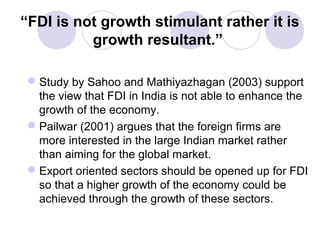
“FDI is not growth stimulant rather it is
growth resultant.”
 Study by Sahoo and Mathiyazhagan (2003) support
the view that FDI in India is not able to enhance the
growth of the economy.
 Pailwar (2001) argues that the foreign firms are
more interested in the large Indian market rather
than aiming for the global market.
 Export oriented sectors should be opened up for FDI
so that a higher growth of the economy could be
achieved through the growth of these sectors.
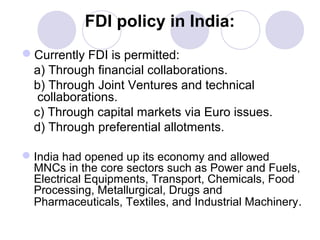
FDI policy in India:
Currently FDI is permitted:
a) Through financial collaborations.
b) Through Joint Ventures and technical
collaborations.
c) Through capital markets via Euro issues.
d) Through preferential allotments.
 India had opened up its economy and allowed
MNCs in the core sectors such as Power and Fuels,
Electrical Equipments, Transport, Chemicals, Food
Processing, Metallurgical, Drugs and
Pharmaceuticals, Textiles, and Industrial Machinery.
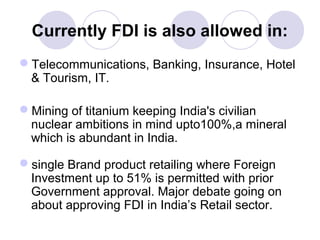
Currently FDI is also allowed in:
Telecommunications, Banking, Insurance, Hotel
& Tourism, IT.
Mining of titanium keeping India's civilian
nuclear ambitions in mind upto100%,a mineral
which is abundant in India.
single Brand product retailing where Foreign
Investment up to 51% is permitted with prior
Government approval. Major debate going on
about approving FDI in India’s Retail sector.
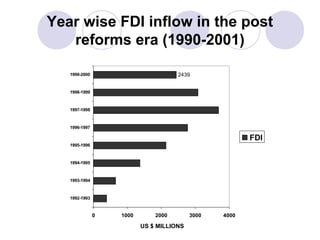
Year wise FDI inflow in the post
reforms era (1990-2001)
2439

1999-2000

1998-1999

1997-1998

1996-1997

FDI
1995-1996

1994-1995

1993-1994

1992-1993

0

1000

2000

US $ MILLIONS

3000

4000
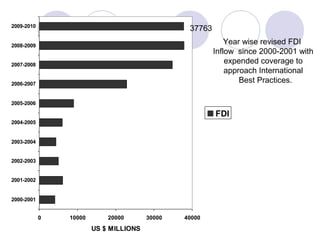
2009-2010

37763
Year wise revised FDI
Inflow since 2000-2001 with
expended coverage to
approach International
Best Practices.

2008-2009
2007-2008
2006-2007

2005-2006

FDI
2004-2005

2003-2004
2002-2003
2001-2002

2000-2001

0

10000

20000

US $ MILLIONS

30000

40000
 The growth of FDI inflows in India was not significant
until 1991 due to the regulatory policy framework.
 There has been a steady build up in the actual FDI
inflows in the post-liberalization period. Actual
inflows have steadily increased from US $ 143.6
million in 1991 to US $ 37,763 million in 2010.

The pace of FDI inflows to India has definitely been
slower than some of the smaller developing
countries like Indonesia, Thailand, Malaysia and
Vietnam.
 India had registered a declining trend of FDI inflows
and the FDI- GDP ratio especially in 1998 and 2003
could be attributed to many factors, including the US
sanctions imposed in the aftermath of the nuclear
tests and Swadeshi movements.

 But since 2006 India has seen a remarkably higher
growth of FDI in accordance with the general trends
of the global economy with a slight dip in the year
2009-2010.
 Capital goods sector has more or less been
bypassed by FDI. This clearly points out the
tendency of foreign investment to exploit the pent up
domestic demand for consumer durable goods.
 A gradual increase in the mergers and acquisitions
during the 1990s which show a tendency of FDI
inflows to acquire existing industrial assets and
managerial control without actually engaging in new
productive activities (Nagraj, 2006).
er
s

2

O
th

ce

4

Fr
an

m
an
y

4

G
er

yp
ru
s

4

C

pa
n

nd
s

5

Ja

er
la

5

et
h

7

N

.K

.

9

U

.S
.A

10

U

ap
or
e

ri t
iu
s

45

Si
ng

M
au

%age to total Inflows (in terms of US $)

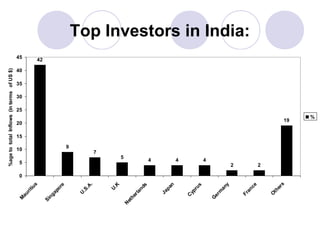
Top Investors in India:

42

40

35

30

25

20
19

15

2

0
%
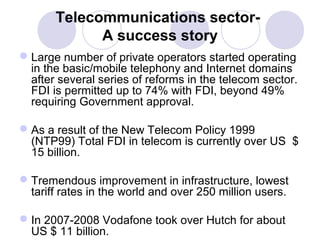
Telecommunications sectorA success story
 Large number of private operators started operating
in the basic/mobile telephony and Internet domains
after several series of reforms in the telecom sector.
FDI is permitted up to 74% with FDI, beyond 49%
requiring Government approval.
 As a result of the New Telecom Policy 1999
(NTP99) Total FDI in telecom is currently over US $
15 billion.
 Tremendous improvement in infrastructure, lowest
tariff rates in the world and over 250 million users.
 In 2007-2008 Vodafone took over Hutch for about
US $ 11 billion.
Retail Sector in India
 Retail industry in India is one of the fastest growing.
 Contributes 14% to the national GDP and employs
7% of the total workforce.
 The retail industry is divided into organised and
unorganised sectors.
 Organised trade employs roughly 5 lakh people
whereas the unorganized retail trade employs nearly
3.95 crores.
 Growth in Retail as a result of economic expansion
as well as jobless growth.
Major arguments against adoption of
FDI in Retail in India:
 FDI driven modern retailing is labour displacing.
 It can only expand by destroying the traditional retail
sector.
 Foreign retail firms have deep pockets and can
cause even the organized retail sector to go out of
business.
 Will buy big from India and abroad and be able to
sell low. When monopoly situation is created will will
buy low and sell high.
It is true that it is in the consumer’s best interest
to obtain his goods and services at the lowest
possible price. But collective well being should
take precedence.
Suggestive measures to eliminate the
negative effects of FDI in Retail
 FDI should be aggressively promoted in R&D,
Manufacturing, Entertainment to accommodate the
people who have lost their jobs.
 Import duty should be imposed to protect domestic
production units.
 Labour laws should be imposed to ensure that no
management jobs are outsourced.
 Jobs should be reserved for the poor people.
 Hindi and local languages as a mode of operation
should be encouraged.
 Cooperative societies should be formed for the
farmers and other agricultural suppliers to take care
of their rights.
 The foreign retail units should be made to divest a
certain percentage of their equity in the Indian
financial markets.
 Social infrastructure like schools, colleges and
hospitals should be developed to promote human
capital formation
Bibliography
http://en.wikipedia.org/wiki/Foreign_direct
_investment
http://www.sharetipsinfo.com/fdiretail.html
http://en.wikipedia.org/wiki/Retailing_in_In
dia
http://toostep.com/debate/what-is-impactof-fdi-in-indian-market
THANK
YOU !

Fdi & its impact

  • 1.
    FDI in India: Impact of FDI in India
  • 2.
    Presented by : AviPipada – 13011 Divya Parekh - 13022 Jayesh Porwal - 13036 Yusuf Shaikh – 13043 Rahul Chabukswar - 13051
  • 3.
    INDEX :  Whatis FDI  Why FDI  Drawbacks of FDI  Impact of FDI on host economy  Studies on FDI in India  FDI policy in India  Year wise FDI inflow in the post reforms era (1990-2010)  Top Investors in India  Telecommunications sector  Retail Sector in India
  • 4.
    What is FDI? •Foreign direct investment (FDI) is a direct investment into production or business in a country by an individual or company of another country, either by buying a company in the target country or by expanding operations of an existing business in that country. • • Foreign direct investment is in contrast to portfolio investment which is a passive investment in the securities of another country such as stocks and bonds..
  • 5.
    Why FDI?  Nodebt creation on the part of the government.  Triggers technology transfer.  Assists Human capital formation.  Contributes to international integration by promoting exports.  Increases productivity and competitiveness. Improves efficiency of resources. Promotes innovation
  • 6.
    Drawbacks of FDI Localfirms may loose business because of the oligopolistic power of foreign firms.  The repatriation of profit may drain out the capital of the host country. Local population may be displaced out of their jobs if they are unable to cope with the technologically advanced foreign firms.
  • 7.
    Impact of FDIon host economyReview of literatures.  FDI may have a negative impact on the growth of the developing countries (Singer,1950; Griffin, 1970).  Hanson (2001) argues that evidence that FDI generates positive spillovers for host countries is weak.  FDI could have a favorable short-term effect on growth as it expands the economic activity. However, in the long run it reduces the growth rate due to dependency, particularly due to “decapitalization” (Bornschier, 1980).
  • 8.
    Studies on FDIin India  Banga (2005) demonstrates that FDI, trade and technological progress have differential impact on wages and employment.  Higher extent of FDI in an industry leads to higher wage rate, it has no impact on its employment.  Higher export intensity of an industry increases employment in the industry but has no effect on its wage rate.  Import of technology has unfavorably affected employment in India. The study by Sharma (2000) concluded that FDI does not have a statistically significant role in the export promotion in Indian Economy.
  • 9.
    “FDI is notgrowth stimulant rather it is growth resultant.”  Study by Sahoo and Mathiyazhagan (2003) support the view that FDI in India is not able to enhance the growth of the economy.  Pailwar (2001) argues that the foreign firms are more interested in the large Indian market rather than aiming for the global market.  Export oriented sectors should be opened up for FDI so that a higher growth of the economy could be achieved through the growth of these sectors.
  • 10.
    FDI policy inIndia: Currently FDI is permitted: a) Through financial collaborations. b) Through Joint Ventures and technical collaborations. c) Through capital markets via Euro issues. d) Through preferential allotments.  India had opened up its economy and allowed MNCs in the core sectors such as Power and Fuels, Electrical Equipments, Transport, Chemicals, Food Processing, Metallurgical, Drugs and Pharmaceuticals, Textiles, and Industrial Machinery.
  • 11.
    Currently FDI isalso allowed in: Telecommunications, Banking, Insurance, Hotel & Tourism, IT. Mining of titanium keeping India's civilian nuclear ambitions in mind upto100%,a mineral which is abundant in India. single Brand product retailing where Foreign Investment up to 51% is permitted with prior Government approval. Major debate going on about approving FDI in India’s Retail sector.
  • 12.
    Year wise FDIinflow in the post reforms era (1990-2001) 2439 1999-2000 1998-1999 1997-1998 1996-1997 FDI 1995-1996 1994-1995 1993-1994 1992-1993 0 1000 2000 US $ MILLIONS 3000 4000
  • 13.
    2009-2010 37763 Year wise revisedFDI Inflow since 2000-2001 with expended coverage to approach International Best Practices. 2008-2009 2007-2008 2006-2007 2005-2006 FDI 2004-2005 2003-2004 2002-2003 2001-2002 2000-2001 0 10000 20000 US $ MILLIONS 30000 40000
  • 14.
     The growthof FDI inflows in India was not significant until 1991 due to the regulatory policy framework.  There has been a steady build up in the actual FDI inflows in the post-liberalization period. Actual inflows have steadily increased from US $ 143.6 million in 1991 to US $ 37,763 million in 2010.  The pace of FDI inflows to India has definitely been slower than some of the smaller developing countries like Indonesia, Thailand, Malaysia and Vietnam.
  • 15.
     India hadregistered a declining trend of FDI inflows and the FDI- GDP ratio especially in 1998 and 2003 could be attributed to many factors, including the US sanctions imposed in the aftermath of the nuclear tests and Swadeshi movements.  But since 2006 India has seen a remarkably higher growth of FDI in accordance with the general trends of the global economy with a slight dip in the year 2009-2010.
  • 16.
     Capital goodssector has more or less been bypassed by FDI. This clearly points out the tendency of foreign investment to exploit the pent up domestic demand for consumer durable goods.  A gradual increase in the mergers and acquisitions during the 1990s which show a tendency of FDI inflows to acquire existing industrial assets and managerial control without actually engaging in new productive activities (Nagraj, 2006).
  • 17.
  • 18.
    Telecommunications sectorA successstory  Large number of private operators started operating in the basic/mobile telephony and Internet domains after several series of reforms in the telecom sector. FDI is permitted up to 74% with FDI, beyond 49% requiring Government approval.  As a result of the New Telecom Policy 1999 (NTP99) Total FDI in telecom is currently over US $ 15 billion.  Tremendous improvement in infrastructure, lowest tariff rates in the world and over 250 million users.  In 2007-2008 Vodafone took over Hutch for about US $ 11 billion.
  • 19.
    Retail Sector inIndia  Retail industry in India is one of the fastest growing.  Contributes 14% to the national GDP and employs 7% of the total workforce.  The retail industry is divided into organised and unorganised sectors.  Organised trade employs roughly 5 lakh people whereas the unorganized retail trade employs nearly 3.95 crores.  Growth in Retail as a result of economic expansion as well as jobless growth.
  • 20.
    Major arguments againstadoption of FDI in Retail in India:  FDI driven modern retailing is labour displacing.  It can only expand by destroying the traditional retail sector.  Foreign retail firms have deep pockets and can cause even the organized retail sector to go out of business.  Will buy big from India and abroad and be able to sell low. When monopoly situation is created will will buy low and sell high.
  • 21.
    It is truethat it is in the consumer’s best interest to obtain his goods and services at the lowest possible price. But collective well being should take precedence.
  • 22.
    Suggestive measures toeliminate the negative effects of FDI in Retail  FDI should be aggressively promoted in R&D, Manufacturing, Entertainment to accommodate the people who have lost their jobs.  Import duty should be imposed to protect domestic production units.  Labour laws should be imposed to ensure that no management jobs are outsourced.  Jobs should be reserved for the poor people.
  • 23.
     Hindi andlocal languages as a mode of operation should be encouraged.  Cooperative societies should be formed for the farmers and other agricultural suppliers to take care of their rights.  The foreign retail units should be made to divest a certain percentage of their equity in the Indian financial markets.  Social infrastructure like schools, colleges and hospitals should be developed to promote human capital formation
  • 24.
  • 25.