PRESENTED BY:
Swarna J,
13PMM458,
1 st Semester,
Dept. Of Pharma. Management,
NIPER.
INTRODUCTION


World is perceived as a global village

Globalization is the integration of economies of world
through uninhibited trade and financial flows, as also
through mutual exchange of technology and
knowledge.
 Globalization implies opening up of the economy to
Foreign Investment by providing facilities to foreign
companies to invest in different fields of economic
activity.
 Globalisation has made markets highly competitive
and there is remarkable growth of new service
products

OBJECTIVES:


Expansion Strategy : Companies start investing because
they want to make their product world available.



New Source of demand : In many situations growth is
restricted in the home country because of intense competition
or due to unfavorable market conditions.



Low cost production : In many countries the cost of
production is low because of raw materials, availability of man
power etc.



Economies of scale : if a large scale of a production is done
than the ratio of wastage comes down and the cost reduces
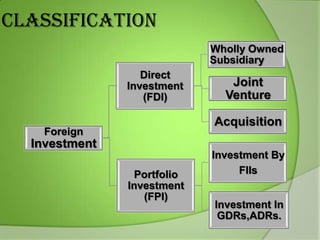
CLASSIFICATION
Wholly Owned
Subsidiary
Direct
Investment
(FDI)

Joint
Venture
Acquisition

Foreign

Investment
Portfolio
Investment
(FPI)

Investment By
FIIs
Investment In
GDRs,ADRs.
FDI AND FII
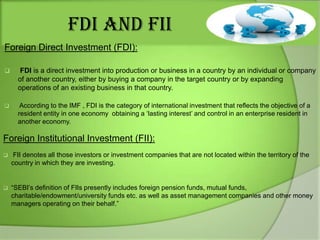
Foreign Direct Investment (FDI):


FDI is a direct investment into production or business in a country by an individual or company
of another country, either by buying a company in the target country or by expanding
operations of an existing business in that country.



According to the IMF , FDI is the category of international investment that reflects the objective of a
resident entity in one economy obtaining a „lasting interest‟ and control in an enterprise resident in
another economy.

Foreign Institutional Investment (FII):


FII denotes all those investors or investment companies that are not located within the territory of the
country in which they are investing.



“SEBI‟s definition of FIIs presently includes foreign pension funds, mutual funds,
charitable/endowment/university funds etc. as well as asset management companies and other money
managers operating on their behalf.”
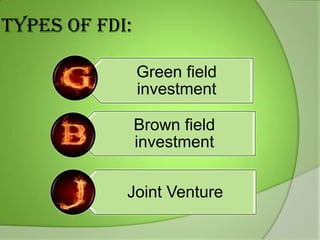
TYPES OF FDI:
Green field
investment

Brown field
investment
Joint Venture
FDI POLICY
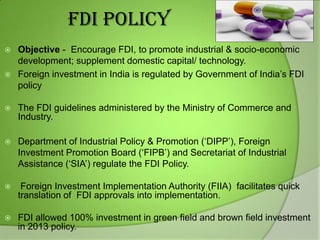
Objective - Encourage FDI, to promote industrial & socio-economic
development; supplement domestic capital/ technology.
 Foreign investment in India is regulated by Government of India‟s FDI
policy




The FDI guidelines administered by the Ministry of Commerce and
Industry.



Department of Industrial Policy & Promotion („DIPP‟), Foreign
Investment Promotion Board („FIPB‟) and Secretariat of Industrial
Assistance („SIA‟) regulate the FDI Policy.



Foreign Investment Implementation Authority (FIIA) facilitates quick
translation of FDI approvals into implementation.



FDI allowed 100% investment in green field and brown field investment
in 2013 policy.
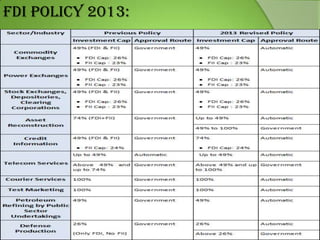
FDI POLICY 2013:
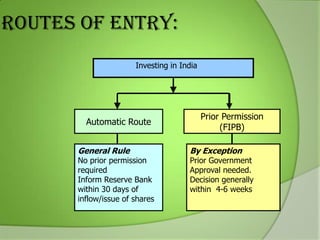
Routes of entry:
Investing in India

Automatic Route
General Rule

No prior permission
required
Inform Reserve Bank
within 30 days of
inflow/issue of shares

Prior Permission
(FIPB)
By Exception

Prior Government
Approval needed.
Decision generally
within 4-6 weeks
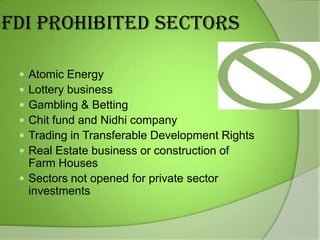
FDI PROHIBITED SECTORS







Atomic Energy
Lottery business
Gambling & Betting
Chit fund and Nidhi company
Trading in Transferable Development Rights
Real Estate business or construction of
Farm Houses
 Sectors not opened for private sector
investments
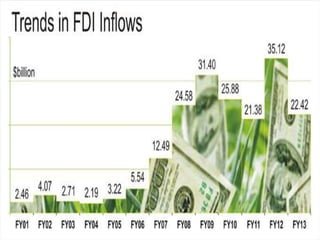
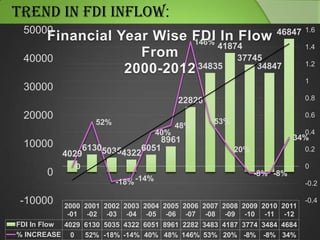
TREND IN FDI INFLOW:
50000

46847

Financial Year Wise FDI In Flow
146%
41874
From
37745
40000
34847
2000-2012 34835

1.4

1.2
1

30000

0.8

22826

20000

52%
40%

10000
0
-10000

1.6

48%

8961
61305035
6051
4322
4029
0

0.6

53%

0.4

34%
20%

0.2
0

-18% -14%

-8% -8%

2000 2001 2002 2003 2004 2005 2006 2007 2008 2009 2010 2011
-01 -02 -03 -04 -05 -06 -07 -08 -09 -10 -11 -12

FDI In Flow 4029 6130 5035 4322 6051 8961 2282 3483 4187 3774 3484 4684
% INCREASE 0
52% -18% -14% 40% 48% 146% 53% 20% -8% -8% 34%

-0.2
-0.4
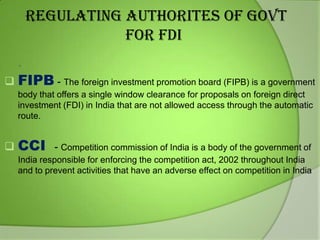
REGULATING AUTHORITES OF GOVT
FOR FDI
.

 FIPB - The foreign investment promotion board (FIPB) is a government
body that offers a single window clearance for proposals on foreign direct
investment (FDI) in India that are not allowed access through the automatic
route.

 CCI - Competition commission of India is a body of the government of
India responsible for enforcing the competition act, 2002 throughout India
and to prevent activities that have an adverse effect on competition in India








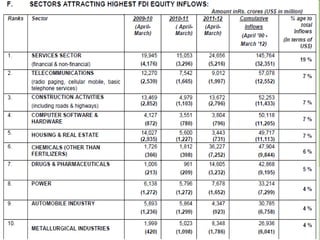
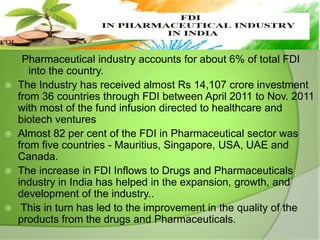
Pharmaceutical industry accounts for about 6% of total FDI
into the country.
The Industry has received almost Rs 14,107 crore investment
from 36 countries through FDI between April 2011 to Nov. 2011
with most of the fund infusion directed to healthcare and
biotech ventures
Almost 82 per cent of the FDI in Pharmaceutical sector was
from five countries - Mauritius, Singapore, USA, UAE and
Canada.
The increase in FDI Inflows to Drugs and Pharmaceuticals
industry in India has helped in the expansion, growth, and
development of the industry..
This in turn has led to the improvement in the quality of the
products from the drugs and Pharmaceuticals.


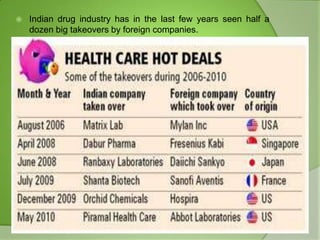
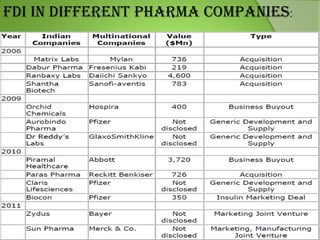
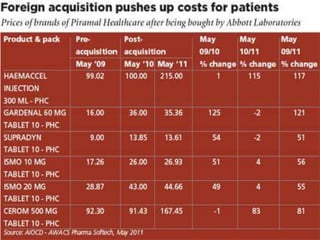
Indian drug industry has in the last few years seen half a
dozen big takeovers by foreign companies.
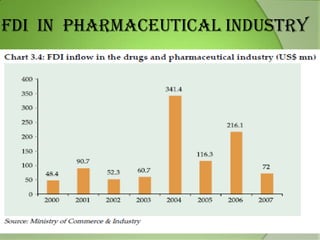
FDI IN PHARMACEUTICAL INDUSTRY
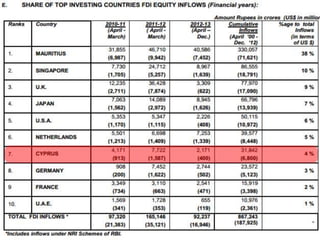
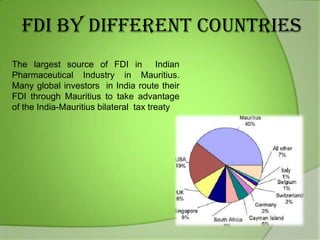
FDI BY DIFFERENT COUNTRIES
The largest source of FDI in Indian
Pharmaceutical Industry in Mauritius.
Many global investors in India route their
FDI through Mauritius to take advantage
of the India-Mauritius bilateral tax treaty
FDI IN DIFFERENT PHARMA COMPANIES:
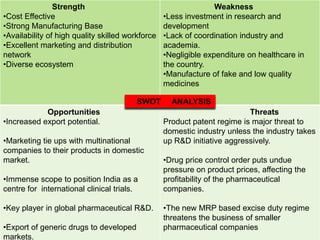
Strength
•Cost Effective
•Strong Manufacturing Base
•Availability of high quality skilled workforce
•Excellent marketing and distribution
network
•Diverse ecosystem

Weakness
•Less investment in research and
development
•Lack of coordination industry and
academia.
•Negligible expenditure on healthcare in
the country.
•Manufacture of fake and low quality
medicines

SWOT ANALYSIS

SWOT
Opportunities
•Increased export potential.
•Marketing tie ups with multinational
companies to their products in domestic
market.

•Immense scope to position India as a
centre for international clinical trials.
•Key player in global pharmaceutical R&D.
•Export of generic drugs to developed
markets.

ANALYSIS
Threats
Product patent regime is major threat to
domestic industry unless the industry takes
up R&D initiative aggressively.
•Drug price control order puts undue
pressure on product prices, affecting the
profitability of the pharmaceutical
companies.
•The new MRP based excise duty regime
threatens the business of smaller
pharmaceutical companies
ADVANTAGES AND DISADVANTAGES
OF FDI:
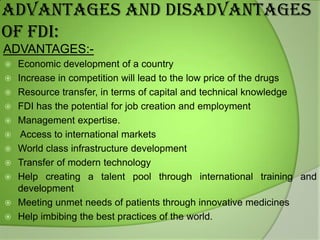
ADVANTAGES:











Economic development of a country
Increase in competition will lead to the low price of the drugs
Resource transfer, in terms of capital and technical knowledge
FDI has the potential for job creation and employment
Management expertise.
Access to international markets
World class infrastructure development
Transfer of modern technology
Help creating a talent pool through international training and
development
Meeting unmet needs of patients through innovative medicines
Help imbibing the best practices of the world.
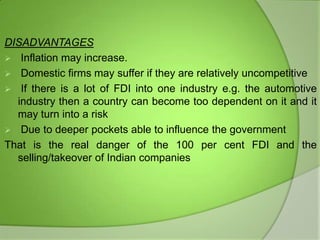
DISADVANTAGES
 Inflation may increase.
 Domestic firms may suffer if they are relatively uncompetitive
 If there is a lot of FDI into one industry e.g. the automotive
industry then a country can become too dependent on it and it
may turn into a risk
 Due to deeper pockets able to influence the government
That is the real danger of the 100 per cent FDI and the
selling/takeover of Indian companies
KEY DRIVERS & BARRIERS
DRIVERS:







Domestic market size, prospects for future market growth,
Cheaper operating cost
Cheaper input and English-speaking skilled manpower cost
Regulatory environment
Pricing environment
Legal, IPR and financial framework

BARRIERS:




Poor healthcare coverage
Country Attractiveness Index (CAI)
Measures taken by government:


Government has offered fiscal incentives to R&D units in Pharma
sector



Steps have been taken to streamline procedures covering
development of new drug molecules, clinical research etc.



A number of in-house R&D units holding recognition of DSIR
have come up in the Pharma sector. These units are eligible for
weighted tax deduction@200% for the R&D expenditure incurred.



Government has also come up with two new schemes specially
targeted at drugs & pharmaceutical research. These are: 'The
New Millennium Indian Technology Leadership Initiative' (NMITLI)
and the 'Drugs and Pharmaceuticals Research Programme'
(DPRP).
CONCLUSION
The effects of globalization on Indian
industry through FDI has proved to be positive as well as negative




The government of India must try to make economic policies
with regard to Indian Industries globalization that are beneficial
and not harmful



To attract more FDI in the pharmaceutical sector and effectively
compete with other developing countries like China, India
should primarily focus in creating a vibrant and large domestic
pharmaceutical product and services market reflecting
sustainable high inclusive growth.
"If there is one place on the face
of this Earth where all the dreams
of living men have found a home
when man began the dream of
existence, it is India".
Romain Rolland,
French philosopher

FDI IN PHARMACEUTICAL INDUSTRY IN INDIA

  • 1.
    PRESENTED BY: Swarna J, 13PMM458, 1st Semester, Dept. Of Pharma. Management, NIPER.
  • 2.
    INTRODUCTION  World is perceivedas a global village Globalization is the integration of economies of world through uninhibited trade and financial flows, as also through mutual exchange of technology and knowledge.  Globalization implies opening up of the economy to Foreign Investment by providing facilities to foreign companies to invest in different fields of economic activity.  Globalisation has made markets highly competitive and there is remarkable growth of new service products 
  • 3.
    OBJECTIVES:  Expansion Strategy :Companies start investing because they want to make their product world available.  New Source of demand : In many situations growth is restricted in the home country because of intense competition or due to unfavorable market conditions.  Low cost production : In many countries the cost of production is low because of raw materials, availability of man power etc.  Economies of scale : if a large scale of a production is done than the ratio of wastage comes down and the cost reduces
  • 4.
  • 5.
    FDI AND FII ForeignDirect Investment (FDI):  FDI is a direct investment into production or business in a country by an individual or company of another country, either by buying a company in the target country or by expanding operations of an existing business in that country.  According to the IMF , FDI is the category of international investment that reflects the objective of a resident entity in one economy obtaining a „lasting interest‟ and control in an enterprise resident in another economy. Foreign Institutional Investment (FII):  FII denotes all those investors or investment companies that are not located within the territory of the country in which they are investing.  “SEBI‟s definition of FIIs presently includes foreign pension funds, mutual funds, charitable/endowment/university funds etc. as well as asset management companies and other money managers operating on their behalf.”
  • 6.
    TYPES OF FDI: Greenfield investment Brown field investment Joint Venture
  • 7.
    FDI POLICY Objective -Encourage FDI, to promote industrial & socio-economic development; supplement domestic capital/ technology.  Foreign investment in India is regulated by Government of India‟s FDI policy   The FDI guidelines administered by the Ministry of Commerce and Industry.  Department of Industrial Policy & Promotion („DIPP‟), Foreign Investment Promotion Board („FIPB‟) and Secretariat of Industrial Assistance („SIA‟) regulate the FDI Policy.  Foreign Investment Implementation Authority (FIIA) facilitates quick translation of FDI approvals into implementation.  FDI allowed 100% investment in green field and brown field investment in 2013 policy.
  • 8.
  • 9.
    Routes of entry: Investingin India Automatic Route General Rule No prior permission required Inform Reserve Bank within 30 days of inflow/issue of shares Prior Permission (FIPB) By Exception Prior Government Approval needed. Decision generally within 4-6 weeks
  • 10.
    FDI PROHIBITED SECTORS       AtomicEnergy Lottery business Gambling & Betting Chit fund and Nidhi company Trading in Transferable Development Rights Real Estate business or construction of Farm Houses  Sectors not opened for private sector investments
  • 12.
    TREND IN FDIINFLOW: 50000 46847 Financial Year Wise FDI In Flow 146% 41874 From 37745 40000 34847 2000-2012 34835 1.4 1.2 1 30000 0.8 22826 20000 52% 40% 10000 0 -10000 1.6 48% 8961 61305035 6051 4322 4029 0 0.6 53% 0.4 34% 20% 0.2 0 -18% -14% -8% -8% 2000 2001 2002 2003 2004 2005 2006 2007 2008 2009 2010 2011 -01 -02 -03 -04 -05 -06 -07 -08 -09 -10 -11 -12 FDI In Flow 4029 6130 5035 4322 6051 8961 2282 3483 4187 3774 3484 4684 % INCREASE 0 52% -18% -14% 40% 48% 146% 53% 20% -8% -8% 34% -0.2 -0.4
  • 15.
    REGULATING AUTHORITES OFGOVT FOR FDI .  FIPB - The foreign investment promotion board (FIPB) is a government body that offers a single window clearance for proposals on foreign direct investment (FDI) in India that are not allowed access through the automatic route.  CCI - Competition commission of India is a body of the government of India responsible for enforcing the competition act, 2002 throughout India and to prevent activities that have an adverse effect on competition in India
  • 16.
        Pharmaceutical industry accountsfor about 6% of total FDI into the country. The Industry has received almost Rs 14,107 crore investment from 36 countries through FDI between April 2011 to Nov. 2011 with most of the fund infusion directed to healthcare and biotech ventures Almost 82 per cent of the FDI in Pharmaceutical sector was from five countries - Mauritius, Singapore, USA, UAE and Canada. The increase in FDI Inflows to Drugs and Pharmaceuticals industry in India has helped in the expansion, growth, and development of the industry.. This in turn has led to the improvement in the quality of the products from the drugs and Pharmaceuticals.
  • 17.
     Indian drug industryhas in the last few years seen half a dozen big takeovers by foreign companies.
  • 18.
  • 19.
    FDI BY DIFFERENTCOUNTRIES The largest source of FDI in Indian Pharmaceutical Industry in Mauritius. Many global investors in India route their FDI through Mauritius to take advantage of the India-Mauritius bilateral tax treaty
  • 20.
    FDI IN DIFFERENTPHARMA COMPANIES:
  • 21.
    Strength •Cost Effective •Strong ManufacturingBase •Availability of high quality skilled workforce •Excellent marketing and distribution network •Diverse ecosystem Weakness •Less investment in research and development •Lack of coordination industry and academia. •Negligible expenditure on healthcare in the country. •Manufacture of fake and low quality medicines SWOT ANALYSIS SWOT Opportunities •Increased export potential. •Marketing tie ups with multinational companies to their products in domestic market. •Immense scope to position India as a centre for international clinical trials. •Key player in global pharmaceutical R&D. •Export of generic drugs to developed markets. ANALYSIS Threats Product patent regime is major threat to domestic industry unless the industry takes up R&D initiative aggressively. •Drug price control order puts undue pressure on product prices, affecting the profitability of the pharmaceutical companies. •The new MRP based excise duty regime threatens the business of smaller pharmaceutical companies
  • 22.
    ADVANTAGES AND DISADVANTAGES OFFDI: ADVANTAGES:           Economic development of a country Increase in competition will lead to the low price of the drugs Resource transfer, in terms of capital and technical knowledge FDI has the potential for job creation and employment Management expertise. Access to international markets World class infrastructure development Transfer of modern technology Help creating a talent pool through international training and development Meeting unmet needs of patients through innovative medicines Help imbibing the best practices of the world.
  • 23.
    DISADVANTAGES  Inflation mayincrease.  Domestic firms may suffer if they are relatively uncompetitive  If there is a lot of FDI into one industry e.g. the automotive industry then a country can become too dependent on it and it may turn into a risk  Due to deeper pockets able to influence the government That is the real danger of the 100 per cent FDI and the selling/takeover of Indian companies
  • 25.
    KEY DRIVERS &BARRIERS DRIVERS:       Domestic market size, prospects for future market growth, Cheaper operating cost Cheaper input and English-speaking skilled manpower cost Regulatory environment Pricing environment Legal, IPR and financial framework BARRIERS:   Poor healthcare coverage Country Attractiveness Index (CAI)
  • 26.
    Measures taken bygovernment:  Government has offered fiscal incentives to R&D units in Pharma sector  Steps have been taken to streamline procedures covering development of new drug molecules, clinical research etc.  A number of in-house R&D units holding recognition of DSIR have come up in the Pharma sector. These units are eligible for weighted tax deduction@200% for the R&D expenditure incurred.  Government has also come up with two new schemes specially targeted at drugs & pharmaceutical research. These are: 'The New Millennium Indian Technology Leadership Initiative' (NMITLI) and the 'Drugs and Pharmaceuticals Research Programme' (DPRP).
  • 27.
    CONCLUSION The effects ofglobalization on Indian industry through FDI has proved to be positive as well as negative   The government of India must try to make economic policies with regard to Indian Industries globalization that are beneficial and not harmful  To attract more FDI in the pharmaceutical sector and effectively compete with other developing countries like China, India should primarily focus in creating a vibrant and large domestic pharmaceutical product and services market reflecting sustainable high inclusive growth.
  • 28.
    "If there isone place on the face of this Earth where all the dreams of living men have found a home when man began the dream of existence, it is India". Romain Rolland, French philosopher