
„Corporate Governance – Code and Practices with special reference to International practice‟
97th MSOP ICSI-EIRC “ GROUP – E”
Members of 97th MSOP Batch: „Group E‟
1 • Mr. Lingraj Patra : 12o350212/08/2009
2 • Ms. Rita Maity : 120401893/04/2010
3 • Mr. Vikhyaat Roy : 120481157/02/2011
4 • Mr. Mayank Sahal : 120354721/08/2009
5 • Mr. Gautam Kumar Singh : 120523626/07/2011
6 • Mr. Sumit Kumar Shaw : 120395111/02/2010
7 • Ms. Ankita Agarwal : 120607931/02/2012
8 • Ms. Nidhi Trivedi : 120370446/02/2010
9 • Ms. Pooja Saraswat : 420900513/02/2011
10 • Mr. Uttam Anurag : 120445839/10/2010
„Corporate Governance – Code and Practices with special reference to International practice‟
97th MSOP ICSI-EIRC “ GROUP – E”
What is Corporate Governance?
 “Corporate Governance is nothing but a step towards strengthening of the
organization so as to face the challenges”
 “It is stepping into the shoes of the shareholders, stakeholders, vendors, suppliers
& employees by the Top Managers and CEO of the company”
 “Process and mechanisms by which the capital market monitors the actions of
corporate management”
 “Corporate governance is holding the balance between economic & social goals
and between individual & community goals. The aim is to align as nearly as
possible, the interests of individuals, corporations & society”.
„Corporate Governance – Code and Practices with special reference to International practice‟
97th MSOP ICSI-EIRC “ GROUP – E”
Principles of Corporate Governance:
Sustainable Development of all „Stakeholders‟
Effective Management and Distribution of „Wealth‟
Discharge of „Social Responsibility‟
Application of „Best Management Practices‟
Compliance of „Law in letter and spirit‟
Adherence to „Ethical Standards‟
„Corporate Governance – Code and Practices with special reference to International practice‟
97th MSOP ICSI-EIRC “ GROUP – E”
Four Pillars of Corporate Governance:
Corporate
Governance
Accountability
Transparency
Responsibility
Fairness
„Corporate Governance – Code and Practices with special reference to International practice‟
97th MSOP ICSI-EIRC “ GROUP – E”
„Corporate Governance – Code and Practices with special reference to International practice‟
97th MSOP ICSI-EIRC “ GROUP – E”
“Board of
Directors and
their
constituent
responsibilities
to the ultimate
owners- The
Shareholders”
Accountability
“Right to
information,
timeliness and
integrity of the
information
produced”
Transparency
“Adherence to
the rules, laws
& spirit of
codes”
Responsibility Fairness
“Clarity in
responsibilities
to enhance
accountability”
Evidence of Corporate Governance from the
„Arthashastra‟:
“Raksha”
„It literally means Protection, and in
Corporates it can be equated with the
Risk Management Aspects‟
“Vridhi”
„It literally means Growth, and in
Corporates it can be equated to
Stakeholders Value Enhancement‟
“Palana”
„It literally means Maintenance or
Compliance, and in Corporates it can
be equated to Compliance in Letter and
Spirit‟
“Yogakshema”
„It literally means Social Security
System, and in Corporates it can be
equated to Corporate Social
Responsibility‟
Kautilya`s fourfold of
Corporate Governance
in Arthashastra
„Corporate Governance – Code and Practices with special reference to International practice‟
97th MSOP ICSI-EIRC “ GROUP – E”
Corporate Governance Development Timeline:
USA UK INDIA
„Corporate Governance – Code and Practices with special reference to International practice‟
97th MSOP ICSI-EIRC “ GROUP – E”
CORPORATE GOVERNANCE DEVELOPMENT
TIMELINE IN USA:
 1977 „The Foreign Practices Act‟- USA made specific provisions regarding
establishment, maintenance and review of systems of internal control.
 1979 „US Securities Exchange Commission‟- US Securities Exchange
Commission prescribed mandatory reporting on internal financial controls.
 1985 „Treadway Commission‟- Due to high profile failures in the US, the Treadway
Commission was constituted, they highlighted the need of putting in place a proper
control environment, independent boards and its committees and objective internal
audit function.
 2002 „Sarbanes –Oxley Act‟- After ENRON debacle of 2001, came other scandals
involving large US companies such as WorldCom, Qwest, Global Crossing and the
auditing lacunae that eventually led to collapse of Andersen, the Sarbanes Oxley Act
popularly called SOX was enacted. The Act made fundamental changes in virtually
every aspect of corporate governance in general and auditor independence, conflict of
interest, corporate responsibility, enhanced financial disclosures and severe penalties
for wilful default by managers and auditors, in particular.
„Corporate Governance – Code and Practices with special reference to International practice‟
97th MSOP ICSI-EIRC “ GROUP – E”
CORPORATE GOVERNANCE DEVELOPMENT
TIMELINE IN UK:
A spate of scandals and financial collapses in the UK in late 1980s and early 1990s
led the birth of concept of Corporate Governance:
 1991- To prevent the recurrence of business failures in UK Cadbury Committee
was set up by the London Stock Exchange to raise standards of corporate
governance.
 1995- Sir Richard Greenbury examine the remuneration of the directors in his
report called The Greenbury Report UK.
 1998- Hampel committee was established to review and revise the earlier
recommendations of the Cadbury and Greenbury Committees.
 2001- The Turnbull Report which denoted as original combined code required to
include a narrative statement in their Annual report of how internal control
provisions had been applied.
 2002- Higgs Report for review of the role and effectiveness of Non-Executive
director. Smith Report for guidance Audit Committee& Tyson Report for
recruitment and development of Non-Executive directors.
„Corporate Governance – Code and Practices with special reference to International practice‟
97th MSOP ICSI-EIRC “ GROUP – E”
Emergence of Corporate Governance in India:
 The Indian corporate scenario was more or less stagnant till the early 90s.
 The position and goals of the Indian corporate sector has changed a lot after the
liberalisation of 90s.
 India‟s economic reform programme made a steady progress in 1994.
 In 1996, Confederation of Indian Industry (CII), took a special initiative on Corporate
Governance.
 The objective was to develop and promote a code for corporate governance to be adopted and
followed by Indian companies, be these in the Private Sector, the Public Sector, Banks or
Financial Institutions, all of which are corporate entities.
 This initiative by CII flowed from public concerns regarding the protection of investor
interest, especially the small investor, the promotion of transparency within business and
industry.
(Contd…)
„Corporate Governance – Code and Practices with special reference to International practice‟
97th MSOP ICSI-EIRC “ GROUP – E”
 SEBI appointed in May 1997 the Kumar Mangalam Birla Committee
 Companies Amendment Act, 2000 introduced:
- Setting up of Audit Committee
- Directors‟ Responsibility Statement
 Kumar Mangalam Birla Committee recommendations adopted by SEBI in 2000
 Clause 49 introduced in Listing Agreement
 Narayana Murthy Committee recommendations in 2002 revised Clause 49
-Definition of independent directors
-Certificate by CFO & CEO
-Risk Assessment & Mitigation strategy of the company
-Code of Conduct for top Management
„Corporate Governance – Code and Practices with special reference to International practice‟
97th MSOP ICSI-EIRC “ GROUP – E”
Light to Corporate Governance by Various
Committees:
Kumar Mangalam Birla
Committee : Year 2000
Naresh Chandra Committee :
Year 2002
N.R. Narayan Murthy Committee :
Year 2003
Dr. J.J. Irani Committee : Year 2005
„Corporate Governance – Code and Practices with special reference to International practice‟
97th MSOP ICSI-EIRC “ GROUP – E”
Present Scenario in INDIA:
“Corporate
Governance”
Companies
Act 2013
Clause 49
„Corporate Governance – Code and Practices with special reference to International practice‟
97th MSOP ICSI-EIRC “ GROUP – E”
Code of Practices for Corporate Governance :
„Clause 49‟
Clause 49 (I)(C) :Disclosure and transparency:
1. The company should ensure timely and accurate disclosure on all material matters including the
financial situation, performance, ownership, and governance of the company.
a) Information should be prepared and disclosed in accordance with the prescribed standards of
accounting, financial and non-financial disclosure.
b) Channels for disseminating information should provide for equal, timely and cost efficient access
to relevant information by users.
c) The company should maintain minutes of the meeting explicitly recording dissenting opinions, if
any.
d) The company should implement the prescribed accounting standards in letter and spirit in the
preparation of financial statements taking into consideration the interest of all stakeholders and
should also ensure that the annual audit is conducted by an independent, competent and qualified
auditor.
Contd…..
„Corporate Governance – Code and Practices with special reference to International practice‟
97th MSOP ICSI-EIRC “ GROUP – E”
Clause 49 (II) : Board of Directors:
A. Composition of Board:
1. The Board of Directors of the company shall have an optimum combination of executive and non-
executive directors with at least one woman director and not less than fifty percent of the Board of
Directors comprising non-executive directors.
2. Where the Chairman of the Board is a non-executive director, at least one-third of the Board
should comprise independent directors and in case the company does not have a regular non-
executive Chairman, at least half of the Board should comprise independent directors.
Provided that where the regular non-executive Chairman is a promoter of the company or is
related to any promoter or person occupying management positions at the Board level or at one
level below the Board, at least one-half of the Board of the company shall consist of independent
directors.
C. Non-executive Directors‟ compensation and disclosures:
All fees / compensation, if any paid to non-executive directors, including independent directors, shall be
fixed by the Board of Directors and shall require previous approval of shareholders in general meeting.
The shareholders‟ resolution shall specify the limits for the maximum number of stock options that can
be granted to non-executive directors, in any financial year and in aggregate.
Provided that the requirement of obtaining prior approval of shareholders in general meeting shall not
apply to payment of sitting fees to non-executive directors, if made within the limits prescribed under
the Companies Act, 2013 for payment of sitting fees without approval of the Central Government.
Contd….
„Corporate Governance – Code and Practices with special reference to International practice‟
97th MSOP ICSI-EIRC “ GROUP – E”
D. Other provisions as to Board and Committees:
1. The Board shall meet at least four times a year, with a maximum time gap of one hundred and
twenty days between any two meetings. The minimum information to be made available to the
Board is given in Annexure - X to the Listing Agreement.
2. A director shall not be a member in more than ten committees or act as Chairman of more than
five committees across all companies in which he is a director. Furthermore, every director shall
inform the company about the committee positions he occupies in other companies and notify
changes as and when they take place.
E. Code of Conduct:
The Board shall lay down a code of conduct for all Board members and senior management of the
company. The code of conduct shall be posted on the website of the company.
F. Whistle Blower Policy:
The company shall establish a vigil mechanism for directors and employees to report concerns about
unethical behaviour, actual or suspected fraud or violation of the company‟s code of conduct or ethics
policy.
„Corporate Governance – Code and Practices with special reference to International practice‟
97th MSOP ICSI-EIRC “ GROUP – E”
Clause 49 (III). Audit Committee
Clause 49 (IV). Nomination and Remuneration Committee
Clause 49 (VI). Risk Management
Clause 49 (VII). Related Party Transactions
Clause 49 (VIII). Disclosures
Clause 49 (IX).CEO/CFO certification
„Corporate Governance – Code and Practices with special reference to International practice‟
97th MSOP ICSI-EIRC “ GROUP – E”
Code of Practices for Corporate Governance :
„Companies Act‟ 2013‟
 Concept of Independent Directors introduced for the first time.
 Different committees are mandated by the Act.
 A full-time director is also covered under the definition of “Key Managerial Personnel”.
 The auditor is to be rotated "at such interval" as may be determined by resolution.
 The limit of the number of companies for which a person may be appointed as auditor is
proposed as 20 companies. In case of an audit firm, the limit is applicable to each partner.
 Appointment of auditors for a five-year period is subject to ratification at every annual
general meeting.
 The Act proposes that corporates spend 2% percentage of three years average profits towards
CSR activities.
 The Act provides for e-voting mechanism for shareholders participation in large.
 The Act provides for various policies to be framed by Companies for more transparency and
Governance.
 The concept of Insider Trading and to regulate the price sensitive information provided in
Act.
 The Act provides for various disclosures and penalty for defaults.
 The Act fulfills the gap that the old Companies Act „ 1956 had in respect of Good Governance.
„Corporate Governance – Code and Practices with special reference to International practice‟
97th MSOP ICSI-EIRC “ GROUP – E”
„Corporate Governance – Code and Practices with special reference to International practice‟
97th MSOP ICSI-EIRC “ GROUP – E”
Case Study:
Collapses Leading to Corporate Governance
Evolution:
Collapses
International
ENRON
Qwest
Worldcom
National
Ranbaxy
Satyam
United Group
Uniworth
„Corporate Governance – Code and Practices with special reference to International practice‟
97th MSOP ICSI-EIRC “ GROUP – E”
„Corporate Governance – Code and Practices with special reference to International practice‟
97th MSOP ICSI-EIRC “ GROUP – E”
Scam Subject Amount involved
(Rs)
Satyam Accounting Scandal 588 crore
NESL & FTIL Corporate scandal 5600 crore
Ranbaxy & Sunpharma Accounting Scandal 3000 crore
Qwest Communications
International Inc.
Corporate scandal 6600 crore
Bird view of Major Scams:
What was Satyam Scam all about…
 The company‟s Balance Sheet was inflated to Rs. 5,361 Cr at the end of
September 2008 against the actual Rs. 5,040 Cr.
 There is an artificial cash balance of Rs.588 Cr in September 2008.
 Rs.1,230 Cr was arranged to Satyam, which is not reflected in its books, to
keep Satyam's operations running.
 Raju also admitted that Satyam's profits were inflated over several years.
„Corporate Governance – Code and Practices with special reference to International practice‟
97th MSOP ICSI-EIRC “ GROUP – E”
How Did The Satyam Scam Matter To The
Nation?
Job’s of over 50,000 technocrats were at risk.
 Country’s booming economy feared slight collapse as
Country's GDP fell by estimated 0.4%.
 India’s I.T. sector suffered downturn as it’s image was
tarnished globally.
„Corporate Governance – Code and Practices with special reference to International practice‟
97th MSOP ICSI-EIRC “ GROUP – E”
Ohh
Nooo….
ALL’s WELL THAT’s END WELL
„Corporate Governance – Code and Practices with special reference to International practice‟
97th MSOP ICSI-EIRC “ GROUP – E”
“Satyam Computers was took over by Mahindra
Group I.T. Arm , Tech Mahindra on April 13, 2009”
Largest Dis-communication Company (Us)
Highlights of Case :
• „Fraudulent recognition of $3.8 billion revenue
• Non Disclosure of $850 million in expenses
• Civil Penalty of $250 million
• Disgorgement of $1
• $200 million capitalized cost
„Corporate Governance – Code and Practices with special reference to International pr
97th MSOP ICSI-EIRC “ GROU
NSEL FTIL Merger- Blunder or Ignorance :
• Ignorance from base transaction being FORWARD from SPOT.
• NO GOODS NO MONEY.. After T+2.. I can‟t see you
honey(stakeholders)
• Scam ends at home.. and MATERIAL taken away by members.
„Corporate Governance – Code and Practices with special reference to International practice‟
97th MSOP ICSI-EIRC “ GROUP – E”
Figures and Lacuna in case:
• Fake Bridge between Investors, Seller & Forward buyer.
• Spot transaction represented as forward contract.
• >11 Days = Non-Transferable Specific Delivery contracts.
• Unpaid settlement of Rs.5400 crore.
• NK Protein, Kadi Castor seeds plant, member-in-law
• T+2 invest, Buy back at T+23 @14% Sky return
- L.O.L
„Corporate Governance – Code and Practices with special reference to International practice‟
97th MSOP ICSI-EIRC “ GROUP – E”
0
5000
10000
Unpaid Claims Unsettled dues
Series 1 Series 2
How did central government allow NSEL to not follow demutualization
rule?
 If the central government wanted the electronic spot exchanges in the
country, why was there no regulators
regulating the contracts traded with T+2 settlement period which were
spot contracts. Is there no governing
body responsible for spot contracts. If the scale of scam is so
widespread, why there is no regulator for spot
exchanges.
 How was liquidity not ensured by the regulators when considering the
introduction of the spot exchanges?
How is that only few members of the exchange did the actual business
for so long years?
 How did NSEL prevent the regulators from faking the contracts with
warehouse receipts?
Some Questions Unanswered?
„Corporate Governance – Code and Practices with special reference to International practice‟
97th MSOP ICSI-EIRC “ GROUP – E”
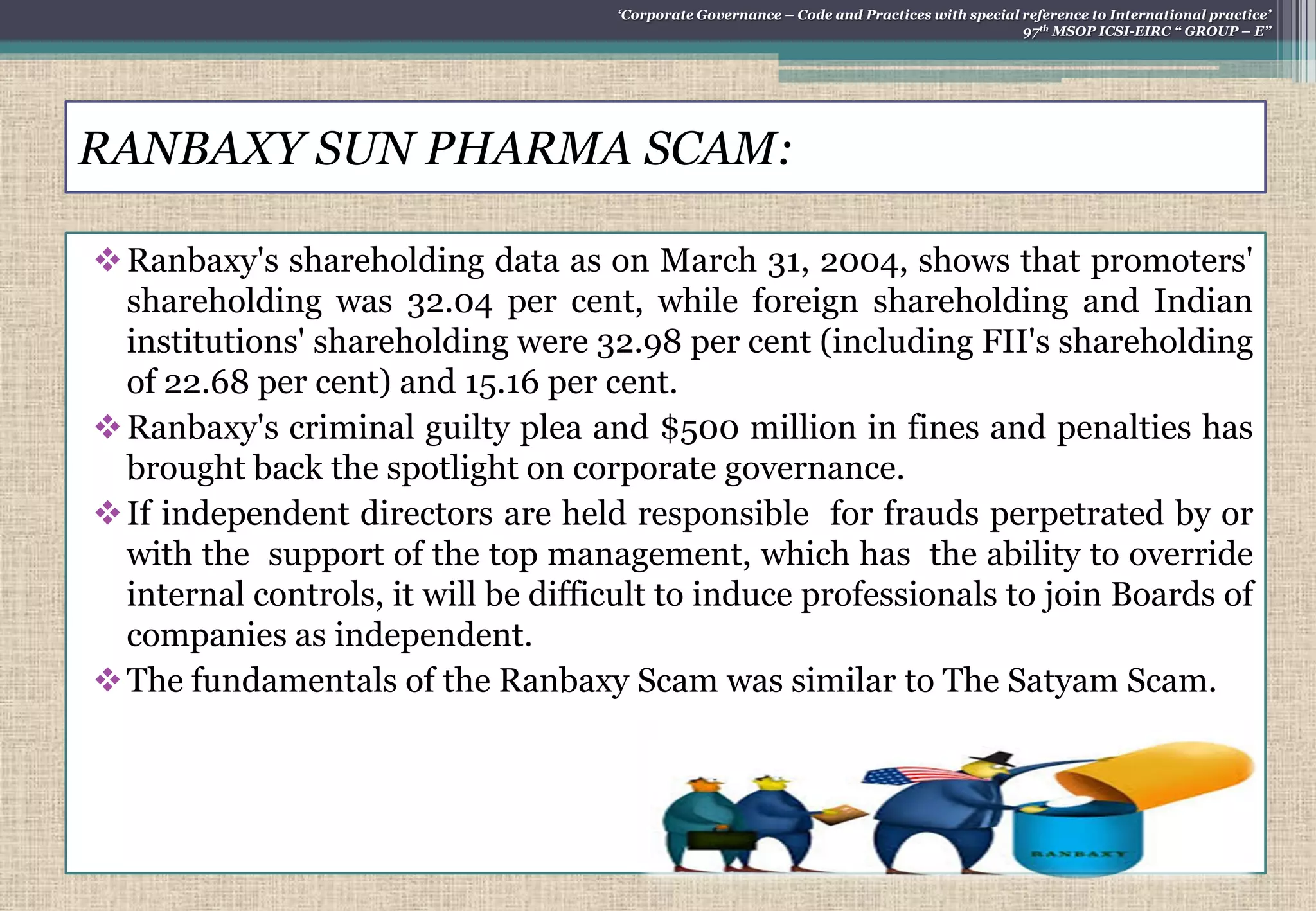
RANBAXY SUN PHARMA SCAM:
Ranbaxy's shareholding data as on March 31, 2004, shows that promoters'
shareholding was 32.04 per cent, while foreign shareholding and Indian
institutions' shareholding were 32.98 per cent (including FII's shareholding
of 22.68 per cent) and 15.16 per cent.
Ranbaxy's criminal guilty plea and $500 million in fines and penalties has
brought back the spotlight on corporate governance.
If independent directors are held responsible for frauds perpetrated by or
with the support of the top management, which has the ability to override
internal controls, it will be difficult to induce professionals to join Boards of
companies as independent.
The fundamentals of the Ranbaxy Scam was similar to The Satyam Scam.
„Corporate Governance – Code and Practices with special reference to International practice‟
97th MSOP ICSI-EIRC “ GROUP – E”
Chart shows the scores for each of the Eight
Asian Countries:
„Corporate Governance – Code and Practices with special reference to International practice‟
97th MSOP ICSI-EIRC “ GROUP – E”
0
10
20
30
40
50
60
70
80
90
India Malaysia Korea Pakistan Thailand Phillipenes Indonesia Veitnam
Corporate Governance Scores
1 • Monetary penalties for non-compliance
2 • Establishing Prosecutorial Procedures
3 • Breaking Ethical Codes
4 • Loss of Shareholder Confidence
5 • Difficulties in Raising Capital
6 • Other Potential Actions
Risk of Non-Compliance in Corporate
Governance :
„Corporate Governance – Code and Practices with special reference to International practice‟
97th MSOP ICSI-EIRC “ GROUP – E”
Corporate Governance is the buzzword in today's business environment. It is a
combination of legal practices, ethics, best management practices, wealth creation
management and foresight.
Company Secretary is the key person, who implements all these in an encouraging
environment. Besides, he plays a vital role in planning Company's future.
A Company Secretary represents a company to the internal and external
stakeholders, coordinates the management functions and company policies, keeps an
eye on ethics, code of conduct and mutual trust, helps in strategic decisions – aligning
the company towards excellence.
There are a number of responsibilities, some of which have been referenced to where
the company secretary assists and adds value:
• Organisational governance
• Supporting the chairman
• Board and committee processes
• Board development
• Communication with stakeholders
• Disclosure and reporting
„Corporate Governance – Code and Practices with special reference to International practice‟
97th MSOP ICSI-EIRC “ GROUP – E”
Company Secretary role in Corporate
Governance:
Bibliography:
1. Listing Agreement – Clause 49
& Companies Act‟ 2013
2. www.wikipedia.com, Times of
India & www.google.com
3. SEBI Regulations relating to
Listing Compliances
4. Corporate Governance ICSI
Module (Executive).
5. International codes and
practices of USA and UK
„Corporate Governance – Code and Practices with special reference to International practice‟
97th MSOP ICSI-EIRC “ GROUP – E”
Thank
You
“Corporate
Governance”
Group – „E‟
97th MSOP Batch
ICSI-EIRC
„Corporate Governance – Code and Practices with special reference to International practice‟
97th MSOP ICSI-EIRC “ GROUP – E”
„Corporate Governance – Code and Practices with special reference to International practice‟
97th MSOP ICSI-EIRC “ GROUP – E”

Corporate governance

  • 1.
    „Corporate Governance –Code and Practices with special reference to International practice‟ 97th MSOP ICSI-EIRC “ GROUP – E”
  • 2.
    Members of 97thMSOP Batch: „Group E‟ 1 • Mr. Lingraj Patra : 12o350212/08/2009 2 • Ms. Rita Maity : 120401893/04/2010 3 • Mr. Vikhyaat Roy : 120481157/02/2011 4 • Mr. Mayank Sahal : 120354721/08/2009 5 • Mr. Gautam Kumar Singh : 120523626/07/2011 6 • Mr. Sumit Kumar Shaw : 120395111/02/2010 7 • Ms. Ankita Agarwal : 120607931/02/2012 8 • Ms. Nidhi Trivedi : 120370446/02/2010 9 • Ms. Pooja Saraswat : 420900513/02/2011 10 • Mr. Uttam Anurag : 120445839/10/2010 „Corporate Governance – Code and Practices with special reference to International practice‟ 97th MSOP ICSI-EIRC “ GROUP – E”
  • 3.
    What is CorporateGovernance?  “Corporate Governance is nothing but a step towards strengthening of the organization so as to face the challenges”  “It is stepping into the shoes of the shareholders, stakeholders, vendors, suppliers & employees by the Top Managers and CEO of the company”  “Process and mechanisms by which the capital market monitors the actions of corporate management”  “Corporate governance is holding the balance between economic & social goals and between individual & community goals. The aim is to align as nearly as possible, the interests of individuals, corporations & society”. „Corporate Governance – Code and Practices with special reference to International practice‟ 97th MSOP ICSI-EIRC “ GROUP – E”
  • 4.
    Principles of CorporateGovernance: Sustainable Development of all „Stakeholders‟ Effective Management and Distribution of „Wealth‟ Discharge of „Social Responsibility‟ Application of „Best Management Practices‟ Compliance of „Law in letter and spirit‟ Adherence to „Ethical Standards‟ „Corporate Governance – Code and Practices with special reference to International practice‟ 97th MSOP ICSI-EIRC “ GROUP – E”
  • 5.
    Four Pillars ofCorporate Governance: Corporate Governance Accountability Transparency Responsibility Fairness „Corporate Governance – Code and Practices with special reference to International practice‟ 97th MSOP ICSI-EIRC “ GROUP – E”
  • 6.
    „Corporate Governance –Code and Practices with special reference to International practice‟ 97th MSOP ICSI-EIRC “ GROUP – E” “Board of Directors and their constituent responsibilities to the ultimate owners- The Shareholders” Accountability “Right to information, timeliness and integrity of the information produced” Transparency “Adherence to the rules, laws & spirit of codes” Responsibility Fairness “Clarity in responsibilities to enhance accountability”
  • 7.
    Evidence of CorporateGovernance from the „Arthashastra‟: “Raksha” „It literally means Protection, and in Corporates it can be equated with the Risk Management Aspects‟ “Vridhi” „It literally means Growth, and in Corporates it can be equated to Stakeholders Value Enhancement‟ “Palana” „It literally means Maintenance or Compliance, and in Corporates it can be equated to Compliance in Letter and Spirit‟ “Yogakshema” „It literally means Social Security System, and in Corporates it can be equated to Corporate Social Responsibility‟ Kautilya`s fourfold of Corporate Governance in Arthashastra „Corporate Governance – Code and Practices with special reference to International practice‟ 97th MSOP ICSI-EIRC “ GROUP – E”
  • 8.
    Corporate Governance DevelopmentTimeline: USA UK INDIA „Corporate Governance – Code and Practices with special reference to International practice‟ 97th MSOP ICSI-EIRC “ GROUP – E”
  • 9.
    CORPORATE GOVERNANCE DEVELOPMENT TIMELINEIN USA:  1977 „The Foreign Practices Act‟- USA made specific provisions regarding establishment, maintenance and review of systems of internal control.  1979 „US Securities Exchange Commission‟- US Securities Exchange Commission prescribed mandatory reporting on internal financial controls.  1985 „Treadway Commission‟- Due to high profile failures in the US, the Treadway Commission was constituted, they highlighted the need of putting in place a proper control environment, independent boards and its committees and objective internal audit function.  2002 „Sarbanes –Oxley Act‟- After ENRON debacle of 2001, came other scandals involving large US companies such as WorldCom, Qwest, Global Crossing and the auditing lacunae that eventually led to collapse of Andersen, the Sarbanes Oxley Act popularly called SOX was enacted. The Act made fundamental changes in virtually every aspect of corporate governance in general and auditor independence, conflict of interest, corporate responsibility, enhanced financial disclosures and severe penalties for wilful default by managers and auditors, in particular. „Corporate Governance – Code and Practices with special reference to International practice‟ 97th MSOP ICSI-EIRC “ GROUP – E”
  • 10.
    CORPORATE GOVERNANCE DEVELOPMENT TIMELINEIN UK: A spate of scandals and financial collapses in the UK in late 1980s and early 1990s led the birth of concept of Corporate Governance:  1991- To prevent the recurrence of business failures in UK Cadbury Committee was set up by the London Stock Exchange to raise standards of corporate governance.  1995- Sir Richard Greenbury examine the remuneration of the directors in his report called The Greenbury Report UK.  1998- Hampel committee was established to review and revise the earlier recommendations of the Cadbury and Greenbury Committees.  2001- The Turnbull Report which denoted as original combined code required to include a narrative statement in their Annual report of how internal control provisions had been applied.  2002- Higgs Report for review of the role and effectiveness of Non-Executive director. Smith Report for guidance Audit Committee& Tyson Report for recruitment and development of Non-Executive directors. „Corporate Governance – Code and Practices with special reference to International practice‟ 97th MSOP ICSI-EIRC “ GROUP – E”
  • 11.
    Emergence of CorporateGovernance in India:  The Indian corporate scenario was more or less stagnant till the early 90s.  The position and goals of the Indian corporate sector has changed a lot after the liberalisation of 90s.  India‟s economic reform programme made a steady progress in 1994.  In 1996, Confederation of Indian Industry (CII), took a special initiative on Corporate Governance.  The objective was to develop and promote a code for corporate governance to be adopted and followed by Indian companies, be these in the Private Sector, the Public Sector, Banks or Financial Institutions, all of which are corporate entities.  This initiative by CII flowed from public concerns regarding the protection of investor interest, especially the small investor, the promotion of transparency within business and industry. (Contd…) „Corporate Governance – Code and Practices with special reference to International practice‟ 97th MSOP ICSI-EIRC “ GROUP – E”
  • 12.
     SEBI appointedin May 1997 the Kumar Mangalam Birla Committee  Companies Amendment Act, 2000 introduced: - Setting up of Audit Committee - Directors‟ Responsibility Statement  Kumar Mangalam Birla Committee recommendations adopted by SEBI in 2000  Clause 49 introduced in Listing Agreement  Narayana Murthy Committee recommendations in 2002 revised Clause 49 -Definition of independent directors -Certificate by CFO & CEO -Risk Assessment & Mitigation strategy of the company -Code of Conduct for top Management „Corporate Governance – Code and Practices with special reference to International practice‟ 97th MSOP ICSI-EIRC “ GROUP – E”
  • 13.
    Light to CorporateGovernance by Various Committees: Kumar Mangalam Birla Committee : Year 2000 Naresh Chandra Committee : Year 2002 N.R. Narayan Murthy Committee : Year 2003 Dr. J.J. Irani Committee : Year 2005 „Corporate Governance – Code and Practices with special reference to International practice‟ 97th MSOP ICSI-EIRC “ GROUP – E”
  • 14.
    Present Scenario inINDIA: “Corporate Governance” Companies Act 2013 Clause 49 „Corporate Governance – Code and Practices with special reference to International practice‟ 97th MSOP ICSI-EIRC “ GROUP – E”
  • 15.
    Code of Practicesfor Corporate Governance : „Clause 49‟ Clause 49 (I)(C) :Disclosure and transparency: 1. The company should ensure timely and accurate disclosure on all material matters including the financial situation, performance, ownership, and governance of the company. a) Information should be prepared and disclosed in accordance with the prescribed standards of accounting, financial and non-financial disclosure. b) Channels for disseminating information should provide for equal, timely and cost efficient access to relevant information by users. c) The company should maintain minutes of the meeting explicitly recording dissenting opinions, if any. d) The company should implement the prescribed accounting standards in letter and spirit in the preparation of financial statements taking into consideration the interest of all stakeholders and should also ensure that the annual audit is conducted by an independent, competent and qualified auditor. Contd….. „Corporate Governance – Code and Practices with special reference to International practice‟ 97th MSOP ICSI-EIRC “ GROUP – E”
  • 16.
    Clause 49 (II): Board of Directors: A. Composition of Board: 1. The Board of Directors of the company shall have an optimum combination of executive and non- executive directors with at least one woman director and not less than fifty percent of the Board of Directors comprising non-executive directors. 2. Where the Chairman of the Board is a non-executive director, at least one-third of the Board should comprise independent directors and in case the company does not have a regular non- executive Chairman, at least half of the Board should comprise independent directors. Provided that where the regular non-executive Chairman is a promoter of the company or is related to any promoter or person occupying management positions at the Board level or at one level below the Board, at least one-half of the Board of the company shall consist of independent directors. C. Non-executive Directors‟ compensation and disclosures: All fees / compensation, if any paid to non-executive directors, including independent directors, shall be fixed by the Board of Directors and shall require previous approval of shareholders in general meeting. The shareholders‟ resolution shall specify the limits for the maximum number of stock options that can be granted to non-executive directors, in any financial year and in aggregate. Provided that the requirement of obtaining prior approval of shareholders in general meeting shall not apply to payment of sitting fees to non-executive directors, if made within the limits prescribed under the Companies Act, 2013 for payment of sitting fees without approval of the Central Government. Contd…. „Corporate Governance – Code and Practices with special reference to International practice‟ 97th MSOP ICSI-EIRC “ GROUP – E”
  • 17.
    D. Other provisionsas to Board and Committees: 1. The Board shall meet at least four times a year, with a maximum time gap of one hundred and twenty days between any two meetings. The minimum information to be made available to the Board is given in Annexure - X to the Listing Agreement. 2. A director shall not be a member in more than ten committees or act as Chairman of more than five committees across all companies in which he is a director. Furthermore, every director shall inform the company about the committee positions he occupies in other companies and notify changes as and when they take place. E. Code of Conduct: The Board shall lay down a code of conduct for all Board members and senior management of the company. The code of conduct shall be posted on the website of the company. F. Whistle Blower Policy: The company shall establish a vigil mechanism for directors and employees to report concerns about unethical behaviour, actual or suspected fraud or violation of the company‟s code of conduct or ethics policy. „Corporate Governance – Code and Practices with special reference to International practice‟ 97th MSOP ICSI-EIRC “ GROUP – E”
  • 18.
    Clause 49 (III).Audit Committee Clause 49 (IV). Nomination and Remuneration Committee Clause 49 (VI). Risk Management Clause 49 (VII). Related Party Transactions Clause 49 (VIII). Disclosures Clause 49 (IX).CEO/CFO certification „Corporate Governance – Code and Practices with special reference to International practice‟ 97th MSOP ICSI-EIRC “ GROUP – E”
  • 19.
    Code of Practicesfor Corporate Governance : „Companies Act‟ 2013‟  Concept of Independent Directors introduced for the first time.  Different committees are mandated by the Act.  A full-time director is also covered under the definition of “Key Managerial Personnel”.  The auditor is to be rotated "at such interval" as may be determined by resolution.  The limit of the number of companies for which a person may be appointed as auditor is proposed as 20 companies. In case of an audit firm, the limit is applicable to each partner.  Appointment of auditors for a five-year period is subject to ratification at every annual general meeting.  The Act proposes that corporates spend 2% percentage of three years average profits towards CSR activities.  The Act provides for e-voting mechanism for shareholders participation in large.  The Act provides for various policies to be framed by Companies for more transparency and Governance.  The concept of Insider Trading and to regulate the price sensitive information provided in Act.  The Act provides for various disclosures and penalty for defaults.  The Act fulfills the gap that the old Companies Act „ 1956 had in respect of Good Governance. „Corporate Governance – Code and Practices with special reference to International practice‟ 97th MSOP ICSI-EIRC “ GROUP – E”
  • 20.
    „Corporate Governance –Code and Practices with special reference to International practice‟ 97th MSOP ICSI-EIRC “ GROUP – E” Case Study:
  • 21.
    Collapses Leading toCorporate Governance Evolution: Collapses International ENRON Qwest Worldcom National Ranbaxy Satyam United Group Uniworth „Corporate Governance – Code and Practices with special reference to International practice‟ 97th MSOP ICSI-EIRC “ GROUP – E”
  • 22.
    „Corporate Governance –Code and Practices with special reference to International practice‟ 97th MSOP ICSI-EIRC “ GROUP – E” Scam Subject Amount involved (Rs) Satyam Accounting Scandal 588 crore NESL & FTIL Corporate scandal 5600 crore Ranbaxy & Sunpharma Accounting Scandal 3000 crore Qwest Communications International Inc. Corporate scandal 6600 crore Bird view of Major Scams:
  • 23.
    What was SatyamScam all about…  The company‟s Balance Sheet was inflated to Rs. 5,361 Cr at the end of September 2008 against the actual Rs. 5,040 Cr.  There is an artificial cash balance of Rs.588 Cr in September 2008.  Rs.1,230 Cr was arranged to Satyam, which is not reflected in its books, to keep Satyam's operations running.  Raju also admitted that Satyam's profits were inflated over several years. „Corporate Governance – Code and Practices with special reference to International practice‟ 97th MSOP ICSI-EIRC “ GROUP – E”
  • 24.
    How Did TheSatyam Scam Matter To The Nation? Job’s of over 50,000 technocrats were at risk.  Country’s booming economy feared slight collapse as Country's GDP fell by estimated 0.4%.  India’s I.T. sector suffered downturn as it’s image was tarnished globally. „Corporate Governance – Code and Practices with special reference to International practice‟ 97th MSOP ICSI-EIRC “ GROUP – E” Ohh Nooo….
  • 25.
    ALL’s WELL THAT’sEND WELL „Corporate Governance – Code and Practices with special reference to International practice‟ 97th MSOP ICSI-EIRC “ GROUP – E” “Satyam Computers was took over by Mahindra Group I.T. Arm , Tech Mahindra on April 13, 2009”
  • 26.
    Largest Dis-communication Company(Us) Highlights of Case : • „Fraudulent recognition of $3.8 billion revenue • Non Disclosure of $850 million in expenses • Civil Penalty of $250 million • Disgorgement of $1 • $200 million capitalized cost „Corporate Governance – Code and Practices with special reference to International pr 97th MSOP ICSI-EIRC “ GROU
  • 27.
    NSEL FTIL Merger-Blunder or Ignorance : • Ignorance from base transaction being FORWARD from SPOT. • NO GOODS NO MONEY.. After T+2.. I can‟t see you honey(stakeholders) • Scam ends at home.. and MATERIAL taken away by members. „Corporate Governance – Code and Practices with special reference to International practice‟ 97th MSOP ICSI-EIRC “ GROUP – E”
  • 28.
    Figures and Lacunain case: • Fake Bridge between Investors, Seller & Forward buyer. • Spot transaction represented as forward contract. • >11 Days = Non-Transferable Specific Delivery contracts. • Unpaid settlement of Rs.5400 crore. • NK Protein, Kadi Castor seeds plant, member-in-law • T+2 invest, Buy back at T+23 @14% Sky return - L.O.L „Corporate Governance – Code and Practices with special reference to International practice‟ 97th MSOP ICSI-EIRC “ GROUP – E” 0 5000 10000 Unpaid Claims Unsettled dues Series 1 Series 2
  • 29.
    How did centralgovernment allow NSEL to not follow demutualization rule?  If the central government wanted the electronic spot exchanges in the country, why was there no regulators regulating the contracts traded with T+2 settlement period which were spot contracts. Is there no governing body responsible for spot contracts. If the scale of scam is so widespread, why there is no regulator for spot exchanges.  How was liquidity not ensured by the regulators when considering the introduction of the spot exchanges? How is that only few members of the exchange did the actual business for so long years?  How did NSEL prevent the regulators from faking the contracts with warehouse receipts? Some Questions Unanswered? „Corporate Governance – Code and Practices with special reference to International practice‟ 97th MSOP ICSI-EIRC “ GROUP – E”
  • 30.
    RANBAXY SUN PHARMASCAM: Ranbaxy's shareholding data as on March 31, 2004, shows that promoters' shareholding was 32.04 per cent, while foreign shareholding and Indian institutions' shareholding were 32.98 per cent (including FII's shareholding of 22.68 per cent) and 15.16 per cent. Ranbaxy's criminal guilty plea and $500 million in fines and penalties has brought back the spotlight on corporate governance. If independent directors are held responsible for frauds perpetrated by or with the support of the top management, which has the ability to override internal controls, it will be difficult to induce professionals to join Boards of companies as independent. The fundamentals of the Ranbaxy Scam was similar to The Satyam Scam. „Corporate Governance – Code and Practices with special reference to International practice‟ 97th MSOP ICSI-EIRC “ GROUP – E”
  • 31.
    Chart shows thescores for each of the Eight Asian Countries: „Corporate Governance – Code and Practices with special reference to International practice‟ 97th MSOP ICSI-EIRC “ GROUP – E” 0 10 20 30 40 50 60 70 80 90 India Malaysia Korea Pakistan Thailand Phillipenes Indonesia Veitnam Corporate Governance Scores Corporate Governance Scores
  • 32.
    1 • Monetarypenalties for non-compliance 2 • Establishing Prosecutorial Procedures 3 • Breaking Ethical Codes 4 • Loss of Shareholder Confidence 5 • Difficulties in Raising Capital 6 • Other Potential Actions Risk of Non-Compliance in Corporate Governance : „Corporate Governance – Code and Practices with special reference to International practice‟ 97th MSOP ICSI-EIRC “ GROUP – E”
  • 33.
    Corporate Governance isthe buzzword in today's business environment. It is a combination of legal practices, ethics, best management practices, wealth creation management and foresight. Company Secretary is the key person, who implements all these in an encouraging environment. Besides, he plays a vital role in planning Company's future. A Company Secretary represents a company to the internal and external stakeholders, coordinates the management functions and company policies, keeps an eye on ethics, code of conduct and mutual trust, helps in strategic decisions – aligning the company towards excellence. There are a number of responsibilities, some of which have been referenced to where the company secretary assists and adds value: • Organisational governance • Supporting the chairman • Board and committee processes • Board development • Communication with stakeholders • Disclosure and reporting „Corporate Governance – Code and Practices with special reference to International practice‟ 97th MSOP ICSI-EIRC “ GROUP – E” Company Secretary role in Corporate Governance:
  • 34.
    Bibliography: 1. Listing Agreement– Clause 49 & Companies Act‟ 2013 2. www.wikipedia.com, Times of India & www.google.com 3. SEBI Regulations relating to Listing Compliances 4. Corporate Governance ICSI Module (Executive). 5. International codes and practices of USA and UK „Corporate Governance – Code and Practices with special reference to International practice‟ 97th MSOP ICSI-EIRC “ GROUP – E”
  • 35.
    Thank You “Corporate Governance” Group – „E‟ 97thMSOP Batch ICSI-EIRC „Corporate Governance – Code and Practices with special reference to International practice‟ 97th MSOP ICSI-EIRC “ GROUP – E”
  • 36.
    „Corporate Governance –Code and Practices with special reference to International practice‟ 97th MSOP ICSI-EIRC “ GROUP – E”