1
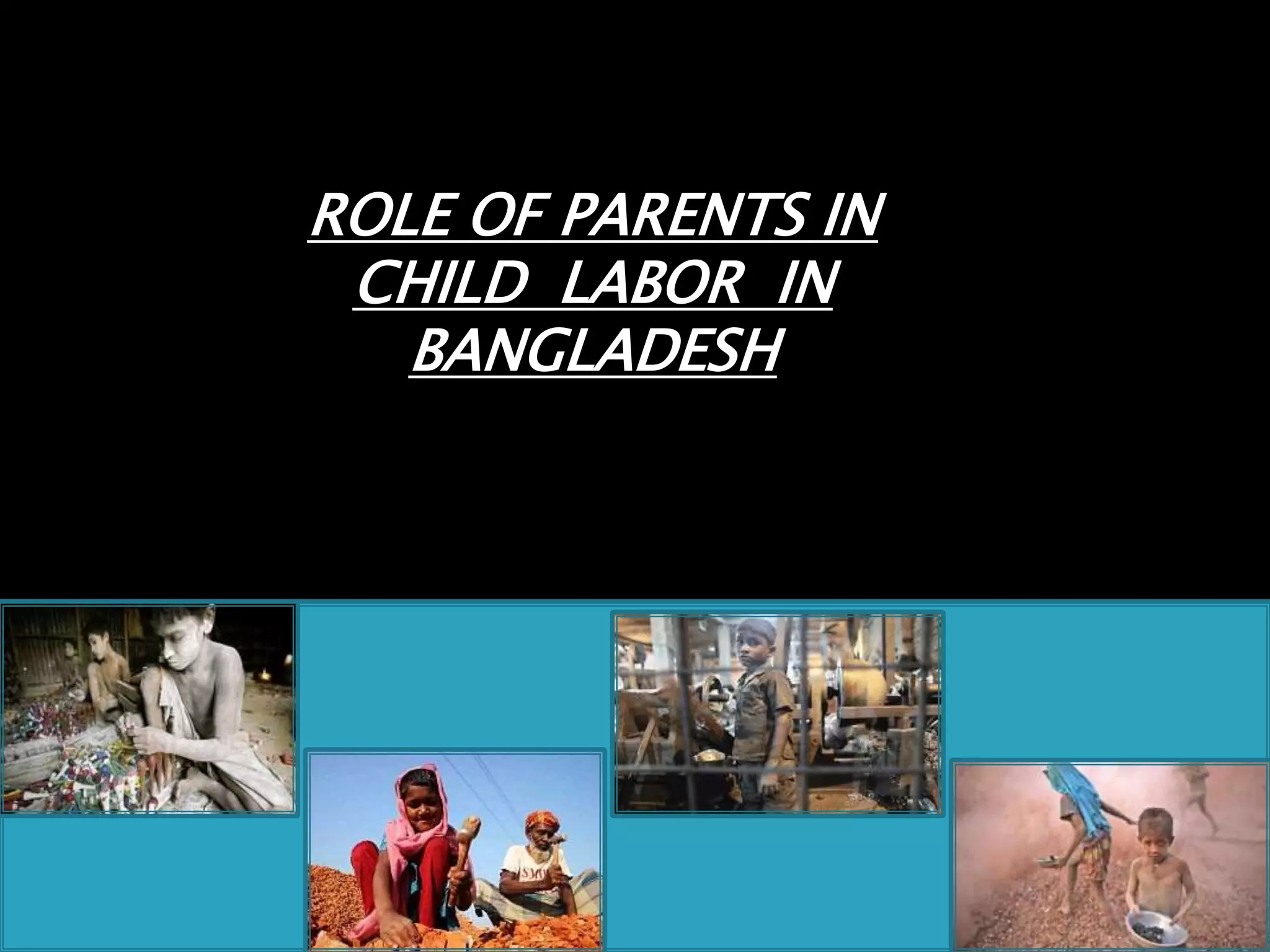
ROLE OF PARENTS IN
CHILD LABOR IN
BANGLADESH
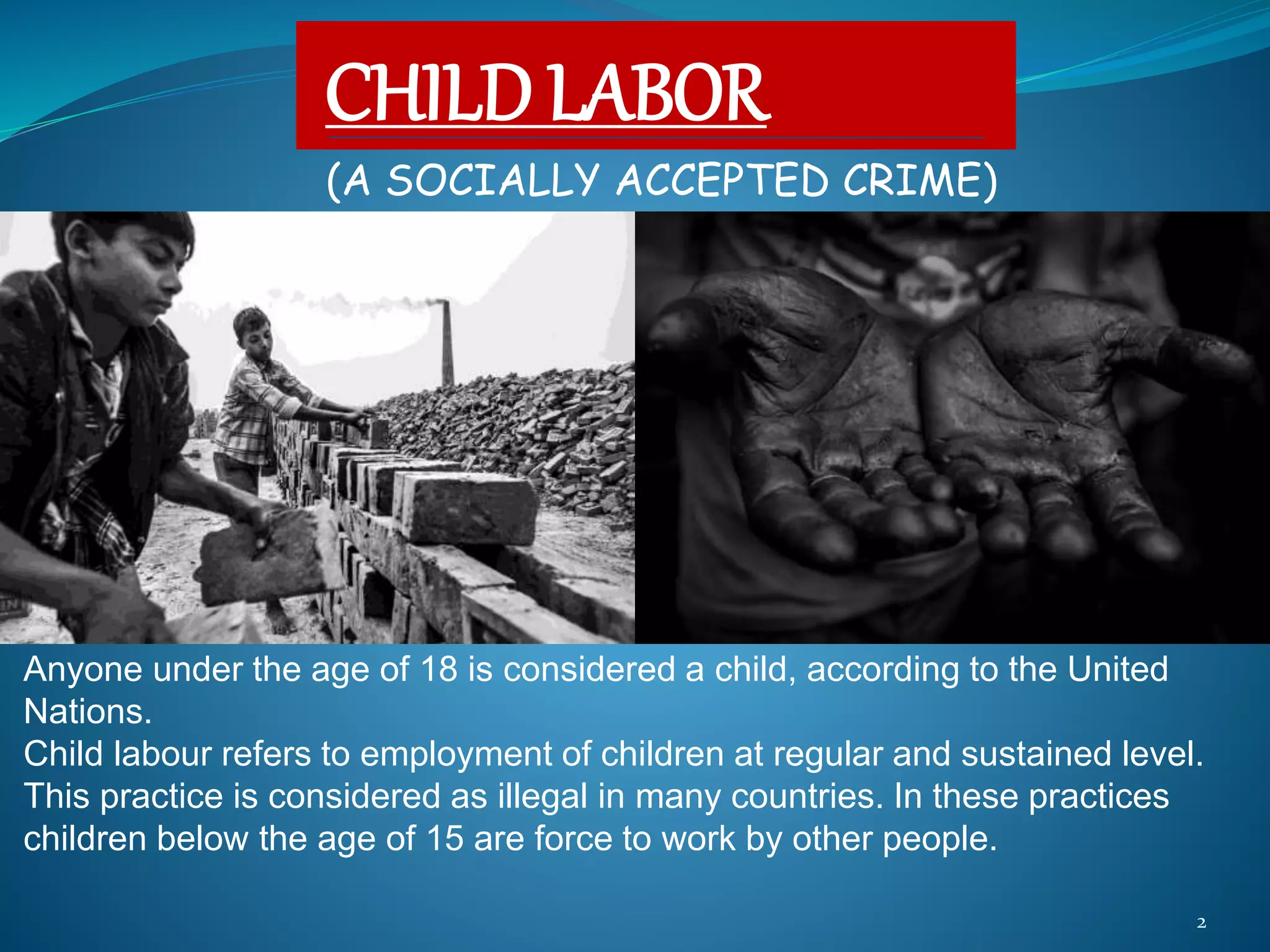
CHILD LABOR
(A SOCIALLY ACCEPTED CRIME)
Anyone under the age of 18 is considered a child, according to the United
Nations.
Child labour refers to employment of children at regular and sustained level.
This practice is considered as illegal in many countries. In these practices
children below the age of 15 are force to work by other people.
2
•According to International Labor Organization (ILO), the term ‘child labor’ is
often defined as work that deprives children of their childhood, their potential
and their dignity, and that is harmful to physical and mental development. It
refers to work that is mentally, physically, socially or morally dangerous and
harmful to children. It interferes with their schooling by depriving
them of the opportunity to attend school, obliging them to
leave school prematurely or requiring them to attempt to combine school
attendance with excessively long and heavy work.
What is child labor ?
Child labor is...
Child labor is not...
• Light work done after school.
• Internship opportunities
• Helping out the family farm or business
3
INTRODUCTION
Child labour has become a major issue throughout the
world but in the third world countries, like Bangladesh,
it has grown to the maximum level.
According to United Nations International Children
Emergency Funds (UNICEF) there are approximately 158
million children of age 5 to 15 working as child labor
worldwide.
4
 Child labour is a socioeconomic problem of Bangladesh
from the beginning and presenting negative effects till
now.
 Today child labor in Bangladesh is the most prominent
issue of all the social issues.
5
Child labor in Bangladesh is common, with 4.8 million or
12.6% of children aged 5 to 14 in the work force.
Out of the child laborers engaged in the work force, 83% are
employed in rural areas and 17% are employed in urban
areas.
Child labor can be found in -
•agriculture,
•poultry breeding,
•fish processing,
•the garment sector and the leather industry,
•in shoe production,
•jute processing,
•the production of candles,
•soap and furniture,
•salt industry,
•ship breaking
[ acc. to wikipedia]
6
• In 2006, Bangladesh passed a Labor Law
setting the minimum legal age for employment
as 14. Nevertheless, the enforcement of such
labor laws is virtually impossible in Bangladesh
because 93% of child laborers are employed in
the informal sector such as small factories and
workshops, on the street, in home-based
businesses and domestic employment.
7
CYCLE OF CHILD LABOR
8
CAUSES
OF
CHILD
LABOR
9
10
• Poverty
•Unemployment of Elders
• Excess population
•Tradition of making children learn the
family skill
•Parental illiteracy
•Failure of Laws
Causes of CHILD LABOR
 poverty is the basic reason and driving force that compels these children to work like
labours and earn a little money at the end of the day. The bad financial condition up-
thrust to the problem of child labour.
 Mostly poor families have more number of children, so it becomes very difficult for
them to survive on the income of only one family member so they make their small
children their source of income .
11
Unemployment Of Elders.
• Due to unemployment its become compulsion of parents to make their children
to work in factories, shops, even selling items on streets.
• There are many cases of child labor where a child has to work against the
repayment of a loan which was taken by his father.
• Another important reason is unemployment which forces the parents to send
their children to work places
12
Excess Population
• In villages there is trend of early marriages and have large number of children. To
fulfill the basic needs they compel their children to do work.
• So they have no other choice but to work and earn a little amount to support their
families
• They consider children as their source of income and they make them to work like
pulling carts, repairing machines, work in factories, selling goods etc. 13
Tradition Of Making Children LearnThe Family Skills
Children are force to follow the foot
prints of their parents.
They are trained from their childhood in
the profession that the family has been
following since ages. So they are unable
to get primary education .
Children are forbidden from doing any
other work. Because of this the
children of laborers, craftsmen etc.
start working with their parents at a
very young age.
14
Many developing countries like Pakistan,
India, Bangladesh etc. facing a huge
problem of illiteracy. Lower class people
are mostly illiterate, so it is difficult for
uneducated parents to understand the
importance of education for their children.
Parental Illiteracy
Literacy rate of Bangladesh is :
Male: 68.6%
Female: 40.3%
15
 Another main reason for the
promotion of child labor is due to the
failure of government in practicing the
laws to stop child labour due to which
child labor is increasing day by day .
Failure Of Laws
16
17
What role do the parents play in
child labor in Bangladesh?
18
The answer is that most of the parents
play a huge role in compelling their
children to be engaged in child labor in
Bangladesh . Some factors make a great
contribution in this matter.
Those factors are:
-Poverty
-Adult Unemployment
-illiterate parents
-family demographics
19
Poverty is certainly the greatest single
force driving children into the workplace.
Income from a child's work is felt to be
crucial for his/her own survival or for
that of the household.
Bangladesh is a poor country with
millions of illiterate people living with a
miserable life standard. In order combat
poverty , most of the parents forced
their children to beg on the street and
doing odd jobs to make some money
without giving priority on education.
Adult unemployment may also contribute
to the immediate reason why parents send
their children to work.
Most of the parents have this logic that
since they can not afford to feed their
children, the children have to somehow
earn to feed themselves.
The UNICEF survey of the garment
factories found that almost 90% of the
children were from single-parent
households and homes where there had
been a death or disability.
20
Popular perceptions of parents and local customs and
traditions (even when they are well-intended) also play
an important part, such as:
The view that work is good for the character-building
and skill development of children;
The tradition that children are expected to follow in
their parents' footsteps in a particular trade, and to
learn and practice that trade at a very early age;
Traditions that push poor families into indebting
themselves heavily for social occasions or religious
events, such as marrying off their daughters with
dowry, then relying on their children's work to pay off
the debt. largely because of the vulnerability of poor.
21
The widely held view that girl children are less in need
of education than boys, which leads to them being taken
out of school at an early age and placed in work at home,
or sold into domestic employment.
Child labor may be so deeply ingrained in local
customs and habits that neither the parents nor the
children themselves realize that it is against the interests
of children and illegal;
Children from large families are more likely to be at
work than those from small families, simply because the
parents' income is quite insufficient to support a large
family.
PREVENTIVE MEASURES
 Free Education for everyone
Creating employment for parents
 Awareness Programs in parents
 Mid Day Meal System In Schools
 Laws Should Be Implemented Strictly
 Punishment Should Be Given To People Who Exploit
Children.
S
T
O
P 22
23
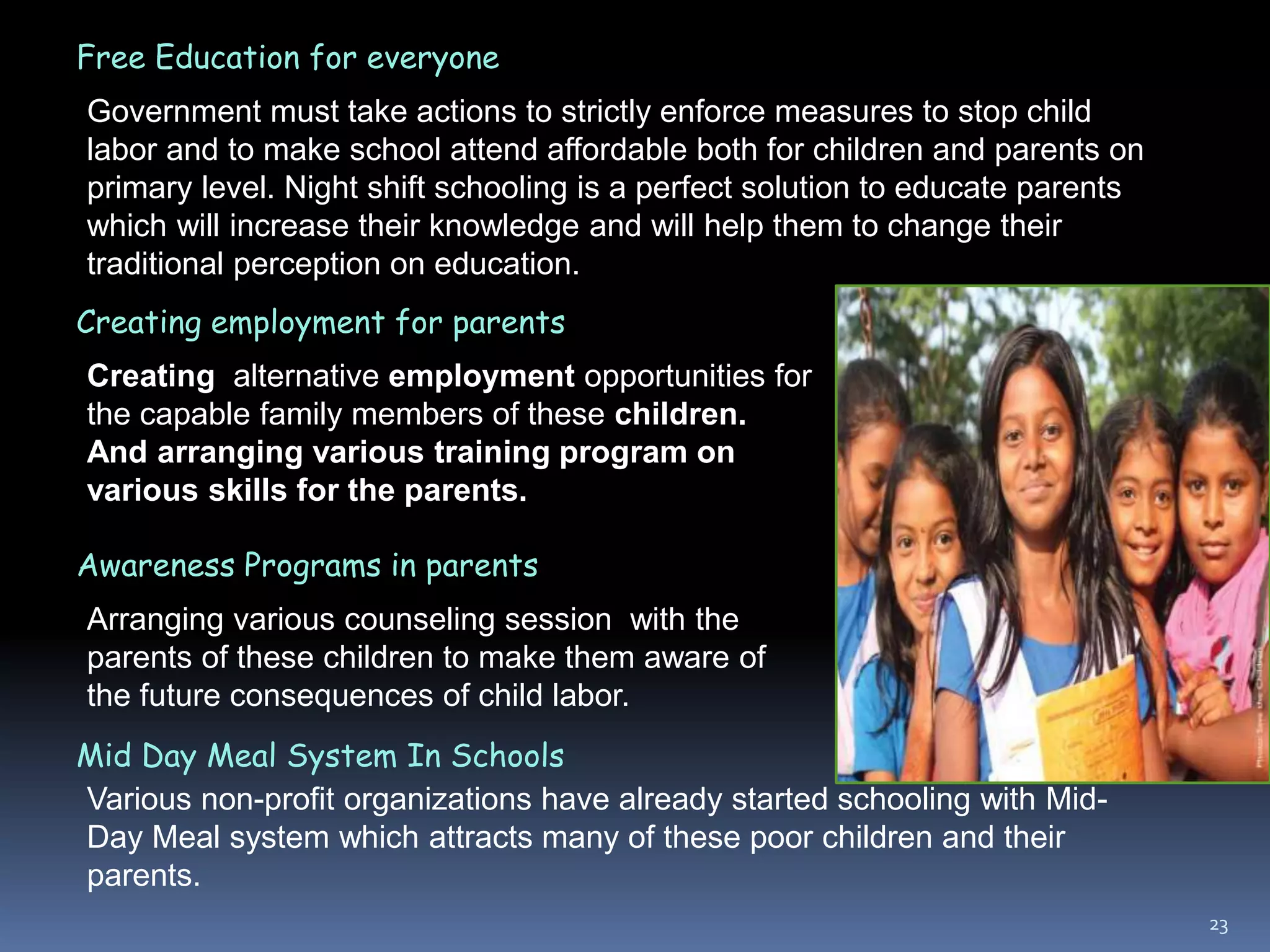
Free Education for everyone
Government must take actions to strictly enforce measures to stop child
labor and to make school attend affordable both for children and parents on
primary level. Night shift schooling is a perfect solution to educate parents
which will increase their knowledge and will help them to change their
traditional perception on education.
Creating employment for parents
Creating alternative employment opportunities for
the capable family members of these children.
And arranging various training program on
various skills for the parents.
Awareness Programs in parents
Arranging various counseling session with the
parents of these children to make them aware of
the future consequences of child labor.
Mid Day Meal System In Schools
Various non-profit organizations have already started schooling with Mid-
Day Meal system which attracts many of these poor children and their
parents.
24
•The Government of Bangladesh, owing to its Constitutional obligation, remains
committed to eliminating child labor and realizing child rights.
•At the international level, the country has ratified the Convention on the Rights
of the Child (CRC), which protects and promotes the rights of children including
the right to compulsory and free education (Articles 28 & 29), the right to be
protected from hazardous work that interrupts their education and development
(Article 32), and the right to an adequate standard of living.
• Bangladesh has also ratified the ILO Convention on the Worst Form of Child
Labor, 1999 (No. 182), pledging to take effective measures to secure the
prohibition and elimination of the worst forms of child labor as a matter of
urgency (Article 1).
•At the national level, Bangladesh enacted the Labor Act in 2006, which includes
a chapter on child labor. This new law prohibits employment of children less than
14 years of age, as well as prohibiting hazardous forms of child labor for persons
under age 18. However, children who are aged 12 and above may be engaged in
‘light work’ that does not pose a risk to their mental and physical development
and does not interfere with their education. The law does not provide a strong
enforcement mechanism for the child labor provisions.
Laws Should Be Implemented Strictly
http://www.bangladeshstudies.org/files/WPS_
no8.pdf
www.wikipedea.com/childlabour.
Child labor in Bangladesh UNICEF
Google.com/childlabor
Ask.com/childlabor
ilo.com/childlabor
25
Child labours are working not by their own choice. They are the victims of their
circumstances and we are taking benefit of their compulsions.
These children are working as a labor in school going age for the survival of
their families and to full fill the basic necessities.
We all should come forward to help them. Government should provide the basic
rights to these children and should also help them in getting education. In this
way our country can get rid of social evil.
CONCLUSION
26
THANK
YOU
27

Role of the parents in child labor in bangladesh

  • 1.
    1 ROLE OF PARENTSIN CHILD LABOR IN BANGLADESH
  • 2.
    CHILD LABOR (A SOCIALLYACCEPTED CRIME) Anyone under the age of 18 is considered a child, according to the United Nations. Child labour refers to employment of children at regular and sustained level. This practice is considered as illegal in many countries. In these practices children below the age of 15 are force to work by other people. 2
  • 3.
    •According to InternationalLabor Organization (ILO), the term ‘child labor’ is often defined as work that deprives children of their childhood, their potential and their dignity, and that is harmful to physical and mental development. It refers to work that is mentally, physically, socially or morally dangerous and harmful to children. It interferes with their schooling by depriving them of the opportunity to attend school, obliging them to leave school prematurely or requiring them to attempt to combine school attendance with excessively long and heavy work. What is child labor ? Child labor is... Child labor is not... • Light work done after school. • Internship opportunities • Helping out the family farm or business 3
  • 4.
    INTRODUCTION Child labour hasbecome a major issue throughout the world but in the third world countries, like Bangladesh, it has grown to the maximum level. According to United Nations International Children Emergency Funds (UNICEF) there are approximately 158 million children of age 5 to 15 working as child labor worldwide. 4
  • 5.
     Child labouris a socioeconomic problem of Bangladesh from the beginning and presenting negative effects till now.  Today child labor in Bangladesh is the most prominent issue of all the social issues. 5
  • 6.
    Child labor inBangladesh is common, with 4.8 million or 12.6% of children aged 5 to 14 in the work force. Out of the child laborers engaged in the work force, 83% are employed in rural areas and 17% are employed in urban areas. Child labor can be found in - •agriculture, •poultry breeding, •fish processing, •the garment sector and the leather industry, •in shoe production, •jute processing, •the production of candles, •soap and furniture, •salt industry, •ship breaking [ acc. to wikipedia] 6
  • 7.
    • In 2006,Bangladesh passed a Labor Law setting the minimum legal age for employment as 14. Nevertheless, the enforcement of such labor laws is virtually impossible in Bangladesh because 93% of child laborers are employed in the informal sector such as small factories and workshops, on the street, in home-based businesses and domestic employment. 7
  • 8.
  • 9.
  • 10.
    10 • Poverty •Unemployment ofElders • Excess population •Tradition of making children learn the family skill •Parental illiteracy •Failure of Laws Causes of CHILD LABOR
  • 11.
     poverty isthe basic reason and driving force that compels these children to work like labours and earn a little money at the end of the day. The bad financial condition up- thrust to the problem of child labour.  Mostly poor families have more number of children, so it becomes very difficult for them to survive on the income of only one family member so they make their small children their source of income . 11
  • 12.
    Unemployment Of Elders. •Due to unemployment its become compulsion of parents to make their children to work in factories, shops, even selling items on streets. • There are many cases of child labor where a child has to work against the repayment of a loan which was taken by his father. • Another important reason is unemployment which forces the parents to send their children to work places 12
  • 13.
    Excess Population • Invillages there is trend of early marriages and have large number of children. To fulfill the basic needs they compel their children to do work. • So they have no other choice but to work and earn a little amount to support their families • They consider children as their source of income and they make them to work like pulling carts, repairing machines, work in factories, selling goods etc. 13
  • 14.
    Tradition Of MakingChildren LearnThe Family Skills Children are force to follow the foot prints of their parents. They are trained from their childhood in the profession that the family has been following since ages. So they are unable to get primary education . Children are forbidden from doing any other work. Because of this the children of laborers, craftsmen etc. start working with their parents at a very young age. 14
  • 15.
    Many developing countrieslike Pakistan, India, Bangladesh etc. facing a huge problem of illiteracy. Lower class people are mostly illiterate, so it is difficult for uneducated parents to understand the importance of education for their children. Parental Illiteracy Literacy rate of Bangladesh is : Male: 68.6% Female: 40.3% 15
  • 16.
     Another mainreason for the promotion of child labor is due to the failure of government in practicing the laws to stop child labour due to which child labor is increasing day by day . Failure Of Laws 16
  • 17.
    17 What role dothe parents play in child labor in Bangladesh?
  • 18.
    18 The answer isthat most of the parents play a huge role in compelling their children to be engaged in child labor in Bangladesh . Some factors make a great contribution in this matter. Those factors are: -Poverty -Adult Unemployment -illiterate parents -family demographics
  • 19.
    19 Poverty is certainlythe greatest single force driving children into the workplace. Income from a child's work is felt to be crucial for his/her own survival or for that of the household. Bangladesh is a poor country with millions of illiterate people living with a miserable life standard. In order combat poverty , most of the parents forced their children to beg on the street and doing odd jobs to make some money without giving priority on education. Adult unemployment may also contribute to the immediate reason why parents send their children to work. Most of the parents have this logic that since they can not afford to feed their children, the children have to somehow earn to feed themselves. The UNICEF survey of the garment factories found that almost 90% of the children were from single-parent households and homes where there had been a death or disability.
  • 20.
    20 Popular perceptions ofparents and local customs and traditions (even when they are well-intended) also play an important part, such as: The view that work is good for the character-building and skill development of children; The tradition that children are expected to follow in their parents' footsteps in a particular trade, and to learn and practice that trade at a very early age; Traditions that push poor families into indebting themselves heavily for social occasions or religious events, such as marrying off their daughters with dowry, then relying on their children's work to pay off the debt. largely because of the vulnerability of poor.
  • 21.
    21 The widely heldview that girl children are less in need of education than boys, which leads to them being taken out of school at an early age and placed in work at home, or sold into domestic employment. Child labor may be so deeply ingrained in local customs and habits that neither the parents nor the children themselves realize that it is against the interests of children and illegal; Children from large families are more likely to be at work than those from small families, simply because the parents' income is quite insufficient to support a large family.
  • 22.
    PREVENTIVE MEASURES  FreeEducation for everyone Creating employment for parents  Awareness Programs in parents  Mid Day Meal System In Schools  Laws Should Be Implemented Strictly  Punishment Should Be Given To People Who Exploit Children. S T O P 22
  • 23.
    23 Free Education foreveryone Government must take actions to strictly enforce measures to stop child labor and to make school attend affordable both for children and parents on primary level. Night shift schooling is a perfect solution to educate parents which will increase their knowledge and will help them to change their traditional perception on education. Creating employment for parents Creating alternative employment opportunities for the capable family members of these children. And arranging various training program on various skills for the parents. Awareness Programs in parents Arranging various counseling session with the parents of these children to make them aware of the future consequences of child labor. Mid Day Meal System In Schools Various non-profit organizations have already started schooling with Mid- Day Meal system which attracts many of these poor children and their parents.
  • 24.
    24 •The Government ofBangladesh, owing to its Constitutional obligation, remains committed to eliminating child labor and realizing child rights. •At the international level, the country has ratified the Convention on the Rights of the Child (CRC), which protects and promotes the rights of children including the right to compulsory and free education (Articles 28 & 29), the right to be protected from hazardous work that interrupts their education and development (Article 32), and the right to an adequate standard of living. • Bangladesh has also ratified the ILO Convention on the Worst Form of Child Labor, 1999 (No. 182), pledging to take effective measures to secure the prohibition and elimination of the worst forms of child labor as a matter of urgency (Article 1). •At the national level, Bangladesh enacted the Labor Act in 2006, which includes a chapter on child labor. This new law prohibits employment of children less than 14 years of age, as well as prohibiting hazardous forms of child labor for persons under age 18. However, children who are aged 12 and above may be engaged in ‘light work’ that does not pose a risk to their mental and physical development and does not interfere with their education. The law does not provide a strong enforcement mechanism for the child labor provisions. Laws Should Be Implemented Strictly
  • 25.
    http://www.bangladeshstudies.org/files/WPS_ no8.pdf www.wikipedea.com/childlabour. Child labor inBangladesh UNICEF Google.com/childlabor Ask.com/childlabor ilo.com/childlabor 25
  • 26.
    Child labours areworking not by their own choice. They are the victims of their circumstances and we are taking benefit of their compulsions. These children are working as a labor in school going age for the survival of their families and to full fill the basic necessities. We all should come forward to help them. Government should provide the basic rights to these children and should also help them in getting education. In this way our country can get rid of social evil. CONCLUSION 26
  • 27.