Principle of Management
Created By :
Amna Alobied.
Henri Fayol
(1841-1925)
Introduction
 While people gave
Taylor more attention in
UK and USA , Fayol’s
distinguished book ”
General and Industrial
Management” was
translated from French
to English only after 13
years.
 Administrative
management theory
attempts to find a
rational way to design an
organization as a whole.
 The theory generally calls for a formalized
administrative structure, a clear division of
labor, and delegation of power and authority
to administrators relevant to their areas of
responsibilities and administrative
management theory important because its
Promote decisions based on data .
 Administrative management helps you work
on your processes and results to improve
your overall results and ensuring that
businesses run smoothly.
The Three Contributions
 Mainly, Fayol offered three contributions:
1. management activities.
2. management functions
3. the fourteen management principles.
Management Activities
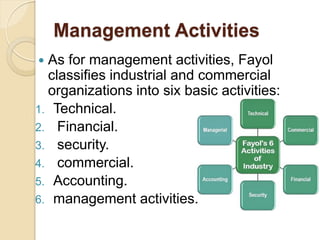
 As for management activities, Fayol
classifies industrial and commercial
organizations into six basic activities:
1. Technical.
2. Financial.
3. security.
4. commercial.
5. Accounting.
6. management activities.
Management Functions
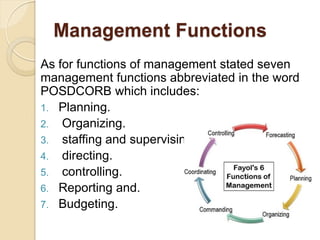
As for functions of management stated seven
management functions abbreviated in the word
POSDCORB which includes:
1. Planning.
2. Organizing.
3. staffing and supervising.
4. directing.
5. controlling.
6. Reporting and.
7. Budgeting.
The 14 Management Principles
 The third and most critical, contribution
offered by Fayol is the 14management
principles. Fayol emphasized two facts
here:
 first these principles should be
recognized as an aggregated managerial
tool which means that they work together
as a combination or sum total.
 Secondly, these principles should be
applied with flexibility that even new
managers could learn how to manage.
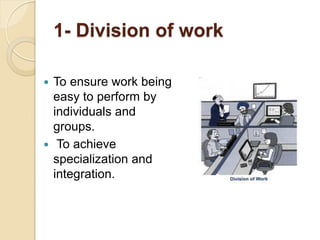
1- Division of work
 To ensure work being
easy to perform by
individuals and
groups.
 To achieve
specialization and
integration.
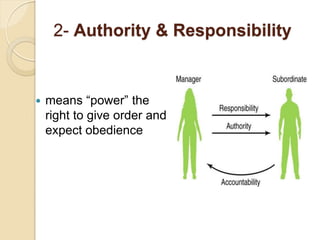
2- Authority & Responsibility
 means “power” the
right to give order and
expect obedience
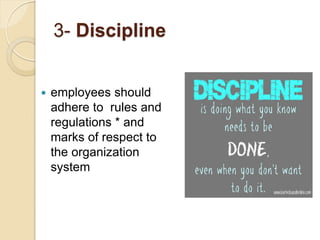
3- Discipline
 employees should
adhere to rules and
regulations * and
marks of respect to
the organization
system
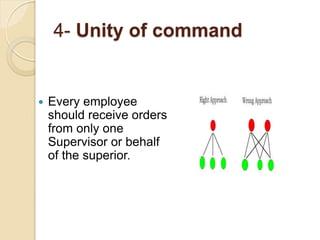
4- Unity of command
 Every employee
should receive orders
from only one
Supervisor or behalf
of the superior.
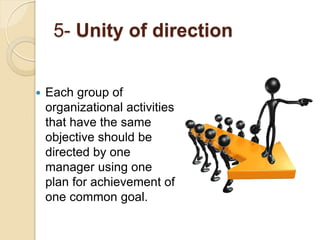
5- Unity of direction
 Each group of
organizational activities
that have the same
objective should be
directed by one
manager using one
plan for achievement of
one common goal.
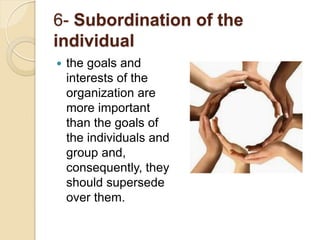
6- Subordination of the
individual
 the goals and
interests of the
organization are
more important
than the goals of
the individuals and
group and,
consequently, they
should supersede
over them.
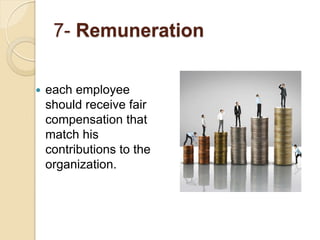
7- Remuneration
 each employee
should receive fair
compensation that
match his
contributions to the
organization.
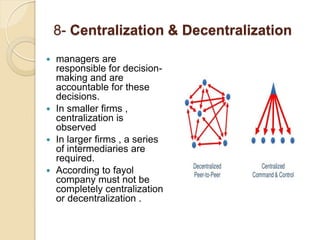
8- Centralization & Decentralization
 managers are
responsible for decision-
making and are
accountable for these
decisions.
 In smaller firms ,
centralization is
observed
 In larger firms , a series
of intermediaries are
required.
 According to fayol
company must not be
completely centralization
or decentralization .
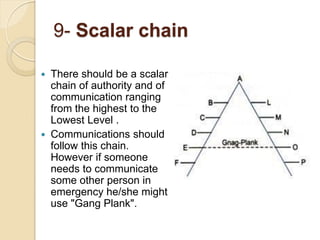
9- Scalar chain
 There should be a scalar
chain of authority and of
communication ranging
from the highest to the
Lowest Level .
 Communications should
follow this chain.
However if someone
needs to communicate
some other person in
emergency he/she might
use "Gang Plank".
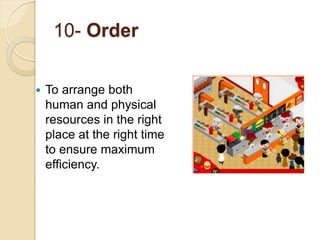
10- Order
 To arrange both
human and physical
resources in the right
place at the right time
to ensure maximum
efficiency.
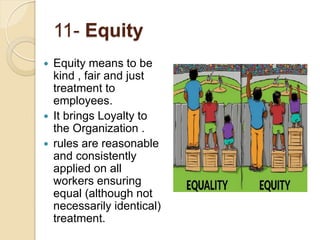
11- Equity
 Equity means to be
kind , fair and just
treatment to
employees.
 It brings Loyalty to
the Organization .
 rules are reasonable
and consistently
applied on all
workers ensuring
equal (although not
necessarily identical)
treatment.
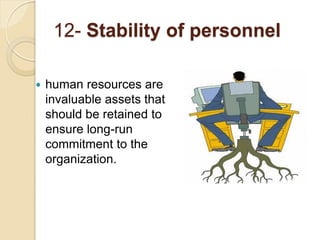
12- Stability of personnel
 human resources are
invaluable assets that
should be retained to
ensure long-run
commitment to the
organization.
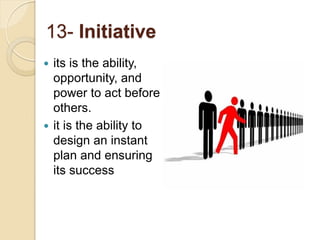
13- Initiative
 its is the ability,
opportunity, and
power to act before
others.
 it is the ability to
design an instant
plan and ensuring
its success
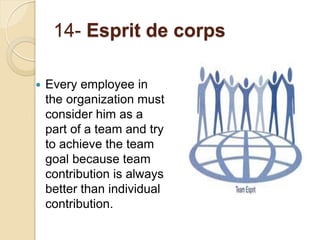
14- Esprit de corps
 Every employee in
the organization must
consider him as a
part of a team and try
to achieve the team
goal because team
contribution is always
better than individual
contribution.
 Henri fayol developed the 14 principles of
management According to its specialization
promotes efficiency of the workforce and
increases productivity, This is why Fayol is
counted as "the father of modern management
Henri fayol

Henri fayol

  • 1.
    Principle of Management CreatedBy : Amna Alobied. Henri Fayol (1841-1925)
  • 2.
    Introduction  While peoplegave Taylor more attention in UK and USA , Fayol’s distinguished book ” General and Industrial Management” was translated from French to English only after 13 years.  Administrative management theory attempts to find a rational way to design an organization as a whole.
  • 3.
     The theorygenerally calls for a formalized administrative structure, a clear division of labor, and delegation of power and authority to administrators relevant to their areas of responsibilities and administrative management theory important because its Promote decisions based on data .  Administrative management helps you work on your processes and results to improve your overall results and ensuring that businesses run smoothly.
  • 4.
    The Three Contributions Mainly, Fayol offered three contributions: 1. management activities. 2. management functions 3. the fourteen management principles.
  • 5.
    Management Activities  Asfor management activities, Fayol classifies industrial and commercial organizations into six basic activities: 1. Technical. 2. Financial. 3. security. 4. commercial. 5. Accounting. 6. management activities.
  • 6.
    Management Functions As forfunctions of management stated seven management functions abbreviated in the word POSDCORB which includes: 1. Planning. 2. Organizing. 3. staffing and supervising. 4. directing. 5. controlling. 6. Reporting and. 7. Budgeting.
  • 7.
    The 14 ManagementPrinciples  The third and most critical, contribution offered by Fayol is the 14management principles. Fayol emphasized two facts here:  first these principles should be recognized as an aggregated managerial tool which means that they work together as a combination or sum total.  Secondly, these principles should be applied with flexibility that even new managers could learn how to manage.
  • 8.
    1- Division ofwork  To ensure work being easy to perform by individuals and groups.  To achieve specialization and integration.
  • 9.
    2- Authority &Responsibility  means “power” the right to give order and expect obedience
  • 10.
    3- Discipline  employeesshould adhere to rules and regulations * and marks of respect to the organization system
  • 11.
    4- Unity ofcommand  Every employee should receive orders from only one Supervisor or behalf of the superior.
  • 12.
    5- Unity ofdirection  Each group of organizational activities that have the same objective should be directed by one manager using one plan for achievement of one common goal.
  • 13.
    6- Subordination ofthe individual  the goals and interests of the organization are more important than the goals of the individuals and group and, consequently, they should supersede over them.
  • 14.
    7- Remuneration  eachemployee should receive fair compensation that match his contributions to the organization.
  • 15.
    8- Centralization &Decentralization  managers are responsible for decision- making and are accountable for these decisions.  In smaller firms , centralization is observed  In larger firms , a series of intermediaries are required.  According to fayol company must not be completely centralization or decentralization .
  • 16.
    9- Scalar chain There should be a scalar chain of authority and of communication ranging from the highest to the Lowest Level .  Communications should follow this chain. However if someone needs to communicate some other person in emergency he/she might use "Gang Plank".
  • 17.
    10- Order  Toarrange both human and physical resources in the right place at the right time to ensure maximum efficiency.
  • 18.
    11- Equity  Equitymeans to be kind , fair and just treatment to employees.  It brings Loyalty to the Organization .  rules are reasonable and consistently applied on all workers ensuring equal (although not necessarily identical) treatment.
  • 19.
    12- Stability ofpersonnel  human resources are invaluable assets that should be retained to ensure long-run commitment to the organization.
  • 20.
    13- Initiative  itsis the ability, opportunity, and power to act before others.  it is the ability to design an instant plan and ensuring its success
  • 21.
    14- Esprit decorps  Every employee in the organization must consider him as a part of a team and try to achieve the team goal because team contribution is always better than individual contribution.
  • 22.
     Henri fayoldeveloped the 14 principles of management According to its specialization promotes efficiency of the workforce and increases productivity, This is why Fayol is counted as "the father of modern management