3.5 Archimedes’ Principle
Relationshipbetween buoyant force with the actual weight and apparent weight
Buoyant force
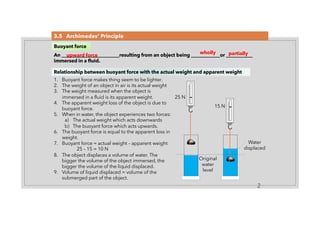
1. Buoyant force makes thing seem to be lighter.
2. The weight of an object in air is its actual weight
3. The weight measured when the object is
immersed in a fluid is its apparent weight.
4. The apparent weight loss of the object is due to
buoyant force.
5. When in water, the object experiences two forces:
a) The actual weight which acts downwards
b) The buoyant force which acts upwards.
6. The buoyant force is equal to the apparent loss in
weight.
7. Buoyant force = actual weight – apparent weight
25 – 15 = 10 N
8. The object displaces a volume of water. The
bigger the volume of the object immersed, the
bigger the volume of the liquid displaced.
9. Volume of liquid displaced = volume of the
submerged part of the object.
2
25 N
15 N
Original
water
level
Water
displaced
An ________________________resulting from an object being ____________or ___________
immersed in a fluid.
upward force
wholly partially
3.
Relationship between buoyantforce to the weight of the liquid displaced
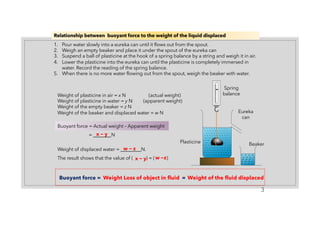
1. Pour water slowly into a eureka can until it flows out from the spout.
2. Weigh an empty beaker and place it under the spout of the eureka can
3. Suspend a ball of plasticine at the hook of a spring balance by a string and weigh it in air.
4. Lower the plasticine into the eureka can until the plasticine is completely immersed in
water. Record the reading of the spring balance.
5. When there is no more water flowing out from the spout, weigh the beaker with water.
Weight of plasticine in air = x N (actual weight)
Weight of plasticine in water = y N (apparent weight)
Weight of the empty beaker = z N
Weight of the beaker and displaced water = w N
Buoyant force = Actual weight – Apparent weight
= N
Weight of displaced water = N.
The result shows that the value of ( ) = ( )
3
Plasticine
Eureka
can
Beaker
Spring
balance
Buoyant force = =
x − y
w − z
x − y w −z
Weight Loss of object in fluid Weight of the fluid displaced
4.
Archimedes’ Principle
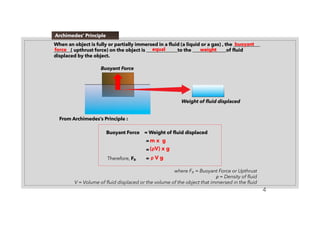
When anobject is fully or partially immersed in a fluid (a liquid or a gas) , the ___________
_______( upthrust force) on the object is _____________to the ______________of fluid
displaced by the object.
From Archimedes’s Principle :
Buoyant Force = Weight of fluid displaced
=
=
Therefore, FB =
where FB = Buoyant Force or Upthrust
ρ = Density of fluid
V = Volume of fluid displaced or the volume of the object that immersed in the fluid
4
Buoyant Force
Weight of fluid displaced
buoyant
equal weight
ρ V g
m x g
(ρV) x g
force
5.
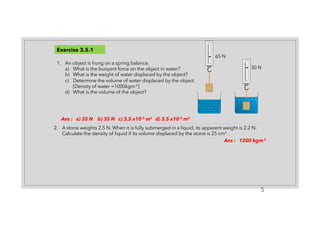
1. An objectis hung on a spring balance.
a) What is the buoyant force on the object in water?
b) What is the weight of water displaced by the object?
c) Determine the volume of water displaced by the object.
[Density of water =1000kgm-3
]
d) What is the volume of the object?
2. A stone weights 2.5 N. When it is fully submerged in a liquid, its apparent weight is 2.2 N.
Calculate the density of liquid if its volume displaced by the stone is 25 cm3 .
5
65 N
30 N
Exercise 3.5.1
Ans : a) 35 N b) 35 N c) 3.5 x10⁻³
m3
d) 3.5 x10⁻³
m3
Ans : 1200 kgm-3
6.
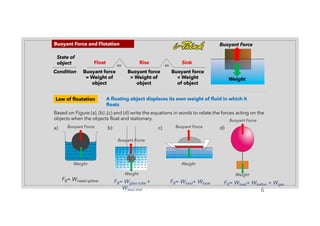
Buoyant Force andFlotation
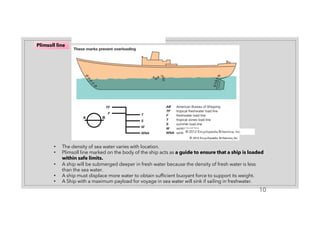
Law of floatation A floating object displaces its own weight of fluid in which it
floats
Based on Figure (a), (b) ,(c) and (d) write the equations in words to relate the forces acting on the
objects when the objects float and stationary.
FB= Wmetal sphere
6
Buoyant Force
Weight
Buoyant Force
Weight
a) b) c) d)
State of
object
Condition
as
Float
Buoyant force
= Weight of
object
Rise
Buoyant force
> Weight of
object
as
Sink
Buoyant force
< Weight
of object
FB= Wglass tube +
Wlead shot
FB= Wload+ Wboat FB= Wload+ Wballon + Wgas
Buoyant Force
Weight
Buoyant Force
Weight
Buoyant Force
Weight
7.
1. An objectof mass 5 kg floats on the surface water. What is the upthrust experienced by
the object.
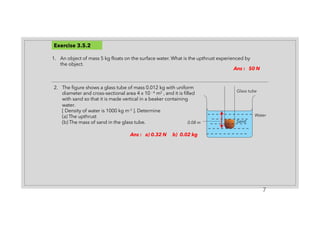
2. The figure shows a glass tube of mass 0.012 kg with uniform
diameter and cross-sectional area 4 x 10 - 4 m2 , and it is filled
with sand so that it is made vertical in a beaker containing
water.
[ Density of water is 1000 kg m-3 ]. Determine
(a) The upthrust
(b) The mass of sand in the glass tube.
7
Sand
Water
Glass tube
0.08 m
Exercise 3.5.2
Ans : a) 0.32 N b) 0.02 kg
Ans : 50 N
8.
8
Applications of ArchimedesPrinciple
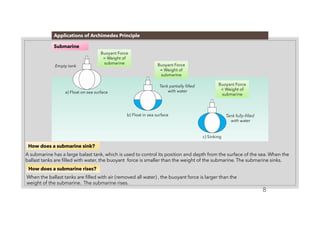
How does a submarine sink?
A submarine has a large balast tank, which is used to control its position and depth from the surface of the sea. When the
ballast tanks are filled with water, the buoyant force is smaller than the weight of the submarine. The submarine sinks.
Submarine
How does a submarine rises?
When the ballast tanks are filled with air (removed all water) , the buoyant force is larger than the
weight of the submarine. The submarine rises.
Buoyant Force
= Weight of
submarine Buoyant Force
= Weight of
submarine
Buoyant Force
< Weight of
submarine
Empty tank
a) Float on sea surface
b) Float in sea surface
c) Sinking
Tank partially filled
with water
Tank fully-filled
with water
9.
9
Hydrometer
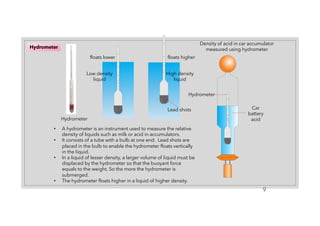
• A hydrometeris an instrument used to measure the relative
density of liquids such as milk or acid in accumulators.
• It consists of a tube with a bulb at one end. Lead shots are
placed in the bulb to enable the hydrometer floats vertically
in the liquid.
• In a liquid of lesser density, a larger volume of liquid must be
displaced by the hydrometer so that the buoyant force
equals to the weight. So the more the hydrometer is
submerged.
• The hydrometer floats higher in a liquid of higher density.
Hydrometer
Low density
liquid
Lead shots
High density
liquid
Car
battery
acid
Hydrometer
Density of acid in car accumulator
measured using hydrometer
floats higher
floats lower
11
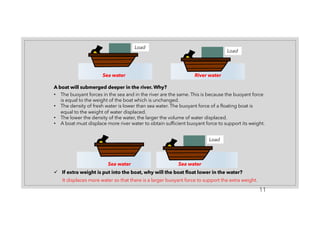
A boat willsubmerged deeper in the river. Why?
• The buoyant forces in the sea and in the river are the same. This is because the buoyant force
is equal to the weight of the boat which is unchanged.
• The density of fresh water is lower than sea water. The buoyant force of a floating boat is
equal to the weight of water displaced.
• The lower the density of the water, the larger the volume of water displaced.
• A boat must displace more river water to obtain sufficient buoyant force to support its weight.
ü If extra weight is put into the boat, why will the boat float lower in the water?
Sea water
Load
Sea water
Load
Load
River water
Sea water
It displaces more water so that there is a larger buoyant force to support the extra weight.
12.
12
Explain why aboat made of steel will float in water, but a block of steel will sink.
• A block of steel will displaced a small volume of water only. So the buoyant force acting on it
is smaller than its weight. Therefore it sinks.
• A ship floats on the surface of the sea because the volume of water displaced by the ship is
sufficiently
• large. The weight of water displaced is large so the buoyant force acting on the ship is also
greater. Weight of ship equal Buoyant force. Therefore it floats.
• Although a ship is constructed of metal, which has a larger density than water, its shape is
hollow so that the overall density of the ship is smaller than the sea water.
• As a result, the buoyant force acting on the ship is large enough to support its weight.
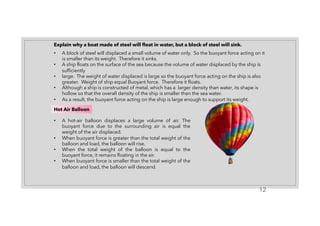
• A hot-air balloon displaces a large volume of air. The
buoyant force due to the surrounding air is equal the
weight of the air displaced.
• When buoyant force is greater than the total weight of the
balloon and load, the balloon will rise.
• When the total weight of the balloon is equal to the
buoyant force, it remains floating in the air.
• When buoyant force is smaller than the total weight of the
balloon and load, the balloon will descend.
Hot Air Balloon
13.
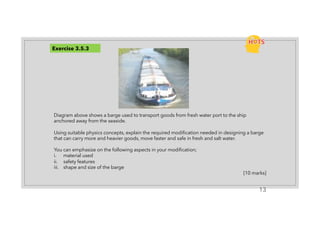
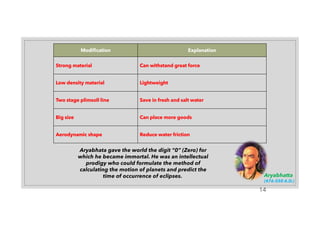
Diagram above showsa barge used to transport goods from fresh water port to the ship
anchored away from the seaside.
Using suitable physics concepts, explain the required modification needed in designing a barge
that can carry more and heavier goods, move faster and safe in fresh and salt water.
You can emphasize on the following aspects in your modification;
i. material used
ii. safety features
iii. shape and size of the barge
[10 marks]
13
Exercise 3.5.3
14.
Modification Explanation
Strong materialCan withstand great force
Low density material Lightweight
Two stage plimsoll line Save in fresh and salt water
Big size Can place more goods
Aerodynamic shape Reduce water friction
14
.
Aryabhata gave the world the digit “0” (Zero) for
which he became immortal. He was an intellectual
prodigy who could formulate the method of
calculating the motion of planets and predict the
time of occurrence of eclipses. Aryabhatta
(476-550 A.D.)

 Most read
 Most read
 Most read


