WHAT ARE DBMS KEYS?
Subject: Database Security
Teacher: Dr.Majid Sumro
Group Members:
1. Zaiba Aziz
2. Yumna Niaz
3. Shumaila Sajjad
4. Shabana Iqbal
WHATARE DBMS KEYS?
KEYS in DBMS is an attribute or set of attributes that help you to
identify a row(tuple) in a relation(table).
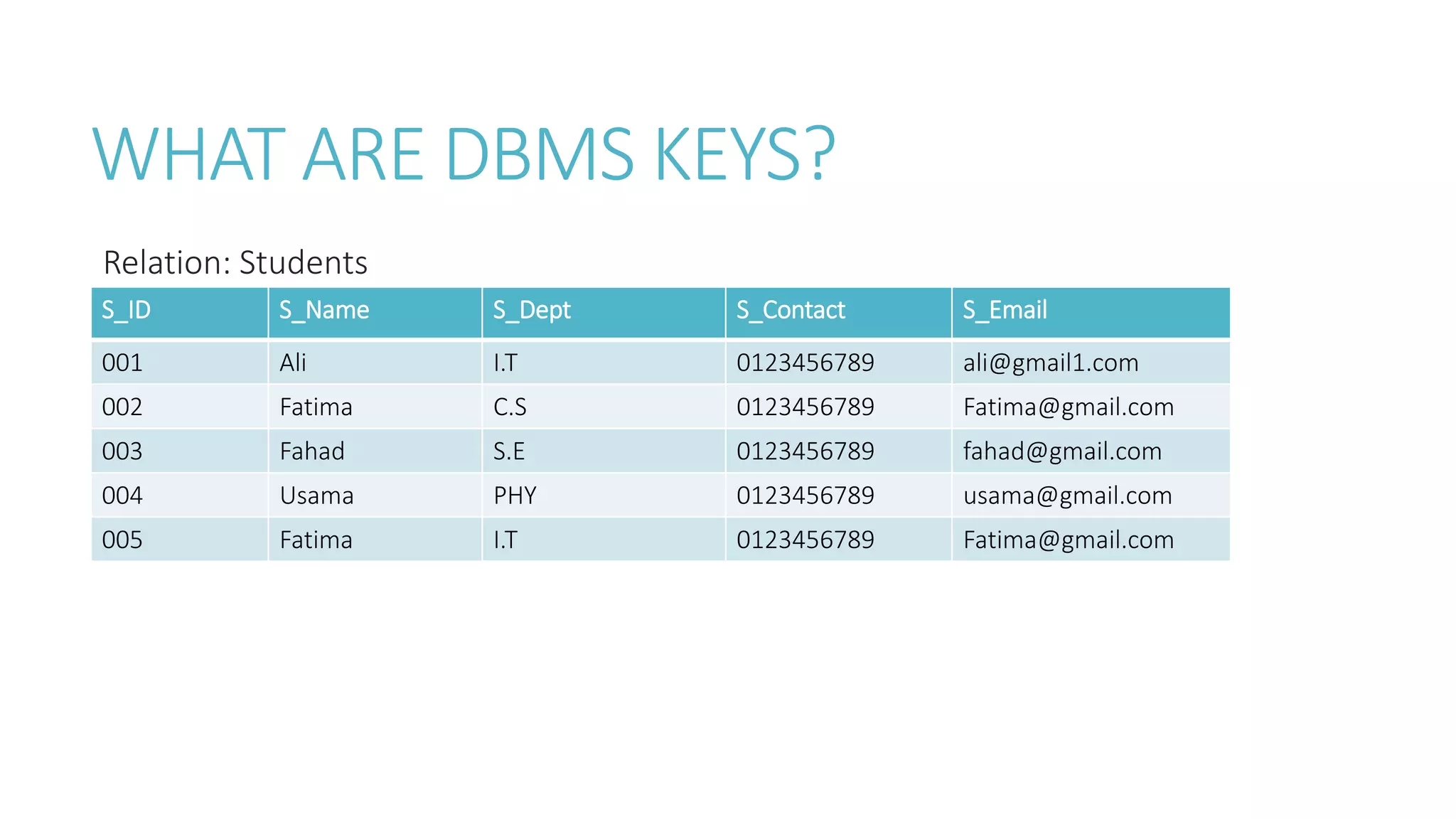
WHAT ARE DBMS KEYS?
Relation: Students
S_ID S_Name S_Dept S_Contact S_Email
001 Ali I.T 0123456789 ali@gmail1.com
002 Fatima C.S 0123456789 Fatima@gmail.com
003 Fahad S.E 0123456789 fahad@gmail.com
004 Usama PHY 0123456789 usama@gmail.com
005 Fatima I.T 0123456789 Fatima@gmail.com
WHY DO WE NEED OF DBMS KEYS?
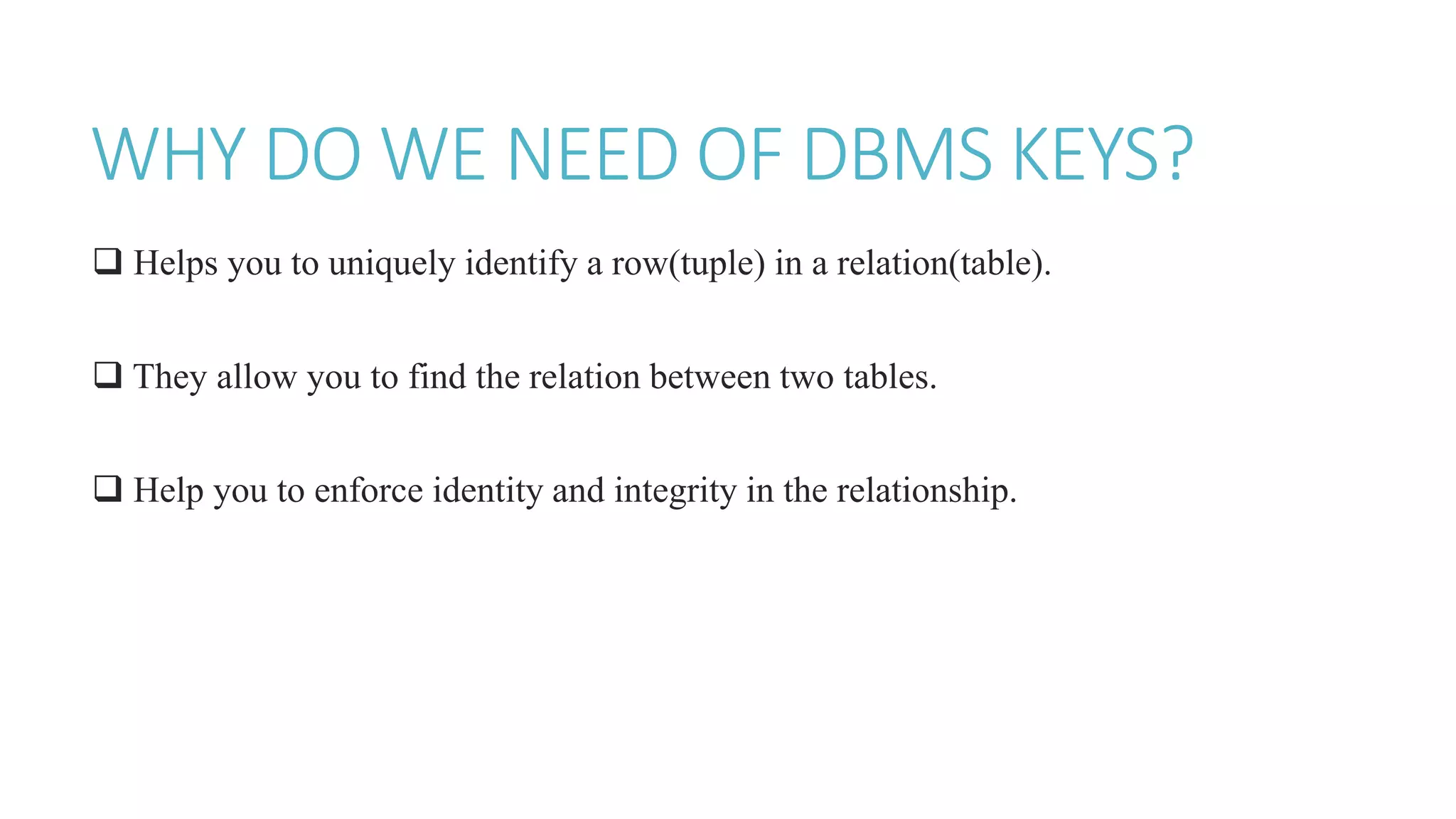
 Helps you to uniquely identify a row(tuple) in a relation(table).
 They allow you to find the relation between two tables.
 Help you to enforce identity and integrity in the relationship.
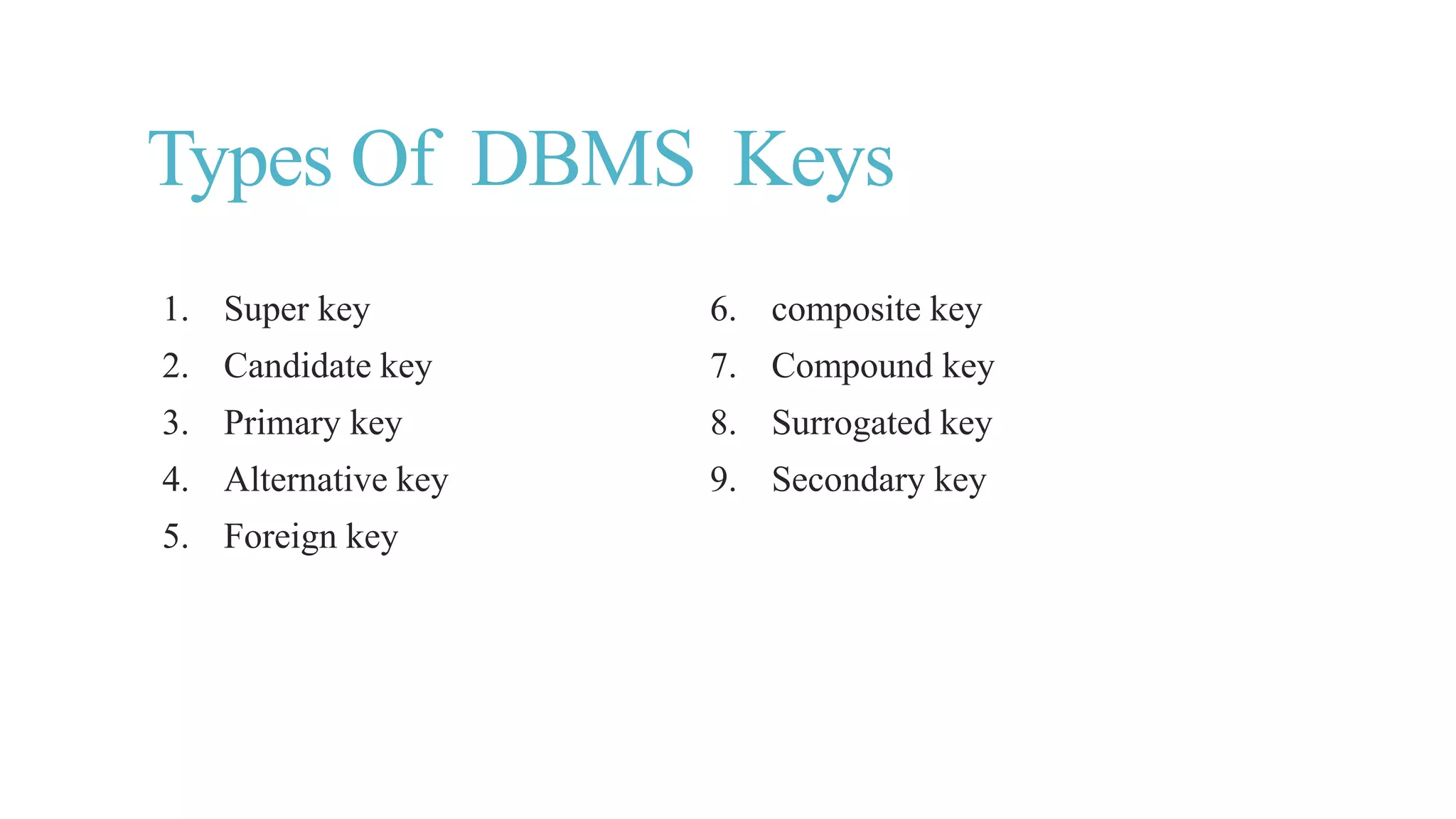
Types Of DBMS Keys
1. Super key
2. Candidate key
3. Primary key
4. Alternative key
5. Foreign key
6. composite key
7. Compound key
8. Surrogated key
9. Secondary key
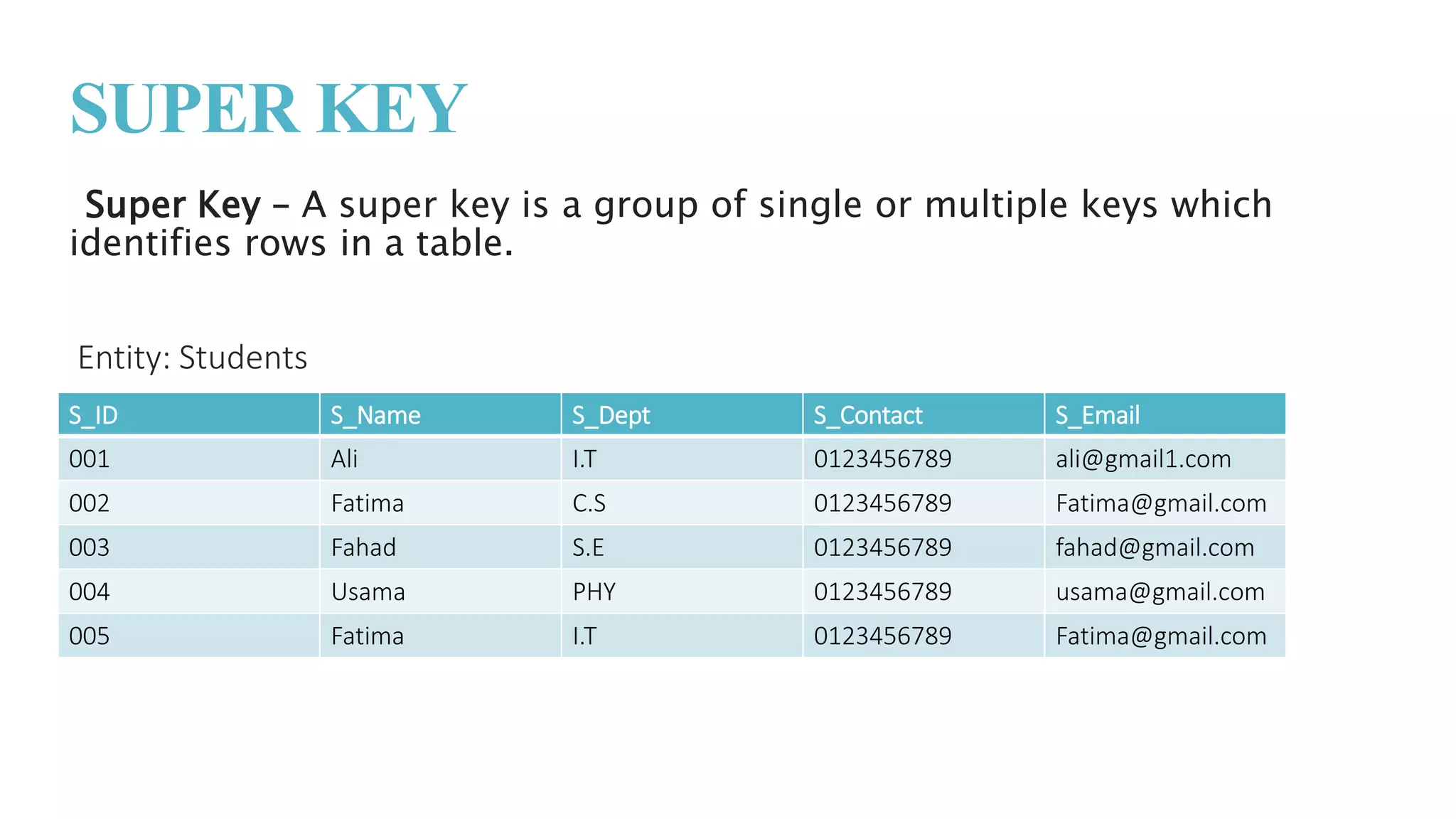
SUPER KEY
Super Key – A super key is a group of single or multiple keys which
identifies rows in a table.
Entity: Students
S_ID S_Name S_Dept S_Contact S_Email
001 Ali I.T 0123456789 ali@gmail1.com
002 Fatima C.S 0123456789 Fatima@gmail.com
003 Fahad S.E 0123456789 fahad@gmail.com
004 Usama PHY 0123456789 usama@gmail.com
005 Fatima I.T 0123456789 Fatima@gmail.com
SECONDARY KEY
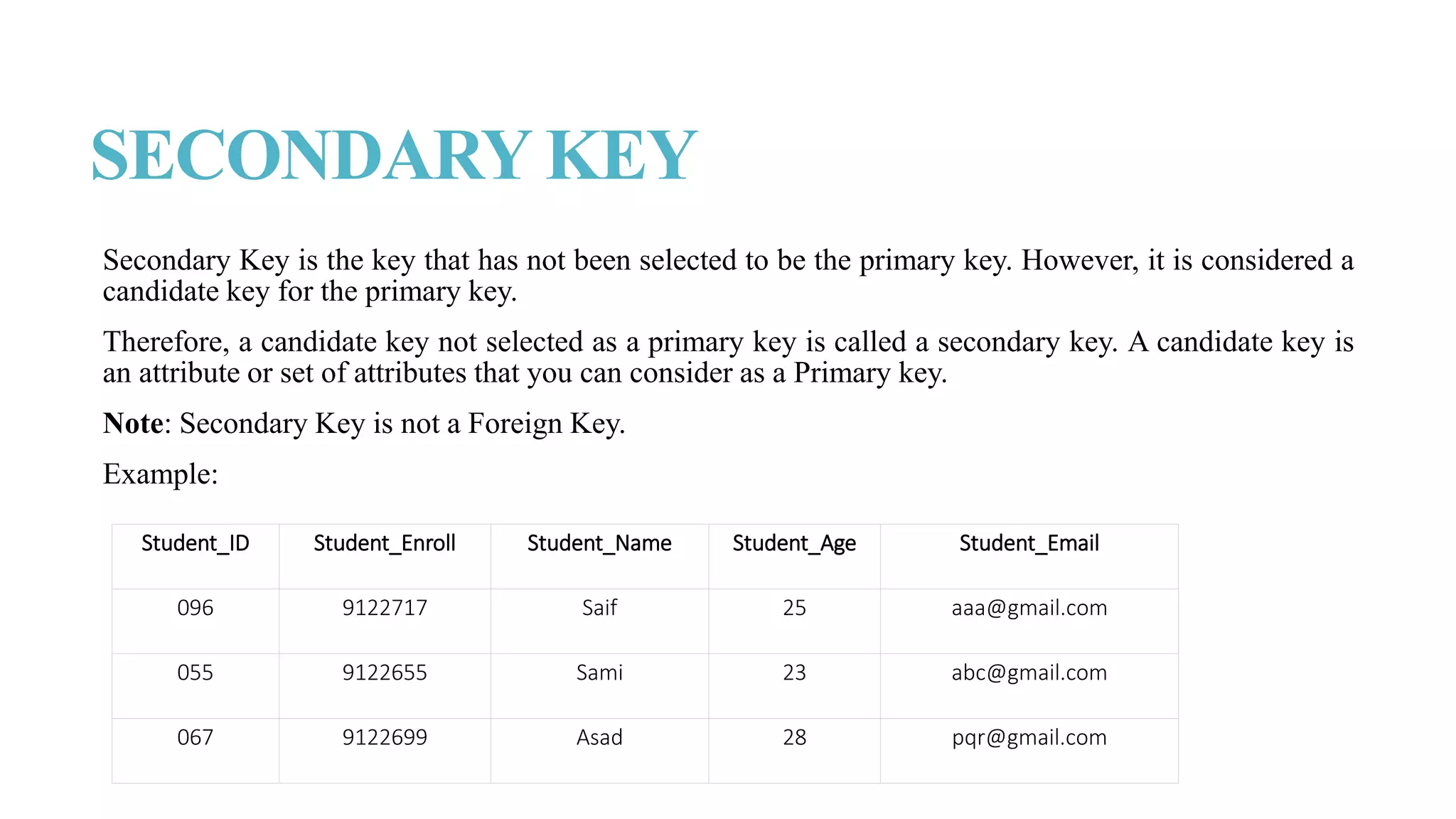
Secondary Key is the key that has not been selected to be the primary key. However, it is considered a
candidate key for the primary key.
Therefore, a candidate key not selected as a primary key is called a secondary key. A candidate key is
an attribute or set of attributes that you can consider as a Primary key.
Note: Secondary Key is not a Foreign Key.
Example:
Student_ID Student_Enroll Student_Name Student_Age Student_Email
096 9122717 Saif 25 aaa@gmail.com
055 9122655 Sami 23 abc@gmail.com
067 9122699 Asad 28 pqr@gmail.com
PRIMARY KEY
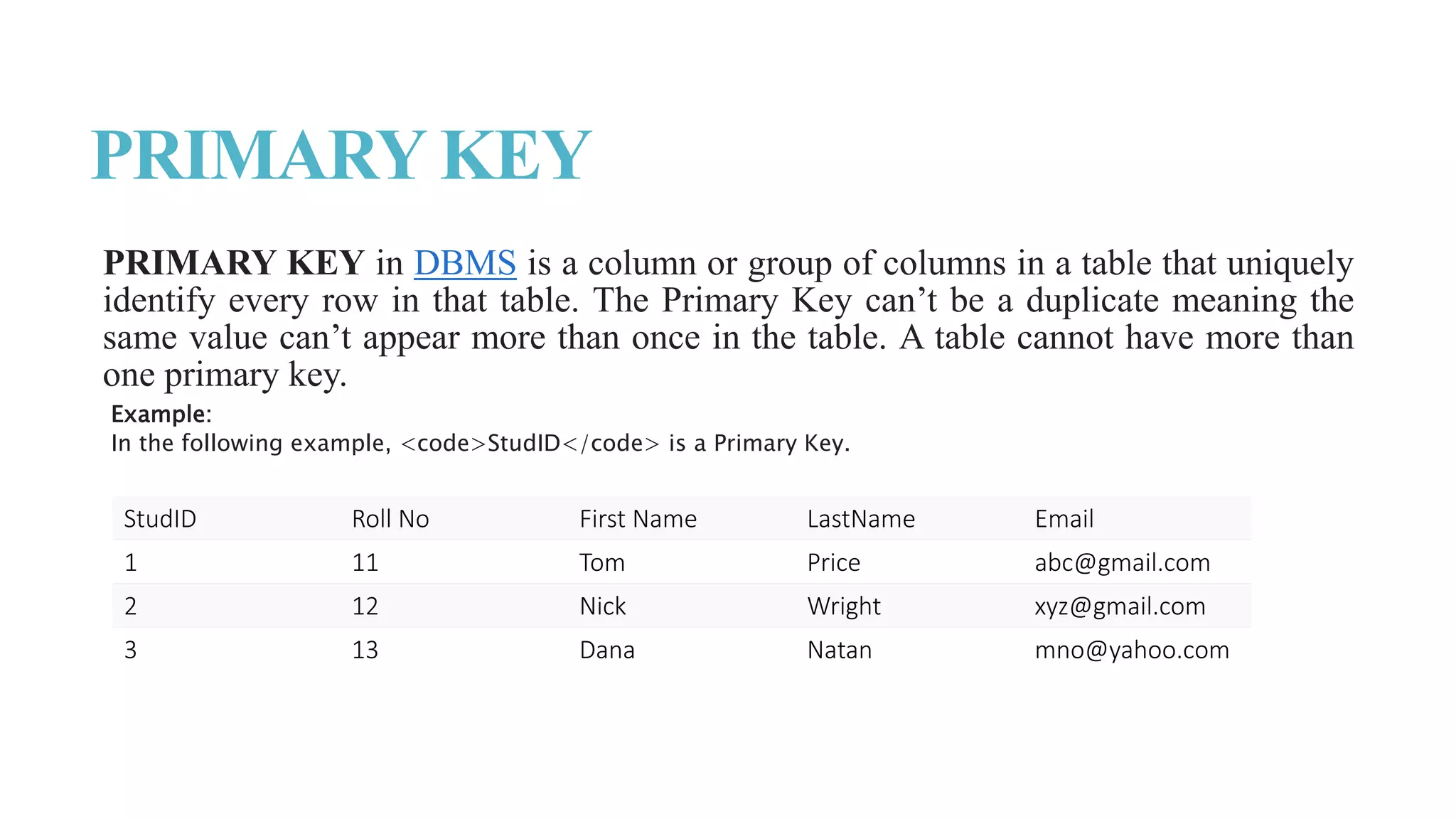
PRIMARY KEY in DBMS is a column or group of columns in a table that uniquely
identify every row in that table. The Primary Key can’t be a duplicate meaning the
same value can’t appear more than once in the table. A table cannot have more than
one primary key.
StudID Roll No First Name LastName Email
1 11 Tom Price abc@gmail.com
2 12 Nick Wright xyz@gmail.com
3 13 Dana Natan mno@yahoo.com
Example:
In the following example, <code>StudID</code> is a Primary Key.
ALTERNATE KEY
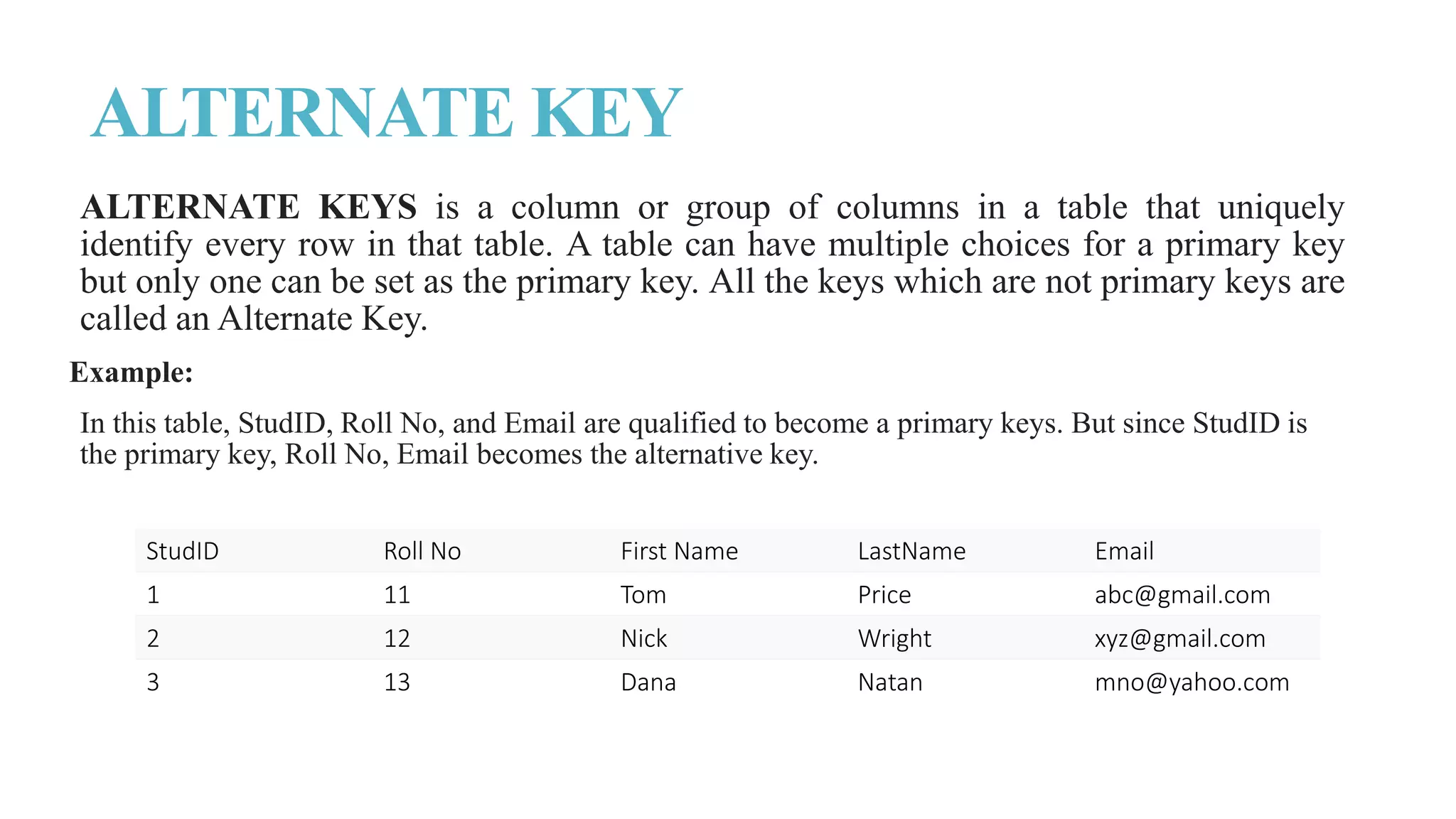
ALTERNATE KEYS is a column or group of columns in a table that uniquely
identify every row in that table. A table can have multiple choices for a primary key
but only one can be set as the primary key. All the keys which are not primary keys are
called an Alternate Key.
Example:
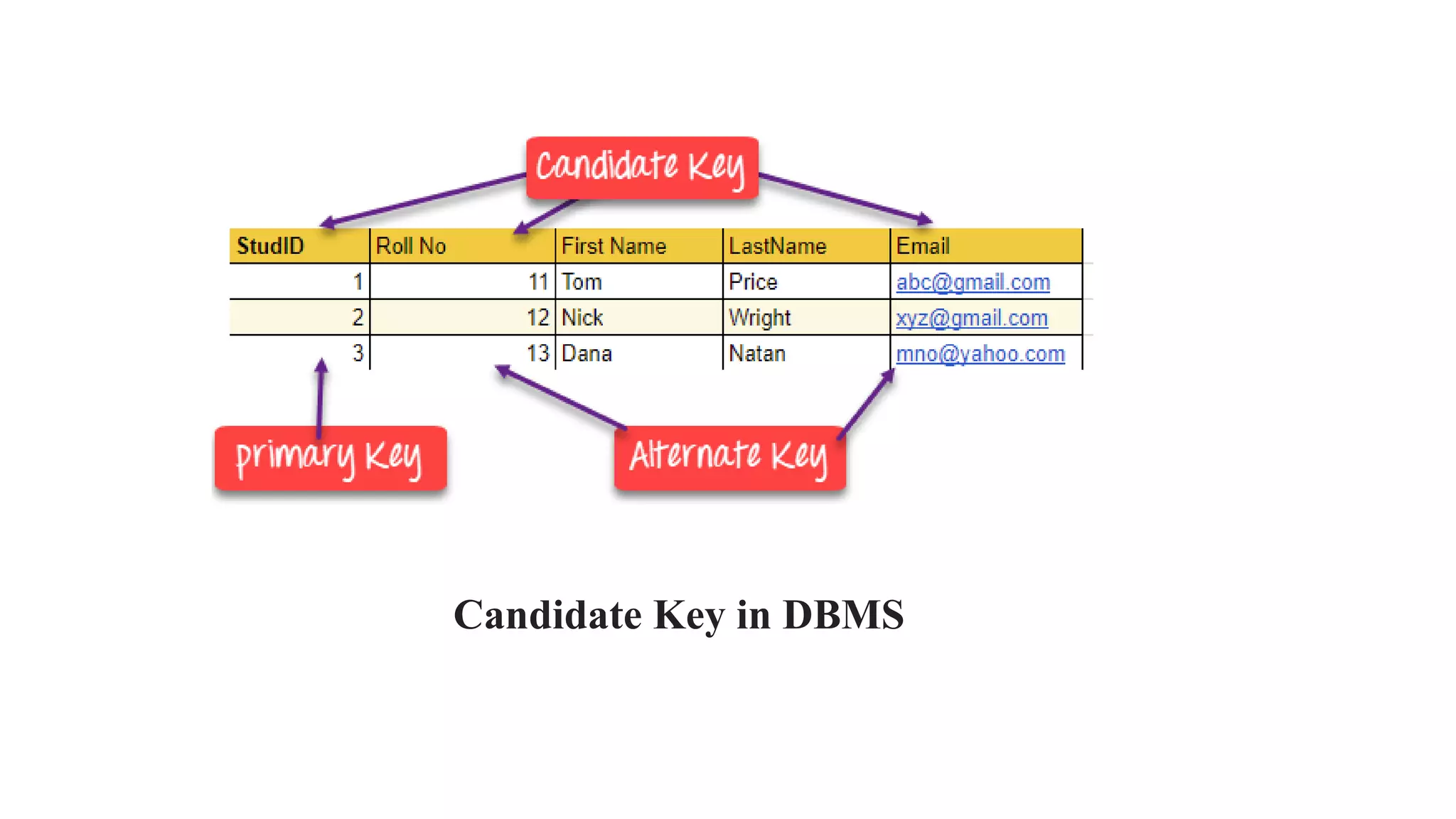
In this table, StudID, Roll No, and Email are qualified to become a primary keys. But since StudID is
the primary key, Roll No, Email becomes the alternative key.
StudID Roll No First Name LastName Email
1 11 Tom Price abc@gmail.com
2 12 Nick Wright xyz@gmail.com
3 13 Dana Natan mno@yahoo.com
COMPOSITE KEY
COMPOSITE KEY is a combination of two or more columns that uniquely identify rows in a table.
The combination of columns guarantees uniqueness, though individual uniqueness is not guaranteed.
Hence, they are combined to uniquely identify records in a table.
The difference between the compound and the composite key is that any part of the compound key can
be a foreign key, but the composite key may or maybe not be a part of the foreign key.
CANDIDATE KEY
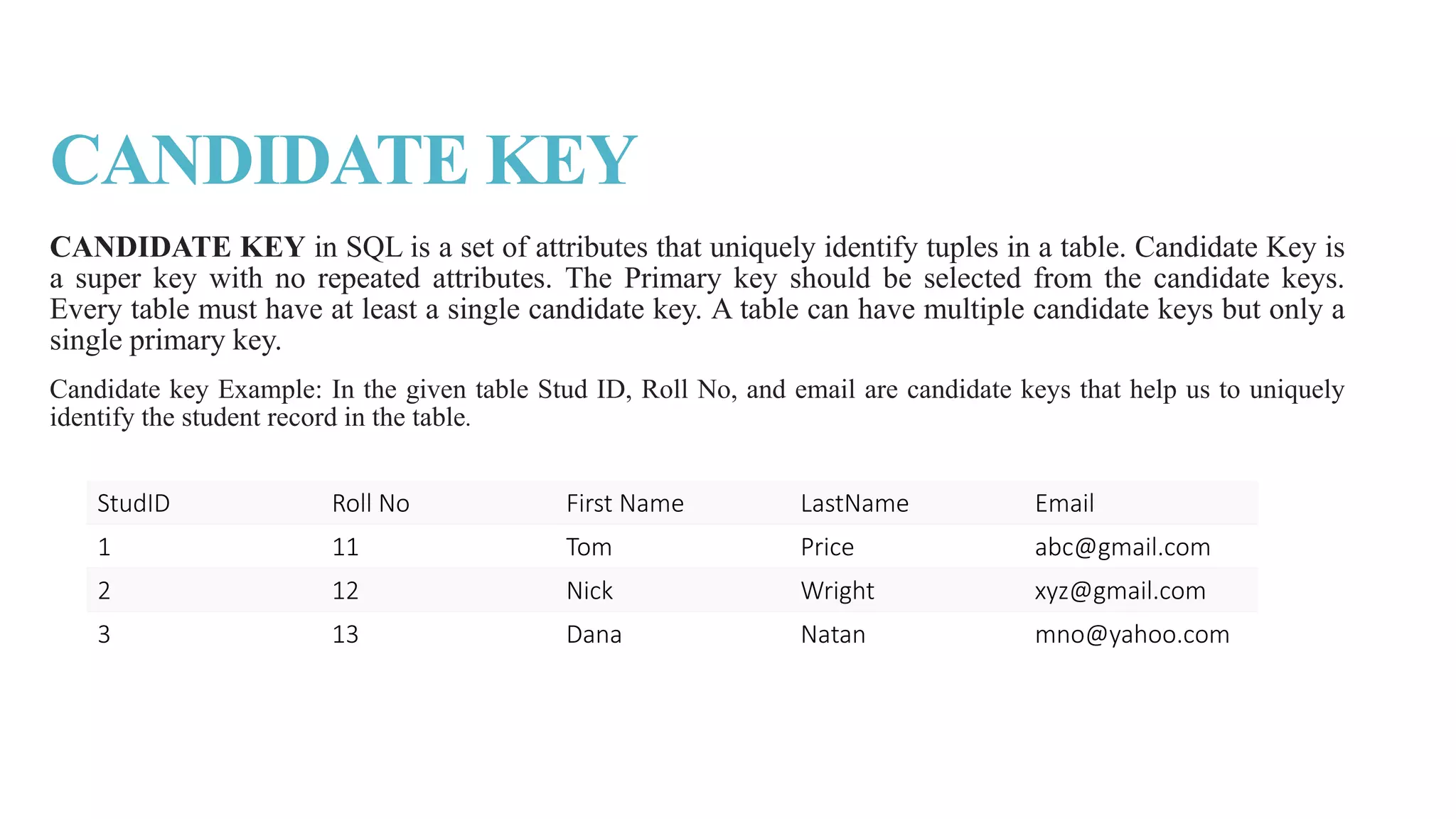
CANDIDATE KEY in SQL is a set of attributes that uniquely identify tuples in a table. Candidate Key is
a super key with no repeated attributes. The Primary key should be selected from the candidate keys.
Every table must have at least a single candidate key. A table can have multiple candidate keys but only a
single primary key.
Candidate key Example: In the given table Stud ID, Roll No, and email are candidate keys that help us to uniquely
identify the student record in the table.
StudID Roll No First Name LastName Email
1 11 Tom Price abc@gmail.com
2 12 Nick Wright xyz@gmail.com
3 13 Dana Natan mno@yahoo.com
Candidate Key in DBMS
COMPOUND KEY
COMPOUND KEY has two or more attributes that allow you to uniquely
recognize a specific record. It is possible that each column may not be unique by
itself within the database
Example:
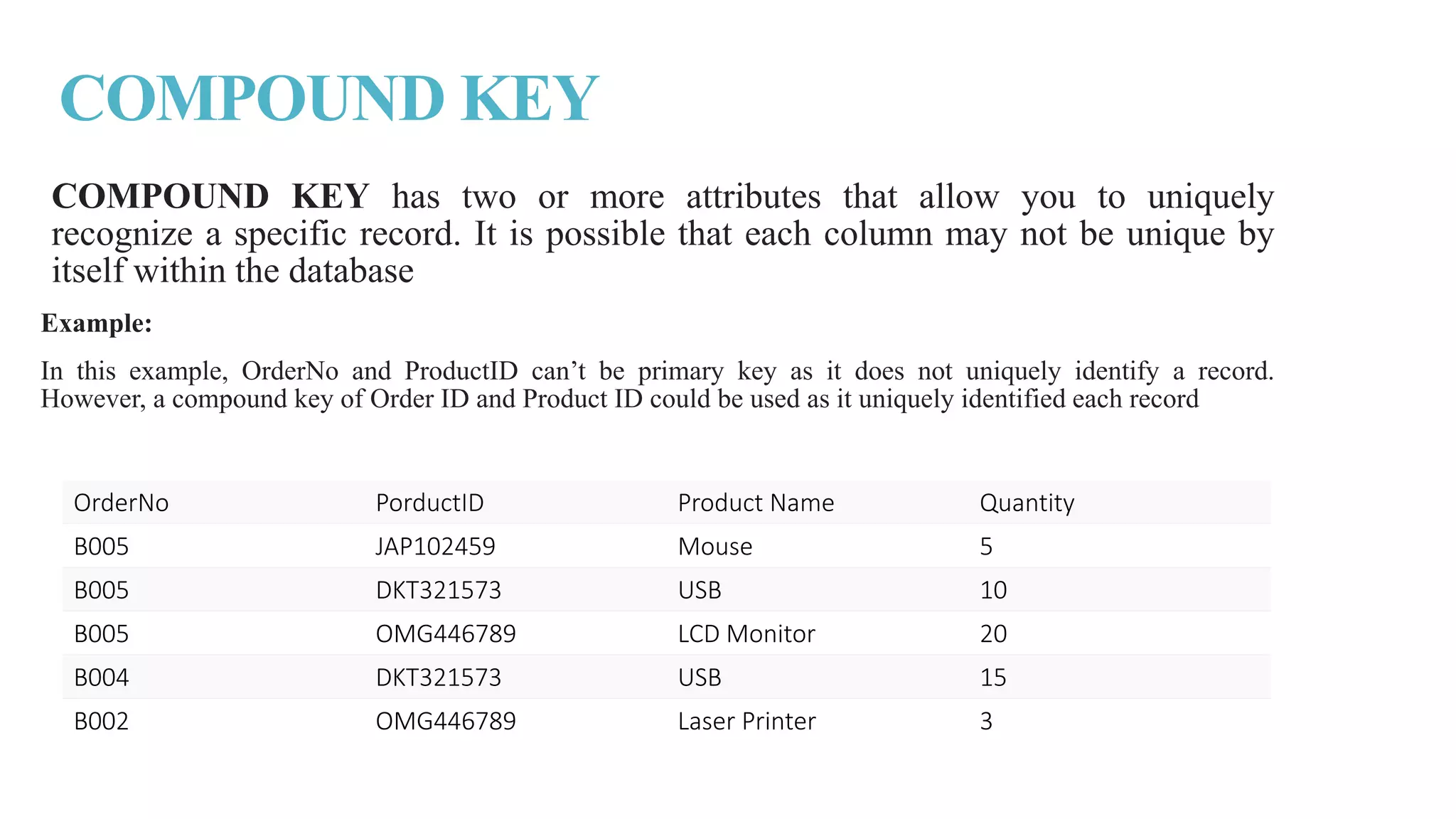
In this example, OrderNo and ProductID can’t be primary key as it does not uniquely identify a record.
However, a compound key of Order ID and Product ID could be used as it uniquely identified each record
OrderNo PorductID Product Name Quantity
B005 JAP102459 Mouse 5
B005 DKT321573 USB 10
B005 OMG446789 LCD Monitor 20
B004 DKT321573 USB 15
B002 OMG446789 Laser Printer 3
FOREIGN KEY
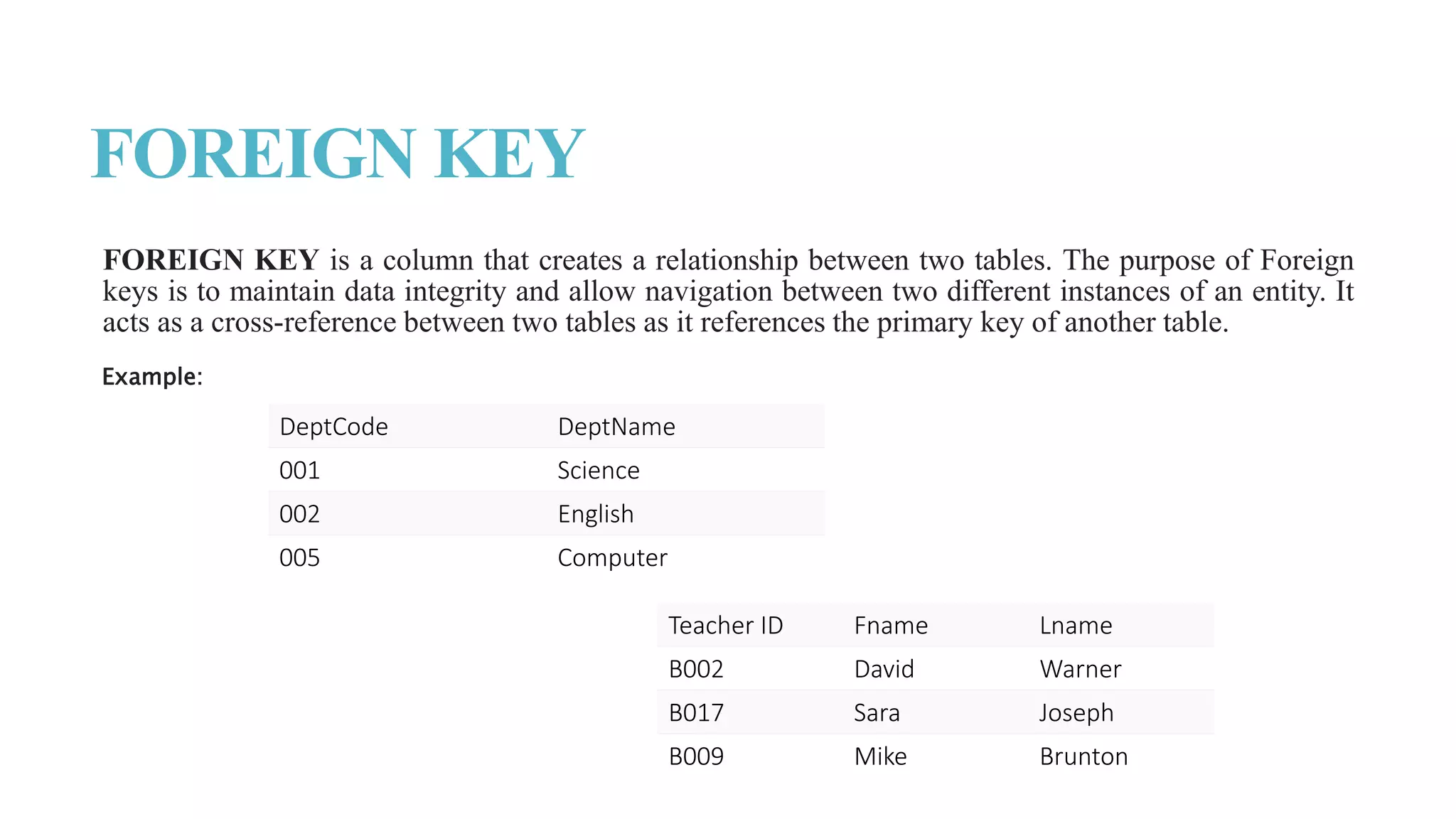
FOREIGN KEY is a column that creates a relationship between two tables. The purpose of Foreign
keys is to maintain data integrity and allow navigation between two different instances of an entity. It
acts as a cross-reference between two tables as it references the primary key of another table.
DeptCode DeptName
001 Science
002 English
005 Computer
Teacher ID Fname Lname
B002 David Warner
B017 Sara Joseph
B009 Mike Brunton
Example:
FOREIGN KEY
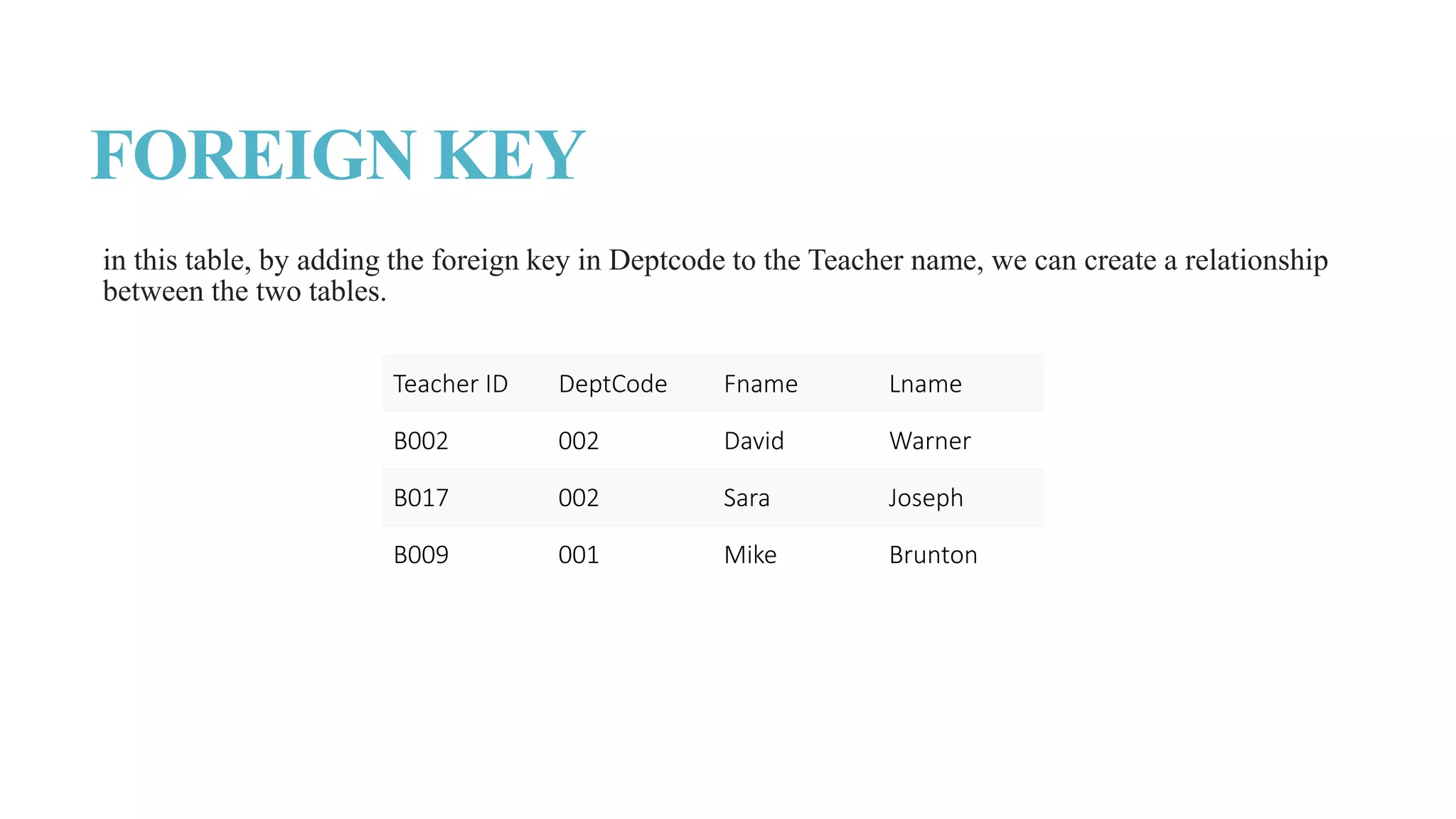
in this table, by adding the foreign key in Deptcode to the Teacher name, we can create a relationship
between the two tables.
Teacher ID DeptCode Fname Lname
B002 002 David Warner
B017 002 Sara Joseph
B009 001 Mike Brunton
SURROGATE KEYS
SURROGATE KEYS An artificial key that aims to uniquely identify each record is called a surrogate
key. This kind of partial key in DBMS is unique because it is created when you don’t have any natural
primary key. They do not lend any meaning to the data in the table. The surrogate key in DBMS is
usually an integer. A surrogate key is a value generated right before the record is inserted into a table
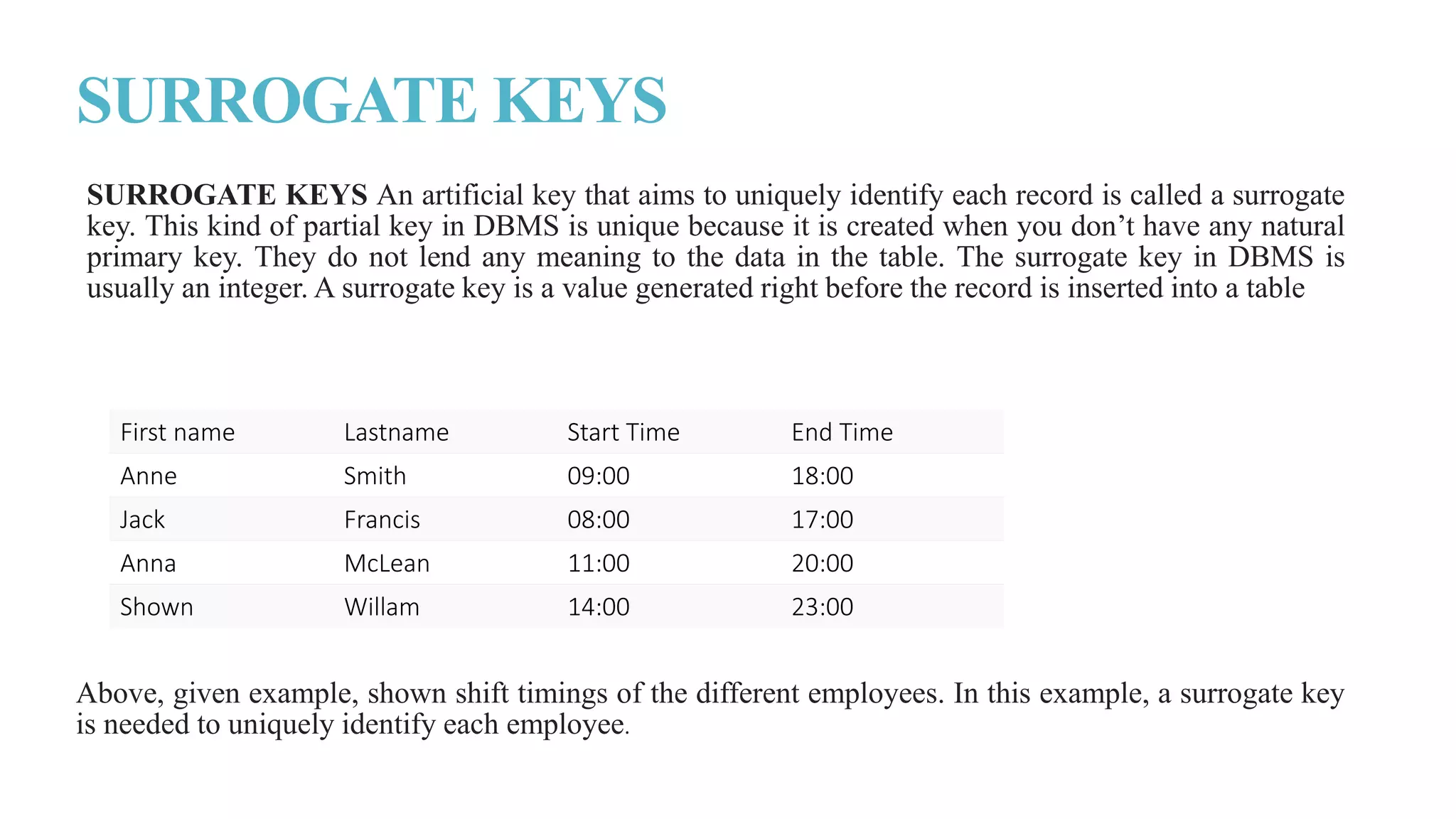
Above, given example, shown shift timings of the different employees. In this example, a surrogate key
is needed to uniquely identify each employee.
First name Lastname Start Time End Time
Anne Smith 09:00 18:00
Jack Francis 08:00 17:00
Anna McLean 11:00 20:00
Shown Willam 14:00 23:00
Presentation OF DBMS-2.pptx

Presentation OF DBMS-2.pptx

  • 2.
    WHAT ARE DBMSKEYS? Subject: Database Security Teacher: Dr.Majid Sumro
  • 3.
    Group Members: 1. ZaibaAziz 2. Yumna Niaz 3. Shumaila Sajjad 4. Shabana Iqbal
  • 4.
    WHATARE DBMS KEYS? KEYSin DBMS is an attribute or set of attributes that help you to identify a row(tuple) in a relation(table).
  • 5.
    WHAT ARE DBMSKEYS? Relation: Students S_ID S_Name S_Dept S_Contact S_Email 001 Ali I.T 0123456789 ali@gmail1.com 002 Fatima C.S 0123456789 Fatima@gmail.com 003 Fahad S.E 0123456789 fahad@gmail.com 004 Usama PHY 0123456789 usama@gmail.com 005 Fatima I.T 0123456789 Fatima@gmail.com
  • 6.
    WHY DO WENEED OF DBMS KEYS?  Helps you to uniquely identify a row(tuple) in a relation(table).  They allow you to find the relation between two tables.  Help you to enforce identity and integrity in the relationship.
  • 7.
    Types Of DBMSKeys 1. Super key 2. Candidate key 3. Primary key 4. Alternative key 5. Foreign key 6. composite key 7. Compound key 8. Surrogated key 9. Secondary key
  • 8.
    SUPER KEY Super Key– A super key is a group of single or multiple keys which identifies rows in a table. Entity: Students S_ID S_Name S_Dept S_Contact S_Email 001 Ali I.T 0123456789 ali@gmail1.com 002 Fatima C.S 0123456789 Fatima@gmail.com 003 Fahad S.E 0123456789 fahad@gmail.com 004 Usama PHY 0123456789 usama@gmail.com 005 Fatima I.T 0123456789 Fatima@gmail.com
  • 9.
    SECONDARY KEY Secondary Keyis the key that has not been selected to be the primary key. However, it is considered a candidate key for the primary key. Therefore, a candidate key not selected as a primary key is called a secondary key. A candidate key is an attribute or set of attributes that you can consider as a Primary key. Note: Secondary Key is not a Foreign Key. Example: Student_ID Student_Enroll Student_Name Student_Age Student_Email 096 9122717 Saif 25 aaa@gmail.com 055 9122655 Sami 23 abc@gmail.com 067 9122699 Asad 28 pqr@gmail.com
  • 10.
    PRIMARY KEY PRIMARY KEYin DBMS is a column or group of columns in a table that uniquely identify every row in that table. The Primary Key can’t be a duplicate meaning the same value can’t appear more than once in the table. A table cannot have more than one primary key. StudID Roll No First Name LastName Email 1 11 Tom Price abc@gmail.com 2 12 Nick Wright xyz@gmail.com 3 13 Dana Natan mno@yahoo.com Example: In the following example, <code>StudID</code> is a Primary Key.
  • 11.
    ALTERNATE KEY ALTERNATE KEYSis a column or group of columns in a table that uniquely identify every row in that table. A table can have multiple choices for a primary key but only one can be set as the primary key. All the keys which are not primary keys are called an Alternate Key. Example: In this table, StudID, Roll No, and Email are qualified to become a primary keys. But since StudID is the primary key, Roll No, Email becomes the alternative key. StudID Roll No First Name LastName Email 1 11 Tom Price abc@gmail.com 2 12 Nick Wright xyz@gmail.com 3 13 Dana Natan mno@yahoo.com
  • 12.
    COMPOSITE KEY COMPOSITE KEYis a combination of two or more columns that uniquely identify rows in a table. The combination of columns guarantees uniqueness, though individual uniqueness is not guaranteed. Hence, they are combined to uniquely identify records in a table. The difference between the compound and the composite key is that any part of the compound key can be a foreign key, but the composite key may or maybe not be a part of the foreign key.
  • 13.
    CANDIDATE KEY CANDIDATE KEYin SQL is a set of attributes that uniquely identify tuples in a table. Candidate Key is a super key with no repeated attributes. The Primary key should be selected from the candidate keys. Every table must have at least a single candidate key. A table can have multiple candidate keys but only a single primary key. Candidate key Example: In the given table Stud ID, Roll No, and email are candidate keys that help us to uniquely identify the student record in the table. StudID Roll No First Name LastName Email 1 11 Tom Price abc@gmail.com 2 12 Nick Wright xyz@gmail.com 3 13 Dana Natan mno@yahoo.com
  • 14.
  • 15.
    COMPOUND KEY COMPOUND KEYhas two or more attributes that allow you to uniquely recognize a specific record. It is possible that each column may not be unique by itself within the database Example: In this example, OrderNo and ProductID can’t be primary key as it does not uniquely identify a record. However, a compound key of Order ID and Product ID could be used as it uniquely identified each record OrderNo PorductID Product Name Quantity B005 JAP102459 Mouse 5 B005 DKT321573 USB 10 B005 OMG446789 LCD Monitor 20 B004 DKT321573 USB 15 B002 OMG446789 Laser Printer 3
  • 16.
    FOREIGN KEY FOREIGN KEYis a column that creates a relationship between two tables. The purpose of Foreign keys is to maintain data integrity and allow navigation between two different instances of an entity. It acts as a cross-reference between two tables as it references the primary key of another table. DeptCode DeptName 001 Science 002 English 005 Computer Teacher ID Fname Lname B002 David Warner B017 Sara Joseph B009 Mike Brunton Example:
  • 17.
    FOREIGN KEY in thistable, by adding the foreign key in Deptcode to the Teacher name, we can create a relationship between the two tables. Teacher ID DeptCode Fname Lname B002 002 David Warner B017 002 Sara Joseph B009 001 Mike Brunton
  • 18.
    SURROGATE KEYS SURROGATE KEYSAn artificial key that aims to uniquely identify each record is called a surrogate key. This kind of partial key in DBMS is unique because it is created when you don’t have any natural primary key. They do not lend any meaning to the data in the table. The surrogate key in DBMS is usually an integer. A surrogate key is a value generated right before the record is inserted into a table Above, given example, shown shift timings of the different employees. In this example, a surrogate key is needed to uniquely identify each employee. First name Lastname Start Time End Time Anne Smith 09:00 18:00 Jack Francis 08:00 17:00 Anna McLean 11:00 20:00 Shown Willam 14:00 23:00