KEYS IN DBMS
A key is a single or combination of multiple fields in a table. It is
used to fetch or retrieve records/data-rows from data table
according to the condition/requirement. Keys are also used to
create a relationship among different database tables or views.
Types of SQL Keys
We have following types of keys in SQL which are used to fetch
records from tables and to make relationship among tables or
views.
1.Super Key
2.Super key is a set of one or more than one keys that can be
used to identify a record uniquely in a table. Example: Primary
key, Unique key, Alternate key are a subset of Super Keys.
Candidate Key
A Candidate Key is a set of one or more fields/columns that can
identify a record uniquely in a table. There can be multiple
Candidate Keys in one table. Each Candidate Key can work as
Primary Key.
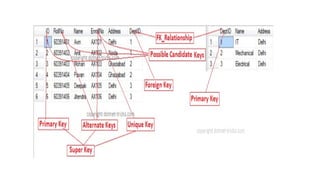
Example: In the below diagram ID, RollNo and EnrollNo are
Candidate Keys since all these three fields can be work as
Primary Key.
Primary Key
Primary key is a set of one or more fields/columns of
a table that uniquely identify a record in a database
table. It can not accept null, duplicate values. Only
one Candidate Key can be Primary Key.
1.
Alternate key
An Alternate key is a key that can be work as a
primary key. Basically, it is a candidate key that
currently is not a primary key.
Example: In the diagram RollNo and EnrollNo
become Alternate Keys when we define ID as
Primary Key.
Composite/Compound Key
Composite Key is a combination of more than one fields/columns of a table.
It can be a Candidate key, Primary key.
Unique Key
A unique key is a set of one or more fields/columns of a table that uniquely
identify a record in a database table. It is like Primary key but it can accept
only one null value and it can not have duplicate values.
Foreign Key
Foreign Key is a field in a database table that is Primary key in another table.
It can accept multiple null, duplicate values.Example: We can have a DeptID
column in the Employee table which is pointing to a DeptID column in a department
table where it a primary key.

KEYS IN DBMS.pptx soap ui kkeys and eclipse id

  • 1.
  • 2.
    A key isa single or combination of multiple fields in a table. It is used to fetch or retrieve records/data-rows from data table according to the condition/requirement. Keys are also used to create a relationship among different database tables or views. Types of SQL Keys We have following types of keys in SQL which are used to fetch records from tables and to make relationship among tables or views. 1.Super Key 2.Super key is a set of one or more than one keys that can be used to identify a record uniquely in a table. Example: Primary key, Unique key, Alternate key are a subset of Super Keys.
  • 3.
    Candidate Key A CandidateKey is a set of one or more fields/columns that can identify a record uniquely in a table. There can be multiple Candidate Keys in one table. Each Candidate Key can work as Primary Key. Example: In the below diagram ID, RollNo and EnrollNo are Candidate Keys since all these three fields can be work as Primary Key.
  • 4.
    Primary Key Primary keyis a set of one or more fields/columns of a table that uniquely identify a record in a database table. It can not accept null, duplicate values. Only one Candidate Key can be Primary Key.
  • 5.
  • 6.
    Alternate key An Alternatekey is a key that can be work as a primary key. Basically, it is a candidate key that currently is not a primary key. Example: In the diagram RollNo and EnrollNo become Alternate Keys when we define ID as Primary Key.
  • 7.
    Composite/Compound Key Composite Keyis a combination of more than one fields/columns of a table. It can be a Candidate key, Primary key. Unique Key A unique key is a set of one or more fields/columns of a table that uniquely identify a record in a database table. It is like Primary key but it can accept only one null value and it can not have duplicate values. Foreign Key Foreign Key is a field in a database table that is Primary key in another table. It can accept multiple null, duplicate values.Example: We can have a DeptID column in the Employee table which is pointing to a DeptID column in a department table where it a primary key.