Waste Management in Germany
Challenges, Obstacles, Factors of Success
Andrea Jünemann
Head of Division Waste and Water Management
www.bmwi.de
Content
1. Overview on the Development of Waste Management in
Germany
2. Factors of Success
3. Outlook on Future Activities in Germany and
the European Union
Waste Management in Germany
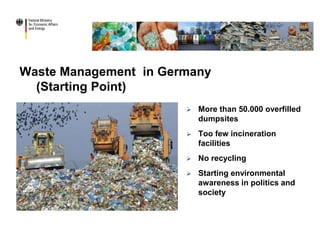
(Starting Point)
 More than 50.000 overfilled
dumpsites
 Too few incineration
facilities
 No recycling
 Starting environmental
awareness in politics and
society
German Waste Management (2015)
An extensive and powerful economic sector with more than
o 3.000 private companies (including machine and plant construction)
o 430 municipal companies
o more than 250 000 employees and
o an annual business volume of more than 50 billion €
o High Recycling Rates
o Leading Export Country for
modern and efficient Treatment Technologies
Benefits
o Cleaner environment (no more littering, less air pollution, clean soil and water)
o Tremendous reduction of CO2-emissions over the last 15 years (more than 56
million of CO2 emissions, which is nearly a quarter of our total savings)
o Creation of more than 250 000 local jobs ranging from low skill to high skill levels
o Generation of local, affordable and renewable heat and power through WtE-
plants (more than 7 billion kWh power and 18 billion kWh heat p.a.)
o Savings of raw materials (16 % of raw materials replaced with recovered materials)
o Competitive edges through a resource efficient production
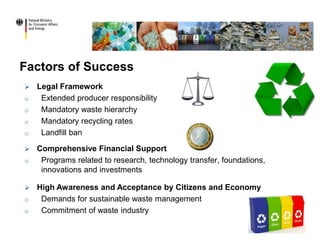
Factors of Success
 Legal Framework
o Extended producer responsibility
o Mandatory waste hierarchy
o Mandatory recycling rates
o Landfill ban
 High Awareness and Acceptance by Citizens and Economy
o Demands for sustainable waste management
o Commitment of waste industry
 Comprehensive Financial Support
o Programs related to research, technology transfer, foundations,
innovations and investments
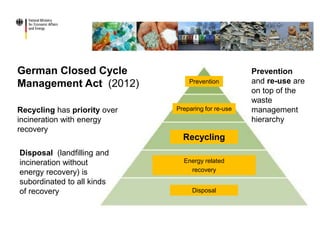
German Closed Cycle
Management Act (2012)
Recycling has priority over
incineration with energy
recovery
Disposal (landfilling and
incineration without
energy recovery) is
subordinated to all kinds
of recovery
Prevention
and re-use are
on top of the
waste
management
hierarchy
Prevention
Preparing for re-use
Recycling
Energy related
recovery
Disposal
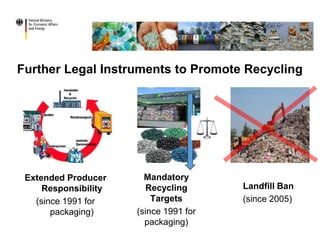
Further Legal Instruments to Promote Recycling
Landfill Ban
(since 2005)
Extended Producer
Responsibility
(since 1991 for
packaging)
Mandatory
Recycling
Targets
(since 1991 for
packaging)
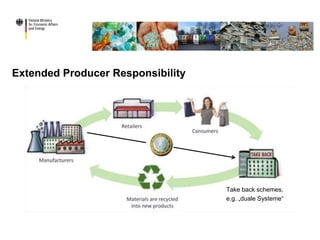
Extended Producer Responsibility
Take back schemes,
e.g. „duale Systeme“
Take-Back Schemes in Germany
• Important Role
as a link between producers/retailers, municipalities, and
waste companies
driving force to optimize e.g. sorting technologies and the
design for recycling
Recycling costs have more than halved in the last 20 years
25 years of Experience with EPR
EPR as an important incentive
• to foster
- the recovery of waste
- the eco-design of products
• EPR has strong impetus on
- the development of modern treatment technologies
- markets for recyclable materials
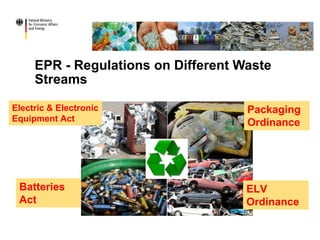
EPR - Regulations on Different Waste
Streams
Packaging
Ordinance
Electric & Electronic
Equipment Act
Batteries
Act
ELV
Ordinance
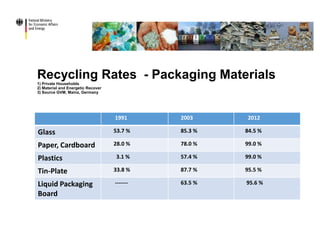
Recycling Rates - Packaging Materials1) Private Households
2) Material and Energetic Recover
3) Source GVM, Mainz, Germany
1991 2003 2012
Glass 53.7 % 85.3 % 84.5 %
Paper, Cardboard 28.0 % 78.0 % 99.0 %
Plastics 3.1 % 57.4 % 99.0 %
Tin-Plate 33.8 % 87.7 % 95.5 %
Liquid Packaging
Board
------- 63.5 % 95.6 %
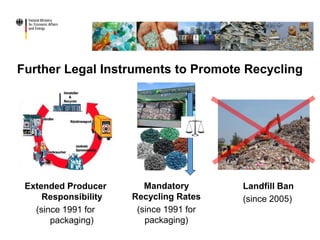
Further Legal Instruments to Promote Recycling
Landfill Ban
(since 2005)
Extended Producer
Responsibility
(since 1991 for
packaging)
Mandatory
Recycling Rates
(since 1991 for
packaging)
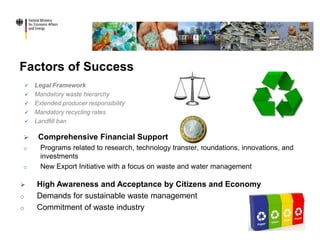
Factors of Success
 Legal Framework
 Mandatory waste hierarchy
 Extended producer responsibility
 Mandatory recycling rates
 Landfill ban
 High Awareness and Acceptance by Citizens and Economy
o Demands for sustainable waste management
o Commitment of waste industry
 Comprehensive Financial Support
o Programs related to research, technology transfer, foundations, innovations, and
investments
o New Export Initiative with a focus on waste and water management
To-do List Germany / European Union
Germany:
Advancement Packaging Act
Revision and Strengthening of our Industrial Waste Ordinance
Separate collection of organic waste all over the country
European Union:
Increase recycling of municipal and packaging waste
Phase out landfilling for recyclable waste
Reduce food waste
Inclusion of aspects like recycling capability, new methods of use and ownership
THANK YOU FOR YOUR
ATTENTION

Presentation mrs. andrea junemann chile

  • 1.
    Waste Management inGermany Challenges, Obstacles, Factors of Success Andrea Jünemann Head of Division Waste and Water Management www.bmwi.de
  • 2.
    Content 1. Overview onthe Development of Waste Management in Germany 2. Factors of Success 3. Outlook on Future Activities in Germany and the European Union
  • 3.
    Waste Management inGermany (Starting Point)  More than 50.000 overfilled dumpsites  Too few incineration facilities  No recycling  Starting environmental awareness in politics and society
  • 4.
    German Waste Management(2015) An extensive and powerful economic sector with more than o 3.000 private companies (including machine and plant construction) o 430 municipal companies o more than 250 000 employees and o an annual business volume of more than 50 billion € o High Recycling Rates o Leading Export Country for modern and efficient Treatment Technologies
  • 5.
    Benefits o Cleaner environment(no more littering, less air pollution, clean soil and water) o Tremendous reduction of CO2-emissions over the last 15 years (more than 56 million of CO2 emissions, which is nearly a quarter of our total savings) o Creation of more than 250 000 local jobs ranging from low skill to high skill levels o Generation of local, affordable and renewable heat and power through WtE- plants (more than 7 billion kWh power and 18 billion kWh heat p.a.) o Savings of raw materials (16 % of raw materials replaced with recovered materials) o Competitive edges through a resource efficient production
  • 6.
    Factors of Success Legal Framework o Extended producer responsibility o Mandatory waste hierarchy o Mandatory recycling rates o Landfill ban  High Awareness and Acceptance by Citizens and Economy o Demands for sustainable waste management o Commitment of waste industry  Comprehensive Financial Support o Programs related to research, technology transfer, foundations, innovations and investments
  • 7.
    German Closed Cycle ManagementAct (2012) Recycling has priority over incineration with energy recovery Disposal (landfilling and incineration without energy recovery) is subordinated to all kinds of recovery Prevention and re-use are on top of the waste management hierarchy Prevention Preparing for re-use Recycling Energy related recovery Disposal
  • 8.
    Further Legal Instrumentsto Promote Recycling Landfill Ban (since 2005) Extended Producer Responsibility (since 1991 for packaging) Mandatory Recycling Targets (since 1991 for packaging)
  • 9.
    Extended Producer Responsibility Takeback schemes, e.g. „duale Systeme“
  • 10.
    Take-Back Schemes inGermany • Important Role as a link between producers/retailers, municipalities, and waste companies driving force to optimize e.g. sorting technologies and the design for recycling Recycling costs have more than halved in the last 20 years
  • 11.
    25 years ofExperience with EPR EPR as an important incentive • to foster - the recovery of waste - the eco-design of products • EPR has strong impetus on - the development of modern treatment technologies - markets for recyclable materials
  • 12.
    EPR - Regulationson Different Waste Streams Packaging Ordinance Electric & Electronic Equipment Act Batteries Act ELV Ordinance
  • 13.
    Recycling Rates -Packaging Materials1) Private Households 2) Material and Energetic Recover 3) Source GVM, Mainz, Germany 1991 2003 2012 Glass 53.7 % 85.3 % 84.5 % Paper, Cardboard 28.0 % 78.0 % 99.0 % Plastics 3.1 % 57.4 % 99.0 % Tin-Plate 33.8 % 87.7 % 95.5 % Liquid Packaging Board ------- 63.5 % 95.6 %
  • 14.
    Further Legal Instrumentsto Promote Recycling Landfill Ban (since 2005) Extended Producer Responsibility (since 1991 for packaging) Mandatory Recycling Rates (since 1991 for packaging)
  • 15.
    Factors of Success Legal Framework  Mandatory waste hierarchy  Extended producer responsibility  Mandatory recycling rates  Landfill ban  High Awareness and Acceptance by Citizens and Economy o Demands for sustainable waste management o Commitment of waste industry  Comprehensive Financial Support o Programs related to research, technology transfer, foundations, innovations, and investments o New Export Initiative with a focus on waste and water management
  • 16.
    To-do List Germany/ European Union Germany: Advancement Packaging Act Revision and Strengthening of our Industrial Waste Ordinance Separate collection of organic waste all over the country European Union: Increase recycling of municipal and packaging waste Phase out landfilling for recyclable waste Reduce food waste Inclusion of aspects like recycling capability, new methods of use and ownership
  • 17.
    THANK YOU FORYOUR ATTENTION