LARAC 2009 Where have we come from – recycling over the last 20 years Ray Georgeson
Ray Georgeson Resources Resource and waste industry professionals specialising in policy and strategy, communications, research, facilitation and stakeholder engagement Working with local authorities, UK Government and its agencies, the private and third sectors, European Commission, NGOs and other European governments Knowledge across the spectrum of resource efficiency, climate change, resources management and sustainable development Based in the North, but with an international perspective
Twenty years in ten minutes  There was life (and recycling ) before 1989 1989 as a trigger point for environmental awareness European and UK strategies & initiatives Targets, techniques and technologies  Education and communication
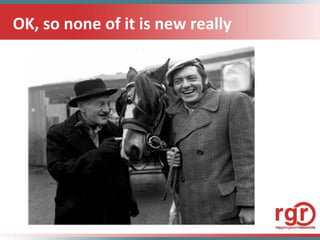
OK, so none of it is new really
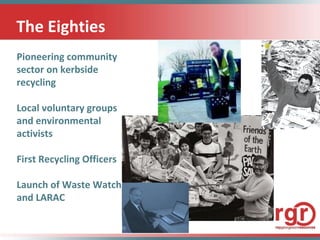
The Eighties Pioneering community sector on kerbside recycling Local voluntary groups and environmental activists First Recycling Officers  Launch of Waste Watch and LARAC
Stuff like this was big news…
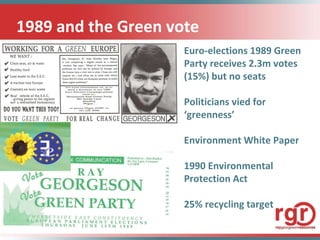
1989 and the Green vote Euro-elections 1989 Green Party receives 2.3m votes (15%) but no seats Politicians vied for ‘greenness’ Environment White Paper 1990 Environmental Protection Act 25% recycling target
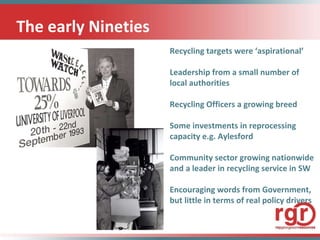
The early Nineties  Recycling targets were ‘aspirational’ Leadership from a small number of local authorities Recycling Officers a growing breed  Some investments in reprocessing capacity e.g. Aylesford Community sector growing nationwide and a leader in recycling service in SW Encouraging words from Government, but little in terms of real policy drivers
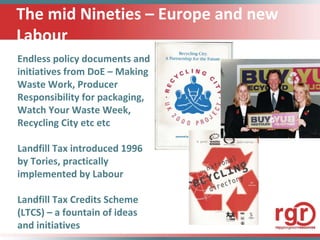
The mid Nineties – Europe and new Labour Endless policy documents and initiatives from DoE – Making Waste Work, Producer Responsibility for packaging, Watch Your Waste Week, Recycling City etc etc Landfill Tax introduced 1996 by Tories, practically implemented by Labour Landfill Tax Credits Scheme (LTCS) – a fountain of ideas and initiatives
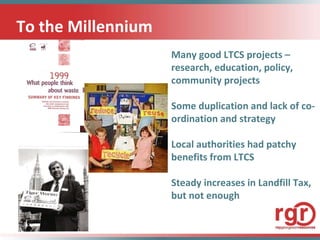
To the Millennium   Many good LTCS projects – research, education, policy, community projects Some duplication and lack of co-ordination and strategy Local authorities had patchy benefits from LTCS Steady increases in Landfill Tax, but not enough
2000 and beyond EU Landfill Directive first and foremost The rise of Market Development Waste Strategy 2000 – the first statutory targets for local authorities Creation of WRAP in 2001 2000/01 we were still  at 11.2% recycling rate
The Noughties Fiscal instruments – LATS, increased Landfill Tax, PFI Producer responsibility – WEEE, ELV, batteries, tyres Early review of WS2000 – the Cabinet Office report Reform of LTCS and investment through WRAP and others in local authority support, communications, retail and packaging innovation, waste minimisation and home composting Councils competing for Defra and WRAP funds for projects
More initiatives Increased pace of activity – new recycling schemes, plant and reprocessing The growth of organics – collection and treatment – chasing the targets The use of social marketing and more investment in communications
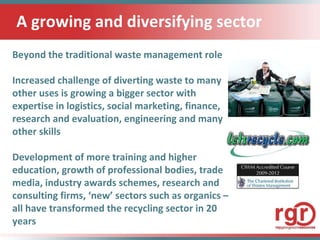
A growing and diversifying sector Beyond the traditional waste management role Increased challenge of diverting waste to many other uses is growing a bigger sector with expertise in logistics, social marketing, finance, research and evaluation, engineering and many other skills Development of more training and higher education, growth of professional bodies, trade media, industry awards schemes, research and consulting firms, ‘new’ sectors such as organics – all have transformed the recycling sector in 20 years
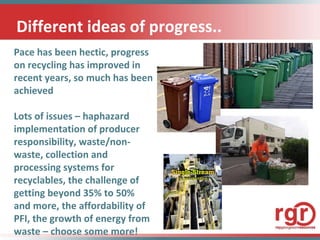
Different ideas of progress.. Pace has been hectic, progress on recycling has improved in recent years, so much has been achieved Lots of issues – haphazard implementation of producer responsibility, waste/non-waste, collection and processing systems for recyclables, the challenge of getting beyond 35% to 50% and more, the affordability of PFI, the growth of energy from waste – choose some more!
The joy of developing strategy.. Farming looks easy when your plow is a pencil and you’re a thousand miles from a cornfield. Dwight D Eisenhower
Where are we going to? Is it getting harder to achieve higher levels of recycling?  What more can be done to engage the public? How will we engage properly with the climate change agenda and the role of carbon in resources management? What more can Government do? Are technologies such as energy from waste options crowding out new recycling initiatives?
Thank you Ray Georgeson Resources Ltd 2 Garnett Villas, North Avenue,  OTLEY, West Yorkshire, LS21 1AJ Telephone:  +44 (0) 1943 463680 Mobile: +44 (0) 7711 069433 E-mail: [email_address] Website: www.raygeorgesonresources.co.uk

Ray Georgeson Larac 2009 Presentation

  • 1.
    LARAC 2009 Wherehave we come from – recycling over the last 20 years Ray Georgeson
  • 2.
    Ray Georgeson ResourcesResource and waste industry professionals specialising in policy and strategy, communications, research, facilitation and stakeholder engagement Working with local authorities, UK Government and its agencies, the private and third sectors, European Commission, NGOs and other European governments Knowledge across the spectrum of resource efficiency, climate change, resources management and sustainable development Based in the North, but with an international perspective
  • 3.
    Twenty years inten minutes There was life (and recycling ) before 1989 1989 as a trigger point for environmental awareness European and UK strategies & initiatives Targets, techniques and technologies Education and communication
  • 4.
    OK, so noneof it is new really
  • 5.
    The Eighties Pioneeringcommunity sector on kerbside recycling Local voluntary groups and environmental activists First Recycling Officers Launch of Waste Watch and LARAC
  • 6.
    Stuff like thiswas big news…
  • 7.
    1989 and theGreen vote Euro-elections 1989 Green Party receives 2.3m votes (15%) but no seats Politicians vied for ‘greenness’ Environment White Paper 1990 Environmental Protection Act 25% recycling target
  • 8.
    The early Nineties Recycling targets were ‘aspirational’ Leadership from a small number of local authorities Recycling Officers a growing breed Some investments in reprocessing capacity e.g. Aylesford Community sector growing nationwide and a leader in recycling service in SW Encouraging words from Government, but little in terms of real policy drivers
  • 9.
    The mid Nineties– Europe and new Labour Endless policy documents and initiatives from DoE – Making Waste Work, Producer Responsibility for packaging, Watch Your Waste Week, Recycling City etc etc Landfill Tax introduced 1996 by Tories, practically implemented by Labour Landfill Tax Credits Scheme (LTCS) – a fountain of ideas and initiatives
  • 10.
    To the Millennium Many good LTCS projects – research, education, policy, community projects Some duplication and lack of co-ordination and strategy Local authorities had patchy benefits from LTCS Steady increases in Landfill Tax, but not enough
  • 11.
    2000 and beyondEU Landfill Directive first and foremost The rise of Market Development Waste Strategy 2000 – the first statutory targets for local authorities Creation of WRAP in 2001 2000/01 we were still at 11.2% recycling rate
  • 12.
    The Noughties Fiscalinstruments – LATS, increased Landfill Tax, PFI Producer responsibility – WEEE, ELV, batteries, tyres Early review of WS2000 – the Cabinet Office report Reform of LTCS and investment through WRAP and others in local authority support, communications, retail and packaging innovation, waste minimisation and home composting Councils competing for Defra and WRAP funds for projects
  • 13.
    More initiatives Increasedpace of activity – new recycling schemes, plant and reprocessing The growth of organics – collection and treatment – chasing the targets The use of social marketing and more investment in communications
  • 14.
    A growing anddiversifying sector Beyond the traditional waste management role Increased challenge of diverting waste to many other uses is growing a bigger sector with expertise in logistics, social marketing, finance, research and evaluation, engineering and many other skills Development of more training and higher education, growth of professional bodies, trade media, industry awards schemes, research and consulting firms, ‘new’ sectors such as organics – all have transformed the recycling sector in 20 years
  • 15.
    Different ideas ofprogress.. Pace has been hectic, progress on recycling has improved in recent years, so much has been achieved Lots of issues – haphazard implementation of producer responsibility, waste/non-waste, collection and processing systems for recyclables, the challenge of getting beyond 35% to 50% and more, the affordability of PFI, the growth of energy from waste – choose some more!
  • 16.
    The joy ofdeveloping strategy.. Farming looks easy when your plow is a pencil and you’re a thousand miles from a cornfield. Dwight D Eisenhower
  • 17.
    Where are wegoing to? Is it getting harder to achieve higher levels of recycling? What more can be done to engage the public? How will we engage properly with the climate change agenda and the role of carbon in resources management? What more can Government do? Are technologies such as energy from waste options crowding out new recycling initiatives?
  • 18.
    Thank you RayGeorgeson Resources Ltd 2 Garnett Villas, North Avenue, OTLEY, West Yorkshire, LS21 1AJ Telephone: +44 (0) 1943 463680 Mobile: +44 (0) 7711 069433 E-mail: [email_address] Website: www.raygeorgesonresources.co.uk

Editor's Notes

  • #19 Acknowledgement to colleagues around the table from the Partnership, and to Jane Beasley for her input to this assignment. We wish you well in getting to the next stage with your recycling programme – and thank you for the opportunity to work with you on this important project.