EXTENDED PRODUCER
RESPONSIBILITY:
OVERVIEW, RECENT TRENDS AND FORUM OBJECTIVES
Shardul Agrawala
Head, Environment and Economy Integration Division
OECD Environment Directorate
Outline
• Defining Extended Producer Responsibility (EPR)
• Goals, policy instruments and the product life cycle
• 2001 OECD Policy Guidance
• Trends since 2001: Adoption, literature, emerging issues
• Key issues and objectives of the Global Forum
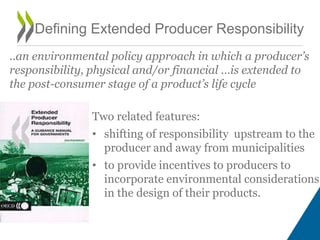
Two related features:
• shifting of responsibility upstream to the
producer and away from municipalities
• to provide incentives to producers to
incorporate environmental considerations
in the design of their products.
Defining Extended Producer Responsibility
..an environmental policy approach in which a producer’s
responsibility, physical and/or financial …is extended to
the post-consumer stage of a product’s life cycle
EPR Goals
• Source reduction
• Waste prevention
• Design for environment
• Closure of material loops
(increased recycling)
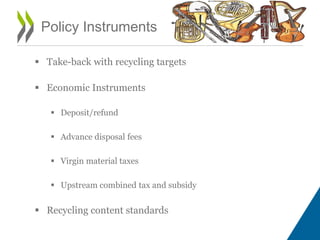
Policy Instruments
 Take-back with recycling targets
 Economic Instruments
 Deposit/refund
 Advance disposal fees
 Virgin material taxes
 Upstream combined tax and subsidy
 Recycling content standards
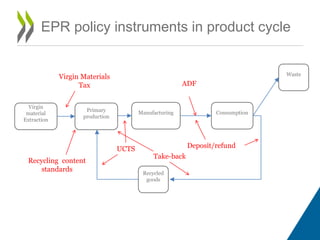
EPR policy instruments in product cycle
Virgin
material
Extraction
Primary
production
Consumption
Recycled
goods
Waste
Manufacturing
Virgin Materials
Tax
Recycling content
standards
Deposit/refund
ADF
UCTS
Take-back
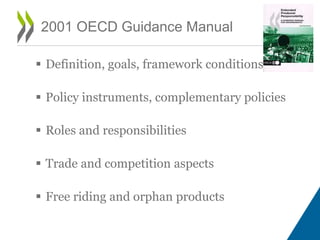
 Definition, goals, framework conditions
 Policy instruments, complementary policies
 Roles and responsibilities
 Trade and competition aspects
 Free riding and orphan products
2001 OECD Guidance Manual
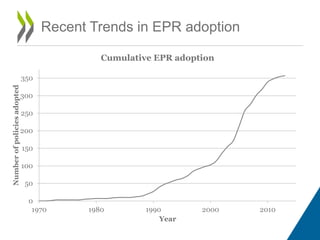
Recent Trends in EPR adoption
0
50
100
150
200
250
300
350
1970 1980 1990 2000 2010
Numberofpoliciesadopted
Year
Cumulative EPR adoption
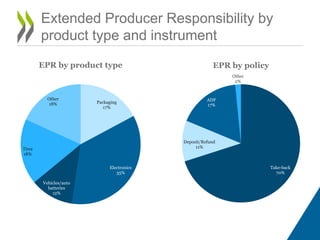
Extended Producer Responsibility by
product type and instrument
Packaging
17%
Electronics
35%
Vehicles/auto
batteries
12%
Tires
18%
Other
18%
EPR by product type
Take-back
70%
Deposit/Refund
11%
ADF
17%
Other
2%
EPR by policy
 Great deal of information on impact of EPR
on recycling rates.
 Not enough on cost-effectiveness
 Not enough known about the potential to
address waste prevention through EPR
 Relatively few EPR systems oriented
towards incentivising eco-design
Recent trends and some open issues
 Significant additional experience since 2001:
o More product groups (e.g furniture, textiles)
o More diverse approaches (e.g recycling certificates)
o More information on environmental effectiveness and on
competition issues
o Adoption in more countries, including emerging economies
Further rationale for update of Guidance
 Literature review and typology of EPR schemes
 Case studies :
Australia, Belgium, Canada, Chile, China, Colombia,
France, Japan, Korea, Slovakia, United States, and
building on EU studies
 Views exchanged here at the Global Forum in Tokyo
Financial support from Japan and EU
12
Towards updating policy guidance
 Take stock of recent experience
 Identify key challenges in design and
implementation
 Identify measures to meet these challenges
 Begin to identify key areas where guidance can
be developed
Global Forum Objectives
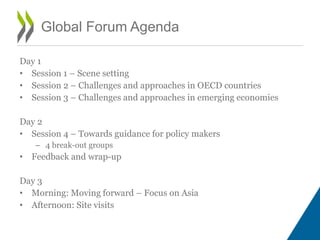
Day 1
• Session 1 – Scene setting
• Session 2 – Challenges and approaches in OECD countries
• Session 3 – Challenges and approaches in emerging economies
Day 2
• Session 4 – Towards guidance for policy makers
– 4 break-out groups
• Feedback and wrap-up
Day 3
• Morning: Moving forward – Focus on Asia
• Afternoon: Site visits
Global Forum Agenda
www.oecd.org/env/waste
www.oecd.org/env/policies
www.oecd.org/env/taxes
◦
Further information

1.3 S. Agrawala, OECD work on extended producer responsibility

  • 1.
    EXTENDED PRODUCER RESPONSIBILITY: OVERVIEW, RECENTTRENDS AND FORUM OBJECTIVES Shardul Agrawala Head, Environment and Economy Integration Division OECD Environment Directorate
  • 2.
    Outline • Defining ExtendedProducer Responsibility (EPR) • Goals, policy instruments and the product life cycle • 2001 OECD Policy Guidance • Trends since 2001: Adoption, literature, emerging issues • Key issues and objectives of the Global Forum
  • 3.
    Two related features: •shifting of responsibility upstream to the producer and away from municipalities • to provide incentives to producers to incorporate environmental considerations in the design of their products. Defining Extended Producer Responsibility ..an environmental policy approach in which a producer’s responsibility, physical and/or financial …is extended to the post-consumer stage of a product’s life cycle
  • 4.
    EPR Goals • Sourcereduction • Waste prevention • Design for environment • Closure of material loops (increased recycling)
  • 5.
    Policy Instruments  Take-backwith recycling targets  Economic Instruments  Deposit/refund  Advance disposal fees  Virgin material taxes  Upstream combined tax and subsidy  Recycling content standards
  • 6.
    EPR policy instrumentsin product cycle Virgin material Extraction Primary production Consumption Recycled goods Waste Manufacturing Virgin Materials Tax Recycling content standards Deposit/refund ADF UCTS Take-back
  • 7.
     Definition, goals,framework conditions  Policy instruments, complementary policies  Roles and responsibilities  Trade and competition aspects  Free riding and orphan products 2001 OECD Guidance Manual
  • 8.
    Recent Trends inEPR adoption 0 50 100 150 200 250 300 350 1970 1980 1990 2000 2010 Numberofpoliciesadopted Year Cumulative EPR adoption
  • 9.
    Extended Producer Responsibilityby product type and instrument Packaging 17% Electronics 35% Vehicles/auto batteries 12% Tires 18% Other 18% EPR by product type Take-back 70% Deposit/Refund 11% ADF 17% Other 2% EPR by policy
  • 10.
     Great dealof information on impact of EPR on recycling rates.  Not enough on cost-effectiveness  Not enough known about the potential to address waste prevention through EPR  Relatively few EPR systems oriented towards incentivising eco-design Recent trends and some open issues
  • 11.
     Significant additionalexperience since 2001: o More product groups (e.g furniture, textiles) o More diverse approaches (e.g recycling certificates) o More information on environmental effectiveness and on competition issues o Adoption in more countries, including emerging economies Further rationale for update of Guidance
  • 12.
     Literature reviewand typology of EPR schemes  Case studies : Australia, Belgium, Canada, Chile, China, Colombia, France, Japan, Korea, Slovakia, United States, and building on EU studies  Views exchanged here at the Global Forum in Tokyo Financial support from Japan and EU 12 Towards updating policy guidance
  • 13.
     Take stockof recent experience  Identify key challenges in design and implementation  Identify measures to meet these challenges  Begin to identify key areas where guidance can be developed Global Forum Objectives
  • 14.
    Day 1 • Session1 – Scene setting • Session 2 – Challenges and approaches in OECD countries • Session 3 – Challenges and approaches in emerging economies Day 2 • Session 4 – Towards guidance for policy makers – 4 break-out groups • Feedback and wrap-up Day 3 • Morning: Moving forward – Focus on Asia • Afternoon: Site visits Global Forum Agenda
  • 15.

Editor's Notes

  • #4 Multiple definitions of EPR. At its core EPR seeks to give producers appropriate incentives concerning gthe life-cycle environmental impacts of their product. It addresses the weakest link in the product responsibility chain – the final disposal of the product. Main objective is to use EPR as a pressure point to drive upstream changes in materials selection and product design.
  • #5 A wide variety of specific objectives can be defined to help achieve these goals (e.g. reducing use of specific resources/toxi substances, reducing spread of landfills, energy use..). Waste reduction by closure of material loops is a common theme of EPR schemes. Other goals have varying emphasis.
  • #8 Definition, goals, continuum of approaches (voluntary – mandatory).
  • #9 Most OECD countries have introduced EPR systems for certain product categories. At least 384 systems in place globally, two-thirds of which implemented since 2001.
  • #10 Electronics most common EPR product 35% (followed by Tires, Packaging 17-18% each; Vehicles/auto batteries 12%). This corresponds to guidance in 2001 OECD Manual: product groups best suited for EPR: Low residual value High environmental impact Large volume of material Urgency of waste magement problem Take-back most common EPR instrument (73%; followed by ADF 16%; Deposit/refund 10%).
  • #12 New experience is available. Also a number of issues have emerged that are not or insufficiently discussed in the 2001 Guidance, eg: Cost effectiveness and full cost recovery; Competition; Reliability and comparability of data; Mostly in the context of emerging markets, the informal waste sector and social issues; New and emerging issues, eg internet sales, waste as a strategic resource etc.