How Old is Too Old? Age, Genetics and Reproduction Marcelle I. Cedars, M.D. Director, Division of Reproductive Endocrinology UCSF
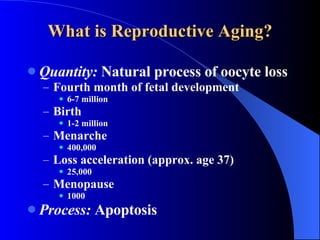
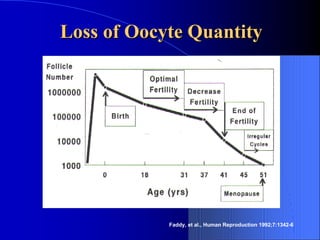
What is Reproductive Aging? Quantity:  Natural process of oocyte loss Fourth month of fetal development 6-7 million Birth 1-2 million Menarche 400,000 Loss acceleration (approx. age 37) 25,000 Menopause 1000 Process:  Apoptosis
 
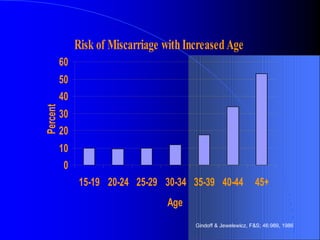
What is Reproductive Aging? Quality:  decreased implantation potential Increase in meiotic non-disjunction “ Production-line” theory Accumulated damage Deficiencies of the granulosa cells
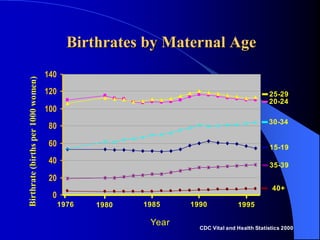
Reproductive Aging:  Why do we care?  Changing Demographics   20% of women wait until they are at least 35 years of age before having their first child Establishment of a career Awaiting a stable relationship Desire for financial security False sense of security provided by high-tech fertility procedures
 
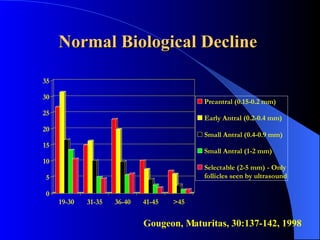
Normal Biological Decline  Gougeon, Maturitas, 30:137-142, 1998
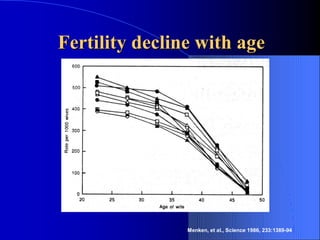
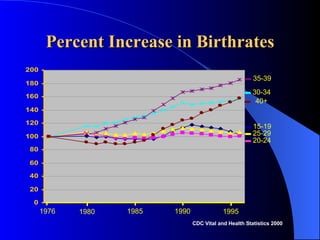
Percent Increase in Birthrates CDC Vital and Health Statistics 2000 1976 1980 1985 1990 1995 35-39 30-34 40+ 15-19 25-29 20-24
 
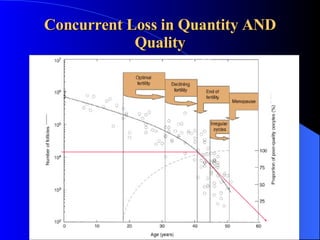
Concurrent Loss in Quantity AND Quality
Oocyte Quality Chromosomes and DNA Mitochondria and ooplasm
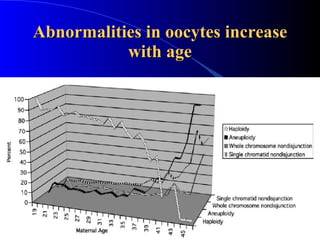
Abnormalities in oocytes increase with age
 
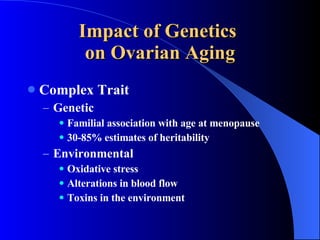
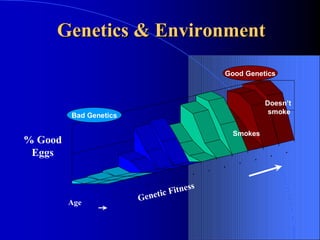
Impact of Genetics  on Ovarian Aging Complex Trait Genetic Familial association with age at menopause 30-85% estimates of heritability Environmental  Oxidative stress Alterations in blood flow Toxins in the environment
 
Reproductive Aging Lifestyle Factors Cigarette smoking Female Affect the follicular microenvironment Affect hormonal levels of the luteal phase Accelerates oocyte loss (menopause 1-4 years earlier) Male Negative affect on sperm production, motility and morphology Increased risk for DNA damage
Reproductive Aging Lifestyle Factors Weight:  BMI < 20 or > 25 Female Alterations in hormonal profile and anovulation Increased time to conception Male Increased time to conception
Reproductive Aging Lifestyle Factors Stress Lack of clear evidence Difficult to measure Some reduction with ART outcome noted Caffeine Studies with problems of recall bias Suggestion of association with reduced fertility Alcohol Studies with problems of recall bias Biological plausibility
Reproductive Aging Lifestyle Factors Environmental Factors Organic solvents Pesticides Phthalates
Loss of Ooctye Quality Abnormal fertilization, arrest of early development Failure to implant Post-implantation problems recognized loss developmentally delayed child (down syndrome)
Assessing Reproductive Age What are you measuring? And Why? Reproductive performance Response to stimulation Live-born
Assessing Reproductive Age Direct measures AFC/ovarian volume Anti-mullerian Hormone (AMH) Inhibin B Indirect measures FSH
Reproductive Aging Is it Quantity or Quality FSH Indirect measure of follicular pool Decrease in inhibin B leads to increase FSH Not associated with increased risk of aneuploidy (vanMongfrans, 2004) Decreased predictive ability in populations with a low prevalence (young women)
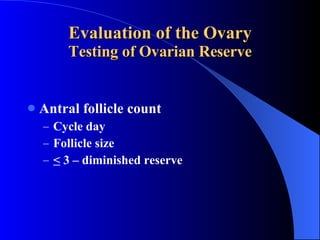
Antral follicle count Cycle day Follicle size <  3 – diminished reserve Evaluation of the Ovary Testing of Ovarian Reserve
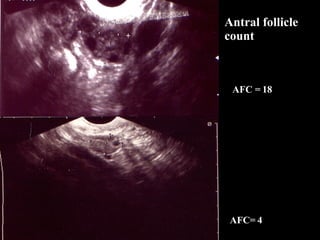
Antral follicle count AFC = 18 AFC= 4
How to identify  age-related  problems? Body as “bioassay” Shortened menstrual cycles Pre-cycle spotting
 
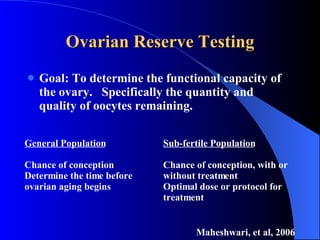
Ovarian Reserve Testing Goal: To determine the functional capacity of the ovary.  Specifically the quantity and quality of oocytes remaining. General Population Chance of conception Determine the time before  ovarian aging begins Sub-fertile Population Chance of conception, with or without treatment Optimal dose or protocol for treatment Maheshwari, et al, 2006
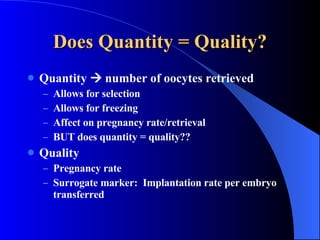
Does Quantity = Quality? Quantity    number of oocytes retrieved Allows for selection Allows for freezing Affect on pregnancy rate/retrieval BUT does quantity = quality?? Quality Pregnancy rate Surrogate marker:  Implantation rate per embryo transferred
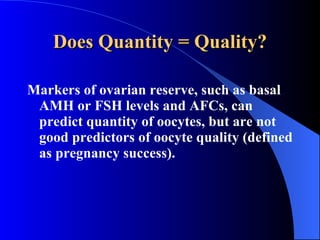
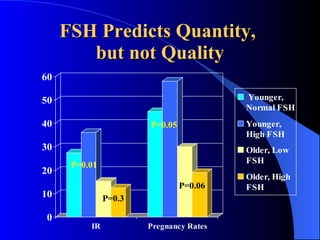
Does Quantity = Quality? Markers of ovarian reserve, such as basal AMH or FSH levels and AFCs, can predict quantity of oocytes, but are not good predictors of oocyte quality (defined as pregnancy success).
FSH Predicts Quantity,  but not Quality P=0.3 P=0.05 P=0.06 P=0.01
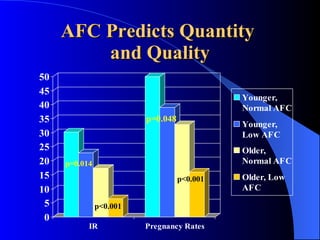
AFC Predicts Quantity  and Quality p=0.014 p=0.048 p<0.001 p<0.001
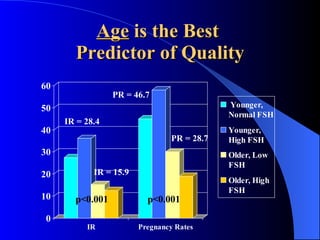
Age  is the Best  Predictor of Quality IR = 28.4 IR = 15.9 p<0.001 PR = 28.7 PR = 46.7 p<0.001
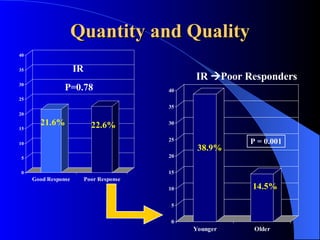
Quantity and Quality IR 21.6% 22.6% P=0.78 IR   Poor Responders 38.9% 14.5% P = 0.001
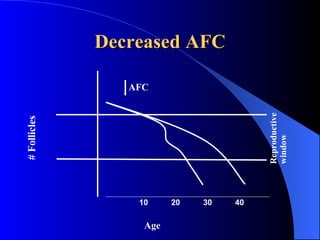
Decreased AFC 10 20 30 40 AFC Age # Follicles Reproductive window
Reproductive Aging Treatment Counsel couple Likelihood for success Prepare treatment schedule Stimulation based on ovarian (not chronological ) age
 
Stimulations for Advanced Reproductive Aging High dose protocols Flare protocols Halt protocols Antagonist protocols What’s new? Estradiol priming Minimal stimulation Androgen pretreatment
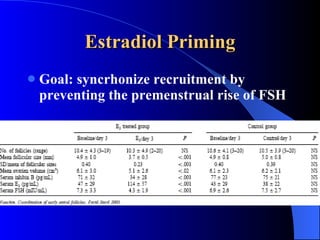
Estradiol Priming Goal: syncrhonize recruitment by preventing the premenstrual rise of FSH
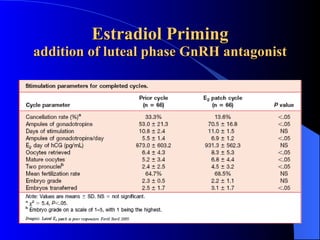
Estradiol Priming addition of luteal phase GnRH antagonist
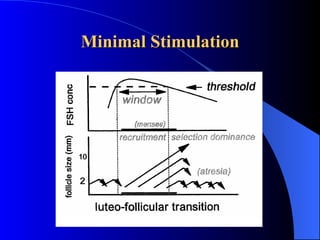
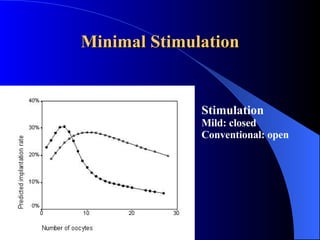
Minimal Stimulation Cancellation of a short treatment cycle is not a great burden.. Few oocytes is not bad at all.. Quality  is more important than  Quantity . Less oocytes means less burden at aspiration… Mild stimulation cycles have a higher repeat rate…
Minimal Stimulation
Minimal Stimulation Stimulation Mild: closed Conventional: open
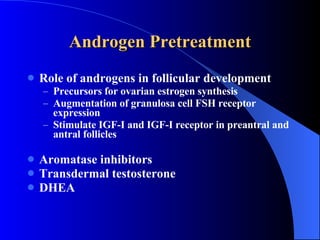
Androgen Pretreatment Role of androgens in follicular development Precursors for ovarian estrogen synthesis Augmentation of granulosa cell FSH receptor expression Stimulate IGF-I and IGF-I receptor in preantral and antral follicles Aromatase inhibitors Transdermal testosterone DHEA
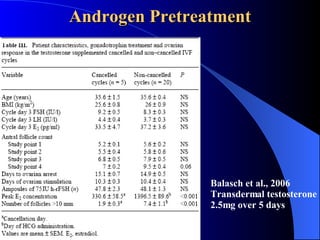
Androgen Pretreatment Balasch et al., 2006 Transdermal testosterone 2.5mg over 5 days
 
 
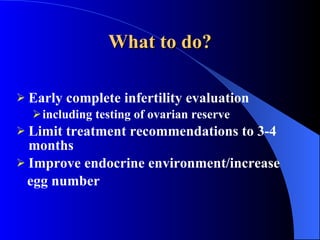
What to do? Early complete infertility evaluation including testing of ovarian reserve Limit treatment recommendations to 3-4 months Improve endocrine environment/increase  egg number
 
 
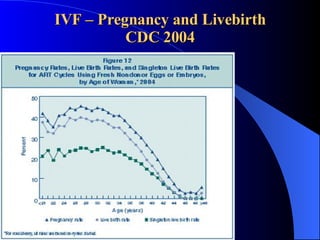
IVF – Pregnancy and Livebirth CDC 2004
Decide What Is Important Having a child to raise Being pregnant Sharing genetic make-up with partner
Oocyte Donation Candidates diminished ovarian reserve premature ovarian failure genetic problems Success rate 50-60%/cycle 70-90% cumulative Provides evidence that the age of the egg, NOT the uterus, is the critical factor
The Bottom Line Evaluate early Give a fair estimate of outcome Develop a time-limited treatment plan
Thank you for your attention

Presentation Marcelle

  • 1.
    How Old isToo Old? Age, Genetics and Reproduction Marcelle I. Cedars, M.D. Director, Division of Reproductive Endocrinology UCSF
  • 2.
    What is ReproductiveAging? Quantity: Natural process of oocyte loss Fourth month of fetal development 6-7 million Birth 1-2 million Menarche 400,000 Loss acceleration (approx. age 37) 25,000 Menopause 1000 Process: Apoptosis
  • 3.
  • 4.
    What is ReproductiveAging? Quality: decreased implantation potential Increase in meiotic non-disjunction “ Production-line” theory Accumulated damage Deficiencies of the granulosa cells
  • 5.
    Reproductive Aging: Why do we care? Changing Demographics 20% of women wait until they are at least 35 years of age before having their first child Establishment of a career Awaiting a stable relationship Desire for financial security False sense of security provided by high-tech fertility procedures
  • 6.
  • 7.
    Normal Biological Decline Gougeon, Maturitas, 30:137-142, 1998
  • 8.
    Percent Increase inBirthrates CDC Vital and Health Statistics 2000 1976 1980 1985 1990 1995 35-39 30-34 40+ 15-19 25-29 20-24
  • 9.
  • 10.
    Concurrent Loss inQuantity AND Quality
  • 11.
    Oocyte Quality Chromosomesand DNA Mitochondria and ooplasm
  • 12.
    Abnormalities in oocytesincrease with age
  • 13.
  • 14.
    Impact of Genetics on Ovarian Aging Complex Trait Genetic Familial association with age at menopause 30-85% estimates of heritability Environmental Oxidative stress Alterations in blood flow Toxins in the environment
  • 15.
  • 16.
    Reproductive Aging LifestyleFactors Cigarette smoking Female Affect the follicular microenvironment Affect hormonal levels of the luteal phase Accelerates oocyte loss (menopause 1-4 years earlier) Male Negative affect on sperm production, motility and morphology Increased risk for DNA damage
  • 17.
    Reproductive Aging LifestyleFactors Weight: BMI < 20 or > 25 Female Alterations in hormonal profile and anovulation Increased time to conception Male Increased time to conception
  • 18.
    Reproductive Aging LifestyleFactors Stress Lack of clear evidence Difficult to measure Some reduction with ART outcome noted Caffeine Studies with problems of recall bias Suggestion of association with reduced fertility Alcohol Studies with problems of recall bias Biological plausibility
  • 19.
    Reproductive Aging LifestyleFactors Environmental Factors Organic solvents Pesticides Phthalates
  • 20.
    Loss of OoctyeQuality Abnormal fertilization, arrest of early development Failure to implant Post-implantation problems recognized loss developmentally delayed child (down syndrome)
  • 21.
    Assessing Reproductive AgeWhat are you measuring? And Why? Reproductive performance Response to stimulation Live-born
  • 22.
    Assessing Reproductive AgeDirect measures AFC/ovarian volume Anti-mullerian Hormone (AMH) Inhibin B Indirect measures FSH
  • 23.
    Reproductive Aging Isit Quantity or Quality FSH Indirect measure of follicular pool Decrease in inhibin B leads to increase FSH Not associated with increased risk of aneuploidy (vanMongfrans, 2004) Decreased predictive ability in populations with a low prevalence (young women)
  • 24.
    Antral follicle countCycle day Follicle size < 3 – diminished reserve Evaluation of the Ovary Testing of Ovarian Reserve
  • 25.
    Antral follicle countAFC = 18 AFC= 4
  • 26.
    How to identify age-related problems? Body as “bioassay” Shortened menstrual cycles Pre-cycle spotting
  • 27.
  • 28.
    Ovarian Reserve TestingGoal: To determine the functional capacity of the ovary. Specifically the quantity and quality of oocytes remaining. General Population Chance of conception Determine the time before ovarian aging begins Sub-fertile Population Chance of conception, with or without treatment Optimal dose or protocol for treatment Maheshwari, et al, 2006
  • 29.
    Does Quantity =Quality? Quantity  number of oocytes retrieved Allows for selection Allows for freezing Affect on pregnancy rate/retrieval BUT does quantity = quality?? Quality Pregnancy rate Surrogate marker: Implantation rate per embryo transferred
  • 30.
    Does Quantity =Quality? Markers of ovarian reserve, such as basal AMH or FSH levels and AFCs, can predict quantity of oocytes, but are not good predictors of oocyte quality (defined as pregnancy success).
  • 31.
    FSH Predicts Quantity, but not Quality P=0.3 P=0.05 P=0.06 P=0.01
  • 32.
    AFC Predicts Quantity and Quality p=0.014 p=0.048 p<0.001 p<0.001
  • 33.
    Age isthe Best Predictor of Quality IR = 28.4 IR = 15.9 p<0.001 PR = 28.7 PR = 46.7 p<0.001
  • 34.
    Quantity and QualityIR 21.6% 22.6% P=0.78 IR  Poor Responders 38.9% 14.5% P = 0.001
  • 35.
    Decreased AFC 1020 30 40 AFC Age # Follicles Reproductive window
  • 36.
    Reproductive Aging TreatmentCounsel couple Likelihood for success Prepare treatment schedule Stimulation based on ovarian (not chronological ) age
  • 37.
  • 38.
    Stimulations for AdvancedReproductive Aging High dose protocols Flare protocols Halt protocols Antagonist protocols What’s new? Estradiol priming Minimal stimulation Androgen pretreatment
  • 39.
    Estradiol Priming Goal:syncrhonize recruitment by preventing the premenstrual rise of FSH
  • 40.
    Estradiol Priming additionof luteal phase GnRH antagonist
  • 41.
    Minimal Stimulation Cancellationof a short treatment cycle is not a great burden.. Few oocytes is not bad at all.. Quality is more important than Quantity . Less oocytes means less burden at aspiration… Mild stimulation cycles have a higher repeat rate…
  • 42.
  • 43.
    Minimal Stimulation StimulationMild: closed Conventional: open
  • 44.
    Androgen Pretreatment Roleof androgens in follicular development Precursors for ovarian estrogen synthesis Augmentation of granulosa cell FSH receptor expression Stimulate IGF-I and IGF-I receptor in preantral and antral follicles Aromatase inhibitors Transdermal testosterone DHEA
  • 45.
    Androgen Pretreatment Balaschet al., 2006 Transdermal testosterone 2.5mg over 5 days
  • 46.
  • 47.
  • 48.
    What to do?Early complete infertility evaluation including testing of ovarian reserve Limit treatment recommendations to 3-4 months Improve endocrine environment/increase egg number
  • 49.
  • 50.
  • 51.
    IVF – Pregnancyand Livebirth CDC 2004
  • 52.
    Decide What IsImportant Having a child to raise Being pregnant Sharing genetic make-up with partner
  • 53.
    Oocyte Donation Candidatesdiminished ovarian reserve premature ovarian failure genetic problems Success rate 50-60%/cycle 70-90% cumulative Provides evidence that the age of the egg, NOT the uterus, is the critical factor
  • 54.
    The Bottom LineEvaluate early Give a fair estimate of outcome Develop a time-limited treatment plan
  • 55.
    Thank you foryour attention