In vitro maturation of oocytes as a promising treatment option for infertile couples:   a transdisciplinary study Beum Soo An, Junling Chen Xi-Kuan Chen, Jack Huang Se-Hyung Park, Qiuying Yang
Background In-vitro maturation (IVM) Immature eggs are retrieved from ovary and mature in laboratory. Once eggs are matured, in vitro fertilization (IVF) is then performed.
Background In vitro maturation (IVM) of oocytes vs. conventional in vitro fertilization (IVF) Proposed advantages of IVM: Simplify treatment and reduces cost Avoids potential side effects-weight gain, bloating, breast tenderness, nausea, mood swings, and OHSS Fear of potential risk of malignancy associated with repeated cycles of ovarian stimulation.
Overall Objective To assess biological, clinical, psychological and economical impact of in vitro maturation (IVM) of eggs
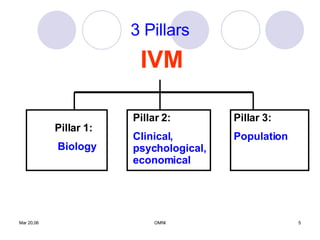
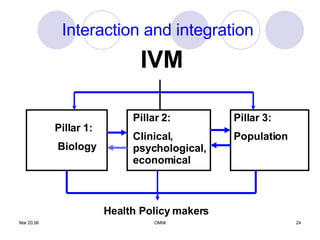
3 Pillars IVM Pillar 1: Biology Pillar 2: Clinical, psychological, economical Pillar 3: Population
Pillar I:  Biological assessment of  IVM
Biological approach for IVM group Objectives To compare life cycles and occurrences of disease from IVF and IVM treated offspring To compare gene profile in maternal placenta of IVM and IVF derived embryos
Hypotheses IVM or IVF offspring have no difference in life cycles and occurrences of diseases. Maternal placentas from IVM or IVF embryos do not have different gene profile.
Research design Using animal models (mouse or rat), we will compare life cycles and occurrences of diseases after IVF or IVM We will analyze gene profile in the maternal placenta using microarray after IVF or IVM embryo injection, and confirm this by real time PCR and western blot in the different gestational stages
Pillar II:    Clinical, psychological, economical impact of IVM
Objectives To evaluate: Efficacy of IVM-pregnancy and live birth rates. Safety of IVM-complication rates Cost of health service Psychological impact on infertile couples
Hypotheses IVM treatment will result in comparable clinical efficacy as standard IVF (i.e. pregnancy and live birth). IVM decreases the risk of maternal complications and does not increase the risk of fetal, neonatal and long term complications. IVM is more cost effective than IVF IVM reduces psychological stress of infertile couples
Research Design Multicenter prospective randomized control trial comparing IVM to IVF Cohort study-follow up babies from IVM vs. IVF and spontaneous pregnancy -1 year Health economic analysis Psychological assessment using validated structured questionnaire Focus group discussion-clinicians, nurses, clients
Outcomes Efficacy of IVM vs. IVF: Fertilization Implantation  Pregnancy Live birth Safety of IVM vs. IVF: Maternal complications (i.e. OHSS, miscarriage) Fetal complications (i.e. congenital anomalies) Newborn (Gestational age, birth weight, APGAR) Follow up of IVM vs. IVF vs. spontaneous pregnancy babies as a cohort Cost-effectiveness of IVM vs. IVF  Impact of IVM and IVF treatment on psychological well being of infertile couples.
Pillar III:  IVF and pregnancy complication and birth outcomes:   a population based study
Objective To assess the effects of IVF and IVM on pregnancy complications and perinatal outcomes
Methods-subjects A population-based retrospective cohort 2004-2008 Niday Perinatal Database, Ontario 120 000 births in Ontario every year 900-1000 births with assistant reproduction technology
Methods-exposure and control Exposure: IVF and IVM Control: spontaneous pregnancy  Frequency matched by:  Year of birth Postal code of residence Plurality Parity Maternal age
Outcome Pregnancy complications: Gestational hypertension Preeclampsia Eclampsia Gestational diabetes Obstetric complications Placenta previa Placenta abruption
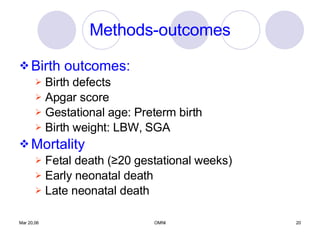
Methods-outcomes Birth outcomes: Birth defects Apgar score Gestational age: Preterm birth Birth weight: LBW, SGA Mortality Fetal death ( ≥20 gestational weeks) Early neonatal death Late neonatal death
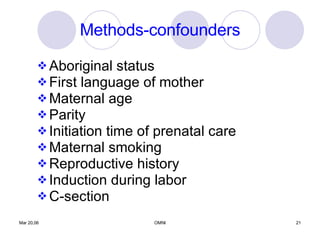
Methods-confounders Aboriginal status First language of mother Maternal age Parity Initiation time of prenatal care Maternal smoking Reproductive history Induction during labor C-section
Timetable and Budget Timetable Preparation and coordination (6 months) Implementation (4 years) Report writing (6 months) Budget
Research Team Biologists Clinicians Psychologists Ethicists Epidemiologists Lawyers
Interaction and integration  IVM Pillar 1: Biology Pillar 2: Clinical, psychological, economical Pillar 3: Population Health Policy makers
STIRRHS Mentors Dr. Raymond Lambert Dr. Marcel Melancon  Dr. Roger Pierson Dr. Peter Leung (UBC) Dr. Seang Lin Tan (McGill) Dr. Mark Walker (U Ottawa) Dr. Shi Wu Wen (U Ottawa) Acknowledgement

Ivm Of Oocytes Study (1)

  • 1.
    In vitro maturationof oocytes as a promising treatment option for infertile couples: a transdisciplinary study Beum Soo An, Junling Chen Xi-Kuan Chen, Jack Huang Se-Hyung Park, Qiuying Yang
  • 2.
    Background In-vitro maturation(IVM) Immature eggs are retrieved from ovary and mature in laboratory. Once eggs are matured, in vitro fertilization (IVF) is then performed.
  • 3.
    Background In vitromaturation (IVM) of oocytes vs. conventional in vitro fertilization (IVF) Proposed advantages of IVM: Simplify treatment and reduces cost Avoids potential side effects-weight gain, bloating, breast tenderness, nausea, mood swings, and OHSS Fear of potential risk of malignancy associated with repeated cycles of ovarian stimulation.
  • 4.
    Overall Objective Toassess biological, clinical, psychological and economical impact of in vitro maturation (IVM) of eggs
  • 5.
    3 Pillars IVMPillar 1: Biology Pillar 2: Clinical, psychological, economical Pillar 3: Population
  • 6.
    Pillar I: Biological assessment of IVM
  • 7.
    Biological approach forIVM group Objectives To compare life cycles and occurrences of disease from IVF and IVM treated offspring To compare gene profile in maternal placenta of IVM and IVF derived embryos
  • 8.
    Hypotheses IVM orIVF offspring have no difference in life cycles and occurrences of diseases. Maternal placentas from IVM or IVF embryos do not have different gene profile.
  • 9.
    Research design Usinganimal models (mouse or rat), we will compare life cycles and occurrences of diseases after IVF or IVM We will analyze gene profile in the maternal placenta using microarray after IVF or IVM embryo injection, and confirm this by real time PCR and western blot in the different gestational stages
  • 10.
    Pillar II: Clinical, psychological, economical impact of IVM
  • 11.
    Objectives To evaluate:Efficacy of IVM-pregnancy and live birth rates. Safety of IVM-complication rates Cost of health service Psychological impact on infertile couples
  • 12.
    Hypotheses IVM treatmentwill result in comparable clinical efficacy as standard IVF (i.e. pregnancy and live birth). IVM decreases the risk of maternal complications and does not increase the risk of fetal, neonatal and long term complications. IVM is more cost effective than IVF IVM reduces psychological stress of infertile couples
  • 13.
    Research Design Multicenterprospective randomized control trial comparing IVM to IVF Cohort study-follow up babies from IVM vs. IVF and spontaneous pregnancy -1 year Health economic analysis Psychological assessment using validated structured questionnaire Focus group discussion-clinicians, nurses, clients
  • 14.
    Outcomes Efficacy ofIVM vs. IVF: Fertilization Implantation Pregnancy Live birth Safety of IVM vs. IVF: Maternal complications (i.e. OHSS, miscarriage) Fetal complications (i.e. congenital anomalies) Newborn (Gestational age, birth weight, APGAR) Follow up of IVM vs. IVF vs. spontaneous pregnancy babies as a cohort Cost-effectiveness of IVM vs. IVF Impact of IVM and IVF treatment on psychological well being of infertile couples.
  • 15.
    Pillar III: IVF and pregnancy complication and birth outcomes: a population based study
  • 16.
    Objective To assessthe effects of IVF and IVM on pregnancy complications and perinatal outcomes
  • 17.
    Methods-subjects A population-basedretrospective cohort 2004-2008 Niday Perinatal Database, Ontario 120 000 births in Ontario every year 900-1000 births with assistant reproduction technology
  • 18.
    Methods-exposure and controlExposure: IVF and IVM Control: spontaneous pregnancy Frequency matched by: Year of birth Postal code of residence Plurality Parity Maternal age
  • 19.
    Outcome Pregnancy complications:Gestational hypertension Preeclampsia Eclampsia Gestational diabetes Obstetric complications Placenta previa Placenta abruption
  • 20.
    Methods-outcomes Birth outcomes:Birth defects Apgar score Gestational age: Preterm birth Birth weight: LBW, SGA Mortality Fetal death ( ≥20 gestational weeks) Early neonatal death Late neonatal death
  • 21.
    Methods-confounders Aboriginal statusFirst language of mother Maternal age Parity Initiation time of prenatal care Maternal smoking Reproductive history Induction during labor C-section
  • 22.
    Timetable and BudgetTimetable Preparation and coordination (6 months) Implementation (4 years) Report writing (6 months) Budget
  • 23.
    Research Team BiologistsClinicians Psychologists Ethicists Epidemiologists Lawyers
  • 24.
    Interaction and integration IVM Pillar 1: Biology Pillar 2: Clinical, psychological, economical Pillar 3: Population Health Policy makers
  • 25.
    STIRRHS Mentors Dr.Raymond Lambert Dr. Marcel Melancon Dr. Roger Pierson Dr. Peter Leung (UBC) Dr. Seang Lin Tan (McGill) Dr. Mark Walker (U Ottawa) Dr. Shi Wu Wen (U Ottawa) Acknowledgement