ANALYSIS OF THE CASE STUDIES VIDEO RECORDINGS Kostelec nad Černými lesy 14. – 15. 10. 2010  Petr MACH  &  Regina JANÍKOVÁ University of West Bohemia in Pilsen ,  Faculty of Education,  Department of Technical Education Czech Republic
PRESENT  EDUCATION  SYST E M  IN  CZ  high requirement on teachers at all levels  innovations in pre-service professional development  development of teachers’ personality is often neglected development of creative skills and abilities to solve problems of conceptual matter and dynamic changes in process of education
IT CAN BE IMPROVED BY: personality development   professional development CASE STUDY complex and creative solution of a given  didactic situation  in simulated didactic environment. It is based on  interactive  and  situational learning and deciding
DIDACTIC SITUATION short term interaction between the teacher and pupils (or just between pupils) characterized by : chosen methods chosen communicative tools chosen means and forms atmosphere etc. it brings good results in creating basic teaching skills
STRUCTURE OF A CASE STUDY exists in form of descriptive or research (problem) document content is formed by a thorough multi-dimensional analysis of connections, elements and reality of the situation attention is focused on explicit discussion with the sense of detail and various suggestions of the solution case study concept use d  for subject methodologies has a wider and more complex notion. It can be understood as a broader participation method.   It comprises:
SOCIAL-COMMUNICATIVE COMPONENT Participants learn to: design a common activity,  accept various options of behaviour,  seek and from contacts in the family, control cooperation,  show praising feelings,  analyze barriers and failures of cooperation, play different social roles,  influence social-cultural values,  revise mutual behaviour in the group, regulate  the social climate,  use a wide range of communication tools and other factors.
2. METACOGNITIVE COMPONENT psychodidactic application of metacognitive training focuse d  on the area of changes in personality and cognitive preconditions of the participant - the so called  inner area focuse d  on the  outer area  – contextuality of didactic situations, influencing the conditions, choice of concepts, methods, forms, means etc. application results from revised Bloom taxonomy
3. PROFESSION COMPONENT Consists of: development of main teacher competencies ability to create conceptual documents cho ic e  of  learning strategies. In this component ,  link to framework and school educational programmes is important .
Case studies in this form are based on the solution of specific didactic situations . A  didactic situation  means a short term, finished interaction between the teacher and a pupil or pupils, or between pupils It occurs in an identified environment that considerably influences the interaction . The content is of  cognitive ,  affection  or  sensomotoric  (psychomotoric) character. Student independently: modifies the environment chooses the methods chooses  forms and means needed for the solution of the situation and so of the whole case study
The case study is run by an educator (teacher at the faculty) and its course has  four  basic phases : choice and preparation of didactic situation .  c reation of pre - concept - anticipated course of the didactic situation and so the whole case study. pedagogy of the experience didactic situation is realized in simulated environment .   reflection and self-reflection .  application of  metacognitive elements student tries to see all the important moments of his role as a teacher .   individual matter of the student b ased on results of the previous phase ,  students adjust the original concept of the ir  study
COMPLEX  ANALYSIS 100 video recordings sufficient database for complex analysis.  90  video recordings were analyzed  95 probationers’ questionnaires and personal reflections were processed.  Basic methods of the research: observation  transcription  analysis of video-recording  questionnaire method (mainly with scaled items)  controlled interview  spontaneous account
For students it is usually very difficult to confront their often self-confident ideal ego with the faulty ego in the recording. When analyzing personal responses I often come across utterances such as “Did I say this?, “I never behave like that.“, I would never do that“.
FROM THE STATISTICS : 89 % of respondents in the course of the realization phase do not check and correct their language,  60 % of respondents  are not able to control their activity  - behavior, moving around the classroom, gestures, miming, clothes, are not able to react to the failure of teaching aids ( laboratory equipment, presentation technologies) etc. They focus mainly on the subject matter of interaction.
ANALYSIS OF SOLVING CONFLICT ELEMENTS 5 % of respondents did not realize the existence of conflict elements.  20 % of respondents notice the conflict situation, but did not try to solve it. They used the sublimation method risking the escalation of the conflict.  o nly 12 % of respondents managed to aptly assess the causes of the developing conflict, articulate the attitudes and opinions of all parties and suggest and put through a procedure leading to the solution of the conflict.
SOME OF THE RESULTS OF THE MACRO-ANALYTIC STUDIES c ontribution of doing case study for professional competences development  c hoice of lesson phase (into which the didactic situation is incorporated) c hoice of predominant form of teaching c hoice of predominant method of teaching u sing technical teaching aids (presenting and interactive technologies) u sing other aids, equipment and other teaching tools w ork with time dimension  w ork with the aim  s ubject matter level  l anguage level  m otivation
2x  evaluated  by  a scaled questionnaire during the teaching period 72 % of respondents stated high contribution of the case study to their professional development  5 % of them expressed essential disagreement with the contribution and  9 % did not have any opinion CONTRIBUTION OF THE CASE STUDIES TO PROFESSIONAL DEVELOPMENT OF THE STUDENTS
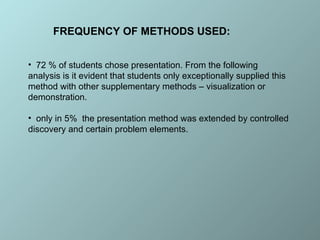
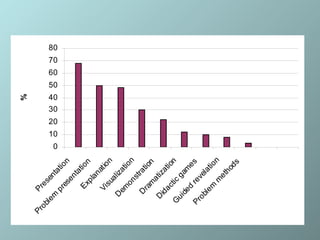
FREQUENCY OF METHODS USED: 72 %  of students chose presentation . From the following analysis is it evident that students only exceptionally  supplied  this method with other supplementary methods – visualization or demonstration.  o nly in 5%  the presentation method was extended by controlled discovery and certain problem elements.
 
C HOICE OF DIDACTIC FORMS
CONCLUSION not sufficient number of respondents    no  generalizing conclusions.  methodology of verifying validity of questionnaires was not perfect.  Ne vertheless : c ase studies definitely contribute to creating key pedagogical habitudes in students.  s tudents often fail to use modern methods and approaches in teaching. They know these theories only theoretically.  Being exposed to the specific pedagogical reality ,  they easily adopt traditional pragmatism and classical style of teaching.
Examples of  two case studies. wrong precise
Thank you for  your  attention.

Presentation mach janikova

  • 1.
    ANALYSIS OF THECASE STUDIES VIDEO RECORDINGS Kostelec nad Černými lesy 14. – 15. 10. 2010 Petr MACH & Regina JANÍKOVÁ University of West Bohemia in Pilsen , Faculty of Education, Department of Technical Education Czech Republic
  • 2.
    PRESENT EDUCATION SYST E M IN CZ high requirement on teachers at all levels innovations in pre-service professional development development of teachers’ personality is often neglected development of creative skills and abilities to solve problems of conceptual matter and dynamic changes in process of education
  • 3.
    IT CAN BEIMPROVED BY: personality development professional development CASE STUDY complex and creative solution of a given didactic situation in simulated didactic environment. It is based on interactive and situational learning and deciding
  • 4.
    DIDACTIC SITUATION shortterm interaction between the teacher and pupils (or just between pupils) characterized by : chosen methods chosen communicative tools chosen means and forms atmosphere etc. it brings good results in creating basic teaching skills
  • 5.
    STRUCTURE OF ACASE STUDY exists in form of descriptive or research (problem) document content is formed by a thorough multi-dimensional analysis of connections, elements and reality of the situation attention is focused on explicit discussion with the sense of detail and various suggestions of the solution case study concept use d for subject methodologies has a wider and more complex notion. It can be understood as a broader participation method. It comprises:
  • 6.
    SOCIAL-COMMUNICATIVE COMPONENT Participantslearn to: design a common activity, accept various options of behaviour, seek and from contacts in the family, control cooperation, show praising feelings, analyze barriers and failures of cooperation, play different social roles, influence social-cultural values, revise mutual behaviour in the group, regulate the social climate, use a wide range of communication tools and other factors.
  • 7.
    2. METACOGNITIVE COMPONENTpsychodidactic application of metacognitive training focuse d on the area of changes in personality and cognitive preconditions of the participant - the so called inner area focuse d on the outer area – contextuality of didactic situations, influencing the conditions, choice of concepts, methods, forms, means etc. application results from revised Bloom taxonomy
  • 8.
    3. PROFESSION COMPONENTConsists of: development of main teacher competencies ability to create conceptual documents cho ic e of learning strategies. In this component , link to framework and school educational programmes is important .
  • 9.
    Case studies inthis form are based on the solution of specific didactic situations . A didactic situation means a short term, finished interaction between the teacher and a pupil or pupils, or between pupils It occurs in an identified environment that considerably influences the interaction . The content is of cognitive , affection or sensomotoric (psychomotoric) character. Student independently: modifies the environment chooses the methods chooses forms and means needed for the solution of the situation and so of the whole case study
  • 10.
    The case studyis run by an educator (teacher at the faculty) and its course has four basic phases : choice and preparation of didactic situation . c reation of pre - concept - anticipated course of the didactic situation and so the whole case study. pedagogy of the experience didactic situation is realized in simulated environment . reflection and self-reflection . application of metacognitive elements student tries to see all the important moments of his role as a teacher . individual matter of the student b ased on results of the previous phase , students adjust the original concept of the ir study
  • 11.
    COMPLEX ANALYSIS100 video recordings sufficient database for complex analysis. 90 video recordings were analyzed 95 probationers’ questionnaires and personal reflections were processed. Basic methods of the research: observation transcription analysis of video-recording questionnaire method (mainly with scaled items) controlled interview spontaneous account
  • 12.
    For students itis usually very difficult to confront their often self-confident ideal ego with the faulty ego in the recording. When analyzing personal responses I often come across utterances such as “Did I say this?, “I never behave like that.“, I would never do that“.
  • 13.
    FROM THE STATISTICS: 89 % of respondents in the course of the realization phase do not check and correct their language, 60 % of respondents are not able to control their activity - behavior, moving around the classroom, gestures, miming, clothes, are not able to react to the failure of teaching aids ( laboratory equipment, presentation technologies) etc. They focus mainly on the subject matter of interaction.
  • 14.
    ANALYSIS OF SOLVINGCONFLICT ELEMENTS 5 % of respondents did not realize the existence of conflict elements. 20 % of respondents notice the conflict situation, but did not try to solve it. They used the sublimation method risking the escalation of the conflict. o nly 12 % of respondents managed to aptly assess the causes of the developing conflict, articulate the attitudes and opinions of all parties and suggest and put through a procedure leading to the solution of the conflict.
  • 15.
    SOME OF THERESULTS OF THE MACRO-ANALYTIC STUDIES c ontribution of doing case study for professional competences development c hoice of lesson phase (into which the didactic situation is incorporated) c hoice of predominant form of teaching c hoice of predominant method of teaching u sing technical teaching aids (presenting and interactive technologies) u sing other aids, equipment and other teaching tools w ork with time dimension w ork with the aim s ubject matter level l anguage level m otivation
  • 16.
    2x evaluated by a scaled questionnaire during the teaching period 72 % of respondents stated high contribution of the case study to their professional development 5 % of them expressed essential disagreement with the contribution and 9 % did not have any opinion CONTRIBUTION OF THE CASE STUDIES TO PROFESSIONAL DEVELOPMENT OF THE STUDENTS
  • 17.
    FREQUENCY OF METHODSUSED: 72 % of students chose presentation . From the following analysis is it evident that students only exceptionally supplied this method with other supplementary methods – visualization or demonstration. o nly in 5% the presentation method was extended by controlled discovery and certain problem elements.
  • 18.
  • 19.
    C HOICE OFDIDACTIC FORMS
  • 20.
    CONCLUSION not sufficientnumber of respondents  no generalizing conclusions. methodology of verifying validity of questionnaires was not perfect. Ne vertheless : c ase studies definitely contribute to creating key pedagogical habitudes in students. s tudents often fail to use modern methods and approaches in teaching. They know these theories only theoretically. Being exposed to the specific pedagogical reality , they easily adopt traditional pragmatism and classical style of teaching.
  • 21.
    Examples of two case studies. wrong precise
  • 22.
    Thank you for your attention.