Teachers’ formative assessment practices
in the classroom: a literature review
20-10-2016. Competence Conference 2016
Judith Gulikers (Wageningen University) &
Liesbeth Baartman (Utrecht University of Applied
Sciences)
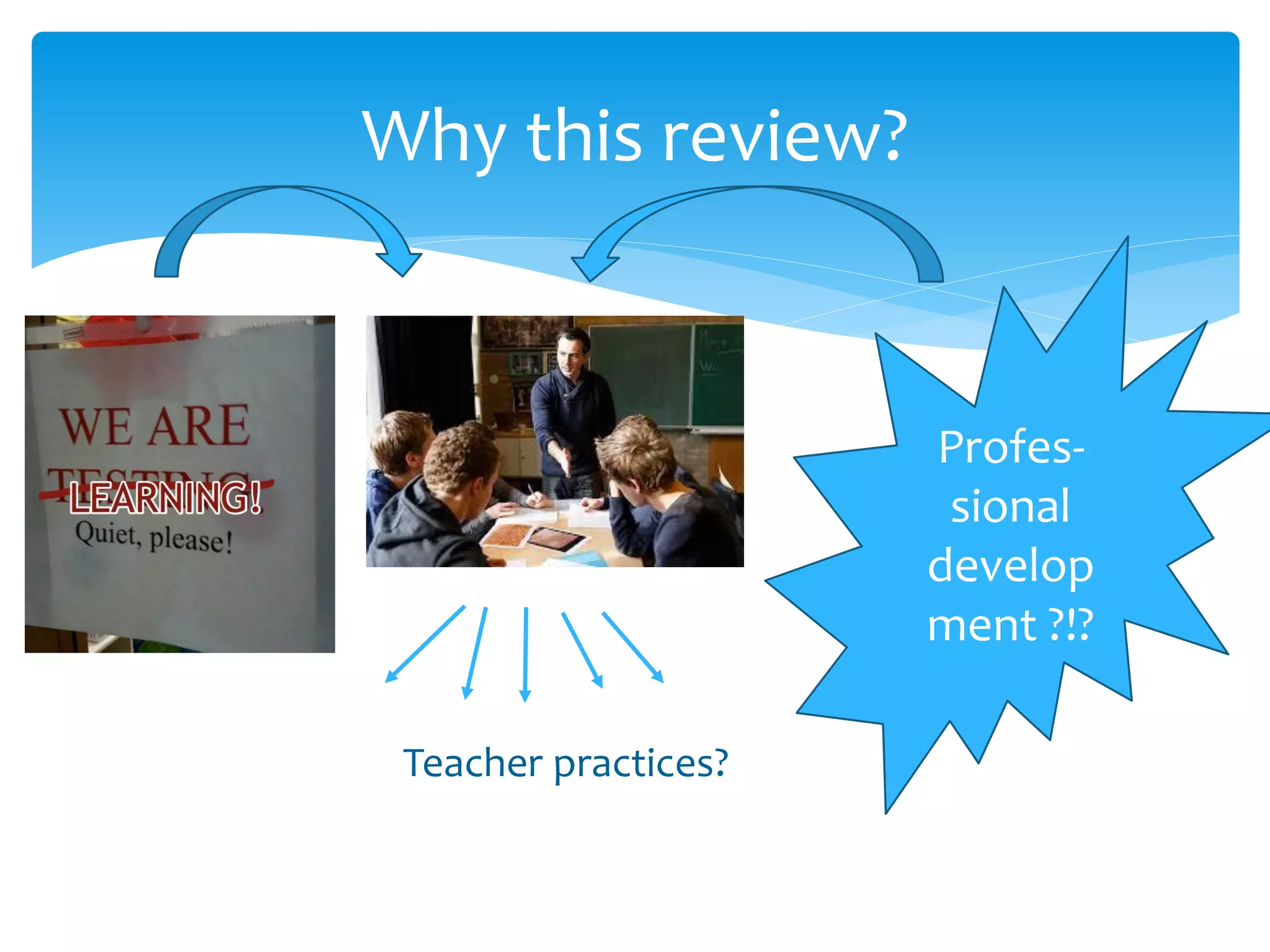
Why this review?
Teacher practices?
Profes-
sional
develop
ment ?!?
Many formative assessment frameworks (eg. Antoniou &
James, 2014; Lai & Schildkamp, 2014; Ruiz-Primo & Furtak, 2006;2007;
Wiliam, 2011)
Our focus:
 Formative assessment is a cyclic process
 Teachers’ concrete activities in the classroom
→
Combining elements of existing framework into “ the
formative assessment cycle” (FA-cycle) as conceptual
and analytical model of our literature review
How to grasp teachers FA activities?
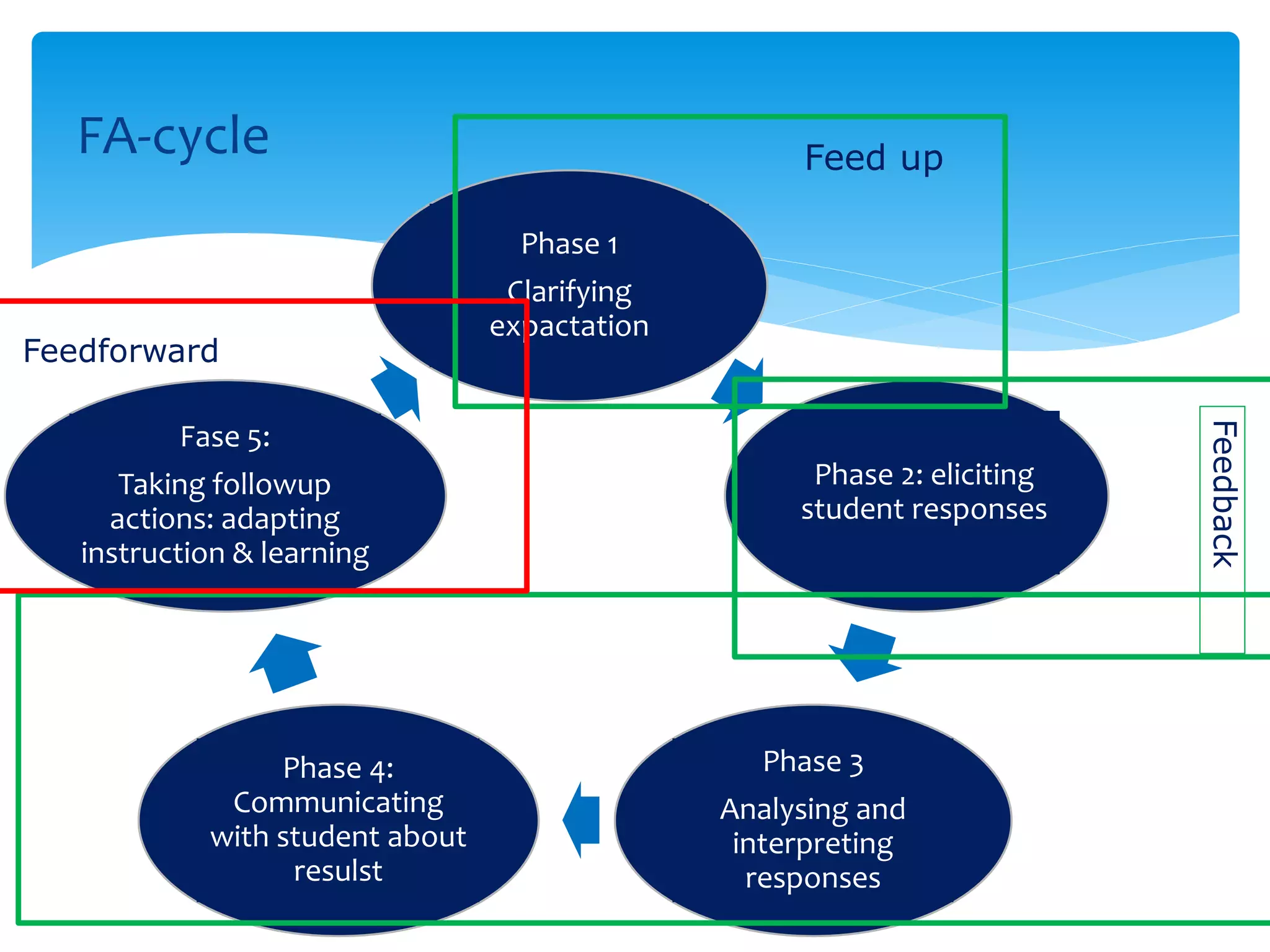
FA-cycle
Phase 1
Clarifying
expactation
Phase 2: eliciting
student responses
Phase 3
Analysing and
interpreting
responses
Phase 4:
Communicating
with student about
resulst
Fase 5:
Taking followup
actions: adapting
instruction & learning
Feed up
Feedback
Feedforward
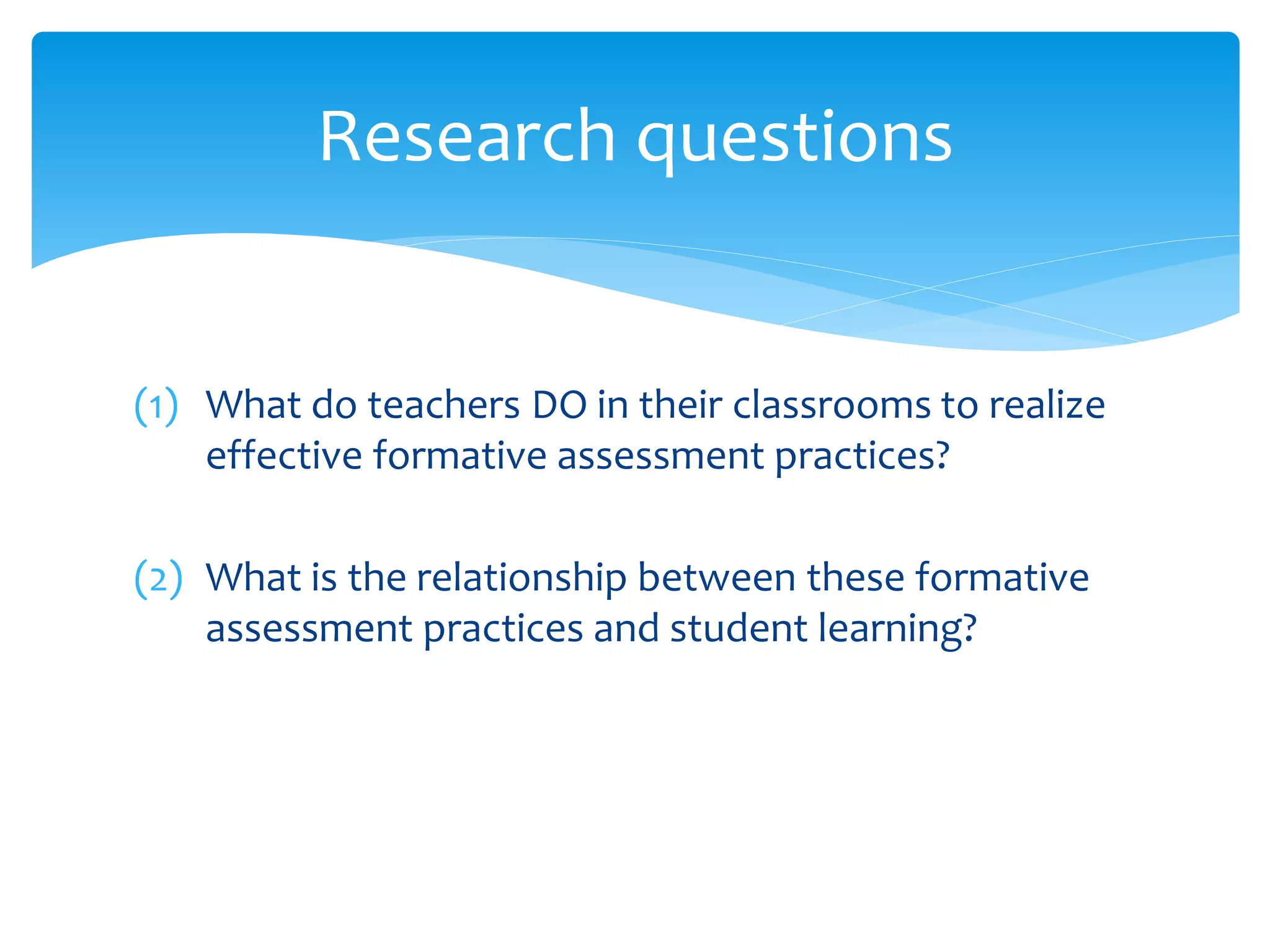
(1) What do teachers DO in their classrooms to realize
effective formative assessment practices?
(2) What is the relationship between these formative
assessment practices and student learning?
Research questions
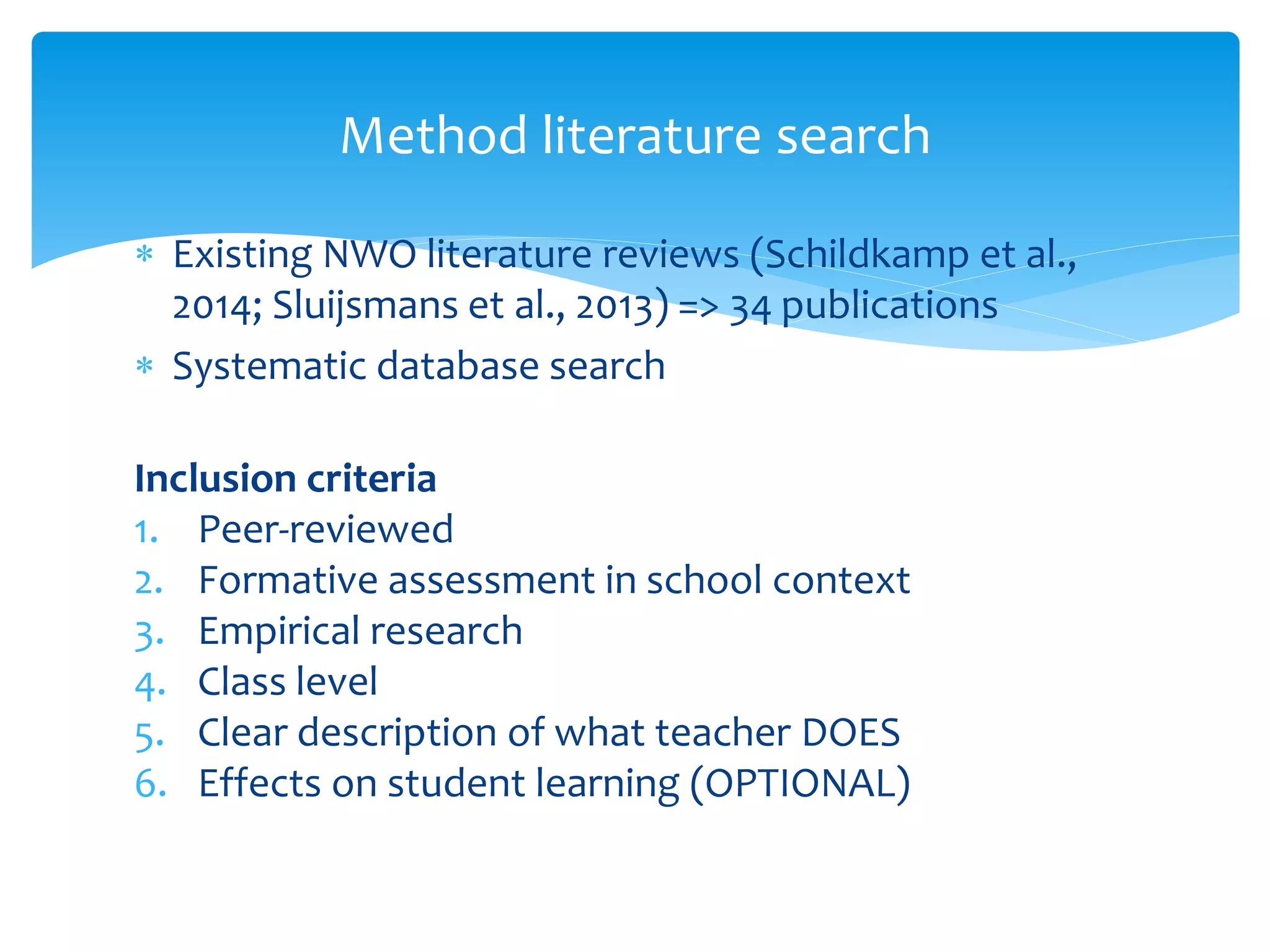
 Existing NWO literature reviews (Schildkamp et al.,
2014; Sluijsmans et al., 2013) => 34 publications
 Systematic database search
Inclusion criteria
1. Peer-reviewed
2. Formative assessment in school context
3. Empirical research
4. Class level
5. Clear description of what teacher DOES
6. Effects on student learning (OPTIONAL)
Method literature search
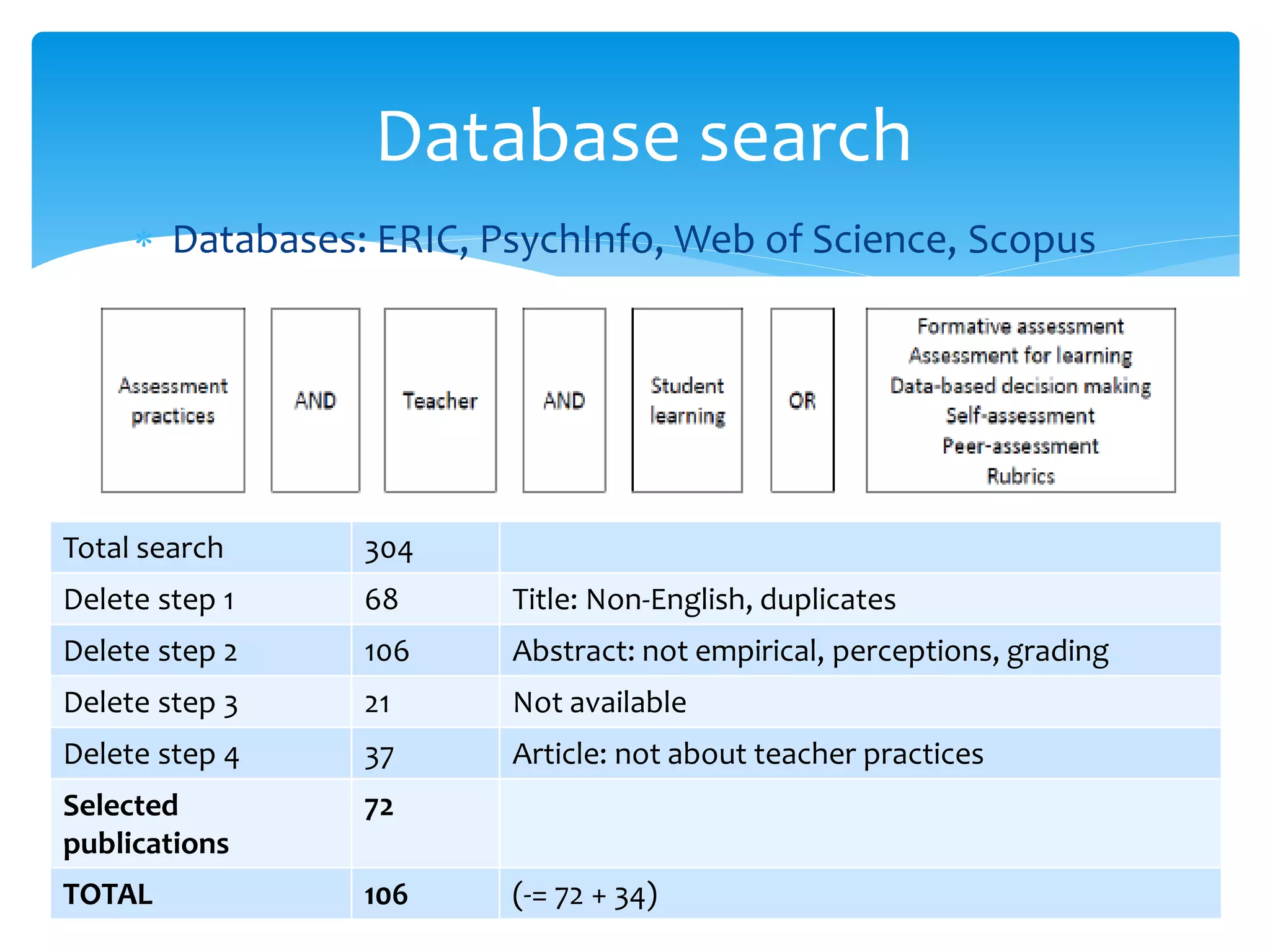
 Databases: ERIC, PsychInfo, Web of Science, Scopus
Database search
Total search 304
Delete step 1 68 Title: Non-English, duplicates
Delete step 2 106 Abstract: not empirical, perceptions, grading
Delete step 3 21 Not available
Delete step 4 37 Article: not about teacher practices
Selected
publications
72
TOTAL 106 (-= 72 + 34)
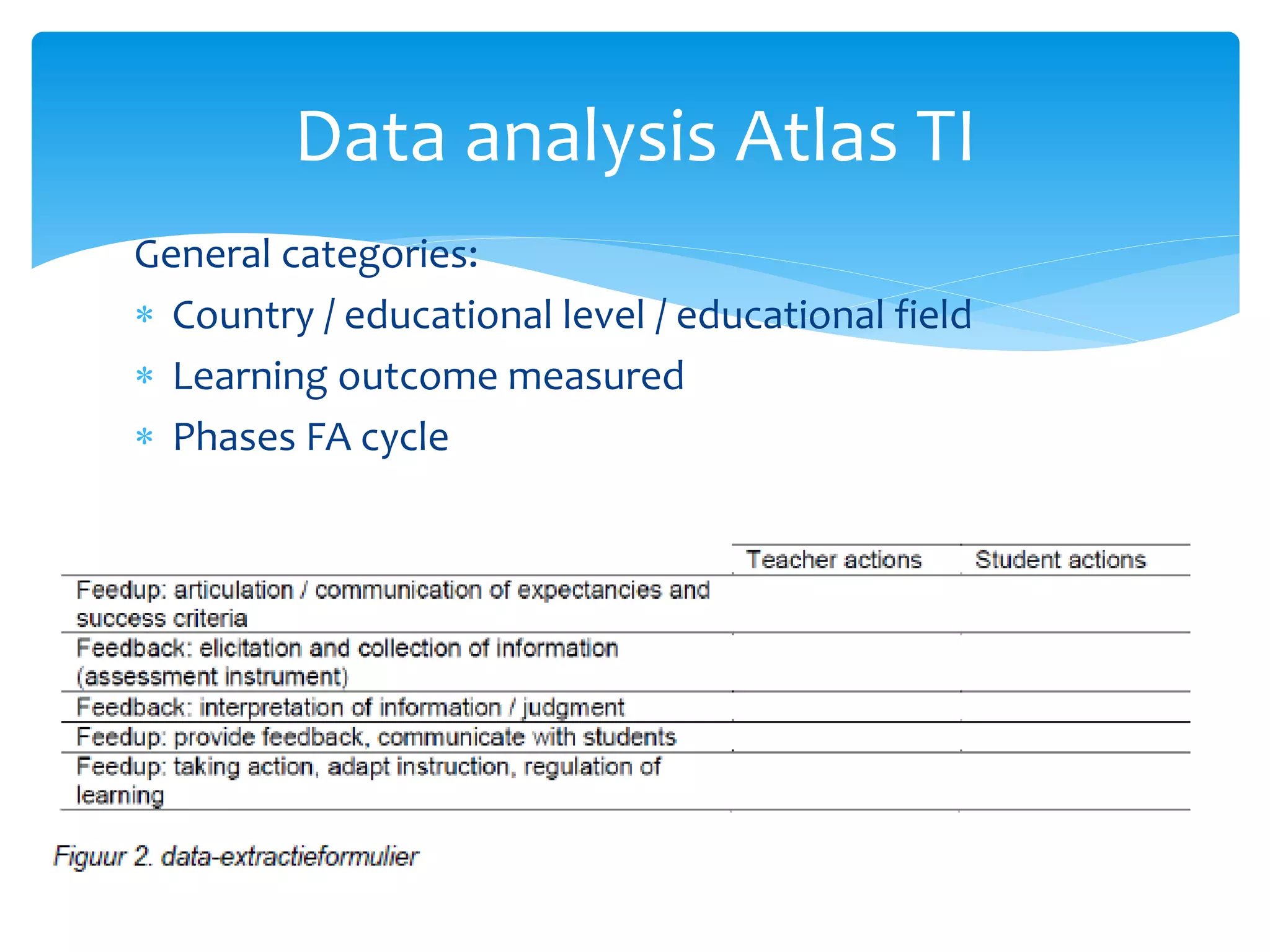
General categories:
 Country / educational level / educational field
 Learning outcome measured
 Phases FA cycle
Coding per FA phase
Data analysis Atlas TI
Phase 2
Phase 3
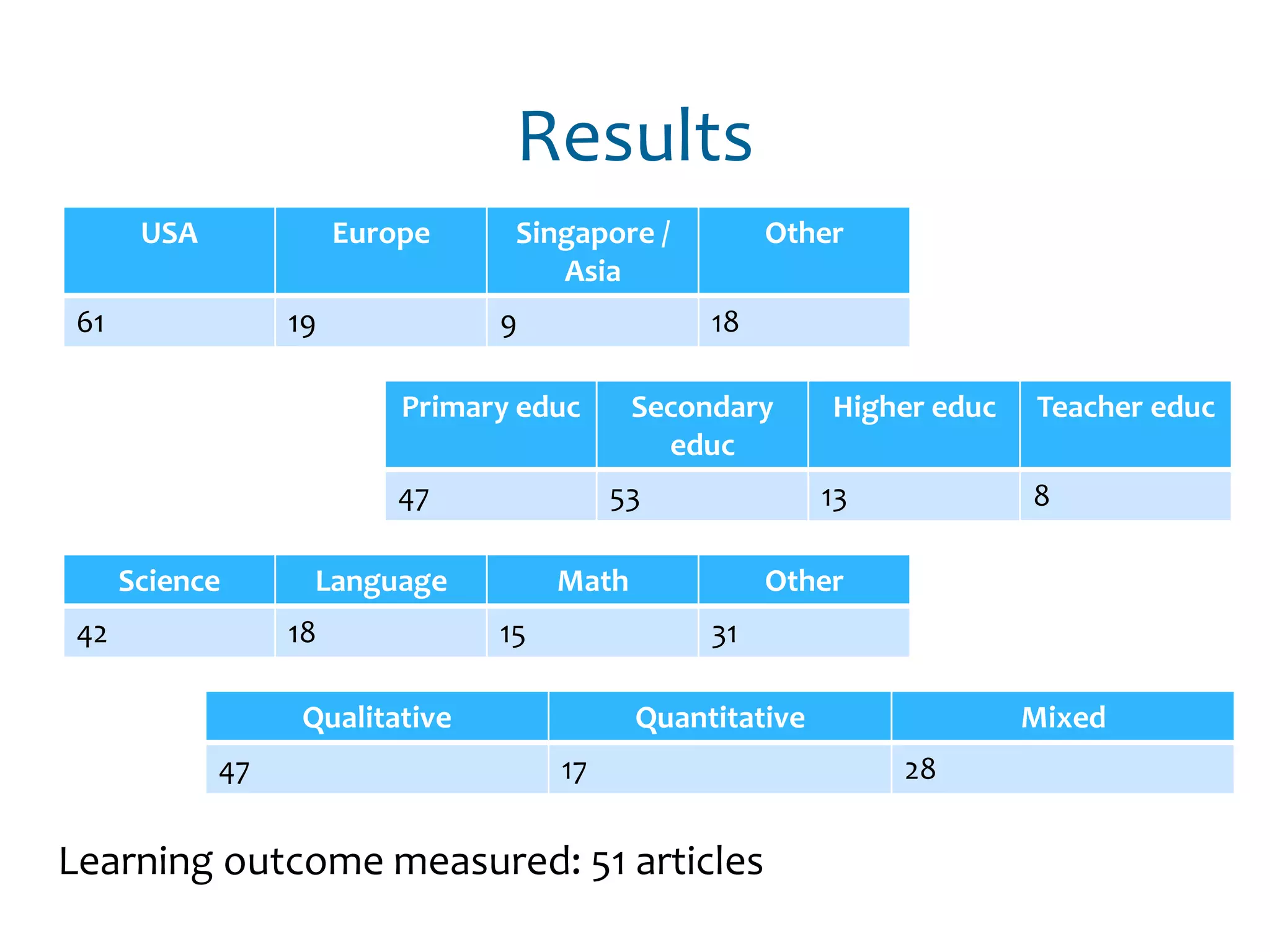
USA Europe Singapore /
Asia
Other
61 19 9 18
Results
Primary educ Secondary
educ
Higher educ Teacher educ
47 53 13 8
Science Language Math Other
42 18 15 31
Qualitative Quantitative Mixed
47 17 28
Learning outcome measured: 51 articles
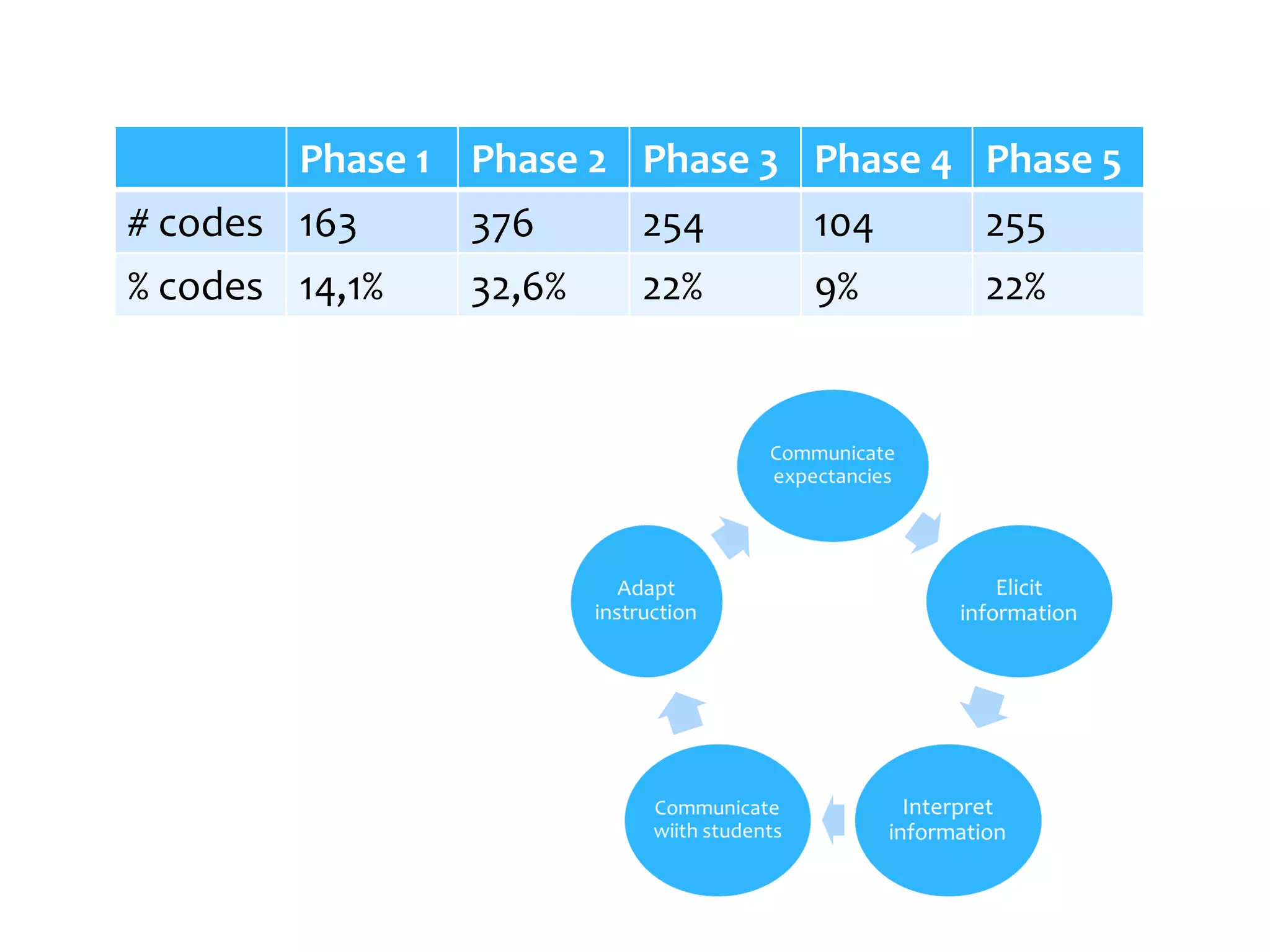
Phase 1 Phase 2 Phase 3 Phase 4 Phase 5
# codes 163 376 254 104 255
% codes 14,1% 32,6% 22% 9% 22%
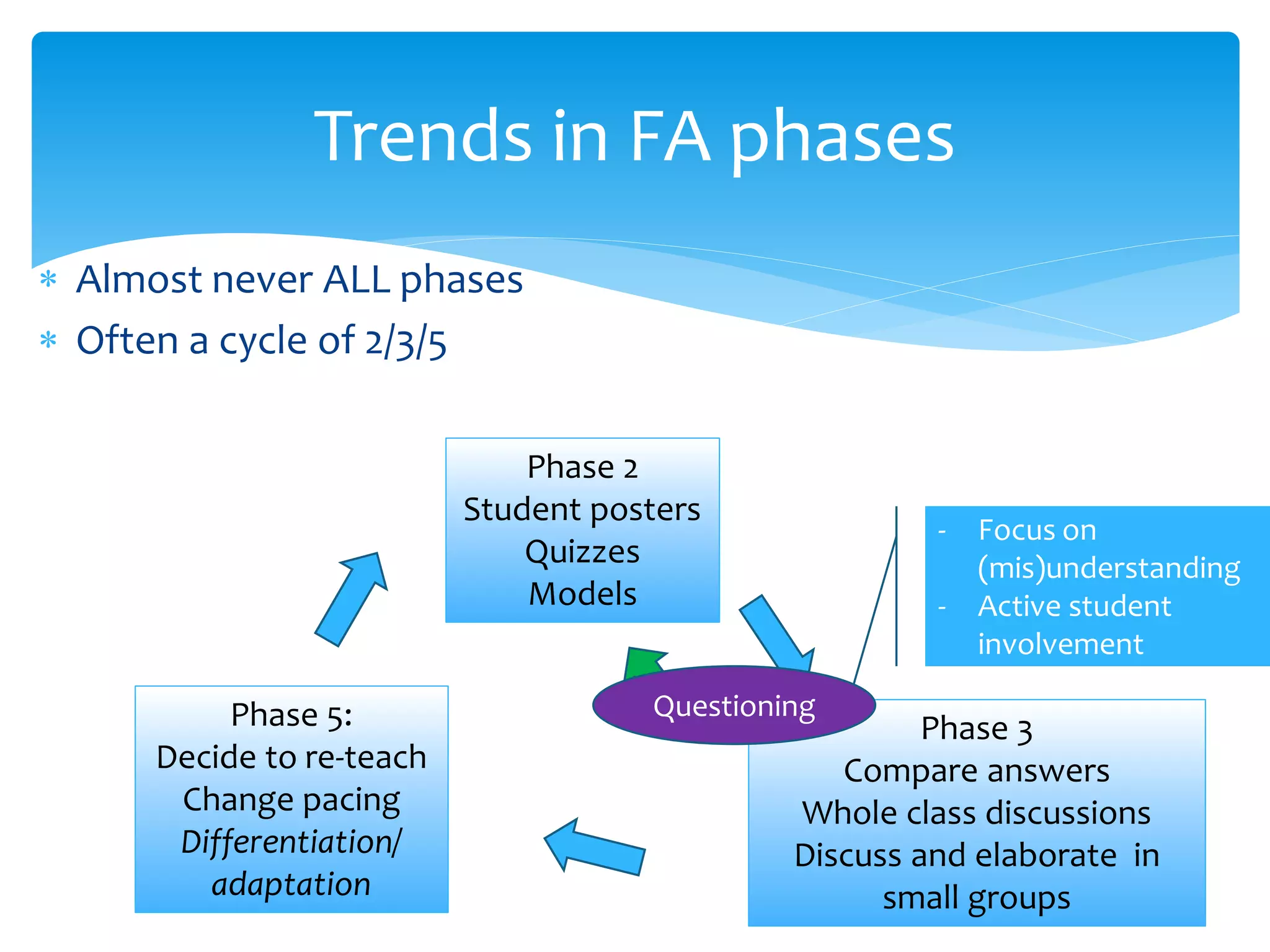
Trends in FA phases
 Almost never ALL phases
 Often a cycle of 2/3/5
Phase 2
Student posters
Quizzes
Models
Phase 3
Compare answers
Whole class discussions
Discuss and elaborate in
small groups
Phase 5:
Decide to re-teach
Change pacing
Differentiation/
adaptation
- Focus on
(mis)understanding
- Active student
involvement
Questioning
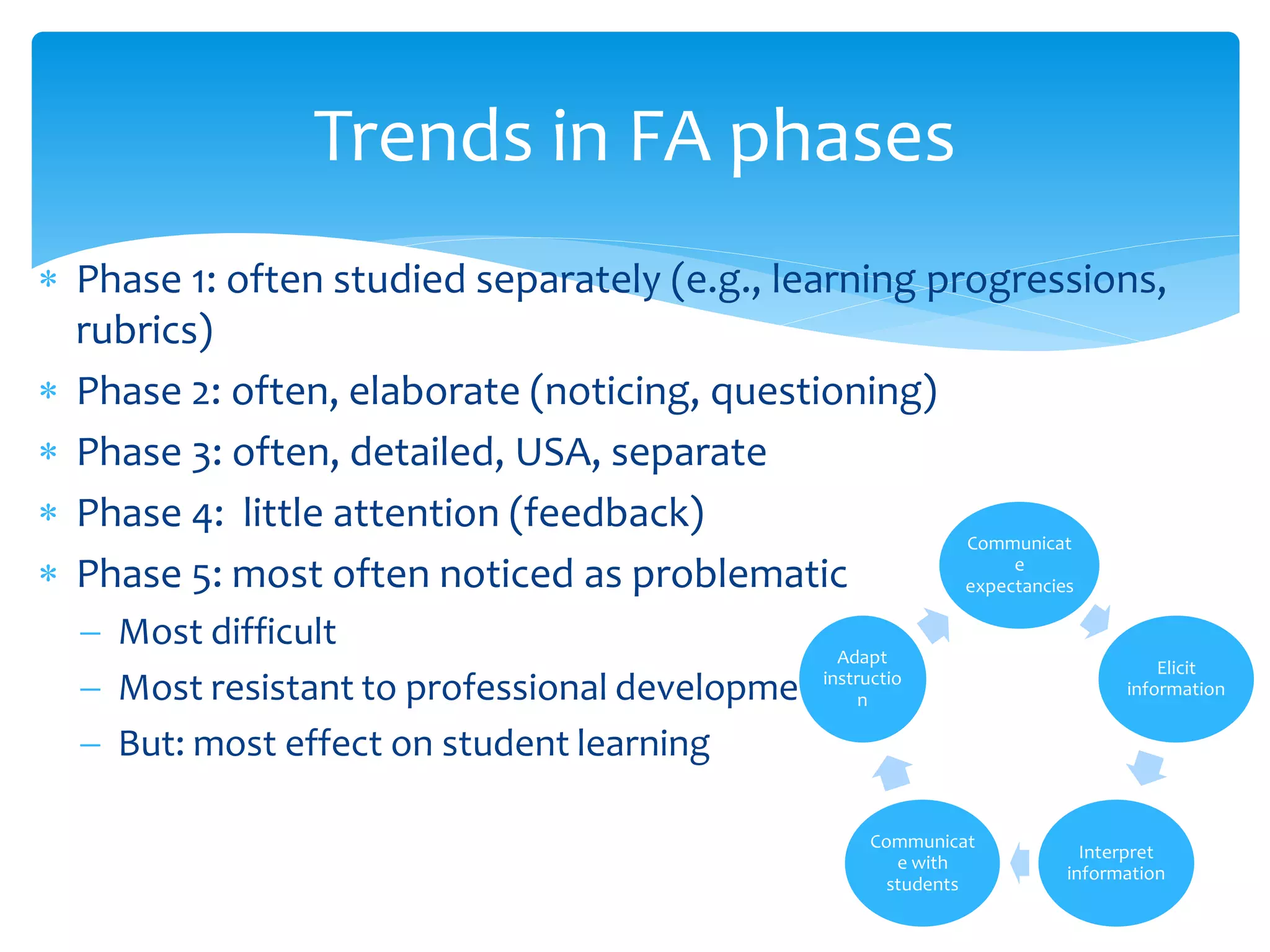
Trends in FA phases
 Phase 1: often studied separately (e.g., learning progressions,
rubrics)
 Phase 2: often, elaborate (noticing, questioning)
 Phase 3: often, detailed, USA, separate
 Phase 4: little attention (feedback)
 Phase 5: most often noticed as problematic
− Most difficult
− Most resistant to professional development
− But: most effect on student learning
Communicat
e
expectancies
Elicit
information
Interpret
information
Communicat
e with
students
Adapt
instructio
n
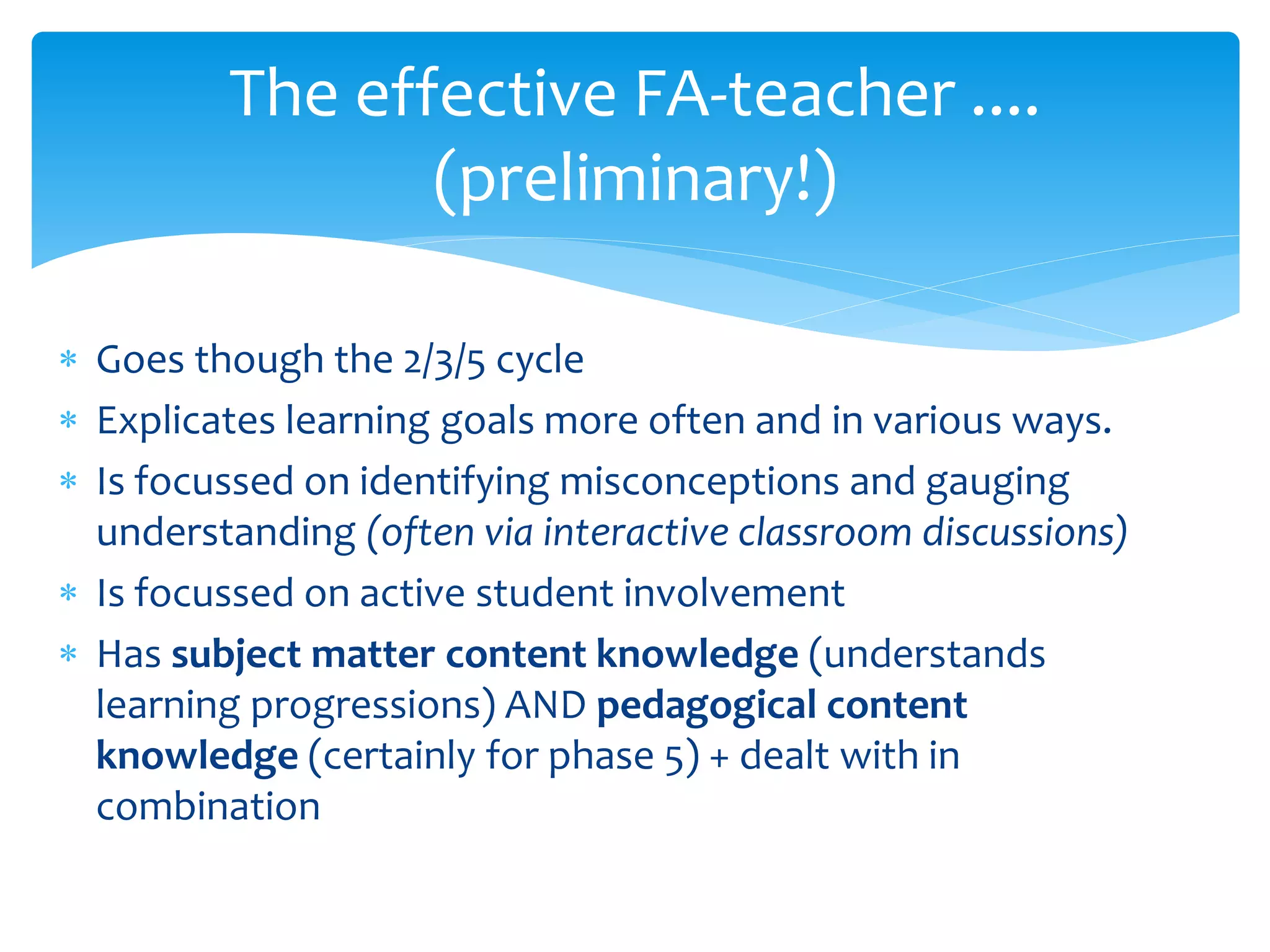
The effective FA-teacher ....
(preliminary!)
 Goes though the 2/3/5 cycle
 Explicates learning goals more often and in various ways.
 Is focussed on identifying misconceptions and gauging
understanding (often via interactive classroom discussions)
 Is focussed on active student involvement
 Has subject matter content knowledge (understands
learning progressions) AND pedagogical content
knowledge (certainly for phase 5) + dealt with in
combination
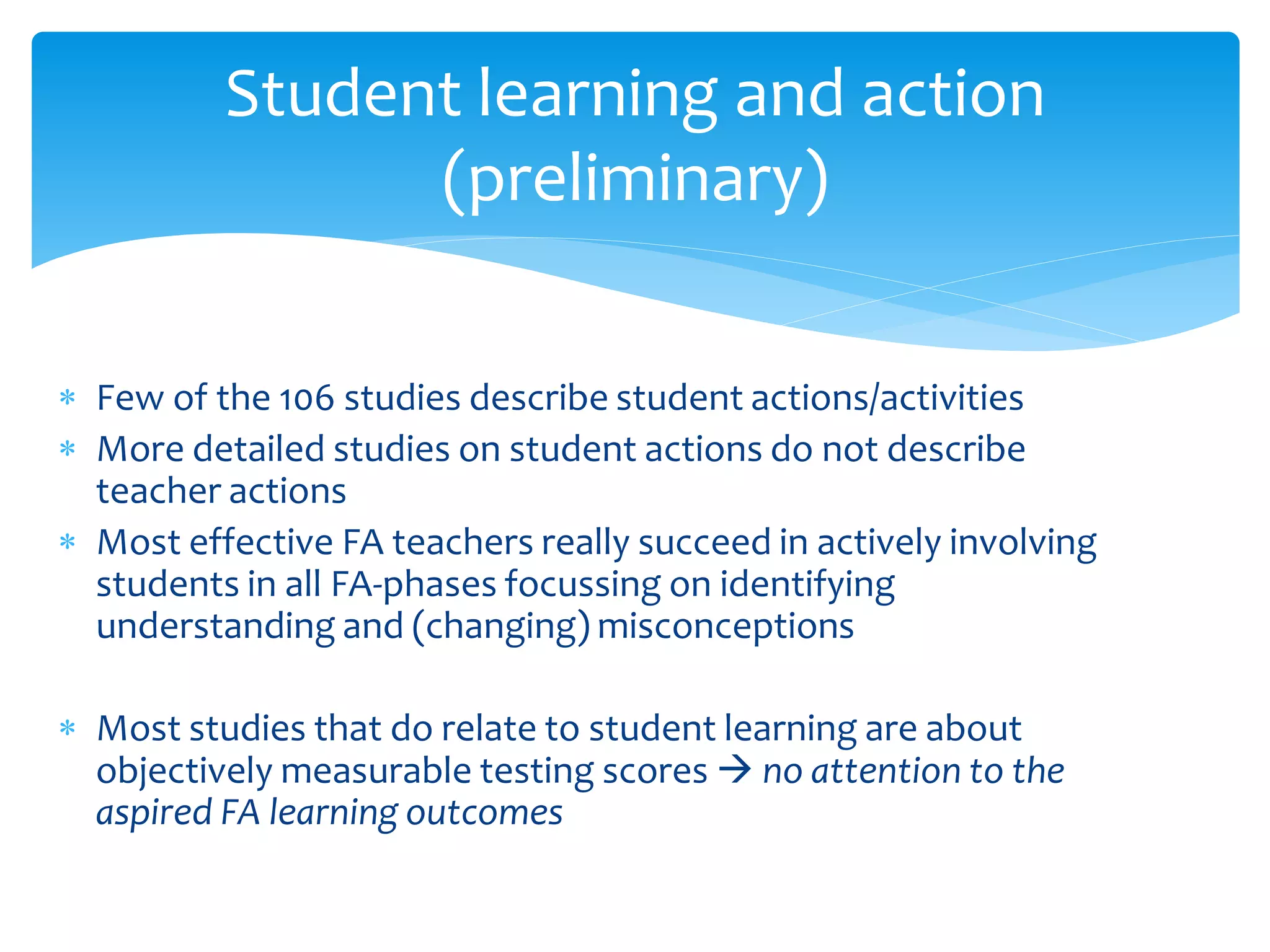
 Few of the 106 studies describe student actions/activities
 More detailed studies on student actions do not describe
teacher actions
 Most effective FA teachers really succeed in actively involving
students in all FA-phases focussing on identifying
understanding and (changing) misconceptions
 Most studies that do relate to student learning are about
objectively measurable testing scores → no attention to the
aspired FA learning outcomes
Student learning and action
(preliminary)
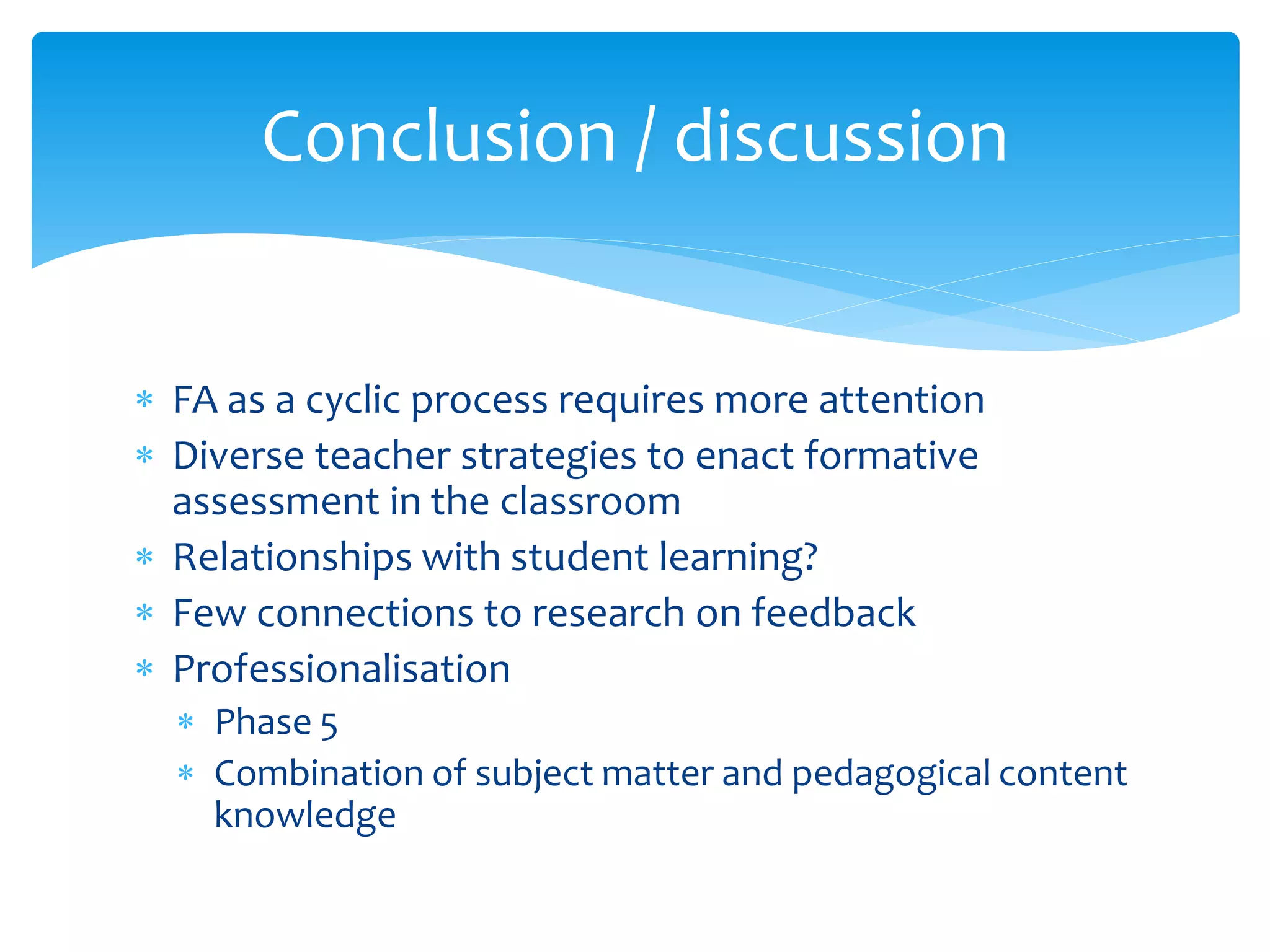
 FA as a cyclic process requires more attention
 Diverse teacher strategies to enact formative
assessment in the classroom
 Relationships with student learning?
 Few connections to research on feedback
 Professionalisation
 Phase 5
 Combination of subject matter and pedagogical content
knowledge
Conclusion / discussion
For more information..........
Judith Gulikers, PhD
Wageningen University, the Netherlands
judith.gulikers@wur.nl
Liesbeth Baartman, PhD
Utrecht University of applied sciences, the Netherlands
liesbeth.baartman@hu.nl
This project was financed by NRO under project number 405-15-
722
16

Teachers' formative assessment practices in the classroom: a literature review using the formative assesssment cycle

  • 1.
    Teachers’ formative assessmentpractices in the classroom: a literature review 20-10-2016. Competence Conference 2016 Judith Gulikers (Wageningen University) & Liesbeth Baartman (Utrecht University of Applied Sciences)
  • 2.
    Why this review? Teacherpractices? Profes- sional develop ment ?!?
  • 3.
    Many formative assessmentframeworks (eg. Antoniou & James, 2014; Lai & Schildkamp, 2014; Ruiz-Primo & Furtak, 2006;2007; Wiliam, 2011) Our focus:  Formative assessment is a cyclic process  Teachers’ concrete activities in the classroom → Combining elements of existing framework into “ the formative assessment cycle” (FA-cycle) as conceptual and analytical model of our literature review How to grasp teachers FA activities?
  • 4.
    FA-cycle Phase 1 Clarifying expactation Phase 2:eliciting student responses Phase 3 Analysing and interpreting responses Phase 4: Communicating with student about resulst Fase 5: Taking followup actions: adapting instruction & learning Feed up Feedback Feedforward
  • 5.
    (1) What doteachers DO in their classrooms to realize effective formative assessment practices? (2) What is the relationship between these formative assessment practices and student learning? Research questions
  • 6.
     Existing NWOliterature reviews (Schildkamp et al., 2014; Sluijsmans et al., 2013) => 34 publications  Systematic database search Inclusion criteria 1. Peer-reviewed 2. Formative assessment in school context 3. Empirical research 4. Class level 5. Clear description of what teacher DOES 6. Effects on student learning (OPTIONAL) Method literature search
  • 7.
     Databases: ERIC,PsychInfo, Web of Science, Scopus Database search Total search 304 Delete step 1 68 Title: Non-English, duplicates Delete step 2 106 Abstract: not empirical, perceptions, grading Delete step 3 21 Not available Delete step 4 37 Article: not about teacher practices Selected publications 72 TOTAL 106 (-= 72 + 34)
  • 8.
    General categories:  Country/ educational level / educational field  Learning outcome measured  Phases FA cycle Coding per FA phase Data analysis Atlas TI Phase 2 Phase 3
  • 9.
    USA Europe Singapore/ Asia Other 61 19 9 18 Results Primary educ Secondary educ Higher educ Teacher educ 47 53 13 8 Science Language Math Other 42 18 15 31 Qualitative Quantitative Mixed 47 17 28 Learning outcome measured: 51 articles
  • 10.
    Phase 1 Phase2 Phase 3 Phase 4 Phase 5 # codes 163 376 254 104 255 % codes 14,1% 32,6% 22% 9% 22%
  • 11.
    Trends in FAphases  Almost never ALL phases  Often a cycle of 2/3/5 Phase 2 Student posters Quizzes Models Phase 3 Compare answers Whole class discussions Discuss and elaborate in small groups Phase 5: Decide to re-teach Change pacing Differentiation/ adaptation - Focus on (mis)understanding - Active student involvement Questioning
  • 12.
    Trends in FAphases  Phase 1: often studied separately (e.g., learning progressions, rubrics)  Phase 2: often, elaborate (noticing, questioning)  Phase 3: often, detailed, USA, separate  Phase 4: little attention (feedback)  Phase 5: most often noticed as problematic − Most difficult − Most resistant to professional development − But: most effect on student learning Communicat e expectancies Elicit information Interpret information Communicat e with students Adapt instructio n
  • 13.
    The effective FA-teacher.... (preliminary!)  Goes though the 2/3/5 cycle  Explicates learning goals more often and in various ways.  Is focussed on identifying misconceptions and gauging understanding (often via interactive classroom discussions)  Is focussed on active student involvement  Has subject matter content knowledge (understands learning progressions) AND pedagogical content knowledge (certainly for phase 5) + dealt with in combination
  • 14.
     Few ofthe 106 studies describe student actions/activities  More detailed studies on student actions do not describe teacher actions  Most effective FA teachers really succeed in actively involving students in all FA-phases focussing on identifying understanding and (changing) misconceptions  Most studies that do relate to student learning are about objectively measurable testing scores → no attention to the aspired FA learning outcomes Student learning and action (preliminary)
  • 15.
     FA asa cyclic process requires more attention  Diverse teacher strategies to enact formative assessment in the classroom  Relationships with student learning?  Few connections to research on feedback  Professionalisation  Phase 5  Combination of subject matter and pedagogical content knowledge Conclusion / discussion
  • 16.
    For more information.......... JudithGulikers, PhD Wageningen University, the Netherlands judith.gulikers@wur.nl Liesbeth Baartman, PhD Utrecht University of applied sciences, the Netherlands liesbeth.baartman@hu.nl This project was financed by NRO under project number 405-15- 722 16